In 2026, I’m witnessing an exciting transformation in the world of public relations. New trends are shaping how I approach PR in this AI-driven era.
Among these trends, Answer Engine Optimization (AEO) stands out, changing the way I prepare for search queries that don’t require clicks. I’m also adapting to the rise of zero-click searches, which demand more sophisticated strategies.
Additionally, I’m personalizing my pitching techniques more than ever before, ensuring that my messages resonate on a personal level. Newsletters are becoming a critical tool for me, offering direct and reliable communication channels with stakeholders.
Speed in crisis management is no longer negotiable; it’s a necessity. I am constantly enhancing brand authority to build trust and resilience in the face of challenges.
These changes are rewriting the traditional PR playbook, and I’m eager to see how they continue to evolve. Embracing these innovations is key to staying ahead in the rapidly changing PR landscape.
When I watch a TV commercial that truly connects with me, it’s more than just a fleeting moment of entertainment. It triggers curiosity, encourages me to search online, and often leads to making a purchase.
This is precisely why the “Breaking TV Ads Report,” collaboratively launched by Kinetiq and DAIVID, should be on every search marketer’s radar.
The report ranks the top-performing new TV ads in the U.S., combining Kinetiq’s real-time ad detection with DAIVID’s AI-driven creative analytics to identify which ads truly stand out, why they connect with audiences, and what brands can learn from their success.
It’s a powerful reminder that search doesn’t begin with typing into Google, it starts with a spark in our mind.
As Barney Worfolk-Smith, chief growth officer at DAIVID, said to me via email:
“Search + TV matter – together. TV can boost search volume by up to 60%, and even more in well-coordinated campaigns. AI has altered, and will continue to shape, the TV-to-search relationship, though the principle remains constant: impactful, emotive TV advertising leads to all favorable brand outcomes – search being a prominent one. It’s also key to note that search volume itself is an invaluable indicator of TV ad effectiveness.”
How LeBron James and Indeed Captured Attention
In the first issue of the “Breaking TV Ads Report,” one commercial stood out: Indeed’s “What If LeBron James’ Skills Were Never Seen?”
The ad traces James’s journey from his early days, linking it to Indeed’s “skills-first” hiring message, resonating with viewers due to its authenticity and star power.
Indeed’s ad sparked 11% higher intense positive emotions and garnered 7% more attention than an average U.S. TV ad according to DAIVID. It was among the top 10 ads, alongside campaigns from TikTok, Subaru, and Taco Bell, each with themes revolving around family, mentorship, and belonging.
These ads aren’t merely entertaining stories – they ignite search actions.
When an emotional bond is formed with a brand message, I, like many others, am compelled to explore more – often turning to Google or YouTube for details, reviews, or purchase options.
In 2011, Google introduced the “Zero Moment of Truth” concept, emphasizing that the initial “stimulus” step, like a TV ad, precedes the ZMOT buying journey step.
For many search marketers, focus remains on the measurable second step – insights from clicks and conversions – neglecting the initial step which drives search but often feels like it drains our budgets.
However, research over the past decade indicates that TV advertising significantly extends into search behavior:
In 2015, a Google and Nielsen study revealed TV ads could increase branded search queries by up to 20%, often within just hours after airing.
By 2022, Thinkbox found UK TV advertising provided the strongest multiplier effect on search, social, and web traffic.
In 2024, Comscore identified that coordinated TV and digital campaigns deliver stronger engagement, prompting “second-screen” actions.
In essence, successful TV campaigns quickly translate into search demand – sometimes within mere minutes.
For those of us in SEO and PPC, this generates a clear call to action: be ready to capitalize on these moments.
The Integration of TV and Search by Leading Brands
Prominent brands have effectively demonstrated that coordinated TV stories and search strategies boost performance across both channels.
Apple: Building Curiosity to Ignite Search
Apple’s product launches exemplify cross-channel synergy. Airing an iPhone ad leads to skyrocketing search for “iPhone 17 Pro Max” or its release date.
Following major campaigns, Apple’s branded search traffic can see a up to 40% spike, per Semrush data.
Apple crafts its TV ads to spur questions, not provide answers – nudging viewers to seek more online, where Apple’s search-optimized content completes the user journey.
Progressive: Tying Humor to Searchability
Progressive’s “Flo” campaign is a lesson in how consistent creative narration cultivates search interest.
The campaign’s narratives arouse curiosity, leading to increased branded searches like “Progressive car insurance” or “Flo from Progressive.”
Their media team precisely aligns search and display campaigns with TV schedules, ensuring spikes in interest are met with ready search ads.
Coca-Cola: An Ad Both Shareable and Searchable
Coca-Cola’s historic success with “Share a Coke” underlines TV’s capacity to drive search behavior.
The original campaign, born in Australia in 2011, replaced Coke logos with popular names, enhancing emotional connections and boosting sales globally through a focus on personalization.
The 2025 relaunch targets Gen Z, fostering digital and in-person connections, featuring personalized cans and new interactive tools.
Strategies like QR codes invite consumers to Google “custom Coke” or “share a Coke names.”
Data insights support their approach. By monitoring spikes in branded searches and social mentions, Coca-Cola fine-tuned its campaign strategies.
Assessing Creative Success with Real Audience Indicators
The “Breaking TV Ads” report stands out due to its data-centered approach to measuring creativity.
Kinetiq deploys propietary technology to capture TV ads across the U.S., while DAIVID’s AI gauges emotional responses and attention, yielding a comprehensive creative effectiveness score based on real audience experience.
In today’s fleeting media landscape, such insights are vital to understanding which narratives break through, directly connecting with downstream behaviors like searches or site visits.
As Kinetiq CEO Kevin Kohn highlighted, this partnership offers marketers a panoramic understanding of TV and CTV advertising – not only insights into aired content, but its audience resonance.
This type of insight is what performance marketers, like me, need to bridge the gap between creative resonance and measurable outcomes.
In February 2025, Neal Mohan, YouTube’s CEO, shared that TV has overtaken mobile, becoming the primary device for YouTube viewing in the U.S., according to Nielsen.
Search marketers can apply insights from the Breaking TV Ads Report in various strategic ways:
Expect search spikes: With emotionally charged or celebrity-driven TV ads, branded search activity is likely to rise. Tailor PPC budgets, ad messaging, and keywords to match campaign themes and taglines.
Target intent-rich moments: TV spots spark “navigational” and “informational” queries. Ensure that organic content – landing pages, FAQs, YouTube videos – caters to such queries.
Coordinate search campaigns with TV airings: Use ad scheduling to sync with TV airings or streaming releases. Nielsen Catalina Solutions research shows that coordinated efforts can greatly amplify conversion rates.
Monitor branded search as a creative KPI: Tracking branded search volume can signal advertising impact. Utilize Google Trends or Search Console for tracking shifts post major media campaigns.
Adopt emotional cues in marketing copy: Insights from DAIVID highlight the need for emotionally resonant headlines, ad extensions, and meta descriptions that align with TV-driven sentiment.
Why Cross-Channel Strategies Are the Future of Performance Marketing
Traditionally seen as a response channel, search today functions as the connective tissue between inspiration and action.
Whether it’s a QR code at the end of a TV ad, or a YouTube masthead following a TV broadcast, search seamlessly bridges storytelling and sales.
As brands increasingly embrace connected TV (CTV) and streaming, the lines between “brand” and “performance” marketing will increasingly blur.
Creative effectiveness data helps bridge that gap by highlighting which emotional and visual cues drive search and conversions.
The “Breaking TV Ads” report is a vital reminder that the most impactful search strategies start long before the search itself.
They start with captivating attention and sparking emotions, usually on the biggest screen in the house.
I’ve embarked on a journey to understand how we can transition from traditional SEO to an approach I call brand-focused algorithmic education. With algorithms powering AI-driven results, this multi-speed strategy aims to strengthen our brand’s authority and online presence.
It all started when I recognized the importance of an AI-driven resume for brands. This asset has become a critical part of our strategy, especially as we explore various research modes to align with evolving technologies.
To thrive in this new landscape, I realized we need to shift our focus from just ranking to educating these algorithms. This involves understanding platforms like Google AI, ChatGPT, and Microsoft Copilot, which synthesize information instead of just providing links.
Conversations I had with industry leaders, such as Google’s Gary Illyes and Bing’s experts like Frédéric Dubut, have been enlightening. They all emphasize the importance of mastering what I call the algorithmic trinity.
Let’s dive into each part of this trinity.
Firstly, traditional search engines form the foundation, offering real-time web data. AI uses this for current events and niche topics, acting as its “here and now” window.
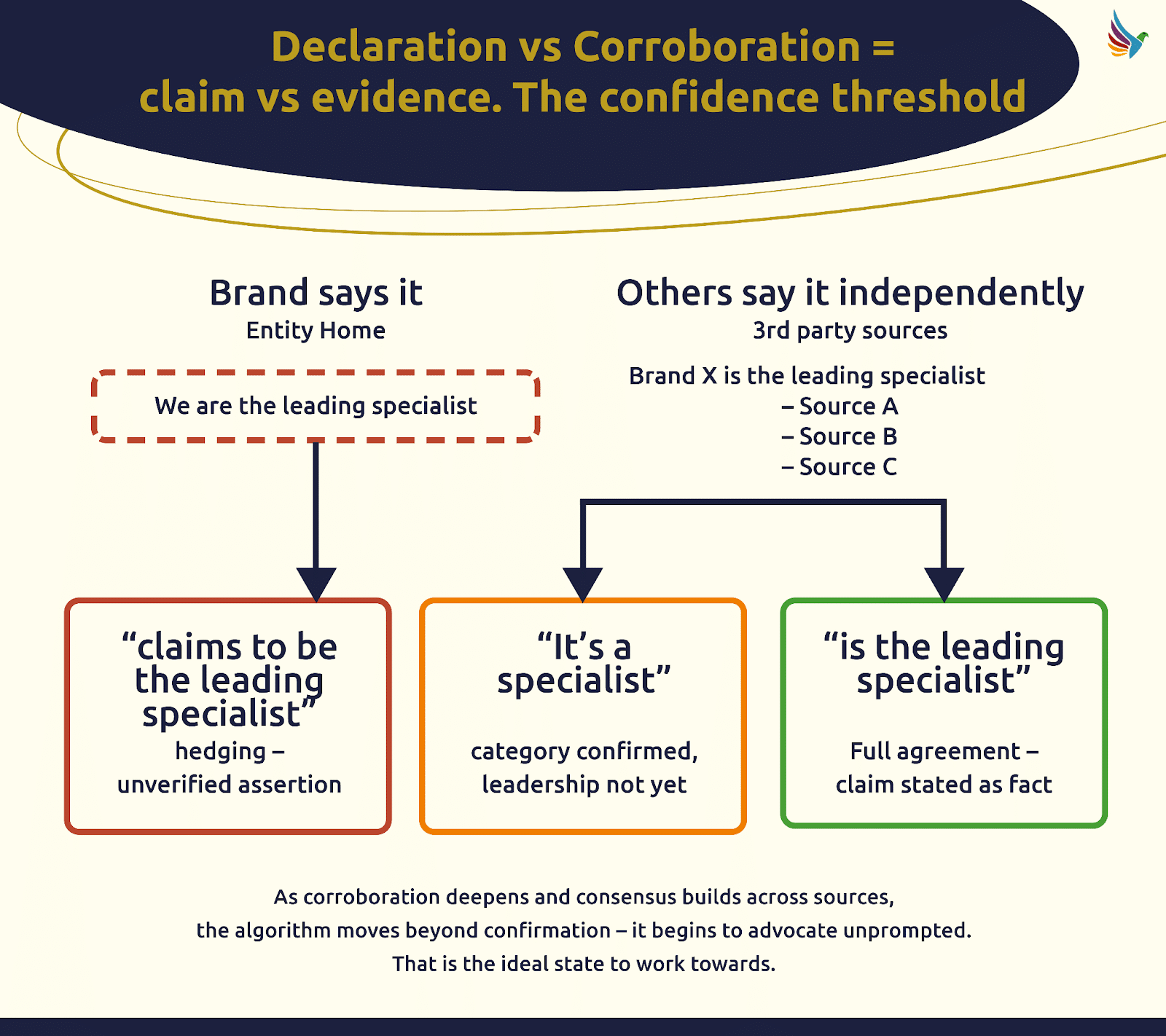
Next, knowledge graphs serve as the AI’s encyclopedia, storing a brand’s core identity. Google’s Knowledge Graph is massive, and maintaining accuracy here is crucial for avoiding AI hallucinations.
Finally, large language models (LLMs) are the conversational face of AI, synthesizing information to deliver user-friendly answers.
For our brand strategy to succeed, we must operate on three timelines: short-term, mid-term, and long-term. Each requires a nuanced approach.
In the short term, boosting our visibility through search results is key. Implementing simple SEO tactics can get us noticed in AI search results quickly.
Mid-term, we focus on educating the Knowledge Graph over several months, ensuring our brand’s factual foundation is robust and accurate.
Long-term, our aim is to become part of an LLM’s training data, ensuring our brand is ingrained in AI knowledge over many years. This is the pinnacle of algorithmic authority.
Central to achieving these goals is building our strategy on solid entity SEO. I’ve even expanded on Google’s E-E-A-T framework to include notability and transparency, aligning with the underlying questions algorithms ask: Who are we, can we be trusted, and are we authorities?
Looking ahead, AI’s role as a decision-making assistant is growing. I’ve personally tested ChatGPT to assist in purchasing decisions, and its potential as a personal agent is vast.
In essence, our digital strategy must continually evolve. We can no longer chase outdated SEO strategies but should instead cultivate comprehensive algorithmic education for our brand.
To thrive, our content must be frictionless for bots, digestible for accurate indexing, and tasty to establish authority. This ensures we remain top of mind for AI engines.
Let’s commit to this holistic strategy today, as AI assistive agents of tomorrow are already preparing. Our work will not only build a formidable AI resume but establish a lasting brand legacy.