Tag: AI

  • Master AEO Content Writing: Boost Visibility in LLMs

    Master AEO Content Writing: Boost Visibility in LLMs

    I’ve discovered the art of AEO content writing, and it’s all about structure, thorough research, and establishing authority signals. This approach can significantly boost the chances of your content being cited by LLMs such as ChatGPT, Gemini, and Perplexity.


    Inspired by this post on HiGoodie Blog.


    crushpress.ai community screenshot
  • AI Max: Navigating the Challenges with Match-Type Precision

    AI Max: Navigating the Challenges with Match-Type Precision

    I recently dived into how Google’s new AI Max setting is changing the game for search term matching and reporting. It’s like an adventure where advertisers find themselves facing challenges in maintaining precise keyword control.

    Why AI Max Might Not Be Ideal It’s important to note that AI Max isn’t necessarily negative. However, if broad match has underperformed in your past account history, or if your budget already limits top exact or phrase match keywords, then AI Max might require a second thought.

    If you dislike text customization or Final URL expansion, which are inherent features of AI Max, you might want to reconsider.

    You can maintain control by adding broad match keywords manually if they suit your objectives.

    Understanding AI Max and Your Keywords From the Adalysis test, I learned that even when your campaigns lack a broad match version, AI Max behaves as if it includes one, distributing impressions and clicks to your existing keywords. This can obscure match-type reporting, crediting AI Max for traffic already earned by exact and phrase match terms.

    To achieve clearer reporting, I recommend adding broad match versions of core keywords.

    Trouble with Search-Term Reporting By checking search terms under AI Max, I’ve observed issues like brand terms matching non-brand queries and vice versa. Even with brand filters, misspellings and variants might sneak in. Strong negative keywords remain a vital defense line.

    AI Max Isn’t Always Unearthing New Searches More often, AI Max is merely claiming credit for existing queries and can override Google’s usual matching hierarchy, misallocating impressions to less relevant ad groups.

    This could partly explain why its metrics seem inflated.

    The Mystery Bucket I’ve found that AI Max sometimes generates search terms not aligned with any current keyword or past searches. This might relate to Google’s keywordless technology, although confirmation is pending.

    Adalysis advises de-duplicating search terms across match types to pinpoint real performance enhancements.

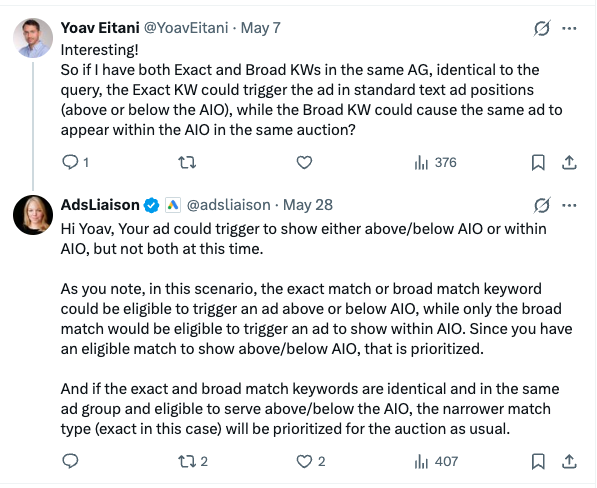
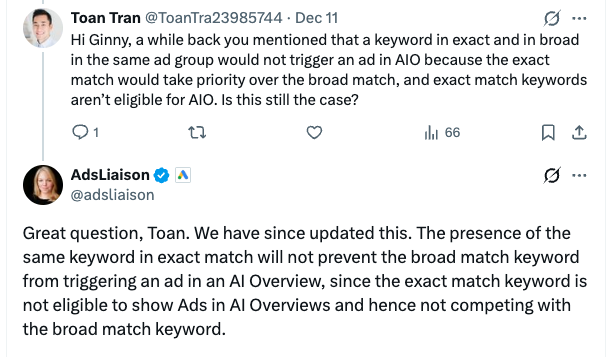
    Decoding Google’s Priority Order Though Google asserts that exact matches should take precedence when search terms are identical, our tests sometimes revealed AI Max taking over. This inconsistency necessitates adding exact matches for even minor spelling variations to protect valued search queries.

    Why It Matters This journey with AI Max highlights how it can blur match types and reporting clarity. This murkiness makes it difficult to discern the true drivers of results, hindering budget optimization and protection of brand traffic.

    Final Thoughts The Adalysis test strongly suggests that while AI Max offers campaign scaling opportunities, its structure can deceive with inflated metrics by reallocating impressions from original match types.

    If you’re using AI Max or planning to test it, ensure to include broad match versions, differentiate traffic with strong negatives, and keep exact match for your key queries while watching for mixed search terms. Managing search terms is as crucial now as it has always been to align your spending with high-performing searches.

    Explore Further For more insights on AI Max, check these valuable reads:


    Inspired by this post on Search Engine Land.


    crushpress.ai community screenshot
  • Boost Purchase Intent with Meta’s Native Reels Ads

    Boost Purchase Intent with Meta’s Native Reels Ads

    I’ve discovered that Meta’s recent research highlights the potential of native Reels ads to significantly enhance purchase intent and brand interest. This insight could be a game-changer for advertisers looking to harness the power of Reels.

    Reels have rapidly become a favorite format for entertainment, education, and discovery. What I’ve learned from Meta is that advertisers must prioritize native creative content—forget about recycling old assets. Embrace 9:16 framing, platform-first audio, and swift storytelling aimed at capturing attention in a swipe-driven world.

    Brand advertiser insights from Meta’s data:

    • Show your brand early: Introducing branding in the first 5 seconds can make ads 1.7 times more effective in achieving top purchase-intent rankings.
    • Use dynamic branding: Featuring your brand multiple times within the ad boosts top-tier purchase intent by 1.8 times.
    • Combine speech + music: This combination doubles the chance of landing in the top 20% for brand interest.
    • Say it visually and audibly: Dual-channel messaging can increase brand interest by 1.8 times.
    • Keep it relatable: Incorporating everyday “slice of life” moments enhances purchase intent by 1.5 times.

    Direct response advertiser takeaways:

    • Product > everything: Presenting the product multiple times can boost purchase intent by 2.7 times.
    • Brand lightly: Keeping branding to less than 25% of the ad’s duration drives a 4.8 times increase in purchase intent.
    • Add context: Highlighting USPs, features, and benefit-driven messaging raises purchase intent by a staggering 5.3 times.
    • Always include a CTA: Both visual and audio CTAs have the potential to lift purchase intent by 1.9 times.
    • Pair speech + music: This high-impact strategy makes it 2.1 times more likely to achieve top rankings.
    • Use native elements: Emojis play a significant role in helping direct response creatives rank 2.5 times higher.
    • Open with a hook: Audio-visual hooks can improve purchase intent by 1.5 times.

    Why I care. Reels are not just a current trend; they’re fundamentally shaping the way we approach short-form storytelling. With more than half of Instagram users spending their time on Reels, and video consumption up over 30% annually, the importance of native content is undeniable. Meta’s research makes it clear that success on Reels demands creative strategies that are tailored specifically for the platform. Early and strong branding, multiple product showings, a blend of audio and speech, relatable content, and clear CTAs are all crucial for maximizing results.

    The lesson here is straightforward: ads crafted with Reels in mind, rather than repurposed from other formats, achieve the best results. Structured testing and continuously evolving creative approaches are essential for anyone aiming to capture the Reels audience effectively.

    Meta’s bottom line. Reels aren’t fading away; they’re integral to the advertising landscape, with effective ads looking and behaving like native Reels content. The more seamlessly integrated the creative, the better the outcome.

    What’s next. Meta recommends that advertisers develop a robust “test and learn” program, focusing on elements like incrementality measurement and A/B testing. The objective is to discern which combination of format, messaging, and creative content drives the most significant impact for their offerings. The guiding principle is to iterate quickly, validate what’s effective, and refine approaches tirelessly.

    The takeaway. Successful brands on Reels are not just crafting short clips; they are designing specifically for the medium. Meta’s new data provides a roadmap, but it’s up to advertisers to test, learn, and continually adapt their creative strategies to fully realize the advantages available.


    Inspired by this post on Search Engine Land.


    crushpress.ai community screenshot
  • Discover How Google AI Mode Drives 69% of Transactional Clicks

    Discover How Google AI Mode Drives 69% of Transactional Clicks

    AI-generated answer

    I’ve explored recent UX testing that reveals Google AI Mode doesn’t eliminate high-value clicks. Users still visit websites when choosing services like doctors and dentists.

    In the SEO world, there’s a prevailing belief: Google’s AI Mode fails to drive traffic. The worry is that if it becomes the default search tool, websites might miss out on crucial clicks.

    However, there’s a catch—most studies highlighting traffic loss focus on informational queries.

    Imagine someone curious about the appearance of basal cell carcinoma; AI might indeed reduce those clicks.

    But what about when someone needs to book an appointment with a dermatologist?

    No studies had ventured into this territory yet, so I took the initiative.

    I conducted the first UX study focusing on transactional intent within AI mode, observing 52 participants across the U.S. and Canada over nearly 22 hours as they searched for high-commitment services.

    Here’s what I uncovered.

    1. 69% of AI Mode Users Visited a Website

    During transactional searches, such as finding a dentist or dermatologist, 69% of sessions in AI Mode led to a website visit.

    Through our study, only 27% felt “ready to make a decision” solely from the AI summary, with 4% checking traditional Google Search and social media for more info.

    ```json
{
  "alt": "Bar chart comparing website visits versus staying in AI Mode.",
  "caption": "AI Engagement: A bar chart reveals the comparative data between users visiting a website and those remaining in AI Mode, highlighting engagement patterns.",
  "description": "This bar chart illustrates a comparison between users who stayed in AI Mode versus those who visited a website, showcasing engagement levels. The 'Stayed in AI Mode' bar is shorter. Conducted by Sagapixel Healthcare Marketing, the study provides insights into user behavior and digital engagement metrics. Relevant for understanding AI interaction trends."
}
```

    Users rely on AI Mode to form a consideration set rather than to follow its directive blindly.

    2. Being Ranked #1 Isn’t the Ultimate Win

    For decades, holding the top SEO spot was like hitting the jackpot.

    AI Mode has redefined this dynamic: in our study, 89% of users clicked on multiple businesses.

    Users aren’t looking for just one suggestion; they want a selection to consider. On average, participants checked 3.7 results per session, and only 10% looked at just one business.

    This shift is enormous.

    You no longer need to expend all efforts to be at the top but rather aim to secure a spot within the top three to five results. Clicking the competitors is common, too.

    3. 16% of Users Trust Above-the-Fold Content

    It’s often assumed users don’t scroll.

    This isn’t true for AI Mode users. 84% of participants scrolled down to explore options.

    Because AI results are seen more as curated lists, users are keen to browse and find the best fit.

    ```json
{
  "alt": "Bar chart showing the number of businesses checked in AI mode against the number of searches, with data from 1 to 10 businesses.",
  "caption": "Explore how AI mode influences the number of businesses checked per search in this insightful bar chart. Discover patterns and trends in business searches.",
  "description": "This image displays a bar chart titled 'Number of Businesses Checked in AI Mode.' The chart shows varying levels from 1 to 10 businesses checked, with the highest number seen in the lower business range, tapering off towards higher numbers. The y-axis represents the number of searches up to 40. Conducted by Sagapixel Healthcare Marketing, this visual provides insights into consumer behavior in AI search contexts."
}
```

    4. Reviews Outweigh Photos in Influence

    Only 21% of users looked at photos in Google Business Profiles, even for services like Botox, which saw a slight increase to 24%.

    What’s the main draw for clicks? Social proof.

    74% of users read reviews before deciding, emphasizing the weight of textual information over visuals.

    The Verdict: AI Mode Won’t Take All Your Traffic

    Crucially, AI Mode won’t strip you of your most valuable traffic: those ready to invest in your services.

    With AI Mode, it’s essential to reframe how we view SEO goals:

    • Old goal: Rank #1 or risk being overlooked.
    • New goal: Aim for the top 5 and secure the click with strong social proof (via reviews).

    If your business depends on ‘how-to’ traffic, there might be cause for concern.

    However, if you’re a local business leveraging local SEO, remain calm.

    The study: 69% of Transactional Searches in AI Mode Drive Traffic


    Inspired by this post on Search Engine Land.

    crushpress.ai community screenshot
  • Inside Google’s Overambitious Daily Hub Revolutionizing Search

    Inside Google’s Overambitious Daily Hub Revolutionizing Search

    I recently delved into the enigmatic world of Google’s Daily Hub, a complex system aiming to redefine how we interact with search. At its core, Daily Hub sought to seamlessly integrate embeddings, entities, and real-time context. Unfortunately, the system crumbled under the weight of its own complexity.

    The Daily Hub is far more intricate than many of us originally thought. It represents a broader trend toward hyperpersonalization we’ve seen lately. Elements like Preferred Sources and followable profile pages in Discover are steadily headed toward predicting what I need even before I type my queries.

    Tracing its roots, Daily Hub extends from the “News Digest and Daily Brief” agent, which surfaced during my exploration into Google’s vast, ongoing AI initiatives. This system launched with much fanfare on the Pixel 10, yet was swiftly paused due to its intricate technical web.

    The Daily Hub’s Three-Tier Architecture

    Imagine Google’s system as a grand conductor, coordinating a diverse ensemble in real-time harmony. This is precisely the vision for Daily Hub.

    First Tier: The ‘Memory and Embeddings’ Layer

    Daily Hub’s foundation is built on two key document types, forming its memory.

    The MemoryDocument encapsulates full content units, complete with structured text, entity identifiers from the Knowledge Graph, comprehensive embeddings, and essential technical metadata.

    There’s also the MemoryEntityDocument, a leaner form that embodies each specific entity highlighted in the content.

    In practice, if Daily Hub processes an article about “Lionel Messi joining Inter Miami,” it constructs a MemoryDocument for the article and various entity documents for involved topics like “Lionel Messi” and “Inter Miami CF.”

    Second Tier: The Personalization Triumvirate

    Various systems power the personalization aspect of Daily Hub, ensuring its response to personalized searches and updates is both swift and attuned to individual preferences.

    Nephesh, known for refining user interests, AIP_TOP_ENTITIES, and TAPAS_USER_PROFILE each contribute to crafting a unique user interaction experience by leveraging behavior and contextual data.

    ```json
{
  "alt": "Flowchart depicting data processing from inputs to outputs involving various stages like signal processing, entity ranking, and behavior analysis.",
  "caption": "This flowchart visualizes a data processing pipeline, showcasing steps from capturing user signals to creating personalized content cards using AI models.",
  "description": "The image is a flowchart illustrating a complex data processing pipeline. It starts with inputs such as user signals, knowledge graph data, behavioral profiles, and memory layers. These inputs are processed through stages like NEPHESH for signal processing, AIP Top Entities for entity ranking, and TAPAS User Profile for behavioral analysis. Outputs such as AMBIENTRANKING algorithms yield personalized content cards. The system integrates AI models like GEMINI 2.5 FLASH LITE, showing a sophisticated process for generating data-driven results."
}
```

    Third Tier: ‘Ambient’ Orchestration

    In this realm, the AmbientRanking system oversees card presentations, using metadata to refine user experiences based on relevance and timeliness.

    For example, sports scores and calendar events are prominently displayed when their relevance is at its peak, ensuring my engagement with timely content.

    Understanding Gemini Prompts

    Andell’s documentation of Gemini’s prompts offers unparalleled insights into the system’s strategic thinking.

    Prompt ‘News Topics’: News over 7 Days

    With precise formatting and numerous constraints, this prompt identifies and summarizes pertinent news while meticulously adhering to laid down thematic boundaries.

    The prompt logic considers only the top interests and excludes unnecessary themes, maintaining focus solely on pertinent areas.

    A System with Potential: The Journey Ahead

    Despite its hiccups, Daily Hub is a prototype that embodies Google’s goal to create an assistant capable of forecasting our needs through sophisticated data integration and hyper-personalized content delivery.

    As these technical hurdles are addressed, I anticipate a transformation in how I interact digitally, setting a new standard for search interfaces.

    From today’s suspended project to tomorrow’s blueprint for digital interaction, Google’s vision pivots on delivering a groundbreaking consumer experience.


    Inspired by this post on Search Engine Land.


    crushpress.ai community screenshot
  • Mastering Paid Media Budgets in an AI-Driven World

    Mastering Paid Media Budgets in an AI-Driven World

    As someone deeply involved in PPC marketing, planning and managing budgets across various paid media channels has become a vital skill in my toolkit.

    I’m perpetually tasked with determining how to allocate spending across channels, handling significant budget fluctuations, and deciding whether to set total or daily budgets.

    In the world of AI-driven ad platforms, campaign budgets are one of the few areas I still have full control over, and so they demand thoughtful attention.

    Depending on my business model, I may have varying degrees of input into the overall paid media budget, but I usually have the reins when it comes to distributing that budget across channels and campaigns.

    My strategy begins with assessing the total budget available. It’s unwise to spread a modest budget across too many campaigns, as this limits the platforms’ capacity to gather data and drive effective results.

    However, with a larger budget, exploring new testing channels or campaign styles becomes feasible.

    Dig deeper: PPC budget planning: Aligning business goals, ad spend, and performance

    For instance, if my efforts in paid search are maxed out and additional budget is available, I might allocate some to Google Demand Gen or social channels to see how they perform.

    Considering the brand’s current awareness level is crucial. If building credibility is still ongoing, focusing on social prospecting could enhance visibility and audience building for future retargeting.

    Another factor is my ability to support campaigns requiring creative assets. If getting creative approved is challenging, keeping budget in paid search might be more pragmatic, with plans to expand to other channels once assets are ready.

    When making budget decisions, I ensure not to view individual channels or campaign types in isolation. It’s important to understand how they might affect each other and leverage data to guide these decisions.

    For instance, if I launch a YouTube campaign that raises product awareness, I might notice improved conversion rates in search, with video viewer remarketing audiences performing well.

    Even if direct conversions from YouTube are minimal, data might show improved overall conversion efficiency, justifying an ongoing budget for both YouTube and search.

    When mapping out annual budgets, aligning them with peak buying times or potential slumps specific to the industry at hand is vital.

    Ecommerce brands may raise budgets around holiday seasons, while B2B brands might choose to invest earlier in the year.

    Historical data can be a guide, and tools like Google Trends offer insights into monthly trends for relevant keywords.

    Unexpected budget shifts are common, whether due to financial constraints or last-minute fiscal year decisions. I’m prepared to adapt by pausing campaigns or reallocating budgets where they’ve proven efficient.

    Opportunities to increase budgets prompt a focus on campaigns that are currently capped and performing efficiently. However, I avoid increasing budgets too rapidly, to prevent inefficiencies.

    Dig deeper: How to manage a paid media budget: Allocation, risk and scaling

    Finally, selecting between total or daily budget types is a frequent consideration. Short campaigns or ones with strict budget limits benefit from a total budget, while ongoing campaigns are better suited to daily budgets.

    I’m mindful of spending spikes and aim to avoid overspending, especially when adjusting budgets mid-month.

    Dig deeper: How to optimize B2B PPC spend when budgets and confidence are low

    Having a budget strategy that’s adaptable to ongoing and exploratory efforts, while considering the unique nuances of each platform, is key to successful paid media campaign management.


    Inspired by this post on Search Engine Land.


    crushpress.ai community screenshot
  • How AI Revolutionizes Ad Rankings: Winning the Top Spot

    How AI Revolutionizes Ad Rankings: Winning the Top Spot

    The position of ads is more crucial than ever. I’ve recently come across new data that underscores how Google AI Overviews are reshaping paid search visibility and click-through rates (CTR).

    In my experience, Google’s AI Overviews have dramatically altered the search landscape almost overnight. As someone deeply invested in paid search, I’ve noticed the battle for visibility isn’t just about ad rank anymore—it’s about appearing above the AI results.

    This change is part of a rapid surge in AI Overviews, which I discovered in Adthena’s earlier study. My analysis found that AI Overviews are now trespassing into short, high-volume commercial searches.

    The underlying mechanism causing this is pretty clear to me: AI Overviews intercept user attention, slash CTRs, and push both organic and paid listings lower down the page. As a result, clicks and revenue take a hit.

    From what I’ve seen in Adthena’s latest research, it accurately identifies how often advertisers secure top ad positions above AI Overviews across seven major industries, device types, and query categories. The research highlights clear leaders and provides actionable strategies for the rest of us in paid search.

    The topline reality: Ad position visibility is lost 25% of the time

    The industry benchmark table below reveals how fierce the fight is for the top spot. It shows us the percentage of ads that appear either above or below AI Overviews across seven industries.

    ```json
{
  "alt": "Industry performance chart showing percentage above and below average for Automotive, Energy, Financial Services, Gaming, Healthcare, Retail, and Travel sectors.",
  "caption": "Discover how different industries stack up in performance, with percentages showing which sectors lead and lag relative to the average.",
  "description": "This image is a chart detailing the performance of various industries, measuring percentages above and below average. It covers sectors such as Automotive, Energy, Financial Services, Gaming, Healthcare, Retail, and Travel. Automotive (62.3% above), Energy (76.9% above), and others are analyzed, with variables like Healthcare showing 35.4% above and 64.6% below. The chart is branded by Adthena for marketing and analysis insights."
}
```

    Strategic implications from the topline data

    • The leaders: Industries like Travel, Energy, Financial Services, and Retail consistently land above the AI Overviews in more than 75% of cases. However, I’ve noticed that even in these sectors, 1 in 4 paid ads are still affected. When keywords drive major revenue, that 20% to 30% exposure is a direct threat to ROI.
    • The runners-up (the risk of being hidden): Healthcare is a major outlier. Ads in this field often appear below AI Overviews 64.6% of the time, given the high-stakes nature and research-heavy aspect of healthcare searches. Google’s AI prioritizes “expert” information first, meaning healthcare ads see significantly less visibility.
    • The volatility: The gaming sector shows a clear 50/50 split. Visibility feels like flipping a coin, demonstrating to me the need for agile bidding strategies.

    The device divide: Why mobile is your biggest threat

    From what I’ve gathered, device-specific data indicates that ads are more likely to be displaced by AI Overviews in a mobile setting due to limited screen space.

    Strategic implications on device differences

    • Automotive’s Mobile Problem: Although Automotive shows strong “Above %” placement overall, daily trends are worrying. On mobile, ads are frequently buried by AI Overviews, making them invisible without extensive scrolling. This leads to diminishing visibility and CTR for us marketers.
    • The “double whammy”: In healthcare, desktop ads generally appear below AI Overviews, although mobile sometimes performs slightly better. It seems the AI Overviews box might be designed for mobile screens, occasionally allowing one or two ad slots to remain visible. However, desktop visibility still suffers greatly.
    • Actionable insight: Mobile is where AI Overviews present the greatest challenge. For industries like healthcare and gaming, where this is a significant problem, securing top ad positions is vital for survival.

    The query intent test: Where does AI Overviews win and lose?

    Generally, I’ve observed that long queries tend to be more informational and thus more likely to activate AI Overviews, while shorter ones are typically transactional. The table below unfolds a surprising industry pattern related to this.

    This table reveals the connection between query complexity (or user intent) and AI Overviews’ dominance, spread over query lengths from one to ten words.

    ```json
{
  "alt": "Heatmap showing percent above and below benchmarks for various industries and devices from 11/11/2025 to 11/17/2025.",
  "caption": "Explore industry trends with this heatmap displaying percentage data across devices from November 11 to 17, 2025, illustrating performance benchmarks.",
  "description": "This heatmap visualizes percentage data for industries like Automotive, Energy, and Gaming across desktop and mobile devices. It spans from November 11 to 17, 2025, showing percentages above and below benchmarks. Each cell is color-coded to reflect performance, providing a clear view of industry trends. Created by Adthena, this chart is useful for analyzing market variations and device-specific engagement with specific focus on sectors such as Financial Services, Healthcare, Retail, and Travel."
}
```

    Strategic implications on query intent

    1. AI Overviews dominance on the fringes:
      • Healthcare shows that as queries get longer (up to 10 words), ad positions above AI Overviews drop to 0%. Google clearly prioritizes complex health questions, relegating commercial interests lower.
      • Gaming reveals the opposite: short terms (1-2 words) have 0% visibility above AI, suggesting organic results or features claim the top spot. However, for longer terms (7-9 words), ads dominate above AI Overviews, a golden opportunity to engage users deeply researching.
    2. The unexpected paid search opportunity (Automotive & Travel):
      • Automotive and Travel ads excel with longer informational queries rather than short, high-volume ones. For example, Automotive’s “Ad Above AI Overviews” rate leaps from 21.9% (one word) to over 74% (four words).
      • Strategic implication: This upends conventional PPC strategy, suggesting we should be bidding eagerly on mid-to-upper-funnel terms where AI Overviews are present, intercepting the user’s journey before their final decisions.

    Next steps for paid search marketers

    Adthena’s research highlights that the threat of Google AI Overviews is fragmentary. Precision is key: know when and where your ads can outrank AI Overviews, adjust your bids and content accordingly.

    From my ongoing observations, as the frequency of AI Overviews rises, these ad position percentages might swing. I advise regularly auditing profitable keywords to effectively handle changes in the AI-driven search landscape.

    Here are three game-changing steps we can take:

    1. Have you explored testing a device-specific strategy?

    I’ve realized that mobile often amplifies visibility loss from AI Overviews, notably in sectors like automotive.

    I recommend considering a device-specific strategy, especially for campaigns severely impacted by AI Overviews.

    2. Have you identified quick wins in keyword coverage?

    Data on word counts reveals unexpected possibilities. Industries like Gaming and Automotive often see robust ad placements with long-tail queries (four words or more) above AI Overviews.

    ```json
{
  "alt": "Heatmap table showing word count in search queries across industries like Automotive, Energy, and Retail.",
  "caption": "Explore the trends in search query word counts across industries such as Automotive and Healthcare. This heatmap reveals insights into percentage distributions above and below average.",
  "description": "This image is a heatmap table illustrating the word count distribution in search queries for various industries, including Automotive, Energy, Financial Services, Gaming, Healthcare, Retail, and Travel. Each industry's search query percentages are categorized as above or below the average, with varying word counts from 1 to 10. Darker shades indicate higher percentages. This data is presented by Adthena and provides insights into how different industries perform in search result metrics."
}
```

    This signals high-visibility traffic in mid- to upper-funnel searches that our competitors may be ignoring.

    3. Have you reviewed your ad copy against the AI answer?

    AI Overviews can miss out on brand nuances and emotional resonance.

    To captivate users, ads must deliver what AI can’t: a strong, compelling reason to choose you over Google’s summary. Using messaging that includes trust, guarantees, or urgency can clearly differentiate from AI’s generic style.

    Convey transactional incentives like deals, free shipping, or scarcity (“Limited stock, grab yours!”), and use emotional elements like customer testimonials to build trust and convey your unique brand narrative.

    The search landscape has evolved. Adthena’s data suggests that marketers who rapidly analyze and adjust their ad strategies in response to AI Overviews will thrive.

    Ready to see where your ads sit today?

    Adthena gives you the precise data on ad appearances in relation to AI Overviews, helping you adapt to changes in AI search performance. Book a demo to see where your ads rank today.


    Inspired by this post on Search Engine Land.


    crushpress.ai community screenshot
  • Elevate Your Site with Our AI Integration for WordPress

    Elevate Your Site with Our AI Integration for WordPress

    I’m excited to share some thrilling news with you. Profound’s Agent Analytics now fully supports WordPress with a custom-made plugin. This integration offers seamless AI observability for WordPress sites, which means your team can easily track AI crawlers and agents as they interact with your content, even if traditional CDN log drains are unavailable.

    This development is a significant step forward for anyone using WordPress, making it easier to understand and optimize AI-driven interactions. Whether you’re on a managed hosting platform or running your own setup, this plugin is designed to enhance your capabilities in managing AI observability effortlessly.


    Inspired by this post on Try Profound Blog.


    crushpress.ai community screenshot
  • Transforming B2B eCommerce: Slava Kravchuk’s Vision for 2026

    Transforming B2B eCommerce: Slava Kravchuk’s Vision for 2026

    In my recent dialogue with Slava Kravchuk, the Founder and CEO of Atwix, we delved into the future of B2B eCommerce and the key elements businesses need to thrive beyond 2026. Drawing from Atwix’s 15+ years of industry experience with manufacturers, distributors, and wholesalers, Slava shared invaluable insights on the rapidly evolving marketplace.

    Slava started his journey with Atwix back in 2006, and the transformation in the B2B eCommerce realm since then has been nothing short of remarkable. Initially, the majority of B2B firms lacked a digital presence, but today, eCommerce is indispensable. Slava highlighted how COVID-19 rapidly accelerated digital transformation, compressing a decade’s worth of changes into mere quarters. This urgency pushed countless businesses to embrace digital commerce as a means of survival and growth.

    We discussed the ongoing debate about selecting the right eCommerce platform. Slava emphasized that it’s not about the ‘best’ platform but choosing one that meets a business’s specific needs. Atwix offers expertise across various platforms like Adobe Commerce, Magento, Shopify Plus, and Shopware, because of their diverse capabilities. For complex B2B operations, Adobe Commerce and Shopware are often ideal due to their flexible architecture suited for intricate business requirements.

    Another crucial aspect of B2B eCommerce is effective ERP integration. Slava insists that seamless eCommerce and ERP connectivity is vital to avoid data errors and ensure customer satisfaction. Atwix’s proprietary tool, Sirius, allows businesses to integrate their ERPs with their eCommerce frontends smoothly. This tool has transformed customer experiences, enabling real-time order tracking and payment capabilities.

    We also touched on the decision-making process between building a custom solution or utilizing a platform. Slava advised starting with a platform due to the efficiencies and flexibility they offer. He stressed the importance of customizing smartly to avoid technical debt and ensuring a platform can evolve with the business’s future needs.

    Slava’s approach is one of partnership. He believes in engaging with clients to map out a strategic vision before any development begins. This foresight helps prevent costly setbacks and aligns the technology with long-term business goals. For example, Byrne Electrical’s rapid development during the pandemic was successful due to careful, phased planning upfront.

    Looking ahead to 2026 and beyond, Slava predicts that AI, integrated experiences, and personalization will be the driving forces of change in B2B eCommerce. AI advancements are already shaping product discovery and customer interactions. Meanwhile, customers now expect integrated, personalized experiences akin to B2C interactions.

    For businesses contemplating digital transformation, Slava’s advice is clear: start with a minimal viable product and continuously refine it based on feedback. Choosing the right partner who understands your industry is crucial for building lasting, adaptable eCommerce solutions. The time for B2B companies to embark on their digital journey is now.


    Inspired by this post on First Page Sage Blog.


    crushpress.ai community screenshot