I remember when a few strategic links from niche-related sites could consistently boost organic traffic. Those days have passed.
Now, with Google’s AI Overviews and the emergence of answer engines like ChatGPT, the visibility stakes are higher. Hiring a seasoned link building agency is critical to navigating this challenge effectively.
Choosing the right partner is a vital investment. It’s not just about link building; it’s about establishing your brand as a trusted authority in this AI-dominated landscape.
So, how do you find the ideal agency for your business?
Despite changes in interfaces, core ranking signals are largely unchanged, though their priorities have shifted.
Large Language Models (LLMs) require credible sources for accurate answers, making authoritative link building more crucial than ever.
In this article, I’ll guide you through vetting and selecting a link building agency that comprehends these new priorities and aids your brand in earning AI trust in the evolving SEO landscape.
How Link Building and SEO Are Changing
Gartner forecasts a 25% decline in search engine volume by 2026 due to AI chatbots taking over more answers. Partnering with an agency that grasps AI SEO is essential.
But how can you be sure they actually do?
The key indicators lie in holistic authority and AI visibility. According to an Authoritas study, only 1 in 5 links in Google’s AI Overviews aligned with a top-10 organic result, and 62.1% of cited links didn’t rank in the top 10 at all.
The conclusion is clear. AI systems and search engines assess websites differently now. We’re no longer just building links for Google’s crawler.
Link equity alone won’t suffice. Sites must establish topical authority, brand mentions, and a genuine market presence, aiming to build a footprint recognizable and unavoidable by AI models.
The New Criteria: Evaluating a Link Building Agency for AI SEO
Choosing the ideal link building agency depends on their alignment with current priority factors.
Here’s what to focus on.
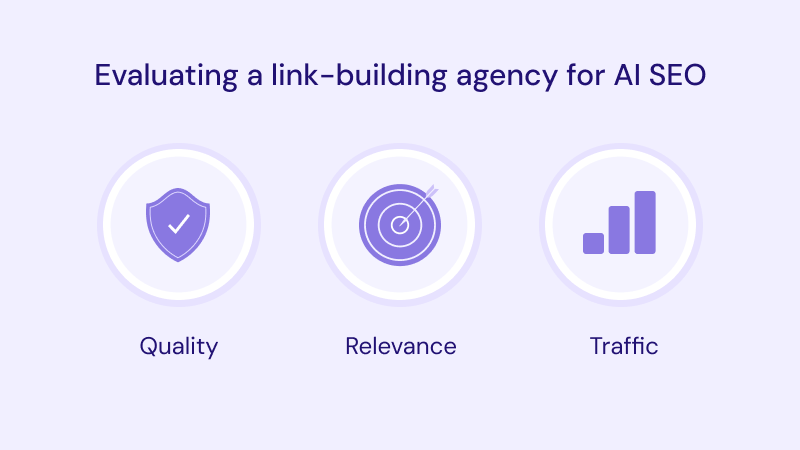
Prioritizing Quality, Relevance, and Traffic
I’ve seen many marketing directors judge link quality solely by Domain Rating (DR).
While high DR is important, at uSERP, we recognize it’s not the ultimate measure. Additional factors to consider include:
Relevance: A niche-specific site with a DR of 60 often provides more value than a DR 80 general news site that covers diverse topics.
Minimum traffic standards: A site’s ranking for keywords and real traffic are critical; hence, strict traffic minimums are essential.
When vetting an agency, request contractual site-traffic guarantees.
An agency confident in their capabilities will gladly sign a Statement of Work guaranteeing each link comes from a site with a traffic threshold, such as 5,000+ monthly organic visitors.
If they refuse to document traffic minimums, they may intend to place links on “ghost town” sites—domains appearing robust but lacking a real audience, safeguarding their margins rather than fostering your growth.
Look for a Content-Driven Approach and Digital PR
Links thrive as part of genuine conversations.
Leading agencies now function like content marketing and digital PR teams, not traditional link builders.
Instead of requesting links, they craft linkworthy assets—data studies, expert commentary, and in-depth guides publishers want to cite, understanding that:
Google’s algorithms and AI models are adept at spotting paid placements, making a content-led approach crucial for ensuring links remain natural and valuable.
Guest posting in the AI SEO era is about thought leadership, not throwaway articles, positioning your CEO as a credible expert.
Your stories can keep ranking and still deliver fewer visits. When an AI answer absorbs the headline fact, definition, or short explanation, the reader may finish the task without opening your page. That changes the value of a ranking, but it does not make search irrelevant.
If you run a publishing operation, the wrong response is to produce more interchangeable articles and hope volume compensates for a lower click-through rate. You need to identify the pages AI can replace, make your distinctive work easier to cite, preserve a compelling reason to visit, and connect that visibility to revenue.
Key takeaways
Do not treat every lost organic visit as the same problem. Separate easily answered queries from stories that provide original evidence, continuing updates, analysis, or utility.
AEO and GEO should make your claims easier to understand and attribute. They cannot make generic content distinctive or guarantee inclusion in an AI answer.
Give readers the direct answer, then earn the visit with proof, depth, freshness, tools, or an ongoing relationship.
Measure search visibility, AI citations, referral traffic, audience retention, and revenue as separate stages. A citation is not a visit, and a visit is not a business result.
Keep investing in technical SEO while reducing your dependence on any single distribution platform.
Find the search traffic AI can replace
A 43% decline in publisher search referrals by 2029 has been projected. That is a planning estimate, not a guaranteed result for every publisher. Your actual exposure depends on what people search for, what your pages provide, and whether an AI interface can satisfy the need without sending the reader elsewhere.
Start with a page-level exposure map. Export your organic landing pages with their impressions, clicks, entrances, conversions, and revenue contribution where available. Group pages by template and query purpose rather than reviewing thousands of URLs as unrelated items.
Your page can be readable, technically clean and still fail in AI search in two very different ways: it may never be selected, or it may be cited without giving anyone a reason to continue. Those are not the same problem, so they should not get the same fix.
The practical goal is not the largest possible mention count. It is a reliable path from a query, to a useful AI-generated answer, to a next step your page is uniquely equipped to support. That requires content an AI system can extract without misreading and an experience worth visiting after the immediate answer is known.
Separate AI visibility from user engagement
AI visibility is often treated as a single metric, but it contains several handoffs. A page can succeed at one and fail at the next. Unless you record them separately, you won’t know whether to rewrite the answer, improve the landing experience or leave the page alone.
Handoff
What must happen
Typical failure to inspect
Machine comprehension
The system can identify the subject, answer, conditions and supporting information.
Vague headings, buried conclusions, ambiguous pronouns or missing context.
Answer selection
The page is useful enough to inform or support the generated response.
The section does not answer the exact task, lacks necessary qualification or is difficult to extract cleanly.
Reader continuation
The searcher has a legitimate reason to open the cited page.
The page merely repeats the answer already visible in search.
On-page outcome
The visit leads naturally to a relevant decision or action.
The landing section, next step or call to action does not match the original query.
That statement is easy to overread. It describes engagement with AI Overviews as a search feature. It does not establish that clicks on an individual publisher determine whether that publisher is cited. On this evidence, you should not present publisher click-through rate as a confirmed AI citation ranking factor.
The distinction changes your diagnosis. If no AI result appears for a query, the feature itself may not have been served. If an AI result appears but your page is absent, inspect the page’s relevance, clarity, accessibility and support. If the page is cited but attracts little useful activity, examine what remains for the reader to learn or do. These conditions may look identical in a traffic chart, but they call for different work.
Build answer units that can be extracted without losing context
Replace topic-label headings with task-specific headings. Implementation is a topic; How do you implement the change without losing existing data is a question with an identifiable answer.
Put the conclusion before the long explanation. A reader and an extraction system should not have to reconstruct your position from several setup paragraphs.
Attach qualifications to the claim they limit. If an answer applies only to a particular platform, plan, region, use case or version, name that boundary in the same answer unit.
Use explicit nouns when a pronoun could point to more than one thing. Repeating a product, feature or process name is better than leaving the meaning of it or this unclear.
Separate the direct answer from its support. State the answer, explain why it holds, show the conditions or exceptions, and then provide the evidence or example.
Use lists for real sequences and criteria. Use a table only when the reader needs to compare the same fields across several options. Formatting should reveal the relationship between facts, not decorate the page.
Make freshness visible where it matters. Review facts that can change, identify the applicable version or period, and remove outdated claims instead of relying on a generic updated date.
Apply schema that describes the visible content and the correct entity or page type. Markup should reinforce what the page clearly says; it cannot repair an answer that is vague, unsupported or missing.
Check whether the useful content is actually accessible. The page needs to load reliably, work on mobile and expose its main information without avoidable technical barriers.
A strong answer unit is complete enough to stand on its own but connected to deeper material. For a choice query, that usually means naming who should choose each option, the constraint that changes the recommendation and any important exception. For a process query, it means stating the starting condition, the ordered actions and how the reader can tell the task is complete.
Do not split a necessary qualification into a distant section simply because the page looks cleaner that way. An extracted sentence can become misleading when its boundary is several screens away. Put optional depth elsewhere; keep meaning-critical context beside the answer.
Schema belongs at the end of this editorial sequence, not the beginning. First make the visible page accurate and structurally clear. Then use markup to identify what is already there. Schema is a description layer, not a substitute for the thing being described.
Offer continuation value without withholding the answer
An AI response may satisfy the basic question before the searcher visits you. If your page offers only the same fact in many more words, the click has no clear payoff. The answer is not to hide the conclusion or manufacture curiosity. Give the immediate answer plainly, then provide value the generated summary cannot conveniently deliver.
For an understand query, add boundaries, examples, exceptions and the relationship to easily confused concepts.
For a decide query, add selection criteria, trade-offs, disqualifying conditions and a path through the decision.
For a do query, add the complete workflow, prerequisites, reusable templates, implementation details and checks that reveal whether the result is correct.
For a verify query, show dates, scope, definitions, assumptions and the evidence needed to assess the claim.
For a product or service query, connect each option to the situation it fits instead of presenting an undifferentiated feature list.
For a visual query, use images that help a person identify, compare, match or complete the task. Add nearby text that explains what the image demonstrates and why it matters.
That does not mean adding generic images to every page. The image must carry information. Show the relevant differences, label important features, provide useful captions and place the visual beside the decision or instruction it supports. Decorative imagery creates weight without creating continuation value.
The call to action should continue the same job. Someone asking what a concept means may be ready for an example, checklist or implementation path, but not an immediate sales conversation. Someone comparing options may need a requirements worksheet or a deeper breakdown of trade-offs. Do not make a generic contact button the only route forward.
Place the next step beside the section that earns it. A citation may land the reader in the middle of a long page, so the relevant explanation and action cannot depend on a journey from the top. Every major answer section should work as a useful entry point.
Measure each handoff at the query level
Page-level organic traffic cannot tell you which handoff failed. A citation can appear without producing many visits, and a traffic change can come from something unrelated to AI visibility. Build a small, repeatable query-level record so that your edits have a diagnosis behind them.
Define a fixed query set around real user tasks. Group together questions that express the same job, even when the wording differs. The unit you are managing is the query need, not an isolated keyword.
Record the starting search state. Note whether an AI answer appears, which page is cited, what role the citation plays and whether the generated response already completes the task.
Inspect the cited or candidate section. Record its heading, direct answer, qualifications, supporting material, visible freshness cues and relevant structured data.
Name the continuation asset. Identify exactly what the reader gains by visiting: a decision framework, workflow, example, tool, template, visual explanation, evidence trail or another concrete resource.
Name the desired on-page action. It might be reading the implementation section, using a tool, downloading a relevant resource, subscribing or beginning a commercial step. Choose the action that fits the query rather than the action that is easiest to count.
Change the layer associated with the failure. Keep extraction-oriented edits separate from landing-page and call-to-action edits when possible, or you will not know which change affected the outcome.
Repeat the observation using the same method. Compare AI-result presence, citation presence, landing behavior and meaningful actions instead of collapsing them into one success label.
A practical log can contain these fields: query, user task, AI answer present, cited domain, cited URL, role of the citation, answer gap, continuation asset, intended action, observed outcome and next edit. This is enough to expose patterns without pretending that you can see the platform’s internal ranking process.
Interpret the patterns carefully. No AI answer across a query group may mean the feature is not being retained for that kind of question; it is not proof of a page penalty. An AI answer with no citation from you points toward comprehension, relevance or selection. A citation with no useful visit points toward weak continuation value. Visits without the intended action point toward an expectation or landing-experience mismatch.
Keep commercial exposure in a separate column. AI-powered search experiences may include ads around shopping, comparisons and product research, with sponsored material intended to remain distinguishable. A paid placement, an organic citation and a brand mention are different outcomes. Combining them will make both your visibility reporting and your budget decisions less reliable.
Treat AI-result presence, publisher citation, site visit and meaningful on-page action as separate outcomes.
Do not call publisher click-through rate a confirmed citation ranking factor based on statements about engagement with AI Overviews as a feature.
Write answer units in which the question, conclusion, conditions and supporting detail remain understandable when extracted.
Use schema to describe accurate visible content, not to compensate for weak or ambiguous writing.
Answer the immediate question fully, then earn the visit with decision support, implementation depth, evidence, tools or task-relevant visuals.
Track a stable set of queries by user task, diagnose the failed handoff and keep paid exposure separate from organic citations.
Start with the query that matters most and inspect the whole path. Capture the current search result, rewrite the weakest answer unit, add one honest continuation asset and align the next action with the original task. Then observe citation and on-page behavior separately. That gives you a testable improvement cycle instead of another vague AI visibility initiative.
Your pages can rank, answer the right questions, and still disappear when someone asks an AI assistant for help. Publishing more content will not necessarily solve that. The missing piece is often the chain between the user’s decision, the evidence on your page, the format an answer engine selects, and the citation it ultimately shows.
You need a content system that can earn inclusion across generated answers without turning useful pages into fragments written for machines. That means choosing queries more carefully, making claims easier to verify, using video where demonstration matters, and measuring citations separately from rankings and clicks.
Stop treating AI visibility as one ranking
Traditional rank tracking gives you a position for a query, device, location, and search engine. AI visibility is less tidy. The same question can produce a brand mention, an owned citation, a third-party citation, a video, or no reference to you at all. A single visibility score can hide those differences.
Your plan also has to account for different discovery systems. AI-assisted discovery now spans ChatGPT, Perplexity, Google AI, and Siri, among other interfaces. Absence from one response does not prove universal invisibility, while one favorable citation does not establish broad coverage.
Build your strategy around decision clusters rather than isolated keyword variants. A decision cluster is the connected set of questions someone asks while trying to understand, compare, choose, implement, or troubleshoot something. For each cluster, define:
The decision: What is the person trying to do, and what would a useful answer let them decide?
The canonical asset: Which owned page should provide the complete, maintained answer?
The evidence: Which claims, examples, specifications, or demonstrations make that answer credible?
The supporting formats: Would the user benefit from a video, visual demonstration, comparison, or other representation?
The target surfaces: Which search engines and AI assistants matter to this audience?
The success signals: Are you looking for an accurate mention, an owned citation, a video inclusion, referral traffic, or some combination?
This prevents a common planning error: producing several pages that repeat the same basic answer while leaving the actual decision unsupported. One strong canonical page, backed by the right evidence and formats, is usually a better foundation than a collection of near-duplicates.
Build a complete human answer, then make its evidence legible
The wrong response to AI search is to break every subject into tiny pages or disconnected answer fragments. Google has explicitly discouraged creating special bite-sized content for LLMs and has warned against maintaining one version for people and another for generative systems. Google has acknowledged that narrow tactics may sometimes show an advantage, but its stated direction is toward systems that reward content made for people.
That is Google’s position, not proof that concise passages never help an AI system. The useful distinction is between fragmentation and structure. Fragmentation removes the context a reader needs. Structure keeps the complete explanation while making its answer, reasoning, proof, and limits easy to locate.
A citation-ready page should give the reader the following elements in a natural order:
If your conventional rankings look respectable but your brand rarely appears in AI-generated answers, adding more pages or rolling out schema across the site is a poor first move. You first need to locate the break: can the system find your content, understand it, select it for the question, and represent it accurately?
A useful answer engine optimization strategy connects those stages. It starts with the questions that matter to your audience, assigns each question to a credible page, removes technical barriers, and measures what actually appears across AI search surfaces. Here is how to build that system over a focused 90-day cycle.
Key takeaways
AEO does not replace SEO. A page still needs to be accessible, indexable, relevant, and understandable before an answer engine can use it.
Optimize around question-and-answer relationships, not isolated keywords. Each priority question needs a canonical page, a direct answer, supporting evidence, and clear boundaries.
JSON-LD should confirm what a visitor can already see. It cannot compensate for thin content, contradictory facts, or blocked pages.
Measure brand mentions, cited URLs, answer accuracy, and useful visits separately. A single visibility score hides the reason you are winning or losing.
Use a 90-day cycle to establish a baseline, repair priority pages, rerun the same prompt set, and decide the next round of work.
Diagnose the visibility failure before you optimize
AI visibility is not one event. It is a chain of events, and each link can fail for a different reason:
Discovery: the system must be able to reach or otherwise encounter the page.
Interpretation: it must identify the subject, entities, claims, and relationships correctly.
Selection: the content must be useful for the particular question, not merely related to its general topic.
Composition: the answer must preserve your meaning while deciding whether to name or link to you.
Conversion: the resulting mention or citation must help the reader take a relevant next step.
You usually cannot see an AI product’s internal retrieval process. Work from observable signals instead. If the preferred page is missing from conventional search indexes, fix technical discovery first. If competing pages answer the question precisely while yours circles the topic, repair the answer. If your brand appears with the wrong description, resolve inconsistent entity information across the site. If you earn citations but visitors reach a generic page with no useful continuation, fix the landing experience.
Keep these failure types separate in your reporting. A brand mention is not automatically a citation. A citation is not automatically an accurate recommendation. An accurate recommendation is not automatically a visit. Combining them into one score produces a number you can present, but not a diagnosis you can act on.
Your baseline should record the exact question, the AI surface and mode used, the response, whether the brand appeared, whether a source link appeared, which URL was cited, whether the answer was materially accurate, and when the observation was captured. Visibility now spans environments such as ChatGPT, Google, Perplexity, and Meta AI, but their behavior and access to web material can differ. Record the surface rather than treating AI search as one interchangeable channel.
Use the same wording and comparable conditions when you repeat a prompt. Even then, regard each response as an observation rather than a permanent ranking. Generated answers can vary, so a defensible trend comes from a consistent log, not a single favorable screenshot.
Build an answer map around decisions, not keyword variants
A keyword list tells you how people phrase a topic. An answer map tells you what they need to understand or decide. That distinction matters because an AI response normally resolves a question, combines supporting details, and anticipates a follow-up. A page targeting a broad phrase can rank conventionally yet still supply no clean answer to reuse.
Build the map in this order:
Choose the audience decision. Write down what the person is trying to choose, fix, verify, compare, or complete.
State the core question in natural language. Use the wording a buyer, practitioner, or stakeholder would recognize, not an internal product label.
Add the necessary follow-ups. Include the definition, criteria, process, limitations, alternatives, and failure conditions that affect the decision.
Assign a canonical page. Decide which existing or planned URL should provide the strongest complete answer.
Specify the required evidence. Mark which claims need primary citations, visible calculations, product documentation, examples, or a clear explanation of methodology.
Define the next useful action. Decide what the reader should be able to inspect, compare, configure, or request after receiving the answer.
For an AEO audit topic, for example, the cluster might include: What counts as an AI search appearance? Which questions should be monitored? What can prevent a page from being used? When does structured data help? How should an inaccurate brand description be corrected? What evidence would show that visibility improved? Those are connected information needs, not six excuses to publish near-duplicate pages.
Give each page an answer contract
Before revising a page, complete this sentence: For this audience making this decision, the page will answer this question using this evidence, while making these limits clear. If you cannot fill in every part, the brief is still too vague.
The answer contract prevents three common forms of content sprawl. It stops one page from trying to serve unrelated intents. It stops several pages from competing to provide the same answer. It also exposes evidence gaps before polished copy disguises them.
Do not create a separate URL for every prompt variation. Consolidate questions that share the same intent and evidence. Give a question its own page only when the answer, audience, proof, or next action is materially different. Otherwise, use descriptive subheadings and internal links to help readers and machines reach the relevant answer unit.
Engineer pages that are extractable and hard to misread
Clear technical access before rewriting copy
Review the preferred URL as a retrievable document. Confirm that it loads successfully without authentication, is not excluded by a robots directive, does not carry an unintended noindex instruction, and declares the canonical URL you expect. Make sure the important answer is present in the rendered page and can be reached through ordinary internal links.
Also look for contradictions created by migrations and templates: an old canonical pointing elsewhere, several live versions of the same answer, a title that names one product while the body describes another, or structured data carrying details that no longer appear on the page. Rewrite work will not solve those defects.
Place a direct response immediately after the heading that asks or frames the question. The opening sentence should name the subject explicitly and resolve the central point. Follow it with the qualification that changes how the answer should be used.
For example, a weak opening says that modern brands need to adapt to a changing landscape. A usable opening says: Answer engine optimization is the practice of making content easier for answer systems to find, interpret, select, and represent when responding to a question. The second version defines the entity and its purpose without forcing a reader to reconstruct the meaning from surrounding copy.
A strong answer unit usually contains:
The direct answer: a short passage that resolves the question without a promotional preamble.
The scope: the audience, platform, condition, or use case for which the answer holds.
The support: evidence or reasoning placed beside the claim it supports.
The boundary: an exception, limitation, or condition that prevents an overbroad interpretation.
The continuation: the next question or action a reader is likely to need.
Resolve ambiguous pronouns and labels. Use the full brand, product, organization, or method name where a passage must remain understandable outside its surrounding paragraphs. Keep terminology consistent unless you are explicitly defining synonyms. If two terms mean different things, say where the boundary lies instead of rotating them for variety.
Put evidence near the claim. Link material factual statements to the best available originating authority. Label proprietary observations as such, explain how internal figures were produced, and include the applicable date or version when a fact can change. Citation density is not the goal; claim-level traceability is.
Use JSON-LD to corroborate the visible page
Structured data works best as a machine-readable confirmation of content that is already clear to a visitor. Choose types and properties that accurately describe the page you have, not the search feature you hope to win. Keep names, URLs, organizational relationships, authorship, dates, and other shared facts aligned with the visible copy.
Only mark up information that genuinely appears on the page. An FAQ structure should correspond to visible questions and answers. An organization relationship should agree with the site’s About and contact information. If the JSON-LD calls something a product while the page presents a general service or an editorial resource, correct the model rather than adding more properties.
Validate syntax, but do not stop at syntax. A technically valid graph can still be semantically wrong. Review the rendered page and the JSON-LD side by side, compare identifiers and canonical URLs, and treat every mismatch as a data-quality defect. Schema can reduce ambiguity; it cannot manufacture authority, evidence, or relevance.
Internal linking should reinforce the same model. Link from supporting pages to the canonical answer using anchor text that describes the relationship. Connect definitions to procedures, procedures to limitations, and comparisons to the underlying product or service facts. That creates a navigable information structure rather than a collection of isolated articles.
Run the work as a 90-day AEO operating cycle
Use a 90-day operating window for AI-driven search visibility to separate diagnosis, implementation, and evaluation. This is a management cadence, not a promise that a particular system will cite you by a particular date.
Days 1-30: establish the baseline and choose the work
Create the answer map for topics tied to meaningful audience decisions.
Freeze a prompt set you can repeat. Store the exact wording, surface, mode, conditions, response, mentions, citations, accuracy judgment, and capture date.
Identify which domains and pages are being cited for those questions. Compare their answer coverage and evidence with your assigned canonical pages.
Audit technical access, canonicalization, rendering, internal discovery, visible entity information, and structured-data consistency on the priority URLs.
Classify each gap as discovery, interpretation, selection, representation, or conversion. Prioritize the pages where the question matters and the failure is specific enough to fix.
Do not begin by rewriting the entire site. A narrow baseline makes later movement interpretable. If you change templates, taxonomy, copy, schema, and internal links everywhere at once, you may improve the site while learning very little about what repaired the visibility chain.
Days 31-60: repair canonical pages and supporting signals
Rewrite each priority page around its answer contract. Put the direct answer, scope, evidence, boundary, and continuation in a logical sequence.
Consolidate overlapping answers so one preferred URL carries the strongest version. Update internal links to point to it consistently.
Correct unsupported, stale, or contradictory claims. Add traceable citations where a factual claim requires them.
Align visible entity information with titles, headings, author or organization details, canonical URLs, and JSON-LD.
Add structured data only after the visible content is accurate. Validate both syntax and meaning.
Record what changed, where it changed, and when it was published. That change log is essential when you evaluate the next baseline.
Keep the batch coherent. If several questions expose the same missing definition or entity conflict, repair the shared foundation once and then update the affected pages. If the questions require different evidence or serve different decisions, keep their answers separate even when the keywords overlap.
Days 61-90: retest, classify movement, and set the next cycle
Repeat the baseline prompts under comparable conditions. Preserve the complete responses rather than recording only favorable mentions.
Compare brand presence, linked citations, cited URLs, answer accuracy, and landing-page relevance as separate fields.
Review results by question class and surface. An average can hide strong definition coverage alongside weak comparison or troubleshooting coverage.
Inspect newly cited pages to learn which answer units were selected and whether the surrounding context represented your position correctly.
For unchanged questions, return to the failure chain. Recheck access, answer completeness, evidence, entity consistency, and the strength of the competing material.
Carry unresolved gaps into the next cycle with a stated diagnosis and proposed change. Do not turn every absence into a demand for more content.
Report outcomes in language the business can use. Named but not linked, cited and accurate, cited to the wrong URL, and visible but commercially irrelevant lead to different decisions. A visibility dashboard should preserve those distinctions.
Your first action does not need to be a sitewide initiative. Take the highest-value unanswered question in your baseline, open the canonical page meant to resolve it, and inspect the entire chain from crawl access to the reader’s next step. Fix that chain, document the change, and retest it through the cycle. Once you can explain why a page is or is not being selected, you have an AEO operating system rather than a collection of guesses.
Reflecting on another year in the world of search, I’ve seen how Google labeled 2025 as year three of a 10-year transformative shift. This change, centering on AI, became undeniably evident. No longer just an experiment, AI has now firmly integrated into the core processes of search.
Here, I’ll share the most significant SEO news stories of 2025 from Search Engine Land.
Note: This overview excludes Google algorithm updates, which Barry Schwartz has covered in a separate recap published today.
10. Perplexity Ranking Factors and Systems
Diving into the intricacies, independent researcher Metehan Yesilyurt examined browser-level interactions, revealing how Perplexity scores, ranks, and sometimes drops content. His findings uncovered a three-layer machine learning system reordering entity searches, manual authority whitelists, and many engagement signals.
He also observed that authoritative domains, early strong performance, and tech-focused topics received boosts. The ranking further mirrored time decay, interconnected content clusters, and trending YouTube content that amplified visibility.
In a move all about clarity, Google introduced Query groups to the Search Console Insights report. By employing AI, it groups similar search queries into distinct audience topics. These don’t influence rankings but make performance trends more apparent, especially for high-volume sites.
I was surprised to see HubSpot’s organic traffic plummet from 13.5 million to 8.6 million within a month, mainly impacting its blog. This followed several Google updates, with SEOs pointing to thin, broad content not aligned with HubSpot’s core expertise.
The ongoing identity debate in SEO continues as Google rejects new terminologies like GEO (generative engine optimization) and AEO (answer engine optimization). They maintain that strong SEO practices are also effective for GEO, underpinning AI Overview rankings’ fundamentals.
Yet, as AI answers replace clicks, traditional search still plays a vital role in discovery, despite search behavior evolving with users seeking AI for quick answers but relying on Google for extensive research.
The expansion of Google AI Mode from a trial to an almost default, comprehensive search experience was rapid. It incorporated more in-depth research, agentic activities, personalization, and the advanced Gemini 2.5—a drastic evolution toward complex search behaviors.
This AI Mode initially struggled with transparency, breaking referral tracking and merging its performance data with standard Search Console reports, sparking concerns over visibility and attribution in a more AI-centric search landscape.
When Cloudflare CEO Matthew Prince spoke about AI disrupting the web’s search-driven business model, it resonated with many. He highlighted the disproportionate relationship—Google and AI companies scrape extensive content while returning minimal traffic, jeopardizing original publishing unless the economic model adapts.
Seeing Google’s search share dip below 90% globally for the first time since 2015 was significant, driven by shifts in Asia and the U.S. This opened opportunities for Bing, Yandex, and Yahoo to capture some of Google’s shrinking share.
Google’s stricter stance on AI-generated content was clear when it instructed quality raters to assign the Lowest ratings to predominantly auto-generated pages. The expanded spam definitions targeted scaled, low-effort AI implementations.
Concurrent tests of AI-generated and AI-summarized search snippets indicated a future where AI not only critically examines content but also influences its presentation in searches.
I noticed analysis from various sources showing a troubling trend: Google Search offered more impressions and AI Overview visibility but resulted in fewer clicks. This was especially evident with non-branded, informational queries where AI Overview overshadowed classic results.
Brands mentioned in AI Overviews saw improved CTR, whereas those outside these features lost prominence, emphasizing that AI visibility is pivotal in driving successful outcomes.
Google’s removal of the &num=100 search parameter has widely impacted the SEO industry, disrupting rank-tracking tools and coinciding with a noticeable decrease in Google Search Console impressions and query counts.
Initial evaluations suggested that the majority of sites experienced reduced visibility, especially beyond Page 1, hinting at historic overreported metrics and a more realistic view of organic performance going forward.
You can still hold rankings and lose visits. Google can answer the query inside an AI Overview, while ChatGPT, Gemini, and Perplexity absorb searches that once began on a traditional results page. The referral traffic that reaches your site from these systems may not replace the clicks you lose elsewhere. That is a change in buyer behavior, not a reporting glitch, and waiting for the old traffic pattern to return is not a strategy.
Your response should not be to publish more AI-generated copy. You need an operating system that connects buyer questions, search visibility, useful assets, business outcomes, and a repeatable work queue. The workflow below gives you that system.
Key takeaways
Manage AI search around a fixed portfolio of commercially relevant buyer questions, not an unbounded list of prompts.
Separate business outcomes from classic search signals and AI visibility signals. Each layer answers a different management question.
Diagnose the visibility gap before choosing the tactic. A missing citation, a declining click-through rate, and an inaccurate brand description require different work.
Use content for questions that need explanation or evidence. Build an interactive asset when the user must provide inputs, compare scenarios, or complete a task.
Treat AI-assisted development as a fast prototyping method, not permission to bypass security, accessibility, compliance, or engineering review.
Report what changed, what you shipped, what you learned, and which decision or resource is needed next. Do not hide business declines behind a new visibility score.
Build a baseline that separates outcomes from visibility
Do not begin with an AI visibility score. Begin with the business result that prompted the investigation. Revenue, qualified leads, purchases, and other key actions tell you whether performance changed. Search and AI metrics help you diagnose why.
A useful baseline has four layers. Keeping them separate prevents a common reporting error: treating every mention, ranking, or visit as if it carried the same commercial value.
Measurement layer
Signals to record
Decision it supports
Business outcomes
Revenue, qualified leads, purchases, pipeline actions, and conversion rate
Whether search performance is helping the organization reach its goals
Classic search
Impressions, clicks, click-through rate, rankings, landing-page traffic, and conversions
Whether demand, visibility, result-page behavior, or on-site performance changed
AI answer visibility
Brand mention, citation, link, description accuracy, answer position, and competing brands across a fixed question set
Where the brand is absent, weakly represented, or represented incorrectly
Demand and competition
Search-interest direction, competitor visibility, competitor traffic estimates, and changes in the questions buyers ask
Whether the problem is specific to your site or reflects a broader market shift
Compare business outcomes and organic performance year over year where the data allows it. That helps distinguish a structural decline from ordinary seasonality. Confirm the numbers with whoever owns analytics before presenting them to leadership. A ranking report alone cannot show the business effect, although rankings remain useful as a diagnostic when you are trying to separate lost visibility from lost demand.
Next, inspect impressions, clicks, and click-through rate together in Google Search Console and Bing Webmaster Tools. AI-generated result-page answers can reduce third-party clicks, so annotate whether an AI Overview appears on queries or pages with a falling click-through rate. That association is evidence of a changed result page. It does not prove that the AI Overview caused every lost visit.
Impressions are steady while clicks and click-through rate fall: investigate result-page changes, including AI Overviews, and whether the visible answer now satisfies the basic question without a visit.
Impressions and clicks both fall: inspect demand, rankings, indexing, competitors, and the query mix before rewriting the page.
Traffic falls while conversions hold: determine which landing pages and query types lost visits. You may have lost low-intent discovery traffic, but that is a hypothesis to test, not a reason to dismiss the decline.
Traffic holds while conversions fall: inspect intent alignment, offer relevance, page experience, and conversion instrumentation. AI visibility work will not repair a broken on-site journey.
Use competitor estimates and demand tools such as Google Trends or Exploding Topics as context, not as substitutes for your own data. If several competitors decline around the same query group, the market or results page may have changed. If they gain while you decline, your content, authority, distribution, or technical implementation deserves closer inspection.
AI answer tracking needs similar discipline. Keep the question wording, platform, date, and any observable location or account conditions with each result. Generated answers can vary, so a single screenshot is an observation, not a trend. Track repeated patterns across the fixed question set, and label AI visibility as a leading indicator rather than revenue.
Turn buyer questions into a prioritized intervention queue
A keyword inventory is not yet an AI search workflow. The unit of work should be a buyer question connected to a decision: choosing a category, evaluating an approach, comparing options, estimating a result, reducing a risk, or completing a task.
Build the portfolio from queries in Search Console, tracked keywords, on-site search, sales conversations, support requests, and the language used on high-value conversion paths. Keep it deliberately bounded. If the list grows every time someone invents another prompt variation, you will produce activity without a stable baseline.
Choose the question. Write the natural-language version a buyer would use, then connect it to the relevant product, service, topic, and business outcome.
Label the user job. Record whether the person needs an explanation, comparison, recommendation, calculation, validation, or action.
Capture the current answer. Review the traditional results page and the AI surfaces that matter to your audience. Save the exact wording used for the check.
Code the brand outcome. Mark the brand as absent, mentioned, cited, linked, inaccurately described, or accurately represented. Record which competitors appear and which pages support them.
Diagnose the gap. Decide whether the problem is missing content, weak evidence, inconsistent entity information, insufficient web mentions, poor distribution, an uncompetitive offer, or an experience that a static page cannot provide.
Select the smallest credible intervention. Assign a page improvement, new evidence asset, digital PR task, entity correction, partnership, interactive experience, or technical fix.
Name the success signal. Use the signal appropriate to the intervention: a corrected description, a citation, improved qualified traffic, tool completion, lead quality, or a business conversion.
Assign an owner and review point. Every item needs someone responsible for shipping it and a future decision to continue, revise, expand, or stop.
The diagnosis matters because the same symptom can produce very different work. Use this matrix to keep the team from defaulting to another generic content brief.
Observed gap
Investigate first
Likely work item
The brand is absent while competitors are cited
Whether competitors have clearer evidence, broader topic coverage, stronger third-party mentions, or a better page for the question
Evidence-led content, digital PR, partnerships, or distribution to relevant external sites
The brand is mentioned but not cited or linked
Whether the site provides a clear, authoritative page that supports the claim being made
Improve the source page, factual specificity, internal relationships, and consistent entity information
The brand is described inaccurately
Conflicting claims across the website, profiles, product information, and third-party coverage
Correct first-party facts, align public descriptions, and pursue corrections where appropriate
A page still ranks but receives fewer clicks when an AI answer appears
Whether the result page now resolves the basic question and whether the brand appears in that answer
Improve answer inclusion while adding a deeper reason to visit, such as original evidence, a workflow, a tool, or a decision aid
Visitors arrive but do not complete the intended action
Query intent, landing-page promise, offer relevance, calls to action, and measurement
Conversion and journey improvements rather than more awareness content
The correct answer depends on the user’s inputs
Whether a generic explanation can genuinely help the person decide or act
A calculator, configurator, assessment, planner, template generator, or other interactive experience
When content is the right intervention, write for extraction and action at the same time. State the direct answer early, name the relevant entities and scope, support important claims, and keep business facts consistent across first-party pages. Then give the reader a useful next step that cannot fit inside a short generated response.
This is why the strategy has to move from isolated keyword pages toward coherent entities, topic coverage, expertise signals, and consistent web mentions. The goal is not to repeat the same phrase across more URLs. It is to build a connected body of useful information that explains what the organization is, what it knows, what it offers, and why those claims deserve support.
Relevant structured data can make visible page information easier for machines to interpret. It cannot manufacture evidence, authority, or a relationship that the page and the wider web do not support. Treat JSON-LD as an accurate machine-readable description of the content, not as a shortcut around the content and distribution work.
Build experiences when a generated answer is not enough
AI answers are strongest when the user wants a compact explanation assembled from existing information. They are less able to replace a branded experience that accepts meaningful inputs, applies transparent logic, and helps the person complete a specific job. That distinction gives you a practical way to decide when to publish and when to build.
A good interactive candidate passes a simple screen:
Does the user’s input materially change the output?
Will the output help the person decide, estimate, configure, diagnose, plan, or produce something useful?
Can you explain the underlying assumptions and data clearly enough for the user to judge the result?
Is there a natural next action after the result, rather than a forced lead form attached to an unrelated interaction?
Can the organization maintain the logic, dependencies, content, and data after launch?
Reject the idea if every user receives effectively the same answer. That should probably be a page, template, or downloadable resource. Reject it if the only purpose is to conceal a sales form behind a superficial quiz. Build when the interaction itself creates value.
AI-assisted development has shortened the path from a natural-language specification to a working prototype. The loose, exploratory version is often called vibe coding. It can let search teams test a calculator, assessment, content utility, or internal workflow before a conventional development cycle would normally begin. It does not make production engineering unnecessary.
Use a documented build workflow even when the prototype feels disposable:
Define the user problem. Name the audience, the decision they face, the information they possess, and the useful outcome they should receive.
Write the content and product specification. Include inputs, outputs, logic, assumptions, data sources, edge cases, error states, accessibility requirements, analytics events, calls to action, and acceptance criteria.
Design the states before the integrations. Map the empty, loading, completed, invalid-input, and failure states with static data. This exposes a confusing experience before implementation complexity hides it.
Build the smallest complete loop. The user should be able to enter information, receive a trustworthy result, understand it, and take the intended next action.
Validate the substance. A subject-matter owner should check the calculations, assumptions, language, and limitations. A polished interface does not make an unsupported result reliable.
Review the production risks. Check authentication, authorization, input handling, data storage, privacy, dependencies, error handling, accessibility, analytics, performance, backups, and rollback.
Test real tasks. Give representative users a goal without explaining the interface. Record where they hesitate, misread the result, abandon the flow, or lose trust.
Deploy with ownership. Document the architecture, prompts, dependencies, data, release process, known limitations, and maintenance owner before promoting the tool.
Treat AI-generated code as unreviewed code. Do not place production secrets, customer credentials, or sensitive data into an exploratory build. If the experience processes payments, makes consequential financial or health calculations, stores regulated data, or creates legal exposure, route it through qualified engineering, security, compliance, and legal review before release.
The failure modes are practical, not theoretical abstractions: security and compliance gaps, expanding platform costs, fragile systems, and technical debt can turn a fast prototype into an expensive obligation. Keep a rollback path, inspect third-party dependencies, and decide who will fix the tool when an input, API, model, data source, or business rule changes.
Measure the result as a product, not merely as a page. Acquisition signals include relevant queries, links, citations, and qualified entrances. Usage signals include starts, completions, errors, abandonment points, and repeat use. Business signals include qualified leads, purchases, pipeline actions, and assisted conversions. Maintenance signals include defects, dependency changes, operating costs, and the effort required to keep the output correct.
Run a learning loop that leadership can fund
AI search is not a campaign that ends when a group of pages is optimized. Answers change, competitors publish, result-page features expand, and buyer language shifts. Your workflow therefore needs a recurring loop that turns observations into decisions.
Observe: update business outcomes, classic search data, AI answer observations, demand context, and competitor presence.
Diagnose: identify whether each material change comes from demand, visibility, click behavior, representation, content quality, distribution, technical performance, or conversion.
Prioritize: rank work by commercial relevance, severity of the gap, confidence in the diagnosis, effort, risk, and the value of what the team expects to learn.
Ship: release the smallest credible intervention with an owner, baseline, expected signal, and review point.
Measure: record the business result and the leading signals without pretending that a mention is equivalent to a sale.
Decide: continue, revise, expand, or stop. Save the reasoning so the next team member does not repeat the same test without context.
Keep a decision log beside the backlog. Each entry should contain the buyer question, observed gap, evidence, chosen intervention, owner, expected signal, actual result, caveats, and next decision. The log is more valuable than a gallery of screenshots because it preserves why the team acted and what changed afterward.
Make ownership explicit
Search cannot produce this system alone. SEO can own the question portfolio, result-page diagnosis, and technical discoverability. Content and subject-matter teams own explanation and evidence. Public relations and partnerships help earn relevant mentions and citations beyond the website. Analytics owns definitions, instrumentation, and reporting integrity. Product, engineering, security, and legal review interactive experiences according to their risk. Leadership decides whether long-term brand visibility, experimentation, and cross-functional work receive the necessary priority and resources.
A leadership update should answer five practical questions in order:
What changed in the business? Show revenue, qualified leads, key actions, and organic traffic with an appropriate comparison period.
What changed in discovery? Show the relevant movement in impressions, clicks, click-through rate, rankings, AI answer presence, demand, and competitors.
What can we reasonably infer? Separate observed facts from hypotheses. Name missing data and alternative explanations.
What did we ship and learn? Connect each intervention to its buyer question, baseline, leading signal, business result, and next decision.
What decision is needed? Ask for the specific budget, data support, engineering review, content capacity, public-relations involvement, or expectation change required for the next work queue.
Do not use improved AI visibility to disguise falling revenue or leads. Do not attribute all direct traffic, branded search, or offline demand to AI without evidence. Do not promise that a citation will produce a click. Instead, show where the brand is becoming easier to discover, where the journey still breaks, and which experiment will reduce uncertainty next.
Forecasting needs the same honesty. If AI answers continue to absorb informational clicks, the old traffic baseline may no longer be attainable through incremental title changes and additional copy. Model the effect on leads and sales, improve conversion where visits still occur, invest in brand inclusion where answers replace clicks, and build experiences that give people a reason to continue to your site.
Start with a commercially important topic before the next planning meeting. Lock the buyer-question set, establish the four-layer baseline, diagnose the clearest gap, and ship the smallest intervention that can teach you something useful. Bring the result and the next decision to leadership. Once that loop works, expand it deliberately. That is how AI search becomes an operating discipline instead of another dashboard the organization stops checking.
You want AI systems to recognize and cite your expertise, but you don’t want a generated answer to replace the page, dataset, or original work that paid for it. A blanket allow-or-block decision cannot resolve that conflict.
The workable approach is to decide separately what should be discoverable, available for live answers, eligible for model training, or kept behind real access controls. Connect those decisions to business value and rights status before anyone edits a crawler directive.
Stop treating crawl access as one permission
Traditional search indexing, result previews, live retrieval for an AI answer, and model training are different uses. A platform may offer separate controls for some of them, combine others, or provide no control that matches the choice you actually want to make.
The European Commission’s antitrust investigation puts this lack of choice at the center of the dispute: publishers argue that they cannot meaningfully reject generative use without jeopardizing search visibility. The investigation does not settle what is lawful for your content, but it does expose the strategic mistake of treating search inclusion as consent to every downstream use.
For every important group of URLs, answer four separate questions:
Should an ordinary search crawler be allowed to index this content?
Should a search result be allowed to display a preview or snippet?
Do you want an AI system to retrieve this page when constructing a live answer?
Do you want the content used to train or improve a model?
Do not assume that one directive answers all four questions. Write down the desired outcome first, and then identify whether each platform provides a documented control for it.
A robots.txt rule is also not a security boundary. It communicates a preference to crawlers that honor it; it does not make public material confidential or prevent every form of copying. If disclosure of a dataset, licensed report, client deliverable, or proprietary method would cause serious commercial or legal harm, protect it with authentication or another genuine access control. If ownership or licensing terms are unclear, have intellectual-property counsel review them before changing access or reuse terms.
Build a rights-to-visibility matrix before changing directives
Make decisions at the URL-family level rather than applying one sitewide rule. A public glossary, a product page, an original investigation, and a licensed database do not carry the same discovery value or substitution risk.
Decision factor
What to record
How it should affect your posture
Business role
Discovery, authority building, conversion, support, or paid deliverable
Discovery content usually benefits from broader access; a paid deliverable needs a stronger boundary
Rights status
Owned, licensed, contributor-supplied, user-supplied, or uncertain
Uncertain or restricted rights require review before you authorize new uses
Substitution risk
Whether a generated answer could satisfy the need without a visit
High-risk pages may need a useful public summary with the full asset kept under access control
Visibility dependency
Search impressions, qualified visits, leads, sales, or assisted conversions
Do not restrict a high-dependency URL group without a baseline and rollback plan
Distinctive value
Original data, reporting, methodology, tools, templates, or expert analysis
The harder the asset is to replace, the more deliberate its public surface should be
Available controls
Crawler, directive, affected product, documented behavior, and owner
Implement only controls that match the intended use closely enough to justify the tradeoff
Turn that matrix into an implementable policy:
Group URLs by template and business function. Start with categories such as public reference content, commercial pages, original editorial work, licensed material, and authenticated assets.
Assign a default posture to each group: open for discovery, public but bounded, restricted, or licensed for specific uses.
Record which team owns the decision. SEO can explain visibility consequences, but it should not silently decide rights questions for editorial, product, or legal teams.
Inventory the current robots.txt rules, page-level directives, authentication boundaries, and contractual restrictions before changing anything.
For each crawler instruction, record the exact crawler and product behavior it is meant to affect. Do not infer behavior from the directive’s name.
Apply the first change to a non-critical URL family. Preserve the previous configuration, capture the baseline, and define the condition that would trigger a rollback.
The same caution applies to noai, nopreview, and similar emerging conventions. A label does not tell you which systems honor it, whether it affects training or live retrieval, or whether it changes ordinary search eligibility. Platform-specific documentation has to answer those questions.
Make the public layer easy to cite and hard to confuse
Protecting high-value material does not require making your whole brand invisible. A stronger architecture separates a public reference layer from the asset that contains the complete commercial value.
Build a useful public reference layer
The public page must contain enough substance to deserve selection. A vague teaser gives an answer engine little reason to cite you, while publishing the entire asset may let the generated response replace you.
Use descriptive headings and answer one recognizable question directly under the relevant heading. Follow the short answer with scope, exceptions, evidence, and the next action.
Name your organization, authors, products, and subject entities consistently. Make authorship, expertise, editorial responsibility, and update history visible rather than leaving authority to be inferred.
Add structured data that agrees with the visible content. Appropriate schema, complete metadata, and meaningful image alt text can help machines connect the page to the correct entities, but markup does not grant a license or compel an AI system to cite you.
Show provenance for consequential claims. Identify who produced original data, explain the method at a useful level, state important limitations, and distinguish an observed fact from your interpretation.
Give the reader a reason to continue beyond the extracted answer: an interactive tool, complete dataset, implementation workflow, downloadable resource, consultation path, or transaction that the summary cannot reproduce.
Generic explanations are especially vulnerable to substitution because the answer contains little that belongs distinctly to your entity. The public layer should carry something attributable: a clear framework, original evidence, a named expert’s analysis, a transparent method, or a maintained record of change.
Keep the irreplaceable asset behind a real boundary
Keep full proprietary datasets, premium templates, licensed archives, and account-specific outputs behind authentication when public exposure is not an acceptable cost of discovery.
Publish a useful summary only if you are comfortable with that summary being publicly accessible and potentially reused.
State ownership and permitted uses in clear terms, and provide a licensing or permissions contact for organizations that want broader access.
Do not publish confidential material and rely on a bot instruction to protect it. Remove it from public delivery or require authorized access.
This creates a deliberate exchange: machines can understand what you know and why your entity is relevant, while the complete experience or asset still requires a relationship with you.
Measure whether visibility creates value or merely extraction
Organic sessions alone no longer describe search performance. Many AI interactions end without a click, so referral traffic cannot capture every useful mention or every instance in which your material satisfies the user elsewhere.
Capture a baseline before changing access controls, then monitor five layers:
Answer visibility: Use a fixed set of important prompts and record whether your brand, product, expert, or content appears. Keep the prompt wording stable enough to compare observations.
Attribution quality: Record whether the answer names you, links to the correct page, represents the claim accurately, and distinguishes you from similarly named entities.
Discovery: Track ordinary search impressions, clicks, AI referrals that can be identified, landing pages, and changes by URL family.
Business value: Measure qualified conversions, assisted conversions, sales conversations, subscriptions, branded search, and other downstream outcomes that matter to the page’s assigned role.
Exposure: Review server logs for crawler activity and document cases where protected or distinctive material appears elsewhere without the attribution or use you expected.
Interpret combinations of signals instead of chasing a single metric:
If AI mentions rise and qualified conversions also rise, the public layer is probably supporting discovery even when direct clicks are limited.
If mentions rise but links and downstream value do not, inspect whether the answer reproduces too much of the page, the citation is missing, or the page lacks a compelling next step. Blocking should not be your automatic first response.
If visibility falls after a directive change, compare crawler logs, indexing, and the affected URL family against the recorded intent. Roll back when the lost discovery is more valuable than the use you prevented.
If an AI answer misstates your position, improve the page’s explicit definitions, entity relationships, evidence, and limitations. Preserve examples of the error so you can determine whether the problem changed.
If licensed, confidential, or access-controlled material is reproduced, preserve the output, URL, date, relevant access logs, and configuration. Escalate to the platform and qualified counsel rather than trying to settle the rights question through SEO settings alone.
Keep a change log with the affected URL family, intended behavior, implementation owner, prior configuration, observed result, and rollback condition. Without that record, a later traffic change will tempt the team to assign causation to whichever AI event is most visible.
Key takeaways
Search indexing, snippets, live AI retrieval, and model training are separate uses, even when a platform does not provide separate controls for all of them.
Google-Extended can address Gemini training without necessarily removing indexed content from AI Overviews or preventing live use in generated answers.
Make rights decisions by URL family and business role, not with one sitewide allow-or-block rule.
Schema and clear HTML improve machine understanding; they do not create access control, waive rights, or guarantee attribution.
Use authentication for assets that must remain protected. Crawler preferences are not a substitute for a security boundary.
Judge AI visibility by attribution, accuracy, qualified outcomes, and exposure as well as traffic.
Your next move is to choose one important URL family and complete the rights-to-visibility matrix before touching its directives. Capture the current configuration and performance, decide which uses you actually want, and change only the control that can credibly serve that decision. The durable strategy is neither maximum exposure nor total disappearance. It is a deliberately designed public surface with a defensible boundary around the value you cannot afford to give away.
If your pages rank but rarely appear in AI answers, the obvious reaction is to chase the exact prompts that omitted you. That usually produces brittle content: one page for every wording, screenshots mistaken for measurement, and no clear connection to revenue, trials, or qualified leads.
A stronger approach is to build enough topical depth to match related questions, make each answer easy to extract and verify, measure visibility without ignoring model variance, and run the work through a plan that can absorb change. You cannot control every generated response. You can improve how often your brand is a relevant, defensible choice.
Key takeaways
Do not treat one headline keyword as the whole opportunity. AI systems can fan a prompt out into related searches, so coverage across the reader’s decision matters.
A citation and a top organic ranking are related but distinct outcomes. Measure both instead of using rankings as a proxy for AI visibility.
Make important passages self-contained: answer the question directly, state the scope, place evidence beside the claim, and link to the next relevant detail.
Track citations, mentions, recommendations, referral traffic, and business outcomes separately. They describe different kinds of visibility.
Use annual goals to set direction, then manage execution quarterly with named owners, dependencies, leading indicators, and capacity for interruptions.
Build topic coverage around fan-out, not one headline keyword
A broad prompt rarely represents one information need. Someone asking for the best software for a particular job may also need eligibility criteria, feature comparisons, implementation constraints, pricing logic, risks, alternatives, and proof. An AI system can search across those subordinate questions before composing its answer. Those searches are commonly called fan-out queries.
The citation opportunity is therefore wider than the visible prompt. Across 10,000 keywords analyzed by Surfer SEO, 76% triggered AI Overviews and Gemini produced 33,000 fan-out queries. Pages ranking for the main query and at least one fan-out represented 51% of AI Overview citations, while pages ranking only for the main query represented just under 20%. Pages with fan-out rankings were 161% more likely to be cited than pages ranking exclusively for the main query.
The relationship was strong – a Spearman correlation of 0.77 connected the number of fan-out queries a page ranked for with its likelihood of being cited – but it was still correlation, not proof of causation. Ranking for more related queries does not force an AI system to cite you. It is better read as evidence that broad, coherent topic relevance creates more chances to qualify.
Fan-out is also unstable. Only about 27% of the generated fan-outs remained constant across test runs, with context and personalization affecting the rest. Do not turn one exported list into a permanent content calendar. Use fan-out as a model of the reader’s decision space, then build durable coverage around the questions that remain useful even when their wording changes.
Traditional rankings still matter, but they do not define the citation pool. About 68% of cited pages were outside Google’s top 10 for both the main and fan-out queries. Among the three most prominent citations, that share fell to roughly 46%. The practical reading is not that rankings are irrelevant. Strong rankings may still help with prominent placement, while relevant pages outside the first page can remain citation candidates.
Build a fan-out map from the reader’s decision
Choose a business theme. Start with a product, service, or problem that can lead to an ecommerce purchase, SaaS trial, qualified lead, or another defined outcome. A broad traffic topic with no business role is a weak foundation.
Write the core prompt in the reader’s language. Frame the decision or task they are trying to complete, not merely the keyword you want to rank for.
Expand the hidden questions. Cover fit, criteria, comparisons, constraints, execution, exceptions, and validation. These categories are more durable than a list of minor keyword variations.
Map each question to an existing URL before creating anything. Update a suitable page when the question serves the same reader and decision. Create a separate page when it requires a different task, audience, evidence set, or depth.
Record what would make the answer complete. Specify the direct answer, required qualification, supporting evidence, relevant entity names, and the next page a reader should visit.
Fan-out facet
What the reader needs to resolve
Useful content action
Fit and scope
Whether the option applies to their situation
State the intended audience, use case, exclusions, and prerequisites near the answer.
Evaluation criteria
How to judge competing options
Explain each criterion and connect it to a practical consequence.
Comparison
What changes between alternatives
Compare the same attributes in the same order and explain the tradeoff, not just the winner.
Constraints
What could prevent adoption or change the recommendation
Cover compatibility, dependencies, limits, risks, and situations requiring a different path.
Execution
What to do after choosing
Provide an ordered process with decision points, ownership, and verification.
Validation
How to know the choice or implementation worked
Name the observable result, the metric that represents it, and the next action if it is missing.
This map should not automatically become one enormous page. Keep closely related questions together when they are steps in the same decision. Split them when the searcher has moved to a different job, such as moving from choosing a platform to implementing it. That gives each URL a clear purpose while allowing the site as a whole to demonstrate depth.
Make each page easy to understand, extract, and trust
Topic coverage gets a page into more relevant situations. Citation-ready writing gives a system a clear passage to use once the page is considered. The two jobs support each other, but neither substitutes for the other. A technically accessible page full of vague prose is weak evidence, while a precise answer hidden on an isolated page has too few opportunities to qualify.
Write answer units that can stand on their own
Treat every important subsection as a small answer unit. A reader arriving at its heading should understand the answer without reconstructing context from several earlier paragraphs.
Use a descriptive heading that names the actual question or decision.
Answer in the first sentence or short paragraph. Do not spend the opening announcing that the issue is complicated.
Name the entity, product, platform, audience, or condition the answer applies to. Pronouns and generic phrases become ambiguous when a passage is extracted.
Place the evidence and qualification beside the claim they support. A footnote-sized caveat several sections later is easy for readers and machines to miss.
Separate documented facts from editorial judgment. If you are recommending an option, state the criterion that drives the recommendation.
Link to the next supporting page where the reader’s task genuinely continues. Internal links should express a useful relationship, not merely repeat an exact-match phrase.
Run a passage-level audit before publishing. Ask whether the answer still makes sense when copied without the introduction, whether every number has its scope, whether a comparison uses equivalent criteria, and whether two pages make conflicting claims about the same entity. Fixing those faults improves the page for human readers even when no AI citation follows.
Build a stable association between your brand and a defined topic
AI visibility is not only a passage-selection problem. It is also a brand-positioning problem. Brands identified as category leaders through Semrush’s AI Visibility Index showed less than 20% monthly volatility in AI share of voice, suggesting that established associations can become relatively stable. Newer challengers still gained traction, and niche relevance repeatedly created an opening.
Do not adopt 20% as a universal benchmark. It came from a specific index built from more than 2,500 real prompts processed through ChatGPT and Google AI Mode across four industries. Your prompt set, category, market, and measurement method may behave differently. The useful lesson is narrower: competing for every broad prompt is less realistic than becoming consistently relevant to a well-defined set of decisions.
Write a plain positioning statement that names the audience, problem, and area of expertise you intend to own.
Use consistent names for the brand, products, features, and categories across product pages, editorial content, documentation, and public relations material.
Correct contradictory or stale claims instead of publishing another page that introduces a third version of the answer.
When you have original evidence, publish its method, scope, and limitations. Do not manufacture a statistic merely to make a paragraph look authoritative.
Choose narrower topics where you can provide complete, differentiated help before expanding into a larger category.
Use JSON-LD as a consistency layer
Structured data can clarify the page type and the entities represented on it, but it is not an AI citation switch. JSON-LD cannot repair thin coverage, unsupported claims, or an unclear brand position. Its job is to reinforce facts that the visible page already communicates.
Select schema types that truthfully match the visible page and its primary purpose.
Keep entity names, canonical URLs, and other identity fields consistent with the page and the rest of the site.
Do not place claims in markup that a visitor cannot find in the visible content.
Update or remove structured data when the underlying page changes. Stale markup creates another version of the truth to reconcile.
Validate the rendered result after deployment, especially when templates or plugins generate markup dynamically.
Measure AI visibility without turning variance into a KPI
A screenshot of one favorable answer proves that the answer appeared once. It does not show stable visibility, competitive share, or business value. Measurement becomes useful only after you define the signals separately and observe them through a repeatable prompt set.
Separate the outcomes you are currently blending together
Citation: the generated answer links to an owned page. Record the cited URL and the claim or section it supports.
Mention: the answer names the brand without linking to it. This is visibility, but it cannot be counted as an owned citation.
Recommendation: the brand is presented as a suitable option for the user’s stated need. Record the qualifying language and the alternatives that appeared beside it.
Referral: a person visits from the AI surface. Track the landing page and subsequent behavior where analytics can identify the session.
Business outcome: the activity contributes to revenue, a trial, a qualified lead, or the result your organization funds marketing to produce.
A brand can gain mentions without citations, citations without measurable visits, and visits without conversions. Combining them into one visibility score hides the part of the system that needs work.
Use a repeatable prompt-testing protocol
Create a fixed core set. Group prompts by business theme and reader stage, including discovery, evaluation, comparison, and implementation where those stages apply.
Record the testing context. Save the exact prompt, platform and surface, test date, available region or account context, answer, cited URLs, mentions, and recommendations.
Keep the core stable. Add emerging customer questions as a separate cohort. If you substantially rewrite a prompt, version it instead of overwriting the historical test.
Repeat at a consistent cadence. Compare like with like and treat an isolated gain or loss as a signal to retest, not an instruction to rewrite the roadmap immediately.
Review by theme and page. Identify which subject areas earn citations, which URLs recur, which pages disappear, and which commercial themes remain absent.
This protocol matters because generated searches and answers vary. The roughly 27% fan-out consistency observed across repeated runs makes a single test especially weak evidence. Logging the context does not eliminate variability, but it lets you distinguish a changed result from a changed method.
Build a dashboard with three layers
Business performance: ecommerce revenue from organic discovery, SaaS trials, qualified service leads, or the equivalent outcome. This layer determines whether the work deserves continued investment.
Contextual visibility: organic keyword groups organized by business theme, citations and mentions across the fixed prompt set, recurring cited URLs, and competitive presence within the same decisions. This layer shows where discoverability is changing.
Leading indicators: publication and update throughput, unresolved indexation issues, fan-out coverage gaps, technical defects, and content or structured-data quality checks. This layer reveals execution problems before lagging outcomes fully respond.
Use the layers diagnostically. If leading indicators are healthy and contextual visibility rises while business outcomes remain flat, inspect intent, offer fit, and conversion paths before commissioning more content. If publication slows or indexation problems grow before visibility falls, address the operating constraint. If citations fluctuate while the fixed prompts, organic visibility, and site coverage remain broadly stable, rerun the tests before treating the movement as a strategic change.
Put visibility work into a resilient operating plan
AI search changes too quickly for an annual plan built as a rigid list of deliverables. It does not change too quickly for an annual plan that sets business priorities, resource boundaries, and decision rules. Used as a direction and resource-allocation framework, the plan tells your team what to protect when a new interface, product launch, or urgent request changes the quarter.
Establish a baseline before adding projects
Technical health: identify indexation failures, conflicting canonical signals, broken internal paths, and template defects that can prevent important pages from being discovered or understood.
Content coverage: map the core decision and fan-out facets for each commercially relevant theme. Mark useful existing pages, weak passages, contradictions, and genuine gaps.
Authority and positioning: check whether the brand is consistently associated with the intended topic and whether product, editorial, and public-facing claims agree.
Measurement: capture the current business outcome, theme-level organic visibility, fixed-prompt AI presence, cited URLs, and leading indicators.
Keep the baseline at the business-theme level. A single sitewide score can improve while the product category that generates qualified demand loses visibility. Granularity tells you where resources should move.
Convert annual direction into a quarterly cycle
Choose the outcome and theme. State the business result the quarter should influence and the reader decision you intend to serve better.
Prioritize by impact, effort, and dependency. A valuable content gap may still need to wait for product facts, engineering work, legal review, or a measurement fix. Make that constraint visible.
Commit to verifiable deliverables. Name the pages to update or create, technical problems to repair, structured-data changes to make, prompt baseline to establish, and measurement work required.
Assign one accountable owner. Contributors can span several teams, but every deliverable needs someone responsible for moving it through dependencies and review.
Reserve capacity for change. Do not allocate the entire quarter before it begins. Unexpected launches, indexation failures, and platform changes otherwise displace the plan without an explicit decision.
Review leading indicators during execution. Resolve blocked production, quality, and technical work while there is still time to affect the quarter.
Reallocate at the reset. Continue work that improves the intended theme, repair work that is blocked but still valuable, and stop projects whose business rationale no longer holds.
Avoid copying a competitor’s roadmap. Their authority, technical constraints, products, and conversion model are not yours. Competitor visibility can reveal a gap, but your baseline and business outcome should determine whether the gap deserves resources.
Make cross-functional dependencies part of the plan
SEO and AI visibility cannot be handed to the content team after the important decisions are already made. Product teams hold capability and launch facts. Editorial teams turn those facts into useful answers. Technical teams control templates, indexability, and structured-data implementation. Analytics teams connect visibility to behavior. Public relations teams help keep external positioning aligned with the claims the site can support.
A practical quarterly brief should contain the business theme, reader decision, performance baseline, contextual visibility measure, leading indicators, committed pages and fixes, accountable owner, contributing teams, dependencies, reserved capacity, and next review point. If one of those fields is blank, the execution gap is already visible.
Start with one theme tied to a real business outcome. Map its fan-outs, improve the strongest existing page at passage level, establish a fixed prompt baseline, and place the remaining gaps into the next quarterly cycle with owners and dependencies.
The goal is not to appear in every generated answer. It is to become the clearest, best-supported choice for a defined set of decisions, then maintain an operating system capable of preserving that relevance as search interfaces change.
Your Google Ads campaign can hit its platform target while becoming less useful to the business. Revenue may rise as margin falls. Conversion volume may look stable while lead quality weakens. Spending may accelerate into queries you would never have chosen yourself.
You do not regain control by trying to outbid the algorithm auction by auction. You regain it by deciding what the system may optimize, where it may explore, which evidence you will inspect, and what conditions require an override. That is the operating model you need as AI Max, Smart Bidding, and AI Overview placements take on more of the execution.
Key takeaways
Google Ads automation has moved advertiser control upstream. Your main levers are the conversion goal, assigned value, campaign boundaries, budget, target, targeting eligibility, and intervention rules.
Exact and broad match keywords can trigger ads above or below an AI Overview, but ads within an AI Overview require broad match or keywordless targeting. An exact-match version of a keyword does not block its broad-match counterpart from that placement.
A Smart Bidding learning period typically lasts seven to 14 days. Learning that continues beyond two weeks is a diagnostic trigger, especially when conversion volume is low or frequent edits keep resetting the process.
Judge automation against profit, qualified demand, cash constraints, and downstream customer value. Platform CPA or ROAS alone cannot represent business economics you have not supplied.
Control the business inputs before you automate the bids
Target CPA, Target ROAS, Maximize Conversions, and Maximize Conversion Value use machine learning to predict the likelihood or value of a conversion and adjust bids during each auction. They can process signals such as device, location, and time of day at a scale no manual workflow can match. But auction-time sophistication does not give the system access to business context you never encoded.
This creates an important distinction: a bidding target is not the same thing as a business objective. A 400% ROAS target describes attributed revenue relative to advertising cost. It does not tell Google whether that revenue came from a high-margin product, whether the cash arrives soon enough, or whether the sales team can profitably handle the resulting leads.
Consider two $100 orders. If one product carries a 60% margin and the other carries a 15% margin, revenue-only reporting assigns both orders the same value even though their economic contribution is very different. An algorithm asked to maximize that value can be mathematically successful and commercially wrong. Margin-based segmentation and profit-relevant reporting are what close that gap.
Before you increase automation, write a short control brief for the campaign. It should answer five questions: