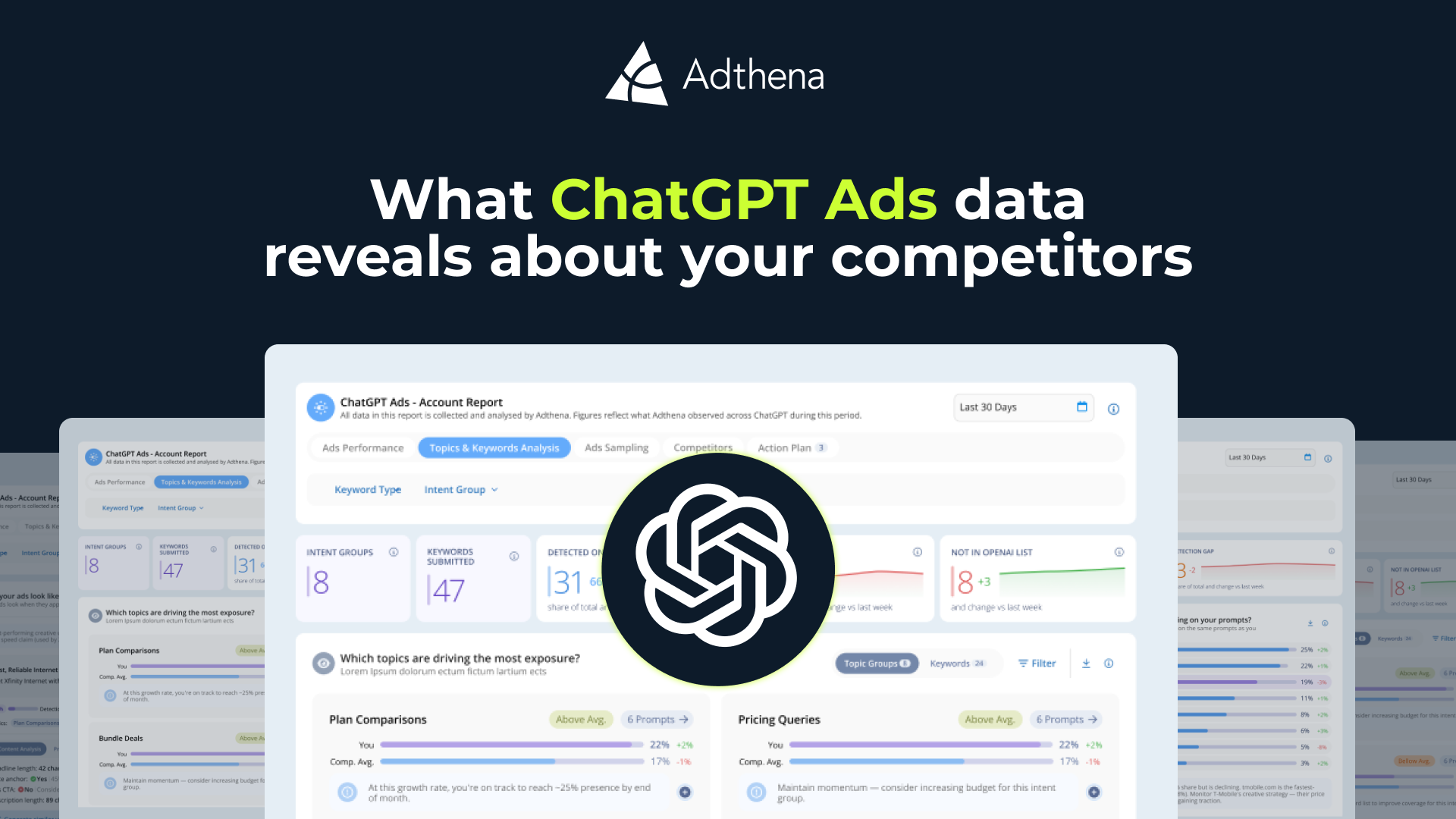
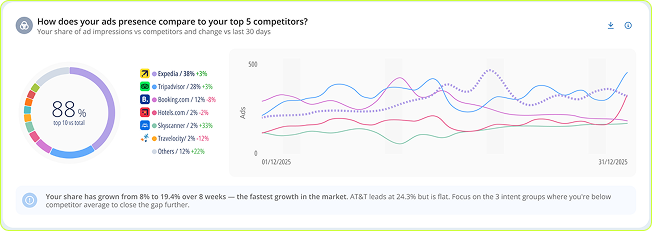
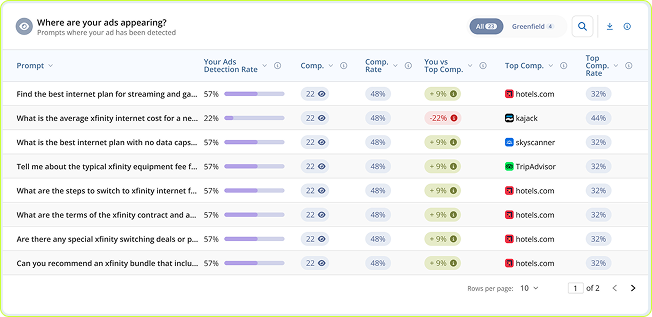
I recently dove deep into the fascinating world of ChatGPT Ads with insights from Adthena. It turns out, the advertising space on ChatGPT is a treasure trove of competitive information that many search teams are missing out on.
Your competitors are running stealth campaigns via ChatGPT, and the frustrating part is that it’s not immediately visible what they’re bidding on or what creative strategies they’re adopting. Unlike Google Ads, there’s no native way—yet—to get a behind-the-scenes look at this in ChatGPT.
When OpenAI launched advertising within AI-generated responses, brands jumped on board quickly. With the Ads Manager and lowered spending thresholds, this new ad channel grew rapidly. And with plans to expand to U.K. markets soon, there’s a quickly closing window for early adopters to gain a significant advantage.
From the start, we’ve been closely monitoring these developments, and what we’ve found is eye-opening.
What Does the Current ChatGPT Ads Landscape Look Like?
Our analysis spans nearly a million queries across 20 industries in five markets, telling a clear story of the current landscape.
It’s Primarily a U.S. Channel—Other Markets are Catching Up
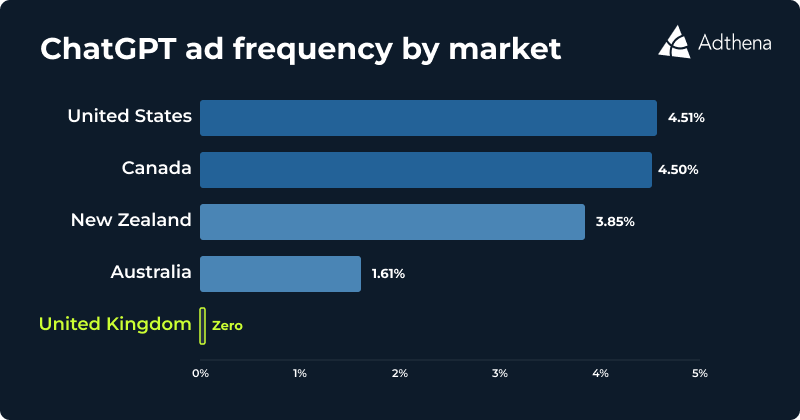
In the U.S., ads are run on about 4.5% of queries. In contrast, during the same period, the U.K. had none. The U.S. dominates, accounting for 90% of ChatGPT ad placements in our dataset, with Canada and New Zealand also active and Australia at 1.6%.
For U.K. teams, it means while the channel isn’t live yet, U.S. competitors are already fine-tuning prompts and creative strategies, placing them at a strategic advantage when the U.K. market opens.
The Majority of Responses Contain Just One Ad
On average, ChatGPT presents only 1.06 ad items per response in the U.S., implying a single sponsored slot per query. This level of exclusivity changes the game completely compared to multi-slot Google Ads.
Industry Restrictions Still Apply
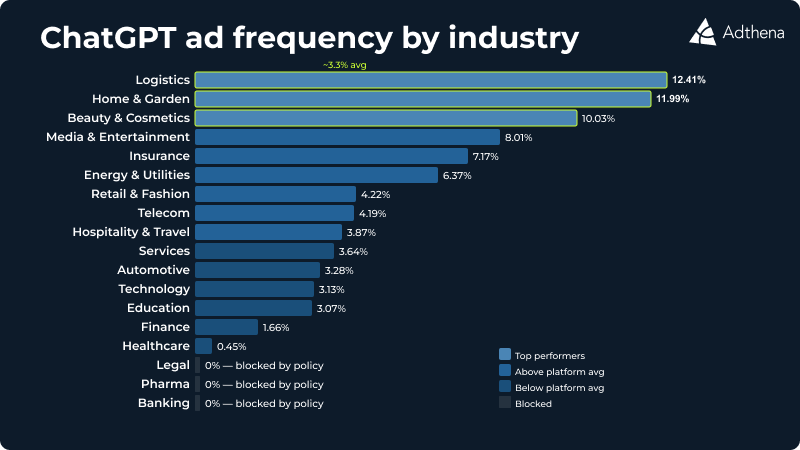
Certain sectors, like Legal and Pharma, show no ad activity due to what seems to be OpenAI’s deliberate restrictions, although this could change, providing proactive teams an edge.
Unexpected Hot Categories
Logistics, Home & Garden, and Beauty & Cosmetics are leading in ad frequency, indicating high potential for growth in these sectors.
Retail Leads in Ad Spend
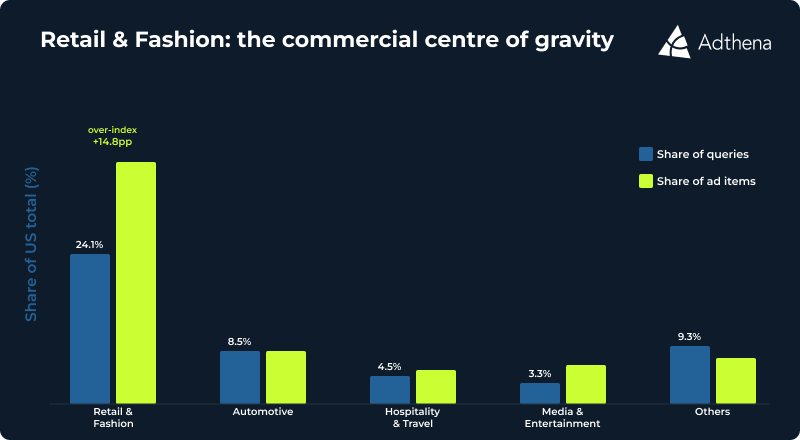
Retail & Fashion accounts for a vast share of U.S. ad items, indicating robust advertiser demand, far surpassing the national average. This suggests the significant investments made by retail brands in this space.
Current Challenges in Competitive Intelligence
Without tools like Auction Insights, understanding your competitive landscape on ChatGPT is practically impossible. You’re spending budget where you can barely track competitor activity. It’s a gap that Adthena aims to close.
Achieving Full Market Visibility with Adthena
Adthena’s ChatGPT Ads Intelligence offers broader insights by monitoring a plethora of prompts daily, providing a competitive overview previously unavailable.
You can now see who bids on your prompts, track share of voice, and spot open prompts ripe for targeting before competitors do.
In a new and rapidly evolving channel, being an early mover is an opportunity that shouldn’t be missed. Try ChatGPT Ads Intelligence free for 21 days and unlock the full potential of your advertising strategy.
Beyond Just ChatGPT: Expanding Your Search Horizons
As users move towards AI-driven searches for high-intent queries, such as product recommendations, it’s essential for search practitioners to adapt. Simply put, the game is changing.
If you’re attentive to ChatGPT Ads now, you’ll be hard to budge later. Our data shows a window of opportunity open now, similar to the early days of Google Ads. Capitalize on this before it closes.
Start your free 21-day trial of Adthena’s ChatGPT Ads Intelligence today to discover what’s unfolding in the ChatGPT ad space.
If you are deciding whether ChatGPT advertising deserves budget, do not start by asking whether it resembles paid search. Start with the moment the ad enters: the user has already described a need, added constraints, and moved partway toward a decision.
That is enough activity to reveal recurring creative conventions. It is not enough to establish a universal cost per acquisition, return on ad spend, or incrementality benchmark. The observations come from a vendor-tracked index during a trial, span materially different verticals, and do not provide one standardized performance baseline for every advertiser.
Use the data to answer questions such as how much copy the format can carry, which information tends to appear first, and how closely creative reflects the conversation. Do not use it to forecast your return before you have campaign-level evidence from your own offer, audience, and destination.
Before assigning meaningful budget, make sure your pilot can answer a defined question:
Can you identify a narrow group of commercial topics where the user is likely to be comparing options or preparing to act?
Do you have a specific, verifiable benefit that can be understood without several lines of explanation?
Does the destination continue the exact promise made in the ad?
Can you separate ChatGPT placements from your other paid traffic when evaluating outcomes?
Have you defined what would justify expanding, revising, or stopping the test before spend begins?
Rollout status is time-sensitive, so confirm actual inventory and account eligibility before committing budget or launch dates. A projected geographic expansion is not the same thing as inventory you can buy.
Write an answer fragment, not a compressed search ad
A traditional search ad often has several components competing for attention: multiple headlines, descriptions, sitelinks, extensions, and other assets. The early ChatGPT format is more restrained. That makes every word carry more of the decision.
The strongest working model is an answer fragment. It should make sense beside the assistant’s response, acknowledge the user’s decision criteria, and introduce a next step without pretending to be the neutral answer.
Lead with the decision-driving benefit. Do not spend the available space on a generic slogan.
Headline opening
Most begin with the brand name
Test a Brand: Benefit construction when recognition and accountability matter.
Body
About 19 words, commonly split into two sentences
Use the first sentence for proof and the second for a low-friction action.
Relevance
Stronger creative mirrors the user’s context
Reflect the category, constraint, or desired outcome instead of repeating a loose keyword.
Offer detail
Dollar signs, rates, and concrete figures were associated with stronger conversion performance
Prioritize a specificity test, but treat the pattern as a hypothesis to validate in your own campaign.
Build each variation from three prompt components
When a user asks for accounting software for a small team, for example, accounting software is only the category. Small team is the constraint. The unstated decision criterion might be fast setup, predictable cost, or limited administrative work. Creative that reflects only the category will feel generic even if it contains the right keyword.
Extract the category: what kind of product, service, or action does the user want?
Extract the constraint: what price, use case, location, feature, risk, or timing narrows the choice?
Choose one decision criterion your offer can substantiate.
Write the headline as Brand: Verified Benefit.
Use the body for one proof point and one proportionate call to action.
Remove any claim that the landing page cannot immediately confirm.
A useful template is: Brand: [specific outcome]. [Proof tied to the user’s constraint]. [Simple next action]. The brackets are not an invitation to stuff several benefits into one placement. Choose one reason to continue.
Specificity needs controls. If you advertise a price, rate, discount, delivery window, or availability claim, it must be current, approved, and visible at the destination. A concrete figure can improve clarity, but an outdated figure creates both conversion friction and potential compliance exposure. When the value changes frequently, build a review process before testing it in ad copy.
Test in an order that explains the result
Changing the headline, proof, call to action, and landing page at the same time may produce a winner, but it will not tell you why it won. Start with the variables most closely tied to conversational relevance:
Specific offer versus general benefit.
Query-matched benefit versus broad category language.
Quantified proof versus qualitative proof.
Low-commitment call to action versus immediate purchase or signup language.
General landing page versus a page that continues the same constraint and benefit.
Hold the other elements steady during each comparison. The point is not merely to improve the ad. It is to learn which part of the conversation your audience needs resolved before moving forward.
Measure prompt coverage and response duplication before calling it reach
Clicks and conversions still matter, but they do not tell you whether your brand is present across the conversations that matter. Conversational inventory needs an observation layer organized around topics, prompts, and individual responses.
That becomes especially important because one brand has been observed appearing twice within the same ChatGPT response. This double-parked behavior creates more placements, but it does not automatically create more unique reach. Counting each placement as a separate conversation would overstate coverage.
For every observed placement, record the topic, prompt or prompt class, response identifier, timestamp, position, advertiser, headline, body, and destination. Add post-click outcomes when your analytics can connect them. That record supports several more useful measurements:
Observed prompt coverage: the portion of your monitored commercial prompts in which your brand appeared.
Observed response presence: responses containing your brand divided by eligible responses you actually monitored.
Duplication rate: brand-present responses containing more than one placement for the same brand.
Competitor overlap: responses where your brand and a named competitor appeared together.
Creative-context match: whether the ad reflects the category, constraint, and decision criterion in the prompt.
Post-click continuity: whether the destination preserves the offer and language that earned the click.
Business outcome: qualified lead, sale, signup, or another result defined before the pilot.
Call these observed rates, not platform-wide impression share. A monitoring sample cannot tell you the total number of eligible conversations unless the platform provides that denominator. This naming discipline prevents a directional visibility metric from turning into a false market-share claim.
Review duplication separately from performance. Two appearances might reinforce recall, or they might add no incremental value. The placement pattern alone cannot settle that question. Compare duplicated and single-placement responses only when you have enough campaign data to evaluate their downstream outcomes.
Your landing-page review should be just as specific. Check whether the advertised benefit appears without searching, whether the price or rate matches, whether the next action is obvious, and whether the page answers the constraint expressed in the originating conversation. A relevant ad that lands on a general homepage throws away the context that made the placement useful.
Coordinate ChatGPT ads with AEO and GEO without merging the KPIs
Paid presence and organic AI visibility can occur in the same conversational environment, but they are not the same achievement. A sponsored placement buys labeled exposure. An organic citation, recommendation, or brand mention depends on how the system constructs its answer. Early placement observations do not establish that buying ads improves organic answer inclusion.
Keep the two lanes separate in reporting. If you combine them into one AI visibility number, you will not know whether a change came from media spend, content improvements, brand demand, or answer-engine behavior.
Use one shared topic map. Organize paid monitoring and organic visibility work around the same commercial questions, constraints, entities, and decision criteria.
Give paid media its own outcomes. Track observed presence, duplication, clicks, qualified actions, and campaign economics.
Give AEO and GEO their own outcomes. Track whether the brand is mentioned, cited, represented accurately, and connected to the intended category across monitored answers.
Align the factual layer. Prices, rates, features, availability, and offer terms should agree across ad copy, visible page content, and applicable structured data.
Investigate cross-channel clues. A commercial prompt with competitor ads but weak organic answers may expose a content opportunity. Strong organic visibility with no paid presence may identify a conversation worth testing, but neither observation guarantees demand or return.
JSON-LD can clarify entities, products, offers, and other machine-readable facts when it accurately represents visible content. It does not purchase inventory, guarantee inclusion in an AI response, or repair a weak offer. Use structured data to reduce ambiguity, then use advertising to test whether a clear commercial promise earns action.
This coordinated model also gives you a cleaner competitive view. You can distinguish a competitor that is buying exposure from one that is repeatedly earning non-sponsored visibility. The response is different: one may call for a media test, while the other may require better content, stronger entity signals, clearer proof, or a more competitive offer.
Key takeaways for your first ChatGPT ad pilot
Treat early placement data as evidence about format and creative conventions, not as a guaranteed ROI benchmark.
Write for a user who has already supplied context: lead with the brand, one verified benefit, one proof point, and one next action.
Use the observed 30-character headline and 19-word body patterns as editing discipline, not as assumed platform limits.
Test concrete figures before vague claims when your offer supports them, but keep every price, rate, and term synchronized with the destination.
Measure prompts and unique responses as well as placements, because two appearances in one response do not equal two reached conversations.
Coordinate paid, AEO, GEO, landing-page content, and structured data around one topic map while reporting paid and organic outcomes separately.
Your next move is a narrow pilot, not a platform-wide commitment. Choose a small set of high-intent topics, document the user’s constraints, create controlled variations, and establish an organic visibility baseline before ads run. You will then be able to decide from your own evidence whether conversational advertising adds qualified demand, merely adds placements, or reveals a larger content opportunity.