An SEO report can be technically accurate and still fail its audience. Rankings, impressions, and sessions describe search activity, but executives usually need to know whether that activity produced revenue, leads, sales, or a meaningful reduction in acquisition cost.
The solution is not to discard operational SEO data. It is to separate diagnostic metrics from decision-making metrics, then present each at the level where it is useful.
Start with the decision the report must support
Before selecting charts, define the business question. Leadership may need to decide whether to maintain investment, shift resources toward higher-value pages, or compare organic search with other acquisition channels. The report should make that decision easier.
Search Engine Land argues that stakeholder reporting should begin with an existing corporate goal rather than whatever data happens to be available. If the goal concerns revenue or lead generation, the headline measures should show SEO’s contribution to that outcome. Rankings can explain performance, but they are not a substitute for it.
Build a measurement chain from visibility to value
A useful report connects early search signals to later commercial results. Visibility can lead to visits, visits can produce qualified actions, and those actions can become orders, opportunities, or revenue. Reporting should reveal where that chain is working and where it breaks.
Conversions by channel, cost per lead, cost per acquisition, profitability, and revenue contribution can therefore serve as executive-level indicators. Engagement and branded search may add context, especially when they help explain growing demand or stronger audience intent. Their role should be explicit rather than presented as proof of value on their own.
The same standard applies to referrals from ChatGPT, Perplexity, AI Overviews, and other AI-driven discovery experiences discussed by the source. A rising visit count is only an intermediate signal. The commercially relevant question is whether those visits generate qualified leads, sales, or revenue.
Organic visibility, paid media and artificial intelligence merge into one connected search ecosystem, where vivid data streams link a creative website with a powerful analytics dashboard.
Key takeaways
Lead with revenue, orders, qualified leads, profitability, or acquisition cost when those measures match the business goal.
Use rankings, impressions, and traffic as diagnostic evidence, not as the main executive result.
Measure AI referral traffic by the same commercial standard applied to conventional organic search.
Keep technical detail available for practitioners while giving leadership a shorter decision-focused view.
Explain attribution limits and disclose negative movement before stakeholders have to uncover it themselves.
Design two reporting layers for two audiences
Executive reporting and operational reporting have different jobs. A leadership view can open with business contribution, compare results with the relevant target, and identify risks or decisions. A practitioner appendix can retain keyword movement, indexing data, technical findings, page-level traffic, and other evidence needed to diagnose causes.
This layered structure prevents technical teams from losing visibility into their work while keeping the main narrative commercially focused. It also improves the language of the report. A title centered on organic search’s contribution to new business sets a different expectation than a generic SEO performance label, even when both draw from the same underlying data.
Branded search and direct visits may also deserve supporting roles when they move alongside organic investment. They do not fit perfectly within conventional channel attribution, so they should be presented as contextual indicators rather than automatically assigned to SEO.
Handle attribution and declining traffic without false precision
Organic search rarely receives clean credit for every sale or lead it influences. Overly elaborate attribution can create a precise-looking number that stakeholders cannot interpret or trust. A documented, consistently applied estimate is often more useful, provided the report explains what is counted, what is excluded, and where uncertainty remains.
The source also notes that traffic is declining for many sites, particularly those historically dependent on clicks to informational pages. When that affects performance, the report should address it directly. Early disclosure protects credibility and creates room to discuss whether commercial outcomes, branded demand, or higher-intent visits tell a different story.
A gradual transition is practical: introduce one or two business-led measures beside the current dashboard, validate the definitions with finance or sales, and move diagnostic metrics into a secondary layer over time. The strongest SEO report is ultimately the one that lets leadership see value, understand uncertainty, and make the next investment decision with confidence.
A traffic decline is a warning, not a diagnosis. Before rewriting an underperforming page, teams need to determine whether the page lost rankings, stopped matching search intent, encountered more zero-click results, or serves a topic with shrinking demand.
This framework uses Search Console trends and a live results-page review to connect each pattern with an appropriate response.
Start with the decision, not the refresh
Content decay is a sustained reduction in organic performance, rather than an isolated weekly fluctuation. Search Engine Land identifies four distinct causes. Only ranking decay is consistently suited to a conventional content refresh.
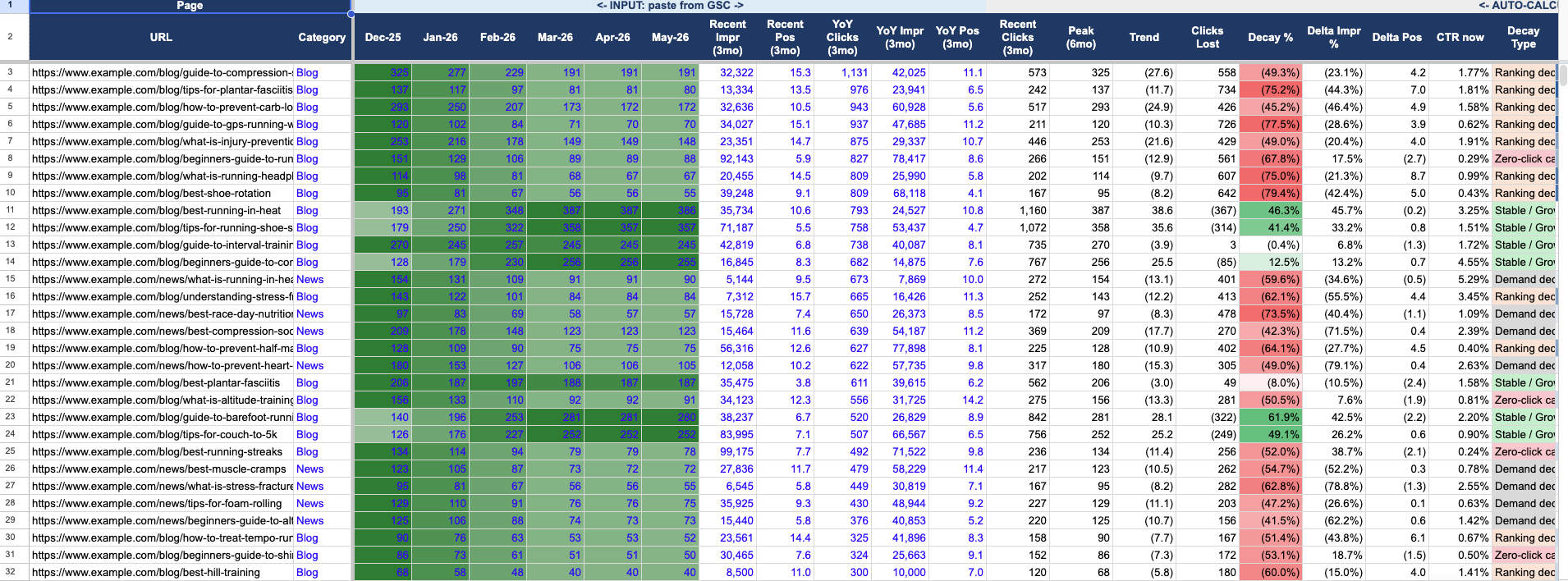
A wide spreadsheet compares example.com Blog and News URLs from Dec-25 to May-26, alongside impressions, positions, click losses, decay percentages, CTR, and trends.
Ranking decay: The page has lost visibility to competitors, become outdated, lost links, or begun competing with another page on the same site.
Zero-click capture: The page remains visible, but an AI Overview, featured snippet, or another search feature satisfies more users without a visit.
Intent drift: Google now favors a different type of result, such as a video, product page, forum discussion, or comparison table.
Demand decay: The page still performs competitively, but fewer people search for its subject.
A fifth pattern sits outside this framework: a date-aligned, site-wide decline may indicate an algorithm-related issue requiring broader investigation.
Read the combined Search Console signals
Clicks reveal that performance changed, but impressions and average position help explain why. The source recommends reviewing six months of monthly clicks for the trend, then comparing three months year over year for clicks, impressions, and position. This reduces short-term noise while accounting for seasonality.
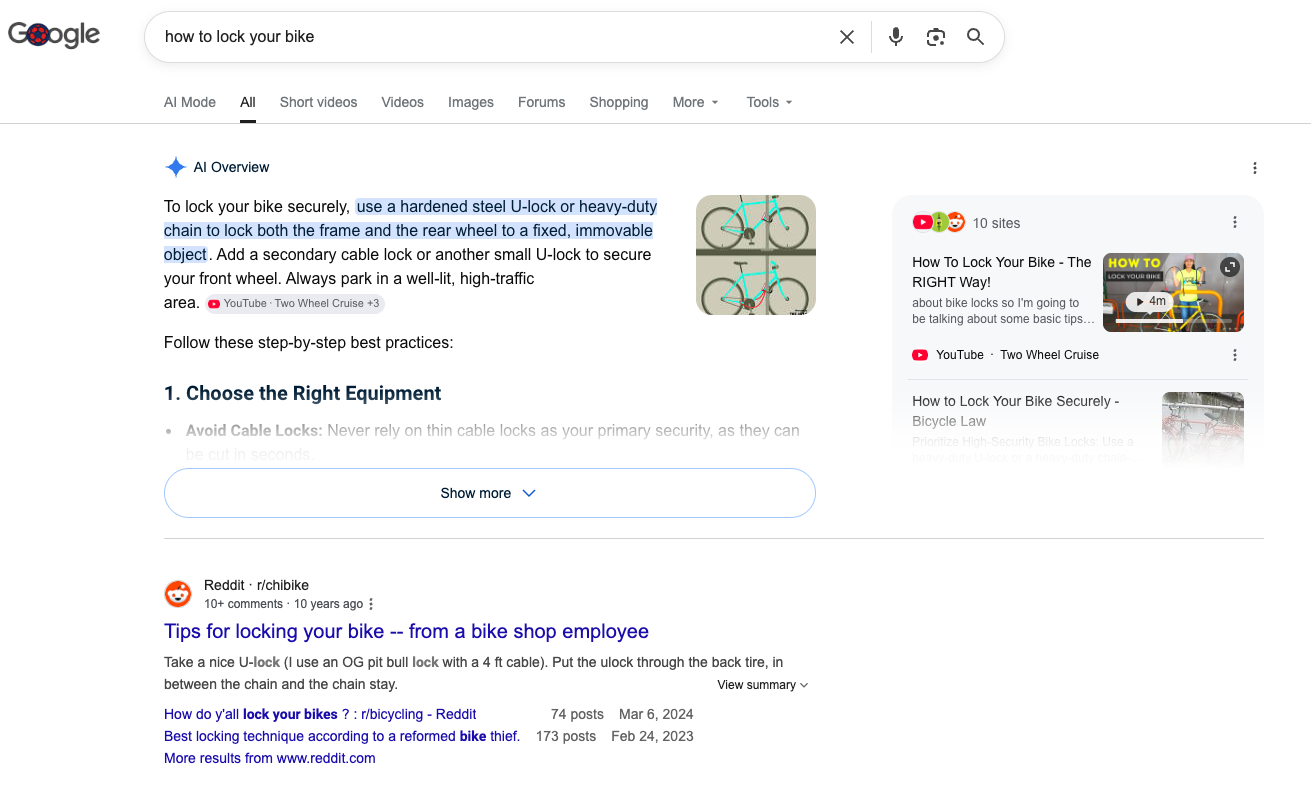
Search results for "how to lock your bike" feature an AI Overview with locking advice and bike diagrams, alongside video suggestions and a Reddit tips thread.
Clicks
Impressions
Average position
Likely diagnosis
Down
Down
Worse
Ranking decay
Down
Flat or up
Stable or better
Zero-click capture
Down
Down
Stable or better
Demand decay
Down
Varies
Holding, but results changed
Intent drift
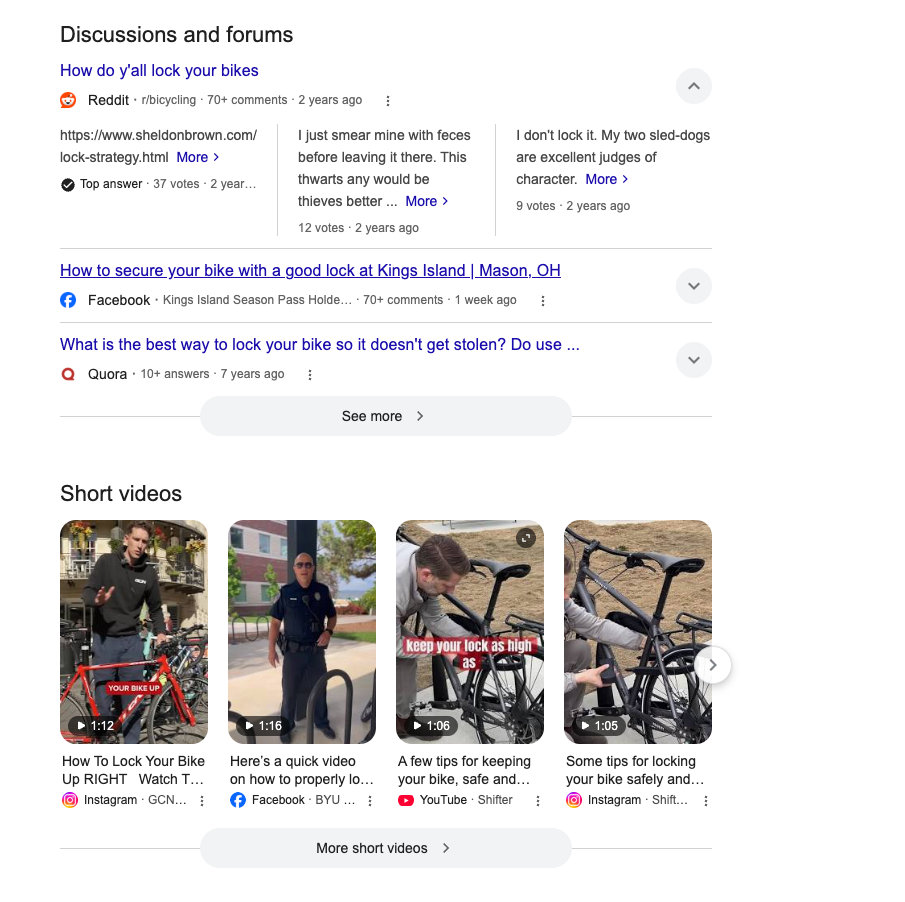
Intent drift cannot be confirmed from exported metrics alone. Search the main queries manually and inspect which formats, features, and source types now occupy prominent positions.
Match the intervention to the cause
Rebuild pages with genuine ranking losses
A ranking-decay refresh should add substance rather than merely change the publication date. Useful interventions include original testing, proprietary information, missing answers, stronger internal links, and consolidation of competing URLs. Competitor analysis should also consider whether Google now prefers a different source type.
A search results page displays discussions and forums about how to lock a bike, followed by four short video previews demonstrating bike-locking techniques.
Create value that a search summary cannot replace
Zero-click capture calls for assets that reward a visit: calculators, tools, original data, or a defensible perspective. Clear organization and unique evidence may also make a page more suitable for citation by answer systems. If the query no longer produces meaningful visits, resources may be better directed toward comparison, service, or other conversion-oriented pages.
Change the format or retire the topic
For intent drift, preserve the established URL when practical but reshape the experience around the format users now receive. For confirmed demand decay, first check whether attention moved to forums, video, social search, or AI assistants. If the audience has genuinely disappeared, consolidation, redirection, or pruning is more rational than rewriting.
Organic visibility, paid media and artificial intelligence merge into one connected search ecosystem, where vivid data streams link a creative website with a powerful analytics dashboard.
Rule out measurement and editing problems
Before assigning any decay type, compare the decline date with the page’s revision history. If performance fell immediately after an edit, restoring the previous version provides a cleaner test than adding another rewrite.
Historical impression data also needs caution. Search Engine Land reports that Google’s removal of the num=100 parameter in September 2025 reduced bot-inflated counts. The source also notes that Google disclosed a logging error that had inflated impressions from May 2025 and corrected it without repairing the historical figures; clicks were reportedly unaffected. A pattern that resembles lost demand should therefore be checked against the live results page, especially when position is stable or improving.
Turn diagnosis into a quarterly operating habit
A practical review sorts declining pages by decay type, recoverable traffic, and business value. GA4 conversion or revenue data can improve prioritization, while rank-tracking and search-feature data can help evaluate zero-click exposure at scale.
Key takeaways
Use clicks, impressions, and average position together before deciding to refresh.
Confirm intent changes and ambiguous zero-click patterns on the live results page.
Reserve rewrites for pages where better content can address the diagnosed cause.
Redirect effort when demand has disappeared or the search result no longer produces valuable visits.
The strongest content-maintenance program is selective. Its advantage comes from recognizing when editing can recover value and when another decision will produce a better return.
My eight-year-old daughter desperately wanted a Nintendo Switch. Her “evil” parents—my spouse and I—refused to buy one for her.
She was too young to get a job, so she did what any resourceful child would do: she opened a lemonade stand in front of our house.
She did more than set out a table and a pitcher, though. She designed what amounted to a high-stakes A/B test.
Her hypothesis was simple: if she could persuade more people to stop, she could sell more lemonade and reach her Nintendo Switch goal faster.
Variant A was her two-year-old sister, Julie, stationed out front to attract attention.
Variant B was our dog, Ginger.
I know what I would have guessed.
The dog. Obviously, the dog.
But Julie won—and it was not even close.
The only metric that mattered
The funny part is that my daughter did not really care about the A/B test result. She was not interested in how many people stopped at the stand or which variant produced the best response.
She cared about one outcome and one outcome only:
At this lemonade stand, the cute-dog advantage loses: Variant A, featuring the seller’s young sister, wins the visibility A/B test over Variant B’s golden retriever.
Did she make enough money to buy the Nintendo Switch?
I believe marketers are facing a similar problem right now.
Generative engine optimization (GEO) is the practice of increasing a brand’s visibility in AI-generated answers across platforms such as ChatGPT, Gemini, Perplexity, and AI Overviews.
I can track AI visibility, citation share, impressions, rankings, and nearly every other signal available. Meanwhile, leadership is asking a much simpler question:
Is any of this helping the business grow?
I answer that question with a simple test I call the Dollar Rule: if I cannot put a dollar sign in front of a metric, I treat it as a channel metric rather than a business metric.
That distinction captures the central measurement challenge in GEO.
Most of the numbers we track are valuable operational signals. They show us what is happening within the channel, but leadership wants to understand the resulting business impact.
GEO emerged at precisely the moment attribution was becoming less reliable.
Traditional SEO measurement relied on a straightforward journey: someone searched, clicked, visited a website, and converted. We could trace that path and connect it to an outcome.
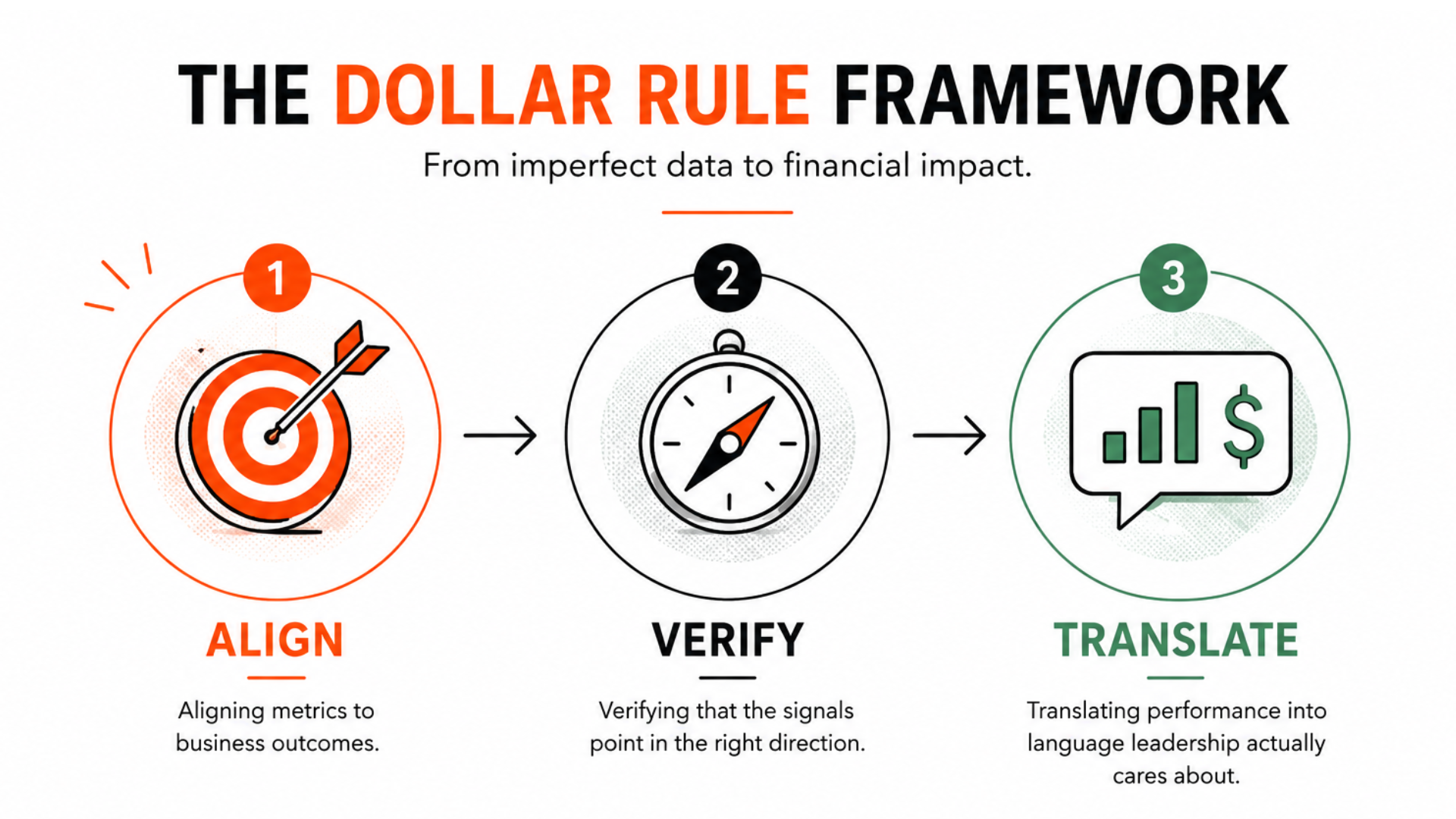
The Dollar Rule turns imperfect GEO attribution into a business case: align metrics with outcomes, verify directional signals, then translate performance into financial language leaders value.
AI search disrupted that model.
I now see buyers forming opinions and making decisions before they ever reach a company’s website. That makes AI’s influence much harder to capture with conventional attribution.
AI search broke attribution
I see buyers discovering brands through AI-generated answers, citations, publishers, forums, reviews, videos, and many other sources. Those touchpoints can shape a decision long before a click occurs, and much of that influence never appears cleanly in analytics.
That is why I see so many teams struggle to justify GEO investments. The visibility is real, and the influence is real, but the attribution is frequently incomplete.
I do not believe waiting for perfect attribution is a sound strategy. Increasingly, it is simply a convenient reason to avoid acting.
When I want leadership to support GEO, I need to connect its influence to business outcomes—even when I cannot connect every interaction to a conversion.
How I make the financial case for GEO
The biggest mistake I see marketers make is trying to prove attribution before proving value.
Before I worry about attribution, I ask whether I am measuring something the business actually considers important. That is where the Dollar Rule becomes useful.
I have found that justifying a GEO investment usually comes down to three actions:
I align my metrics with business outcomes.
I verify that those metrics reliably point me in the right direction.
I translate the evidence into language a CFO understands.
My Dollar Rule is deliberately simple:
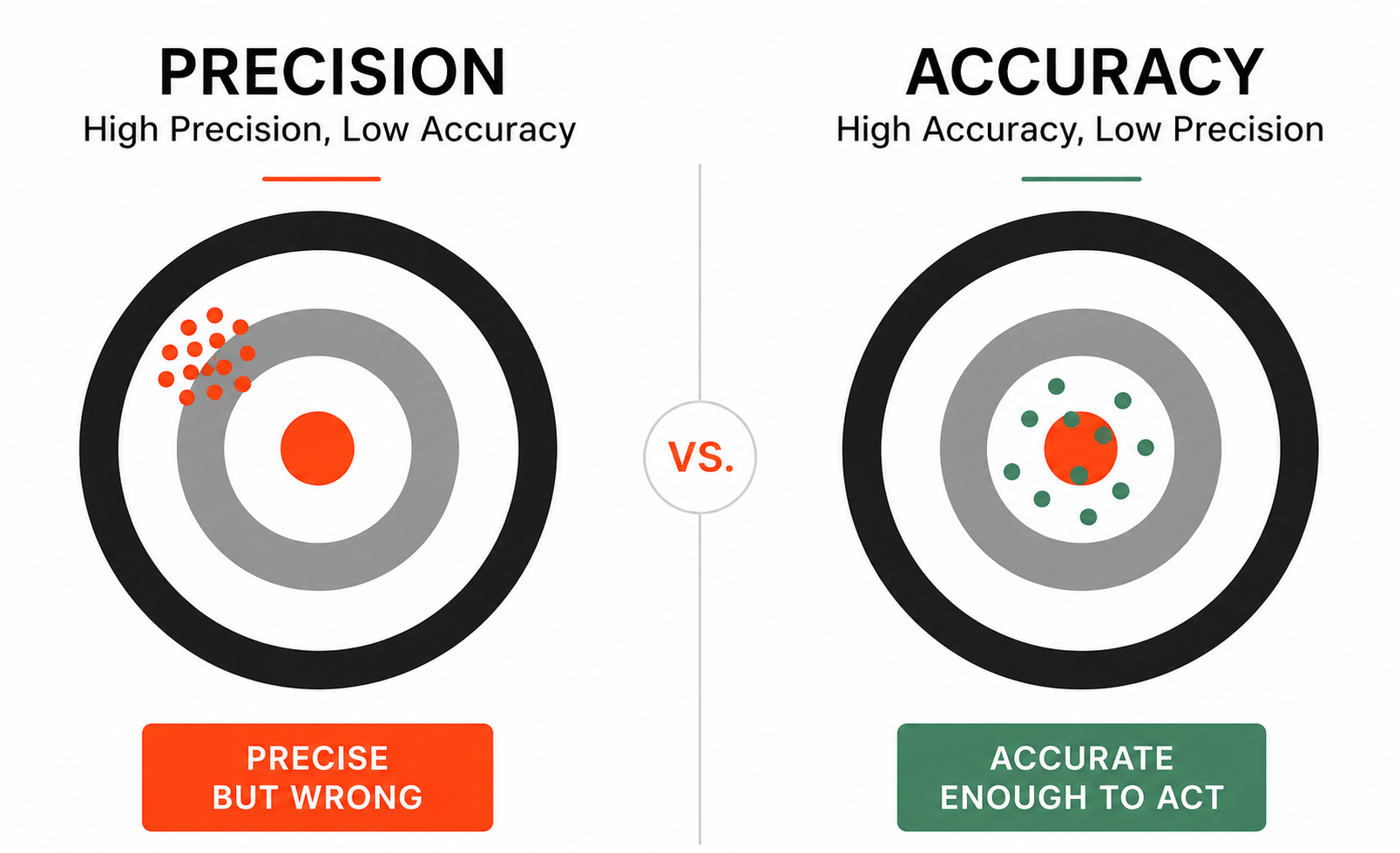
Precision can form a tight cluster in the wrong place; accuracy keeps evidence centered on the outcome that matters. For GEO measurement, a useful estimate can beat an exact but irrelevant metric.
If a number does not translate into dollars, I treat it as a channel metric, not a business metric.
I focus on revenue opportunity, revenue at risk, payback period, and customer acquisition cost. Those metrics live on a P&L, and they are the numbers leadership teams use to evaluate investments.
In my experience, CFOs do not allocate budget because an attribution model looks impressive. They allocate budget based on credible expectations of financial return, risk, and growth.
That principle changes how I measure and present GEO.
I measure influence, not just attribution
AI search did more than change discovery. It changed what I can realistically measure.
Traditional organic attribution assumes a clean sequence: search, click, visit, convert.
AI platforms increasingly answer questions before a click, influence buyers across multiple touchpoints, and withhold the referral data marketers once relied on.
That leaves me in an unusual position: a GEO campaign may be influencing pipeline even while the analytics platform struggles to prove it.
One estimate illustrates the gap. Loamly estimates that roughly 70% of AI-influenced traffic appears as Direct traffic in GA4, making a substantial share of AI’s contribution difficult to trace through traditional attribution models.
I do not take that measurement gap to mean measurement is impossible. I take it as a reason to broaden the evidence I examine.
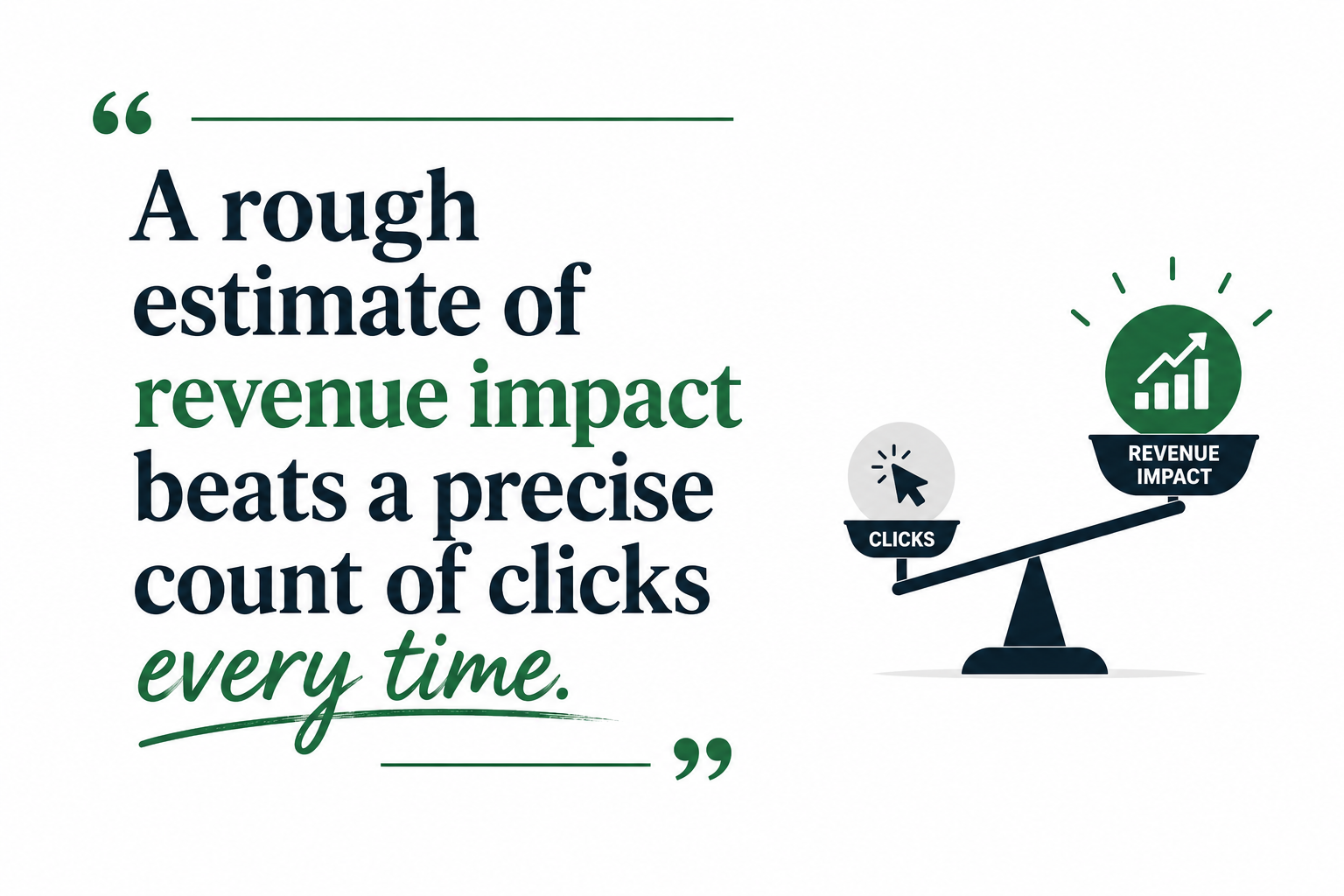
When attribution is incomplete, business value tips the scale: a credible estimate of revenue impact can guide GEO investment better than a perfectly precise tally of clicks.
Instead of asking only, “How many clicks did we receive from AI search?” I ask:
Is our branded search growing?
Are prospects arriving already familiar with our positioning?
Are we being cited in AI answers for questions that drive revenue?
I would not treat any one of these signals as definitive. When I combine them, however, they can create enough confidence to support a responsible investment decision.
That is the essential difference between GEO measurement and traditional SEO measurement. I am not simply measuring a click path; I am measuring market influence.
I believe the marketers who adapt fastest will stop treating attribution as a traffic-sorting exercise. We will combine quantitative signals with qualitative evidence because the goal is not absolute certainty. The goal is confidence that our GEO investment is moving the business in the right direction.
Why I may be measuring the wrong thing
I do not think SEO or GEO metrics are inherently wrong. The problem is that they can be highly precise without being relevant to the business outcome I am trying to influence. They tell me exactly what happened inside a channel, but not whether the business is moving in the right direction.
SEO tools are packed with precise numbers. The challenge is that many of those numbers have only a weak connection to business outcomes.
Precise = exact
Accurate = connected to business outcomes
I have found that leadership would rather receive a roughly correct estimate of revenue impact than a perfectly precise count of clicks.
I studied engineering in school, where we spent a great deal of time discussing precision: how exact and repeatable a measurement is, right down to the decimal point.
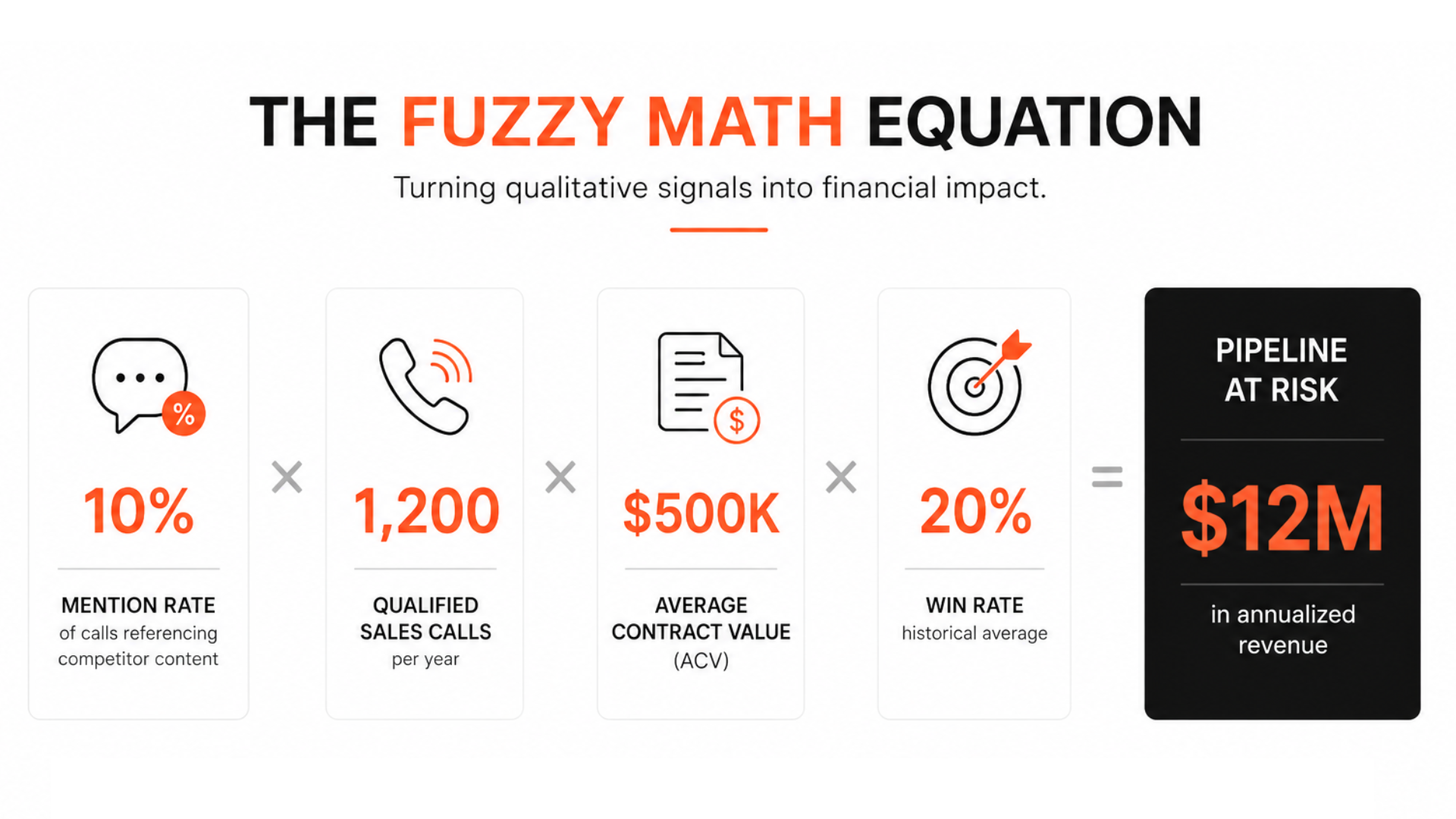
The fuzzy math equation turns a qualitative sales signal into a figure leaders understand: a 10% competitor-content mention rate translates to $12 million in annualized pipeline at risk.
In marketing, I see that kind of precision in organic clicks, rankings, impressions, and click-through rates. Tools such as Google Search Console can give me extremely exact figures for those channel activities.
The problem is that a precise channel number is not necessarily accurate in the business sense. I consider a measurement accurate when it tells me whether I am getting closer to an outcome that matters.
Even when those measurements are not perfectly precise, I find them more useful if they point toward the bullseye: the business outcomes leadership cares about.
Knowing that a page received 40 organic clicks is precise. It tells me almost nothing about whether we are winning or losing in the market—just as a visitor count did not tell my daughter whether she was close to buying her Nintendo Switch.
That is how I apply the Dollar Rule in practice. When attribution is incomplete, I translate the evidence I do have into a directional estimate of business impact.
Why I put revenue ahead of attribution
For me, a rough number tied to revenue beats an exact number tied only to channel activity.
When reliable attribution is unavailable, I build the case from signals I can actually access and then work through the math.
I do not use fuzzy math to replace SEO metrics or attribution. I use it alongside them when traffic-based attribution cannot capture the influence taking place.
One of our healthcare clients gave us a useful example.
Prospects were arriving at sales calls already convinced of claims that were not true.
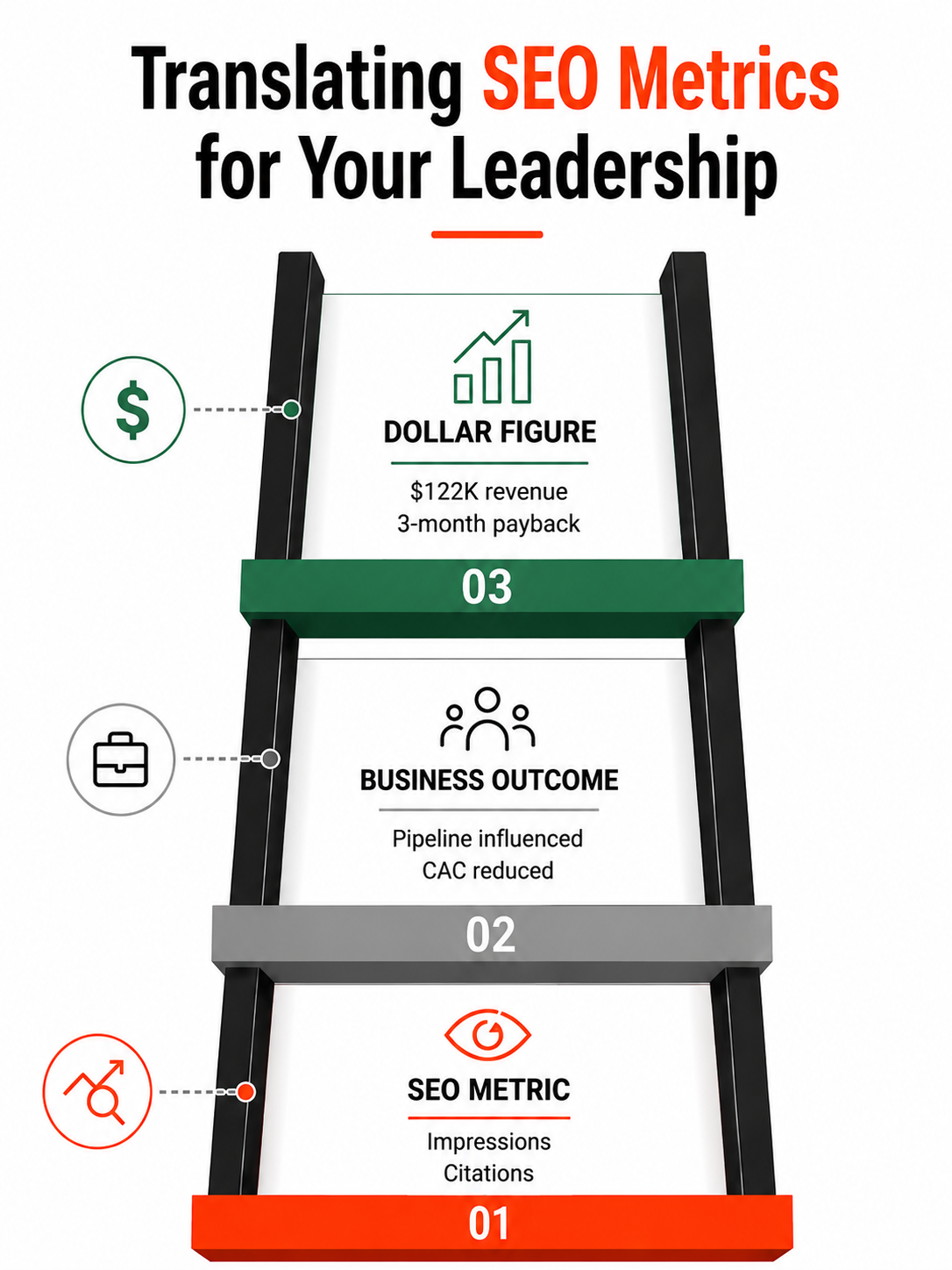
Climb from channel data to executive value: translate SEO impressions and citations into pipeline and lower CAC, then show leadership what matters—$122K in revenue and a three-month payback.
We traced the source to a competitor’s comparison page. That page was shaping buyer perceptions long before our client had an opportunity to present its side of the story.
We recommended publishing content that would counter the narrative, but the leadership team did not believe there was enough evidence to justify a response. We needed to make a stronger business case.
SEO tools estimated that the competitor’s page received roughly 40 organic visits per month. Whether that estimate was right or wrong was beside the point: it did not measure the page’s influence on active buyers.
So we looked for evidence that was closer to the business outcome.
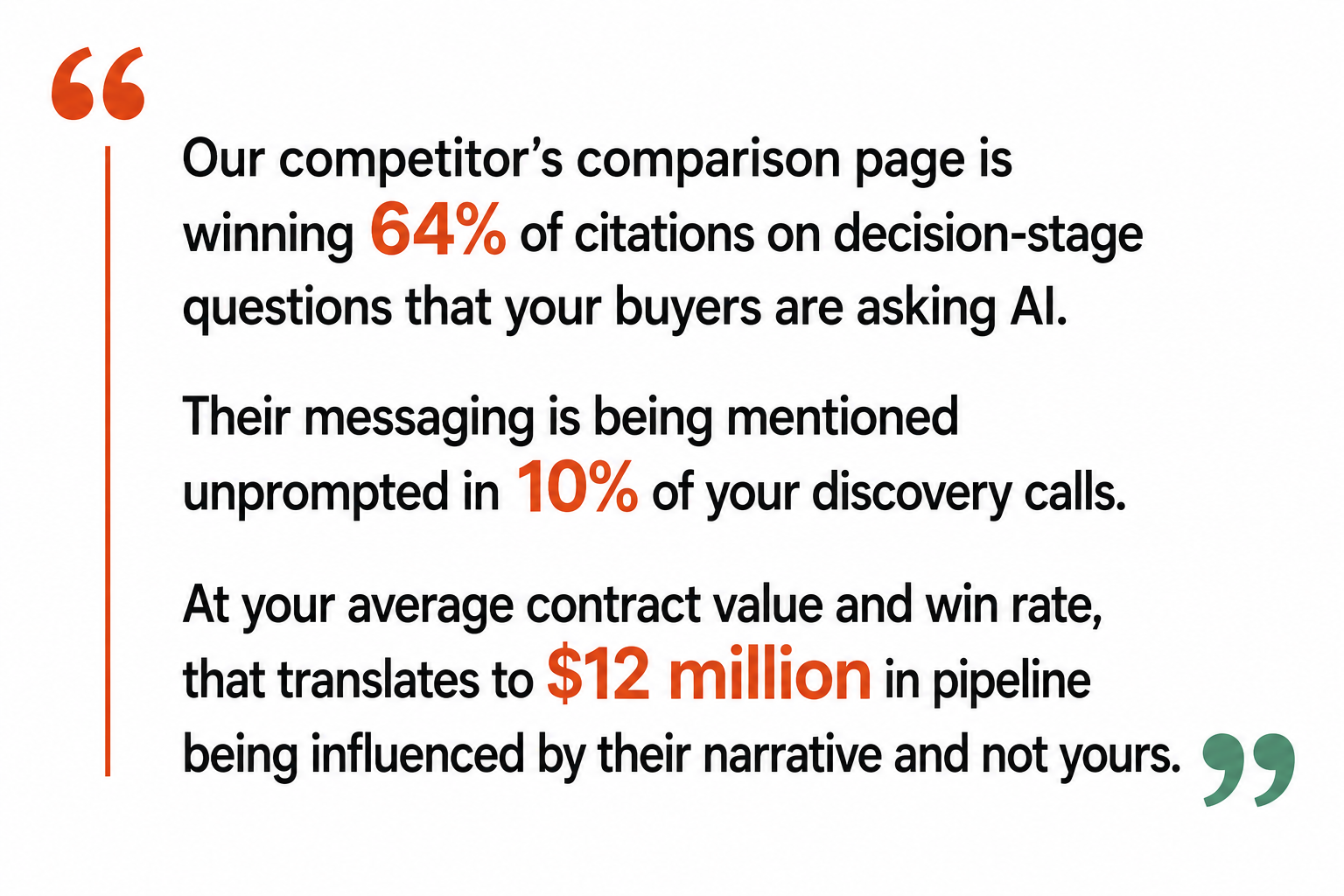
We spoke with our client’s salespeople. They told us that roughly 10% of qualified B2B discovery calls included unprompted mentions of specific claims from the competitor’s page.
That was not a clean number suitable for an exact attribution model, but we could not dismiss it. The influence was real, and it was showing up during live sales conversations.
We used that evidence to build a directional calculation:
10% mention rate on discovery calls
× 1,200 qualified B2B sales calls per year
× $500,000 average contract value
A competitor’s comparison page earns 64% of citations on decision-stage AI questions and surfaces in 10% of discovery calls—putting an estimated $12 million in pipeline under its narrative.
× 20% average win rate
= $12 million in annualized revenue being influenced by the competitor’s narrative
I did not present this as a forecast or a formal attribution model. It was a directional estimate of how much revenue the competitor’s messaging could influence.
That reframing changed the conversation. We stopped debating 40 clicks per month and started discussing $12 million in influenced revenue.
That is the number we brought to leadership—not impressions or citation share, but $12 million in revenue being influenced by a page our client had declined to counter. That is a number a CFO immediately understands.
I lead with value metrics
If we enter a GEO campaign review and lead with rising citation share or growing impressions, our CMO may lose interest and our CFO may wonder what those numbers mean financially. In the worst case, we can lose budget because leadership cannot see the return.
Here is how we framed the situation for our client’s leadership team:
I have learned that leadership funds marketing campaigns based on business impact. Translating a problem into dollars changes the nature of the discussion.
The decision-makers did not need certainty. They needed a credible financial story supported by leading indicators, observable momentum, and enough evidence to inspire confidence.
I focus on what the business values
That is what my eight-year-old intuitively understood at her lemonade stand. Her goal was never to count visitors. Her goal was to buy the Nintendo Switch.
A neon-lit smartphone imagines advertising inside ChatGPT, highlighting how AI platforms are reshaping brand discovery, GEO strategy, and the measurement of marketing influence.
GEO has created anxiety because it disrupted attribution models we relied on for years. But I remind myself that attribution was never the ultimate objective.
The real objective is business growth.
If I can connect GEO activity to revenue opportunity, revenue at risk, pipeline influence, or customer acquisition, I do not need perfect certainty to justify the investment.
I need credible evidence that our GEO campaigns are moving the business in the right direction.
Precise metrics tell me what happened. Relevant metrics tell me whether we are winning.
Before I deliver my next GEO report, I can examine every metric on the page and ask one question:
If this metric doubled tomorrow, would the business care?
Then I ask the follow-up:
Can I translate this metric into revenue opportunity, revenue at risk, pipeline influence, or customer acquisition cost?
If I cannot, I am probably reporting channel impact rather than business impact—and that is unlikely to justify the next GEO investment.
At Resolve, we define link building for legitimacy as earning authoritative backlinks, brand mentions, and media coverage that demonstrate trust, expertise, and credibility to search engines and AI systems. Instead of chasing link volume, we use digital PR, original research, thought leadership, and journalist relationships to earn genuine editorial citations. These are the authority signals behind Google’s E-E-A-T framework, and they can help us appear in AI Overviews, earn citations from large language models, and build visibility that survives ranking swings.
We believe a little competition is healthy. It challenges us, sharpens our thinking, and pushes us to pursue bigger and better results.
However, today’s search environment is changing faster than ever. Large language models, AI-generated answers, and frequent algorithm updates are reshaping how people find information, making it increasingly difficult for us to rely on yesterday’s playbook.
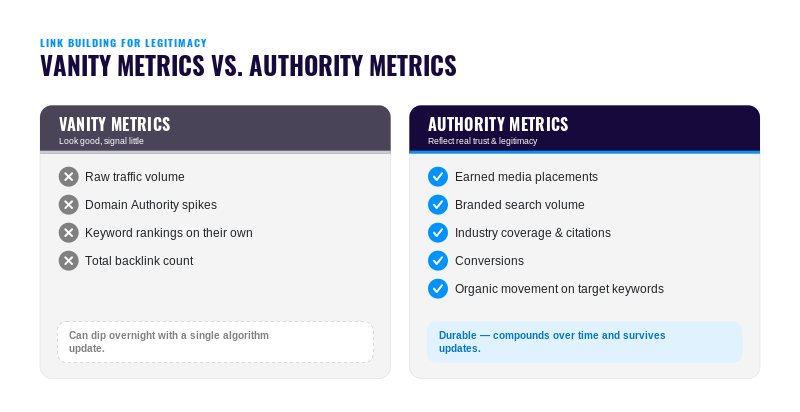
The metrics we once used to keep brands afloat — traffic, domain authority increases, and keyword rankings — no longer define SEO success on their own. We can reach the top of a search results page and still see very few conversions.
If we continue chasing those numbers in isolation, we risk being left behind. We have to adapt.
We now widen our view to the outcomes that matter most: trust and brand authority. Unlike a temporary ranking or traffic spike, trust and authority are not earned quickly or easily.
We need time to spread the word about our brand, and we need even more time to prove that people can rely on us. Once we establish that trust, however, it becomes much harder to dislodge.
An algorithm update can cut our traffic overnight. It cannot erase genuine trust overnight.
Our challenge is learning how to build trust and strengthen our brand while every competitor is trying to do the same. We also need meaningful ways to measure concepts that can initially seem difficult to quantify.
We have found that the answers involve some nuance, but they are simpler than they appear. The process begins with a shift in perspective.
Why we see link building as more than rankings
For years, we treated link building like a popularity contest. The site that collected the most votes, in the form of backlinks, was often rewarded with a prominent position in the search results.
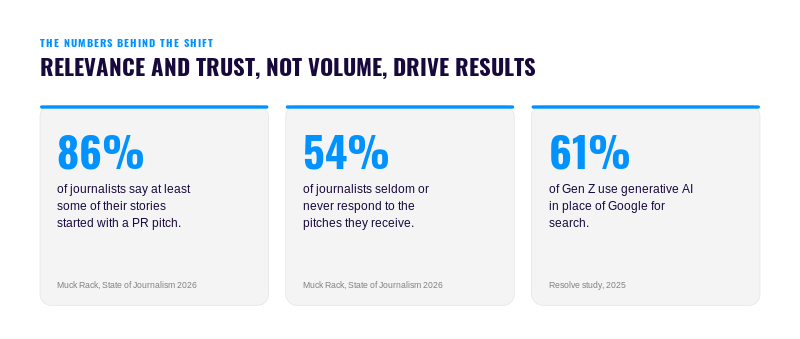
Relevance and trust beat volume: 86% of journalists use at least some PR-pitched stories, yet 54% seldom respond, while 61% of Gen Z turn to generative AI instead of Google.
Over time, Google and other search engines updated their algorithms to improve the search experience. With each change, Google cracked down on more sites that tried to manipulate the system with backlink volume instead of earning links with real editorial and audience value. Countless sites lost traffic, and many still feel the effects.
Today, we see Google place more emphasis on relevance, industry trust, and authority. That helps explain why a familiar brand can attract more searchers than a smaller competitor even when both publish similar content and target similar keywords.
Large language models and Google’s AI Overviews have widened this divide. These systems can use retrieval-augmented generation, or RAG, to retrieve relevant sources, often favoring authoritative publications and proprietary information. If we merely repeat a statistic already cited by a top-tier publication, an AI system may choose the better-known source to reduce the risk of spreading inaccurate information.
We also see younger searchers moving toward AI tools. In a 2025 Resolve study, 61% of Gen Z respondents said they used generative AI instead of Google.
None of this means every form of link building looks like spam to Google or an LLM. It means we need backlinks to work alongside a broader set of authority signals.
When publications and journalists cite our brand, they signal authority. When we publish original content and proprietary data, we signal authority. When we create useful graphics and informative videos, we signal authority again.
Once Google and AI systems recognize these signals, the backlinks supporting them become meaningful votes of confidence. Our site may then be more likely to rank prominently, appear in AI Overviews, and receive citations in LLM-generated answers.
How we use E-E-A-T in a competitive search environment
Experience: We demonstrate that an author has personally engaged with the subject. Examples include a forum where people describe testing a product or a gardener documenting firsthand pest-prevention trials.
Expertise: We show that the author has relevant knowledge, qualifications, or credentials supporting the information and advice.
Authoritativeness: We earn recognition from credible sources and industry voices that cite or link to our work, helping establish us as a respected participant in the field.
Trustworthiness: We remain transparent, accurate, and honest. We avoid deceiving readers or using manipulative link-building practices.
We apply E-E-A-T both on and off the page. Author biographies can demonstrate expertise, while accurate sourcing can demonstrate trustworthiness. Off the page, we strengthen E-E-A-T signals through the quality of the sites that link to us and the journalists who rely on us as a source. Both dimensions influence how search engines assess whether our information is useful, accurate, and credible.
If we consistently earn backlinks from dozens of irrelevant websites, that pattern can look like a low-quality or manufactured signal. If several respected journalists mention our brand because we published a valuable study, those mentions are much more likely to function as genuine votes of confidence.
Move beyond fragile SEO numbers. This side-by-side graphic shows how earned media, branded searches, industry citations and conversions build authority that can survive algorithm updates.
For us, link quantity is no longer a reliable proxy for legitimacy. We look for backlinks that demonstrate real relevance and value.
We cannot earn those links half-heartedly. We need a coordinated strategy that strengthens credibility both on and off our site.
The off-page SEO tactics we use to demonstrate value
When we ask how to earn links that search engines and LLMs will treat as signs of trust, we do not look for a single outreach tactic. Strong links usually emerge from several activities that we sustain over time.
We create genuinely linkable assets
To prove that people genuinely want to reference our site, we first create content worth referencing. If we are accustomed to quick and easy links, this may require a larger investment in content than we have made before. A routine how-to article or listicle is rarely enough by itself.
We define linkable content as something journalists, publishers, and readers find distinctive and useful — something they have not already encountered dozens of times. We often draw from the following content formats.
Original data and proprietary research: We publish information people cannot find elsewhere. In a crowded search environment, that means conducting original research rather than recycling familiar statistics. When a journalist needs a statistic and our site is the primary source, we can earn a natural backlink.
Thought leadership and expert commentary: We share an original perspective from a credible expert within our organization, giving publishers a useful idea or quotation they may cite in future coverage.
Authoritative long-form guides: We answer the main question thoroughly and anticipate the follow-up questions a reader is likely to ask. This depth can help us earn links as audiences move further into their research.
Engaging visuals and infographics: We invest in visual assets that make complex information easier to understand and share. Ahrefs found that YouTube mentions strongly correlated with inclusion in AI Overviews. Videos can be especially valuable, but informative infographics also give publishers a useful visual for their own audiences.
These formats demand more time, effort, and money, but we have found that they are often more sustainable than disposable content. They help us earn credible editorial citations and build industry authority that is more resilient to algorithm updates.
We connect link building with digital PR
We place digital PR at the center of authority building because it connects brand development with link acquisition. It helps us earn coverage, attract links, and introduce our organization to new audiences through credible journalists. Those are precisely the kinds of signals search engines can consider when assessing legitimacy.
Unlike traditional PR, our digital PR work focuses on online coverage and backlinks from news organizations and media outlets. We create useful assets or proprietary data, identify the journalists most likely to care, and pitch stories that fit their established beats.
Many of these publications carry significant influence and reach large audiences that can introduce our brand to more people. When a highly authoritative outlet covers our story, other journalists may discover and cite it organically. Syndication can amplify the effect further when a media group republishes an article across its network, potentially producing many relevant links from one story.
Our strongest digital PR campaigns typically use one or more of the following approaches.
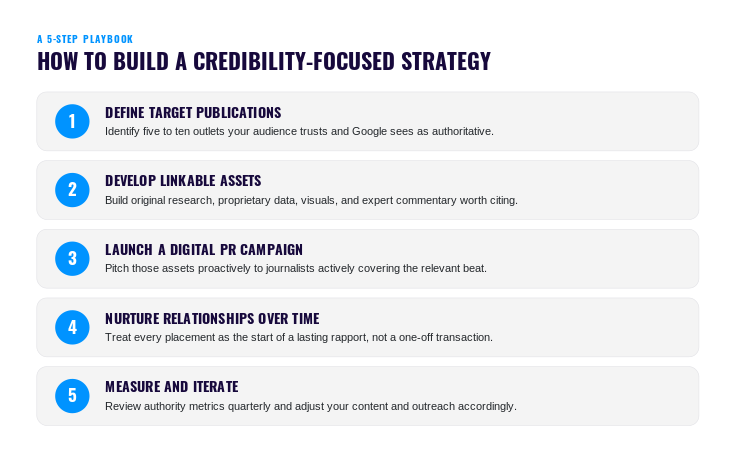
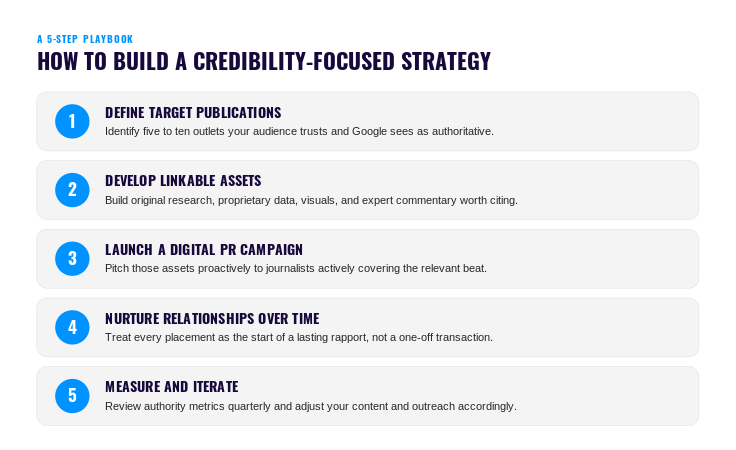
Build lasting brand authority in five steps: target trusted publications, create citation-worthy assets, launch digital PR, nurture journalist relationships, then measure and refine your approach.
Data-led PR campaigns: We begin with what journalists and their readers care about, not simply what we find interesting. We review local news, Google News, and current coverage to understand which subjects are gaining attention. By considering journalist intent from the start, we improve our chances of receiving responses and earning placements.
Newsjacking or reactive PR: When we can move quickly, we contribute expert opinions, data, or commentary to breaking stories that relate to our brand. This gives journalists material they can use while the topic is still timely.
Proactive PR: We anticipate trends before they break and prepare insights around recurring news cycles, holidays, and other relevant media moments.
Contributed content and guest features: We place useful content written by our experts in relevant publications, allowing us to speak directly to established audiences and earn recognition.
When we combine these tactics effectively, we can elevate our brand to a level that competitors cannot reproduce with a batch of low-value links.
We build relationships with journalists and publishers
We know that even fascinating proprietary data, packaged in an expertly designed analysis, can fail if our journalist outreach is poorly targeted.
Journalists receive an enormous number of PR pitches, and those messages can either support or obstruct their work. According to a 2026 Muck Rack study, nearly nine in 10 journalists said at least some of their stories originated with PR pitches.
The same survey found that 54% of journalists seldom or never responded to most pitches. Relevance was a central problem: nearly half said a genuinely relevant pitch was rare.
If we send a journalist at an economics publication a pitch about music-listening habits, we should expect a rejection because the subject may matter to only a small part of that publication’s audience. We do not take that response personally. Journalists build their careers around particular topics and beats, and our job is to support that work rather than distract from it.
We therefore approach outreach as relationship building: a two-way exchange that should benefit everyone involved. Above all, we remember that there is a real person on the other side of every email.
We personalize our emails and explain why a story fits the journalist’s audience.
We respond graciously when a journalist says no because our next idea may be a better fit.
We share relevant work from journalists and publications through social media.
We contribute thoughtful comments when we have something useful to add.
We cite journalists’ reporting in future content when it genuinely supports our work.
As we strengthen these relationships, journalists become more likely to consider future opportunities. A thoughtful follow-up or second pitch can receive a warmer response when a reporter already knows that we provide reliable data and useful commentary.
PR relationships grow over time. Even when our first pitch does not fit a journalist’s beat, we remain willing to return with a better story or a new set of relevant data.
How we measure real brand authority
We recognize that authority, trust, and legitimacy feel less concrete than traffic or keyword position. Yet they have become more important. A traffic surge may look encouraging while reflecting temporary attention, weak intent, or an advantage that disappears after an algorithm update.
Authority and legitimacy are more durable. We can also measure the impact of credibility-focused work through several meaningful indicators.
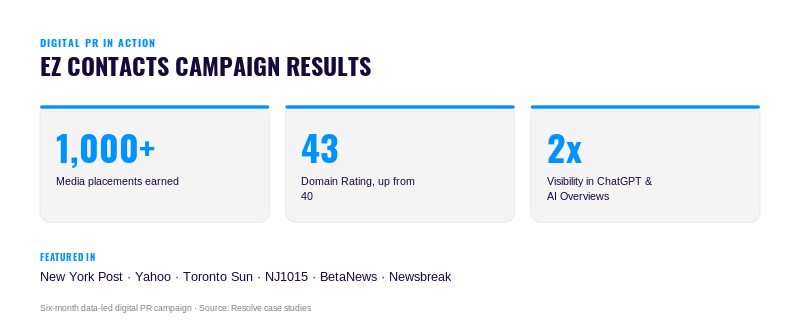
EZ Contacts’ six-month digital PR campaign delivered 1,000+ media placements, raised Domain Rating from 40 to 43, and doubled visibility across ChatGPT and Google AI Overviews.
Earned media placements: We track the publications that cover our brand, including coverage containing an unlinked mention. These placements help us assess brand credibility.
Branded search volume: We monitor whether more people search for our company or products after discovering us through media coverage.
Industry coverage: We look for the point at which publications we have not contacted begin citing our work. That organic pickup is a valuable sign that our authority is spreading.
Conversions: We measure whether greater credibility leads more people to trust our organization, products, or services and ultimately take meaningful action.
Organic ranking improvements for target keywords: We still review rankings, but we treat them as one indicator within a broader picture. Sustained movement can show that search engines increasingly view us as a credible result relative to competing pages.
We do not expect these indicators to appear overnight.
We invest real effort in creating proprietary data.
We build trust with journalists through repeated, useful interactions.
We grow authority through sustained work over time.
Our advice is simple: we stay patient, keep improving, and allow credible results to compound.
How we build a credibility-focused link strategy
Knowing the principles of SEO authority is one thing; building an entire campaign around them is another. We use the following five-step process to turn those principles into consistent action.
Step 1 — We define our target publications: We identify five to 10 publications that our audience trusts and that search engines are likely to recognize as authoritative within our field. These become our priority coverage targets.
Step 2 — We develop linkable assets: We create at least two content or media assets designed around the interests of those publications. We may use original survey data, visual guides, proprietary analysis, or expert thought leadership.
Step 3 — We launch a digital PR campaign: We proactively pitch our assets to relevant publications. We can also use platforms such as Connectively or Muck Rack to identify ongoing opportunities with writers covering subjects related to our research.
Step 4 — We nurture relationships: We treat every positive media interaction as the beginning of a longer relationship. We follow up with useful information, engage with published coverage, and build the kind of rapport a journalist can rely on.
Step 5 — We measure and iterate: We review our authority indicators each quarter, learn from the response to our campaigns, and adjust our content and outreach accordingly.
We know this process can consume a team’s time, particularly when resources or specialized expertise are limited.
In those situations, we may benefit from working with a link-building and digital PR specialist who can expand our capacity and keep pace with search changes. The right support can help us establish sustainable visibility without allowing every minor ranking fluctuation to pull us off course.
How we build authority that lasts at Resolve
We know that quality usually stands the test of time better than quantity. The difficult part is maintaining that focus when competitors appear to be winning with sudden traffic spikes or eye-catching vanity metrics.
We do not let temporary numbers distract us from the larger goal. We focus on lasting authority and legitimacy earned through sustained content creation, thoughtful PR outreach, and genuine relationship building.
When an internal team lacks the time or patience required to maintain that effort, we can step in.
At Resolve, we work with brands to build credibility-focused SEO campaigns through linkable content, data-led digital PR, and hands-on link building. Our goal is sustainable organic growth, not a burst of visibility that disappears after the next algorithm update.
We have seen this approach pay off. In a recent data-led campaign for EZ Contacts, we earned more than 1,000 placements in outlets including the New York Post and Yahoo. As the coverage grew, the brand’s visibility in ChatGPT and Google’s AI Overviews doubled. That is the kind of durable growth we want to build — growth that extends beyond the next algorithm update.
A bold Google logo sits atop layered, colorful digital documents, evoking the fast-moving world of search marketing, ad formats, campaign assets, and platform updates.
When we are ready to build links that last, we can visit growresolve.com to learn more.
Our answers to common link-building questions
How do we distinguish link building from digital PR?
We see considerable overlap between link building and digital PR, but we do not treat them as identical. Link building is the broader practice of acquiring backlinks from other websites to improve search authority. Digital PR is a particular approach within that practice, focused on earning links through media coverage, journalist relationships, and placements in credible publications rather than relying on directory submissions, guest-post exchanges, or other lower-authority tactics.
We often use digital PR to pursue the strongest editorial backlinks because reputable outlets have real audiences and established review standards. At the same time, this work builds brand visibility and consumer trust in ways that many conventional link-building methods do not.
How long do we wait for meaningful results?
We do not expect authoritative backlinks or earned media coverage to produce results overnight. That is an honest trade-off when we choose a credibility-focused approach instead of more aggressive tactics. Most brands can begin seeing meaningful domain-authority gains and early ranking movement after three to six months of consistent execution, while highly competitive keywords and top-tier placements may require more time.
The advantage is that our results can compound. Links from credible publications tend to endure, strong journalist relationships can create repeat opportunities, and the authority generated through consistent coverage can keep delivering value long after the initial campaign.
What do we mean by an authority backlink?
We define an authority backlink as a link from a source that search engines and its audience regard as credible and trustworthy. These sources typically have genuine readers, clear editorial processes, established authority, and topical relevance to our industry.
A regular backlink can come from any website willing to link to us, regardless of its relevance, quality, or editorial standards. That distinction matters because search engines do not evaluate every link equally. One editorial link from a respected industry publication can be more valuable than dozens of links from low-authority sites, while also supporting the kind of E-E-A-T credibility that bulk link acquisition cannot reproduce.
Do we value brand mentions without hyperlinks?
Yes. We recognize that Google can associate brand mentions with entities even when a publication does not include a hyperlink. Relevant, unlinked mentions in credible coverage can still contribute to the wider authority signals surrounding our brand.
That is why we consider digital PR valuable even when every placement does not produce a direct link. A credibility-focused off-page strategy should not be reduced to backlink acquisition alone. Our larger objective is to build a brand that respected publications genuinely want to mention, cite, and cover.
What risks do we face with outdated link-building tactics?
We see risks ranging from wasted effort to serious search penalties. Link buying, reciprocal-link schemes, private blog networks, and manipulative anchor-text optimization can violate Google’s spam policies. These tactics may trigger manual actions or algorithmic suppression that substantially reduces our search visibility.
Even when outdated tactics do not produce an immediate penalty, they can lose their value as search systems become better at identifying manufactured signals. Recovering from a link-related penalty can be slow and expensive. We would rather invest in credible link building from the beginning than repair the damage caused by shortcuts later.
Evidence-led SEO connects three questions that are too often handled separately: What is happening in search performance, what might explain it, and why should the business act? Google Search Console data can reveal demand and performance patterns, while official documentation can clarify the search requirements behind a recommendation.
AI can shorten the journey from raw data to a plausible opportunity, but it does not turn a hypothesis into proof. A reliable strategy keeps observed data, machine-assisted interpretation, documented guidance, and business judgment distinct until they are assembled into a decision.
Build an evidence chain instead of citing a best practice
The two source articles address different weaknesses in SEO decision-making. The Search Console analysis article describes using AI to detect patterns across large query exports. The documentation article explains how official Google references can make technical recommendations easier to defend with developers, clients, and other stakeholders.
Together, they suggest an evidence chain with four layers. Each layer answers a different question, and none should be asked to do the work of all the others.
Evidence layer
Question it answers
Proper role
Search Console data
What happened in organic search?
Establish observed queries, pages, impressions, clicks, rankings, and click-through patterns.
AI-assisted analysis
What patterns or hypotheses deserve attention?
Classify, cluster, compare, and organize large datasets for human review.
Official documentation
What behavior or implementation does Google describe?
Support the technical rationale and create a shared external reference point.
Business context
Why should this action be prioritized?
Connect the recommendation to likely value, risk, effort, and competing priorities.
This separation matters. Search Console can show that a page receives comparison-oriented impressions, but it cannot by itself establish why the page underperforms. AI can propose explanations, but its output remains analysis rather than observed fact. Documentation may support a technical requirement, but it does not establish the commercial value of fixing a particular page. The final recommendation becomes credible only when the layers are connected without being conflated.
Turn query data into a prioritized opportunity
The Search Console source reports a workflow that begins by narrowing query data with regular expressions and then exporting the result for AI-assisted classification. Its examples include question-led searches, comparison terms, emerging terminology, and signals related to pricing, alternatives, implementation, migration, or vendor evaluation.
The strategic value is not the regular expression itself. Filtering reduces a large dataset to a decision-shaped subset. AI can then group related queries by intent or theme, revealing patterns that would be difficult to recognize one row at a time.
Start with a decision. Define the question before exporting data, such as whether an existing educational page is attracting evaluation-stage searches.
Isolate the relevant observations. Filter for patterns connected to that question, then retain the associated performance fields and landing pages.
Ask AI for structured analysis. Request categories, themes, confidence assessments, and ambiguous cases rather than an unqualified verdict.
Inspect the underlying rows. Check whether the proposed cluster is coherent and whether a few high-volume queries are distorting the interpretation.
Map the pattern to a page-level action. Decide whether the evidence supports updating an existing page, creating a focused asset, improving internal links, or changing the path to the next step.
Define a measurement plan. Record the affected query set, page, intended outcome, and comparison method before implementation.
This approach also changes how content opportunities are framed. The source notes that clusters of audience questions can inform FAQs, support material, sales resources, and content intended to provide direct answers. It also reports that apparently informational traffic can contain evaluation signals. In those cases, improving the page that already earns visibility may be more appropriate than automatically publishing another article.
Use AI to accelerate analysis, not manufacture certainty
AI is most useful when the assignment is bounded and auditable. Suitable tasks include generating a proposed Search Console regex, classifying query intent, clustering questions, identifying changes in terminology, and suggesting content formats. The Search Console source describes prompts that request CSV classifications with confidence scores or group queries into definitions, tutorials, comparisons, and expert recommendations.
Those outputs should be treated as provisional labels. Intent can be mixed, a query can fit several themes, and an apparent trend can reflect the selected date range, page set, or filter. A defensible workflow therefore preserves the original export and maintains a visible connection between each conclusion and the rows supporting it.
A practical review should test:
Whether the filter matches the intended language without excluding obvious variants.
Whether classifications are supported by the wording of the queries and their landing pages.
Whether the opportunity is broad-based or driven by a small number of observations.
Whether the recommended content format fits the likely task behind the query.
Whether the proposed action follows from the evidence or merely sounds plausible.
This distinction is especially important for queries that may produce AI-generated search features. The source describes using informational and comparison patterns as an approximation for searches likely to trigger AI Overviews because Search Console does not provide the filter needed for that analysis. That is a useful hypothesis-building method, but the approximation should not be reported as confirmed feature exposure.
Translate the opportunity into a defensible recommendation
Finding an opportunity does not guarantee that it will reach a development sprint or content roadmap. The documentation source emphasizes that SEO work competes with product schedules, CMS constraints, legal concerns, brand requirements, technical debt, security, and other business priorities. Its central argument is that an official reference can move a discussion beyond personal preference, even though it cannot determine priority on its own.
The same source cautions that Google documentation is incomplete and simplified for a broad audience. It should therefore serve as a starting reference, not an infallible account of every ranking mechanism or edge case. The article identifies canonicalization, robots.txt behavior, JavaScript rendering, discoverable internal links, structured-data eligibility, and HTTP status codes as areas where documented guidance can clarify implementation discussions.
A strong recommendation package can combine both sources’ methods:
Observation: State the Search Console pattern without interpretation.
Hypothesis: Explain the likely missed intent, content gap, or technical obstacle, and identify AI’s role if it helped generate the hypothesis.
Documentation: Link to the relevant official guidance and explain precisely how it applies to the current implementation.
Recommendation: Describe the requested change in terms that content, engineering, or product teams can evaluate.
Expected value and risk: Connect the change to the observed opportunity while avoiding unsupported forecasts.
Validation: Specify what will be monitored after release and what result would challenge the original hypothesis.
This format also improves collaboration. Developers can evaluate how to satisfy a documented search requirement within the site’s technical constraints. Content teams can see which audience behavior supports an update. Decision-makers can compare the opportunity with other work instead of being asked to accept an unexplained SEO rule.
Key takeaways
Search Console establishes observed performance; AI helps organize it into hypotheses and possible actions.
Query filtering should begin with a decision question, not an open-ended search for anything interesting.
AI classifications, clusters, and trend signals require review against the original query and landing-page data.
Official Google documentation can support the technical rationale, but it does not replace experience, testing, or business prioritization.
The most defensible SEO proposal connects observation, hypothesis, documentation, action, value, and validation.
As search interfaces and audience language continue to change, the durable advantage will come from shortening the path between evidence and action while keeping every inference inspectable. Teams that preserve that discipline can use AI for speed without surrendering accountability.
A revenue-focused SEO strategy starts with a different decision: organic visibility is a means, not the outcome. Rankings and traffic remain useful indicators, but priorities should ultimately reflect the sales, margins and profit that search can influence.
The practical payoff is a more defensible investment plan. By combining search demand with commercial value, an SEO team can identify which pages deserve attention, sequence work around likely business impact and explain its choices in terms leadership can compare with other acquisition channels.
Key takeaways
Treat rankings and organic sessions as diagnostic signals rather than final business outcomes.
Evaluate search demand alongside margins, average order values and existing organic performance.
Prioritize commercially valuable pages that are decaying or already close to stronger visibility.
Use paid-search conversion data to compensate for organic search’s limited query-level conversion reporting.
Connect content, internal links and digital PR to the commercial page clusters they are intended to support.
Build the strategy from the business model backward
Traditional keyword research begins with the search market: query volume, ranking difficulty, current positions and estimated traffic. The supplied Search Engine Land article argues that these demand-side measures reveal where an audience exists but not where that audience is most valuable to the business.
A commercial planning process therefore needs a second layer. Margin by category, transaction value and the long-term profitability of customer segments can materially change which opportunities deserve investment. A lower-volume category may be more attractive than a popular one when each resulting sale contributes more profit.
Planning question
Demand-side evidence
Value-side evidence
Where is there an addressable search audience?
Search volume, intent and ranking difficulty
Not sufficient on its own
Which area matters most to the business?
Current organic visibility and traffic potential
Margin, transaction value and customer profitability
Where could SEO produce a meaningful result?
Ranking position and competitive gap
Potential sales, revenue and profit contribution
This framing does not make keyword data less important. It changes its role. Demand establishes whether an opportunity exists; commercial evidence determines how much that opportunity should matter.
Use a commercial scorecard without inventing false precision
The article identifies organic sales, revenue, profit, average order value, average margin per sale and channel return on investment as useful financial measures. Obtaining them generally requires analytics data to be connected with transactional records. Channel costs also need to be captured if the organization wants a meaningful view of return rather than revenue alone.
One especially useful measure in the source is organic profit per sale, calculated as organic profit divided by organic sales. It shows the average profit contribution associated with each organic transaction. Broken down by category, subcategory or landing page, it can reveal that two similarly sized traffic opportunities have very different economic consequences.
These figures should guide prioritization without being presented as more certain than the underlying attribution allows. Organic search can assist a purchase that is eventually credited elsewhere, while branded demand may reflect earlier marketing activity. The scorecard is therefore best used as a consistent decision framework, not as a claim that every sale has one perfectly identifiable cause.
A workable prioritization sequence is:
Identify categories, products or services with attractive margins or transaction values.
Measure relevant search demand and classify the intent behind it.
Review current rankings, page performance and the competitive gap.
Estimate the commercial role of improving each page, using available sales and profit data.
Rank initiatives by the combined strength of business value, demand and realistic opportunity.
The process does not require an elaborate universal formula. A transparent qualitative score can be more useful than a highly precise number built on weak assumptions. What matters is that the same commercial questions are applied across competing SEO initiatives.
Organize execution around defend, capture and compound
Once commercially important areas are known, SEO tactics can be organized by the job they perform. This prevents content production, technical work, link acquisition and conversion improvements from becoming disconnected activity streams.
Defend revenue-bearing pages
Commercial pages can lose performance as competitors improve, result pages change and content becomes dated. The source consequently recommends reviewing valuable existing pages before defaulting to new production. Useful interventions include finding competitive content gaps, restructuring information into readily extractable formats such as tables where appropriate, reviewing drafts against competing pages and strengthening internal links.
This is a defensive revenue task as much as a content task. A modest recovery on a page with proven transactions may be more consequential than publishing an informational article with a much larger theoretical audience.
Capture opportunities near meaningful visibility
The article highlights transactional terms ranking in positions 10 through 20. These queries are already associated with pages that search engines consider relevant, yet their visibility may be too limited to produce substantial traffic. Filtering that group by commercial intent and business potential creates a more focused recovery list than treating every near-Page 1 keyword equally.
Content improvements, internal links and relevant authority building can then be directed at the pages with both a plausible ranking opportunity and a valuable destination. The principle is broader than any fixed position range: closeness to visibility matters only when the underlying query and page can contribute to the business.
Compound authority around commercial clusters
Informational content still has a role because a strategy restricted to transactional queries eventually runs out of room. Its purpose should be explicit: answer relevant audience questions, establish topical depth and pass users and internal authority toward appropriate commercial pages.
The same logic applies to digital PR. The supplied article favors campaigns that are thematically connected to priority product categories and use an on-site destination within a deliberate linking environment. That architecture gives earned attention a route to support commercially important clusters instead of leaving links isolated from the pages expected to generate returns.
Connect SEO decisions with paid-search intelligence
Organic reporting commonly provides landing-page conversion data without revealing exactly which query led to each purchase. The article proposes recent paid-search data as a practical source of conversion intelligence, with seasonality taken into account. It specifically suggests reviewing a recent 30- to 90-day window to identify keyword patterns associated with sales and valuable customers.
This evidence should inform, rather than mechanically dictate, organic priorities. Paid and organic results occupy different environments, and advertisement performance does not guarantee an equivalent SEO result. Even so, paid-search data can reveal commercially productive language, offers and landing-page themes that ordinary organic keyword tools cannot connect directly to transactions.
The resulting collaboration can work in both directions. Paid data helps SEO choose valuable queries and pages; organic landing-page performance can expose content and conversion lessons that benefit the broader acquisition program. Shared commercial definitions also make budget discussions less dependent on channel-specific metrics.
Make revenue accountability part of the operating rhythm
A commercially aware strategy needs reporting that follows the chain from work to outcome. Technical fixes, content changes and new links remain important, but they should be connected to changes in qualified visibility, landing-page behavior, transactions and profit where the available data permits.
That chain also improves diagnosis. If rankings rise without sales, the problem may involve intent, offer alignment or conversion performance. If revenue rises but profit does not, the strategy may be attracting low-margin orders. If a high-margin category has demand but little visibility, the case for targeted SEO investment becomes clearer. These interpretations are more useful than celebrating traffic growth in isolation.
The next stage for revenue-focused SEO is not the abandonment of technical excellence or audience-building content. It is the consistent connection of those capabilities to economic choices. Teams that establish that connection can direct their next unit of effort toward the pages and markets most likely to matter.
When I work on a site built with a framework like Next.js, Nuxt, SvelteKit, or a similar JavaScript framework, I pay close attention to hydration. It is the step that turns server-rendered HTML into an interactive page, but it is often explained in a way that does not connect clearly to SEO.
I think hydration is easier to understand when I separate content from behavior. The content may already be visible, but the page may not be fully usable until the browser finishes connecting that content to the JavaScript behind it.
What I mean by hydration
Hydration is the process where JavaScript in the browser takes over the static HTML that was built on the server. The server sends a complete page first, and then the framework attaches the logic that makes buttons, menus, forms, filters, and other interactive pieces actually work.
Here is how I usually explain the sequence. First, the server builds the page and sends fully formed HTML to the browser. I can see the content quickly, but the page is not interactive yet. Then the framework loads, walks through the existing HTML, attaches event listeners, and reconnects the visible markup to the application logic. Once that is done, the page behaves like a normal interactive app.
This is why server-rendered HTML can feel fast at first. It can paint quickly and often helps with first impressions and Largest Contentful Paint (LCP). The tradeoff is that, with traditional hydration, the page may appear ready before it is actually usable.
Hydration adds interactivity, not content
The most important distinction I keep in mind is this: hydration does not add the main content to the page. The text, images, and layout should already be present in the server-rendered HTML. Hydration only adds behavior by wiring that HTML to the JavaScript that responds to clicks, typing, taps, and other user actions.
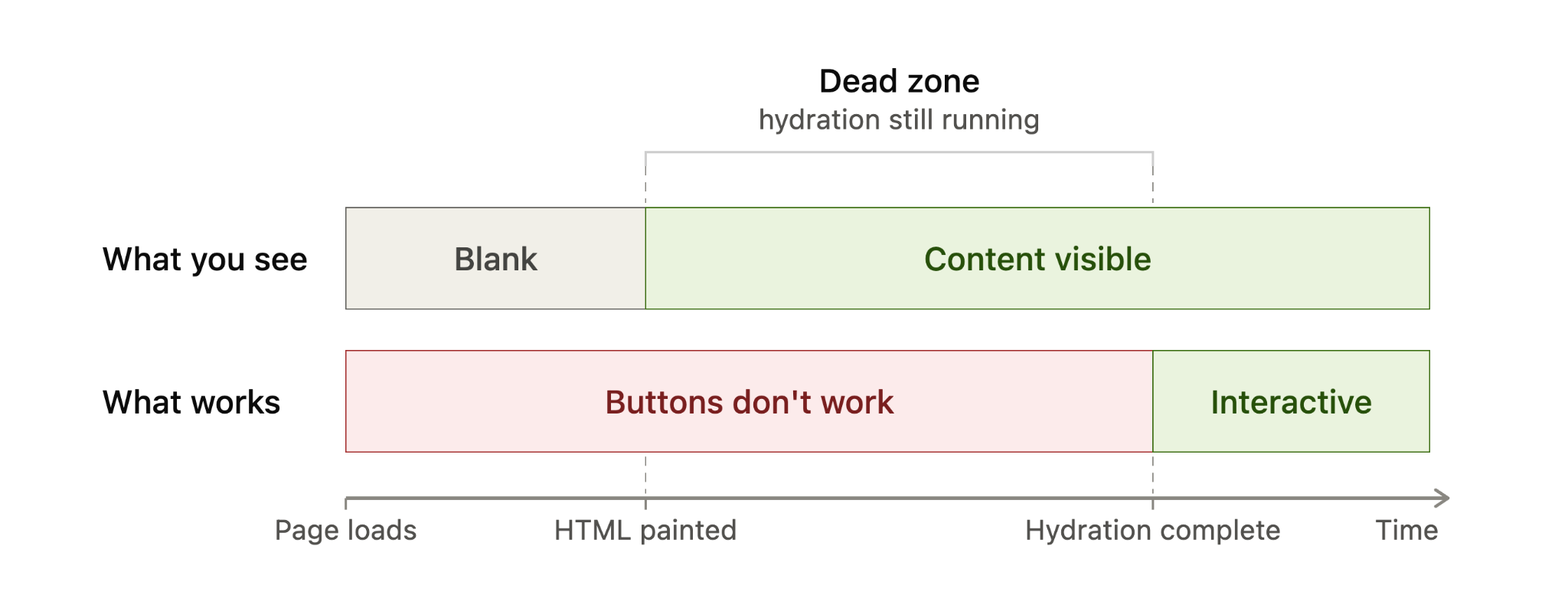
A hydration timeline shows the gap between content appearing and a page becoming usable: HTML is visible first, but buttons only work after hydration completes.
Put simply, before hydration I can read the page. After hydration, I can use it.
I also avoid confusing hydration with the rendering pattern itself. Server-side rendering (SSR), static site generation (SSG), and client-side rendering (CSR) describe where and when the page is built. Hydration describes what happens after server-rendered or statically generated HTML reaches the browser and needs to become interactive.
From an SEO perspective, that distinction matters. When a page uses SSR or SSG correctly, the core content is already in the initial HTML. Google can discover and index that content from the HTML before depending on a JavaScript render step, which is generally more reliable than sending a mostly empty client-rendered shell.
When I see hydration become an SEO problem
Most of the time, I do not treat hydration itself as an SEO problem. It becomes a problem when hydration breaks, usually because the HTML created on the server does not match what the framework expects to create in the browser.
That kind of mismatch can happen when content depends on browser-only APIs such as localStorage, when a value changes between server and client rendering such as new Date(), when a third-party script or browser extension changes the DOM before hydration finishes, or when invalid HTML causes the browser to rewrite the structure before the framework can attach to it.
Before hydration, a server-rendered page can be read but not used; after hydration, JavaScript adds behavior so elements like the Subscribe button respond.
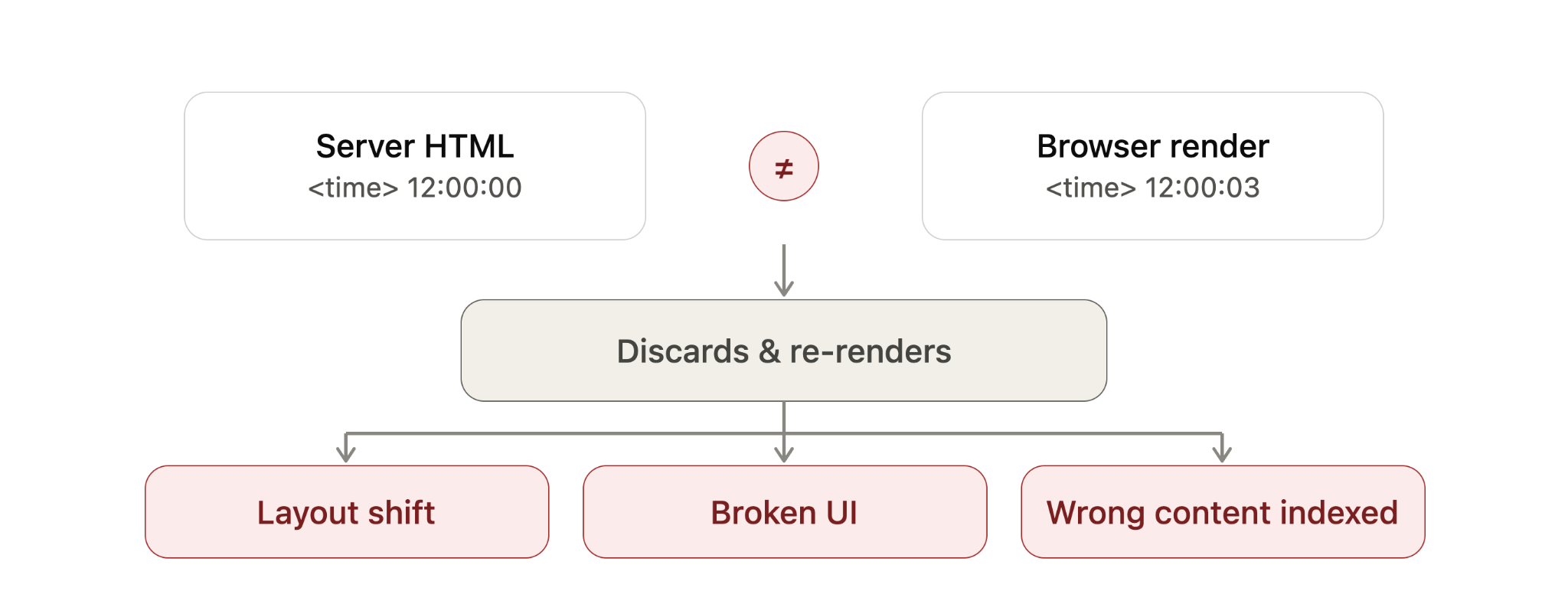
When the two versions do not line up, the framework may throw away the mismatched section and re-render it in the browser. The exact behavior depends on the framework, but the SEO and performance risks are similar.
For example, if a <time> value is generated with new Date(), the server may output one value while the browser generates another. That mismatch can force a re-render, even though the page appeared to load correctly at first.
I worry about this because it can hurt the page in several ways. A re-render can make the page feel sluggish, which can affect Interaction to Next Paint (INP). It can shift the layout, which can affect Cumulative Layout Shift (CLS). It can also break user actions if event listeners fail to attach properly, leaving buttons, menus, or forms unresponsive.
In severe cases, Google may read the raw server HTML before JavaScript finishes rendering and then index content that visitors never actually see after the page re-renders. That is the scenario I want to avoid most: search engines and users experiencing different versions of the same page.
The fix is usually not an SEO trick. It is a development fix. I want the underlying mismatch removed by using valid HTML, avoiding browser-only logic during server rendering, stabilizing values that change between server and client, and controlling third-party scripts that alter the DOM too early.
When server HTML and browser-rendered content disagree, hydration may discard and rebuild the page, creating layout shifts, broken UI and potential SEO indexing problems.
How I spot hydration problems on a live site
Hydration errors are usually easier to catch in development than on a live site, but I still look for a few practical signals. I start with the browser’s Developer Tools console and check for hydration warnings, JavaScript errors, or framework-specific mismatch messages.
Then I watch the page load carefully. If content flickers, shifts, disappears, reappears, or stays unresponsive for longer than expected, I treat that as a sign worth investigating.
I also use Google Search Console’s URL Inspection tool on important templates to see how Google renders the page. For larger sites, I prefer crawling with JavaScript rendering enabled in tools like Screaming Frog or Sitebulb so I can compare rendered output against raw HTML at scale.
How I think about different hydration approaches
Modern frameworks handle hydration in different ways, and I think of those differences as a balance between performance, interactivity, and how much JavaScript must run in the browser.
Full hydration means the entire page hydrates in one pass. It is straightforward, but it usually ships the most JavaScript and asks the browser to do the most main-thread work. Next.js Pages Router is a common example of this model.
A glowing Google search bar cuts through streams of digital data, capturing the fast-moving world of search, shopping visibility, and SEO innovation.
Partial hydration hydrates only the interactive pieces, often called islands. Static sections remain plain HTML and do not need client-side JavaScript. Astro’s islands architecture is a well-known example of this approach.
Progressive hydration hydrates the page in pieces over time. A framework may hydrate sections as they scroll into view or as browser resources become available. Angular’s incremental hydration follows this general pattern.
React Server Components take a different path by letting some components render entirely on the server and ship no client-side JavaScript for those server-only parts. In those cases, there is nothing for the browser to hydrate for that portion of the page. Next.js App Router uses this model.
Resumability goes further by trying to skip hydration entirely. Instead of re-running components on load, the page resumes from the state the server already produced. Qwik is the main example here, although I still view it as newer and less battle-tested than some of the older patterns.
When I compare these techniques, I look at what hydrates, how much JavaScript ships, and how much work the browser must do. Full hydration touches the entire page and usually ships the most JavaScript. Partial hydration touches only interactive components and ships less. Progressive hydration spreads the work over time. React Server Components reduce hydration for server-only parts. Resumability aims to avoid hydration altogether.
What this means for my SEO work
I do not assume hydration is bad for SEO. In most cases, it is simply part of how modern server-rendered and statically generated sites become interactive.
What I do watch closely is whether the server HTML and the browser-rendered version agree. If they do, hydration is usually a performance and user experience consideration. If they do not, hydration can become a visibility problem, especially when Google indexes a version of the page that users never see.
Newer frameworks reduce some of this risk by shipping less JavaScript and doing less work in the browser, but they do not remove the need for careful implementation. For me, the practical takeaway is simple: make sure the important content is present in the initial HTML, keep server and client output consistent, and test how search engines actually render the page.
I use Conductor’s MCP Server to ground the AI tools my team already relies on in verified AEO and SEO intelligence, instead of depending on a stale snapshot of the web.
A bold launch visual introduces an AEO and SEO Intelligence Layer, framing verified search and AI visibility data as a modern layer for marketing teams.
[Boston, MA, July 6, 2026] — I am sharing that Traffic Think Tank has officially joined the Search Engine Land family, creating more opportunities for search marketers like us to connect, collaborate, and keep learning through one of the industry’s most established professional communities.
I want members to know that Traffic Think Tank will continue operating as a private Slack community. It will remain a trusted place where we can exchange ideas, validate strategies, solve real marketing challenges, and stay current on search engine optimization, paid media, artificial intelligence, and related marketing topics.
As part of this relationship, I see Search Engine Land supporting the community’s continued growth by increasing visibility across its editorial and marketing channels while preserving the collaborative environment members already value.
“For years, Search Engine Land has represented the marketing community through its contributor network in a way few other sites have,” said Kyle Morley, Head of Sales and Marketing at Third Door Media, parent to Search Engine Land. “Launching a community like Traffic Think Tank feels like a natural extension of our identity, and I’m thrilled we now have more opportunity to connect with marketers in our space.”
I am also noting that David Broderick has been appointed Lead Community Manager and will oversee the day-to-day community experience. He will be supported by Liz Dougherty, who will take an active role in encouraging member engagement and helping guide the community’s continued growth.
Beyond ongoing peer-to-peer discussions, I expect members to benefit from expanded community programming and discussions, increased visibility through Search Engine Land and Third Door Media channels, exclusive discounts on Search Marketing Expo events and training, and new opportunities to connect with search marketers across the industry.
For me, Traffic Think Tank fits naturally with Search Engine Land’s mission of helping marketers stay informed and succeed in a rapidly evolving search landscape. Together, the publication and community give us access to trusted journalism, practical education, live events, and an active peer network for ongoing professional development.
Old search marketing tools give way to a faster, connected future, with data streams, AI icons, and a glowing search hub symbolizing SEO innovation and community growth.
I view Search Engine Land as a leading publication for news, insights, and education covering search engine optimization, paid media, artificial intelligence, and digital marketing. Through editorial coverage, events, training, and professional resources, Search Engine Land helps marketers stay ahead of industry change.
About Traffic Think Tank
I see Traffic Think Tank as a private community for search marketers that connects professionals through expert discussions, peer collaboration, and practical knowledge sharing. Members use the community to exchange ideas, solve challenges, validate strategies, and stay current on what’s working across search engine optimization, paid media, and artificial intelligence.
I’m tracking a growing Google Business Profile issue after several days of complaints from businesses that say reviews have disappeared from their local listings. Google has now confirmed that it is investigating the reports, and in some cases, review submissions on affected profiles appear to be paused.
What Google said. Google told us that when its systems detect suspicious review activity, it may take several actions, including removing reviews and temporarily pausing reviews on a profile to prevent further abuse. Google also said it is investigating the issue and will restore any reviews that were incorrectly removed.
What I’m seeing. As I documented on the Search Engine Roundtable, there are dozens of complaints in the Google Business Profile Forums from business owners and local SEOs who say their reviews have mysteriously vanished. In some cases, businesses are also unable to receive new reviews on their local listings.
From what I can tell, Google’s review spam detection systems may be identifying certain patterns and aggressively removing or blocking reviews on suspected Google Business Profiles. What remains unclear is whether this is tied to spammers abusing some profiles, a recent algorithmic adjustment, or Google’s systems becoming overly sensitive.
More details. Amy Toman, a volunteer Google Product Expert for Google Business Profiles, shared on LinkedIn that businesses or clients affected by this issue can post in the forum if they want to, but Google is already aware of the problem and working on it. She also noted that no timeline for a resolution has been provided yet.
She said she is seeing a new pattern where, after fake or spam reviews are reported, some Google listings receive a review block and all reviews are hidden. In at least one case, she said the rating was reduced to 0.
Why I care. If I noticed a sudden drop in reviews or stopped receiving new reviews this week, I would consider this issue a likely explanation. For local businesses, reviews can directly affect trust, visibility, and customer decisions, so even a temporary review disruption can be frustrating.
Google is investigating, and I’m watching to see whether missing reviews are restored and whether affected Google Business Profiles can begin receiving new reviews again.