If your SEO plan starts with keyword volume and ends with a page type, you can rank for the phrase and still miss the person behind it. Someone using AI search may supply a goal, constraints, prior attempts, and a desired outcome in one prompt. In other cases, the system may infer a goal from a sequence of actions rather than a neatly worded query.
Your strategy therefore needs to answer a harder question than What keyword should this page target? It needs to establish what the person is trying to accomplish, what would let them make progress, and which page or resource should support the next step.
Key takeaways
- Treat a keyword as evidence of intent, not a complete description of it.
- Map the searcher’s trigger, current state, constraints, decision, required evidence, and desired next action.
- Assign each page one dominant intent state, then link it to the next logical state in the journey.
- Write for both answer-seeking and task delegation by exposing criteria, limitations, requirements, and actionable steps.
- Build a consistent citation surface on your site and in the social spaces where your audience discusses the problem.
- Measure whether people move from uncertainty to a useful action, not only whether the page gains impressions or rankings.
What AI search intent changes
Traditional intent labels such as informational, commercial, navigational, and transactional remain useful. They tell you the broad kind of interaction a query may represent. They don’t tell you enough to design the answer.
Consider a search for AI SEO plugin for WordPress. The phrase might come from someone learning what these plugins do, building a shortlist, checking whether an existing workflow can support one, or looking for implementation instructions after choosing a product. All four people use similar language. They need different evidence and different next steps.
A workable intent model needs several layers:
- Literal request: What did the person explicitly ask for?
- Trigger: What happened that made the question relevant now?
- Current state: What does the person already know, have, or believe?
- Desired state: What would be different after a successful answer?
- Constraints: Which platform, budget, capability, policy, deadline, or compatibility requirement limits the options?
- Decision: What choice must the person make?
- Completion condition: What result would make the search feel finished?
- Next action: Does the person need to learn, compare, verify, configure, buy, troubleshoot, or hand off a task?
The distinction matters because intent can develop across an entire session. In work presented at EMNLP 2025, Google researchers separated intent extraction into two stages: summarizing individual interactions and then using the factual parts of those summaries to infer the overall goal. Preliminary guesses were discarded before the final intent statement was produced. That fact-first decomposition of session behavior reduced the risk of letting an early assumption distort the whole interpretation.
This was intent-extraction research, not confirmation of a Google Search ranking factor. Don’t turn it into an algorithm claim. Use it as a planning clue: a query may be only one observation in a longer path, and your own intent analysis should keep observed facts separate from marketer guesses.
Keywords still matter. They show you the language people use, expose recurring modifiers, and help you understand demand. Their role changes from being the strategy to being one input into the strategy.
AI-first interactions add another important distinction. Some sessions move beyond finding information into delegating a comparison, recommendation, or next action. A page that merely defines a term may satisfy an answer request while failing a prompt that asks a system to evaluate options under explicit constraints.
Map the goal before you choose the page

Start with behavior you can legitimately observe: query clusters, on-site searches, navigation paths, sales questions, support requests, community discussions, and comments. Don’t collect more personal data than your organization is entitled to use. You need patterns in the questions and transitions, not a dossier on an individual.
Then build the intent map in this order:
- Record the observation without interpretation. Write down the exact query, question, page transition, or objection. Keep inferred motives out of this field.
- Group observations by the job they imply. Synonyms can share a cluster when they lead to the same decision and action. Similar keywords should separate when they represent different stages or outcomes.
- Write a job statement. Use this template: When [trigger], the person wants to [decision or action] under [constraints] so that [desired outcome].
- Mark each element as known, supported, or assumed. If the constraint is only a guess, don’t build the whole page around it. Address plausible branches explicitly or gather better evidence.
- List the evidence needed to finish the job. This might include definitions, comparison criteria, compatibility requirements, limitations, examples, implementation steps, or proof for a factual claim.
- Choose the page’s role. Decide whether it should orient, compare, validate, implement, or troubleshoot. Avoid asking one URL to perform every role equally.
- Name the next state. Specify what a well-served reader should be ready to do after using the page.
For the hypothetical WordPress query, an intent brief could look like this:
Trigger: The person believes their existing SEO process doesn’t prepare content for AI-generated answers. Current state: They use WordPress but haven’t chosen an AI SEO tool. Decision: Which capabilities and controls should determine the shortlist? Constraints: Compatibility with the current publishing workflow and the ability to review changes before publication. Evidence needed: Clear capability boundaries, requirements, workflow details, and evaluation criteria. Next state: Compare qualified options or test the preferred approach.
This example is deliberately more precise than a label such as commercial intent. The label helps classify the query. The brief tells a writer what the page must accomplish.
Use the map to make URL decisions as well. One page can serve many keyword variants when those variants represent the same job. Split the content when the reader’s decision, evidence requirement, or next action materially changes. This keeps you from creating a separate thin page for every phrasing while also preventing one broad page from burying several incompatible intents.
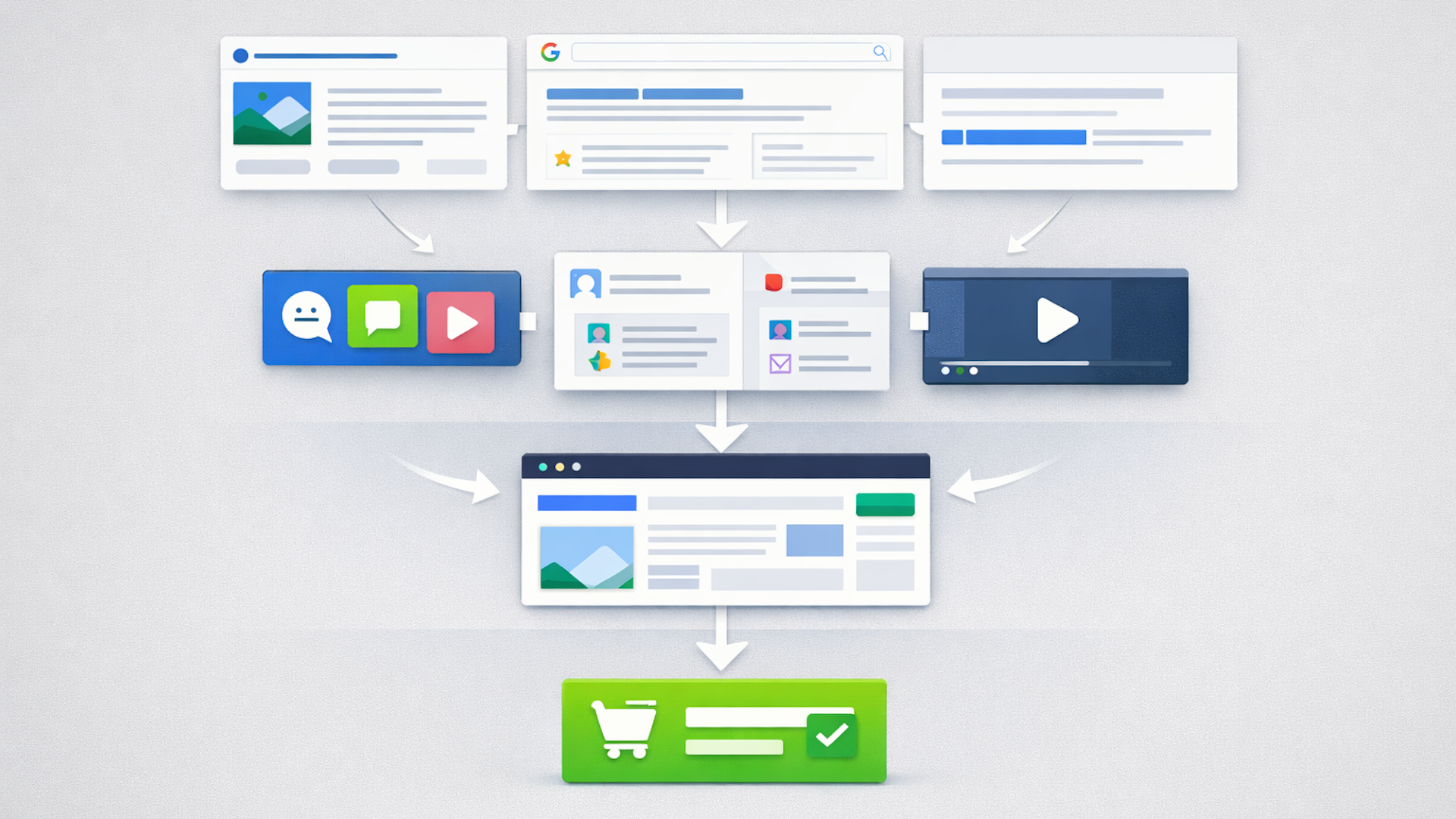
A practical content architecture often follows an intent sequence such as orient, compare, validate, implement, and troubleshoot. You don’t need a page for every stage in every topic. You do need an intentional route between the stages you support. Internal links should name the next decision clearly; vague calls to read more leave both people and retrieval systems to infer the relationship.
Build pages that answer questions and support action
An AI-search-ready page has two jobs. It must contain an answer that can stand on its own, and it must provide enough context for that answer to be applied correctly. Concision without qualification produces brittle answers. Exhaustive context without a clear answer makes the useful part difficult to retrieve.
Give each answer a complete evidence unit
For every important question, assemble a compact unit with four parts:
- Claim: State the answer directly and name the entity or concept involved.
- Qualification: Say when the answer applies and where it stops applying.
- Support: Provide the relevant evidence, reasoning, example, or primary reference.
- Action: Tell the reader what to check or do next.
Put that unit under a heading that names the actual decision. When this approach fits is more useful than Benefits. Requirements before implementation is more useful than Getting started. The heading should still make sense when separated from the page title.
Be explicit with nouns. If several tools, plans, standards, or organizations appear on the page, repeated pronouns create avoidable ambiguity. Name the subject again when the relationship could otherwise be misread. Clear entity relationships help a reader scan the page and make individual passages easier to reuse accurately.
Expose the inputs needed for delegation
A person asking for a definition needs an answer. A person delegating a task needs decision inputs. If your page may inform a comparison, recommendation, configuration, or purchase, include the information required to make that task safe and bounded:
- Who or what the option is for.
- The problem it addresses and the outcome it does not promise.
- Prerequisites, dependencies, and compatibility constraints.
- Selection criteria and meaningful tradeoffs.
- What information must be supplied before action can begin.
- The sequence of implementation steps.
- Conditions that should stop or redirect the process.
- The expected next checkpoint or verifiable result.
This information should appear in visible page copy. Structured data can describe the entities, properties, and relationships that are genuinely present, but it can’t repair an incomplete explanation. Use the most specific valid schema that matches the visible content, and don’t add claims to JSON-LD that a reader cannot verify on the page.
Design the route after the answer
A successful answer often creates the next question. A comparison may lead to validation. Validation may lead to setup. Setup may lead to troubleshooting. Decide which transition your page owns, then make it explicit in the closing section and relevant internal links.
Don’t force the same call to action onto every intent. Someone still defining the problem may need a diagnostic checklist. Someone validating a shortlist may need requirements and limitations. Someone implementing a decision needs exact steps. Matching the action to the current state is more useful than treating every visit as an immediate conversion opportunity.
Before publishing, run an intent-resolution review. Ask whether the page answers the primary question before branching, distinguishes facts from assumptions, states the important constraints, gives the reader adequate evidence, and points to a logical next state. If the page can’t pass that review, adding more related keywords won’t solve its central problem.
Extend your citation surface beyond your own site

Your website is the canonical place to maintain a complete explanation, but it isn’t the only place where an AI system may encounter the topic. Social platforms have become more prominent in the AI citation graph, with that pattern examined across 6.1 million citations. That is a reason to include relevant social spaces in your visibility strategy. It is not proof that every platform matters equally, that engagement is a direct ranking factor, or that frequent posting causes citations.
Treat social participation as an extension of intent research and evidence distribution:
- Publish the canonical answer on your site. Give it the complete reasoning, qualifications, supporting evidence, and next steps.
- Choose communities by question fit. Use the places where your intended audience already asks the specific comparison, implementation, or troubleshooting question. Platform popularity alone is not a useful selection rule.
- Publish a native, self-contained contribution. Answer the immediate question on the platform instead of dropping an unexplained link. Point to the canonical page when the reader needs the complete evidence or process.
- Respond to objections and corrections. A disagreement can expose a missing constraint, ambiguous term, or unsupported assumption in the original page.
- Feed recurring questions back into the content. Update the relevant answer unit rather than attaching an ever-growing miscellaneous FAQ to every page.
- Keep the entity consistent. Use the same organization or product name, canonical URL, category, and defensible core description across owned profiles and pages.
A brand-owned social post remains a brand claim. It can clarify your position and make the material discoverable, but it doesn’t become independent validation because it appears on another domain. Keep first-party claims labeled, link to underlying evidence where available, and avoid manufacturing apparent consensus through repetitive promotional posts.
Community language is especially useful for intent mapping. People often state constraints, failed attempts, and objections more plainly in a discussion than in a short search query. Record those observations, but don’t assume that the most vocal comment represents the entire audience. Use recurring patterns to form hypotheses, then test them against other first-party signals.
Measure whether the content resolves intent
Rankings, impressions, and clicks tell you whether a page was exposed and selected. They don’t establish that it helped the person finish the job. Add a second measurement layer that follows movement from the current state to the intended next state.
| Question | Evidence to inspect | What to change |
|---|---|---|
| Did the intended audience reach the page? | Query or prompt themes, landing pages, on-site search terms, and the questions recorded by customer-facing teams | Adjust targeting or the page’s opening if the observed need doesn’t match the intended job |
| Did the page address the main uncertainty? | Use of comparison criteria, requirement sections, supporting references, and recurring reformulations of the same question | Move the direct answer earlier, define ambiguous terms, or add the missing qualification |
| Did the reader move to the next state? | Transitions to validation, comparison, implementation, troubleshooting, or another outcome that fits the intent | Strengthen the internal path and make the next action more specific |
| Is the answer being reused or cited? | Identifiable AI referrals, linked and unlinked mentions, citations, social discussions, and branded follow-up searches where available | Improve the evidence unit and distribute it in the communities that discuss that exact question |
| Where did the intent model fail? | Unexpected on-site searches, repeated support questions, community objections, and visits to content built for a different stage | Correct the job statement, split incompatible intents, or create the missing bridge between stages |
No single proxy proves satisfaction. A visit to an implementation page may indicate progress, curiosity, or confusion. An exit may mean the answer worked or that it failed. Read several signals together, and distinguish an observed transition from your explanation of why it happened.
Maintain a simple intent scorecard for each important cluster. Record the job statement, target page, evidence requirement, intended next state, observable outcome, unresolved questions, and material content or distribution changes. This gives SEO, content, product, sales, and support teams one shared description of what the page is supposed to do.
When performance disappoints, diagnose the layer before rewriting everything. A targeting problem means the wrong people or prompts reach the page. An answer problem means the page doesn’t resolve the question. An evidence problem means the claim is hard to trust or reuse. A journey problem means the answer works but the next step is missing. A distribution problem means useful material isn’t present where the relevant discussion occurs.
Start with the intent cluster that matters most to your organization. Write its job statement, mark every unsupported assumption, and inspect the current page against the evidence and next action the job requires. That exercise will usually give you a sharper content brief than another round of keyword expansion.