I’ve recently delved into the world of AI search engines like ChatGPT, Google AI Mode, and Perplexity, and how they’re transforming the way consumers find and buy products online. It’s clear to me that if my product pages aren’t optimized for these AI assistants, I’m likely missing out on significant traffic and revenue.
What I’ve discovered is that AI assistants evaluate product pages differently than traditional search engines. They require a deep understanding of products to recommend them confidently to users with varied needs.
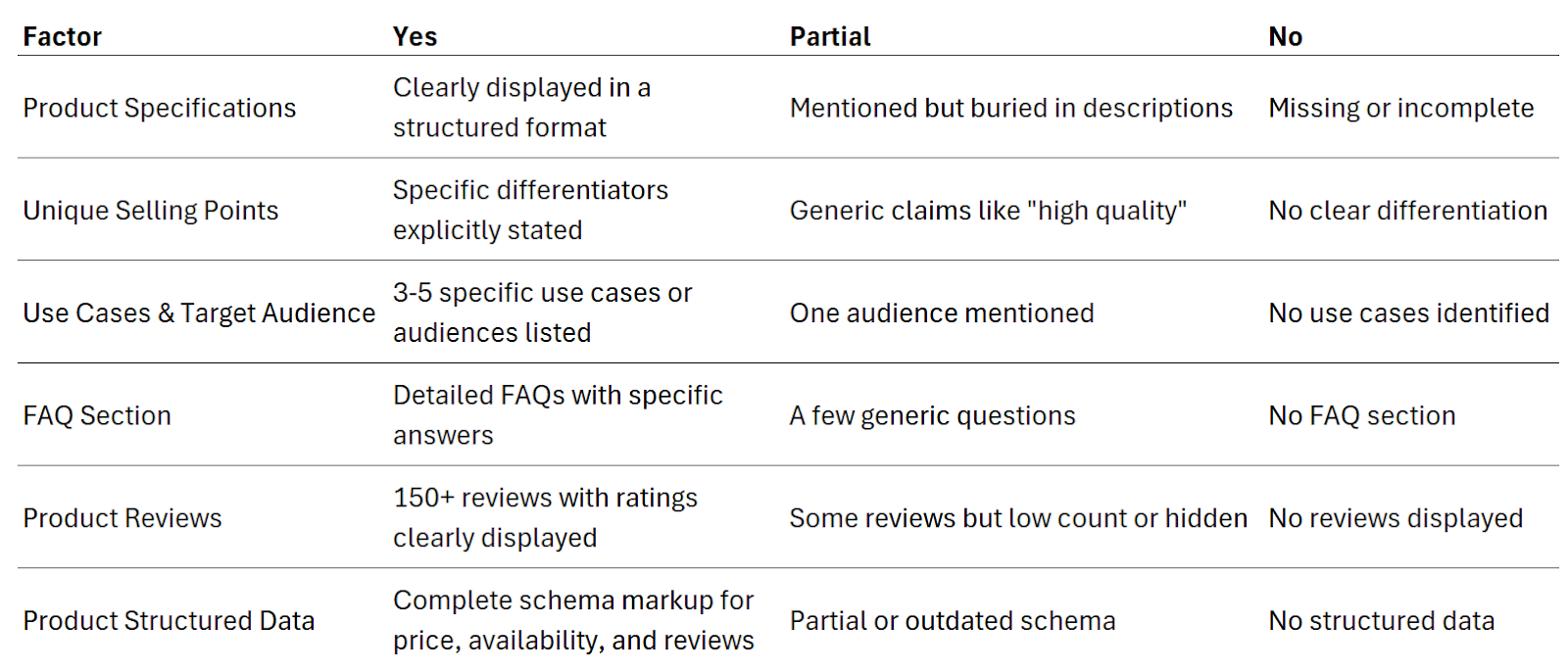
To ensure my product pages are AI-ready, I’ve crafted a simple scorecard focusing on six key factors:
1. Product specifications
Does the product page clearly display the product’s attributes and specifications?
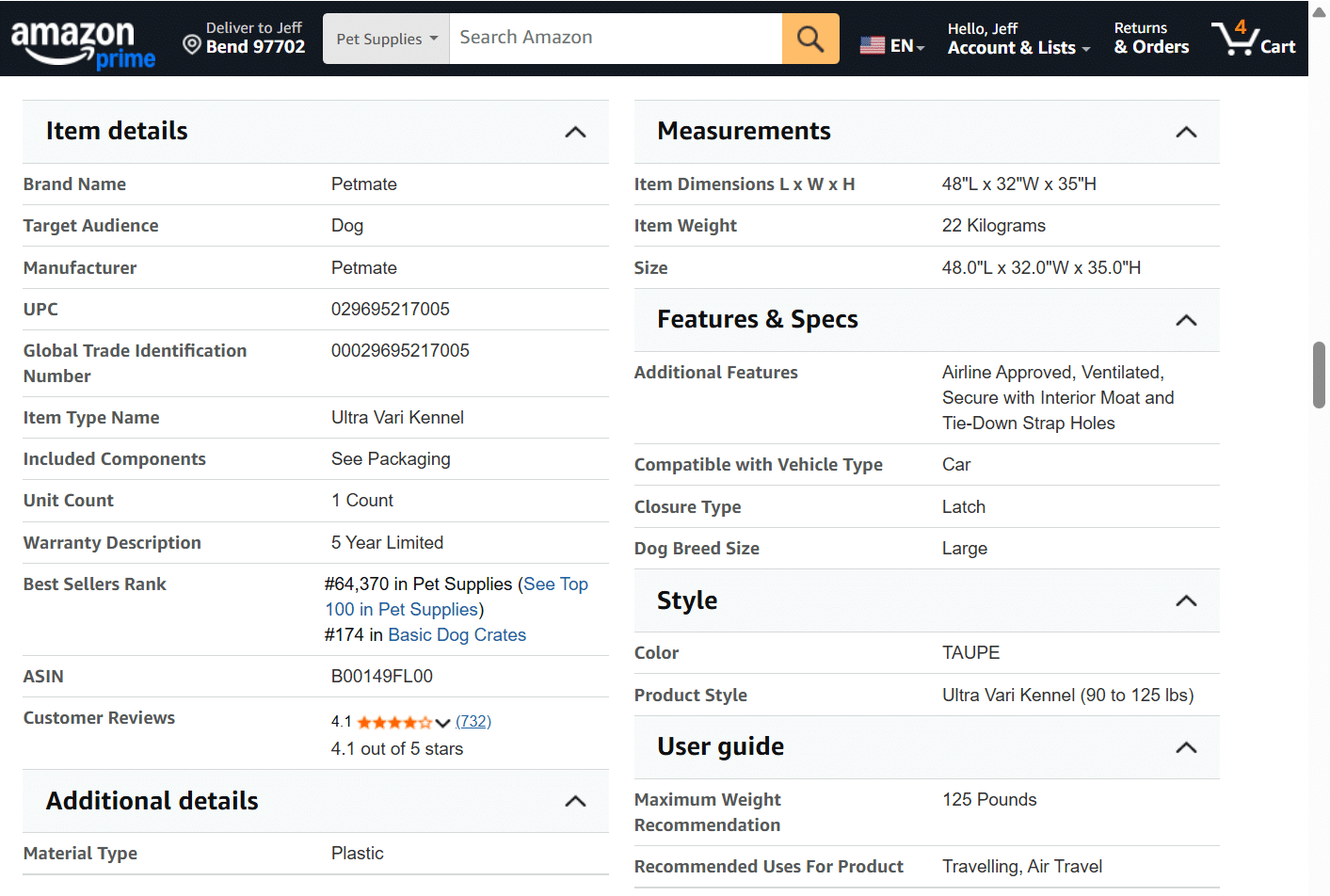
AI assistants need explicit specifications to understand my products and match them with customer needs. For example, if someone asks for “an airline-friendly crate for a 115-pound dog,” the AI must see the weight limit clearly to recommend it.
Amazon excels at this, as their product pages display detailed specifications that likely boost their AI search performance.
Action item: I ensure all specifications are clearly presented on my product pages, ideally in a structured table or a list, rather than burying them in the description or marketing copy.
2. Unique selling points
Are the product’s unique benefits clearly described?
Highlighting what makes my products special gives AI a reason to recommend them over competitors. It’s crucial for AI to grasp these unique features to decide on recommendations.
Action item: I emphasize key features that set my products apart, avoiding vague claims like “high-quality craftsmanship” and instead focusing on specific differentiators.
3. Use cases and target audience
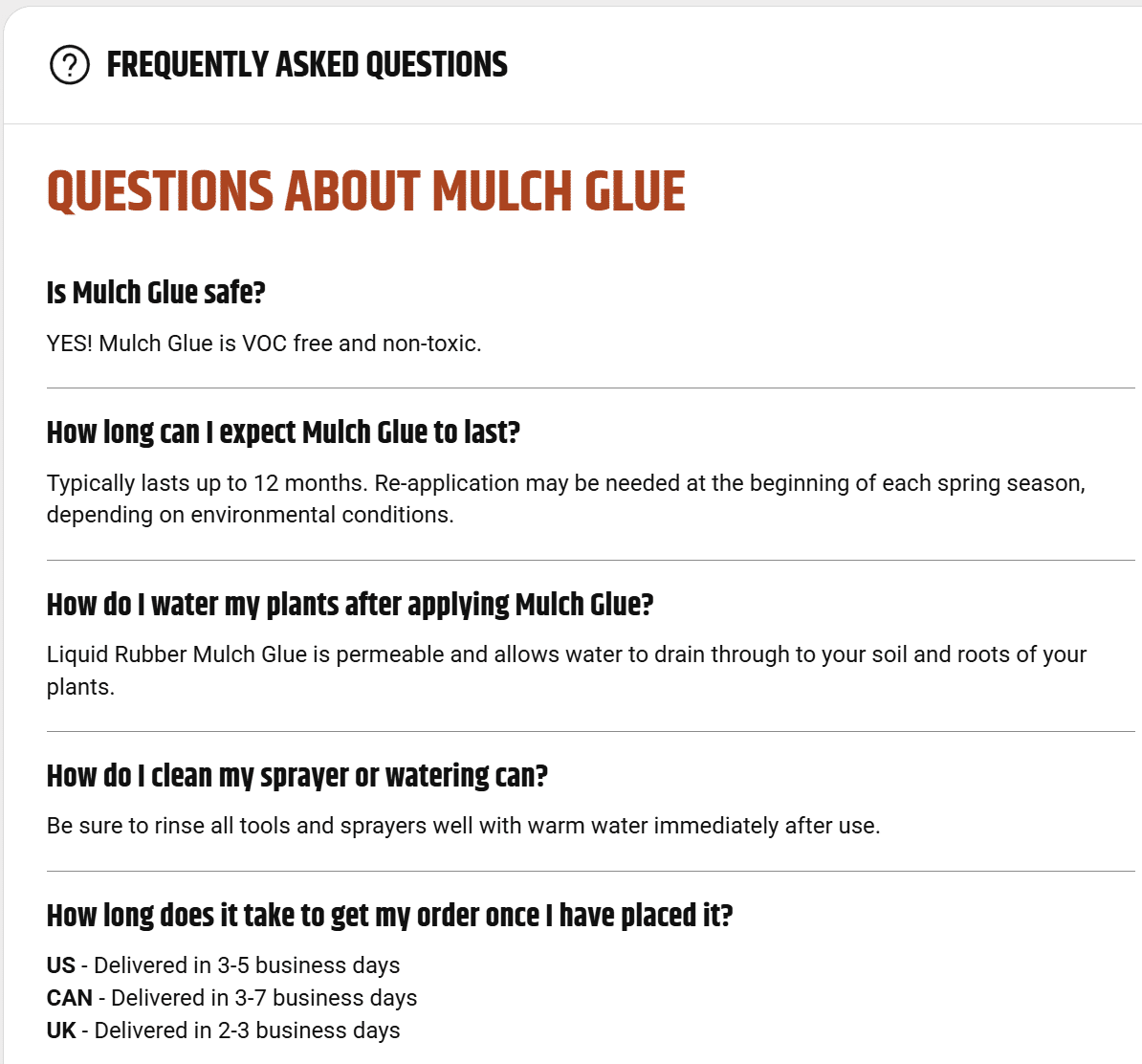
Discover everything you need to know about Mulch Glue, from safety and longevity to watering tips and delivery times.
Are the product’s intended use cases and audience clear?
AI matches products with people and their needs, not just keywords. Explicitly stating who the product is for and how it’s used makes it more likely to be recommended by AI.
Action item: I list the top use cases and audience segments for each product, considering situations, pain points, and goals.
4. FAQ section
Does the product page include an FAQ section answering common questions about the product?
FAQs can bolster AI’s confidence in recommending my products by showing they’re a good fit for specific queries. The more detailed the FAQ section, the more it helps in AI search contexts.
Action item: I gather and answer the most common questions from customer inquiries, reviews, and even competitor analysis to include on product pages.
5. Product reviews
Does the product page display customer ratings and review counts?
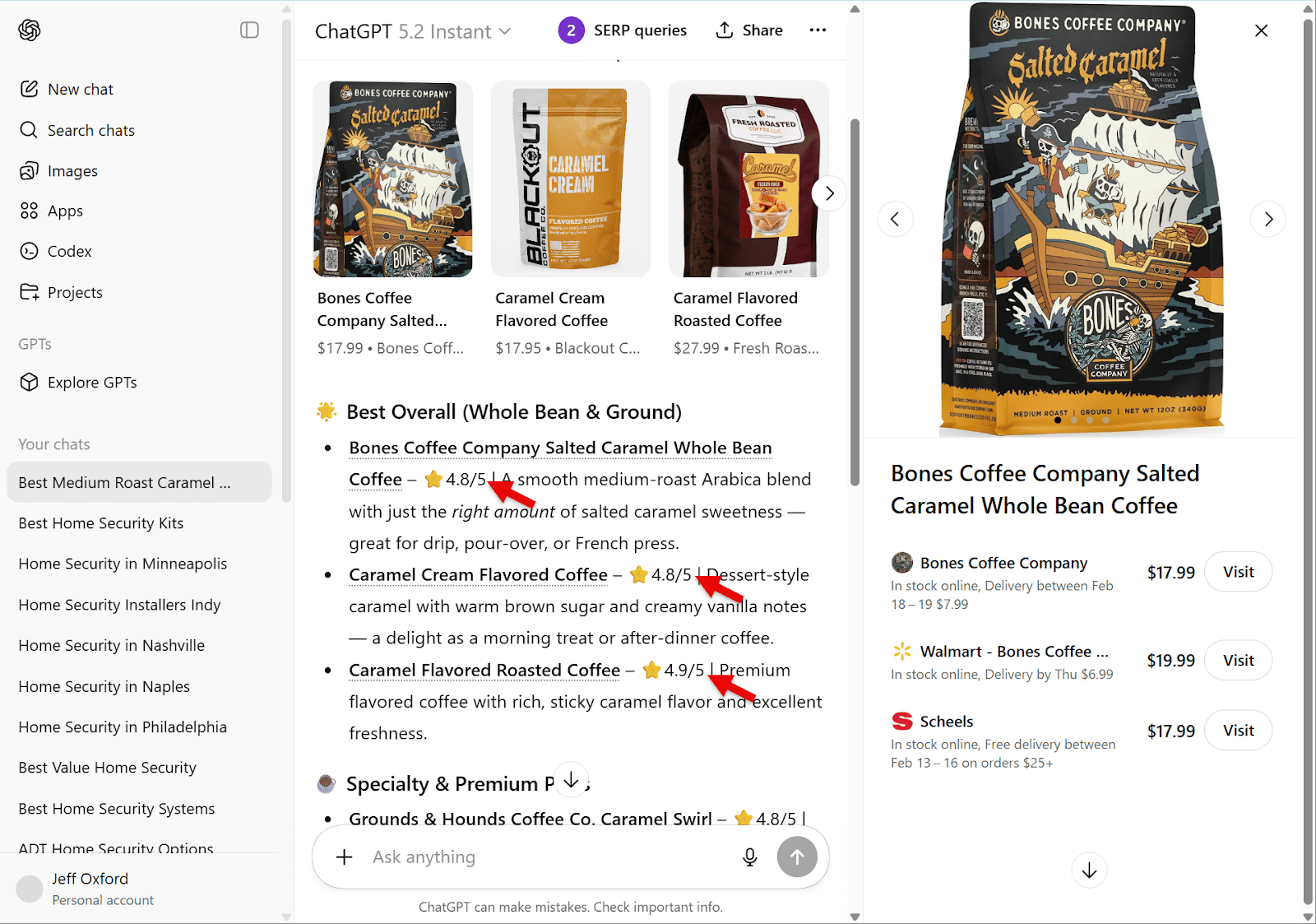
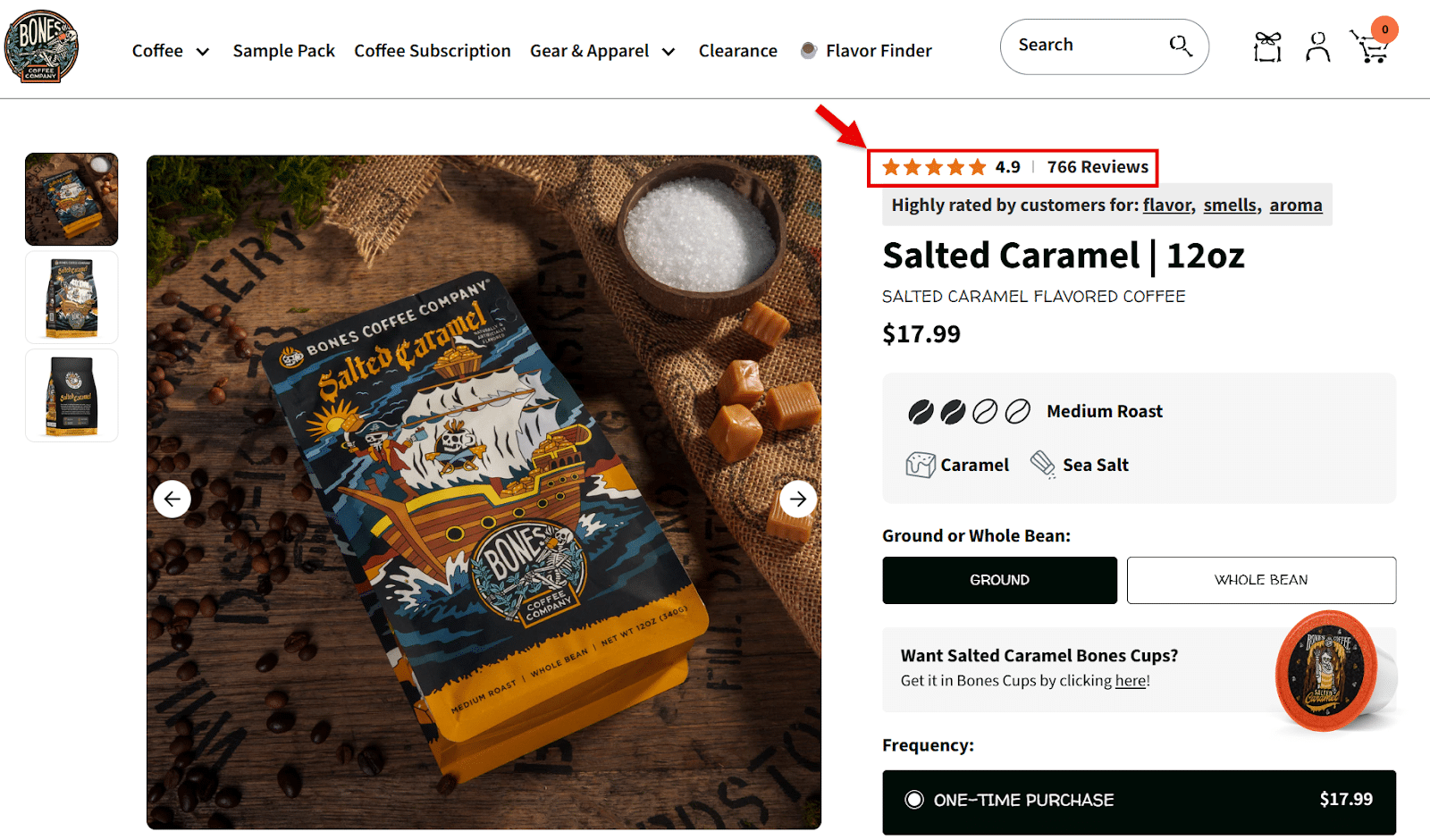
AI recommends products with proven reputations. Displaying a high rating and substantial number of reviews increases the chances of my products being recommended by AI.
Action item: I ensure high visibility for product ratings and review counts on every product page, possibly using third-party platforms to solicit reviews.
6. Product structured data
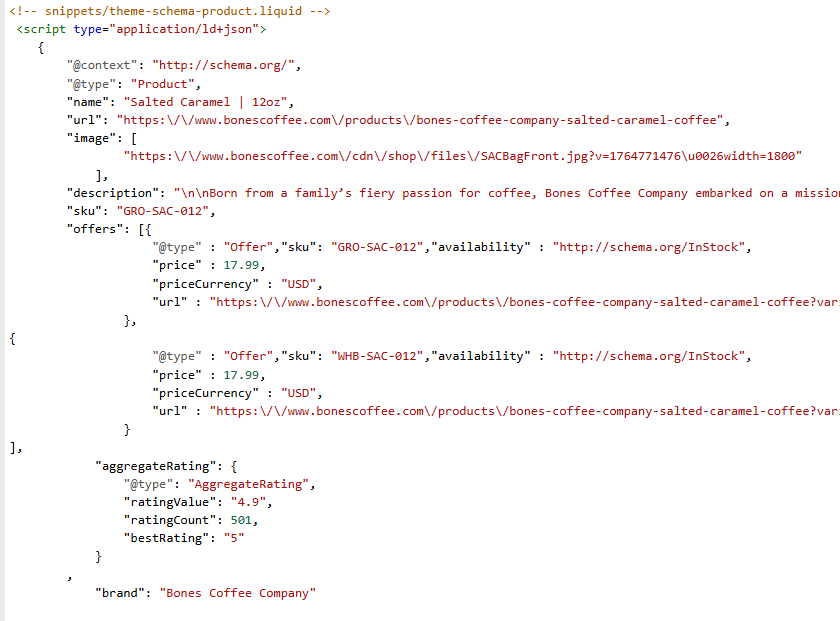
Does the product page include structured data for price, availability, reviews, and other key attributes?
Structured data helps AI understand my product information effortlessly and even feeds into knowledge graphs that power AI recommendations.
I understand that as AI agents engage more deeply in commerce, detailed product data becomes crucial for comparisons and purchasing.
Putting the scorecard to work
Here’s my concise strategy to audit and enhance my product pages for AI optimization, focusing on closing gaps where AI might overlook my products.
Prioritizing these optimizations means I’m not only engaging effectively but also increasing my competitiveness in the AI-driven market landscape.
You may be wondering whether TurboQuant requires an immediate SEO response. The short answer is no: it is not an announced ranking update, and there is no disclosed evidence that Google Search is using it in production.
It still matters. TurboQuant targets a constraint that shapes semantic search, retrieval-augmented generation, and AI answer systems: how much meaning a system can search within a limited memory and response-time budget. If that constraint loosens, more content can become practical to retrieve. Your job is to make sure your content remains understandable, competitive, and worth citing when the candidate pool grows.
TurboQuant changes retrieval economics, not your ranking brief
Semantic search systems commonly convert documents, passages, products, images, or other objects into vectors. A vector is a numerical representation that places related meanings near one another. When someone asks a question, the system can retrieve nearby vectors even when the wording in the query does not exactly match the wording in the content.
The difficulty is scale. Detailed vectors consume memory, moving them through processors takes time, and building or updating large searchable indexes can be expensive. A system may therefore search only a restricted candidate set before another model ranks, filters, or summarizes the results.
TurboQuant addresses that infrastructure problem by compressing vectors while preserving a close approximation of their original relationships. It mathematically rotates the data to make it easier to pack efficiently, then carries a 1-bit error-correction signal intended to reduce mistakes introduced by compression. Google also associates the approach with substantially lower memory requirements and nearly zero indexing time.
That is important, but it is not the same as a new ranking factor. TurboQuant does not tell a search engine which page is trustworthy, which claim is current, which source deserves a citation, or which answer best satisfies a user. It makes one stage of the pipeline more efficient: locating semantically similar candidates.
Keep the distinction clear in planning meetings. Retrieval asks, “Which items might be relevant?” Ranking and answer generation ask, “Which of those items should be used, in what order, and for what purpose?” Faster retrieval can affect the first decision without replacing the others.
A larger candidate pool changes what can be discovered
A search or AI system operates inside practical limits. It has finite memory, compute capacity, and time to produce a response. If vectors become cheaper to store and faster to search, the system could examine a broader collection of candidates within those limits. That could include more documents, more passages within each document, or more specialized material that would otherwise sit outside an economical retrieval set.
This does not guarantee that AI answers will cite more websites. A larger candidate pool can increase opportunity and competition at the same time. Your page may become easier to retrieve, but so may a more precise product manual, a better-supported explanation, or a specialist page that previously sat too deep in the corpus.
The likely strategic shift is from winning inside a narrow set of obvious pages to surviving comparison against a deeper set of semantically related passages. Thin content becomes more exposed in that environment. Repeating the target phrase does little when the system can find pages that answer the underlying question with clearer entities, stronger evidence, and better-qualified claims.
Nearly zero indexing time could also make rapid ingestion more practical for systems built around TurboQuant. Do not turn that possibility into a claim about Google Search freshness. Crawling, rendering, canonicalization, quality assessment, and index-selection policies remain separate processes. Faster vector indexing cannot make an uncrawled or rejected page searchable.
The same logic applies outside public search. An organization operating a large retrieval-augmented generation system could use aggressive vector compression to reduce memory pressure or update a knowledge index more quickly. If you own that system, TurboQuant is an engineering option to evaluate. If you publish content that such systems may ingest, the more durable task is to improve the material being represented by those vectors.
Optimize the passage before you optimize the embedding
You usually cannot control which embedding model, quantization method, retrieval threshold, reranker, or answer model a third-party search system uses. You can control whether a passage contains enough information to be correctly interpreted after it is separated from the rest of the page.
Start with answer-bearing passages. A useful passage names the subject, resolves the question, and carries the qualification that prevents the answer from becoming misleading. Avoid openings that rely on nearby headings or pronouns to supply all the context. “It depends on the plan” is fragile. “Indexing frequency depends on the crawler, the site’s change rate, and whether the URL remains eligible for indexing” retains meaning when retrieved alone.
Do not force every paragraph into a rigid template. The goal is semantic completeness, not robotic prose. Use the following checks where a passage contains a definition, recommendation, comparison, process, limitation, or factual answer:
Name the entity. Use the full product, organization, method, or standard name before relying on shorthand. This reduces ambiguity between similarly named entities.
State the relationship. Make it explicit whether the entity creates, supports, replaces, depends on, conflicts with, or applies to something else.
Carry the qualifier. Keep version, platform, audience, condition, and scope close to the claim they limit.
Put evidence beside the claim. A citation attached to a vague paragraph is less useful than a link on the specific statement it supports.
Separate fact from inference. Use direct language for documented behavior and conditional language for plausible consequences. TurboQuant could support broader retrieval; that does not establish its use in Google Search.
Next, cover the relationships around the central entity. A page about TurboQuant should not merely repeat that it accelerates vector search. A useful treatment connects compression to memory use, index construction, similarity accuracy, candidate retrieval, reranking, and downstream answer generation. Those relationships help a system match the page to different formulations of the same underlying problem.
This is semantic breadth, not permission to inflate word count. Add a section only when it resolves a real adjacent question. Remove a section when it paraphrases a claim already made. Efficient retrieval can expose comprehensive content, but it can also expose padding.
Make structured data support the same meaning
JSON-LD and schema markup can reinforce entity identity and relationships, but they do not rescue unclear visible content. Treat structured data as a machine-readable restatement of the page, not a hidden layer where you make claims the reader cannot see.
For each important page, compare the visible content with its structured data. The page title, main entity, author or organization, publication information, and any explicitly marked questions or steps should agree. If the markup identifies one subject while the body drifts into several loosely related topics, compression is not the problem. The underlying document is ambiguous.
Internal links deserve the same discipline. Use anchor text that describes the destination’s role rather than generic commands such as “learn more.” Link from a broad concept to the page that resolves its important subtopic, and link back where the relationship helps the reader. This creates navigable context for crawlers and people without pretending that internal links directly control vector proximity.
Technical eligibility remains the floor. Confirm that the canonical URL is crawlable, the primary answer appears in rendered HTML, internal links reach the page, and structured data matches the visible material. A brilliantly written passage cannot enter a retrieval pipeline that never receives or accepts the page.
Run a retrieval-readiness audit you can repeat
Do not create a TurboQuant-specific score. You have no public implementation details that would make such a score credible. Audit the properties that remain useful across embedding models and compression methods.
Select a representative page from each important topic cluster. Include the pages that answer commercial, informational, troubleshooting, and comparison questions rather than auditing only your highest-traffic URLs.
Build query families around user intent. For each page, write the direct question, a paraphrase, a problem-first version, and a version that names a competing approach. This reveals whether the page answers the concept or merely repeats one keyword pattern.
Locate the passage that should satisfy each query. If you cannot point to a self-contained answer, rewrite the relevant section. Do not assume the title or surrounding page will repair an incomplete paragraph.
Check entities and qualifiers. Mark unclear pronouns, unexplained abbreviations, missing versions, unsupported superlatives, and conditions placed far away from the claims they govern.
Verify evidence and provenance. Link important claims to their originating authority when available. Remove assertions whose confidence exceeds the evidence.
Compare visible content, metadata, and JSON-LD. Resolve conflicts in names, dates, page purpose, authorship, and entity type. Consistency makes the page easier to interpret; markup volume does not.
Record answer-surface outcomes. For the query families you monitor, note whether your URL appeared, whether it was cited, which passage was used, and which alternative sources won. Ordinary rank position alone cannot show how an AI answer assembled its response.
When a competing page is selected, diagnose the difference at the passage level. Ask whether it gave a more direct answer, named the relevant entity more clearly, carried a necessary qualification, supplied stronger evidence, or addressed an adjacent intent you omitted. Those observations produce useful editorial work. Guessing at an undisclosed quantization configuration does not.
Keep infrastructure tests separate from content tests if you operate your own vector search system. Engineering teams can compare memory use, indexing cost, latency, and retrieval quality under compression. Editorial teams should evaluate answer completeness, ambiguity, evidence, and citation suitability. Combining both into one vague “AI optimization” metric makes it impossible to tell which layer improved.
Key takeaways
TurboQuant compresses vectors to reduce memory pressure and accelerate similarity search, with a 1-bit signal designed to correct small compression errors.
It is retrieval infrastructure, not a disclosed Google Search ranking factor or confirmed production deployment.
Cheaper retrieval could let an AI system search a broader candidate set, but broader access also exposes your content to more competitors.
Your durable advantage is a crawlable page with self-contained passages, unambiguous entities, nearby qualifications, and evidence attached to specific claims.
Use JSON-LD to reinforce visible meaning. Do not use it to compensate for vague writing or to introduce claims absent from the page.
Measure citation and passage selection across query families, not just traditional rankings for one exact keyword.
Your next move is modest: choose one important topic cluster and run the retrieval-readiness audit before rewriting the entire site. Fix the places where meaning breaks when a paragraph stands alone. That work remains valuable whether TurboQuant reaches public search, stays inside other AI systems, or inspires a different compression method.
You publish a precise title, a useful answer and a well-structured page. Then an AI system presents a different headline, compresses the answer into a few sentences or recommends a forum discussion instead. The immediate temptation is to chase whichever domain dominates the latest citation chart.
That reaction solves the wrong problem. In AI-mediated discovery, your audience may encounter a machine-generated interpretation before it encounters your page. You therefore need content that is easy to select, difficult to misrepresent, clearly attributable and still worth visiting after the summary appears.
Treat AI as a second presentation layer
Publishing controls the material you make available. It doesn’t fully control how an intermediary presents that material. A search engine, answer engine or content platform may select a passage, combine it with other material, rewrite its label or generate a summary. Ranking is only one part of that process.
Discovery outcome
Question to ask
Typical failure
Selection
Does the system use your content for the relevant question?
A competitor, forum or reference site supplies the answer instead.
Representation
Does the generated answer preserve your meaning and important conditions?
A caveat disappears, a comparison becomes absolute or an old claim is repeated without context.
Attribution
Can the user connect the claim to your brand, expert or page?
Your idea appears without a citation or with another entity presented as the authority.
Action
Does the presentation give the user a reason and a path to continue?
The summary answers enough to stop the journey, or the destination doesn’t match the generated promise.
Audit priority content against all four outcomes. Start with the rendered page, not just its keyword report, and ask:
Can someone identify the exact question the page answers from its title, opening and section headings?
If a single answer paragraph is extracted, do its subject, scope and conditions remain intact?
Does the passage name the relevant product, company, person or concept, or does it rely on pronouns and surrounding context?
Can a reader distinguish your verified claims from opinions, examples and predictions?
If the generated answer earns a visit, does the destination immediately continue the same task?
A page can rank and still fail this audit. It can also be quoted accurately without producing a visit. Those are different outcomes, so don’t hide them inside one visibility score.
Choose channels at the query level, not from citation charts
Make the query family your unit of analysis. Build a working inventory around the decisions your audience actually faces:
Problem recognition: What is happening, and what is the problem called?
Category education: How does the approach work, and when is it appropriate?
Comparison: Which options differ on the criteria that matter to this buyer?
Risk and objection: What can go wrong, what are the limitations and what evidence reduces uncertainty?
Implementation: What must the user configure, verify or troubleshoot?
Brand validation: Is this company or product credible for the stated use case?
For each family, inspect which kind of material supplies the answer. A reference page may win a definition query. A practitioner discussion may win a question about lived trade-offs. Product documentation may win a configuration question. An original analysis may win when the user needs evidence or a defensible comparison. The point is not to force your site into every role. It is to identify the role your content can credibly own and the gaps that require another channel.
Use community visibility only when participation is the real strategy
Wikipedia is a different environment. Its editorial constraints make it unsuitable as a brand-controlled distribution surface. Treating either community as inventory misses the mechanism that gives it value.
Use this decision gate before investing in an external community:
Would the contribution still help the reader if your company name and link were removed?
Can the contributor disclose an affiliation without weakening the substance of the answer?
Does your team have knowledge, evidence or direct product context that is missing from the discussion?
Can someone return to answer follow-up questions, correct errors and maintain the contribution?
Would the claim survive skeptical review from people who don’t share your commercial interest?
If those conditions aren’t met, put the effort into a stronger owned resource. If they are met, participate under the community’s rules and measure usefulness before citations. On Reddit, answer the actual question, disclose the relationship and avoid manufacturing consensus. On Wikipedia, limit involvement to verifiable corrections and respect editorial review. On YouTube, make the video’s subject and central claim clear within the content itself, while continuing to write accurate creator-controlled titles wherever the interface displays them.
Give every channel a defined job
Channel
Useful role
Warning sign
Owned website
Canonical explanations, product facts, original evidence, documentation and conversion paths.
The page makes claims that cannot be verified or understood without sales contact.
Reddit or another forum
Firsthand context, candid trade-offs, follow-up discussion and questions in the audience’s own language.
The plan depends on disguised promotion, disposable accounts or coordinated agreement.
Wikipedia
Neutral, verifiable reference information that meets the community’s editorial expectations.
The goal is to control brand positioning or insert unsupported commercial claims.
YouTube
Demonstration, explanation and visual evidence for questions that benefit from video.
The meaning exists only in a clever title and isn’t stated clearly in the content.
Build answer blocks that remain accurate after compression
AI optimization doesn’t require flattening every page into short, generic answers. It requires making the smallest useful answer unit complete enough to stand on its own. A strong unit identifies the subject, states the answer, carries the necessary boundary and provides a reason to trust or continue.
A practical answer block performs these jobs:
Name the entity and question. Don’t make an extracted passage depend on the previous heading or a chain of pronouns.
State the answer directly. Put the useful conclusion before background that only explains why the question matters.
Keep the qualifier attached. Version, market, audience, use case and exception should sit beside the claim they limit.
Show the mechanism or evidence. Explain why the answer holds, or point to the observable fact that supports it.
Offer the next useful step. Lead to a comparison, method, specification or decision that a short summary cannot fully replace.
A reusable pattern is: entity plus answer plus condition, followed by mechanism or evidence, then the next decision. It is a drafting aid, not a rigid sentence template. Use as much space as accuracy requires. There is no universal paragraph length that guarantees extraction or citation.
Keep the page, metadata and schema in agreement
Your page title, visible heading, opening answer, section labels, internal anchor text and structured data should describe the same entity and promise. If the title offers a comparison but the page delivers a category overview, an intermediary has to infer the relationship. If the JSON-LD identifies an author or entity differently from the visible page, you have created another avoidable ambiguity.
Use structured data for facts that are visible and supported on the page. Treat it as a consistency layer, not a citation switch. Schema cannot make a weak claim authoritative, force an answer engine to select the page or prevent a platform from generating a different presentation.
Also separate author-controlled fields from generated output in your audits. A rewritten headline is not evidence that the original title was changed in your CMS. Record what you published and what the platform displayed. You need both to diagnose whether the problem is in the content, the markup or the intermediary’s presentation.
Run a compression test before publishing
Choose one high-value question the section must answer.
Copy the smallest passage that contains the complete answer.
Review that passage without the page title, navigation or preceding paragraphs.
Identify the subject, conclusion, conditions, evidence and responsible entity using only that passage.
Rewrite any point that becomes broader, stronger or less attributable when removed from its surroundings.
Pay special attention to words such as it, this, they, best, always and should. They aren’t inherently wrong, but they often conceal a missing entity, comparison set, condition or rationale. Replace them when the isolated passage could support more than one reasonable interpretation.
This test also catches a common content-design mistake: placing the caveat several paragraphs after the claim. A human reader may connect them. A generated answer built from a smaller passage may not. Keep a condition beside the statement it changes, then expand on the edge case later.
Measure the generated answer and fix the correct layer
Referral analytics can’t tell you whether an AI system named your brand, represented a claim correctly, cited your page without a visit or recommended a competitor while borrowing your framing. Add output observation to your usual search and content reporting.
Start with a stable panel of real audience questions. Preserve the exact wording, group each query by decision stage and record the platform, mode and other conditions that could affect what you see. Capture the answer on a consistent cadence. The purpose is not to declare a permanent rank from one response; it is to identify repeated representation problems and useful patterns.
Signal
What to record
What it helps you decide
Selection
Whether your brand, page or claim appears at all.
Whether the content is eligible and relevant for this query family.
Representation
The claim as generated, including lost or added qualifications.
Whether the source material needs a clearer answer block.
Attribution
Which brand, author or organization receives credit.
Whether entity naming and ownership are explicit enough.
Citation
The destination cited and the passage that supports the answer.
Whether the system is reaching a canonical, current and useful page.
Recommendation
The option presented and the stated reason for choosing it.
Which buyer criteria and evidence your content fails to address.
Action path
Whether the user can continue to the relevant page or task.
Whether discovery can become a productive visit or decision.
Variation
What changes across repeated observations under recorded conditions.
Whether you are seeing a durable gap or unstable output.
Keep these signals separate until you understand them. A mention with an inaccurate claim is not a success. A correct uncited answer is not the same problem as total omission. A citation to an outdated page requires a different fix from a recommendation that favors a competitor on a criterion you never addressed.
Use the failure type to choose the response:
Selection failure: confirm that the page directly answers the query and that its purpose is clear in the title, opening and headings.
Representation failure: rewrite the relevant passage so the answer and its conditions survive extraction together.
Attribution failure: name the responsible entity inside the answer unit and align visible authorship with structured data.
Citation failure: consolidate duplicate explanations, strengthen internal paths to the canonical page and keep the preferred destination current.
Recommendation failure: address the actual decision criteria with evidence rather than adding more generic brand language.
Community-source dominance: determine whether users need experiential evidence that your owned page cannot credibly provide; participate only if you can contribute that evidence transparently.
Don’t overhaul a content program because one platform runs a small interface experiment or one broad citation chart changes. Look for the same failure across a meaningful query family, then repair the layer responsible for it.
Key takeaways
Optimize for selection, representation, attribution and action rather than treating a citation as the whole outcome.
Use query-level evidence to choose channels; a domain’s overall citation share is not a strategy for your audience.
Keep the answer, subject, qualifier and evidence close enough to survive compression as one coherent unit.
Align visible content, metadata and JSON-LD, while recognizing that no markup can force an AI-generated presentation.
Participate in Reddit, Wikipedia or another community only when you can add transparent, durable value under its rules.
Track generated claims and recommendations alongside referrals, then match each failure to the layer that can actually fix it.
Choose one commercially important query family and inspect the generated answers before expanding your program. Repair the clearest selection or representation gap on the page that should own the answer, then observe the same queries again under recorded conditions. That cycle gives you a defensible AI discovery strategy without surrendering it to whichever platform happens to lead a headline chart.
Your analytics dashboard may show a human arriving at checkout while missing the machine that found the product, compared the options, and initiated the journey. It may also show nothing at all when an agent completes an action without running your client-side analytics code.
You can close that gap, but not with a new referral channel alone. Reliable AI agent attribution starts in server and CDN logs, continues through first-party action events, and ends with an attribution model that distinguishes direct execution from assistance and unlinked automation.
Key takeaways
Measure AI agents at the HTTP request layer. A request that does not execute your analytics script cannot create a normal browser event.
Separate training crawlers, real-time retrieval systems, and task-performing agents. They represent different intent and should not share one conversion rate.
Do not trust a user-agent string by itself. Combine it with published network information, request behavior, authentication state, and your own event data.
Use distinct attribution states for agent-executed, agent-assisted, discovery-only, and unresolved activity. Do not force uncertain traffic into a conversion channel.
Instrument forms, account actions, carts, and orders on the server. Page requests show access; confirmed business events show outcomes.
Classify traffic by the job the machine is doing
An automated request is not automatically a prospective customer. A model-training crawler collecting material, an answer engine retrieving a current page, and an agent submitting a form can all request the same URL. Their commercial meaning is entirely different.
This distinction matters because machine activity is growing faster than human activity. HUMAN Security measured more than a quadrillion interactions from 2022 through 2025. In that dataset, automated traffic increased 23.5% in 2025 while human traffic increased 3.1%. AI-driven traffic rose 187%, and activity associated with AI agents and agentic browsers rose by nearly 8,000%. Those figures come from aggregated, anonymized customer data, so treat them as a market signal rather than a forecast for your site.
Traffic class
Likely job
What to measure
Attribution treatment
Training crawler
Collect content for later model development
Pages fetched, bytes served, crawl frequency, response status
Content access, not a visit or conversion
Real-time retriever or scraper
Fetch current information for an answer or comparison
Training crawlers still represented 67.5% of measured AI traffic, while real-time scrapers grew by nearly 600% in 2025. That mix explains why a large increase in AI-labelled requests does not necessarily produce leads or revenue. Start by assigning each request to a functional class; calculate commercial performance only for traffic capable of participating in a user journey.
Create at least two classification fields in your data: agent_type for the machine’s apparent job and verification_status for the strength of the identification. Keep the values independent. A request can look transactional while its claimed identity remains unverified.
Build an evidence chain from request to outcome
Attribution becomes credible when you can follow an agent from an incoming request to a server-confirmed action. A dashboard label such as “AI traffic” is not enough. You need a chain of evidence that survives redirects, browser changes, authentication, and the absence of JavaScript events.
Capture the request before classifying it
Preserve the raw evidence in your CDN, load balancer, or application logs before a bot filter removes it. For each relevant request, capture:
A UTC timestamp and a unique request ID.
The HTTP method, normalized route, response status, and response size.
The full user-agent value as received, plus the parser’s normalized result.
The source network information needed for verification.
Referrer and origin headers when present, without treating their absence as proof of anything.
Whether a first-party session was present or created.
A pseudonymous account or customer identifier when the request was legitimately authenticated.
The resulting application event, such as search performed, form accepted, cart updated, or order confirmed.
Do not log authorization headers, passwords, payment details, complete form bodies, or sensitive query-string values for the sake of attribution. Strip or tokenize sensitive fields before they reach the analytics store. The useful connection is between a request identifier and a confirmed event, not between a marketing report and a copy of the user’s private data.
Instrument the business action on the server
A page view tells you that an agent requested a page. It does not tell you that a form was accepted, an account changed, or a payment completed. Emit a first-party server-side event only after the application confirms the action.
Give that event its own ID and record the initiating request ID, event time, action type, outcome, and any internal transaction or lead identifier. If the event represents money, use the same finalized value your order system recognizes. Failed submissions and abandoned workflows belong in diagnostic reporting, not completed-conversion totals.
Make an agent-to-human handoff observable
Many useful agent journeys will not end inside the agent. The machine may find a product or prepare a configuration, then send the user into a browser to review, authenticate, or pay. Standard last-click attribution can give the browser all the credit because the earlier agent request had no ordinary campaign parameter or client-side session.
When you control the handoff, attach an opaque, first-party handoff token to the destination URL. The token should identify a journey record, not expose an email address, prompt, account number, or other personal data. Expire it, prevent it from granting access, and associate it with the eventual conversion only after your server validates it. If the user is already authenticated, an internal pseudonymous account key can provide the connection without placing identity in the URL.
If you cannot observe a deterministic handoff, do not manufacture one from matching timestamps or similar page paths. You may analyze those patterns in aggregate, but label the result as discovery influence rather than an assisted conversion.
Recognize Google-Agent without weakening security
Google-Agent creates a useful distinction between continuous crawling and a request made while an AI system performs a user-initiated task. Google introduced it for agents hosted on its infrastructure, including experimental systems such as Project Mariner, and provided network ranges for desktop and mobile agent activity.
That identity gives you a better starting signal, not a substitute for authentication. User-agent strings are supplied by the requester and can be copied. Never allow an account action, bypass a challenge, or relax a security rule solely because a request calls itself Google-Agent.
Use confidence-based verification
Apply the same verification pattern to Google-Agent and any other named agent:
Match and preserve the claimed user-agent identity.
Compare the source with the provider’s published network information and keep that information current.
Check whether the request pattern is consistent with the claimed function, including the routes, methods, timing, and workflow sequence.
Record the result as verified, probable, or unverified rather than reducing all three states to a boolean bot flag.
Apply normal authorization, rate limiting, abuse detection, and transaction controls regardless of the identity label.
Review your CDN and web application firewall logs for named agents before changing any rule. Then test product search, detail pages, forms, sign-in, account functions, cart operations, and checkout with non-production accounts and non-chargeable test transactions where your systems support them.
Look for redirects that loop, challenges that cannot be completed, required state that disappears between requests, and successful browser screens backed by failed server actions. Keep intentional security denials in place. The goal is to remove accidental incompatibility, not to give automated clients a privileged route into sensitive workflows.
Report agent contribution without false precision
Your reporting should tell operators what happened and tell decision-makers how certain the attribution is. One blended “AI conversions” number cannot do both.
Use four mutually exclusive outcome states:
Agent-executed: A verified or explicitly qualified agent request is linked to a server-confirmed conversion that the agent performed.
Agent-assisted: An observable first-party handoff or authenticated journey connects agent activity to a later human conversion.
Discovery-only: An agent retrieved relevant content, but no deterministic connection to an individual outcome exists.
Unresolved automation: Automation was detected, but its identity, purpose, or relationship to an outcome remains uncertain.
Do not add agent-executed and agent-assisted credit if they describe two stages of the same conversion. Keep a deduplicated conversion ID, choose a primary status, and retain the touch sequence separately for analysis.
Your operational dashboard should cover three layers. The access layer needs request volume by agent type, verification state, route group, response status, and security disposition. The workflow layer needs starts, successful steps, failures, and confirmed completions for each key action. The business layer needs deduplicated leads, orders, revenue where applicable, and the four attribution states above.
Choose an assistance window that reflects your actual buying cycle and publish that rule beside the metric. There is no defensible universal window in the available evidence. A short handoff into checkout and a long enterprise evaluation should not inherit the same arbitrary assumption.
Establish the baseline even if named-agent volume is initially small. A rise in training access may affect infrastructure cost and content-control decisions without changing revenue. A rise in verified product-search and account activity deserves workflow testing. Repeated checkout attempts with no confirmed outcomes point to a technical or security investigation, not automatically to weak demand.
Start with one path that matters commercially: discovery, a product or service page, and its next meaningful action. Join the request logs to one server-confirmed outcome, preserve uncertainty as an explicit field, and make that narrow chain trustworthy before expanding it across the site. That gives you a measurement system you can extend as agents become more capable, without rewriting history around traffic you never truly identified.
Your traffic can fall while your content becomes more influential. That sounds contradictory only if a visit is your sole unit of search success. People increasingly receive answers inside search results, AI interfaces, videos, forums, and social feeds, and many of those interactions never produce a website session.
Your job is not to abandon SEO or publish on every platform. It is to make your site the dependable source for a valuable decision, carry that knowledge into the environments where the decision happens, and measure whether your facts shape the answer. That requires a different content system, not merely more content.
Replace the traffic-only scorecard with an answer footprint
Organic sessions still matter. They show that someone reached property you control, where you can explain the full case and offer a next step. But sessions cannot show every place your expertise influenced discovery. Search engines can display the answer directly, AI assistants can synthesize it, and social or video platforms can satisfy the need without sending the person elsewhere.
Measure your answer footprint across four separate layers:
Discoverability: Can search engines, AI systems, and people find the relevant page or platform contribution?
Representation: Is your brand mentioned, and are its products, methods, limitations, and positions described accurately?
Influence: Is your domain cited, or is knowledge associated with your brand reflected in the answer?
Business response: Do you see qualified visits, branded searches, leads, sales conversations, or other outcomes connected to the topic?
Do not collapse these layers into one score. A citation without a click can still extend your influence, but it does not prove commercial value. A rise in branded demand may be meaningful even when the original exposure is invisible to your analytics. Conversely, an AI mention is not a success if the description is wrong or places your brand in an irrelevant category.
Organize measurement around decision clusters rather than isolated keywords. A cluster might include the main question, its prerequisites, common alternatives, implementation concerns, risks, and follow-up questions. This reflects how a person investigates a decision and gives you a stable unit to compare across Google, Bing, AI assistants, YouTube, Reddit, and other relevant environments.
Key takeaways
Keep traffic, citations, mentions, accuracy, and business outcomes as separate signals.
Give each important decision cluster one authoritative home on your website.
Expand onto platforms because your audience searches there or AI answers rely on them, not because the platform is fashionable.
Reuse the underlying knowledge, but adapt its presentation to each platform.
Scale a content pattern only after it shows durable discoverability, accurate representation, or business value.
Make your website the canonical source worth citing
Your website remains the place where you control definitions, evidence, context, updates, and conversion paths. In a zero-click environment, that role becomes more important, not less. AI-generated answers often depend on clear primary explanations from identifiable experts and organizations, even when the person reading the answer never visits the originating page.
A canonical page should do more than target a phrase. It should make a defensible contribution that another person or system can reuse without guessing what you mean. Use this publishing checklist:
Answer the central question near the beginning. State the scope and any important boundary in the same passage.
Add information that came from the work itself: a method, calculation, test procedure, decision framework, original data, documented example, expert explanation, or clearly supported position.
Write self-contained claim blocks. Give each paragraph a clear subject, enough context to stand alone, and language that does not depend on a chain of vague pronouns.
Name entities consistently. Use the same product, organization, person, feature, and category names across the page and related properties.
Show provenance. Identify the author or reviewer, explain relevant expertise, display the publication or update date, and link claims to the evidence actually supporting them.
Connect supporting pages. Link definitions, methods, comparisons, and implementation instructions so the broader topic can be understood as a coherent body of knowledge.
Give the page an owner. Someone should be responsible for correcting outdated facts and reconciling changes across distributed versions.
Structured data can clarify this page, but it cannot supply missing authority. Select the schema type that accurately describes the visible content. For an editorial page, that may include Article or BlogPosting relationships alongside the relevant Person or Organization and BreadcrumbList entities. Keep names, authorship, dates, and relationships consistent with what a reader can see. Do not mark up claims, ratings, questions, or entities that the page does not actually contain.
Treat JSON-LD as a machine-readable identity and relationship layer. The visible page still has to carry the answer, evidence, and context. Adding more schema types to a generic page does not turn it into a primary source.
The same distinction applies to AI-assisted writing. On new domains without established authority, AI-generated pages showed a rapid rise followed by a decline during a 16-month experiment. That pattern does not prove that all AI-assisted content will fail. It does show why an early ranking increase is not enough evidence for a mass-production strategy.
Use AI to reduce production friction where it helps, but put every page through a source-worthiness gate before publishing. Ask whether the page contains a claim you can defend, evidence a competing summary cannot reproduce honestly, a clear task it helps the reader complete, and an update plan. If the only differentiator is wording, the page is not ready to scale.
Match each decision to the surface where people search
Traditional keyword research can reveal demand while still missing where that demand is expressed. People may use YouTube to learn a repair, Reddit to test a claim against lived experience, TikTok to discover a restaurant, or Amazon to narrow a purchase. Those platforms also occupy conventional search results, so ignoring them can cost visibility both inside the platform and on Google or Bing.
The right surface depends on the task. One documented example found that the query about fixing a leaky sink faucet had 15 times more estimated global search volume on YouTube than in traditional search. That is a query-specific result, not a universal ratio. Its practical value is the routing lesson: a demonstration-led need may deserve a video before it deserves another text-only page.
Build a surface map for every priority decision cluster:
Collect the questions people use before, during, and after the decision. Draw from customer conversations, sales objections, support requests, on-site search, community discussions, and your existing search data.
Run the questions on traditional search engines. Record which domains, platforms, and formats repeatedly occupy the visible results.
Repeat the investigation inside the platforms that appear. Look at the language people use, the content format they choose, and the follow-up questions visible in comments or threads.
Inspect representative AI answers for the same decisions. Record cited domains, uncited brand mentions, repeated claims, omissions, and inaccuracies.
Choose the smallest set of surfaces that covers the decision well. Your selection should follow observed behavior, not a generic list of channels.
Use the nature of the question as an initial routing clue. A process that must be seen usually benefits from video. A decision shaped by first-hand trade-offs may need credible community participation. A precise definition, policy, specification, or method needs a stable owned page. A complex explanation may require a detailed page plus shorter platform-native versions that help people discover it.
Then validate the clue against actual results. Your real search competitors may be YouTube channels, Reddit communities, publishers, or marketplaces rather than businesses selling the same service. A conventional competitor list will not reveal that attention gap.
Build an owned-and-rented publishing loop
Your site is owned territory. A YouTube channel, Reddit account, Quora profile, social feed, or marketplace listing is rented territory. You need both, but they do different jobs. The owned page preserves the complete, maintainable version of your knowledge. Outside platforms make that knowledge available in the formats and communities where discovery already happens.
This distribution matters for AI visibility because citations do not come only from brand websites. Across the brand examples examined in a search-everywhere analysis, nearly 90% of citations came from third-party publications, social platforms, and forums rather than the brands’ own sites or their direct competitors. That figure is illustrative, not a benchmark for every industry. It is still a strong reason to examine the citation mix in your market before concentrating the entire strategy on your domain.
Use a publishing loop instead of copying the same text everywhere:
Define the knowledge unit. Write down the claim, its evidence, the audience it serves, the decision it changes, and the limitations that must travel with it.
Publish the canonical version on your site. Include the complete explanation, provenance, supporting links, entity relationships, and appropriate structured data.
Translate the unit for the selected platform. Demonstrate it in a video, answer the exact community question, turn the method into a visual sequence, or expose the relevant product facts in the marketplace format.
Keep identity and facts consistent. Product names, author names, category language, limitations, and key figures should not drift between versions.
Link only when the destination adds genuine value. A useful community answer should remain useful without forcing a click, while the link can provide evidence, methodology, or deeper implementation detail.
Maintain the network. When a material fact changes, update the canonical page first and then correct the versions you still control.
Adaptation is more valuable than duplication. A detailed page can explain assumptions and exceptions. A video can show the process. A forum answer can address the exact situation raised by a community member. A short social contribution can isolate one useful finding and its boundary. Each version should preserve the truth while doing the job native to its environment.
Do not try to manufacture consensus. Repeating the same brand claim through multiple controlled profiles is distribution, not independent corroboration. Fake reviews, planted recommendations, and undisclosed promotion create reputation risk and give readers a reason to distrust the underlying claim. Earn third-party reinforcement by publishing evidence others can inspect, answering real questions transparently, and giving independent experts or customers something substantive to evaluate.
When a third-party page dominates an important result, first determine why. It may offer a format your site lacks, candid comparisons your copy avoids, stronger participation, or clearer evidence. The right response may be to improve your canonical page, contribute responsibly on that platform, or earn independent coverage. Publishing another interchangeable blog page rarely closes a format or trust gap.
Measure visibility as a repeatable observation
AI visibility measurement is useful only when you can tell a content change from a testing change. Build a fixed prompt library for your important decision clusters. Include discovery questions, comparisons, objections, implementation questions, and branded questions where the brand is genuinely relevant.
For every observation, record the prompt, model, mode, date, locale, account state where relevant, answer text, cited URLs, brand mentions, competitor mentions, and any factual error. Keeping these conditions visible prevents a change in model or test setup from being reported as a content gain.
Track the following measures separately:
Owned citation presence: whether an answer cites a page on your domain.
Earned citation presence: whether an independent page cited by the answer accurately discusses your brand or knowledge.
Mention presence: whether your brand appears with or without a clickable citation.
Representation accuracy: whether the claims, categories, capabilities, limitations, and comparisons attached to your brand are correct.
Platform visibility: whether your useful contribution is discoverable inside the outside platforms selected in your surface map.
Traditional search response: whether the canonical page and relevant platform assets gain visibility for the decision cluster.
Business response: whether branded demand, qualified direct visits, assisted conversions, leads, or sales feedback move in a useful direction.
Keep a saved example behind every status. A yes-or-no citation field is easy to audit. An accuracy label should point to the exact sentence evaluated. A message-alignment field should identify which desired claim appeared, which was distorted, and which was absent. This makes the scorecard a work queue rather than a decorative dashboard.
Prioritize corrections by consequence. Fix harmful inaccuracies first. Then address high-value decisions where your brand is absent, misunderstood, or supported only by weak third-party material. After that, expand the patterns already producing accurate citations, useful platform visibility, qualified visits, or sales evidence.
Do not average citations, rankings, traffic, and revenue into one synthetic percentage. They describe different stages of discovery. The useful analysis is the connection between them: which canonical claims gained visibility, where they were repeated, how accurately they were represented, and whether the audience responded.
Start with the decision cluster closest to revenue, reputation, or a recurring customer misunderstanding. Audit its current answer footprint, strengthen the canonical page, and choose the outside surface with the clearest evidence of demand. Capture the baseline before publishing. If you cannot yet name the source-worthy claim you want others to reuse, solve that knowledge gap before increasing production.
You can rank first and still lose the recommendation. A buyer asks an AI assistant for a shortlist, gets a synthesized answer, and never reaches the search result where you lead. Your competitor appears because its name, category, capabilities, and reputation are easier to retrieve and corroborate across the web.
That does not make SEO obsolete. It changes the job. You still need pages that rank, but you also need a brand that AI systems can identify, trust, describe accurately, and use when helping someone make a decision.
Key takeaways for AI search and agent traffic
Keep investing in technical SEO, content quality, and organic rankings. They support retrieval even when the final answer appears somewhere other than a conventional results page.
Give every important product, service, person, and claim one clear source of truth on your site. Make your schema markup and JSON-LD agree with the visible page.
Build independent corroboration. Repeated claims on your own domain are messaging; consistent mentions across credible publishers and communities create consensus.
Audit ChatGPT, Perplexity, Gemini, and Google AI Overviews with the questions customers actually ask. Record accuracy, citations, competitors, and whether your brand appears at all.
Separate AI referrals, brand mentions, and agent requests in your reporting. A crawler request is infrastructure activity, not proof of attention or revenue.
The optimization target has split into three outcomes
Traditional search optimization concentrated on discoverability, ranking, and the click. AI-mediated discovery adds two more requirements: corroboration and actionability. A useful strategy addresses all three instead of renaming ordinary SEO as GEO and leaving the workflow unchanged.
AI can make structured technical work faster, but automation still depends on clean data, precise instructions, expert review, and strategic judgment. Your advantage will not come from producing more machine-written pages than everyone else. It will come from making better decisions about which facts deserve to be published, how they should be represented, and where they need independent support.
Retrieval: can the system find and understand the right page?
Create one authoritative page for each decision-critical subject. A service page should state what the service is, who it is for, what problem it addresses, where it is available, and what its important limitations are. An expert profile should use the same name, role, and area of expertise that appear on the content attributed to that person.
Use stable language for your category. If the homepage calls you an AI visibility platform, a product page calls you an answer marketing suite, and an external profile calls you an SEO automation tool, a machine has to decide whether those descriptions refer to the same thing. Choose a primary category, explain adjacent terms, and use that relationship consistently.
Treat schema markup and JSON-LD as a map of facts that a visitor can verify on the page. Markup should reinforce identity, relationships, authorship, and the subject of the page. It should not contain a more flattering or more complete version of the business than the visible content does. Structured data can reduce ambiguity, but it cannot manufacture third-party trust or guarantee inclusion in an AI answer.
Do not confuse a carefully written title with control over the final interface. Google has tested AI-driven headline rewrites in search, so your title and headings must communicate the subject clearly even when the displayed wording changes. Optimize the underlying meaning, not only the snippet you hope to see.
Corroboration: can the system verify the claim elsewhere?
Your website can establish what you say about yourself. It cannot independently prove that customers, specialists, publishers, and communities recognize you in the same category. AI systems that synthesize answers can compare multiple sources, so a claim supported across independent domains is more defensible than a claim repeated across several pages you control.
This is why rankings and AI visibility can diverge. A page may perform well in a conventional result while the brand behind it remains absent from synthesized recommendations. The missing ingredient is often not another keyword variation. It is distributed evidence.
Actionability: can an assistant help the user decide what to do?
An agent may need more than a persuasive description. It may be comparing price, quality, suitability, availability, prerequisites, or efficiency. Those decision facts should be explicit, current, and easy to distinguish from promotional claims.
State what the offering does and what it does not do.
Name the customer, use case, geography, or prerequisite that determines fit.
Publish current pricing when it is genuinely public. If pricing requires a quote, explain the pricing model and the information needed to obtain one.
Use consistent labels and units when presenting plans, features, limits, or performance evidence.
Give the user a clear next step on the same page: buy, book, apply, request a quote, check availability, or read the relevant documentation.
These details help humans as much as machines. The difference is that an agent may discard a vague brand claim before a person ever sees it. As automated comparison grows, brand familiarity alone may be a weaker shortcut than a clear match on price, quality, and suitability.
Build consensus beyond your own domain
Retrieval-augmented systems assemble context from material they can find and then generate an answer from that context. When multiple credible sources associate the same entity with the same category or capability, the repeated relationship becomes easier to use. When your site is the only place making the connection, your brand looks like an unsupported outlier.
The gap between rankings and citations can be substantial. One reported estimate places approximately nine out of ten pages cited by ChatGPT outside the top 20 organic results. Treat that figure as a directional warning rather than a universal rule: a first-page position does not automatically confer visibility in every AI system, and an AI citation does not require a top-20 ranking in every case.
Start with a claim inventory. For every claim that could affect selection, write down the exact proposition you need the market to understand:
Identity: the brand, product, person, or organization being discussed.
Category: the primary market or problem to which the entity belongs.
Fit: the customer, situation, or constraint for which it is appropriate.
Capability: the outcome it can produce, with material limits attached.
Evidence: the data, method, example, credential, or customer experience that supports the capability.
Currency: the date, edition, plan, location, or version to which a changeable fact applies.
For each proposition, mark where it appears on your site and where an independent source supports it. A capability mentioned on six owned pages still has only owned support. A trade publication, podcast, customer discussion, expert quotation, industry directory, or community recommendation adds a different kind of evidence.
The strongest consensus assets give other people a reason to refer to you. Original data, a proprietary survey, a transparent methodology, a useful public tool, or a genuinely qualified expert can earn citations without requiring every mention to repeat a marketing line. Make the underlying evidence easy to inspect and the responsible person easy to identify.
Communities require a different approach. Answer the actual question, disclose your relationship to the brand, and accept that the product may not be the right recommendation. Planted praise and repetitive link drops can create reputation problems rather than consensus. A natural recommendation from an established participant is valuable precisely because you cannot manufacture it on demand.
Consistency does not mean forcing every publisher to copy your wording. It means that independently written descriptions resolve to the same underlying facts. If credible sources disagree about your category, current features, leadership, or availability, repair the source-of-truth page first and then correct the most consequential external records.
Audit AI visibility by failure mode
Do not begin with another content calendar. Begin with the answers your prospects already receive. An AI visibility audit should tell you whether the problem is retrieval, entity clarity, corroboration, positioning, factual accuracy, or attribution.
Build prompts from real decisions. Include category discovery, problem-to-solution questions, comparisons, use-case constraints, reputation questions, and branded fact checks. Examples include: What are the leading providers in this category? Which option fits this constraint? What do people say about this brand? Is this product suitable for this use case?
Use the same prompt set across relevant surfaces. Check ChatGPT, Perplexity, Gemini, and Google AI Overviews where an overview appears. Keep the wording stable so you are comparing the answer, not your own prompt variations.
Capture evidence, not impressions. Record the date, surface, prompt, whether the brand appeared, the exact category and attributes assigned to it, competing brands, cited domains, factual errors, and the action offered to the user.
Classify the failure. Map each weak answer to a specific cause before creating or editing content.
Fix the smallest responsible layer. Correct dangerous or commercially significant errors first. Then repair the owned source of truth, clarify entity relationships, and pursue external corroboration for claims that remain unsupported.
Observed pattern
Likely gap
First move
Your brand is absent and the relevant owned page is unclear or incomplete
Retrieval or entity clarity
Create or revise the authoritative page; align visible facts, headings, internal references, schema markup, and JSON-LD
Competitors appear through several independent domains while your claims exist only on your site
Consensus
Develop evidence worth citing and earn coverage, expert mentions, customer discussion, or community recognition
Your brand appears with an outdated feature, category, person, or location
Conflicting or stale facts
Correct the owned source of truth and then prioritize the external pages that repeat the error
Your brand appears for branded prompts but not for category or use-case prompts
Weak category association
Clarify the primary category and publish decision-focused content that connects your entity to the relevant problem
Your brand is described accurately but sessions do not rise
Zero-click behavior or attribution
Measure mentions, branded demand, direct visits, and self-reported discovery before declaring the work ineffective
A single favorable response is not a durable ranking. Generated answers can vary by system, context, and timing. Preserve your prompt set and evidence so the next audit can show whether a correction persisted, whether citations diversified, and whether competitors displaced you.
Do not reduce the audit to a brand mention count. A recommendation in the wrong category can be worse than an omission, and an accurate mention supported by an irrelevant page may be fragile. Read the claim, the context, and the cited evidence together.
Measure human demand and machine activity separately
Clicks remain commercially important, but they no longer describe the entire discovery path. Organic click-through rates have declined in reported data for queries displaying AI Overviews since mid-2024, with declines also reported for some queries without AI answers. That is not a reason to abandon search performance reporting. It is a reason to stop using sessions as the sole measure of visibility.
Agent traffic creates a separate measurement problem. Cloudflare CEO Matthew Prince has said bots represented roughly 20% of web traffic for a long period and projected that bot activity could exceed human activity by 2027. The date is a forecast, not a settled timetable. The operational point is more durable: an agent can retrieve far more pages than a person considering the same decision, so request volume may grow without an equivalent rise in human sessions.
Use four reporting layers and resist combining them into one traffic number:
Search performance: rankings, impressions, click-through rate, organic sessions, and conversions. Keep these metrics because search engines remain a retrieval and demand channel.
Answer visibility: the share of your tracked prompts that mention the brand, the share that cite a useful owned or earned page, descriptor accuracy, competitor share of voice, and the diversity of domains supporting decision-critical claims.
Agent access: identifiable automated requests, requested URLs, response status, response volume, and infrastructure cost. Separate useful retrieval from errors, loops, and repeated fetching.
Business outcomes: qualified leads, sales, branded search, direct visits, AI referral sessions when a referrer is exposed, and self-reported discovery from forms or sales conversations.
Give each visibility metric a stable denominator. Mention coverage can be calculated as tracked prompts in which the brand appears divided by all prompts checked. Descriptor accuracy can be calculated as correct brand appearances divided by all brand appearances reviewed. Citation coverage can track how often a relevant owned or earned page supports the answer. Keep the prompt set stable between reporting periods, and document additions instead of quietly changing the test.
Agent requests should never be reported as visits, engagement, or purchase intent. If automated requests rise while answer visibility, branded demand, and qualified outcomes remain flat, you may have a cost increase rather than a marketing gain. If mentions improve while referral sessions decline, inspect branded search, direct demand, and lead-source responses before concluding that AI visibility has no value.
The economic response also depends on your business model. Publishers supported by advertising face a direct problem because bots do not consume ads like people do. Unique reporting, original data, access controls, and possible licensing arrangements may become more important, although licensing is not a guaranteed substitute for audience revenue. Lead-generation and commerce sites have a different priority: publish accurate selection facts and make the next human action unmistakable.
Before changing crawler permissions or rate limits, identify which automated systems request which pages, what those requests cost, and whether they contribute to discovery. Blocking broadly can reduce infrastructure load but may also reduce retrieval. Allowing unrestricted access may raise server costs or content-rights concerns. Treat access as a joint technical, commercial, and legal policy rather than a reflexive SEO setting.
Your next move should happen before you approve another batch of content. Choose one revenue-critical topic, run the same decision prompts across the major AI surfaces, and classify the first failure you find. Fix the source-of-truth page if the facts are unclear; build independent evidence if the facts are clear but unsupported; improve the decision path if the recommendation is accurate but unusable.
The durable SEO plan is not a choice between rankings and AI visibility. Rankings support retrieval, distributed evidence supports inclusion, and clear decision facts support action. Build those layers deliberately, and you will be prepared whether the next visitor arrives as a person, through an AI answer, or behind an agent.
When I first heard about Walmart’s experiment with ChatGPT’s Instant Checkout, I was intrigued. But after testing 200,000 items, Walmart discovered that conversions through this method were three times lower compared to their website.
Why This Matters: This experiment highlights an important point: traditional shopping environments still hold the crown when it comes to conversions. Even in a world dominated by AI, guiding users to owned environments proves more effective.
The Experiment Details: Starting last November, Walmart introduced around 200,000 products available for purchase directly inside ChatGPT through OpenAI’s Instant Checkout. The goal was to let users buy items without ever leaving ChatGPT.
Daniel Danker, Walmart’s EVP of Product and Design, revealed that these purchases had a conversion rate one-third lower than similar transactions on their website. He described the experience as “unsatisfying,” which prompted Walmart to reconsider their approach.
Farewell to Instant Checkout: Originally, Instant Checkout aimed to complete transactions within ChatGPT. However, OpenAI recently confirmed plans to phase it out, leaning towards merchant-handled app checkouts.
Changes on the Horizon: Walmart plans to integrate its own chatbot, Sparky, within ChatGPT. This will allow users to log into Walmart’s system, sync their carts across platforms, and finalize purchases seamlessly.
A similar integration with Google Gemini is expected next month, broadening Walmart’s technological reach.
The WIRED Report: For those interested in the comprehensive story, WIRED provides further insights into how Walmart and OpenAI are revolutionizing agentic shopping (subscription required).
Your ecommerce rankings can look stable while the search journey changes above them. When an AI Overview answers a product question, compares options, or frames the buying decision, your organic result and Shopping placement may have to compete for attention later than they used to.
What the 14% figure should change in your strategy
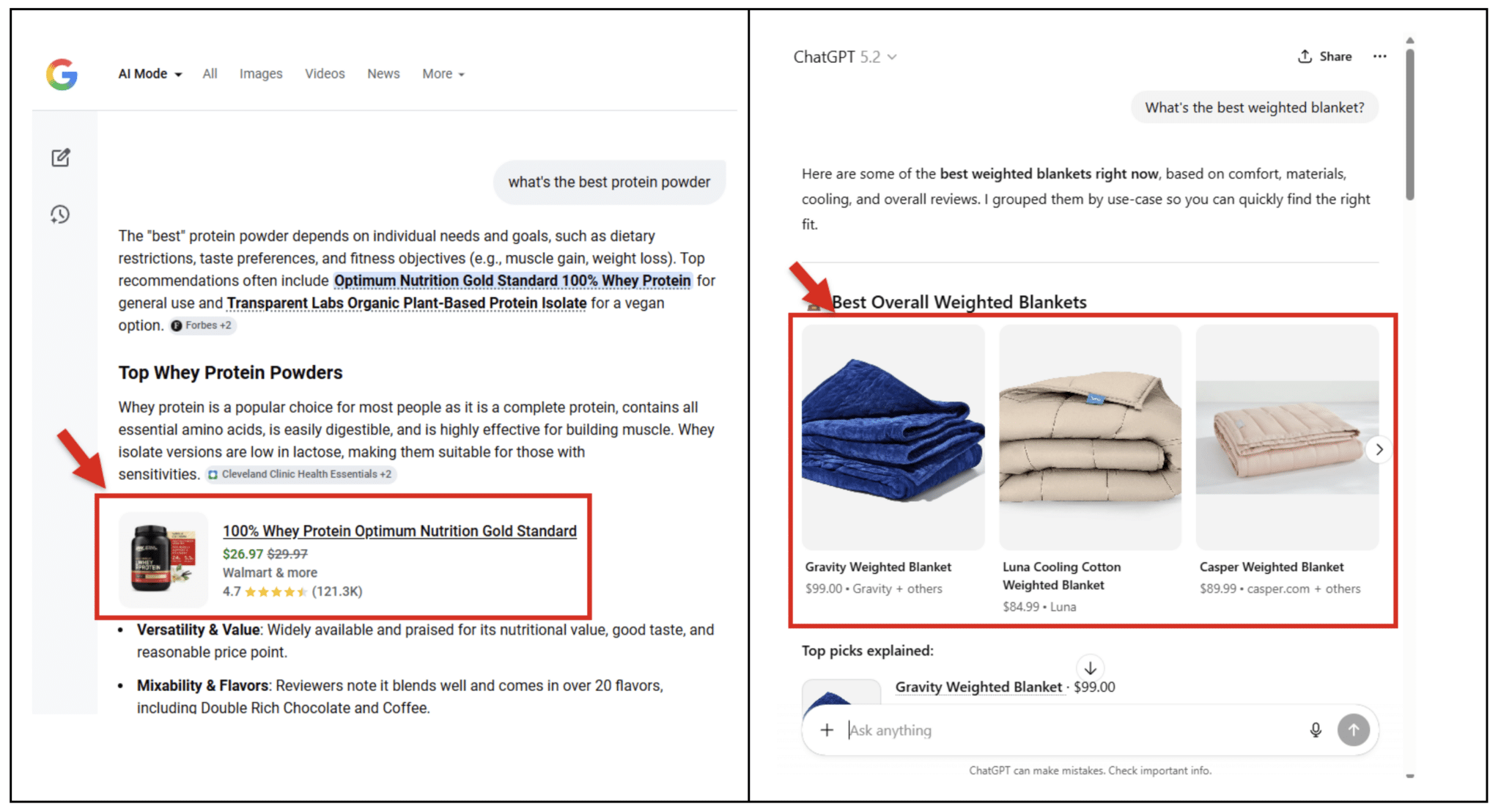
The headline number needs a precise reading. The keyword set consisted of product-intent searches whose results contained a Shopping box, whether paid or organic. Queries included products and categories such as weighted blankets, mushroom coffee, protein powder, and blue T-shirts. Within that defined set, 14.0% produced an AI Overview.
That does not mean every ecommerce site lost 14% of its traffic. It does not measure click loss, revenue loss, AI Overview citations, or the percentage of shoppers who saw the feature. It measures how often the feature appeared across the monitored keyword set. Treating penetration as a traffic-loss estimate would turn a useful warning signal into a bad forecast.
The direction is still hard to dismiss. Penetration had been 2.1% in November 2025 before reaching 14.0% in the later sample. The practical implication is that ecommerce exposure cannot be judged from ten blue links, conventional rankings, or Shopping positions alone.
Your first response should be measurement, not a sitewide rewrite. Establish which valuable queries trigger AI Overviews, whether your brand or pages appear in them, and what happens to clicks when they do. Until you separate those questions, you cannot tell whether you have an inclusion problem, a click-through problem, or no material problem at all.
Key takeaways
The 14.0% figure describes AI Overview penetration within a large set of product-intent queries that also returned a Shopping box. It is not a universal ecommerce traffic-loss rate.
Audit exposure by query intent and commercial value. A high-value comparison query deserves more attention than dozens of low-value searches combined.
Keep visible product information, JSON-LD, and commerce feeds consistent. Structured data can clarify facts, but it cannot guarantee AI Overview inclusion.
Measure AI Overview presence, brand inclusion, organic click-through rate, and conversion separately. A single visibility score cannot diagnose all four.
Improve the pages that already match exposed queries before producing large volumes of new content.
Map AI Overview exposure by query intent and value
A useful audit starts with the searches that already matter to your business. Export product-intent queries from Google Search Console, add priority terms from your keyword tracking, and connect each query to its most relevant category or product page. Include revenue or conversion value where you have it.
Do not examine this as one undifferentiated keyword list. Label the job the shopper is trying to complete. The page requirements are different when someone is exploring a category, narrowing by an attribute, comparing alternatives, or verifying a particular product.
Query pattern
Shopper’s task
What the landing page should make clear
Common audit question
Broad category, such as weighted blankets
Understand the category and available choices
Scope, meaningful differences, selection criteria, and routes to relevant products
Does the page help someone choose, or does it merely repeat the category name?
Attribute-led, such as blue T-shirts
Narrow the catalog using a required feature
Matching products, visible attributes, filters, variants, and accurate availability
Do the page title, copy, filters, products, and structured data agree?
Comparison or best-fit query
Choose between options
Factual differences, limitations, intended use, and a defensible basis for comparison
Can every comparative claim be verified on the page?
Branded or model-specific query
Confirm exact product details
Name, brand, model, identifiers, price, availability, variants, and offer details
Are facts consistent across the visible page, markup, and feed?
Use-case query
Judge whether a product fits a particular need
Supported suitability information, constraints, specifications, and relevant alternatives
Does the page answer the use case without making claims the evidence cannot support?
For every tracked query, record whether an AI Overview appears, which pages or products it includes, whether your brand is visible, the result type around it, and the observation context. Search results can vary by device, location, and observation time, so save those details instead of treating one check as permanent.
Also distinguish an AI Overview from the Shopping box used to define the original keyword set. They are separate search features. Record whether the Shopping element is paid or organic when your tooling exposes that distinction, and avoid attributing every change in click-through rate to the AI Overview.
Prioritize the intersection of commercial value and exposure. Start with queries that contribute meaningful impressions, clicks, sales, or assisted conversions and repeatedly show an AI Overview. A long list of exposed keywords is less useful than a short list tied to products and categories you can improve.
Make product information easy to verify and reuse
AI-search optimization for ecommerce is not a request to turn every product page into an essay. It is a data-quality and decision-support problem. Your pages should make important product facts explicit, keep them consistent across systems, and answer the questions that determine whether a shopper considers the product relevant.
Give category pages a decision-making job
A category page should do more than display a grid. Add concise information that helps a shopper understand the range and move toward a suitable option. The right content depends on the category, but the audit can use the same questions:
Is the category defined clearly enough to distinguish it from adjacent categories?
Are the attributes that genuinely change the buying decision explained in plain language?
Can the shopper identify which product groups fit different needs, constraints, or preferences?
Do links lead directly to useful subcategories, filters, comparisons, or products?
Are limitations and eligibility conditions visible where they affect the choice?
Keep this material specific to the products on the page. Generic buying-guide copy creates words without resolving uncertainty. If a paragraph could be pasted onto a competitor’s category unchanged, it is probably not carrying enough product information to help either the shopper or a retrieval system.
Reconcile the product page, JSON-LD, and feed
Review each priority product as one record expressed through several surfaces. The visible page is what a person reads. Product and Offer structured data describe machine-readable facts. A commerce feed may supply another version of the same product and offer information. Contradictions among those surfaces create ambiguity you can remove.
Check the product name, brand, model, stable identifiers such as SKU or GTIN when available, variant attributes, price, currency, availability, and offer details. Use the same canonical facts everywhere. If the displayed price changes by variant, make that relationship clear rather than exposing one value in the page copy and another in JSON-LD or the feed.
Structured data should describe information that is accurate and supported by the page. Do not add properties merely because they look relevant to AI search, and do not mark up promotional, review, or availability claims that a shopper cannot verify. JSON-LD improves clarity; it is not a switch that forces Google to cite, summarize, or rank a product.
After the core facts agree, look for unanswered decision questions. These may involve dimensions, materials, compatibility, care, included components, variant differences, usage constraints, shipping conditions, or returns. Add only what is applicable and supportable for that product. The goal is not maximum page length. It is minimum ambiguity.
Comparison content deserves the same discipline. State the criteria, compare equivalent attributes, and separate facts from editorial judgement. Avoid unsupported superlatives. A claim such as best, safest, or healthiest needs a defensible basis; repeating it in schema does not make it more trustworthy.
Measure visibility, clicks, and sales as separate outcomes
An AI Overview can affect several stages of search performance, and each stage calls for a different response. Build a small measurement framework rather than compressing everything into an AI visibility score.
Exposure rate: the share of your monitored shopping queries on which you observe an AI Overview.
Inclusion rate: the share of observed AI Overviews that include your brand, product, or URL under the inclusion rule you define in advance.
Organic response: impressions, clicks, click-through rate, and average position for the same query cohort.
Commercial response: conversions, revenue, lead quality, or another outcome appropriate to the catalog and buying journey.
Keep the monitored query set stable when comparing periods. Segment by intent, landing-page type, device, country, and approximate ranking band where the data supports it. Otherwise, a shift toward broader queries or lower organic positions can look like an AI Overview effect even when the query mix caused the change.
When you change a template or content cluster, record the release and preserve an unchanged comparison group when practical. Recheck the same queries and note other factors that could move results, including rankings, price, availability, promotions, seasonality, and changes to paid Shopping activity. This will not create perfect experimental control, but it will stop you from assigning every movement to the newest search feature.
Use the results to choose the next action:
No AI Overview on a valuable query: continue conventional SEO, merchandising, feed, and Shopping work. Keep monitoring rather than rebuilding the page for a feature you have not observed.
AI Overview present, brand absent: inspect the decision the overview resolves and the information its included pages provide. Check whether your relevant page lacks supported facts, comparison context, clear entity information, or consistent commerce data.
Brand included, clicks healthy: preserve the useful page elements and data consistency. Apply the pattern selectively to closely related pages instead of redesigning the whole site.
Brand included, clicks weakening: create a stronger reason to visit. Useful inventory depth, live variants, a complete comparison, detailed specifications, a selector, original product information, or a clear offer may provide value that a short summary cannot.
AI Overview appearance is inconsistent: gather more observations before making a major change. A single screenshot is evidence of one result state, not a durable performance trend.
Start with one commercially important category. Freeze its query list, capture the current search layouts, correct disagreements among the page, JSON-LD, and feed, and improve only the decision questions the existing pages leave unresolved. Then measure that same cohort again. This gives your next catalog release a clear hypothesis and gives you evidence for what to scale.
If your important pages still rank but organic visits keep thinning out, the old SEO scorecard is no longer telling you enough. AI answers, shopping modules, discovery feeds, and other search surfaces can influence a decision before a conventional click reaches your site.
You do not need to abandon SEO or chase every new interface. You need a wider visibility system: diagnose where attention moved, make your brand easy to retrieve and verify, measure whether AI systems select and cite it, and give people a reason to return directly.
Key takeaways
Treat falling organic traffic as a distribution problem before treating it as a ranking problem.
Measure AI visibility in distinct stages: discovery, selection, citation, and business impact.
Match content to the surface. A page that can earn an explanatory citation is not automatically eligible for a shopping result.
Keep brand facts, claims, evidence, and structured data consistent across the channels you maintain.
Do not use fast percentage growth in AI referrals as proof that AI traffic can replace lost search traffic.
Diagnose the traffic loss before changing your SEO strategy
The channel details matter just as much as the headline decline. In the same reporting window, Google Search pageviews fell 34% year over year and Google Discover fell 15%. ChatGPT referrals grew 200%, yet still represented less than 1% of overall traffic. A rapidly growing channel can remain too small to close the absolute gap left by a much larger one.
Traffic has not simply disappeared. Total weekly publisher pageviews declined by 6% from 2024 to 2025 while direct, internal, and messaging channels expanded. That pattern should change your diagnosis: do not assume every organic loss means your rankings, technical SEO, or content quality suddenly failed.
Start by separating four signals that are often blended together:
Impressions: If impressions fell, investigate demand, topic coverage, indexing, and ranking visibility.
Clicks: If impressions or positions are steady but clicks fell, inspect the search-result experience and query intent before rewriting the page.
Landing-page outcomes: Identify which lost visits previously generated leads, sales, subscriptions, or meaningful engagement. A pageview decline and a qualified-demand decline are not automatically the same problem.
Channel mix: Track conventional search, Discover, AI referrals, direct visits, messaging, and internal recirculation separately. Combining them hides where attention is moving.
Also split branded from non-branded demand. Falling non-branded clicks indicate a discovery problem. Falling branded demand points to a broader brand problem. That distinction determines whether your next investment belongs in page-level optimization, wider distribution, reputation work, or audience retention.
Replace the ranking funnel with a visibility funnel
A ranking is an intermediate signal. In an AI-mediated journey, your brand must first enter the system’s candidate set, then be chosen for the response, and sometimes be cited as supporting evidence. AI search can use query fan-outs to retrieve information across related subquestions before selecting material. A page can therefore rank for one visible query while missing the supporting questions that influence an AI-generated answer.
Use three AI-specific stages, then attach a business outcome to them:
Discovery: Can the system retrieve your page, brand, product, expert, or claim for the relevant topic and its related subquestions?
Selection: Does the system name or use your brand when composing its answer, recommendation, comparison, or summary?
Citation: Does the response provide a link or identifiable reference to a page you control?
Business impact: Does that exposure produce qualified visits, branded demand, leads, sales, subscriptions, or returning users?
This sequence gives you a better troubleshooting method than a single visibility score. If the brand is not discovered, look at crawlability, entity clarity, topical coverage, and whether you answer the related questions. If it is discovered but rarely selected, strengthen relevance, evidence, differentiation, and fit for the user’s constraints. If it is named without a citation, make the supporting page easier to identify and substantiate. If citations produce no useful action, examine prompt intent, audience fit, and the destination page rather than celebrating the mention.
Engineer content for retrieval, evidence, and the right surface
Begin with one commercially important topic and map the questions an AI system may need to resolve around it. Include the core problem, relevant entities, selection criteria, user constraints, use cases, comparisons, tradeoffs, supporting proof, and conditions that change the answer. You do not need to force all of this onto one oversized page. You do need an intentional cluster with clear relationships and internal links.
Every important page in that cluster should pass a practical retrieval test:
The opening states what the page resolves without making the reader decode a long preamble.
Headings follow real tasks and decisions, not a list of loosely related keyword variations.
Products, services, organizations, people, locations, versions, and categories are named precisely where they matter.
Evidence sits close to the claim it supports, with limitations and applicable conditions stated plainly.
Comparison content explains who each option fits, what changes the decision, and where a fair comparison is not possible.
Important facts agree across visible copy, metadata, structured data, product information, and maintained public profiles.
JSON-LD can reinforce this work by expressing page entities and relationships in a machine-readable form. It cannot rescue vague copy, manufacture authority, or guarantee a citation. Mark up facts that are actually visible and supported on the page, choose schema types that match the content, and remove conflicting or obsolete values when the underlying information changes.
Treat that result as a strong platform-specific testing hypothesis, not a permanent specification. Interfaces and triggers can change. The immediate lesson is still useful: optimize for the result type your offer can realistically enter.
If you sell shippable goods: Make the product category, intended use, meaningful features, and relevant buying constraints explicit. Keep those facts consistent between the product page, supporting content, and product data.
If you sell software or services: Do not stuff purchase-intent phrases into pages in the hope of forcing a shopping card. Focus on explanatory retrieval, comparison context, evidence, qualification criteria, and a clear path to evaluation.
If you cover travel or financial products: Separate informational visibility from shopping visibility in your reporting. A useful citation or brand selection may be the realistic win even when a product card is not.
This is why universal AI optimization checklists fail. The query, entity category, interface, and desired result type determine what visibility can look like.
Make your brand verifiable beyond its own website
As search referrals shrink, an unknown publisher or brand has fewer chances to turn a borrowed visit into recognition. The safer position is to be consistently identifiable across the places where people encounter, validate, and return to you.
Omnichannel visibility does not mean opening an account everywhere. It means maintaining a coherent set of facts and evidence wherever your audience actually evaluates you. Create a simple brand evidence map with the following fields:
Canonical identity: The preferred brand name, primary website, category, audience, and concise description of what the organization does.
Core entities: Products, services, authors, experts, locations, and other named things that repeatedly appear in your content.
Material claims: The statements that affect a buying or trust decision, paired with the page or evidence that supports each one.
Public consistency: The profiles, listings, documentation, media, community pages, and other maintained surfaces where those facts should agree.
Update ownership: The person or workflow responsible for correcting outdated descriptions, renamed products, changed URLs, and unsupported claims.
Use that map to fix contradictions before producing more content. If your category changes from one profile to another, an offer has several names, or an author bio makes expertise impossible to verify, additional publishing scales the ambiguity.
Distribution should then carry useful evidence, not cloned promotional copy. Publish the definitive explanation on the most appropriate owned page. Adapt it for the channels where the audience discusses or validates the subject. Link back when a link genuinely helps the user. Earn independent mentions through work worth referencing; do not try to simulate corroboration with duplicated properties or fabricated consensus.
At the same time, strengthen the path from first encounter to direct relationship. Direct, internal, and messaging channels expanded while search became a smaller share of publisher traffic. Give a qualified visitor an obvious next step: subscribe, save a tool, follow an update stream, join a relevant community, or move to the next useful page. The right action depends on your business, but relying on another search click should not be the only way someone can find you again.
Measure AI visibility without mistaking noise for progress
Referral analytics alone cannot measure AI visibility. A system may mention a brand without linking, cite a page that earns few clicks, or influence a later direct visit. Conversely, one unusual referral can look important when the underlying volume is tiny.
Build a stable prompt set around decisions that matter to the business. Include category discovery, problem-solving, comparison, constrained recommendation, and branded verification prompts. Add shopping-constrained prompts only where the offer category makes them relevant. For every observation, record:
The engine and specific interface tested.
The exact prompt, including its constraints.
The date of the observation.
Whether the brand was absent, discovered, selected, or cited.
The wording and context of the mention, including any material inaccuracy.
The cited URL and the page a user would reach.
The business intent represented by that prompt.
Keep the core prompts unchanged when you repeat the check. Otherwise, you cannot tell whether the system changed or your test changed. Treat an isolated appearance as an observation, not a trend, and retain screenshots or response records so that later reviews are based on evidence rather than memory.
Pair that prompt log with three groups of business data:
Acquisition: Search, Discover, AI referrals, direct visits, messaging, and other meaningful channels.
On-site behavior: The destination pages, next-page paths, subscriptions, enquiries, and other qualified actions.
Commercial outcomes: Leads, sales, retained users, or the outcome your organization is actually trying to create.
Then prioritize by value and failure stage. Protect topics that produce meaningful outcomes and remain highly dependent on search. Repair high-value topics where your brand is retrieved but not selected. Strengthen the supporting page when the brand is selected without a useful citation. Improve the destination when citations arrive but qualified action does not. Leave low-value visibility gaps alone until the evidence gives you a business reason to pursue them.
For your next work cycle, choose one revenue-relevant topic and take it through the entire system: channel diagnosis, query fan-out, page and entity cleanup, evidence mapping, appropriate structured data, distribution, and a repeatable visibility baseline. One complete loop will teach you more than a broad collection of disconnected AI SEO tactics.
Most content out there tends to be too generic, making it less effective in AI search. I’ve discovered that using customer personas allows me to pinpoint real problems and step into the search space much earlier.
Whenever buyers pose a question, my goal is to deliver a clear answer. That’s essentially the “They Ask, You Answer” (TAYA) framework, which thrives even in AI-driven discovery.
Though it sounds straightforward, I’ve seen many teams struggle to anchor their approach. This typically results in generic questions that lead to generic content.
This is problematic since AI is transforming search behavior, shifting from simple queries to in-depth, context-rich questions. The difference lies in the questions we choose to answer, and that’s where customer personas shine.
The Problem with Generic Questions
Chances are, both I and my competitors have tackled these generic questions already or could do so quite easily.
The trap of generic questions occurs when marketing teams, including mine at times, begin brainstorming content ideas with broad topics like:
What is CRM software?
What is marketing automation?
What is warehouse management?
While reasonable, these questions are not what real buyers ask. Real buyers ask questions based on their specific situations, such as:
“What CRM should a 10-person sales team use?”
“Why are leads slipping through the cracks in our marketing?”
“Why is our warehouse picking speed so slow?”
This distinction is subtle but crucial. The second set of questions integrates a person and a problem, transforming the quality of the content I produce.
Why This Matters More in AI-Driven Discovery
With AI, buyers are asking detailed, context-rich questions, such as:
“I run a 15-person marketing team, and we’re struggling to track leads properly. What should we do?”
The AI provides explanations, outlines solutions, and suggests vendors, essentially giving the buyer a consultation. My content’s job is to explain why a specific persona faces a specific issue, framing how it should be perceived.
This positions me into the conversation earlier, increasing the likelihood of staying top of mind as the user’s understanding evolves.
Imagine this scenario, using myself as the subject:
Marcus.
50 years old.
Meeting old friends in Birmingham, UK.
Looking for things to do for the day.
I might start with a broad question:
“I’m looking for some things to do with friends in Birmingham on the weekend. I’m 50, and I have some old friends visiting for a day. We’ll enjoy some beers, but need activities too.”
The answers might include bars, food, and activity bars. An F1 gaming arcade could be suggested, sparking my interest since I enjoy games but not cars, which prompts my follow-up question:
“Ah, we all like games. What gaming arcades could you recommend?”
The responses might highlight a pinball arcade in Digbeth.
“Pinball Factory in Digbeth sounds fun. What else is there to do around there, food- and drinks-wise?”
This kind of dialogue allows me to refine my day’s plan perfectly for my friends.
Being part of the conversation from the start helps shape the dialogue and boosts the chance of being included in the final decision.
Personas Make TAYA Far More Precise
With personas, I think like my customers, identifying the questions they might ask long before they reach my offerings.
When I define a customer segment, I delve into that persona, understanding their problems and goals to think like them, which helps in crafting content that answers their early-stage questions.
Instead of creating content for a vague audience, I focus on real people, addressing specific needs like, “The best day out in Birmingham for a group of 50-year-old gamers.”
This small shift often leads to valuable content, positioning me within meaningful conversations rather than competing on crowded commercial queries.
A Simple Way to Uncover Better Questions
No need for a complex persona framework. Often, a simple three-question exercise reveals the problems buyers seek to solve.
For each persona, I ask:
What are they responsible for? Examples include sales targets, marketing leads, or warehouse operations.
What problems complicate that responsibility? Issues like missed targets or inefficient operations might arise.
What might they search for when facing these problems?
Now, the questions I generate differ greatly from generic ones:
Instead of saying: “What is CRM software?”
I see questions like:
“Why are leads slipping through the cracks in our CRM?”
“What CRM should a small sales team use?”
“Why is our warehouse picking speed so slow?”
These questions reflect real situations, providing the most substantial content opportunities.
‘They Ask, You Answer’ Works Better with Personas
TAYA covers five key areas: cost, problems, comparisons, reviews, and best-of. These topics offer structure, but approached generically, they mirror what everyone else is doing.
Generic questions like:
“How much does CRM software cost?”
“What problems do warehouse systems have?”
“HubSpot vs. Salesforce”
“Best CRM systems”
“Salesforce review”
Can be transformed into more targeted questions:
“What does CRM cost for a 10-person sales team?”
“Why do my warehouse managers struggle with picking accuracy?”
“HubSpot vs. Salesforce for a small B2B marketing team”
“Best CRM for growing sales teams”
“Is Salesforce suitable for a mid-size sales organization?”
Although the topic remains the same, the approach is tailored to the buyer’s reality. This makes the content more useful and aligns with AI interactions.
Targeted questions might include:
“We’re a small marketing team struggling to track leads properly. What CRM should we use?”
If my content already answers these persona-centered questions, it increases the chance of my explanations becoming part of their conversation.
In short, personas enhance TAYA by transitioning from broad topics to specific questions associated with real problems, improving the content and aligning better with buyers’ needs.
Start with the Problem, Not the Product
A common misstep in content marketing is leading with the product. Buyers, however, start with a problem.
By using personas, I anchor content in the buyer’s perspective rather than my own, ensuring the focus is on the customer.
This change can mean the difference between influence and mere existence of my content.
Where You Enter the Conversation Matters
“They Ask, You Answer” is an effective framework when the questions I address are of high quality.
Personas help in turning vague topics into precise problems, resulting in content that resonates with buyers and AI systems while earning their trust.