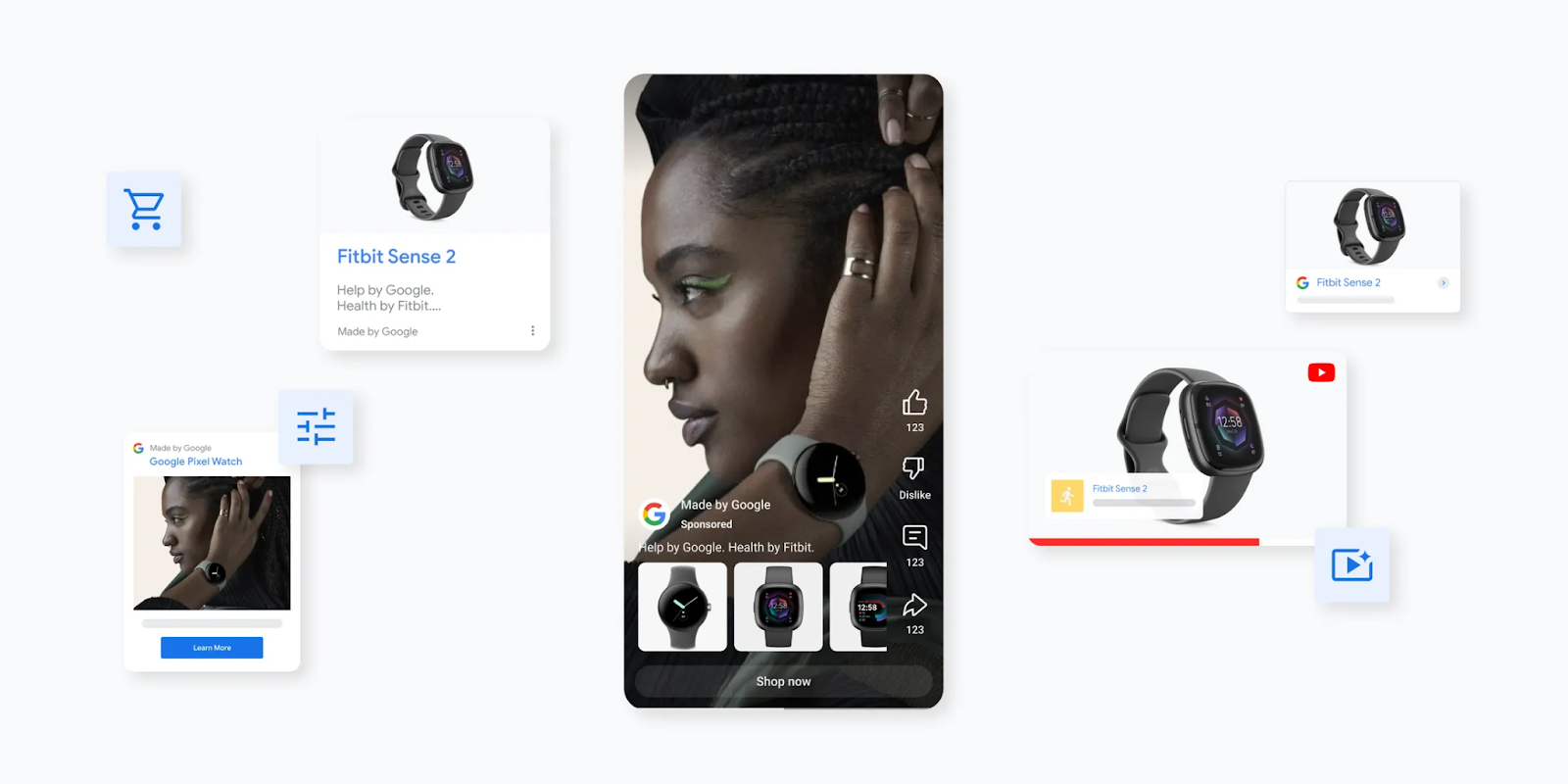
When Google introduced Demand Gen campaigns in 2023, I saw them as a promising way to boost engagement across platforms like YouTube, Discover, and Gmail.
Initially, they felt experimental, straddling the line between awareness and performance, but they’ve come a long way since.
Now, the creative flexibility and enhanced audience control make Demand Gen a go-to campaign type for my ecommerce clients.
This strategy allows me to scale revenue in a controlled manner, maintaining brand consistency while testing creative approaches to drive conversions.
I’ve found that Demand Gen delivers the best results when strategically paired with Performance Max and Search campaigns.
Advertising with Demand Gen is ideal if you crave more control.
One major drawback of Performance Max is its lack of transparency and manual control.
If precise targeting, placement, or creative control is essential, Demand Gen stands out as the better option.
Performance Max auto-generates ads from your uploads, relying on Google’s AI to mix and match for the best performance.
This makes it crucial to provide top-notch creative assets.
For example, a fitness brand might create separate asset groups for products like leggings, shorts, and vests.
While this helps target relevant audiences, the control isn’t exhaustive.
However, Demand Gen offers far superior flexibility.
It allows me to upload, preview, and tweak ad combinations before launch, adapting each creative to its unique placement.
For instance, I can customize YouTube ads for in-feed, in-stream, and Shorts placements.
This control is perfect for ecommerce brands focusing on creative precision, message testing, and maintaining a strong visual identity.
Using Demand Gen alongside Performance Max can be incredibly effective if you leverage their roles within the customer journey. They enhance each other rather than compete.
Demand Gen builds awareness and sparks interest by reaching higher-funnel audiences before they actively start product searching.
Conversely, Performance Max focuses on converting lower-funnel users who are primed to purchase.
For example, a fitness retailer might utilize Demand Gen for lifestyle videos and discovery ads promoting their latest activewear.
When a potential customer begins to research or exhibit purchase intent, Performance Max engages with tailored Shopping and Search ads to finalize the sale.
I’ve set up feed-only Performance Max campaigns, providing only a product feed within the asset group.
This restricts Performance Max activities to Shopping placements, focusing it sharply on direct conversions.
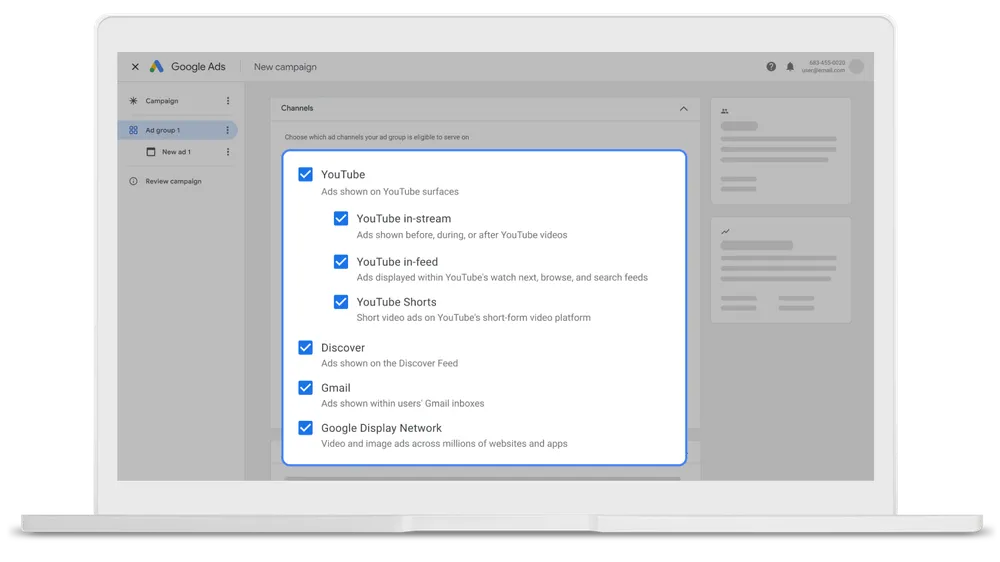
Meanwhile, Demand Gen operates across platforms like YouTube, Gmail, Discover, and Shorts, covering the upper and mid-funnel with more visual, creative content focused on awareness.
This configuration minimizes overlap between campaign types while ensuring user engagement throughout the funnel, from brand discovery to purchase.
For larger accounts with flexible budgets, this dual structure drives holistic performance and clearer attribution.
In contrast, smaller accounts seeking efficiency should prioritize mastering high-intent campaigns before layering in Demand Gen once the core conversions are stable.
The diverse campaign types now offer advertisers more flexibility than ever, yet it requires understanding Google’s restructuring of video and discovery products.
It streamlines Google’s visual placements into one campaign type, including YouTube in-stream, Shorts, in-feed, Gmail, and Discover.
This change is significant. VAC was successful for ecommerce, particularly for conversion-centric video. Its removal underscores Google’s encouragement to embrace Demand Gen.
The advantage is that Demand Gen provides stronger creative control and diverse testing options across YouTube placements.
If you previously ran VAC campaigns, they are now under Demand Gen. Ensure your top-performing assets and audiences have migrated correctly, then use the new controls to optimize performance.
Audience control is a significant benefit of Demand Gen, and it’s a reason why I consistently use it for ecommerce.
Demand Gen allows precise audience creation, letting me decide who sees the ads.
I can select placements, merge audience types, and allocate the budget strategically.
It’s the only Google Ads campaign type supporting lookalike audiences, valuable for brands focused on acquiring quality leads.
While Performance Max utilizes audience signals over fixed targeting, Demand Gen excels for control, testing, and segmentation strategies.
In mid-2025, Google rolled out an open beta for advertisers to opt out of specific Demand Gen channels manually.
This means I can now control ad display, excluding Discover or YouTube Shorts if they don’t align with my objectives or creative format.
This small but significant update offers more control, a feature often lacking in many of Google’s automated campaign types.
In early 2025, Google introduced product feed integration for Demand Gen campaigns. This change allows me to link the Google Merchant Center feed, incorporating live product data directly into visual ads.
This development bridges performance and branding for ecommerce, enabling storytelling through creative visuals while displaying actual products.
For instance, a fashion retailer can showcase a new collection in a video advert while featuring shoppable product cards below.
This update positions Demand Gen as a hybrid between Shopping and Display, a much-anticipated capability among ecommerce advertisers.
Demand Gen typically demands a larger budget than other campaign types.
Google recommends starting at about £100 per day per campaign or 20 times your target CPA/tROAS, whichever is higher.
Practically, the £100-per-day baseline is a viable starting point for effective data collection and optimization. Lower budgets restrict data flow and slow progress.
Demand Gen complements your broader Google Ads strategy, rather than replacing Search or Performance Max.
It’s a premium, visually led campaign type that boosts awareness leading to conversions, particularly effective when you have accurate measurement, a clean product feed, and clearly defined audiences.
The table compares Demand Gen and Performance Max on key aspects that matter to advertisers.
If you are choosing an industrial marketing agency, a polished proposal is the easy part. The harder question is whether the team can learn a technical offer, earn access to your subject-matter experts, reach the people involved in the purchase, and show what became qualified pipeline.
A candidate pool gives you names. A disciplined selection process tells you which agency can actually do the work. Use the framework below to prepare your brief, test technical fluency, compare proposals, and protect the engagement before you sign.
Write the buying brief before you build the shortlist
Do not begin with a list of services you think you need. Begin with the commercial problem the agency must help solve. Otherwise, every proposal will describe a different interpretation of success, and you will be comparing presentation quality rather than strategic fit.
Prepare a compact decision brief with the following information:
Commercial outcome: State whether the priority is qualified pipeline, entry into a market, distributor support, aftermarket growth, account expansion, product adoption, or another defined business result.
Offer boundary: Name the products, services, applications, territories, and customer segments that are in scope. Identify what is explicitly out of scope.
Buying group: List the people who use, specify, approve, purchase, install, maintain, or resell the offer. Do not flatten them into a generic buyer persona.
Available evidence: Inventory approved specifications, certifications, performance data, technical drawings, case material, expert commentary, customer proof, and product imagery. Mark anything that requires legal, engineering, or customer approval.
Valuable conversion: Define the actions that matter, such as a qualified request for quote, sample request, site visit, consultation, drawing download, specification download, phone call, or distributor inquiry.
Measurement path: Identify the CRM stages, lead-status definitions, sales owner, and reporting systems that will determine whether marketing activity produced useful demand.
Operating constraints: Document restricted claims, regulatory reviews, channel conflicts, brand requirements, development limitations, subject-matter expert availability, and internal approval steps.
Replace goals such as “increase awareness” or “generate leads” with language your sales team can recognize. For example, define what information an inquiry must contain before sales can quote it, which customer types are commercially attractive, and which inquiries should be excluded. If marketing and sales cannot agree on a qualified inquiry, an agency cannot optimize toward one.
Set your disqualifiers at the same time. These might include weak analytics capability, no technical review process, outsourced execution with no named owner, unclear account ownership, or an unwillingness to work inside your claims-approval rules. A disqualifier should remain a disqualifier even when the pitch is impressive.
Test industrial fluency with a real working session
An agency does not need to arrive knowing every detail of your process. It does need a credible method for learning technical material without turning it into vague benefit copy. You can see that method more clearly in a working session than in a capabilities deck.
Give each finalist the same public product or service page and the same application context. Ask the proposed team to work through these questions with you:
What does the offer do, where does it fit, and where does it not fit?
Which facts are clear, which are unsupported, and which require an expert to verify?
Who uses the offer, who specifies it, who approves it, and who controls the purchase?
What operational problem brings a buyer to the page, and what information would help that buyer continue evaluating?
What proof would make the central claim credible?
Which search questions, comparison questions, and implementation questions should the content answer?
What should the visitor do next, and what would make that action useful to sales?
What would the team need from engineering, product, sales, service, compliance, or distribution before publishing?
Pay attention to the questions the agency asks. Strong discovery separates facts from assumptions, notices exclusions and tradeoffs, and identifies the internal expert who can resolve each uncertainty. Weak discovery paraphrases the existing page, adds generic adjectives, and starts recommending channels before the buying problem is understood.
Ask for evidence of the working process, not just customer logos. Useful evidence can include a redacted content brief, an interview guide for a technical expert, a claims-review workflow, a campaign measurement specification, a reporting example, or a before-and-after explanation of how a technical page was improved. The closest match is not always an identical industry. Comparable product complexity, buying risk, sales motion, and review constraints can be more revealing than a familiar vertical label.
Confirm who produced each example and whether those people will work on your account. Agency credentials matter less when the proposed delivery team did not create the work being shown.
Judge the channel plan as a connected demand system
Industrial demand rarely fits neatly inside a single campaign report. A buyer may discover a problem through search, compare technical approaches, return through a branded query, download a drawing, speak with a distributor, and enter the CRM under a different source. Your agency should design the content, channels, conversion paths, and measurement rules as parts of the same system.
Make technical content useful before making it plentiful
Ask the agency to propose a page architecture based on buyer tasks, not a publishing quota. Depending on your offer, that architecture may include:
Product or service pages that explain fit, exclusions, specifications, constraints, evidence, and the appropriate next action.
Application pages that connect an operating condition or use case to a suitable solution without pretending every product fits every environment.
Technical answer pages that address selection, compatibility, troubleshooting, maintenance, installation, or implementation questions your experts can answer accurately.
Comparison and alternative pages that explain meaningful tradeoffs rather than declaring your offer universally superior.
Proof pages that organize approved performance evidence, certifications, case material, processes, and expert qualifications.
Commercial access pages that help a visitor request a quote, locate a distributor, submit project details, download the correct resource, or reach the appropriate team.
For search, answer engines, and generative systems, the fundamentals still have to be present on the page. The agency should make products, services, applications, organizations, and expert claims unambiguous; answer important questions directly; connect related pages with purposeful internal links; and use applicable structured data that agrees with the visible content.
Ask who selects the structured-data types, who validates the markup, how conflicts with existing plugins or templates are handled, and what triggers an update when the page changes. JSON-LD can clarify machine-readable facts. It cannot repair an unsupported claim, a confused page, or missing evidence. Treat guaranteed rankings, guaranteed AI citations, and guaranteed inclusion in generated answers as disqualifiers.
The same discipline applies to paid search, paid social, email, industry media, distributor programs, and event support. For every proposed channel, require the agency to state:
Which audience condition or buying task the channel addresses.
Which offer and asset the audience will encounter.
Which next action is appropriate at that stage.
Which signal will indicate useful progress.
Which evidence would cause the team to change or stop the tactic.
Make measurement survive the sales handoff
A useful measurement design follows the path from campaign or source to landing page, conversion, CRM record, sales disposition, and opportunity. A dashboard that stops at impressions, clicks, rankings, or sessions cannot tell you whether the agency is attracting commercially relevant demand.
Require a measurement specification before launch. It should identify each tracked action, the data captured with it, the CRM destination, the person responsible for follow-up, the treatment of duplicates and spam, and the check used to catch broken forms or tags. Campaign identifiers, call tracking, form fields, consent handling, and offline sales updates should fit the systems you actually use.
Marketing should not invent revenue attribution after the fact, and sales should not leave every lead status blank. Agree on shared definitions before judging performance. The most useful report shows not only what happened, but which audience, message, page, offer, or channel should receive more investment, correction, or removal.
Compare proposals by evidence, dependencies, and ownership
Standardize your evaluation before proposals arrive. Mark each requirement as mandatory or preferred, then record the evidence as confirmed, assumed, or missing. This prevents a polished presentation from quietly compensating for a fatal weakness elsewhere.
Evaluation area
Evidence to request
Warning sign
Technical discovery
Product and buyer hypotheses, open questions, expert-interview plan, and claims-review process
Generic personas and recommendations formed before technical discovery
Strategy
Clear connection between the commercial objective, buyer task, channel role, offer, and conversion
A menu of tactics with no decision logic
Content quality
Representative brief, source requirements, technical review steps, and approval ownership
A production-volume promise with no accuracy workflow
SEO, AEO, and GEO
Page architecture, query and intent mapping, entity clarity, internal linking, structured-data governance, and update plan
Guaranteed rankings, citations, or generated-answer placement
Measurement
Event definitions, CRM mapping, lead-status rules, dashboard example, and data-quality checks
Reporting limited to visibility and traffic
Delivery team
Named roles, allocation assumptions, escalation path, and examples produced by the proposed team
Senior specialists sell the engagement but disappear from delivery
Commercial model
Included deliverables, client dependencies, media treatment, change-control process, and acceptance criteria
A vague retainer that leaves scope and accountability open to interpretation
Ownership and access
Written terms for accounts, data, source files, creative assets, tracking, code, and transition support
Critical systems remain under an agency-controlled identity
Ask every finalist to solve the same working problem and use the same evaluation areas. Do not score a claim such as “we can handle analytics” as evidence. Score the measurement design, sample output, named owner, and proposed quality checks.
Reference conversations are more useful when you ask about operating behavior. Find out who actually performed the work, what the client had to supply, how the agency handled technical corrections, whether reporting changed decisions, and what happened when priorities shifted. Speak with the people who will manage and execute your engagement as well as the people selling it.
Contract for learning, ownership, and a clean handoff
The contract should turn proposal language into operating rules. Have the appropriate commercial and legal owners review the terms before signature. Unclear ownership or access provisions can make an agency change expensive, interrupt measurement, or leave you without editable assets.
Resolve these points in writing:
Scope and acceptance: Define included and excluded work, review rounds, approval criteria, and the process for changing priorities.
Client dependencies: Name the access, technical experts, product data, approvals, development support, and sales feedback your team must provide.
Claims governance: Identify who can approve performance claims, comparisons, certifications, customer references, and regulated language.
Account control: Use company-controlled identities for analytics, advertising, search tools, tag management, domains, repositories, and other critical systems. Give the agency the access it needs without making it the only administrator.
Data handling: Define permitted access, storage, retention, deletion, confidentiality, and incident responsibilities for lead, customer, employee, and account data.
Fees and spend: Separate agency fees, media spend, software costs, production expenses, and pass-through charges so the budget can be reconciled.
Transition: Specify how credentials, documentation, files, active campaigns, reporting history, and open work will be transferred when the engagement ends.
If important uncertainty remains, structure the initial phase around a decision checkpoint. Useful outputs include approved positioning, a claims and evidence inventory, a prioritized page architecture, a measurement specification, a representative deliverable, and an execution plan with dependencies. You can then continue, revise the scope, or stop based on visible work rather than optimism.
Key takeaways
Brief the agency in commercial and sales language before discussing channels.
Test the proposed team on a real product, application, and buying problem.
Look for a disciplined learning and technical-review process, not superficial familiarity with industry terminology.
Evaluate content, SEO, AEO, GEO, paid media, conversion, CRM handling, and reporting as a connected demand system.
Require evidence for every capability claim and reject guarantees the agency cannot control.
Keep critical accounts, data, editable assets, and documentation accessible through company-controlled systems.
Your next move is practical: finish the decision brief, choose a representative working problem, and send both to every serious finalist. The strongest choice will be the team whose reasoning stays coherent from product truth and buyer need through conversion, sales acceptance, and measurable pipeline.
You may be staring at several polished agency proposals that all promise strategy, content, search visibility, and growth. The difficult part isn’t finding a capable-looking firm. It is determining which firm understands your revenue path, can work safely inside your approval process, and will let you verify what it actually contributes.
Write the brief around the revenue path, not marketing services
Healthcare and medtech sit near each other on an industry map, but they do not automatically create the same agency brief. A provider organization may need to turn local demand into qualified appointment requests. A medtech company may need to educate clinicians, administrators, procurement stakeholders, distribution partners, or other participants before a commercial conversation can advance.
If you ask for SEO, content, paid media, or AI optimization before defining that path, agencies will sell the services they already deliver. Start with the change your organization needs and work backward to the marketing capability.
If you market a practice or care-delivery organization
Name the service line and location you need to support. Local visibility for a specific service is a different assignment from national brand building.
Define a qualified conversion. It might be an appointment request, a call that meets your intake criteria, or a professional referral inquiry. A raw form submission is not automatically a useful lead.
Describe the path after conversion. Tell the agency who receives the inquiry, how eligibility or fit is assessed, and where the result is recorded.
State operational constraints. If a location, clinician, or intake team cannot absorb additional demand, more traffic can create a worse patient experience without improving the business.
List the people who approve medical statements, patient-facing language, advertising claims, and reputation responses. The agency needs to design around that workflow.
If you market a medical technology
Map the audience chain. Separate the people who use the technology, evaluate it, approve it, purchase it, distribute it, and search for information about it.
Name the decision friction. You may need category education, technical explanation, economic justification, evidence discovery, or help distinguishing the product from an established alternative.
Choose a meaningful commercial action. A demo request, distributor inquiry, sales-accepted conversation, or engagement from a target organization can be more informative than undifferentiated lead volume.
Document the evidence boundary. Give the agency the approved language, supporting material, prohibited claims, required review steps, and owner of each decision.
Identify geographic and organizational complexity. A single-market campaign should not be scoped like a multi-region program that must balance central messaging with local relevance.
Turn those decisions into a short brief before you take another sales call. Include the business outcome, audience, current obstacle, desired conversion, geographic scope, approval owners, evidence constraints, available assets, required systems, and definition of a qualified result. Add explicit non-goals as well. If brand awareness is not the assignment, say so. If the agency will not control paid media, website development, or sales operations, say that too.
This brief makes proposals comparable. It also reveals whether an agency can reason from your problem or merely translate its standard package into healthcare language.
Match the agency model to the bottleneck you actually have
Choose a local-search specialist when patients must discover a particular location or service in geographically relevant results. Ask for evidence of location architecture, business-profile management, local content judgment, review workflows, and conversion tracking through intake.
Choose an authority-and-content specialist when your audience cannot make progress without credible education. Ask to see how topics are selected, how subject-matter experts participate, how claims are checked, and how content connects to an intended commercial action.
Choose a technical website and SEO firm when crawlability, site structure, publishing friction, accessibility, performance, or an impending rebuild is the main constraint. Require a clear division between diagnosis, implementation, design, content migration, validation, and ongoing optimization.
Choose a reputation-led agency when trust signals, inconsistent profiles, or the handling of public feedback is obstructing demand. Ask who is authorized to respond, which issues are escalated, and how the work connects to brand and search visibility without exposing sensitive information.
Choose a multi-location or international specialist when central control and local relevance keep colliding. Ask the agency to show how it governs shared templates, local pages, market-specific review, brand consistency, and reporting across regions.
Choose an integrated firm when channel coordination is the bottleneck. A broad agency can be useful when the same strategy must govern web, search, content, advertising, and social execution. Make it identify the owner of the integrated plan; a bundle of separate channel teams is not automatically integration.
Choose a social-and-search model when audience discovery genuinely crosses those surfaces. Require a clear role for each channel and a method for recognizing when social attention creates branded search, site engagement, or a qualified inquiry.
Do not buy a larger service bundle just because it appears more complete. If the real problem is medical-content production, adding paid media and social posting may increase coordination before it increases performance. Conversely, a narrow SEO firm may be the wrong choice when your website, analytics, intake process, and brand message all need coordinated repair.
Ask each agency to identify the bottleneck in its own words. Then ask what it would defer. A credible prioritization includes work that should not happen yet.
That weighting is a useful starting structure, not a universal procurement rule. Adjust the emphasis before opening proposals. A sensitive content program may deserve more emphasis on compliance and subject-matter workflow. A rebuild may require more scrutiny of technical delivery. A highly specialized device may make relevant audience and category experience more important than the size of the agency’s general healthcare portfolio.
Criterion
Benchmark weight
Evidence to request
Average review score
30%
Recurring themes from clients with comparable scopes, including what happened when delivery was difficult. Treat a rating as a lead for verification, not proof by itself.
Healthcare industry experience
25%
Work involving a similar audience, business model, review burden, and conversion path. General healthcare logos do not establish experience with your particular problem.
Leadership experience
15%
The named person accountable for strategy, their relevant background, and their actual involvement after the sale.
Client portfolio size
10%
Relevant active work, team capacity, possible conflicts, and an explanation of how resources will be assigned to your account.
Compliance expertise
10%
An actual workflow for evidence, medical review, advertising review, privacy-sensitive access, escalation, approval, and revision history.
Median employee tenure
5%
The expected delivery team, continuity of key roles, and the handoff plan if a strategist, writer, or account lead changes.
Media references and case studies
5%
Cases that define the starting problem, agency contribution, measurement method, relevant constraints, and result. Ask which parts can be independently verified.
Rate the evidence behind each answer as verified, plausible but unverified, or absent. Keep that confidence judgment separate from the agency’s claimed capability. A beautiful case study with an undefined baseline should not outscore a less dramatic example with a clear method and comparable scope.
Set disqualifiers before scoring. Reasonable examples include refusal to follow your medical or legal review process, uncertainty about who owns core accounts and content, an unexplained need for sensitive data, a material client conflict, or guarantees of rankings and AI recommendations that the agency cannot control. A disqualifier should represent unacceptable exposure, not merely a preference.
Put finalists through one real working session
References and proposals tell you what an agency wants you to believe. A controlled working session shows you how its team thinks. Give every finalist the same redacted scenario and the same information. Do not share real patient information or sensitive commercial material merely to make the exercise realistic.
Present the business problem without prescribing the channel. Ask the team to identify the audience, conversion, unknowns, constraints, and likely bottleneck before proposing tactics.
Request a prioritized first phase. The team should distinguish prerequisites from experiments and explain what it would postpone. Listen for dependencies on your website, analytics, subject-matter experts, intake operation, or sales process.
Test the content workflow. Provide a fictional or already approved example claim and ask how it would become a page, campaign, or answer-ready content asset. Require the team to identify where evidence, medical review, compliance review, and final approval enter the process.
Trace measurement from discovery to business outcome. Ask the agency to draw the path from a search result, AI answer, advertisement, or social interaction through the website and into the system where your organization accepts or rejects the inquiry.
Examine the AI-search plan separately. Ask which user questions it will monitor, how it will assess brand mentions and citations, which on-site changes it expects to make, how structured data fits the work, and how it will distinguish visibility from a qualified outcome.
Review the operating model. Confirm the day-to-day team, decision rights, meeting purpose, reporting inputs, revision process, account ownership, content ownership, data access, and offboarding handoff.
Make compliance visible in the workflow
Compliance expertise should produce more than a badge in a capabilities deck. Ask the agency to draw the route from topic selection to evidence collection, drafting, subject-matter review, compliance or legal review, publication, monitoring, and later revision. Every handoff needs an owner. The agency should also be able to explain what happens when a reviewer rejects a claim or when approved language changes.
If the work could involve information your organization treats as protected or sensitive, let your privacy, security, compliance, and legal owners determine the access and contractual requirements before access is granted. An agency’s familiarity with HIPAA or healthcare advertising standards does not replace your organization’s review or professional legal advice.
Watch how the agency reacts to limits. Strong teams ask for the evidence they need, mark unresolved claims, and adapt the message. Weak teams treat review as a final proofreading step or assume that careful wording can rescue an unsupported promise.
Treat GEO as auditable work, not a separate pile of AI copy
A defensible healthcare GEO program still needs content that is understandable, medically accurate, and connected to authority. A documented cardiology approach combines accessible medical content and authority building with GEO and conventional Google search. Use that combination as a diligence framework, not as proof that any agency can guarantee inclusion in a particular answer.
Ask the finalist to show the chain of reasoning: which audience question matters, what information an adequate answer requires, what your site currently lacks, which approved evidence supports the response, what content or structured information will change, and how visibility will be observed over time. It should also separate work on your own site from third-party authority or mentions that it cannot directly control.
Do not accept isolated screenshots as a complete measurement system. Require a repeatable query set, a record of the conditions under which observations were made, visibility and citation tracking, site-engagement measures, and a connection to qualified commercial or patient-access outcomes. The agency should acknowledge uncertainty and variation instead of converting every appearance into a success claim.
Make reporting follow the lead beyond the form
Marketing reports often stop at the easiest event to count. Your decision should not. Ask who will connect an inquiry to intake acceptance, a scheduled interaction, a sales disposition, or whichever downstream status your organization uses. If that connection cannot be made yet, the proposal should identify the data gap and assign responsibility for closing it.
The agency should distinguish three things: activity it completed, visibility or engagement that followed, and business outcomes that may have multiple causes. That separation protects you from both exaggerated credit and premature blame. It also makes optimization possible because you can see whether the problem is discovery, conversion, qualification, or follow-up.
Key takeaways for a defensible agency decision
Define the audience, business outcome, qualified conversion, approval path, and non-goals before requesting channels or deliverables.
Choose the agency model that removes your present bottleneck. Local search, content authority, technical web work, reputation, integrated marketing, and GEO are different capabilities.
Use weighted criteria to control the decision, but adjust the emphasis before you see agency proposals.
Score the quality of evidence separately from the claimed capability. Comparable work and a transparent method matter more than a familiar logo.
Test finalists with the same redacted working scenario. Observe how they diagnose, prioritize, handle claims, design measurement, and respond to constraints.
Keep medical, privacy, compliance, and legal decisions with the qualified owners inside your organization. Agency expertise should support that governance, not replace it.
Require AI-search work to identify target questions, content and authority gaps, observable changes, measurement limits, and the connection to a meaningful outcome.
Before your next agency call, reduce your assignment to one sentence: for this audience, we need this measurable action to improve, within these evidence and operating constraints. Send the same brief to every finalist and require each one to show its reasoning against it. The best choice is the team that gives you the clearest, safest, and most verifiable path from audience need to business result.
I’ve decided to transform my expertise in SEO into a powerful fundraising initiative to assist those affected by recent ICE raids in Minnesota. Instead of standing by, I’m trading my consulting hours for donations to support immigrant families in need.
The tipping point for me came when recent events in Minnesota crossed ethical lines I had drawn. I felt a strong urge to act rather than just watch from the sidelines. I shared my initiative on LinkedIn and my blog, inviting the community to join this cause.
What’s happening. I’m leveraging my skills by offering my services in return for donations through GiveMN. This Minnesota-based platform channels funds to families and individuals hit hardest by the ICE raids.
Within just seven hours, we raised $1,850, which soon increased to $1,950. It’s heartwarming to see backing from renowned SEO agencies, SaaS companies, and individual practitioners rallying behind this cause.
Why we care. My efforts showcase a vital aspect of the search marketing industry: our community’s ability to rally resources for broader social causes. This isn’t just about professional skills; it’s about standing up for humanity and activating swift collective action.
Catch up quick. The fundraiser springs from widespread outrage following the launch of Operation “Metro Surge” by federal immigration authorities in December. This operation deployed roughly 3,000 ICE and Border Patrol agents into the Twin Cities, resulting in significant unrest.
The operation triggered issues like racial profiling, unwarranted home invasions, detentions at workplaces, and tragically, the shooting of 37-year-old Renee Nicole Good in downtown Minneapolis, sparking massive protests.
What I’m saying. As I put it, “This is NOT about politics. This is about treating all people as humans.” It’s a call to action to see beyond political lines and focus on our shared humanity.
You see your page cited inside an AI Overview and again as a traditional blue link. It looks like two pieces of search-result real estate, so you expect Google Search Console to report two impressions. It won’t.
When the same URL appears in both places for the same query and search experience, Google Search Console records one impression rather than two. Once you understand what is being counted, you can stop treating the result as a tracking fault and start measuring the extra visibility separately.
Key takeaways
The same URL appearing in an AI Overview and a traditional blue link produces one Search Console impression for that search experience.
Google treats an AI Overview as one position, with the links inside it sharing that position under the usual impression rules.
Repeated appearances of the same URL in the current set of results are aggregated rather than counted as separate impressions.
One impression does not mean there was only one placement. It means Search Console has compressed those placements into one URL-level count.
Keep Search Console performance data and observed SERP placement data in separate reporting layers if you need to evaluate AI Overview visibility.
The counting rule follows the URL, not the number of boxes
An impression is tied to the visibility of a link within the current set of search results. Google does not issue another impression merely because the same URL is presented in a second search feature on that results page.
This matters because an AI Overview may contain several links while occupying a single position. Each link in the Overview shares that position and remains subject to the standard visibility rules. If one of those URLs also appears in the blue links below, the extra occurrence does not create a second impression for that URL.
What happens in one search experience
How to interpret the impression count
What not to assume
The same URL appears in an AI Overview and a blue link
One impression is counted for that URL
The second placement was not necessarily missed or ignored
The same URL appears more than once in the current results
The occurrences are aggregated
Each visual instance does not receive its own impression
The user scrolls past the URL and returns to it
No additional impression is created within that results experience
Repeated visibility does not restart the counter
Two different URLs from the same site appear
The same-URL clarification does not determine the result
Do not extend a URL-level rule to an entire domain without separate evidence
The last distinction is important. The rule is about the same URL. It does not establish that every appearance from the same brand, domain, or group of similar pages will be consolidated. When you investigate a discrepancy, compare URLs rather than counting logos, domains, or visually similar listings.
One impression does not mean one placement
Search Console’s count is easy to misread as an inventory of everything Google displayed. It is not. In this situation, one impression can represent a URL that occupied two visibly different parts of the results page.
That compression limits what you can conclude from the number alone. A single recorded impression cannot tell you whether the searcher noticed the AI Overview citation, the blue link, or both. It also cannot isolate the incremental effect of securing both placements.
Do conclude: the URL received one qualifying Search Console impression under Google’s counting rules.
Do not conclude: the URL appeared only once on the results page.
Do conclude: the Search Console impression total should not be manually doubled to reflect two observed placements.
Do not conclude: the second appearance had no value simply because it did not add another impression.
Do conclude: dual placement can reinforce brand visibility and credibility.
Do not conclude: that reinforcement produced a specific traffic or conversion lift unless you have separate evidence.
This is the practical distinction between measurement and presence. Search Console measures the impression according to its rules. The results page may still give the searcher two opportunities to encounter your page. Those are related facts, but they are not interchangeable metrics.
Audit dual appearances without rewriting Search Console data
If your dashboard appears to be missing an impression, first test whether the expected second impression came from counting the same URL twice on one results page. Use a short audit that preserves the reported data while documenting the SERP layout.
Define the suspected duplication. Record the query, the URL, and the two elements in which you observed it. Use labels such as AI Overview and blue link instead of writing only that the page ranked twice.
Verify that it is the same URL. Do not treat two pages from one domain as though they were automatically one reporting unit. If the displayed addresses differ, flag that difference rather than forcing the same-URL rule onto them.
Capture the search-result composition. Note whether the URL appeared in the AI Overview, the traditional results, or both. This is placement evidence, not an adjustment to Search Console.
Leave the Search Console impression unchanged. If the same URL occupied both placements in the same search experience, one impression is the expected result. Adding a second impression in a spreadsheet would make your derived total incompatible with Google’s count.
Check the reporting model. A dashboard that creates one row per SERP feature may duplicate a shared impression when those rows are added together. Keep the impression in one performance record and store the placement labels separately.
Repeat the observation before making a strategic claim. A single captured results page can confirm that dual placement is possible. It cannot, by itself, establish how often the pattern occurred across the full reporting period.
This process also helps you identify the real problem. If the count matches the same-URL rule, there is no impression-counting error to fix. The missing element is a separate record of where the URL appeared.
Report Search Console performance and SERP coverage separately
A useful report needs two layers. The first preserves Google’s performance data. The second describes the search features you observed. Combining them into one placement-based impression total creates false precision.
Search Console performance layer
Keep the query, URL, impressions, and other Search Console metrics together. Do not clone the record simply because the URL also appeared in an AI Overview. If you create separate AI Overview and blue-link rows, allocate placement labels without assigning the same impression to both rows and then summing them.
SERP observation layer
For each observation, store the query, exact URL, whether an AI Overview link was present, whether a blue link was present, and whether both occurred together. Include when the observation was made so nobody mistakes a captured result for a permanent search layout.
The clean reporting language is: dual placement was observed, while Search Console counted the same URL once under its impression rules. Avoid saying that impressions doubled, that Search Console undercounted visibility, or that the second appearance generated a known incremental benefit. None of those claims follows from the impression total.
Use the same distinction when setting targets. Search Console impressions can track reported URL visibility over time. A separate coverage field can track whether you are present in an AI Overview, a blue link, or both. That gives stakeholders two honest signals instead of one inflated number.
The next time one URL occupies both parts of the results page, don’t adjust the impression count. Add a dual-placement annotation, preserve Google’s number, and evaluate the extra surface coverage as its own signal.
You have one experimental budget and three names in the room: Threads, ChatGPT, and Gemini. Calling all three emerging ad opportunities hides the decision that matters. What can you buy, what can you measure, and what job should each surface do?
Separate the opportunity into three different ad markets
Conversational AI and social feeds may compete for the same experimental budget, but they do not sell the same product. One sells feed distribution through a mature advertising system. Another is testing sponsored exposure beside a generated answer. The third is withholding ads while it develops the assistant.
Treat it as a paid-social placement test. Use familiar campaign objectives, but require placement-level reporting before claiming that Threads caused the result.
Treat it as controlled innovation inventory. It may support reach, learning, and brand objectives before it can support a conventional performance case.
Do not put Gemini impressions in a paid-media forecast. Keep it in your organic AI visibility program and on a product-monitoring list.
Availability is the first gate, not the final reason to spend. Threads has a reported user base of more than 400 million, but that figure describes platform scale rather than the reach available to your account. Meta also indicated that delivery would begin modestly. Your forecast should therefore come from the inventory and placement estimates available during campaign setup, not from the platform-wide audience number.
ChatGPT presents the opposite planning problem. A conversation can reveal strong intent, but impression-based billing does not prove that the user noticed the sponsored unit, asked about it, visited the advertiser, or converted. Pricing tells you what triggers the charge. It does not tell you whether the exposure worked.
Key takeaways
Classify each opportunity by buying model and reporting capability before comparing audience size.
Use Threads as an additional paid-social placement, not as a proxy for conversational intent.
Use early ChatGPT inventory for an impression-led learning objective unless the buying agreement supplies stronger outcome measurement.
Keep Gemini out of paid-media budgets until an actual ad product defines access, formats, billing, reporting, and controls.
Report paid conversational exposure separately from organic mentions and citations in AI answers.
Give each surface one job before you fund it
A new placement becomes expensive when it is asked to prove everything at once. If the same test is supposed to create awareness, generate leads, establish brand safety, and teach you how the format works, almost any result can be rationalized after the fact. Assign one decision question to each surface before approving spend.
Threads: test incremental paid-social distribution
Threads is the most operationally familiar option because Meta can streamline campaign expansion through Advantage+. That convenience can also obscure what happened. A blended Meta result cannot tell you whether Threads earned its share of the budget unless your reporting isolates delivery and outcomes for that placement.
Write one hypothesis. For example, test whether a specific audience and creative concept can produce acceptable traffic or conversion quality on Threads. Do not use a vague objective such as learning the platform.
Select one primary outcome. Choose reach, traffic, leads, sales, or another campaign objective supported by your setup. Keep secondary metrics diagnostic rather than treating every metric as a success condition.
Confirm placement visibility. Before launch, verify that your reporting can show Threads delivery, spend, and the outcome tied to your objective. If it cannot, treat the campaign as a broader Meta test rather than a Threads test.
Control the creative comparison. Carry one existing paid-social concept into the test and pair it with one Threads-specific variation. Hold the offer and audience as steady as your controls permit so that the creative difference remains interpretable.
Predefine the decision rule. Set the acceptable result from your own paid-social benchmark before seeing the data. Record what would justify scaling, revising creative, or stopping.
Modest early delivery may reflect limited inventory rather than a failed message. Do not judge creative after a handful of impressions, but do not wait indefinitely either. Evaluate once the placement has delivered enough exposure for the metric in your prewritten rule, and document underdelivery as a separate finding.
ChatGPT: buy access only when the learning is worth the ambiguity
Access is itself a qualification step. Initial testing involves selected advertisers, spending below $1 million per advertiser, without a self-service interface. The announced audience configuration places ads in free access and the $8-per-month ChatGPT Go tier, while Plus, Pro, and Enterprise remain ad-free for the time being. Your buying brief should identify the audience you can actually reach rather than referring to ChatGPT users as one undifferentiated group.
Get written answers to these questions before approving an insertion order or equivalent commitment:
What event counts as a billable impression, and which impression fields appear in reporting?
Which account tiers, geographies, devices, and conversation contexts are eligible?
Can the unit link to a destination, and how are clicks or other interactions defined?
Are reach, frequency, and repeat exposure available, or will you receive only aggregate impressions?
Can follow-up questions about the sponsored product be measured, and are they reported in aggregate without exposing private conversation content?
Which category exclusions, adjacency controls, and remediation procedures apply?
Can campaign data be exported for reconciliation with your analytics and customer systems?
If those answers do not support your normal acquisition model, label the spend correctly: a brand and product-learning test. Do not place a cost-per-acquisition target in the approval document and then excuse its absence because the format is new.
Do not reserve speculative Gemini media money merely to appear prepared. Put the surface on a watchlist with five activation triggers: buyer access, eligible audience, ad format, billing method, and reporting controls. Until all five are defined, the paid-media row should remain unavailable rather than carrying an invented forecast. Your organic work for Gemini belongs in a different plan and can continue without waiting for an ad product.
Build a measurement contract before the campaign
The measurement plan should be short enough to read in one meeting and strict enough to prevent a weak result from being renamed a success. For every test, record the business question, the primary metric, supporting diagnostics, disqualifying conditions, evaluation window, data owner, and decision owner.
Use a four-level measurement ladder:
Delivery: Record spend, billable impressions, placement share, and reach or frequency when provided. Reconcile the purchased amount with the platform report before interpreting response.
Observable response: Track clicks, destination sessions, or another defined interaction only when the format supports it. State exactly what the platform counts rather than assuming that similarly named metrics are equivalent.
Business outcome: Connect qualified leads, purchases, or other approved outcomes through your normal analytics process. Separate directly observed conversions from modeled or assisted attribution.
Incrementality: When the buying system and budget permit, use a holdout or controlled split to test whether the advertising changed behavior. Without a control, label changes in branded demand or direct traffic as directional rather than causal.
For Threads, the crucial diagnostic is placement-level delivery. A campaign that performed well across Meta does not establish that Threads worked if Facebook or Instagram delivered most of the impressions. Compare the Threads result with the benchmark chosen before launch, and keep differences in audience, creative, and optimization settings visible.
For ChatGPT, the minimum evidence is verified delivery under the contracted impression definition. OpenAI has indicated that follow-up questions about sponsored products could become an engagement signal, but that possibility is not a current performance guarantee. Do not make a future field the cornerstone of today’s business case. If follow-up reporting becomes available, document its definition, privacy treatment, and relationship to downstream action before using it as a KPI.
Do not compare raw click-through rates across a feed ad and a unit beneath an AI answer as if the interfaces were interchangeable. Position, user task, billing, and available actions all differ. Compare each surface with the goal and benchmark assigned to that surface. Then compare investment decisions using business value and confidence in the evidence.
Make trust and brand safety part of campaign acceptance
Turn that principle into acceptance criteria. Before launch:
Review the actual unit or a faithful preview and confirm that the sponsorship label is visible without extra interaction.
Reject creative that imitates the assistant’s voice or implies that the organic answer endorsed the advertiser.
Check that every factual claim in the ad is supported on the destination page and remains accurate when removed from the surrounding conversation.
Document prohibited adjacencies, sensitive categories, escalation contacts, and the remedy available after an unsuitable placement.
Capture a dated preview or screenshot with the approved copy, destination, disclosure, and platform version so later changes can be audited.
For regulated or high-consequence claims, route the complete placement context through the appropriate legal or compliance review rather than submitting isolated ad copy.
A trust failure also damages measurement. If users cannot tell whether a recommendation is paid, engagement may reflect mistaken endorsement rather than persuasive advertising. A high interaction count under that ambiguity is not a clean signal to scale.
Keep paid exposure separate from organic AI visibility
Your reporting should have three lanes: paid social distribution, paid conversational exposure, and organic AI visibility. Combining them in one AI channel bucket makes every number harder to interpret.
Paid social distribution: Put Threads spend, impressions, placement delivery, response, and conversions here.
Paid conversational exposure: Put ChatGPT sponsored impressions and any defined ad interactions here. Keep the sponsorship label and placement type in the campaign record.
Organic AI visibility: Track whether assistants mention or cite the brand for a maintained set of relevant questions. Record the model, access tier, prompt, answer date, cited destination, and repeated observations because generated answers can vary.
A sponsored unit beneath a ChatGPT response does not mean the brand appeared in the organic answer. An organic Gemini citation is not paid delivery. Threads reach does not establish visibility in an AI assistant. Preserve those distinctions in campaign names, analytics dimensions, dashboards, and executive reporting.
The same boundary applies to technical optimization. JSON-LD, schema, clear entity information, and answer-focused content can be evaluated as parts of organic discovery, but the available ad plans do not establish them as levers for ChatGPT ad eligibility, Threads delivery, or a future Gemini auction. Give structured-data work its own validation and visibility objectives instead of attributing paid-media effects to it.
At your next budget meeting, create one row for each surface and fill in four fields: whether it is buyable, the single question the spend will answer, the evidence the platform can return, and the event that would unlock more budget. Fund Threads when you have a paid-social question and placement-level measurement. Fund ChatGPT when impression-led learning is valuable enough to justify limited performance evidence. Leave Gemini out of the paid forecast until a real product changes the decision. The useful early move is not simply being first; it is knowing what the first test must prove before you buy the second.
If your business appears in Google for one service but disappears for a broader search, adding more reviews may not solve the problem. If ChatGPT overlooks you, turning every keyword into a long conversational question may not solve it either.
Local discovery starts with recognition: can the system confidently identify what your business is, what it offers and where it operates? Selection comes next. Your strategy should strengthen that identity first, then give Google, ChatGPT and prospective customers enough evidence to choose you.
Google has to recognize you before it can rank you
Google does not begin every local search by lining up all nearby businesses and comparing reviews, links and proximity. It first has to decide which businesses plausibly satisfy the query. That eligibility decision precedes the familiar ranking competition.
This distinction changes how you diagnose weak local visibility. A business that is not recognized as an eligible match cannot review its way to the top of that result set. The immediate problem is interpretation, not popularity.
Your business name and primary category are central to that interpretation. Google processes them as a combined identity signal: the name communicates how the business identifies itself, while the category supplies a structured description of what kind of business it is. Together, they create an entity boundary around the searches Google can confidently associate with you.
The boundary changes with query breadth. A narrow service query may require a close match between the requested service and your recognized identity. A broad query such as “restaurants” creates a larger eligible set because many categories and business concepts can satisfy it. Once the set exists, reviews, clicks, relevance and real-time facts such as whether a location is open can help distinguish the candidates.
A highly specific business name can reinforce a niche interpretation while making a broader interpretation less obvious. That is not a reason to add keywords to your official business name. It is a reason to keep the name accurate, choose the most truthful primary category and understand which queries that combination naturally supports.
Run this eligibility audit before starting another general link or review campaign:
List your commercially important query families. Write the service and location combinations customers actually use, including both specialist and broad category terms.
Separate narrow queries from broad ones. “Emergency dentist in [area]” asks for a more specific interpretation than “dentist in [area].” Do not assume one result represents the other.
Place your exact business name and primary Google Business Profile category beside each family. Ask whether that pair makes you an obvious candidate without relying on a human to infer services that are not stated.
Mark each family clear, ambiguous or outside the boundary. “Outside” is acceptable when the service is not genuinely part of your business. The objective is accurate eligibility, not visibility for every adjacent phrase.
Correct factual mismatches first. If the primary category understates or misrepresents the core business, fix that identity issue before treating reviews or links as the main remedy.
You can use result patterns as a working diagnosis, although they are not proof of Google’s internal decision. If you are absent for a highly specific service you genuinely provide, inspect the identity and service signals first. If you appear for specialist queries but not broader ones, your entity boundary may be too narrow. If you appear consistently but lose position, selection signals are the more plausible next area to investigate.
Design for the short local prompts people actually use
Using ChatGPT does not automatically turn a local transaction into a long conversation. In observed local healthcare and aesthetic service searches, 75% of sessions contained at least one keyword-style prompt. Participants often entered compact combinations such as a service and location instead of explaining their full situation in a sentence.
The same behavior appeared in the length of the interaction. Forty-five percent of sessions ended after one prompt, the overall average was about 2.1 prompts and 34% of follow-up prompts simply asked for more results. These observations came from a limited set of local healthcare and aesthetic tasks, so they should not be treated as a universal law for every market. They do, however, give you a strong reason not to abandon concise service-and-location language.
For a one-shot prompt, your first-answer visibility matters. You cannot depend on every user conducting a long dialogue that eventually uncovers your business. You need to be understandable from compact intent such as “dentist 11214,” “chiropractor [city]” or “hair transplant [area].”
Give each real service a clear discovery layer
A service page should make its basic proposition recoverable without requiring interpretation across several paragraphs. Near the beginning of the page, state:
The plain-language name of the service.
The business or practitioner providing it.
The city, neighborhood or genuine service area.
What the service includes and, just as importantly, what it does not include.
The next step a prospective customer can take.
This is not an instruction to repeat the same keyword mechanically. It is an instruction to remove avoidable ambiguity. If a visitor has to infer the service from brand language such as “complete transformation solutions,” an automated system has to resolve the same ambiguity.
Do not create a separate thin page for every rearrangement of the same phrase. Build pages around real distinctions: a separate service, a location where the service is genuinely available or a decision that needs materially different information. A page should exist because the offer is distinct, not because the word order changed.
Add the evidence a person needs after discovery
Keyword clarity may help a system understand the candidate, but it does not finish the customer’s decision. People searching for local services still move among websites, social profiles and reviews. Your page should therefore answer the practical questions that arise after recognition: availability, location, relevant qualifications, service scope, appointment process and any constraints that could make the business unsuitable.
Keep transactional content concise, but do not remove useful explanations merely to imitate a short prompt. Longer, question-led content remains valuable when the user’s intent is informational. The mistake is making an extended conversational format the only place where a transactional service is named clearly.
Build one consistent local facts layer for both paths
You do not need a “Google identity” and a separate “ChatGPT identity.” You need one accurate public description of the business that remains coherent wherever a customer or system encounters it. The platforms can produce different results, but contradictory source facts make recognition harder in either environment.
Fact to align
Why it matters
What to inspect
Business name
Establishes the entity’s self-identification
Google Business Profile, website header and contact information, major public profiles
Primary category
Defines the structured business type and helps set the eligibility boundary
Whether it truthfully represents the core offer rather than a secondary service
Services
Connects narrow prompts with specific capabilities
Profile services, service-page headings and visible descriptions
Location or service area
Connects the business to local intent
Contact page, location pages and public profiles
Hours and availability
Can affect results when the user needs an open business
Holiday hours, temporary closures and discrepancies between profiles and the site
Decision evidence
Helps an eligible candidate earn selection
Reviews, qualifications, policies, service details and clear next steps
Start with the highest-authority fields you directly control. Confirm the exact business name, primary category, current hours, location and core services in Google Business Profile. Then compare those facts with the website. Correct contradictions before expanding the site with more articles.
Next, standardize the vocabulary used for genuine services. A business can keep its brand voice while still using the ordinary nouns customers put into short prompts. If your profile calls an offering one thing, the service page calls it another and customers use a third term, connect those terms explicitly in visible copy instead of expecting a system to infer the relationship.
Structured data belongs after this factual alignment. If you publish local business or service markup, make it reflect the verified information visible on the page. Do not use markup to introduce an alternative identity, an unsupported service or different hours. Machine-readable inconsistency is still inconsistency.
Apply corrections in this order:
Identity: official name, core business type and primary category.
Offer: the services the business actually provides and the distinctions among them.
Place and time: location, service area, hours and availability.
On-page explanation: one substantial destination for each real service-and-location need.
Selection evidence: accurate reviews, qualifications, policies and useful decision details.
This order prevents a common waste of effort. Reviews and links may strengthen an eligible candidate, but they do not repair a basic misunderstanding about what the business is. Identity work and selection work support different stages of discovery.
Measure recognition separately from selection
A single visibility score will hide the problem you need to fix. Build a small, repeatable prompt set and record two separate outcomes: whether your business enters consideration and what happens after it does.
Start with 12 prompts as a manageable diagnostic baseline. This is a working set, not a platform requirement:
Four narrow prompts: a specific service plus city, neighborhood or postal code.
Four broad prompts: the primary business category plus the same locations.
Four constraint prompts: a service and location combined with a real decision factor such as current availability or a relevant specialty.
Run the same core set in Google and ChatGPT. For ChatGPT, also test the natural follow-up “more results” because expansion requests made up a substantial share of the observed follow-ups. Preserve the exact wording instead of rewriting prompts between checks; otherwise, you will not know whether the business changed or the test changed.
For every prompt, record:
Inclusion: did the business appear at all?
Interpretation: was it described as the correct type of business and matched to the correct service?
Accuracy: were the location, hours, service and other stated facts correct?
Selection: did it appear in the initial result or only after expansion, and what evidence was presented with it?
Context: the date, prompt wording and any visible citation or destination, so the observation can be compared later.
Do not treat a manual prompt check as a permanent rank. Results can vary, and the two platforms do not expose the same discovery process. The value of the record is diagnostic: it shows repeated patterns across a controlled set.
Use those patterns to choose the next action:
Observed pattern
Likely area to inspect first
Absent from narrow and broad Google queries
Business identity, primary category and basic location eligibility
Present for narrow Google queries but absent for broad ones
Whether the recognized entity boundary is narrower than the intended market
Present in Google but absent from ChatGPT checks
Whether public service-and-location information is explicit, consistent and supported by usable decision details
Present in ChatGPT but absent from relevant Google results
Google Business Profile identity and the name-category relationship
Present in both but rarely selected early
Reviews, accurate availability, usefulness of landing pages and other selection evidence
Present with incorrect facts
The conflicting public profile or page before any visibility campaign continues
These are triage rules, not claims about a platform’s private logic. Use them to decide where to inspect, then verify the underlying facts. Change one class of signal at a time – identity, service content or selection evidence – and rerun the same set. A change log will tell you more than an expanding collection of unrelated prompts.
Key takeaways
Local visibility begins with eligibility. Google must recognize the business as a plausible match before reviews, links and other ranking signals can differentiate it.
Your business name and primary category form a combined identity signal. Audit that pair against both narrow service queries and broad category queries.
Do not abandon keywords for elaborate ChatGPT prompts. In one set of local healthcare and aesthetic searches, 75% of sessions included keyword-style input and 45% ended after one prompt.
Use one consistent facts layer across your profile, website, public profiles and structured data: accurate identity, services, location, hours and decision evidence.
Track recognition separately from selection. Absence, incorrect interpretation and weak placement are different problems and require different work.
Your next move is small and concrete: choose four narrow queries and four broad ones, place your exact business name and primary category beside them, and mark where the match becomes ambiguous. That sheet will show whether you need to repair recognition or strengthen the evidence that earns selection.
Once the identity is clear, carry the same service and location facts through the pages and profiles a customer can encounter. Then repeat the same prompts. Local discovery becomes manageable when you stop treating every absence as a ranking problem.
Your agency can still improve rankings and lose the decision. An AI assistant can satisfy an informational query before a prospect visits a website, while that prospect may later use Google to verify the recommendation. If reporting starts and ends with positions, sessions, and last-click conversions, a meaningful part of the journey remains invisible.
Adapting does not require abandoning SEO or relabeling ordinary content work as generative engine optimization. You still need crawlable pages, sound information architecture, useful content, links, and measurable demand. You also need an operating layer that makes the client’s brand easy to retrieve, interpret, validate, and represent accurately across AI and traditional search.
Key takeaways for agency leaders
Keep technical and content SEO as the eligibility layer. Indexing creates an opportunity to be selected; it does not guarantee selection.
Plan campaigns around user decisions, concepts, entities, and supporting evidence, not isolated keywords and URLs.
Create a controlled source of truth before scaling content with AI. Conflicting names, claims, prices, and market details weaken the whole brand representation.
Give international pages separate URLs when they contain genuine market differences, such as pricing, availability, compliance information, local intent, or local evidence.
Measure mentions, citations, recommendations, factual accuracy, and commercial outcomes separately. They are different signals, and no universal AI ranking combines them.
Write contracts around work the agency controls and outcomes it can influence. Do not promise a fixed position or guaranteed inclusion in a generated answer.
Your product is no longer just a ranking report
Rankings remain useful. They reveal demand, competition, landing-page performance, and changes in conventional search visibility. The mistake is treating them as a complete account of discovery.
AI search introduces a different sequence. A person can ask for an explanation, compare options inside the generated response, verify a recommendation through Google, and visit only when ready to act. The brand can therefore influence a decision without receiving the first click. It can also receive a click after the assistant has framed the brand inaccurately.
A Semrush forecast that AI search could surpass organic traffic by 2028 makes this a reasonable planning scenario, but it is still a forecast. It is not a deadline, and it is not a reason to neglect Google. Build for a mixed discovery environment in which search engines, assistants, review sites, editorial lists, and owned pages all contribute to the same decision.
This changes the campaign brief. A useful brief should identify the decision the user is making, the entity that must be understood, the claims required to answer the question, the evidence supporting those claims, the market in which they apply, and the action the client wants the user to take. A target keyword and preferred URL can still appear, but they no longer carry the whole strategy.
It also changes the commercial conversation. The agency is not merely increasing visits to a page. It is improving the probability that a brand becomes an eligible, understandable, credible option during discovery and verification. That is a broader job, so the scope and measurement plan must be broader too.
Rebuild production around entities, claims, and evidence
A search engine can index a page without prioritizing it, and an AI system can retrieve information without representing the business correctly. Clear identity matters: the system needs to resolve the company, its brands, its products or services, the relevant market, and the evidence behind material claims. AI synthesis also works across concepts and entities rather than following an agency’s page-by-page campaign plan. That is why indexing and isolated page optimization are no longer sufficient measures of visibility.
Create a controlled brand source of truth
Before commissioning another content batch, create an entity and claim register. This should be a working operational record shared by SEO, content, public relations, developers, localization teams, and whoever approves product or legal claims.
Entity: Record the official public name, recognized aliases, parent or subsidiary relationship, product families, and the preferred canonical page.
Claim: Write the approved statement precisely. Separate factual attributes from positioning language and opinions.
Evidence: Attach the owned URL that substantiates the claim and any credible independent corroboration.
Scope: Mark the products, audiences, languages, and markets to which the claim applies. A global default should not silently overwrite a local exception.
Status: Assign an owner, approval state, and condition that triggers review, such as a price, policy, availability, or product change.
Machine representation: Record the stable entity identifier and the structured-data nodes that should express the same facts.
The register prevents content writers, public relations teams, feeds, landing pages, and regional sites from publishing different versions of the same fact. That matters because uncoordinated publishing can create semantic drift. A newer or apparently more authoritative page may then become the preferred representation even when it belongs to the wrong market or no longer reflects the client’s strategy.
Map real decisions to answerable evidence
Keyword research tells you how people search. An AI-search plan also needs to capture what they are trying to decide. Build a question-to-evidence map using demand data, sales objections, support questions, on-site search, existing customer language, and the comparisons that repeatedly appear in the market.
List the questions people ask while learning, comparing, verifying, and choosing. Do not limit the list to questions that already contain the client’s brand.
Group equivalent questions by concept and user decision. Different wording should not create a separate content assignment when the required answer is the same.
Identify every entity the answer depends on: the company, product, service, location, audience, standard, feature, or market.
Assign a canonical answer and supporting evidence. If the business cannot substantiate an important claim, mark it as an evidence gap instead of asking a writer to make the language sound more certain.
Choose the owned page that should carry the complete answer, then identify supporting pages that provide context without contradicting it.
Find external validation where trust depends on more than an owned assertion. Relevant editorial lists, accurate brand mentions, local affiliations, and substantive reviews can support this layer.
Resolve conflicting facts before publishing. More content amplifies a contradiction; it does not settle it.
Each important answer passage should survive a simple extraction test. It should make sense when read without the surrounding introduction, name the relevant entity instead of relying on vague pronouns, state material conditions or market limits, and point to evidence where the claim needs support. Avoid unsupported superlatives. Best, leading, safest, and most trusted are weak answer material when the page never establishes the basis for them.
This is also the safest way to use generative writing tools. Feed them the approved entity record, claim boundaries, evidence URLs, market scope, and content assignment. Review the output against those inputs before publication. The main quality risk is not awkward prose; it is a plausible sentence that changes a condition, drops a regional qualifier, or combines two claims the business cannot actually support.
Use JSON-LD to clarify facts, not invent them
Implement structured data after the source of truth is settled. Where applicable, connect Organization, Product, Service, Person, and Article nodes through stable @id values. Use the same entity names and relationships in visible copy, metadata, feeds, and JSON-LD.
Markup should express facts that a visitor can verify on the page or through an appropriate linked source. If the product feed, page copy, and JSON-LD disagree, fix the underlying system of record instead of deciding that only the markup needs to be correct. Schema can reduce ambiguity and improve machine readability. It cannot manufacture authority or guarantee inclusion, citation, or a fixed position in an AI response.
Owned consistency still needs independent support. For a local business, reviews should contain genuine details about the service, place, or outcome rather than agency-written keyword patterns. For a brand operating across countries, local expertise, affiliations, and market-specific authority can matter more than global brand strength alone. Record useful third-party corroboration in the same evidence system so content and outreach teams know which claims already have support and which do not.
Keep technical SEO, but give every control the right job
International SEO exposes weak AI-search architecture quickly. The same entity appears in several languages, prices and policies vary, regional teams publish independently, and global authority is not always local authority. Technical controls help machines discover and route those versions, but they cannot compensate for pages that say nothing meaningfully different.
Decide when a market page earns a separate URL
A country or regional page deserves its own URL when it represents a real market variation. Use this test before expanding the site architecture:
Pricing, currency, purchasing terms, or available offers differ.
Legal disclosures, regulatory language, or compliance requirements differ.
Product availability, delivery, support, or service coverage differs.
The local audience has a materially different intent, use case, terminology, or decision process.
The page can provide local evidence, such as appropriate reviews, affiliations, expertise, or market-specific proof.
A translated page can still serve a language need even when the underlying offer is global. What it cannot do is create market differentiation merely by changing the language. Thin localization may leave the system with several pages answering the same intent, and the English version may still be favored globally when the alternatives add no clearer local value.
Separate routing signals from selection signals
URLs and canonicals organize distinct resources and consolidate duplicates. They do not prove that a regional page is useful.
Indexability makes a page eligible for conventional retrieval. It does not ensure that the page will be prioritized in a generated response.
Hreflang still helps traditional search engines return the appropriate language or regional version. Its influence is more limited in AI-mediated retrieval, where clear market differences and unambiguous data must exist before selection.
Localization aligns the answer with local intent, conditions, terminology, and evidence. This is content and product work, not a tag implementation.
Local authority validates the brand within the market. Global links and recognition do not automatically establish local relevance.
Extend the central claim register with a regional override record. For every variable fact, store the global default, local value, reason for the difference, approved URL, responsible owner, and affected locales. Regional teams can then make necessary changes without silently redefining the entire brand.
Audit the final system in both directions. First, find local pages that are little more than translations and decide what genuine market value they should add. Second, find facts that should be consistent but have drifted across countries. Pay particular attention to brand names, product relationships, price conditions, availability, support promises, and compliance language. A technically flawless hreflang implementation will not resolve contradictory claims.
Measure selection, accuracy, and commercial movement separately
There is no single AI-search metric equivalent to a stable universal rank. A brand can be mentioned but not recommended, recommended but not cited, cited through the wrong page, or described inaccurately. Combining those states into one visibility percentage hides the problem the agency actually needs to fix.
Use a layered scorecard
Eligibility and clarity cover the parts of the system you can inspect directly:
Crawling, rendering, indexation, canonicalization, internal linking, and hreflang status
Structured-data validity and agreement with visible content
Completeness of entity records and claim evidence
Consistency across pages, feeds, profiles, and market versions
Coverage of priority decisions and supporting concepts
Selection and representation describe what happens on each relevant AI surface:
Mentioned: The brand or product appears in the response.
Cited: The response links to or names an owned or third-party source connected to the brand.
Recommended: The brand is presented as a suitable option for the stated need.
Accurate: Material claims, relationships, conditions, and market details are represented correctly.
Actionable: The user receives a useful route to verify the claim, visit the correct page, or take the intended next step.
Commercial movement connects visibility to the client’s actual objective:
Identifiable referral visits from AI platforms
Qualified leads, sales, bookings, or other agreed conversions from those visits
Assisted conversions where the available analytics can support the connection
Lead quality and customer-reported discovery information, when collected consistently
Branded search and direct traffic as contextual trends, not automatic proof of AI impact
Organic visits that support verification after an AI-assisted discovery journey
Do not reclassify unexplained direct traffic as AI traffic. Do not claim that a rise in branded search proves an assistant caused it. Use those signals as supporting context and state the attribution limit clearly.
Make prompt monitoring reproducible
Your monitoring set should represent real audience decisions, not prompts engineered to force the client’s name into an answer. Include non-branded learning, comparison, selection, and verification questions. Segment them by market and language when the expected answer genuinely differs.
Save the exact prompt and any context supplied with it.
Record the platform, model or interface when visible, language, market assumption, and observation date.
Capture the complete relevant response, not only the favorable sentence.
Log mentions, recommendations, cited domains, cited URLs, material claims, and factual errors separately.
Repeat observations under comparable conditions and report the pattern. A favorable screenshot is an example, not a rank.
Keep platform findings separate before producing a combined executive view. Different products can retrieve, synthesize, and cite differently.
Use the observations to choose work, not merely to produce charts. An inaccurate product relationship points back to entity governance. A correct mention with no supporting citation suggests an evidence or authority gap. A citation to an irrelevant market page points to localization and routing. Strong representation with no commercial action may reveal a weak landing experience or an offer mismatch.
Rewrite the client promise around control and influence
An agency can control technical implementation, owned content, structured data, internal governance, measurement design, and the quality of outreach. It can influence independent coverage, reviews, citations, and AI selection. It cannot guarantee a fixed answer, exact wording, universal visibility, or a permanent position on a third-party platform.
Make that boundary explicit in the scope of work. A defensible AI-search engagement can promise an audited entity register, a decision-question baseline, prioritized technical and content fixes, a structured-data plan, authority-building work, market consistency checks, and a repeatable observation protocol. Report completed interventions and observed changes without turning correlation into certainty.
Client reviews should answer practical questions: Where did the brand become more or less selectable? Which factual errors appeared? Which owned and independent pages were cited? What evidence gap is blocking the next priority decision? Did qualified demand or pipeline move alongside visibility? What intervention will test the next hypothesis?
Before adding another AI-search package to the service menu, apply this operating model to an active account with a clear offer and usable evidence. Build the entity register, map decision questions to claims, inspect the relevant AI surfaces, and fix the highest-consequence contradictions before scaling production. That gives your team a strategy it can execute and your client a result that can be inspected, challenged, and improved.
If ChatGPT advertising has reached your planning meeting, the immediate question isn’t whether to move budget. It is whether you can run a test that teaches you something without weakening trust. ChatGPT ads have entered the marketing landscape, but an emerging ad surface should be treated as an experiment, not a finished channel.
You don’t need a confident prediction about every format, targeting option, or pricing model. You need a campaign brief that survives uncertainty: a defined user decision, a verifiable claim, a useful destination, independent measurement, and rules for stopping or scaling. Build those pieces now and you can evaluate actual inventory on its merits when it is available to you.
Do not treat ChatGPT advertising as another search campaign
A conventional search campaign often starts with a query, a keyword set, and a landing page. A conversational environment starts with a person trying to resolve something. They may be defining a problem, comparing options, checking a claim, or looking for the next step. Your planning should begin with that decision state, even if the advertising product does not offer conversation-level targeting.
That distinction matters. Copying an existing search ad into ChatGPT may preserve the slogan while losing the reason the person would care. The better question is not, “What can we promote here?” It is, “What unresolved decision can we help the right person make?”
Give each campaign one primary job:
Introduce an option the person may not know exists.
Clarify a point that commonly blocks evaluation.
Support a comparison with evidence the person can inspect.
Offer a practical next step after the person understands the issue.
An ad that tries to do all of these at once will be difficult to understand and even harder to evaluate. Use a decision brief before anyone writes copy:
User state: What is the person deciding, and what do they probably understand already?
Question: What would they need answered before taking another step?
Claim: What useful, narrow statement can your brand make?
Proof: Where can the person verify that statement?
Disqualifier: Who should not click, sign up, or buy?
Next step: What is the smallest useful action after the ad?
Success event: What behavior would show meaningful progress rather than curiosity?
A compact objective can follow this pattern: when a person is in a defined decision state, present a verifiable claim, send them to the page that resolves the next question, and judge the test by a qualified action. If you cannot fill in every part, the campaign is not ready for budget.
Keep paid placement separate from AI answer visibility
Paid placement, an AI-generated response, and your destination page can appear within the same journey, but they do different jobs. Treating them as one system leads to two costly assumptions: that buying an ad will change what the AI says, or that an organic brand mention means the advertising worked.
Surface
Primary job
What you can prepare
Common mistake
Paid placement
Earn attention and invite a relevant next step
A narrow claim, suitable creative, budget limits, and explicit targeting assumptions
Presenting the ad as if the assistant independently recommended the brand
AI-generated response
Help the person understand or resolve the question
Clear content, consistent entity facts, current evidence, and valid structured data
Assuming media spend controls or improves the generated answer
Destination page
Prove the claim and move the decision forward
A direct answer, supporting evidence, relevant limitations, a clear action, and measurement
Repeating the ad without resolving the person’s next question
This separation is especially important for SEO, AEO, and GEO teams. Advertising can purchase an opportunity to be seen where inventory is offered. Organic AI visibility depends on whether systems can find, interpret, and use information about your brand. Neither outcome guarantees the other.
Run a message-parity audit before launch. Compare the proposed ad with the landing page, product documentation, policies, sales materials, and structured data. The same factual claim should have the same scope everywhere. If the ad says a capability is available, the destination should state what it does, who can use it, what conditions apply, and when the information was last reviewed.
Create a claim register with these fields:
The exact claim in plain language.
The page or record that substantiates it.
The owner responsible for keeping it current.
The markets, products, plans, or users to which it applies.
The event that should trigger another review, such as a pricing, policy, or feature change.
Use JSON-LD to describe facts that are also supported by the visible page. Choose schema types and properties that match the page’s real subject. Do not create markup that broadens a claim, hides an important limitation, or describes an offer the visitor cannot verify. Structured data can improve clarity and consistency; it does not turn an unsupported statement into truth or guarantee inclusion in an AI response.
Build a launch-ready test before you buy media
Emerging advertising products can change while teams are still planning around them. Keep the stable parts of your strategy separate from platform-dependent details. Your audience problem, evidence, landing experience, economics, and business outcome belong in the stable layer. Inventory, placement, targeting controls, reporting fields, and billing belong in the platform layer and must be verified at activation.
Write a falsifiable test thesis. Use the form: if a defined user state receives a defined claim and next step, a named qualified outcome should improve relative to a documented baseline. Avoid objectives such as creating buzz or seeing what happens.
Record what is known and unknown about the ad product. Verify available placements, sponsorship labels, audience or contextual controls, geographic and language coverage, exclusions, billing, reporting, data use, and content restrictions in the actual buying materials. Do not turn a screenshot, announcement, or assumption into a media plan.
Build the destination around the next question. Its opening should confirm that the visitor is in the right place. Put evidence close to the claim, state relevant constraints, and offer an action proportionate to the person’s readiness. A comparison visitor may need specifications or documentation before a sales form.
Create variants that test one meaningful difference at a time. You might test the framing of the problem, the supporting proof, or the proposed next step. If the claim, audience, destination, and call to action all change together, the result will not tell you what caused the difference.
Instrument the full journey. Use a dedicated landing URL or consistent campaign parameters where supported. Confirm that analytics records the intended onsite action and that your CRM or commerce system retains the acquisition source. Test the path yourself from landing visit to recorded outcome before approving spend.
Set decision rules in advance. Name the metric that permits scaling, the spend ceiling, the conditions that require a pause, and the person authorized to make each decision. This prevents a novelty-driven campaign from continuing merely because it produced traffic.
Run an adversarial review. Ask someone outside the campaign team to read the ad and destination as a skeptical prospect. They should be able to identify who the offer is for, what is being claimed, where the evidence sits, what happens next, and what important limitation applies.
Keep this material in a reusable launch packet. If the available ChatGPT inventory does not fit your decision state, measurement needs, risk limits, or economics, you can decline the test without discarding the strategic work. The same brief can guide organic content, another paid channel, or a later campaign when the product is a better fit.
Set trust guardrails and measurement rules together
Protect the boundary between assistance and promotion
A conversational interface can feel advisory. When a paid message appears close to a generated response, a person may infer a relationship between them even when the placement is separate. Your creative should not intensify that ambiguity.
Do not imitate the assistant’s voice in a way that hides the commercial role of the message.
Do not imply that ChatGPT independently selected, verified, ranked, or endorsed the product unless that precise claim is demonstrably true and permitted.
Make the sponsor identity and destination clear within the controls available to the advertiser.
Use claim language that remains accurate outside an ideal context. Avoid an unqualified best, guaranteed, safe, or suitable claim when the destination cannot substantiate it.
Do not assume that private conversational details are available for targeting. Treat every claim about contextual signals, audience creation, retention, and advertiser access as unverified until the platform documents it.
Route campaigns involving regulated or sensitive decisions through qualified legal, privacy, and compliance review before targeting or creative goes live.
Add an adjacency plan as well. Decide what your team will do if the ad appears near an unsuitable response, if a user interprets the placement as an endorsement, or if a product change makes the claim stale. The plan should identify who can pause the campaign, who captures evidence, who contacts the platform, and who corrects the destination or structured data. Waiting for an incident to establish ownership turns a manageable problem into a prolonged one.
Measure qualified decisions, not the novelty of the click
Early curiosity can produce visits without producing durable demand. A click therefore tells you that the placement earned attention, not that it reached the right person or changed a business outcome. Build a measurement ladder that distinguishes those stages:
Delivery: Did the platform serve the campaign as configured?
Qualified visit: Did the visitor reach the intended page and meet your predefined relevance conditions?
Decision behavior: Did the visitor inspect documentation, compare an option, check compatibility, begin a suitable workflow, or complete another meaningful step?
Business outcome: Did the journey produce a qualified lead, purchase, activation, or other result that the organization already recognizes?
Outcome quality: Did those results remain useful after the initial conversion, or did they produce avoidable cancellations, disqualification, support burden, or low-value activity?
Use platform reporting to understand delivery, your first-party analytics to understand onsite behavior, and your CRM or commerce records to understand downstream outcomes. If those systems disagree, investigate the definition and handoff before changing the campaign. A dashboard that blends incompatible events can look precise while answering the wrong question.
Where a credible comparison is possible, evaluate exposed and unexposed groups or use another controlled design. If the platform does not support that design, run a bounded pilot, compare it with a relevant baseline, document competing explanations, and label the conclusion as directional. Do not present last-click attribution as proof that the ad caused the result.
Scale only when business outcome and outcome quality move in the same direction. If clicks rise while qualified actions stay flat, the answer is not automatically more spend. Revisit the user state, message, placement, and destination. If conversions rise but quality declines, tighten qualification before expanding reach.
Key takeaways
Treat ChatGPT advertising as a bounded experiment until its available formats, controls, economics, and reporting fit your use case.
Plan around the person’s unresolved decision, not around a recycled search ad or a broad desire for awareness.
Keep paid placement, organic AI visibility, and landing-page conversion separate in your strategy and measurement.
Maintain message parity across ad copy, visible content, product documentation, policies, and JSON-LD.
Verify platform capabilities in the real buying materials instead of assuming conversational context is targetable or visible to advertisers.
Predefine evidence, spend limits, stop conditions, trust guardrails, and qualified outcomes before launch.
Your next move is a readiness review, not a forecast. Put the decision brief, claim register, destination, tracking map, and risk rules into a shared launch packet. When suitable inventory is available to your team, you will be able to run a controlled test, learn from it, and scale only when the result survives both a trust check and a business check.
If your organic dashboard is down, “AI killed search” is an easy diagnosis and a useless one. It does not tell you whether rankings slipped, search demand changed, or the results page satisfied more people before they clicked. Each problem requires a different response.
The wider market is not in free fall, but an average cannot protect an individual site. You need to identify where your click opportunity has narrowed, protect the queries tied to business outcomes, and make priority pages useful beyond the answer already visible in search.
Key takeaways
Estimated organic traffic across 40,000 of the largest U.S. sites declined 2.5% year over year, which indicates contraction rather than the disappearance of search.
AI Overviews appeared on roughly 30% of measured results pages and were associated with a 35% reduction in organic click-through rate when present, with informational queries carrying more exposure.
Do not treat every traffic loss as an AI problem. Separate lost rankings, lower impressions, weaker click-through rates, analytics discrepancies, and changes in query mix.
Keep the direct answer easy to extract, then give the reader decision criteria, evidence, tools, comparisons, or a next step worth clicking for.
Measure conversions and other business outcomes alongside clicks. Losing low-value informational visits is different from losing high-intent demand.
Treat the market data as context, not your diagnosis
Organic search traffic across 40,000 of the largest U.S. websites fell an estimated 2.5% year over year. The measurement used Similarweb visit data covering February through December 2024 and January through November 2025. Over the 2025 period, total search-engine traffic increased 0.4%, while Google traffic increased 0.8%.
That is not evidence of an industry-wide collapse. It is evidence of a modest aggregate decline in organic visits while search activity, considered more broadly, remained approximately stable. The distinction matters because “search is dying” leads teams to abandon a channel, while “some searches produce fewer clicks” leads them to diagnose where the economics have changed.
The aggregate also hides a sharp distribution by site size. The ten largest sites gained 1.6% in organic traffic, while sites ranked between the top 100 and top 10,000 experienced more noticeable declines. A stable market can therefore coexist with a painful loss for a mid-sized publisher. Scale, brand demand, topic mix, and exposure to particular result-page features can produce very different outcomes.
The numbers are estimates, not a census of every search or a forecast for your domain. Similarweb combines opt-in panels, ISP and mobile-carrier information, public web signals, and direct site measurements. Comparisons against first-party Google Search Console and Google Analytics data produced a median correlation of 0.86 across the sites checked. That supports using the data for market direction, but it does not make 2.5% an acceptable loss, a benchmark, or an expected result for your site.
Your own page and query data must decide what you do next. If your organic decline is materially larger than the market movement, do not explain the gap with a broad AI narrative. Find the pages, intents, devices, countries, and result-page conditions that account for it.
Separate ranking loss from AI-related click compression
AI Overviews create a real click-through problem, but not a uniform one. They appeared on roughly 30% of measured search results, predominantly for informational queries. When an AI Overview was present, organic click-through rate was 35% lower. Commercial and transactional searches were notably less affected.
Do not multiply those two percentages and treat the result as your expected traffic loss. AI Overviews are not distributed randomly across queries. A reference publisher answering many definitions and how-to questions can have much greater exposure than a business whose visibility comes mostly from product, service, comparison, branded, or purchase-oriented searches.
Build a diagnostic sheet with a row for each important page-query combination. Include the landing page, query, primary intent, current and comparison-period impressions, clicks, click-through rate, average position, AI Overview presence, other prominent search features, and the business outcome associated with the visit. This keeps a site-wide average from hiding the mechanism behind the loss.
Export matching periods from Google Search Console. Use a year-over-year comparison when seasonality affects demand, and segment by page, query, device, and country before drawing conclusions.
Assign each material query a primary intent: informational, commercial or comparison, transactional, branded, or navigational. Imperfect classification is still more useful than treating every click as equivalent.
Compare impressions, position, and click-through rate together. A click decline means little until you know which of those inputs changed.
Inspect the live result pages for representative queries. Record whether an AI Overview is present, what it answers, which pages it cites, where your result appears, and which other features compete for attention. Note the date, location, and device because result layouts can vary.
Connect affected landing pages to conversions, qualified leads, revenue, subscriptions, or the outcome your site is designed to produce. This establishes whether you lost business demand or visits that rarely moved beyond the initial answer.
Pattern in your data
What it may indicate
What to check next
Impressions and position are stable, but click-through rate falls
The result page may be absorbing more clicks through an AI Overview or another feature
Inspect the affected queries and compare the answer visible in search with the additional value on your page
Average position falls on the same page-query combinations
Impressions fall while positions remain broadly stable
Lower demand, a changed query mix, or reduced eligibility across related searches
Compare individual queries and countries rather than relying on the site-wide impression total
Search Console clicks remain stable while analytics sessions fall
A measurement or channel-classification discrepancy
Check landing-page tracking, consent behavior, channel rules, and the date of analytics changes
Clicks fall but conversions remain stable
The lost traffic may have carried relatively little business value
Identify which intents disappeared before spending resources to restore the volume
High-intent clicks and conversions fall together
A direct demand-capture problem
Prioritize the affected commercial pages and queries over broad informational traffic recovery
Average position deserves particular care. It can change because your query mix changed, even when the rankings for your most important queries did not. Make decisions from stable page-query segments wherever possible, not from one domain-level average.
Build pages for the part of the task search cannot finish
A simple informational query may no longer require a visit when the result page supplies a sufficient answer. Making your content vague will not recover that click. It will make the page less useful to readers and less understandable to the systems evaluating it.
Keep the immediate answer concise, accurate, and easy to extract. Then design the page around the decision or action that follows. The search result can state a fact; your page should help the reader apply it under real constraints.
Answer the primary question near the start. State the conclusion, the conditions under which it holds, and any limitation that would materially change the answer.
Add continuation value. Useful options include decision criteria, trade-offs, a worked process, comparisons based on explicit factors, calculation inputs, downloadable templates, or original observations with a transparent methodology.
Show the next relevant question. Link an informational page to a comparison, implementation, service, product, or evaluation page only when that destination is the natural next step for the same reader.
Strengthen higher-intent pages. Because commercial and transactional searches have been less affected by AI Overviews, pages supporting evaluation and action deserve focused attention. Make compatibility, constraints, process, evidence, and the next step explicit.
Use structured data to describe what the page genuinely contains. Choose a schema type that matches the primary entity, keep JSON-LD consistent with visible content, and do not mark up claims or attributes a reader cannot verify on the page. Schema can improve machine interpretation; it cannot guarantee a ranking, citation, or click.
Match the edit to the diagnosed loss. If rankings fell, address the ranking problem. If rankings held while click-through rate fell, improve the page’s distinctive value and its path to a meaningful next action. Rewriting everything as an “AI optimization” project obscures that difference.
For informational content, ask one hard question during the audit: after a searcher has read the short answer, what legitimate reason remains to visit? “More words” is not a reason. A defensible recommendation, a transparent comparison, a tool, a reusable workflow, or evidence that changes the decision can be.
Do not mass-delete or redirect pages because the domain total declined. Redirecting changes which URL can rank and can be difficult to unwind cleanly. Export the page-query history, record the current target, and consolidate only when multiple pages genuinely serve the same intent and one clear destination can satisfy it. A market trend is not enough evidence to erase a page’s accumulated search value.
Measure business contribution, not traffic volume alone
Organic search still accounts for approximately 90% of the measured clicks between organic results and ads, compared with about 10% for advertising. The ad share increased by roughly two percentage points, but that modest shift does not support the claim that paid listings have broadly replaced organic opportunity.
That does not mean every organic click retains its former value. It means you should avoid abandoning SEO or reallocating budget based on a general story about AI or ads. Make the decision from a scorecard that separates visibility, traffic, and business contribution.
Search capture: impressions, clicks, click-through rate, and position, segmented by page, query intent, device, country, and observed result-page features.
Business contribution: conversions, qualified leads, revenue, subscriptions, assisted outcomes, and conversion rate by organic landing page where your measurement supports them.
AI discovery: referral visits from identifiable AI assistants, observed mentions or citations for priority questions, and the landing pages receiving that exposure. Keep these separate from organic search so channel changes remain visible.
Content action: whether each declining page needs ranking remediation, stronger continuation value, consolidation, a better internal path, or no action because the lost visits did not support a meaningful outcome.
Use explicit decision rules. A high-intent page losing rankings and conversions belongs near the top of the backlog. A stable-ranking page losing informational clicks to an AI Overview needs deeper decision support and a stronger route to the next task. A page losing clicks while retaining its conversions may not need traffic restored at any cost. If clicks remain stable but outcomes fall, investigate the offer, page experience, tracking, or audience fit before blaming search.
AI exposure may contribute to later branded searches or direct visits, but ordinary analytics cannot prove that relationship from timing alone. Monitor branded-query demand and direct traffic if the possibility matters to you, then label the finding as directional unless you have a reliable attribution method.
Start with the page-query combinations responsible for your largest high-intent loss. If position fell, fix the SEO problem. If position held and click-through rate fell where an AI Overview appears, preserve the direct answer while adding value that helps the reader decide or act. Recheck the same segment after new data accumulates. That turns a vague fear about AI into a measurable work queue.