Month: May 2026

  • Professional vs. Consumer AI Adoption: What Marketers Should Do

    Professional vs. Consumer AI Adoption: What Marketers Should Do

    If AI seems unavoidable in your professional feed, it is easy to assume your customers have already moved their discovery and buying journeys into ChatGPT, Claude, or Gemini. That assumption can send budget toward the loudest channel rather than the audience you actually serve.

    The useful question is not whether AI is popular. It is which audience uses which assistant for which job, and whether that behavior affects discovery, evaluation, or purchase. Once you separate those questions, you can make a defensible AI search plan instead of reacting to general enthusiasm.

    Professional and consumer adoption are moving on different curves

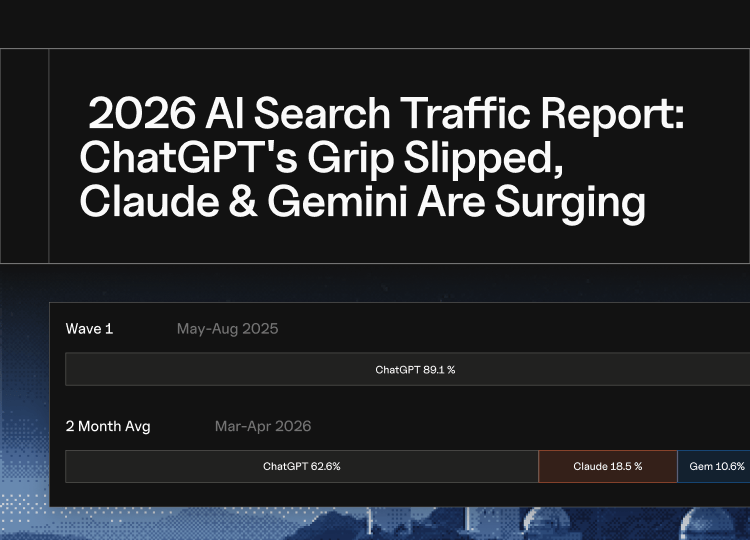
    Broad reach and segment-level growth can move in opposite directions. At its measured high point, OpenAI or ChatGPT reached 37% of U.S. desktop users in September 2025, then slipped to 34% by March. That is a reach signal within a specific geography and device class. It does not mean 34% used the tool daily, preferred it over every alternative, or relied on it during a purchase.

    The professional pattern looks different. Claude usage among B2B professionals was 373% higher than the U.S. average, while Claude and Gemini continued to gain users as ChatGPT’s desktop growth slowed. The 373% figure describes relative overrepresentation. It is not a market-share percentage, and it does not prove that most professionals use Claude.

    Retail-shopping audiences provide the counterweight. People in that audience were 15% less likely to use ChatGPT than a typical U.S. consumer, and Claude did not rank among their top four AI tools. An AI-heavy professional network can therefore give you a distorted baseline for consumer behavior.

    This is not a clean split between people who use AI and people who do not. The same person can be a heavy assistant user at work and follow a conventional search, marketplace, or retailer journey when shopping. Adoption depends on context, task, and perceived value, not just demographics.

    Key takeaways

    • Do not apply one AI adoption rate to professional and consumer audiences.
    • Separate assistant reach, frequency of use, task relevance, brand visibility, and commercial impact. They are different measurements.
    • If you market to B2B professionals, include Claude alongside ChatGPT and Gemini in your visibility testing.
    • If you market to retail shoppers, keep search, category, product, marketplace, and on-site discovery paths strong while you test AI as an additional layer.
    • Increase investment only when audience use and a relevant business outcome appear in the same segment.

    Map adoption by audience and task before assigning budget

    A marketing team arranges audience, device, search, shopping, document, and AI symbols on an unlabeled strategy table connected by illuminated routes.

    A market-wide AI number cannot tell you where to publish, what to optimize, or which assistant deserves attention. Build an audience-by-task map instead. It should distinguish what has been observed from what still needs to be tested.

    AudienceObserved signalWhat it does not establishPlanning response
    Broad U.S. desktop usersOpenAI or ChatGPT moved from 37% reach in September 2025 to 34% by MarchFrequency, task, loyalty, mobile behavior, or purchase influenceMaintain a baseline presence, but do not forecast automatic growth from general awareness
    B2B professionalsClaude usage was 373% higher than the U.S. averageWhich roles, industries, or work tasks produced the differenceAdd Claude to role-specific discovery and evaluation tests
    Retail-shopping consumersChatGPT usage was 15% lower than among typical U.S. consumers; Claude was outside the top four AI toolsWhether AI influences an earlier research step or a later purchase decisionPreserve conventional shopping journeys and test assistants selectively

    Build the map before choosing a platform

    1. Define audiences by commercial context. Separate professional users, procurement participants, existing customers, retail shoppers, and other materially different groups. Do not merge them merely because they can buy the same product.
    2. Name the task. Record whether the person is trying to understand a problem, compare options, verify a claim, troubleshoot, create work, find a seller, or complete a purchase. A tool can be strong for one job and irrelevant to the next.
    3. Collect audience-level evidence. Combine AI referral analytics with customer interviews, sales and support language, on-site search terms, and a direct attribution question. Ask which tool was used and what the person was trying to accomplish; a yes-or-no question about AI is too broad.
    4. Label your confidence. Mark each audience-task-tool combination as observed, indicated, or unknown. A visible market trend can justify a test, but it should not be relabeled as proof about your customers.
    5. Assign an action. Scale combinations supported by audience and outcome evidence, test combinations with a plausible signal, and monitor combinations supported only by general market attention.

    The most common planning error is to start with a platform and look for reasons to fund it. Start with the audience and task instead. The platform should be the last column you fill in, not the first.

    Adjust SEO, AEO, and GEO priorities to match the pattern

    Adoption signals should change your priorities, not your technical standards. Pages still need to be crawlable, indexable, internally linked, consistent about named entities, and clear enough for a person to verify. Structured data must describe visible content accurately; it cannot compensate for a vague, unsupported, or inaccessible page.

    For professional audiences, optimize around decisions

    Where your audience resembles the measured B2B cohort, Claude belongs in the test set. That does not justify abandoning ChatGPT or Gemini. It means a ChatGPT-only visibility report can miss an assistant that is unusually prominent among professional users.

    • Give each important page a decision job. A page might explain compatibility, implementation requirements, operating constraints, use cases, or the difference between two approaches. Do not make one page answer every stage of the buying process.
    • Lead with a direct answer. Follow it with evidence, definitions, exceptions, and practical constraints. This gives human readers a fast answer while leaving enough context for an assistant to represent it accurately.
    • Keep entities unambiguous. Use consistent organization, product, feature, and category names in visible copy, titles, internal links, and applicable schema. If two names refer to the same thing, explain the relationship.
    • Test real professional questions. Run the questions your target roles ask through ChatGPT, Claude, and Gemini. Record whether your brand appears, whether the description is accurate, whether a citation is present, and which URL is surfaced.
    • Fix the underlying page before chasing mentions. If an assistant gives an incomplete answer, check whether your page actually states the missing fact clearly and supports it. Assistant-specific duplicate pages create more content to reconcile and can leave conflicting claims online.

    For consumer audiences, treat AI as an added path

    Lower ChatGPT incidence among retail shoppers and Claude’s absence from that audience’s top four do not make AI irrelevant. They do make an assistant-only discovery plan hard to defend. Keep the complete shopping journey usable without requiring an AI intermediary.

    • Protect category, product, marketplace, local, review, and on-site search paths that already help shoppers find and evaluate an offer.
    • Answer natural-language buying questions on the relevant category or product page instead of hiding useful details in promotional copy or disconnected FAQ pages.
    • Use applicable Product, Offer, or other structured data only when the corresponding information is visible, current, and internally consistent.
    • Test the assistants your audience actually mentions or sends traffic from. Do not give every platform equal budget merely because each one is growing somewhere.
    • Treat AI visibility as a supporting indicator until you can connect it to product discovery, qualified visits, assisted conversions, or purchases for that consumer segment.

    The useful distinction is not B2B equals AI and B2C equals conventional search. It is that professional adoption currently provides a stronger reason to test multiple assistants aggressively, while consumer planning needs more segment-specific proof before AI becomes the primary route.

    Measure adoption separately from visibility and revenue

    An analyst examines three separate transparent instruments containing usage tokens, discovery symbols, and purchase symbols connected by narrow pipes and valves.

    A single AI traffic chart cannot tell you whether customers are adopting assistants, whether assistants know your brand, or whether visibility changes business results. Track those questions in separate layers.

    • Audience use: Ask which assistants people use, for what tasks, and at which point in the journey. Preserve an open-text option so your questionnaire does not force respondents into your platform assumptions.
    • Referral behavior: Break AI-referred sessions down by assistant, landing page, audience, and outcome. Treat this as a floor rather than a complete adoption count: copied answers and manually entered URLs will not preserve an AI referrer.
    • Answer visibility: Maintain a fixed set of audience-specific questions. For each check, record the assistant, date, answer, brand inclusion, factual accuracy, cited URLs, and competitors mentioned. Prompt tracking samples outputs; it does not measure how many customers saw them.
    • Commercial outcomes: Connect identifiable AI visits and self-reported AI use to qualified leads, sign-ups, assisted conversions, purchases, or the outcome your organization already values. Do not label correlation as causation when several channels touched the journey.
    • Technical access: Use server logs and crawl diagnostics to confirm whether relevant bots can reach important pages. Bot activity shows technical access or crawler interest, not human demand.

    Use a simple decision rule. Scale when a defined audience uses an assistant for a relevant task, your visibility has a fixable gap, and improvement is associated with a qualified outcome. Run a contained test when audience and task are supported but commercial impact remains uncertain. Keep monitoring lightweight when the only evidence is broad market enthusiasm.

    For your next planning cycle, choose one high-value professional segment and one important consumer segment. Build separate audience-task maps, test the assistants indicated for each, and move the next content investment only where audience, task, and outcome align.
    References

  • 2026 AI Traffic Insights: ChatGPT Fades as Claude & Gemini Rise

    2026 AI Traffic Insights: ChatGPT Fades as Claude & Gemini Rise

    I’ve just delved into Goodie’s enlightening AI search traffic report for early 2026, covering the period from January to April, and I’m excited to share my insights with you. This report dives into trends in usership, referral traffic, and marketing considerations, offering a comprehensive view of the shifting landscape.

    You’ll want to pay particular attention to how ChatGPT’s dominance is starting to wane, with some surprising contenders like Claude and Gemini making waves. This shift could significantly impact how marketers strategize their efforts in AI-driven search optimization.

    The data reveals fascinating patterns in user habits and referral traffic, which could inform future marketing strategies and the allocation of resources. For a full dive into these emerging trends and what they might mean for businesses, I encourage you to explore the detailed findings of the report.


    Inspired by this post on HiGoodie Blog.


    crushpress.ai community screenshot
  • How to Prepare Your Store for Google’s AI Shopping System

    How to Prepare Your Store for Google’s AI Shopping System

    Your products can be easy to find in Google and still be poorly prepared for an AI-assisted purchase. Discovery is only the first test. A product must also be understood, matched with an eligible offer, placed in a cart, and purchased without its price, availability, or terms changing along the way.

    Google is connecting those jobs across Merchant Center, Google Ads, AI Mode, Gemini, Search, Maps, YouTube, Google Pay, and the Universal Commerce Protocol. If you manage ecommerce visibility, your work now extends from SEO and feed optimization to promotion rules, checkout integrity, and AI-specific measurement.

    Google’s shopping stack now connects four different jobs

    Google’s AI shopping ecosystem is easier to understand as a transaction path than as another search feature. At Google Marketing Live 2026, the company connected conversational product discovery, personalized promotions, cross-retailer carts, checkout, payments, and performance reporting.

    LayerWhat Google is addingWhat you control
    DiscoveryConversational Attributes and description updates for matching products to natural-language shopping requestsAccurate, complete, variant-specific product facts
    RecommendationDirect Offers selected with Gemini from eligible discounts, giveaways, local coupons, and bundlesOffer eligibility, commercial limits, exclusions, and campaign guardrails
    TransactionUCP connections among catalogs, carts, checkout, and paymentsReliable product, price, inventory, checkout, and order data
    MeasurementAI Performance Insights and competitive share-of-voice reportingThe business metrics used to judge whether visibility produces valuable orders

    This distinction matters because each layer can fail independently. A product can be eligible but never recommended. It can be recommended with an unsuitable promotion. The offer can be accepted, only for checkout to reject it. A high AI share of voice can also coexist with weak revenue or poor margins.

    Availability is uneven. Conversational Attributes are launching globally, while AI Performance Insights are expected in the United States, Australia, Canada, India, and New Zealand. Direct Offers remains a United States pilot. The new UCP-powered capabilities are rolling out in the United States, with wider expansion expected later. Account access and geography should therefore be go-or-no-go checks before you assign launch dates or forecast revenue.

    Make product data answer the shopper’s decision question

    A countertop appliance is surrounded by visual attribute tiles connected to symbols representing a shopper's needs.

    A conversational product description is not simply a conventional description rewritten in a friendlier tone. It should supply the facts an AI system needs when someone asks a question such as: Will this fit my situation? Which variant is appropriate? What limitation should I know about? What makes this option different from a similar one?

    Merchant Center’s Conversational Attributes let merchants add structured details and update descriptions that Google’s AI can use across AI Mode, Gemini, and other AI shopping environments. That makes factual coverage more valuable than decorative copy.

    1. Collect the questions that appear at the point of choice. Look at site search, product comparisons, support requests, sales conversations, and return reasons. Focus on questions whose answers would change which product or variant a shopper selects.
    2. Convert each answer into an atomic, verifiable fact. Useful areas can include intended use, compatibility, dimensions, materials, fit, included components, care requirements, prerequisites, and limitations. Include only the fields that genuinely apply to the product.
    3. Keep variant facts attached to the correct variant. If size, material, capacity, color, compatibility, or included components differ, a family-level description should not imply that every option has the same properties.
    4. Reconcile the value across Merchant Center, the product page, structured data, the cart, and checkout. Different wording is acceptable; a different factual answer is not.
    5. Remove unsupported superlatives and inferred use cases. An AI system should not have to decide what terms such as best, professional, safe, sustainable, or universal mean for your product.
    6. Record where each claim came from inside your business. Product specifications, policy owners, and approved commercial copy should be traceable so that outdated values can be corrected at their origin.

    Your JSON-LD should reinforce the same product identity and supported facts, but it should not be treated as a substitute for the Merchant Center feed. Use properties with literal, accurate values. Do not force conversational phrases into unsupported schema fields or create markup for claims that the visible product page cannot substantiate.

    A practical validation test is simple: choose a real pre-purchase question and follow its answer through the feed, landing page, selected variant, cart, and checkout. If the answer disappears or changes at any stage, you have a data-governance problem before you have an AI optimization problem.

    Put commercial guardrails around every AI-selected offer

    Direct Offers moves promotions closer to the recommendation itself. Advertisers can upload eligible promotions and campaign guardrails through Google Ads, after which Gemini can curate relevant bundles and discounts from the shopper’s query and browsing context.

    That does not make the AI your pricing strategist. Relevance can help choose among approved offers, but it cannot protect margins, inventory, channel commitments, or customer promises that you have not expressed as rules. Before making a promotion eligible, create an internal offer card that answers these questions:

    • Which offer type is this: discount, giveaway, local coupon, or bundle?
    • Which products and variants are included, and which are explicitly excluded?
    • Which locations, audiences, order conditions, or fulfillment methods qualify?
    • Can the offer be combined with another promotion, loyalty benefit, or payment incentive?
    • When does eligibility begin and end, and what happens to an in-progress cart after expiry?
    • Which inventory or fulfillment constraint should stop the offer from appearing?
    • What commercial boundary must the offer preserve, including margin and maximum exposure?
    • Where can the shopper verify the terms before committing to payment?
    • Has the exact offer been tested through the checkout route on which it will appear?

    AI-generated bundles deserve particular scrutiny. Define which items may be combined, how unavailable components are handled, whether substitutions are permitted, and which total prices are valid. If your rules cannot distinguish an attractive bundle from an unprofitable or unfulfillable one, do not make the components available for automated bundling yet.

    Native checkout increases the cost of an offer mismatch because there are fewer remaining steps in which to explain or correct it. The displayed promotion, cart calculation, checkout total, and payment amount must resolve to the same commercial promise. A silent price change at checkout is not an optimization issue; it is a customer-trust and revenue-control failure.

    Travel businesses should apply the same discipline to dates, inventory, inclusions, and cancellation terms. Booking and Expedia are expected to surface travel offers inside AI-assisted trip planning, where an appealing deal can become misleading quickly if its underlying availability or conditions are stale.

    Treat UCP readiness as a catalog-to-payment integration audit

    A cutaway commerce system connects a product catalog, guarded offer controls, a shopping cart, and a secure payment device on a workbench.

    The Universal Commerce Protocol is intended to connect product catalogs, checkout, and payment experiences across Google surfaces. Its Universal Cart can hold products from multiple retailers, with purchase completion through Google Pay or a retailer’s own checkout system.

    For a merchant, that creates more than one possible ending to the journey. You cannot assume that every shopper will pass through the same landing pages, cart interface, recovery messages, or payment presentation. The handoff itself needs to carry enough accurate state for each route to finish honestly.

    1. Confirm product identity. The catalog item, variant, cart line, checkout line, and order record should refer to the same purchasable thing.
    2. Confirm commercial truth. Price, currency, quantity, promotion eligibility, and final total should remain consistent as the shopper moves between systems.
    3. Test stale inventory. A newly unavailable variant should stop cleanly before payment, without being replaced by a different product or option unless the shopper explicitly approves it.
    4. Test expired and ineligible offers. Checkout should explain why an offer no longer applies instead of silently removing it or changing the total.
    5. Test every enabled payment route. Google has announced Affirm and Klarna buy now, pay later integrations with Google Pay, but you should not advertise a financing option until its availability and terms are confirmed for the actual transaction.
    6. Check the post-purchase handoff. Confirmation, customer support, order status, cancellation, and return instructions must still be available when the journey begins outside your normal storefront path.

    Test failure states as deliberately as the successful purchase. Use sold-out variants, expired promotions, rejected payment attempts, and transfers to the retailer checkout. The goal is not merely to prevent an error screen. It is to ensure that no failure produces a false product, price, entitlement, or order state.

    Google also expects UCP to expand into hotel bookings and food delivery. If you sell services or time-sensitive inventory, model dates, availability, fulfillment choices, and cancellation conditions as transaction data. Page copy alone cannot keep a changing reservation state accurate.

    Measure AI visibility without mistaking it for revenue

    AI Performance Insights is designed to show a brand’s performance across AI-driven environments, including share of voice compared with similar competitors. That is useful diagnostic information, but it is not a complete business outcome.

    Share of voice does not tell you by itself whether the right products appeared, whether an offer protected margin, whether a recommendation produced an order, or whether the order was later cancelled or returned. Build a measurement ladder that keeps those questions separate:

    • Data readiness: Track missing attributes, rejected items, variant inconsistencies, stale descriptions, and differences between the feed and product page.
    • AI visibility: Review AI share of voice and product presence by country and product family where reporting is available.
    • Offer performance: Separate eligible, surfaced, accepted, expired, and rejected promotions using the reporting and transaction data available to you.
    • Checkout integrity: Count price mismatches, inventory failures, promotion removals, payment failures, and transfers that do not complete successfully.
    • Business outcome: Evaluate completed orders, revenue, contribution, cancellations, returns, and support costs. A recommendation that creates a costly order is not a successful recommendation.

    Keep a change log for every material feed, attribute, offer, and checkout update. Record the affected products, markets, date, commercial rule, and transaction version. Compare equivalent segments before and after the change, and avoid combining a description rewrite, a new bundle, and a checkout migration into one untraceable launch.

    Ask Advisor is also expected to enter Merchant Center. Use advisory output to find questions worth investigating, not as proof that a diagnosis is correct. Your product records, promotion rules, checkout tests, and completed transactions remain the evidence.

    FAQ: Google’s AI shopping rollout

    Do you need UCP before optimizing for conversational discovery?
    No blanket dependency has been established in these launches. Conversational Attributes are Merchant Center discovery controls, while UCP connects carts, checkout, and payments. Run them as connected workstreams, but do not treat them as the same eligibility switch.

    Should you rewrite every product description in a conversational tone?
    No. Start with missing decision facts, variant accuracy, and consistency. Friendly prose cannot compensate for absent compatibility, fit, material, inclusion, or limitation data.

    Is AI share of voice a primary ecommerce KPI?
    It is better used as a visibility diagnostic. Pair it with offer acceptance, checkout integrity, completed orders, and unit economics before deciding that performance improved.

    Can Google decide which discount your store should offer?
    You supply eligible promotions and campaign guardrails. If an eligibility rule, exclusion, or economic boundary has not been defined and tested, keep that offer out of automated selection.

    Start with a commercially important product family that has clean variant data, dependable inventory, and an offer you can explain in one sentence. Complete its Merchant Center facts, define its promotion rules, test every enabled checkout route, and capture a performance baseline. Expand only after the full path remains accurate. In AI commerce, clear operational truth gives the system fewer opportunities to guess.

    References

  • Discover Google Chrome Lighthouse’s New AI Scan Feature

    Discover Google Chrome Lighthouse’s New AI Scan Feature

    I’ve recently discovered that Google has introduced a new feature in Chrome Lighthouse to check for llms.txt files. Though Google mentions that llms.txt isn’t necessary for AI search visibility, Lighthouse has started flagging sites based on their presence.

    Google’s latest Lighthouse audits, under the “Agentic Browsing” category, now focus on a site’s usability for machine interaction. I find this interesting as it aligns with Google’s push towards better machine readability.

    The new audits are part of Chrome’s evolving “Agentic Browsing” features, which analyze if sites are prepared for automated interaction. This concept came soon after Google issued guidance on AI search optimization, debunking the necessity of llms.txt files in their new guide on generative AI features.

    What Lighthouse Evaluates Now. Lighthouse’s Agentic Browsing tests focus on how well my site is built for machine interactions, incorporating various deterministic audits as per Google’s documentation. These checks include:

    – WebMCP integration.

    – Accessibility tree integrity.

    – Layout stability through CLS.

    – Presence of an llms.txt file.

    These audits help ensure that there’s a machine-readable summary at the site’s domain root. Google explains that without llms.txt, agents might take longer to understand a site’s main structure.

    The impact of these audits doesn’t translate into a traditional Lighthouse score but into a fractional pass ratio related to agentic readiness signals.

    The Tension. Interestingly, while these audits don’t directly affect SEO rankings, their mention in Google’s readiness checks could make SEOs reconsider their stance on llms.txt files.

    Agentic Engine Optimization. Google’s approach aligns with insights shared by Addy Osmani from Google Cloud AI about Agentic Engine Optimization. Osmani emphasizes creating web content that is semantically structured, token-efficient, and easy for AI to process.

    SEO vs. llms.txt. According to Google, creating llms.txt or similar files isn’t necessary for AI search success, as outlined in the guide on Mythbusting generative AI search. The AI systems can discover, crawl, and index a variety of file types encountered on the internet.

    John Mueller from Google responded to concerns about the role of llms.txt in a discussion with Lily Ray on Bluesky, stating that the use of these files is more for functionality and not directly linked to search engine optimization.

    Google’s Take on AI Agents. Besides llms.txt, Google’s Lighthouse guidelines place strong emphasis on accessibility and interface stability. The insight I gained is that AI agents heavily rely on the accessibility tree as their core data model, focusing on integrity and proper layout.

    Ultimately, while Google indicates llms.txt isn’t needed for search, including such files might be beneficial for adapting to Google’s evolving tools that prioritize machine readability.

    Further Exploration.

    Meet llms.txt, a proposed standard for AI website content crawling

    llms.txt isn’t robots.txt: It’s a treasure map for AI

    Does llms.txt matter? We tracked 10 sites to find out


    Inspired by this post on Search Engine Land.


    crushpress.ai community screenshot
  • Unlock Coding Potential with the Profound API Cookbook

    Unlock Coding Potential with the Profound API Cookbook

    Hey there! I’m excited to introduce you to something that has truly changed the way I approach coding projects—the Profound API Cookbook. If you’ve ever started with the thought, ‘I want this number,’ and wished for a seamless way to transform that into runnable code, this is for you.

    Imagine having a collection of end-to-end recipes right at your fingertips, perfectly layered on top of our REST API references. This isn’t just about coding; it’s about enhancing your workflow and efficiency in a whole new way. Each recipe is designed to guide you from concept to execution with ease.


    Inspired by this post on Try Profound Blog.


    crushpress.ai community screenshot
  • Mastering Entity Optimization: Boost AI Understanding of Your Brand

    Mastering Entity Optimization: Boost AI Understanding of Your Brand

    Entity optimization might sound like a complex term, but trust me, it’s incredibly powerful when you’re trying to make AI understand your brand better. Essentially, my goal is to help AI see exactly who I am and what I’m about. Let me share more about how you can do the same.

    When I optimize entities related to my brand, I start by clarifying what my brand represents. This means ensuring that all my online content clearly reflects my brand’s identity and core values. By creating a strong, consistent message, AI can better understand and categorize my content.

    Next, I focus on strengthening associations. This involves connecting my brand with relevant entities and concepts within my industry. When AI detects these connections, it increases my brand’s relevance in related searches.

    Finally, driving accurate AI citations is crucial. I make sure that any references to my brand on different platforms are correct and consistent. This helps in building trust with AI, ensuring that it can reliably reference my brand in the right contexts.


    Inspired by this post on HiGoodie Blog.


    crushpress.ai community screenshot
  • Boost Team Efficiency: Overcome GTM Barriers with Storyblok

    Boost Team Efficiency: Overcome GTM Barriers with Storyblok

    I’ve recently stumbled upon some fascinating global research data that highlights a tech gap silently draining team speed, revenues, and competitive edge. The Storyblok Global Speed-to-Market Benchmark Report explores these issues comprehensively.

    This rapidly evolving world demands a new pace, driven by cutting-edge AI and technology, and constant shifts in digital trends have redefined how we handle go-to-market (GTM) strategies.

    In today’s marketplace, everyone, from customers to organizations, expects top-notch deliveries with speed. Unfortunately, only 22.5% of teams consistently meet these soaring speed-to-market expectations, revealing a disconcerting gap between ambition and actualization.

    One might ask, what’s holding us back?

    The Global Speed-to-Market Benchmark survey involved several GTM teams who shared insights on where processes are stalling or facing delays and what steps would truly improve speed-to-market in today’s fast-paced business environment.

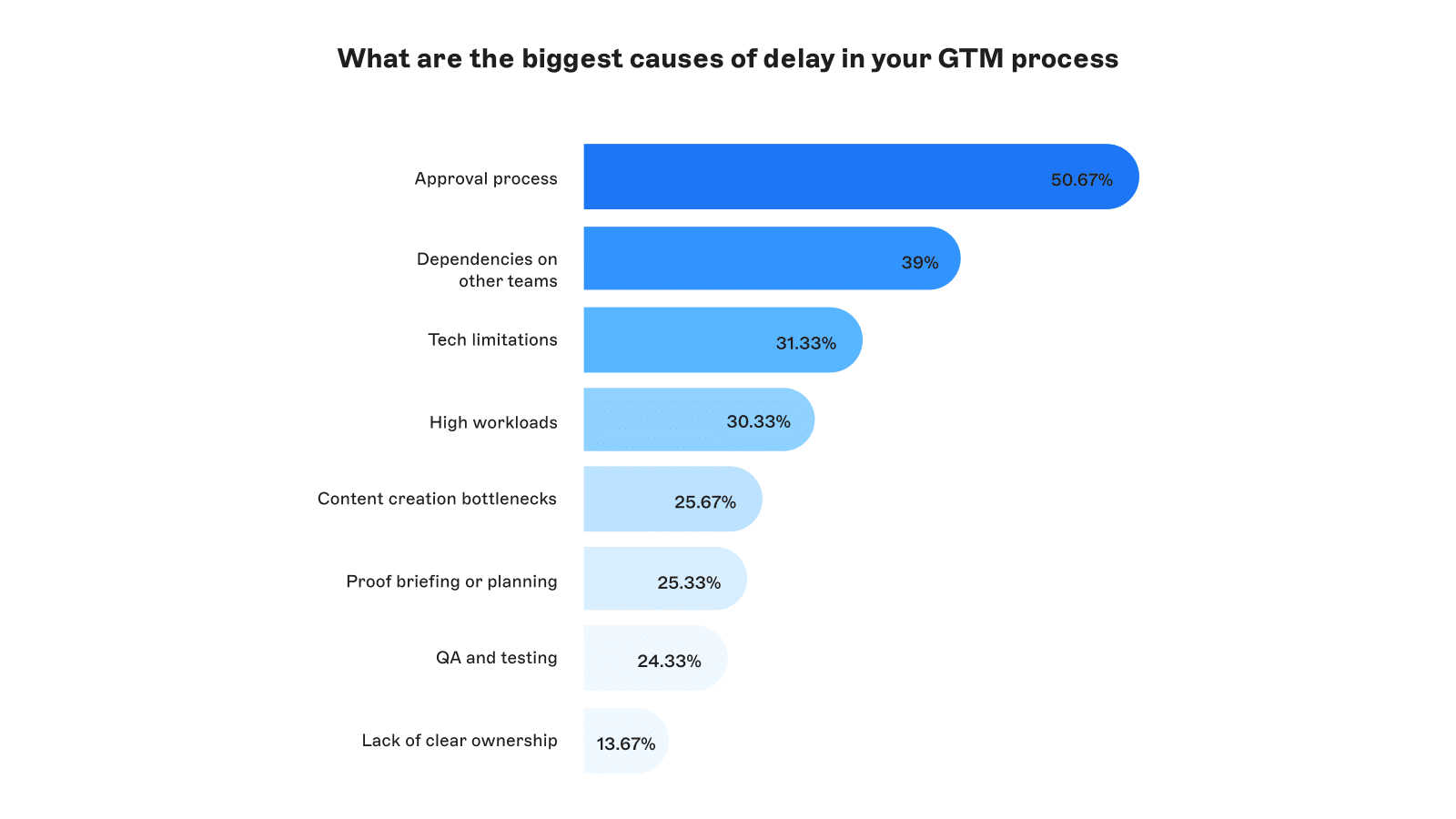
    The survey uncovered four significant bottlenecks largely tied back to technological hiccups or dependencies. The approval process, for instance, emerged as the most substantial bottleneck, with over 50% of teams identifying it as a major hurdle. This includes enduring multiple rounds of content revisions largely driven by disorganized feedback systems, exacerbating inefficiencies.

    The practical solution? A well-configured CMS, particularly a headless one, allows for an organized and efficient content review process by decoupling content from presentation. This ensures stakeholders have access to a central content repository, thereby minimizing review confusion and delays.

    Equally problematic is the overreliance on developers, where 38% of teams require developer input for most GTM operations. This not only slows marketers but also distracts developers from more critical tasks. A modern tech stack enabling team autonomy can mitigate this issue, allowing each team to concentrate on their core functions.

    ```json
{
  "alt": "Bar chart showing biggest causes of delay in GTM processes, with approval process at 50.67% as the top cause.",
  "caption": "Discover what's slowing down your GTM process. Approval processes top the list at over 50%, impacting efficiency and timelines.",
  "description": "This image features a horizontal bar chart highlighting the primary reasons for delays in go-to-market (GTM) processes. Leading the chart is the approval process, causing 50.67% of delays. Following are dependencies on other teams at 39%, tech limitations at 31.33%, and high workloads at 30.33%. Additional factors include content creation bottlenecks, proof briefing, QA and testing, and lack of clear ownership. This breakdown provides insight into operational challenges within marketing strategies. Keywords: GTM process, delay causes, approval process, marketing efficiency."
}
```

    Moreover, compounding tech limitations, including complex deployment and outdated systems, further warrant an overhaul. Tech bottlenecks often operate silently, but they demand attention and timely solutions for improved GTM cycles.

    I also noticed how post-launch firefighting issues are rampant, affecting 79% of teams. This inefficiency stems from fragmented systems, where constant developer intervention is necessary, further delaying launch processes.

    Addressing these challenges involves refining the tech stack, especially choosing a CMS that aligns with modern delivery needs. This results in smoother launches, improved efficiency, and fewer post-launch issues.

    The cost of slow GTM delivery is undeniable, leading to lost revenue and missed market opportunities, while also impacting team morale and increasing turnover risks. Interestingly, there’s a visible discrepancy between executive priorities and the requisite support for improved speed-to-market capabilities.

    Armed with data, teams can make a compelling business case for change, drawing attention to specific bottlenecks and their ramifications, thus bridging the leadership alignment gap.

    Overall, overcoming GTM challenges requires adopting adaptive technology stacks that align with today’s fast-paced demands. By doing so, we not only keep up with competition but also foster a resilient, engaged team poised for success.

    For the complete analysis and strategies, the full Storyblok Global Speed-to-Market Benchmark Report is an invaluable resource.


    Inspired by this post on Search Engine Land.


    crushpress.ai community screenshot
  • Unlocking the Power of Google Discover Publisher Profiles

    Unlocking the Power of Google Discover Publisher Profiles

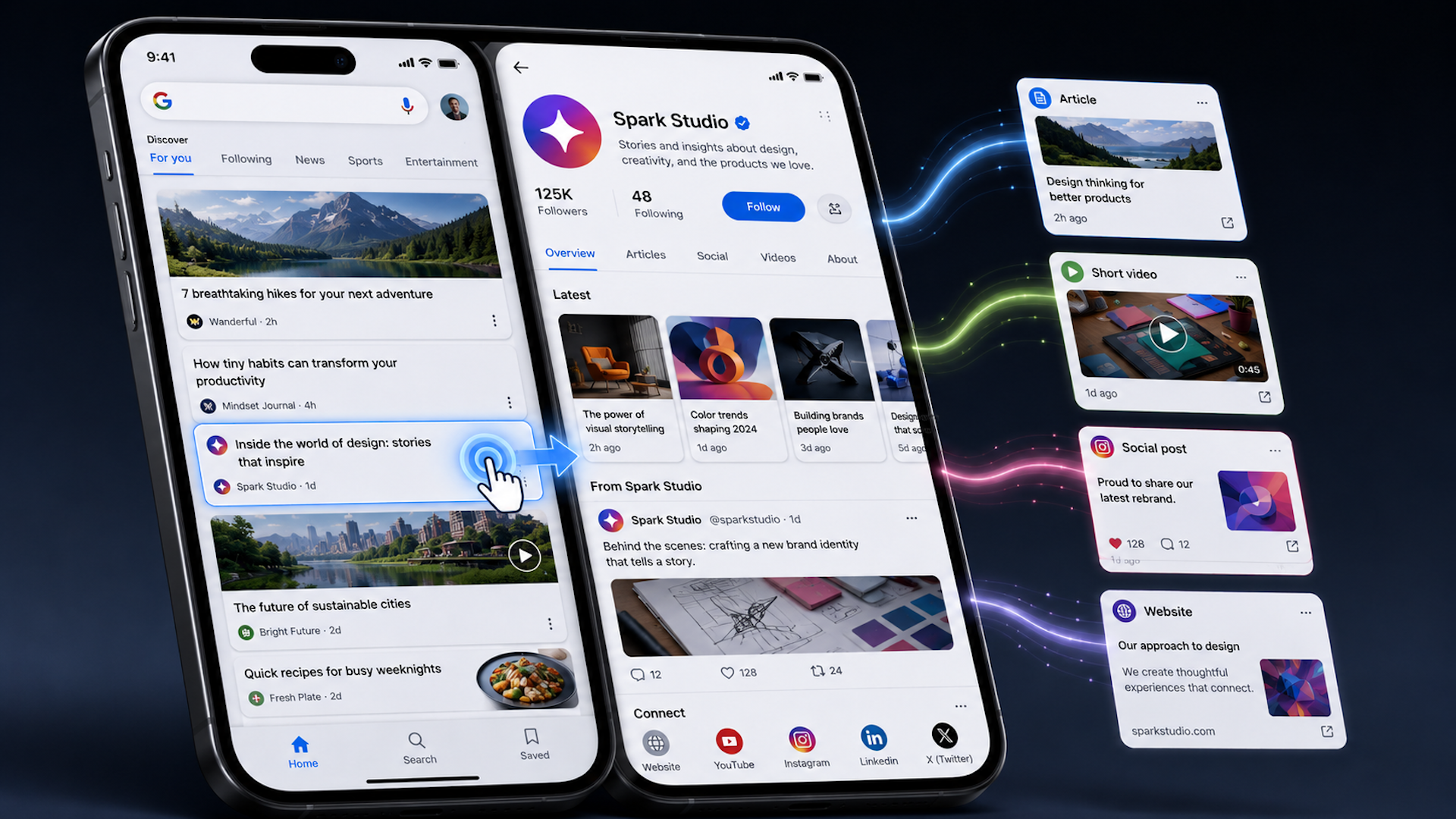
    I find it fascinating how Google Discover has evolved with the introduction of publisher profiles and follow features. These profiles have started making waves, yet they remain a bit enigmatic due to limited documentation.

    More publishers, creators, and social-first accounts are now visible through these profiles. Let me take you through how these profiles work, how they connect with social accounts and the Knowledge Graph, and why some publishers already enjoy enhanced customization features.

    As a technical SEO enthusiast, I’m quite accustomed to Google glossing over details in their documentation. And with Discover publisher profiles, that mystery deepens.

    Google barely mentions these profiles in their official Discover documentation, though they seem to play an increasingly significant role in the visibility of publishers and creators.

    ```json
{
  "alt": "The CapmatchOne logo with a gradient circle and bold text.",
  "caption": "Discover innovation with the CapmatchOne logo, featuring sleek typography and a modern gradient circle.",
  "description": "The CapmatchOne logo features bold, modern typography coupled with a gradient circle, symbolizing connection and innovation. The sleek design conveys a sense of progress and creativity. This image can be used for branding or promotional purposes, appealing to audiences interested in innovative solutions and forward-thinking designs."
}
```

    It’s intriguing to see how Discover profiles let users manage the publishers they follow while gathering content from various websites and social platforms.

    Because Google has been reticent about the inner workings of these profiles, I’ve taken upon myself to study their patterns across different accounts. Here’s what I’ve noticed about:

    Google rolled out substantial updates to Discover in September 2025, vastly altering how we engage with content through publisher follows and profile pages.

    ```json
{
  "alt": "Text explaining how to follow publishers or creators on Google Discover.",
  "caption": "Discover new content on Google by following your favorite publishers and creators. Preview their posts before following to tailor your feed.",
  "description": "An informative text image from Google detailing how users can follow publishers or creators directly on Discover. It highlights the ability to preview content, such as articles and YouTube videos, before following. Users are advised to sign in to their Google Account to explore this feature. Ideal for those looking to customize their content consumption on Google Discover."
}
```

    The update granted publishers dedicated landing pages for content aggregation, offering users a streamlined way to interact with preferred publishers and seamlessly integrating social content into Discover.

    The most eye-catching aspect of this update is how it empowers users to have greater control over publisher visibility while enabling brands to reach their audience more effectively.

    Publishers can’t typically alter the layout of these pages, but some recently gained access to customize their profiles, an option part of a limited beta test.

    ```json
{
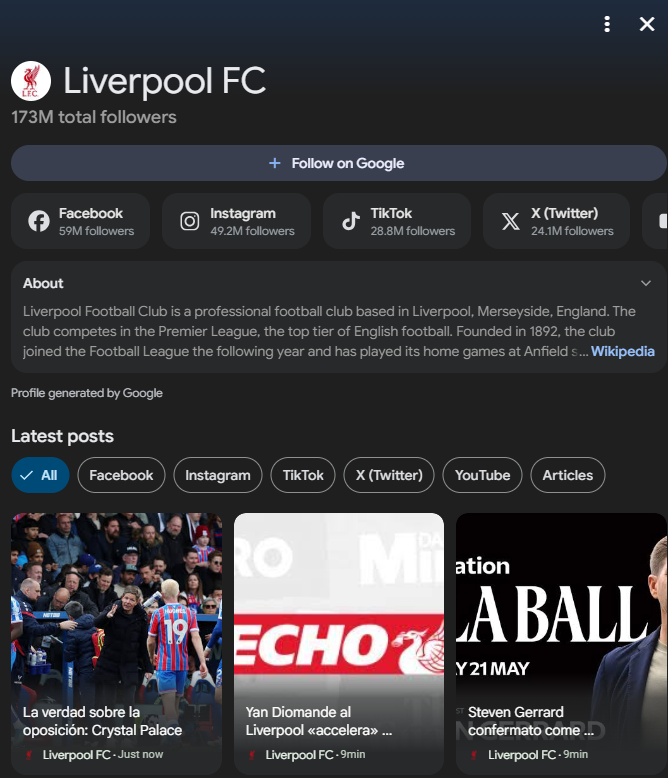
  "alt": "Liverpool FC social media profile overview with follower counts and recent posts.",
  "caption": "Discover Liverpool FC's expansive online presence with millions of followers across platforms and stay updated with the latest posts and news.",
  "description": "This image showcases the Liverpool FC social media profile, highlighting 173 million total followers. It features follower counts across platforms like Facebook, Instagram, TikTok, and Twitter, along with a brief description about the club. At the bottom, recent posts are displayed with options to filter by platform. Keywords: Liverpool FC, social media, followers, football club, recent posts."
}
```

    Common to most publisher profiles are features like a profile photo, usually sourced from the Knowledge Graph or a YouTube profile, which also counts total social followers, and integrates various social media handles.

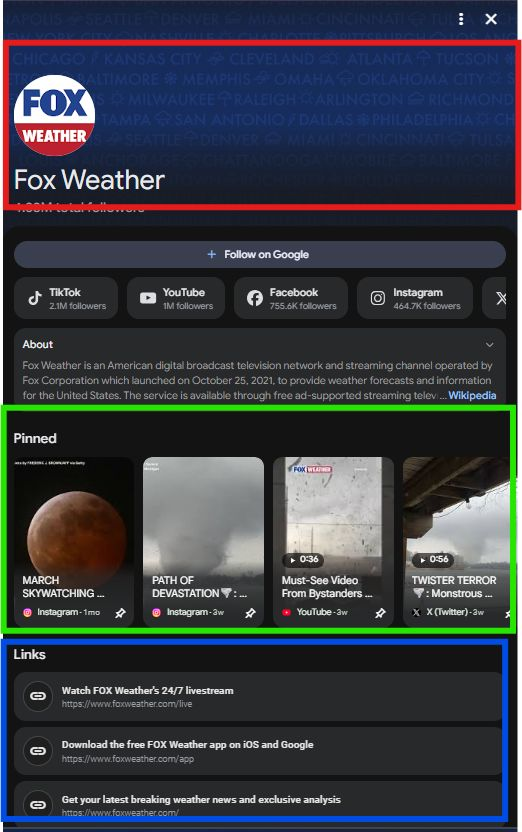
    The social connections catered to include platforms like YouTube, TikTok, Instagram, Facebook, X, and LinkedIn. The ‘About’ section is succinct, often derived from a Wikipedia entry or something similar.

    Some editable profiles offer additional features like customized banners, pinned posts, and external links that could direct users to apps or livestreams, further enhancing content reach.

    ```json
{
  "alt": "Fox Weather page with social media links, about section, pinned videos, and navigation links.",
  "caption": "Explore the dynamic Fox Weather page, featuring live updates, pinned videos, and easy access to their apps and social media platforms.",
  "description": "The Fox Weather page displays their logo and title prominently at the top. Below are quick-follow options for TikTok, YouTube, Facebook, and Instagram. An 'About' section provides details about their services, while a set of pinned videos showcase various weather events. Navigation links at the bottom offer access to their livestream, mobile app downloads, and news updates. This comprehensive setup ensures users stay connected with the latest weather information."
}
```

    There are two main types of Discover publisher profiles: ones for entities with websites and others solely focused on social media publishers.

    Web-focused publishers’ profiles tend to be more comprehensive, often including the About section, logos, social accounts, and website links—although social links might sometimes need a manual push to be included.

    On the other hand, profiles for social media publishers focus on prominent journalists, notable figures, and those solely identifiable through social media.

    These profiles are generally less complete unless they are tied to a Knowledge Graph, missing elements like profile pictures or descriptions, frequently needing aid from connected YouTube accounts for better appearance.

    Looking forward, I anticipate Google may broaden access to these editable profiles, though I suspect customization will remain selective, likely reserved for well-established publishers and creators.


    Inspired by this post on Search Engine Land.


    crushpress.ai community screenshot
  • AI-Powered Ads on Google and Microsoft: A Control Plan

    AI-Powered Ads on Google and Microsoft: A Control Plan

    If you run paid campaigns on Google and Microsoft, the important question is no longer whether AI will touch your advertising. It already influences ad creation, query interpretation, bidding, product discovery, campaign operations, and measurement. Your real decision is which tasks to delegate and which decisions must remain under human control.

    That distinction matters because the two platforms are automating different parts of the job. Google is moving ads deeper into conversational search, discovery, and commerce. Microsoft is reducing the friction of importing, bidding, and reporting across accounts. You need a control plan that reflects those differences, not one generic “AI advertising” switch.

    Decide what AI may decide before you activate it

    A campaign manager controls a transparent gate separating automated advertising tasks from protected human decisions, with several signals paused for review.

    AI-powered advertising is not a single feature. It is a stack of decisions. An AI system can generate an asset, select an audience, adjust a bid, explain a product, recommend an account change, or predict a future outcome. Those actions do not carry the same risk.

    Google’s stack now reaches from Conversational Discovery ads, Highlighted Answers, Shopping explainers, and lead-generation agents to creative production and predictive measurement. Microsoft’s stack emphasizes cross-platform imports, portfolio bidding, attribution, and more configurable reporting. Before adopting any of it, assign a human owner to the decision the system is helping make.

    AI layerPlatform examplesWhat you should control
    Customer interactionConversational Discovery ads, Highlighted Answers, Shopping explainers, and Business Agent for LeadsPermitted claims, qualification rules, escalation paths, and the point at which a person takes over
    Creative productionText, image, and video generation in Asset StudioApproved facts, brand rules, legal review, asset rights, and final publication approval
    Media deliveryDemand Gen optimization and Microsoft cross-account portfolio biddingBusiness objective, budget boundaries, conversion values, exclusions, and stop conditions
    Campaign operationsAsk Advisor and Microsoft Import CenterWhich recommendations become changes, who approves them, and how changes are recorded
    MeasurementMeridian, Qualified Future Conversions, data-driven attribution, and bid-strategy reportingThe definition of success, the quality of conversion data, and whether a result is predictive, attributed, or incremental

    This separation prevents a common mistake: allowing the platform to define the goal while it also optimizes toward that goal. Automation can pursue an objective efficiently, but it cannot decide whether the objective represents profitable growth, a useful lead, or merely an easy conversion.

    Write down the decision rights for every campaign before changing its automation. At minimum, answer these questions:

    • Which conversion should influence bidding, and which events are diagnostic only?
    • What business value is attached to each conversion?
    • Which claims, audiences, locations, products, or queries are outside the campaign’s scope?
    • Can AI-generated assets publish automatically, or must a named person approve them?
    • Which performance change would trigger investigation, a rollback, or a pause?

    If those answers are missing, the campaign is not ready for more autonomy. The problem is governance, not a lack of AI features.

    Fix the input layer before generating ads or answers

    Generative systems multiply whatever you give them. Clean facts become more usable assets. Contradictory facts become more contradictory assets, produced at greater speed.

    This is especially important in conversational advertising. Google’s Business Agent for Leads is designed to answer questions using information from the advertiser’s website. Its Shopping formats can add AI-generated explanations of why a product may fit a shopper’s needs. Merchant Center is also gaining Conversational Attributes and AI Performance Insights for shopping experiences across Search, Gemini, and AI Mode.

    Your website and product feed are therefore operational inputs, not just destinations after the click. If a landing page, product description, promotion, and campaign brief disagree, the model cannot know which version your business intends to honor.

    Prepare a compact campaign truth set before opening a generative tool:

    • Offer facts: the exact product or service, included features, exclusions, availability, eligibility, price conditions, and promotion terms.
    • Approved claims: statements the campaign may make, the evidence behind them, and wording that requires legal or compliance review.
    • Audience intent: the problem being solved, the questions a qualified buyer asks, and the signals that indicate poor fit.
    • Brand rules: tone, visual constraints, prohibited themes, required terminology, and examples of acceptable assets.
    • Product data: consistent titles, descriptions, attributes, images, categories, destinations, and offer details in Merchant Center.
    • Conversion rules: the event that counts, its value, the validation process, and the lag between an ad interaction and a confirmed business outcome.

    Google’s upgraded Asset Studio is designed to interpret marketing briefs, brand guidelines, website content, and campaign goals when generating text, images, videos, and creative themes. That can remove production bottlenecks, but only if those materials are current and internally consistent.

    Use generated creative as a controlled variation, not as automatically approved truth. Check every asset against the offer facts and claims list. Keep the prompt, input materials, output, reviewer, and final disposition together so that you can explain why an asset ran.

    For teams working on SEO, AEO, GEO, and advertising together, align visible page copy, product-feed information, and structured data. JSON-LD cannot repair an inaccurate feed or a vague landing page, and the available platform announcements do not establish schema markup as a direct bidding signal. Its practical role here is consistency: machines and people should encounter the same entity, offer, availability, and business facts wherever those facts appear.

    This becomes more consequential as commerce moves closer to the generated answer. Google has described AI-assisted checkout, Universal Cart, cross-retailer shopping, and buy-now-pay-later integrations, while its Direct Offers pilot includes AI-generated bundles and native checkout for Universal Commerce Protocol merchants. When discovery and transaction happen within the same assisted journey, inaccurate product data has fewer opportunities to be corrected later.

    Give Google and Microsoft different operating roles

    A split illustration contrasts an exploratory product discovery environment with a structured campaign operations room connected by a bridge.

    Running both platforms does not mean cloning one campaign and calling the job complete. Their AI capabilities solve different problems, and your testing plan should reflect that.

    Google is pushing further into the interaction itself. Gemini can interpret a conversational query, assemble an explanation, place a relevant offer within an AI-generated response, or support a lead conversation. Demand Gen can distribute creative and product experiences across YouTube, Discover, Maps, and Shopping. Its expanded tools include creator partnership videos, Merchant Center product videos, Maps inventory, and AI-assisted campaign setup.

    Use Google when you want to test how creative, product data, and assisted discovery work together. The useful question is not merely whether a new format gets more clicks. Ask whether it helps the right user understand the offer, advances that user to a valuable action, and produces a business outcome that survives validation.

    Availability should shape your plan. Conversational Discovery ads and Highlighted Answers were announced as U.S. tests on mobile and desktop. AI-powered Shopping ads and Business Agent for Leads were described for U.S. open beta, while many Demand Gen additions were expanding through open beta globally. Treat tests, pilots, and betas as learning opportunities, not guaranteed inventory in a forecast.

    Microsoft is concentrating more heavily on operational leverage. Its Import Center can search and filter imports from Google Ads and Meta Ads, pause or edit imported campaigns, surface troubleshooting help, and provide recommendations after import. Cross-account portfolio bidding extends automated strategies across Search and Shopping accounts, while new reporting fields make bid targets easier to inspect.

    Use Microsoft to reduce duplicated setup and coordinate related accounts, but do not confuse a successful import with an equivalent campaign. An imported structure can be technically valid while optimizing toward the wrong conversion or carrying assumptions that do not fit its new environment.

    Audit every import before it spends:

    • Confirm campaign status, budgets, bidding strategy, and portfolio membership.
    • Map conversion goals and values to the business outcome you intend to optimize.
    • Review location, audience, product, and inventory scope.
    • Test landing-page URLs and tracking parameters.
    • Recheck negative constraints, brand exclusions, and any setting that limits where an ad can appear.
    • Record differences between the originating campaign and the imported version.

    Cross-account portfolio bidding is most defensible when the participating accounts share compatible goals and value definitions. Pooling signals from unrelated outcomes can make the algorithm look busy without making the portfolio economically coherent.

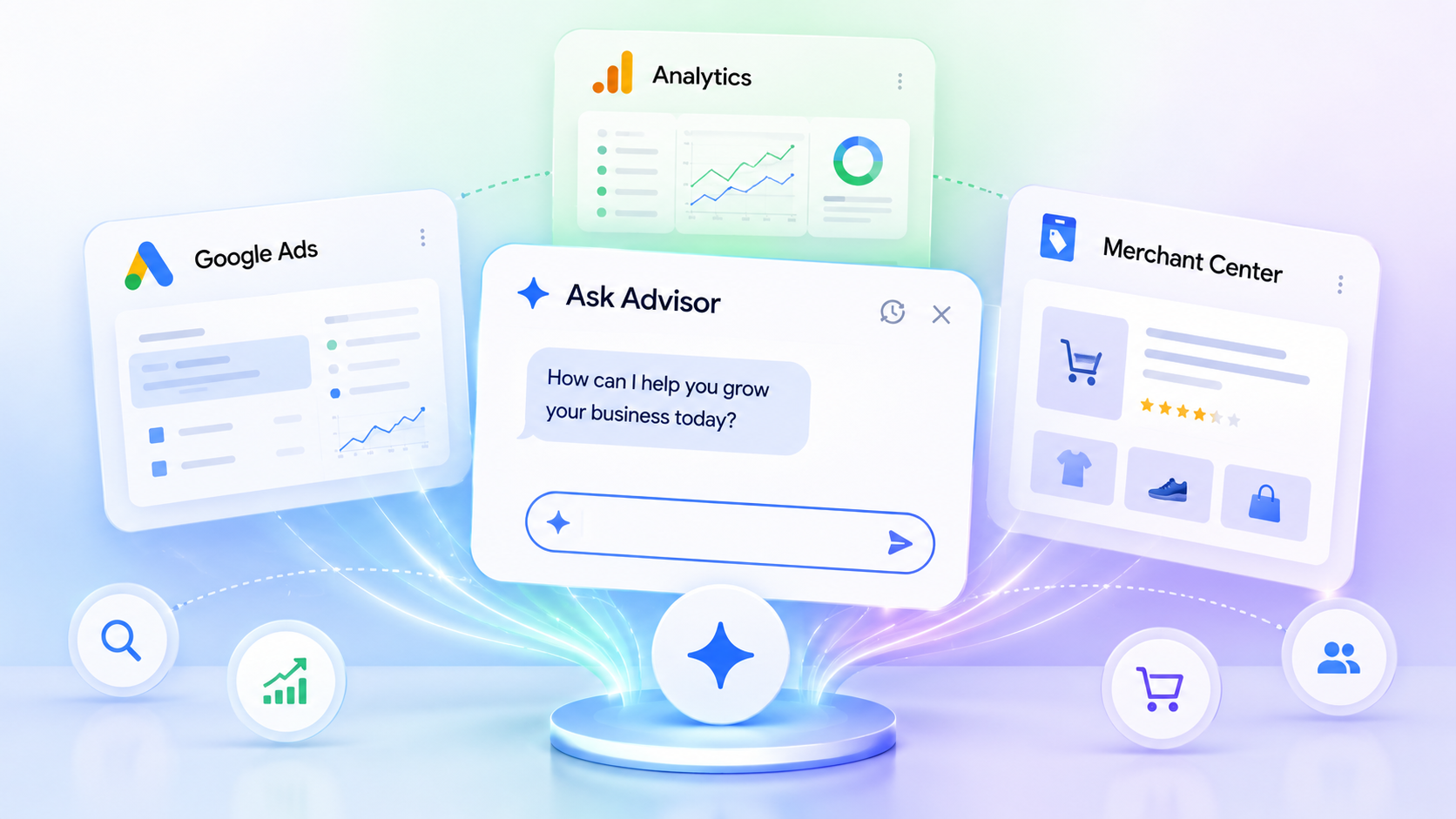
    The same discipline applies to Google’s Ask Advisor, which connects Ads, Analytics, Merchant Center, and the Google Marketing Platform to help build campaigns, analyze performance, recommend changes, and automate operational tasks. A recommendation should enter your normal approval process. The fact that an assistant can execute a task faster does not change who is accountable for the result.

    Measure decisions, not just automated output

    AI advertising creates more observable activity: more assets, more variations, more bid adjustments, more recommendations, and more predictions. Activity is not evidence of incremental value.

    Build measurement at three levels:

    • Control quality: Did the system stay inside the approved offer, brand, audience, and budget boundaries?
    • Platform performance: What happened to conversions, conversion value, cost per acquisition, return on ad spend, impression share, and other campaign metrics?
    • Business impact: Did leads qualify, transactions hold, revenue materialize, and the campaign add outcomes that would not otherwise have occurred?

    Microsoft’s reporting expansion helps with the middle layer. Advertisers can inspect average Target ROAS, average Target CPA, average Target impression share, conversion metrics in custom columns, and reports segmented by goal name. Data-driven attribution is also available for automated strategies including Maximize Conversions, Maximize Conversion Value, and Enhanced CPC.

    Those fields can show how the platform allocated credit and pursued a target. They do not, by themselves, prove that advertising caused the reported outcome. Attribution distributes credit among observed interactions. Incrementality asks what changed because the campaign ran.

    Google is adding tools for that broader question. Demand Gen includes Uplift Experiments and Campaign Type Attribution. Meridian, Google’s open-source marketing mix model, is being integrated into Analytics 360 to combine first-party and cross-channel data, estimate incremental performance, forecast outcomes, and support media-mix decisions.

    Qualified Future Conversions add another type of evidence. The Gemini-powered metric links current advertising activity with possible future sales signals, including branded search behavior. It was announced as a restricted global pilot, with wider beta access anticipated later. A predictive future-conversion signal is useful for planning, but it is not realized revenue and should not be booked or reported as though it were.

    Use a measurement ladder that matches the maturity of the campaign:

    1. Define the validated business conversion and its value before changing bidding.
    2. Verify that Google and Microsoft receive comparable, correctly classified conversion signals.
    3. Inspect performance by goal so that a rise in easy secondary actions cannot hide a decline in valuable outcomes.
    4. Compare generated assets with your established creative process using the same campaign objective and review rules.
    5. Use controlled uplift testing where it is available to investigate causal impact.
    6. Use marketing mix modeling for cross-channel allocation questions that campaign attribution cannot answer alone.
    7. Treat predictive metrics as planning inputs until the predicted behavior becomes an observed business result.

    Do not optimize a campaign against a forecast and then cite the same forecast as proof that the optimization worked. Separate the signal used to make a decision from the evidence used to evaluate that decision.

    Key takeaways

    • AI-powered advertising is a stack of creative, interaction, delivery, operational, and measurement decisions. Assign human ownership at each layer.
    • Google’s strongest shift is toward conversational discovery, generated product explanations, integrated commerce, and creative distribution across its properties.
    • Microsoft’s strongest shift is toward easier cross-platform imports, coordinated portfolio bidding, attribution, and more transparent reporting.
    • Your website, product feed, campaign brief, brand rules, and conversion definitions must agree before you let generative systems use them.
    • An imported campaign needs a full settings and measurement audit; technical compatibility does not guarantee strategic equivalence.
    • Attributed conversions, incremental outcomes, and predicted future conversions answer different questions. Do not report them as interchangeable results.

    Your next move can be deliberately small. Choose a campaign with a clear conversion, document its approved facts and decision boundaries, and activate only the AI capability whose output you can inspect. Once the measurement holds, expand the system. If the measurement does not hold, more automation will only make the uncertainty harder to unwind.

    References

  • Unveiling Google’s Ask Advisor: Revolutionizing Ad Management

    Unveiling Google’s Ask Advisor: Revolutionizing Ad Management

    I’m thrilled to share that Google has just unveiled Ask Advisor, a new AI-driven tool designed to transform the way we approach campaign management, analytics, and optimization. Announced at Google Marketing Live 2026, this Gemini-powered AI is here to integrate seamlessly across Google Ads, Google Analytics, Merchant Center, and the Google Marketing Platform.

    Making Waves. Ask Advisor is set to be a game-changer, acting as a unifying force that weaves together insights, workflows, and recommendations across Google’s vast marketing ecosystem.

    For those of us in marketing, this means we can launch campaigns, analyze performance, and uncover optimization recommendations all without having to juggle between different tools.

    Imagine asking Ask Advisor to “find new customers for my hair care products.” It would seamlessly pull details from the Merchant Center and assist in crafting a campaign right in Google Ads.

    Understanding the Process. Ask Advisor connects the dots between Google Ads, Analytics, the Merchant Center, and the Marketing Platform via a Gemini-powered interface. This connectivity allows it to access a range of data to create recommendations, automate tasks, and offer insights that align with marketing goals.

    It doesn’t stop there. The integration of insights from Google Ads and Google Analytics helps explain campaign performance and suggests subsequent steps.

    The aim, Google states, is to democratize advanced campaign management, enabling even those without extensive technical expertise to make the most out of their advertising strategies.

    ```json
{
  "alt": "Dashboard displaying performance overview with graphs and metrics, showing impressions, cost, and conversions.",
  "caption": "Explore insights with this performance overview dashboard, offering a detailed look at impressions, costs, and conversion metrics with dynamic graphs.",
  "description": "This image showcases a performance overview dashboard, highlighting key metrics such as impressions, cost, and conversion values. The interface features a line graph depicting trends over time, supported by a sidebar with options to manage campaigns, goals, and admin tools. A chat interface appears on the right, indicating available support. This visualization is ideal for users seeking in-depth campaign analysis."
}
```

    This launch supports Google’s expanding lineup of AI-driven in-product agents, positioning Gemini as a fundamental layer in advertising and measurement tools.

    Why This Matters to Us. Ask Advisor symbolizes one of Google’s most direct steps into agent-based advertising workflows.

    Instead of interacting manually with separate reporting dashboards, campaign tools, and optimization settings, AI agents are being poised to handle operational tasks and present strategic insights.

    The more substantial evolution is structural: Google is anchoring Gemini as the core across its advertising platform, potentially redefining how campaigns are developed, optimized, and evaluated.

    Keep an Eye On. The biggest discussion point will be how much control advertisers are willing to cede to AI agents. Transparency over recommendations, automation choices, and reporting accuracy will be under scrutiny as Ask Advisor rolls out.

    When You Can Get It. Currently in beta, Ask Advisor is available for English-language accounts, with more features anticipated later this year.

    Want to Learn More? Here’s additional news from Google Marketing Live 2026:


    Inspired by this post on Search Engine Land.


    crushpress.ai community screenshot