Month: March 2026

  • Google Ask Maps SEO: A Practical Local Visibility Guide

    Google Ask Maps SEO: A Practical Local Visibility Guide

    A customer no longer has to search for a broad category such as a restaurant, charging point, or tennis court. They can describe the whole situation: what they need, where they need it, which constraints matter, when they plan to go, and what they want to do next.

    If your business is technically present on Google Maps but its listing does not answer those details, it may be difficult to match with that request. Preparing for Google Ask Maps is therefore less about adding more keywords and more about making your business accurate, specific, credible, and easy to act on.

    Ask Maps matches a situation, not just a search phrase

    Ask Maps uses Google’s Gemini models to turn complex local questions into a conversational response accompanied by a custom map. A request can include several kinds of information at once:

    • Intent: what the person wants to accomplish.
    • Hard constraints: features or conditions that must be present.
    • Context: preferences, urgency, companions, or the purpose of the visit.
    • Time: whether the place must work tonight, during a journey, or at another relevant moment.
    • Location: nearby, in a particular area, or along an existing route.
    • Action: getting directions, making a reservation, saving a place, or sharing it.

    That is a different optimization problem from trying to rank for a short phrase such as vegan restaurant near me. The useful question is no longer only, Does Google know our category? It is also, Can Google determine which real-world situations we fit?

    A practical way to evaluate your local presence is to use four recommendation gates:

    • Eligibility: Is this actually the type of place or service the person requested?
    • Fit: Does it satisfy the stated location, timing, amenity, preference, or route constraints?
    • Confidence: Are the relevant facts consistent, current, and supported by useful customer context?
    • Actionability: Can the person complete the next step without encountering a broken link, unavailable option, or contradictory information?

    Eligibility gets you into consideration. Fit and confidence help distinguish you from other eligible businesses. Actionability determines whether the recommendation can become a visit, booking, call, or direction request.

    Personalization adds another layer. Ask Maps can use a person’s search and save history, so two people may receive different recommendations for similar questions. It can also surface route information, directions, estimated arrival details, and tips informed by a community of more than 500 million contributors. There is no single universal Ask Maps position that every customer will see.

    Make your Maps profile answer the customer’s next question

    A business owner updates a map profile surrounded by symbols for hours, accessibility, parking, amenities, directions, and booking.

    Your Google Maps presence should do more than identify the business. It should resolve the follow-up questions a customer would normally ask before choosing it. Start with the facts you directly control, then examine the customer-generated context surrounding them.

    Audit the facts you control

    1. Confirm the canonical identity. Use the real business name, primary category, address or service area, phone number, and official website. Do not add promotional phrases or location keywords to the business name.
    2. Describe the actual offer. Select the most accurate categories and complete the applicable product, service, menu, or description fields. A broad category may establish eligibility, but specific services help establish fit.
    3. Keep availability dependable. Check regular hours, special hours, appointment requirements, and temporary changes. A recommendation for tonight is only useful if the customer can rely on the availability shown.
    4. Complete relevant attributes. Record supported amenities, accessibility information, reservation options, service modes, and other fields available for your business type. Do not select an attribute merely because customers search for it.
    5. Verify every action path. Test the website, call, directions, menu, ordering, and reservation links visible on the listing. The landing page should open the relevant location or service rather than forcing the customer to start again.
    6. Use current, representative media. Photos should help a person verify the entrance, environment, products, facilities, or amenities that affect the decision. Remove or replace media you control when it no longer represents the experience.

    Focus on decision-changing facts. A public tennis facility, for example, should make lighting, access, availability, and reservation requirements clear wherever the applicable fields allow it. A restaurant should not stop at its cuisine category if dietary suitability, booking, service mode, or opening hours are the details that determine whether it fits a request.

    Do not hide a qualification. If an amenity is available only in part of the venue, during limited hours, or by prior arrangement, state that plainly on the website and in any profile field that can represent it accurately. A precise limitation is more useful than an attractive claim that produces a failed visit.

    Build useful review context without scripting customers

    Reviews can add real-world context that controlled business descriptions cannot. They may reveal which services people used, what conditions they encountered, and which details mattered during the visit. That makes a healthy body of honest, specific reviews more useful than a collection of repetitive compliments.

    Ask customers for an honest account of their experience, not a required keyword or prewritten sentence. Neutral prompts such as What was most useful about your visit? or Is there anything another customer should know before arriving? leave the substance with the reviewer. Never manufacture reviews or ask people to claim they used a service they did not use.

    Read reviews as a data-quality queue. When several customers mention confusing parking, an outdated menu, inaccessible directions, or a service that is difficult to locate, correct the underlying information. If a review contains a factual mistake, respond calmly with the accurate detail and update your controlled pages if the confusion is understandable.

    There is no dependable Ask Maps threshold for a particular review count or rating. Treat reviews as evidence and customer feedback, not as a number you can mechanically convert into conversational visibility.

    Keep your profile, website, and JSON-LD consistent

    A storefront connects to matching location, hours, contact, and service symbols on a phone, laptop, and structured data network.

    Your Maps listing, visible website content, and structured data have different jobs. They should describe the same business reality without being identical copies of one another.

    Information layerPrimary jobWhat to includeCommon failure
    Google Maps and Business ProfileProvide immediate local facts and actionsIdentity, category, location, hours, applicable attributes, contact details, and booking or direction pathsIncomplete fields, stale hours, duplicate listings, or broken actions
    Location pageExplain details that require contextServices, restrictions, amenities, arrival instructions, availability, policies, and a clear next stepGeneric copy that does not answer location-specific questions
    JSON-LDRestate supported facts in a machine-readable formBusiness type, name, URL, telephone, address, hours, and relevant supported propertiesMarkup that conflicts with visible content or describes unavailable features
    Customer reviewsDescribe observed experiencesUnscripted details about actual visits, services, conditions, and outcomesManipulated, repetitive, irrelevant, or unanswered feedback

    Use a dedicated page for each real location. The page should identify what is offered there, where it is, when it is available, which important constraints apply, and how the visitor can act. A generic corporate page that merely lists city names gives both customers and machines little evidence about the individual location.

    Write nuanced facts in visible page copy before trying to encode them. If evening access ends earlier than the venue’s general opening hours, explain that limitation where a visitor can see it. Structured data should support visible, accurate information rather than introduce a more favorable version of the business.

    For JSON-LD, choose the most specific LocalBusiness subtype that accurately represents the location. Common factual properties include name, url, telephone, address, and openingHoursSpecification. Add business-specific properties only when they apply and are supported by the page. Restaurant properties such as servesCuisine, menu, and acceptsReservations, for example, should not be copied into unrelated business types.

    Do not promise that adding LocalBusiness JSON-LD will earn an Ask Maps recommendation. Schema can make website facts explicit; it cannot prove that Gemini will select the business for a personalized request. Treat structured data as corroboration and entity clarification, not as a hidden command to the recommendation system.

    Consistency matters more than repetition. If Maps shows one closing time, the location page shows another, and JSON-LD contains a third, the solution is not to choose the most SEO-friendly version. Determine the real operating time, correct every controlled surface, and establish one internal source of truth for future updates.

    Avoid creating thin pages for every conceivable conversational query. One detailed location page can answer many situations when it organizes accurate information clearly. Separate pages make sense when the underlying offer, place, audience need, or conversion path is genuinely distinct.

    Test scenarios instead of chasing one Maps position

    Conventional rank tracking asks where a business appears for a fixed keyword at a fixed point. Ask Maps requires a broader test because wording, timing, route, location, and personal history can change the answer. Your objective is to find out whether Google understands the situations your business can truthfully satisfy.

    Build prompts from actual customer decisions using this pattern:

    intent + hard constraint + time or context + location or route + desired action

    A recreation venue might test a request for a public court with lighting that can be used in the evening. A restaurant might test a dietary preference, neighborhood, reservation requirement, and arrival time in the same question. A route-based business might test whether it is a suitable stop without forcing the traveler to leave the planned journey.

    Use scenarios that reflect profitable or strategically important customer needs, but keep every constraint truthful. There is little value in being considered for a high-intent request that the location cannot reliably fulfill.

    1. Write down the exact question. Small wording changes can alter which constraint receives the most weight.
    2. Record the test context. Note the location, time, route context, device, and relevant search or save history rather than treating the response as neutral.
    3. Capture the complete result. Record which businesses appear, which facts the answer cites, which pins are shown, and which actions are offered.
    4. Check factual accuracy. Look for wrong hours, missing services, mistaken attributes, outdated links, or ambiguity about the correct location.
    5. Trace each issue to a controlled surface. Correct the Maps profile, location page, structured data, booking flow, or internal operating record responsible for the gap.
    6. Retest under comparable conditions. Treat movement as directional evidence, not proof that a single edit caused a universal ranking change.

    Maintain an observation log with the query, context, recommendation set, cited details, available actions, factual errors, and changes made. This produces a more useful record than a screenshot labeled only with a rank.

    Classify what you see before deciding what to change:

    • If the business is absent and a required fact is missing, complete or correct that fact first.
    • If the business appears for a poor-fit scenario, look for an overly broad category, ambiguous service description, or outdated customer-facing information.
    • If the business appears but the answer cites the wrong detail, repair the canonical information across controlled surfaces.
    • If the recommendation is accurate but the action fails, fix the booking, calling, website, or directions path before doing more visibility work.
    • If the profile is accurate and the business still does not appear, do not invent a feature or manipulate reviews. Continue improving legitimate local evidence and assess the pattern across several relevant contexts.

    Measure business outcomes conservatively. Direction requests, calls, reservations, visits, and location-page conversions matter, but do not label every change as Ask Maps traffic unless the available analytics actually identify it. Recommendation inclusion, factual accuracy, and working actions are useful leading indicators; completed customer actions are the outcome.

    Key takeaways

    • Optimize for customer situations, not isolated local keywords. Ask what intent, constraints, context, timing, location, and action a recommendation must satisfy.
    • Make the Maps profile operationally complete. Accurate hours, categories, attributes, service details, and action links determine whether a recommendation remains useful.
    • Encourage honest, specific reviews without scripting customers. Use recurring confusion in reviews to improve controlled business information.
    • Keep the Maps listing, location page, and JSON-LD aligned with one real source of truth. Schema should clarify supported facts, not promise selection.
    • Test realistic prompts and record personalization context. An Ask Maps response is an observation under particular conditions, not a universal rank.
    • Fix failed actions as seriously as missing visibility. A recommendation that leads to an unavailable service or broken booking path does not serve the customer.

    Start with the highest-value situation your location genuinely serves. Write the customer’s full question, inspect whether your profile and location page answer every constraint, correct the first material gap, and test the scenario again. That turns Ask Maps optimization into a manageable data-quality practice rather than a guessing game about AI.


    References

  • How to Measure AI Visibility ROI Without False Precision

    How to Measure AI Visibility ROI Without False Precision

    You have an AI visibility dashboard full of mentions, citations, and prompt-level scores. Then someone asks the question the dashboard cannot answer: How much qualified demand or revenue did this work create?

    You do not need a magical attribution model. You need an evidence chain that separates observed visibility, attributed revenue, incremental impact, and the return on your next dollar. Build those layers correctly and you can defend an AI visibility investment without pretending the data is more precise than it is.

    Start with the decision your ROI number must support

    AI visibility ROI is not one universal metric. The right calculation depends on the decision in front of you. A content team deciding which topics to improve needs different evidence from a finance leader deciding whether to expand the program.

    DecisionEvidence that helpsShortcut to avoid
    Improve visibilityMentions, citations, answer inclusion, and brand representation across a stable prompt setComparing totals from different prompt sets
    Improve demand captureQualified visits, discovery responses, assisted conversions, and landing-page behaviorTreating every direct visit as AI traffic
    Defend the existing budgetCRM outcomes and net revenue reconciled with payment or transaction recordsPresenting a monitoring platform’s score as financial return
    Increase or reduce investmentIncremental profit and marginal returnUsing average historical return to predict the next dollar

    Write the decision at the top of your measurement plan. Then define the numerator, denominator, eligible outcomes, and time window before looking at results. This prevents a common failure mode: changing the definition of success after seeing which dashboard looks best.

    Be especially precise about cost. An AI visibility program can include content production, technical implementation, digital PR, sponsorships, monitoring software, agency fees, and internal labor. You can calculate a narrower campaign return, but label it accurately. A denominator that includes media spend but quietly excludes the people and systems required to run the program will overstate ROI.

    Keep revenue, profit, ROAS, and ROI separate:

    • Attributed ROAS is revenue assigned to the program divided by the declared program spend.
    • Attributed ROI is attributed gross profit minus program cost, divided by program cost.
    • Incremental ROI replaces attributed gross profit with the additional gross profit the program actually caused.
    • Marginal ROI measures the additional profit created by an additional unit of investment, rather than the average return across all historical spending.

    Revenue is useful for reconciling sales, but profit is usually the safer allocation metric. It prevents a high-revenue, low-margin customer group from looking more valuable than it is. Use net realized revenue where possible so refunds, cancellations, duplicate orders, and invalid leads do not remain in the result.

    Build an evidence chain from AI answers to financial outcomes

    The commercial standard is not merely that your brand appeared. It is whether visibility can be connected to verified revenue. That connection requires several records, not one dashboard field.

    Build the chain in the same order a buyer moves through it:

    1. Exposure observation: Record the prompt, AI product, date, market or language, answer, brand mention, cited URL, competitor inclusion, and tracking method. Keep a stable core prompt set so movement over time is not caused by changing the sample.
    2. Owned-site activity: Preserve the raw referrer, landing page, campaign parameters when available, session identifier, conversion events, and content path. If you control a link through a sponsorship or partner placement, give it a durable identifier.
    3. Identity and declared discovery: Capture the lead or account identifier and ask how the person first found you. Preserve the response in the buyer’s own words instead of forcing every answer into a channel before review.
    4. Commercial progression: Join the person or account to qualification, opportunity creation, pipeline stage, order, contract, and closed revenue. Keep disqualified and fraudulent records visible so they can be removed consistently rather than selectively.
    5. Transaction verification: Reconcile closed outcomes with payment, commerce, billing, or partner records. Store refunds, cancellations, and reversals so reported revenue can mature into net realized revenue.

    The joins matter more than the dashboard design. Use durable lead, account, opportunity, order, and partner identifiers wherever your systems permit. An aggregate increase in AI mentions next to an aggregate increase in sales is correlation. A joined record shows that the same buyer moved through both systems, although it still does not prove the first event caused the second.

    Do not relabel unattributed traffic to make the chain look complete. A visit without a recognizable referrer belongs in an unknown or direct bucket unless another piece of evidence supports an AI classification. Branded search, direct traffic, and a later conversion may be consistent with AI-assisted discovery, but none is proof by itself.

    This is also why prompt-monitoring data should be treated as a sample. It tells you what happened for the products, prompts, markets, and observation times you measured. It does not establish how often every buyer saw the answer. Preserve the sample definition beside the score so a change in monitoring coverage cannot masquerade as improved visibility.

    Use four measurement layers instead of forcing one answer

    Four connected platforms depict AI responses, website visitors, qualified buyers, and financial outcomes as separate measurement layers.

    A useful measurement ladder moves from platform-reported ROAS to back-end, incremental, and marginal ROAS. The same progression works for AI visibility even when the program includes organic content, technical optimization, digital PR, or sponsorships rather than conventional advertising.

    Measurement layerQuestion it answersBest useWhat it cannot establish
    Observed or platform-level returnWhat activity did the monitoring, analytics, or campaign platform record?Fast operational optimizationWhether the platform deserves credit for the sale
    Back-end returnWhich recorded leads, opportunities, orders, and net revenue were associated with AI discovery or influence?Quality control and financial reconciliationWhether those outcomes would have happened anyway
    Incremental returnHow much additional business occurred because of the intervention?Budget defense and causal evaluationWhether further investment will perform at the same rate
    Marginal returnWhat did the latest increase in investment produce?Choosing where the next dollar should goThe total strategic value of maintaining a baseline presence

    Each layer is valid for a different job. The mistake is promoting a lower layer into a stronger claim. A visibility score is a leading indicator. A CRM match is attribution. A reconciled payment verifies that revenue occurred. Only a credible counterfactual test addresses whether the program caused additional revenue.

    Report all available layers together. A compact executive scorecard can show stable-prompt visibility, qualified AI-sourced and AI-assisted pipeline, net realized revenue, incremental profit when tested, and marginal return where spend has changed. Label unavailable layers as unavailable. Do not fill them with modeled precision simply because an executive report has an empty cell.

    Separate attribution from causation before claiming impact

    Give every conversion an evidence class

    A single source field cannot represent a modern buying journey. If someone discovers your company in an AI answer, later searches for the brand, reads several pages, and finally converts through a paid remarketing link, first-touch and last-touch attribution will tell different stories. Preserve those stories instead of letting the newest value overwrite the earlier one.

    At minimum, keep separate fields for:

    • First known discovery source
    • Latest conversion touch
    • AI-assisted status
    • Self-reported discovery response
    • Self-reported deciding influence
    • Prompt, citation, partner, or campaign evidence when available
    • Evidence class and confidence
    • Qualification, opportunity, revenue, refund, and cancellation status

    Use explicit classification rules. An AI-sourced outcome might require a deterministic tracked path or a clear self-reported statement that an AI product was the first discovery point. An AI-assisted outcome can include credible AI influence somewhere before conversion. A modeled outcome is an estimate based on aggregate patterns. Anything without enough evidence remains unknown.

    Those definitions are examples, not universal standards. Adapt them to your sales process, document them, and apply them consistently. Never merge deterministic, self-reported, and modeled conversions into one number without showing the composition. They carry different levels of evidence.

    Use incrementality when the budget decision requires causality

    Attribution asks which touchpoints were present. Incrementality asks what would have happened without the intervention. That counterfactual is the difference between revenue associated with AI visibility and revenue caused by it.

    Choose a test design that matches what you can actually control:

    • Matched-market holdout: Apply the program in selected comparable markets while maintaining a control where practical. Use this only when audience spillover between markets is limited.
    • Staggered rollout: Launch optimization for one eligible topic cluster, product group, or business unit before another. The delayed group provides a temporary comparison.
    • Campaign or partner holdout: Withhold an AI sponsorship or trackable partner placement from an eligible segment while maintaining the rest of the marketing system.
    • Controlled budget change: Increase investment for an eligible segment while holding major unrelated changes as steady as practical, then compare incremental outcomes rather than raw totals.

    Define the intervention, eligible population, primary commercial outcome, comparison group, and stopping rule before the test begins. Let the normal buying and revenue cycle mature before calling the result. Mentions and visits can move before qualified pipeline or realized revenue, so an early read is a diagnostic signal rather than a final ROI result.

    AI optimization can also improve ordinary search discovery, referral traffic, and brand demand. That overlap is commercially useful but analytically inconvenient. If the intervention changes several channels at once, report the return of the broader content or visibility program unless your design can isolate the AI-specific mechanism. Calling all of the lift AI ROI would create false precision.

    When clean controls are impossible or conversion volume is too thin, say that the evidence is directional. Combine stable-prompt movement, deterministic journeys, self-reported discovery, qualified pipeline, and back-end revenue into a structured case. A transparent evidence stack is more useful than a causal percentage your data cannot support.

    Turn measurement into a budget-allocation flywheel

    A circular system routes investment tokens through AI visibility, audience, experiment, and revenue stages before returning to an allocation dial.

    Measurement earns its cost only when it changes what you do. Use operational signals after prompt-set refreshes and content releases, reconcile outcomes after the normal sales window has matured, and run causal tests when the result could change a meaningful budget decision.

    Read combinations of signals rather than isolated movements:

    PatternQuestion to investigateNext action
    Visibility rises, but qualified demand does notAre you appearing for low-intent prompts, being described weakly, or failing to offer a useful next step?Inspect the actual answers, tighten the prompt set, and improve the cited landing experience before increasing spend.
    AI-associated visits rise, but identities disappearIs the conversion path failing to preserve source and session evidence?Repair analytics-to-form and form-to-CRM handoffs before judging commercial performance.
    AI-assisted pipeline rises, but lead quality fallsAre broad informational topics attracting people outside the target market?Shift effort toward prompts, entities, proof, and pages aligned with qualified buyer needs.
    Attributed revenue rises, but incremental lift is weakIs the program capturing demand that another channel would have converted anyway?Credit the assistance, but do not claim equivalent demand creation. Test a different audience, topic, or intervention.
    Incremental return is healthy, but marginal return declinesHas the current segment approached saturation?Protect the productive baseline and test the next eligible segment instead of extrapolating the average return.
    Back-end revenue exceeds dashboard attributionAre referrers, self-reported discovery, partner identifiers, or CRM joins incomplete?Improve capture before cutting the channel. The gap is a measurement problem until evidence shows otherwise.

    Marginal return should govern expansion. A program can have a strong average ROI because its earliest work captured the easiest opportunities, while the next increment performs poorly. The reverse can also happen: a new program may have modest average return while its latest, better-targeted work is improving. Budget allocation needs the slope, not just the historical average.

    Do not move budget from a channel solely because another channel has a higher attributed ROAS. Platform and attribution models divide credit; they do not measure what disappears when spending stops. Cutting an incrementally productive channel based on incompatible attribution numbers can reduce total profit even when the dashboard appears more efficient.

    Key takeaways

    • AI mentions, citations, and visibility scores are leading indicators, not financial return.
    • Preserve the chain from sampled answer exposure through session, identity, CRM outcome, and verified transaction.
    • Back-end reconciliation confirms that revenue occurred; incrementality tests whether the program caused additional revenue.
    • Keep AI-sourced, AI-assisted, modeled, and unknown outcomes separate.
    • Declare the cost scope and use net revenue or gross profit when the decision concerns budget efficiency.
    • Use marginal return, not average historical ROI, to decide where the next dollar should go.

    Start with one decision now. Freeze a core prompt set, document your attribution rules, add discovery and deciding-influence fields to the customer record, and identify the system that verifies net revenue. If the chain stops before a commercial record, report visibility as a leading indicator and fix the handoff. If the chain reaches revenue but lacks a counterfactual, report attribution and design the next incrementality test. That is how you make AI visibility measurable without manufacturing certainty.

    References

  • How to Defend Your Brand and Stay Visible in AI Search

    How to Defend Your Brand and Stay Visible in AI Search

    Your brand can appear in an AI answer and still lose the decision. The system may name you, then attach an outdated limitation, confuse your product with another company, cite a weak page, or frame a legitimate tradeoff as a reason to avoid you.

    If buyers use ChatGPT, Gemini, and Perplexity to evaluate brands, visibility and brand defense have to become one operating discipline. You need to know which questions matter, what the systems are saying, which public evidence supports those answers, and who will correct a problem when the narrative drifts.

    Key takeaways

    • Do not measure visibility as a simple mention. Separate presence, citations, factual accuracy, decision framing, and answer volatility.
    • Build your audit around the prompts buyers use to discover, compare, validate, question, and reject a brand.
    • Maintain a claim ledger that connects every important brand statement to a canonical page, supporting evidence, an owner, and a freshness trigger.
    • Use structured data to reinforce visible, consistent facts. Schema cannot repair weak evidence or persuade a system that your claims are true.
    • Treat accurate criticism, stale information, factual errors, subjective opinions, and identity confusion as different problems. Each requires a different response.
    • Judge progress by whether important answers become more accurate and supportable across a stable prompt set, not by whether one screenshot looks favorable.

    Map the prompts where your brand wins or loses the decision

    A conventional keyword list will miss much of the risk. Brand decisions often unfold through conversational prompts that combine a product, situation, objection, and desired outcome. A buyer may not search your name until late in that sequence.

    Prompt research for SEO and GEO starts by reconstructing that decision, not by adding question marks to existing keywords. Gather the language used in sales calls, support tickets, on-site search, reviews, community discussions, comparison pages, and customer interviews. Convert recurring needs and objections into prompts that sound like questions a buyer would actually ask.

    Cover the full decision journey

    Your prompt set should include several distinct jobs:

    • Discovery: Which products or providers solve a defined problem for a particular type of buyer?
    • Fit: Is your brand suitable for a specific use case, company size, location, budget, technical environment, or constraint?
    • Comparison: How does your brand differ from a named competitor or another category of solution?
    • Validation: Is the company legitimate, established, available, secure, compliant, reliable, or well supported where those criteria genuinely apply?
    • Objection: What are the disadvantages, complaints, limitations, cancellation terms, switching costs, or reasons not to choose it?
    • Change: Is an old criticism, discontinued feature, previous price, former policy, or earlier incident still relevant?

    Keep branded and unbranded prompts separate. Unbranded prompts reveal whether the system associates you with the category at all. Branded prompts reveal what happens after someone already knows your name. A strong branded answer does not compensate for absence during discovery, and a discovery mention does not protect you from a damaging validation answer.

    Prioritize by consequence, not prompt volume alone

    Give priority to prompts that combine a likely buyer action with a meaningful consequence. A broad question about your industry may produce an interesting answer but little business value. A question about whether your product meets a buyer’s non-negotiable requirement can decide the sale.

    For each prompt, record the intended audience, journey stage, decision at stake, correct answer, acceptable nuance, and evidence that should support it. This becomes the test specification. Without it, teams tend to label any positive mention a success even when the answer is incomplete, poorly cited, or aimed at the wrong customer.

    Do not quietly rewrite a difficult prompt until the answer improves. Preserve natural objections and hostile wording in the audit. Those are often the prompts that expose stale claims, unresolved complaints, and ambiguity in your public record.

    Audit AI answers as claims, not conventional rankings

    An overhead view shows an analyst inspecting translucent answer cards, evidence tokens, broken connections, and mismatched product shapes with a magnifying lens.

    An AI answer is not a fixed search result. Wording, source selection, context, and recommendations can change between sessions. One favorable response is an observation, not a durable position.

    Make each test reproducible enough to investigate. Record the platform, visible model or search mode, date, prompt text, language, location when relevant, sign-in state, and any preceding conversation. Save the complete answer and every visible citation. Run important prompts in fresh sessions as well as realistic follow-up conversations because prior context can change the result.

    Separate the failure types

    Observed resultWhat it may indicateFirst corrective move
    Your brand is absent from important discovery promptsThe public record may not connect the brand clearly enough to the use case, audience, or category.Strengthen the relevant use-case page and seek credible corroboration where buyers already research the category.
    Your brand is named without supporting citationsThe mention may be difficult for a buyer to verify and vulnerable to inconsistent framing.Make the underlying identity and product claims explicit on stable, accessible pages.
    The answer cites a page but states the fact incorrectlyThe cited passage may be ambiguous, stale, poorly qualified, or contradicted elsewhere.Correct the nearest authoritative page and remove conflicts between current and legacy content.
    The answer repeats an accurate negative factThe root problem is operational or reputational, not merely an optimization gap.Fix the underlying issue, then publish a precise account of the current state and any remaining limitation.
    The answer makes an unsupported harmful claimThe system may be mixing entities, extrapolating from weak evidence, or reproducing an external error.Preserve the test conditions, trace any cited origin, report the error where possible, and publish a narrowly evidenced correction.
    The facts are correct but the recommendation is unfavorableYour offer may be a poor fit for the stated need, or your differentiator may lack credible support.Clarify who the product is and is not for. Do not try to turn a genuine mismatch into a visibility problem.

    Use a scorecard that preserves the diagnosis

    A single visibility score hides too much. Track these dimensions separately:

    • Presence: whether the brand appears in the priority prompt set.
    • Citation coverage: whether material claims are accompanied by accessible sources that actually support them.
    • Claim accuracy: whether each identity, product, policy, price, availability, and qualification statement matches the current approved record.
    • Decision framing: whether the answer explains the brand’s fit, limitations, and differentiators fairly.
    • Source quality: whether the answer relies on canonical pages, credible independent evidence, low-quality aggregators, or irrelevant pages.
    • Volatility: whether the conclusion changes materially when the same documented test is repeated.
    • Correction status: whether a detected problem is unverified, confirmed, assigned, repaired at its origin, externally disputed, or resolved in later tests.

    Review citations claim by claim. A reputable domain can still be cited for a statement it does not support. A correct answer can also rest on a stale source and become wrong after your next product or policy change. The audit has to evaluate the evidence chain, not just the domain name or tone of the answer.

    Build a source-of-truth system that AI can reconcile

    A layered central repository connects product, policy, support, and review objects to several abstract AI nodes while conflicting fragments are reconciled.

    You cannot force a generative system to choose your preferred page. You can make the public record less ambiguous. The goal is a set of current, specific, mutually consistent facts that a buyer, publisher, search engine, or AI system can verify without guessing.

    Create a claim ledger before creating more content

    A claim ledger is a working inventory of statements that influence whether someone chooses or trusts the brand. Include identity, ownership, product capabilities, intended users, availability, pricing structure, service limits, cancellation or return terms, support, security, privacy, compliance, and performance claims where relevant.

    Each ledger entry should contain:

    • The exact claim and the qualifiers needed to keep it accurate.
    • The canonical public URL where a person can verify it.
    • The evidence behind the statement, including internal approval where required.
    • The owner responsible for maintaining the fact.
    • The event that makes the claim stale, such as a product release, policy revision, market exit, rebrand, or contract change.
    • Known third-party pages or old URLs that contradict the current position.
    • The priority prompts and audiences affected if the claim is wrong.

    The qualifiers matter. Available in one market is not the same as available everywhere. Supports a workflow is not the same as guaranteeing its outcome. Reviewed against a standard is not automatically the same as certified. Removing those distinctions may make copy sound cleaner, but it also creates the contradictions that brand-defense work later has to untangle.

    Give each fact a clear public home

    Do not scatter the only complete explanation across press releases, support replies, social profiles, and sales PDFs. Give durable claims a stable home on your site, then link supporting pages back to that canonical explanation.

    • Use an organization page for identity, official names, ownership where appropriate, contact paths, and the relationship between the company and its products.
    • Use product or service pages for capabilities, intended users, prerequisites, exclusions, and current availability.
    • Use pricing and policy pages for terms that affect a purchase or cancellation decision.
    • Use documentation and support pages for setup requirements, technical limits, integrations, and troubleshooting.
    • Use trust, security, privacy, or compliance pages only for claims your responsible teams have verified and approved.
    • Use status, incident, or change pages when the history of a material event needs a dated, factual record.

    Write the decisive answer in visible prose. Put the claim near the question it resolves, use the same product and company names used elsewhere, state important limits directly, and show when time-sensitive information was updated. A vague page surrounded by perfect metadata is still a vague page.

    Use schema as a consistency layer

    JSON-LD can help describe the entity and connect machine-readable properties to the page, but it is not a private channel for claims you chose not to show users. Mark up only facts supported by visible content.

    • Use Organization properties to reinforce the official name, URL, logo, and genuine sameAs profiles.
    • Use Product or Service types only when they accurately match the thing described on the page.
    • Use FAQPage only when the questions and complete answers are visible to the reader.
    • Keep names, URLs, identifiers, offers, authorship, and dates aligned with the page and the rest of the site.
    • Validate syntax, but also review semantics. Technically valid markup can still describe the wrong entity or overstate what the page proves.

    Structured data does not guarantee inclusion, citation, or a favorable answer. Its defensive value is precision: it reduces avoidable ambiguity when the markup, visible copy, internal links, and external profiles all describe the same entity.

    Seek corroboration, not manufactured consensus

    Your site is the appropriate authority for many first-party facts, but it cannot independently prove every claim about quality, reputation, or market standing. Earned coverage, accurate directory records, relevant reviews, partner documentation, and expert references can provide independent context when they are legitimate and specific.

    Do not flood low-quality sites with identical claims or disguise promotional placements as independent evidence. That creates a larger cleanup problem and gives buyers little reason to trust the result.

    If you hire outside help, assess AI visibility and LLM citation services by their actual deliverables: prompt mapping, source analysis, claim correction, structured-data review, credible authority building, monitoring, and handoff. A collection of favorable answer screenshots is not a defensible operating system.

    Defend the narrative without trying to erase criticism

    Defensive SEO for AI search is not reputation laundering. Its legitimate purpose is to keep consequential answers accurate, current, properly attributed, and proportionate to the available evidence.

    Classify the disputed claim before publishing a response:

    • Accurate criticism: Fix the underlying product, policy, or service issue. Explain what changed, when it changed, and what limitation remains. Content cannot substitute for the remedy.
    • Previously accurate but stale: Add date context and a clear current-state statement. If the old condition was once true, acknowledge the change instead of pretending the history never existed.
    • Factually wrong: Correct the exact proposition with direct evidence. A broad page claiming that the brand is trustworthy will not resolve a specific error about ownership, price, availability, or policy.
    • Subjective disagreement: Do not relabel opinion as misinformation. Publish fit criteria, tradeoffs, and a candid not-for-you explanation so the buyer can decide.
    • Entity confusion: Reconcile company names, product names, domains, profiles, logos, and relationships. Ask publishers and directory owners to correct records that merge separate entities.
    • Impersonation or materially harmful allegation: Preserve the complete answer, prompt context, date, visible citations, and origin pages. Route it promptly to communications and legal counsel rather than starting an improvised public dispute.

    For regulated, contractual, security, privacy, or financial claims, the accountable subject-matter owner should approve the correction before publication. An overconfident rebuttal can create more exposure than the original AI error. Counsel should decide whether a correction request, takedown request, formal response, or another remedy is appropriate when the allegation could create legal harm.

    Publish the answer a skeptical buyer actually needs

    A defensive page should resolve uncertainty, not demand trust. State the question plainly. Give the short answer. Present verifiable evidence. Explain scope and exceptions. Include the current date where the fact can change. Link to the policy, documentation, incident record, or independent corroboration that carries the detail.

    Comparison content deserves the same discipline. Use criteria a buyer can inspect, distinguish facts from judgments, date changeable details, and correct competitor information when you learn it is stale. A fair comparison is easier to defend and more useful than a page designed only to declare a winner.

    Avoid publishing a new rebuttal for every unfavorable phrase. That can spread the language, fragment your explanation, and create additional conflicting URLs. Repair the canonical source first. Create a dedicated response only when the issue has enough decision impact to need its own durable explanation.

    Turn monitoring into a correction workflow

    Monitoring has little value if every problem ends as a screenshot in a report. Each confirmed issue needs a class, an owner, a source-level repair, and a retest condition.

    Use the same correction loop every time

    1. Capture the answer. Preserve the complete prompt, conversation context, test conditions, response, and citations.
    2. Verify the problem. Compare each consequential claim with the ledger and repeat the test under documented conditions. Do not escalate a mere wording preference as a factual failure.
    3. Classify the cause. Decide whether you are dealing with absence, unsupported recall, stale evidence, source conflict, factual error, criticism, poor fit, or entity confusion.
    4. Repair the nearest authoritative source. Fix the product or policy first when the criticism is valid. Otherwise, update the canonical page, visible explanation, schema, internal links, and official profiles as appropriate.
    5. Address external origins. Request corrections from publishers, platforms, directories, partners, or review profiles when they carry demonstrably wrong facts. Keep an evidence trail and avoid pressuring anyone to remove legitimate opinion.
    6. Retest the prompt set. Look for accuracy across the affected prompt family, not just a favorable response to the exact wording that exposed the issue.
    7. Log the disposition. Record what changed, who approved it, which URLs were updated, which external requests remain open, and what evidence would count as resolution.

    AI answers may not reflect a correction on your preferred timetable. Do not promise an immediate model update. The controllable work is to remove contradictions, make the correction public and verifiable, pursue errors at their origin, and keep testing the decision prompts that matter.

    Assign ownership before an incident

    • Search or GEO owner: maintains the prompt set, test protocol, evidence captures, and scorecard.
    • Content owner: updates canonical explanations, internal links, page dates, and structured data.
    • Product, support, policy, or operations owner: verifies whether the underlying claim is true and fixes real customer problems.
    • Public relations or communications: manages corrections and context beyond owned channels.
    • Security, privacy, compliance, or legal: handles claims that fall within those functions and decides the appropriate escalation.
    • Executive owner: resolves conflicts when the preferred marketing message does not match the evidence.

    Run focused checks after events that can change the public narrative: a product launch, rebrand, price or policy revision, market expansion, service incident, leadership change, significant coverage, or a surge in customer complaints. Between those events, set the cadence according to decision volume and consequence. A prompt that affects a high-value or high-risk decision deserves closer attention than a broad informational query.

    Start with the prompt carrying the greatest commercial or reputational consequence. Capture the current answer, isolate the most important unsupported or incorrect claim, repair the evidence behind it, and retest the surrounding prompt family. That small loop will tell you more about your real AI visibility than a large dashboard built on undiagnosed mentions.

    References

  • Unlocking Google AI Max: Insights from 23 Tests Revealed

    Unlocking Google AI Max: Insights from 23 Tests Revealed

    Over the past nine months, I’ve put Google AI Max to the test, conducting 23 in-depth analyses with 16 well-established advertisers across diverse sectors. My goal? To truly harness the capabilities of this campaign for optimal outcomes.

    Of course, your own tests and insights might differ, and that’s where the real conversation begins. I’m eager to engage in a dialogue about AI Max, encourage replication of my analyses in your accounts, and explore outcomes unique to your data.

    Before you dive into your AI Max tests, consider some critical elements. Two stand out:

    Your campaigns must bid on crucial conversion actions relevant to your business. Utilize tools like Enhanced Conversions to polish your conversion strategy. Aim for value-based bidding when possible. Additionally, ensure your campaigns are not restricted by budget limitations. This is particularly important with AI Max as it opens up new targeting opportunities.

    ```json
{
  "alt": "The CapmatchOne logo with a gradient circle and bold text.",
  "caption": "Discover innovation with the CapmatchOne logo, featuring sleek typography and a modern gradient circle.",
  "description": "The CapmatchOne logo features bold, modern typography coupled with a gradient circle, symbolizing connection and innovation. The sleek design conveys a sense of progress and creativity. This image can be used for branding or promotional purposes, appealing to audiences interested in innovative solutions and forward-thinking designs."
}
```

    Let’s delve into some key insights I’ve gathered from testing AI Max.

    AI Max can reach its full potential when you activate all three core features:

    • Search term matching.
    • Text customization.
    • URL optimization.

    Campaigns that leveraged all three features saw a 40% higher success rate compared to those that only used search term matching.

    ```json
{
  "alt": "Bar chart showing text customization performance by asset type: Headline and Description.",
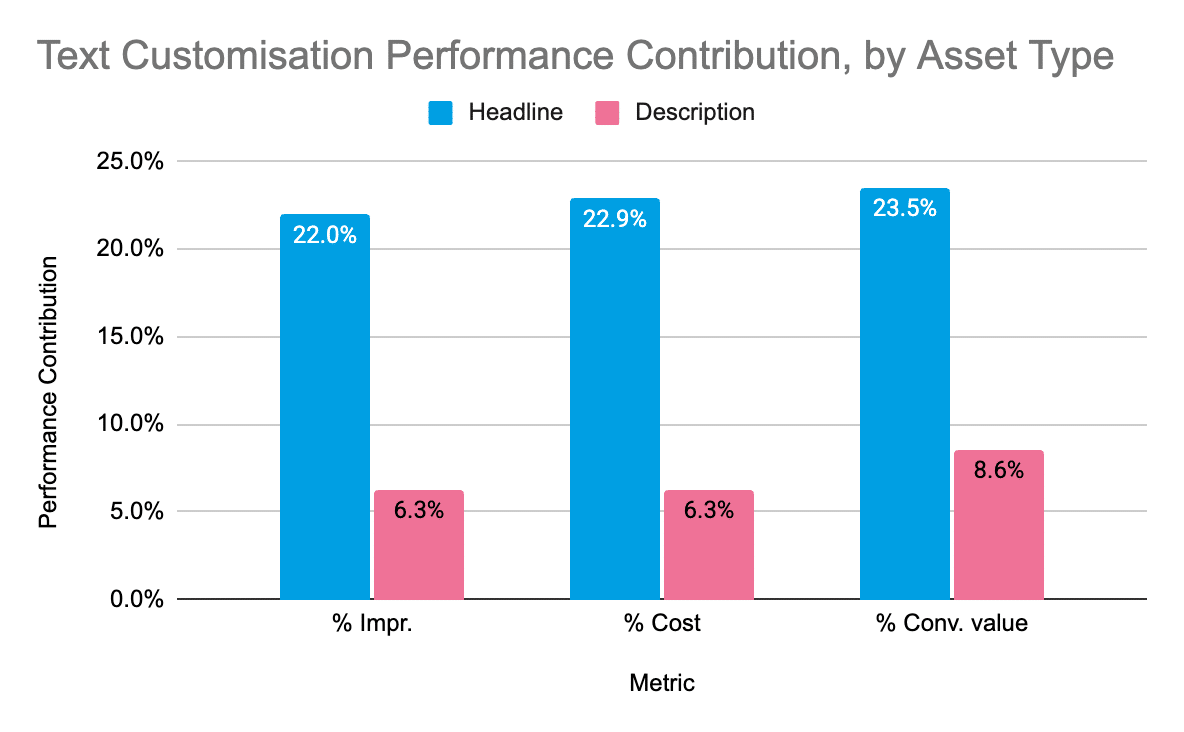
  "caption": "Exploring text customization performance: Headlines significantly outperform Descriptions across impressions, cost, and conversion value.",
  "description": "This bar chart illustrates the performance contribution of text customization by asset type. 'Headline' and 'Description' are compared across three metrics: impressions, cost, and conversion value. Headlines, shown in blue, have higher contributions, peaking at 23.5% for conversion value. Descriptions, in pink, offer lesser contributions, topping at 8.6% for conversion value. Useful for analyzing marketing effectiveness and text strategy optimization."
}
```

    Text customization can significantly enhance performance, increasing return on ad spend and extracting more value per impression. While it’s more frequently applied to headlines than descriptions, the benefits are clear.

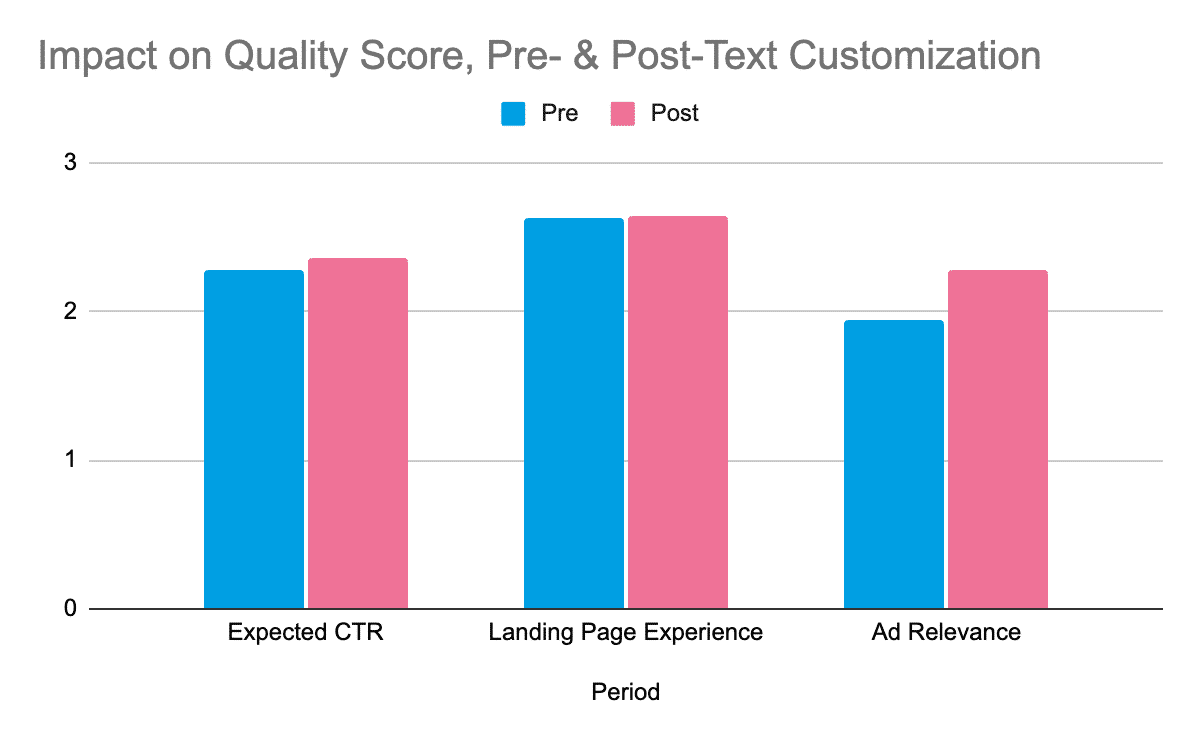
    One exciting outcome of text customization is the observable boost in Quality Score. Our analysis showed that enabling this feature improved Quality Score from 6.8 to 7.3, with ad relevance seeing the most significant rise.

    Given these findings, I encourage testing all three features if possible, especially since our tests showed that only half of the campaigns utilized text customization and even fewer activated URL optimization.

    ```json
{
  "alt": "Bar graph showing impact on quality score with pre- and post-text customization metrics.",
  "caption": "Explore how text customization influences quality scores, with improved metrics post-customization for CTR, landing page experience, and ad relevance.",
  "description": "This bar graph illustrates the impact of pre- and post-text customization on quality score components: Expected CTR, Landing Page Experience, and Ad Relevance. Blue bars represent pre-customization, while pink bars show post-customization results. Each metric sees improved scores post-customization, highlighting the effectiveness of text adjustments in enhancing ad performance. Keywords: quality score, text customization, CTR, landing page, ad relevance."
}
```

    If you’re testing AI Max, consider implementing it across your entire account rather than selectively. This approach facilitates a more comprehensive assessment of its impact.

    Not all new AI Max traffic will be completely new to your account, with 54% of queries having been previously captured by other campaigns. Despite this, AI Max still provides an additional uplift in conversion value.

    Ensure you evaluate AI Max by looking at overall account performance rather than isolated campaign tactics. Additionally, monitor how AI Max interacts with other campaigns, notably Dynamic Search Ads (DSA), since overlapping capabilities can sometimes hinder performance.

    Once you’re comfortable with AI Max, explore additional testing opportunities such as partnering it with Search Bidding Exploration (SBE) for achieving even greater customer reach.

    Finally, it’s crucial to experiment beyond AI Max’s current scope. Consider alternative strategies and the evolving balance between segmentation and consolidation within your account structure.


    Inspired by this post on Search Engine Land.


    crushpress.ai community screenshot
  • Transform Automated Workflows with Gamma Integration

    Transform Automated Workflows with Gamma Integration

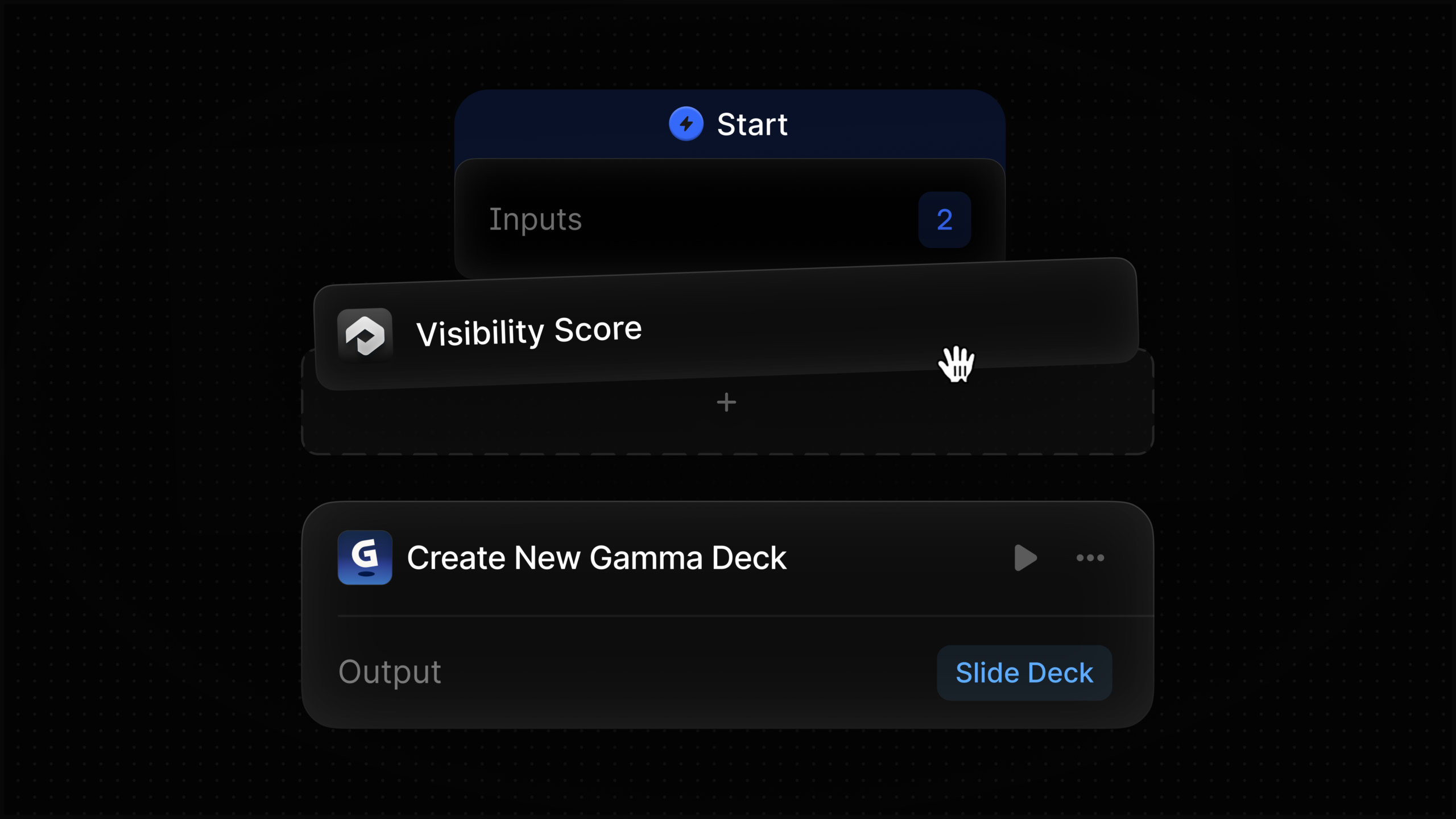
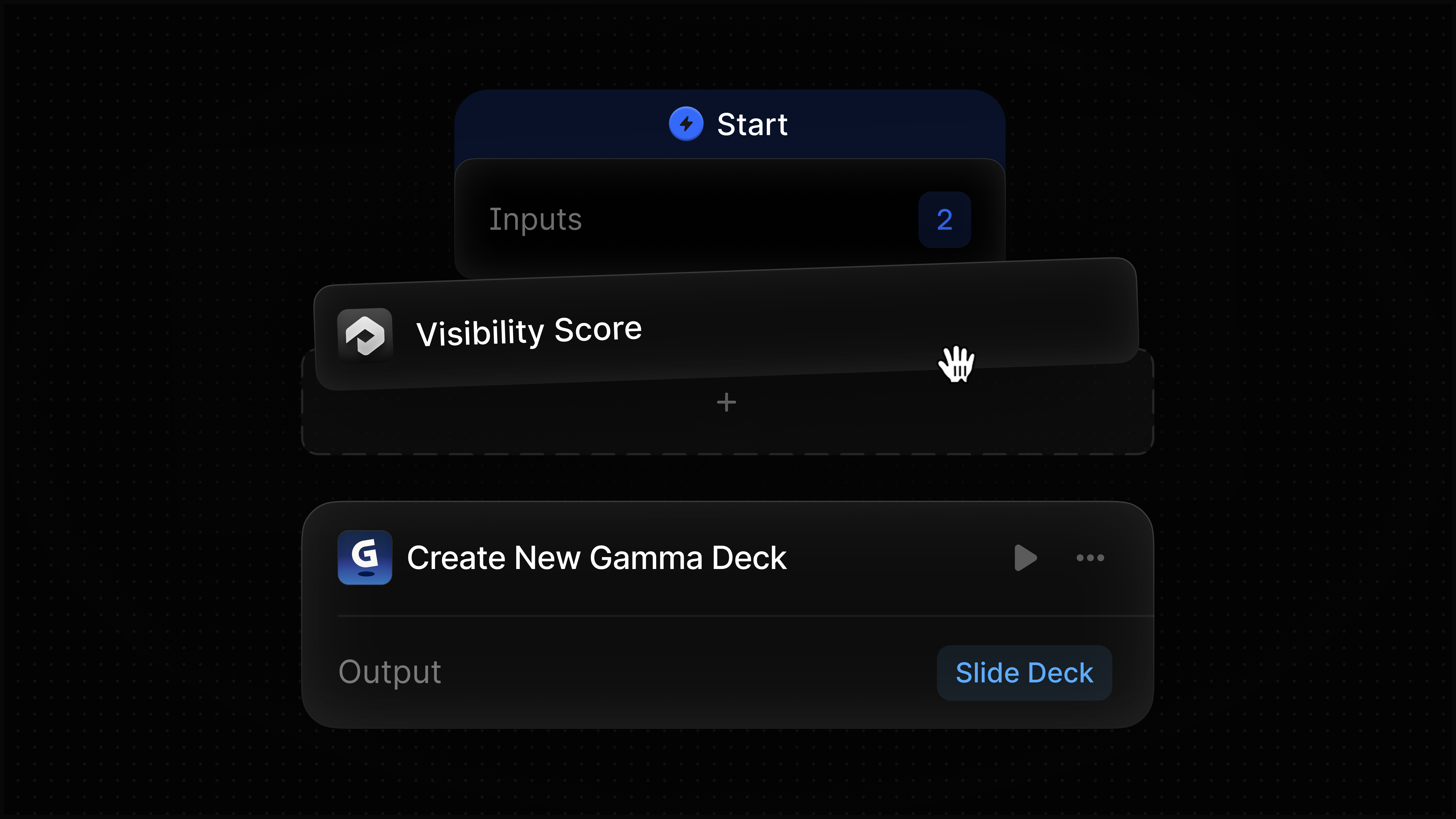
    I’m thrilled to share that Profound Agents can now seamlessly create presentations, documents, and webpages within Gamma as part of my automated workflows. No more hassle of exporting data and rebuilding it elsewhere. My Agent takes the outputs from upstream nodes and crafts them into ready-to-share assets in Gamma, streamlining the entire process.


    Inspired by this post on Try Profound Blog.


    crushpress.ai community screenshot
  • Contextual SEO: A Practical Branded Search Measurement Guide

    Contextual SEO: A Practical Branded Search Measurement Guide

    Your organic clicks increased. Before you call that an SEO win, find out who was searching. If the increase came almost entirely from queries containing your brand, organic search may be capturing demand created by advertising, public relations, product activity, or existing customer awareness. If non-branded queries grew instead, you may be reaching people who were searching for a problem or category rather than for you.

    Contextual SEO keeps those situations separate. The goal is not to find one universal definition of good performance. It is to identify what changed, for which queries and pages, under which conditions, and what you should do next.

    Key takeaways

    • Branded and non-branded search measure different relationships with demand. Do not judge them against the same CTR, position, or growth expectations.
    • Google Search Console’s branded-query filter gives you a native starting point, but its AI-generated classifications still need a human quality check.
    • A branded query is a query classification, not proof that the searcher is a returning customer or that SEO created the demand.
    • Report raw clicks and impressions alongside branded-share calculations. A changing percentage can hide which side of the ratio actually moved.
    • Segment by search type, page role, intent, market, and relevant business events before assigning a cause.
    • Use branded search to measure demand capture and non-branded search to measure discovery, then connect both to conversion data outside Search Console.

    Context decides what an SEO number means

    A click has no strategic meaning by itself. A branded click to a login page, a non-branded click to a comparison page, and an image-search click to a product page all appear in organic performance data, but they represent different needs and different opportunities.

    This is why a responsible SEO answer so often begins with "it depends". Dependence is not an excuse to avoid a recommendation. It tells you which conditions must be defined before the recommendation becomes useful.

    For branded search measurement, define these layers before interpreting a trend:

    1. Business question: Are you evaluating brand demand, organic demand capture, category discovery, reputation, support demand, or revenue?
    2. Query relationship: Does the query explicitly identify your company, a variation or misspelling of its name, or a distinctive product or service?
    3. Search intent: Is the person navigating to a known destination, researching an offering, comparing alternatives, looking for help, or trying to complete a transaction?
    4. Landing-page role: Is the result a homepage, product page, location page, editorial resource, support page, account page, or another type of destination?
    5. Measurement scope: Which Search Console property, search type, country, device group, and comparison period are you using?
    6. External context: Did a campaign, launch, news event, pricing change, public-relations effort, seasonal shift, site migration, or technical release overlap with the movement?

    Without those boundaries, a sitewide average can combine unrelated behavior. Branded queries commonly carry stronger navigational intent than broad category queries, so comparing their CTRs directly does not reveal which segment is better optimized. Each segment should be compared with its own history and with similar query-page cohorts.

    Average position needs the same care. It is an average across the queries included in the view. A change can reflect different queries entering the mix, not just an existing set of pages moving up or down. Use it to locate a question, then inspect the contributing queries and pages before making a decision.

    Build a branded and non-branded baseline in Search Console

    A laptop with an abstract query interface sits beside two trays that separate search tokens into familiar-demand and discovery groups.

    Google Search Console provides a native branded-queries filter in the Search results Performance report. It separates queries into branded and non-branded groups and applies the selected group to impressions, clicks, CTR, and average position. The filter works with Web, Image, Video, and News search types.

    Use it to create a reproducible baseline rather than taking a single screenshot:

    1. Choose one Search Console property. Record whether it is a domain property or a narrower URL-prefix property so the reporting scope is clear.
    2. Select one search type. Do not combine Web, Image, Video, and News into one interpretation because each surface can respond to different content and user behavior.
    3. Set a comparison period that covers the business event you are evaluating. Use the same dates, property, and filters for the total, branded, and non-branded views.
    4. Export clicks, impressions, CTR, and average position for the total view. Repeat the export with Branded selected and then with Non-branded selected.
    5. Break each segment down by the dimensions that matter to the question. Page groups, intent groups, country, and device are usually more useful than one sitewide total.
    6. Save the filter scope, export date, classification notes, and known business events with the report. That record prevents a later analyst from comparing two differently defined datasets.

    The four Search Console metrics answer different questions. Impressions indicate how often the included results were shown. Clicks show how much traffic those appearances produced. CTR describes clicks relative to impressions. Average position provides a directional view of visibility across the selected query set. None of them establishes why demand existed or whether the visit produced a business result.

    Google uses an AI-driven system to classify branded queries. It can recognize brand variations, misspellings, multiple languages, and distinctive products or services associated with a brand. Contextual classification also creates the possibility of mistakes, especially where a term is ambiguous.

    Audit the classification before presenting it as a clean split. Review the highest-impression and highest-click queries in both groups. Mark apparent false positives, false negatives, and terms whose meaning is genuinely ambiguous. You cannot rewrite Google’s classifier, but you can maintain an external exception list and disclose material ambiguity in your report. If questionable terms meaningfully affect the conclusion, create a separate ambiguous group in your exported analysis rather than forcing certainty.

    The option is limited to eligible sites, and query or impression volume can affect eligibility. If the filter is unavailable, use a documented query list or regular-expression rule as a temporary substitute. Include the company name, known variations, misspellings, and distinctive product or service names. Version the rule whenever you change it so historical comparisons do not silently change definition.

    The branded filter changes reporting, not rankings. Turning it on does not alter how a query or page performs in search.

    Read brand demand, demand capture, and discovery separately

    A branded query is a query-level signal. It does not identify the searcher as a loyal customer, prove that the person has visited before, or show which channel created the awareness. Someone can encounter a company elsewhere and then search its name for the first time. An existing customer can also use a generic query. Treat branded versus non-branded as a useful proxy for the wording and likely relationship of the query, not as an audience identity system.

    With that limitation understood, the split gives you three useful views:

    • Observed brand demand: branded impressions show the search activity Google classified as explicitly connected to your brand. Call it observed demand because Search Console is not a complete brand-awareness survey.
    • Organic demand capture: branded clicks and branded CTR show how effectively your organic results captured those branded search opportunities.
    • Organic discovery: non-branded impressions and clicks show where you appeared and earned traffic without the query being classified as brand-led.

    You can also calculate branded click share by dividing branded clicks by the combined branded and non-branded clicks in the same filtered scope. Use that percentage as a dependency indicator: it tells you how much reported organic traffic came through branded queries. It is not market share, brand awareness, or an SEO score.

    Always place the share next to its raw numerator and denominator. Branded click share can fall because branded clicks declined, because non-branded clicks grew, or because both changed at different rates. Those scenarios lead to very different decisions.

    Observed movementPlausible readingWhat to inspect next
    Branded impressions rise while branded CTR is stableMore searches are being classified as brand-related, while organic capture remains proportionally similar.Check which branded terms grew and compare the timing with campaigns, launches, publicity, seasonality, and other demand-generating activity.
    Branded impressions are stable while branded clicks or CTR fallExisting brand demand may be captured less effectively, although a changed query mix or search-results environment could also be involved.Inspect the affected queries, ranking URLs, average position, result titles, page availability, indexation, and any migration or template changes.
    Non-branded impressions rise while clicks lagThe site may be appearing for more queries without yet earning proportionate traffic. Weaker positions, poor intent alignment, or an expanded query mix are possible explanations.Group the new visibility by query intent and landing page. Examine query-page fit, average position, and how accurately the result communicates the page’s value.
    Non-branded clicks rise while branded activity is flatOrganic discovery improved, but the data does not yet show an accompanying increase in observed brand-query demand.Identify the pages and topics driving discovery, then use analytics or customer data to evaluate engagement, conversion, and later brand interaction.
    Branded activity rises while non-branded activity fallsStronger observed brand demand may be masking weaker category discovery in the sitewide total.Report the two movements separately. Diagnose non-branded losses by page group, intent, market, device, and search type before celebrating aggregate growth.
    Both branded and non-branded clicks riseDemand capture and discovery may both be improving, but common causes such as seasonality or broader market demand remain possible.Find the query and page cohorts responsible for each increase, then compare them with known marketing activity and conversion outcomes.

    These are diagnostic hypotheses, not automatic verdicts. Search Console shows patterns of visibility and traffic. It cannot by itself tell you that public relations caused branded demand, that a content change caused non-branded growth, or that an SEO campaign created awareness. The next check is part of the analysis, not an optional footnote.

    Turn the split into a decision-ready SEO report

    A strategist organizes three color-coded streams of search signals into separate stacks of blank reporting cards.

    A useful report does more than label two lines on a chart. It connects a tightly defined observation to a decision. For every material change, write the analysis in this order:

    1. Question: State what the analysis is meant to decide. For example, are you assessing non-branded discovery, branded-result capture, or the effect of a product launch?
    2. Boundary: Record the property, dates, search type, market, device scope, query class, and page group.
    3. Observation: Describe which raw metric moved and where. Avoid causal language at this stage.
    4. Context: List overlapping SEO releases, technical incidents, campaigns, launches, publicity, pricing changes, seasonal conditions, and other events that could matter.
    5. Interpretation: Offer the narrowest explanation supported by the segmented data. Preserve alternatives when more than one explanation fits.
    6. Validation: Name the query, page, technical, analytics, campaign, or customer evidence that would support or weaken the interpretation.
    7. Decision: Assign the next action, its owner, and the signal that will determine whether the action worked.

    Suppose non-branded clicks increase on comparison pages while branded clicks remain flat. The defensible conclusion is that organic discovery improved within that page cohort. It is not yet evidence that brand awareness increased. Your next step is to inspect the gaining queries, confirm that the pages serve the intended comparison need, and evaluate downstream engagement or conversion in your analytics and customer systems.

    The action should follow the diagnosed segment:

    • If branded impressions are healthy but capture weakens, verify that the correct official pages are indexed, available, and ranking for the relevant brand needs. Check whether titles and page purpose make the destination obvious.
    • If non-branded impressions grow without clicks, prioritize query-page alignment. Separate newly visible queries by intent before rewriting titles or content across the entire site.
    • If non-branded visibility declines in one page group, inspect that cohort for ranking, indexation, internal-linking, content-fit, and competitive changes. Do not redesign unrelated sections based on an aggregate loss.
    • If branded search rises after non-SEO activity, give the demand-generating channel appropriate context and evaluate SEO’s role as demand capture. Do not assign creation of the demand to SEO without additional evidence.
    • If the classification audit exposes material ambiguity, correct the exported reporting layer, disclose the rule, and keep the same definition in future comparisons.

    On your next reporting cycle, export the branded and non-branded views before discussing total organic growth. Pick the segment that changed, inspect its query-page cohort, write one falsifiable explanation, and attach one action to it. That small discipline turns "it depends" from a vague qualification into a measurement method your team can use.

    References

  • How to Measure AI Citations in a Personalized, Fragmented Web

    How to Measure AI Citations in a Personalized, Fragmented Web

    You check the AI answers for your priority queries. Your brand appears in one tool, disappears in another, and a colleague sees a different mix of links. That doesn’t automatically mean one test is wrong. It means “AI visibility” is too broad to be useful unless you preserve the conditions that produced each answer.

    If you are deciding where to invest, don’t chase a universal top source or compress every result into one score. Measure visibility by platform, intent, category, user context and data access. That will show you whether you have a content problem, a channel problem, an access problem or simply a misleading average.

    Key takeaways

    • An AI citation is a conditional observation, not a permanent rank. Record the platform, prompt, account state, market and date that produced it.
    • Keep platforms and categories separate until you have examined their differences. A blended citation share can hide the exact gap you need to fix.
    • Measure mentions, linked citations and recurring personalized exposure separately. They represent different user outcomes.
    • Match the intervention to the source pathway. Owned pages, individual community discussions, publisher profiles and crawler access each solve different problems.
    • Treat data access as a strategic decision involving visibility, control and content rights. It is not a technical switch that the SEO team should change in isolation.

    A citation is an observation, not a permanent rank

    A conventional ranking report usually starts with a query and a position. That model is incomplete for AI search. An answer can vary with the platform, the product surface, the user’s intent, the category, the information available to the system and the context attached to the user. The cited page is therefore an outcome of a particular test condition, not a universal position your page owns.

    Start by separating four outcomes that teams often collapse into “visibility”:

    • Mention: the answer names your brand, product or expert but may not provide a link.
    • Citation: the answer links to a page or presents it as supporting material. Record whether that page is owned by you, owned by a third party or part of a community.
    • Recurring exposure: a user follows a publisher, receives a newsletter or keeps a personalized tile that can surface the brand again.
    • Source eligibility: the system can access and use the relevant material. A strong page cannot earn a citation through a pathway that cannot retrieve it.

    The distinctions matter because citation behavior is highly conditional. Across high-commercial-intent prompts in nine verticals, citation patterns varied by platform, industry and intent during four months ending in January 2026. That is enough to reject the idea that one domain is the best citation target for every brand.

    Reddit shows how quickly a headline can become a bad strategy. Its citations grew 73% in the tracked set from October 2025 to January 2026. Yet its January citation share was above 5% on ChatGPT and as low as 0.1% on Google Gemini. The category split was also substantial: Reddit accounted for 10% of citations in apparel and 2% in transportation. Growth, platform share and category share are different measurements. None of them, on its own, tells you to make Reddit the center of your plan.

    The type of page matters too. ChatGPT’s Reddit citations in that period pointed to individual discussion threads rather than generic subreddit pages or branded community content. If those threads appear in your own category tests, the opportunity is useful participation in the exact conversations people and AI systems find valuable. Merely creating a branded Reddit presence does not reproduce that value.

    Keep the scope attached to the figures: high-commercial-intent prompts, nine verticals, four months and an end date of January 2026. Use the numbers as evidence that averages can mislead, not as a benchmark your industry must match.

    Personalization changes the unit of optimization

    Personalization doesn’t just reorder a set of public links. It can change the surface on which discovery happens and place public information beside private account data, live feeds and followed interests.

    Yahoo’s MyScout illustrates the shift. In its U.S. beta, logged-in users can build a personalized homepage from tiles connected to Yahoo Mail, News, Sports, Finance and Games, as well as topics or queries they choose. Users can add, remove and reorder tiles. Some information, such as stock prices, can update in real time; email, sports and breaking-news tiles can refresh during the day. Yahoo says the experience will become more personalized as it learns from activity.

    That creates several data lanes in one interface. A public publisher page can compete for attention beside an inbox preview, a watchlist, a favorite team’s score or a followed topic. You cannot optimize a public article into becoming someone’s private email or finance data. You can, however, make the public part of the journey clear, attributable and worth following.

    Yahoo’s publisher features make that distinction concrete. Brand pages can collect a publisher’s articles, videos and social feeds, while a follow function can turn an initial discovery into a subscription and curated email exposure. A query citation and a publisher follow are both valuable, but they are not the same result and should not share one KPI.

    Use separate scorecards:

    • Discovery: Did the brand appear for the target prompt? Was it linked? Which page and domain received the citation?
    • Retention: Could the user follow the publisher, subscribe or add the topic to a persistent personalized surface?
    • Private utility: Did the surface answer the user through account-specific information? Track this as product context, not as an organic citation win.

    Your testing also needs explicit account states. Label whether a result came from a logged-out session, a dedicated test account or an established account with follows, watchlists or activity. Record the exact account used. Calling a result “personalized” without documenting the relevant context makes it impossible to interpret or reproduce.

    Build a measurement matrix that preserves context

    An isometric glass grid contains varied combinations of colored tokens, user figures, access gates, and glowing citation links.

    The smallest meaningful unit in an AI visibility audit is a test cell: platform and product surface x exact prompt and intent x category x account context x source-access state. You can summarize cells later, but collect the raw conditions first.

    Use a minimum viable citation log

    FieldWhat to captureWhy it matters
    Test conditionPlatform, product surface, app or web, market, account and login statePrevents unlike environments from being treated as the same result
    PromptExact wording, intent, category and journey stageShows whether citation behavior changes with the decision the user is making
    ResponseBrand mention, link presence, cited URLs, domains and page typesSeparates brand awareness from actual citation capture
    Source relationshipOwned site, publisher profile, community thread, third-party editorial page or competitorPoints to the channel and owner capable of making a change
    Access stateKnown crawler policy, restriction or platform relationship affecting the sourceIdentifies cases where availability, rather than page quality, may be the bottleneck
    TimingDate, time and any visible product or model labelPreserves context when feeds refresh or platform behavior changes
    User actionClick, compare, follow, subscribe or another next step offered by the answerConnects visibility to what the user could actually do

    Run the audit in a fixed sequence

    1. Define the decision set. Start with the real questions people ask while comparing, choosing or validating an option in one commercially important category. Assign one intent label to each prompt before collecting answers.
    2. Choose the relevant surfaces. Include the AI products your audience actually uses. Do not add a platform merely because it is prominent in somebody else’s citation report.
    3. Document account context. Use named test states and keep each account consistent. If follows, activity or watchlists are part of the test, record them before the run.
    4. Save the complete response. Preserve the wording, every citation URL and enough page evidence to classify the cited source. A domain-only tally hides whether the system chose a product page, an editorial explanation or an individual discussion.
    5. Calculate metrics inside comparable cells. Measure brand mention rate, linked citation rate and source share separately for each platform, intent and category. If you repeat prompts, use the same conditions and count every run, including runs with no citation.
    6. Compare cells before combining them. Look for platform, intent and account-state differences. Only create a blended view after the underlying segments are visible, and retain those segment labels in every report.
    7. Retest after a defined change. Keep the prompt set and collection conditions stable enough to see whether the intended cell moved. A before-and-after difference is a signal to investigate, not automatic proof that your intervention caused it.

    Be precise about denominators. Citation growth is a change in count over time. Citation share is a source’s portion of all captured citations. Brand citation rate is the portion of eligible test runs that link to your brand or its owned pages, depending on the definition you set. Reporting one as if it were another is how an impressive number becomes an unhelpful decision.

    Do not hide missing citations either. A no-citation answer, a citation to a third party that mentions you and a citation to your own page represent different source pathways. Each should have its own value in the log rather than being collapsed into a generic success column.

    Turn each visibility gap into the right channel decision

    Analyst figures route fragmented glowing signals from a central junction toward a document library, network, guarded gateway, and relationship hub.

    Once the matrix is segmented, the pattern usually tells you where to investigate. The useful question is not “How do we rank in AI?” It is “Why does this source win for this decision on this surface under these conditions?”

    When competitors’ owned pages receive the citations

    Compare the cited page with yours at the decision level. Identify the question it resolves, the claims it supports, the details it makes explicit and the next action it enables. Build the missing value into the most relevant page on your site rather than publishing a generic AI-search article or copying the competitor’s structure.

    Keep important facts in accessible page content. Use appropriate JSON-LD to identify the entity and content type and to connect information already visible on the page. Schema can reduce ambiguity for machines, but it is not a citation switch and should not be reported as one.

    When individual community discussions receive the citations

    Work at the thread level. Find the recurring questions in the cited discussions, answer them with category knowledge and disclose your relationship to the brand. The documented Reddit pattern favored unique discussions, so a generic corporate profile or empty branded community is not an equivalent intervention.

    Track community citations separately from owned citations. A useful third-party discussion can increase brand representation without giving you control of the page, its future edits or its availability. That is a different asset and a different risk profile.

    When a personalized surface offers a follow path

    Make the publisher identity coherent across the material collected by that surface. Treat the brand page, follow action and newsletter as a retention path after discovery. Measure whether users can reach and follow the publisher; do not count the existence of the feature as a citation.

    When access, not content, is the bottleneck

    Data availability is not uniform. Commercial deals, restrictions and lawsuits have been fragmenting what AI systems can access. Your content can remain unchanged while its eligibility differs from one platform to another.

    Amazon demonstrates the competitive consequence. Its more aggressive blocking of AI crawlers coincided with lower Amazon citation visibility on ChatGPT and more room for Walmart in the tracked results. That does not prove that every publisher should open every crawler. Amazon’s choice also reflects a preference for controlling direct customer interactions.

    Before changing access, document which crawler or pathway is affected, which content is in scope, which AI surfaces matter to the business and what control or content-rights concerns prompted the restriction. Bring the content owner, technical team and appropriate legal or commercial stakeholders into the decision. A blanket unblock made only to chase citations can create a larger governance problem; a blanket block can surrender visibility to an accessible competitor.

    Platform-specific source preferences can create another kind of gap. Even Google’s AI surfaces showed different citation mixes for social sources such as Reddit, Medium, YouTube and LinkedIn. If one format performs on one surface, verify the pattern elsewhere before expanding the entire channel program.

    Use the next test to isolate one decision. Select one high-value category, preserve its exact prompts and account states, and map every citation to its source pathway. Then make the narrowest change that addresses the observed gap. Your first useful deliverable is not a universal visibility score. It is a map showing which source wins under which condition, who can influence it and what you will test next.

    References

  • How Tripadvisor Supports Local SEO for Travel Businesses

    How Tripadvisor Supports Local SEO for Travel Businesses

    If you market a hotel, restaurant, tour, or attraction, a weak Tripadvisor listing can shape the decision before a traveler reaches your website. The platform can occupy valuable search-result space for your business name, appear during category discovery, and expose reviews, photos, and business details while the customer is deciding where to book.

    Your goal is not to make Tripadvisor the center of your local SEO strategy. It is to manage the listing as one coordinated part of your search presence: accurate business facts, a clearly described experience, fresh evidence, useful customer language, and a credible path from discovery to action.

    Tripadvisor influences discovery before it influences rankings

    Tripadvisor performs three jobs at once. It is a search result, a comparison marketplace, and a reputation page. That combination matters because travelers visiting it are often beyond general inspiration and actively comparing places, experiences, or meals.

    The scale is difficult to dismiss: Tripadvisor receives about 490 million monthly visits. Its large, programmatically structured collection of indexable destination, category, and business pages also gives it substantial visibility in conventional search results. In some tourism and hospitality searches, a Tripadvisor listing can even appear above the business’s own website.

    That does not mean optimizing Tripadvisor will directly raise your website or Google Business Profile rankings. There is no defensible reason to report it as a guaranteed ranking shortcut. Its local SEO contribution is broader and more practical:

    • Search-result coverage: A complete listing gives searchers a credible third-party result when they look for your brand, location, or business type.
    • Internal discovery: Categories, tags, reviews, and profile content help Tripadvisor understand where the business belongs within its own marketplace.
    • Entity consistency: Matching identity information across Tripadvisor, your website, and Google Business Profile reduces ambiguity about which business each page represents.
    • Decision support: Current photos, detailed reviews, and clear descriptions answer questions that might otherwise stop a booking.
    • Qualified referral traffic: Visitors who reach your website after comparing options on Tripadvisor may arrive with stronger intent than someone conducting broad destination research.

    Tripadvisor can also contribute to AI discovery, but the mechanism should be described carefully. Detailed profile text and factual owner responses create more explicit language about your amenities, audience, setting, and experiences. That gives AI-driven search systems more context to interpret; it does not guarantee that an AI answer will mention or recommend you. For AEO and GEO, prioritize clear passages and verifiable details, not inserted keyword strings.

    Fix identity, duplicates, categories, and tags before polishing copy

    Isometric illustration of duplicate map listings merging into one organized listing for a boutique inn.

    A beautifully written description cannot repair a fragmented business identity. Begin with the fields that determine which entity the listing represents and where it can be discovered.

    1. Look for duplicate and outdated listings. Search Tripadvisor and conventional search results using the exact business name, previous names, address, and common variations. Do this before creating anything new. A duplicate can divide attention, reviews, photos, and brand signals between competing pages.
    2. Claim and verify the correct listing. Use the profile representing the current operating business. Resolving duplicates can require official business documents and information that matches Google Business Profile, so keep the legal and customer-facing identity records available.
    3. Align the core facts. Check the operating name, address, website, primary business type, and other defining details against your website and Google Business Profile. Consistency means the facts agree; it does not mean every platform needs an identical marketing description.
    4. Select accurate categories and tags. Represent the full set of experiences the business genuinely provides. Tripadvisor uses these classifications for internal discovery and curated collections, so an omitted attribute can prevent an otherwise suitable business from appearing in a relevant list.
    5. Complete the decision-making fields. Describe the experience, amenities, menu, and other material offerings that a prospective guest needs to understand. Remove details that are no longer true.
    6. Review the public page as a customer. Confirm that the lead image, summary information, categories, and recent customer feedback create one coherent expectation. Owner dashboards can hide how disconnected a listing feels when its public elements are viewed together.

    Do not add categories merely because they attract desirable searches. If the listing claims a romantic dining experience, family-oriented amenity, or particular type of cuisine, the photos, menu, description, and customer feedback should support that claim. A misleading classification may win an impression but lose the booking when the visitor inspects the page.

    Use this priority order when resources are limited: correct identity, remove duplication, choose the right categories, update the offer, refresh the visual evidence, and then refine promotional wording. The early steps determine whether the right listing can be found; the later steps help it convert.

    Reviews and images should explain the experience, not decorate it

    Traveler photographing a guide presenting a regional dish to a small group inside an independent restaurant.

    Write owner responses that add useful context

    A review response is not only reputation management. It is public content attached to a specific customer experience. A thoughtful reply can turn a vague mention into a clearer explanation of what the business offers.

    If a guest says only that the pool was enjoyable, for example, a useful response can acknowledge the comment and mention a relevant family feature or activity, provided that feature genuinely exists. This creates additional semantic context around the property’s amenities. The response should still sound like a reply to a person, not a paragraph built to carry search terms.

    A reliable response structure is:

    • Acknowledge the specific experience. Refer to what the customer actually mentioned instead of opening with a generic template.
    • Add one relevant clarification. Explain a feature, setting, audience, or use case that helps the next reader understand the experience. Only add details you can substantiate.
    • Close naturally. Keep the response proportionate to the review. Repeating the business name, location, and service keywords adds clutter rather than value.

    You can also encourage more informative reviews without scripting praise. After the visit, invite the customer to describe which experience they booked, what stood out, who the experience suited, or what they would tell another traveler. That produces more decision-useful language than asking only for a star rating.

    Review velocity matters as an operational signal, but do not confuse velocity with sudden volume. The sustainable objective is a continuing stream of feedback from real customers, followed by regular owner attention. A burst of requests followed by months of silence leaves the listing looking less current and gives you fewer recent customer questions to learn from.

    Use current images as evidence of what someone can book

    Travel and hospitality decisions are visual. The strongest images quickly show what the guest will receive: the room, dish, view, activity, atmosphere, or defining feature. Replace photos that show an old menu, previous decor, unavailable amenities, or an experience that no longer represents the business.

    You do not need to guess which creative deserves the lead position. If you already publish comparable photos on Instagram, use the engagement data as a directional signal for which subjects and compositions attract attention, then confirm that the selected image accurately represents the bookable experience. Popularity is useful only after accuracy.

    Captions should describe the image in natural language. A practical formula is: what is shown, where or how it is experienced, and who or when it may be relevant. For example, a dish caption can identify the meal, the terrace or dining setting, and the season in which it is offered. Include audience claims such as “popular with solo travelers” only when you have a real basis for them. A string of location and service keywords does not help a traveler understand the image.

    Manage Tripadvisor as a measurable local search channel

    Profile optimization becomes difficult to defend when the only metric is average rating. Rating matters to customers, but it does not tell you whether the listing is accurate, discoverable, engaging, or sending qualified demand.

    Track the channel in layers:

    • Presence: Record whether the correct Tripadvisor page appears for your business name and relevant local discovery searches. Note duplicate or outdated results separately.
    • Profile health: Monitor completeness, category accuracy, current menu or experience information, image freshness, and unanswered-review backlog.
    • Activity: Watch review velocity, owner response activity, new image publication, and recurring themes in customer language.
    • Engagement: Use the interaction and click information available to the account to identify whether people are moving beyond a listing impression.
    • Business outcomes: In your web analytics, segment Tripadvisor referral visits and evaluate them against the booking, reservation, enquiry, or purchase action that matters to the business.

    Capture a baseline before making a substantial change. Compare equivalent reporting periods and annotate major profile updates, promotions, closures, and seasonal offer changes. This will not prove that a single caption or response caused a result, but it will prevent you from attributing every movement to the most recent edit.

    Website traffic is only one part of the journey. Tripadvisor also functions as a comparison environment where a customer may make a decision without visiting your domain. Read referral traffic alongside profile engagement and actual bookings rather than declaring the channel successful or unsuccessful from sessions alone.

    A manageable recurring workflow is to inspect identity fields and duplicates, clear the review-response backlog, replace outdated images or offer information, record emerging customer themes, and review referral outcomes. Assign ownership to a person or role. A listing that belongs vaguely to “marketing” is likely to remain untouched until a negative review or incorrect detail creates urgency.

    Key takeaways

    • Use Tripadvisor as a distributed local landing page and comparison surface, not merely a place to collect ratings.
    • Resolve duplicate listings and align core identity information with your website and Google Business Profile before rewriting promotional copy.
    • Choose categories and tags for experiences the business actually delivers; those classifications affect internal discovery and customer expectations.
    • Respond to reviews with one useful, factual layer of context instead of inserting keywords or repeating a template.
    • Refresh images, captions, menus, and experience details whenever the public offer changes.
    • Measure profile health, engagement, qualified referral traffic, and business outcomes separately so you can see where the journey is improving or breaking.

    Start with a duplicate and identity audit of the listing that already exists. Once the correct entity is established, improve one decision layer at a time: classification, offer clarity, reviews, images, and measurement. That sequence turns Tripadvisor from an unmanaged reputation page into a useful part of your local search system.

    References

  • Transform B2B Success: Top LinkedIn Ads Tests for 2026

    Transform B2B Success: Top LinkedIn Ads Tests for 2026

    5 B2B LinkedIn Ads tests to run in 2026

    Short-form video, Thought Leader Ads, personalized creative, and Qualified Lead Optimization are showing promise. Here’s how I plan to test them.

    LinkedIn made some noteworthy moves last year with significant payoffs for our B2B clients. As we embrace 2026 and zero in on our yearly marketing goals, I’ve gathered some exciting insights from 2025 to help you maximize your strategies. Let’s dive into the top tests to run, including:

    • Video.
    • Thought Leader Ads.
    • Personalized creative.
    • Qualified Lead Optimization.
    • Ads duplication.

    Let’s explore each of these tests and the potential benefits they offer.

    LinkedIn video is a must

    Even though Meta and TikTok are more suited for videos, LinkedIn hasn’t shied away from the wave — especially with short-form videos (7-15 seconds). Crafting the right content is crucial for your marketing strategy. Here’s how you can leverage video effectively:

    Consider new placements like First Impression Ads. Compare the performance of video ads in the feed against other ads to gauge impact and engagement.

    The usual tips apply:

    • Avoid just repurposing videos from others. LinkedIn users interact differently — focus on content addressing professional challenges, testimonials, or tutorials.
    • Have a follow-up plan for users engaging with your video, as one video isn’t usually enough to convert immediately.
    • Define a strategy to measure video engagement value, from views to actions like “Comment X for the full guide.”

    Dig deeper: LinkedIn study reveals how B2B video ads can gain +129% engagement lift

    Your customers search everywhere. Make sure your brand shows up.

    The SEO toolkit you know, plus the AI visibility data you need.

    Start Free Trial
    Get started with
    Semrush One Logo

    People respond to people, so try Thought Leader Ads

    Engaging potential B2B clients can often be challenging, especially through a corporate lens. Thought Leader Ads (TLAs), which allow companies to boost employee content, have been around. Since I tested them rigorously in 2025, I’ve noticed they garner significantly higher engagement compared to typical business profile ads.

    TLAs also afford creativity. Humorous posts, for instance, feel more authentic when shared from a personal profile.

    As with all boosted content, selective investment is key. If a post organically gains traction and aligns with your business goals, it’s a prime TLA candidate.

    Caveats to consider:

    • Ensure employees whose content you boost have your brand prominent on their profiles. Activate creator mode so users can follow them, adding value to future content.
    • Per LinkedIn, repurposing content published less than 30 days ago works best. My experiences confirm this.

    Dig deeper: LinkedIn Ads retargeting: How to reach prospects at every funnel stage

    ```json
{
  "alt": "The CapmatchOne logo with a gradient circle and bold text.",
  "caption": "Discover innovation with the CapmatchOne logo, featuring sleek typography and a modern gradient circle.",
  "description": "The CapmatchOne logo features bold, modern typography coupled with a gradient circle, symbolizing connection and innovation. The sleek design conveys a sense of progress and creativity. This image can be used for branding or promotional purposes, appealing to audiences interested in innovative solutions and forward-thinking designs."
}
```

    Get the newsletter search marketers rely on.

    MktoForms2.loadForm(“https://app-sj02.marketo.com”, “727-ZQE-044”, 16298, function(form) {});

    Personalize your creative

    In late 2025, I experimented with personalized LinkedIn ads across various regions and campaigns. Globally, I witnessed a >20% improvement in cost per lead, paired with better CTR and lower CPC. U.S. campaigns were remarkable, showing a 33% drop in CPLs.

    According to my LinkedIn contacts, European users value privacy more than their U.S. counterparts, explaining why personalization resonated better stateside. Yet, even U.S. campaigns showed fatigue with personalized ads after a month.

    Combining personalized and non-personalized ads in one campaign decreased the frequency of personalized ads and facilitated side-by-side performance comparisons.

    Dig deeper: LinkedIn’s new playbook taps creators as the future of B2B marketing

    Test Qualified Lead Optimization

    Having experience with Conversions API (CAPI) and enhanced conversions in Meta and Google, the concept of Qualified Lead Optimization is familiar. LinkedIn’s take lets you merge your first-party data with its algorithm to target high-quality users more effectively.

    Though not as adept as Meta and Google yet, I’ve noted an increase in qualified leads through LinkedIn.

    Here’s how to test it:

    • Use LinkedIn’s CAPI to sync CRM data and define what constitutes a qualified lead.
    • Set up a CAPI conversion event for qualified leads and ensure data flow to Campaign Manager.

    Use the new ads duplication feature

    This tactical feature has saved me time across accounts, making it an essential tool. In March 2025, LinkedIn improved Campaign Manager with a feature for duplicating ads across campaigns and accounts, expediting our campaign launches — a win with no downsides.

    One more LinkedIn ad format to watch

    I’m still evaluating LinkedIn’s new CTV capability. It offers potential for testing brand messages and positioning through targeted niche audiences before committing to broader campaigns.

    LinkedIn introduced substantial updates last year, prompting us to boost client budgets there. Setting clear platform expectations and having a robust evaluation framework will maximize LinkedIn’s value.

    Armed with these strategies and a deep understanding of your ideal customer profile (ICP), LinkedIn could serve as a surprising source of growth in the coming months.


    Inspired by this post on Search Engine Land.


    crushpress.ai community screenshot