Month: December 2025

  • AI Search Marketing Strategy: A Practical Operating System

    AI Search Marketing Strategy: A Practical Operating System

    You can still hold rankings and lose visits. Google can answer the query inside an AI Overview, while ChatGPT, Gemini, and Perplexity absorb searches that once began on a traditional results page. The referral traffic that reaches your site from these systems may not replace the clicks you lose elsewhere. That is a change in buyer behavior, not a reporting glitch, and waiting for the old traffic pattern to return is not a strategy.

    Your response should not be to publish more AI-generated copy. You need an operating system that connects buyer questions, search visibility, useful assets, business outcomes, and a repeatable work queue. The workflow below gives you that system.

    Key takeaways

    • Manage AI search around a fixed portfolio of commercially relevant buyer questions, not an unbounded list of prompts.
    • Separate business outcomes from classic search signals and AI visibility signals. Each layer answers a different management question.
    • Diagnose the visibility gap before choosing the tactic. A missing citation, a declining click-through rate, and an inaccurate brand description require different work.
    • Use content for questions that need explanation or evidence. Build an interactive asset when the user must provide inputs, compare scenarios, or complete a task.
    • Treat AI-assisted development as a fast prototyping method, not permission to bypass security, accessibility, compliance, or engineering review.
    • Report what changed, what you shipped, what you learned, and which decision or resource is needed next. Do not hide business declines behind a new visibility score.

    Build a baseline that separates outcomes from visibility

    Two visual streams representing search visibility and business outcomes converge at a central analysis lens.

    Do not begin with an AI visibility score. Begin with the business result that prompted the investigation. Revenue, qualified leads, purchases, and other key actions tell you whether performance changed. Search and AI metrics help you diagnose why.

    A useful baseline has four layers. Keeping them separate prevents a common reporting error: treating every mention, ranking, or visit as if it carried the same commercial value.

    Measurement layerSignals to recordDecision it supports
    Business outcomesRevenue, qualified leads, purchases, pipeline actions, and conversion rateWhether search performance is helping the organization reach its goals
    Classic searchImpressions, clicks, click-through rate, rankings, landing-page traffic, and conversionsWhether demand, visibility, result-page behavior, or on-site performance changed
    AI answer visibilityBrand mention, citation, link, description accuracy, answer position, and competing brands across a fixed question setWhere the brand is absent, weakly represented, or represented incorrectly
    Demand and competitionSearch-interest direction, competitor visibility, competitor traffic estimates, and changes in the questions buyers askWhether the problem is specific to your site or reflects a broader market shift

    Compare business outcomes and organic performance year over year where the data allows it. That helps distinguish a structural decline from ordinary seasonality. Confirm the numbers with whoever owns analytics before presenting them to leadership. A ranking report alone cannot show the business effect, although rankings remain useful as a diagnostic when you are trying to separate lost visibility from lost demand.

    Next, inspect impressions, clicks, and click-through rate together in Google Search Console and Bing Webmaster Tools. AI-generated result-page answers can reduce third-party clicks, so annotate whether an AI Overview appears on queries or pages with a falling click-through rate. That association is evidence of a changed result page. It does not prove that the AI Overview caused every lost visit.

    • Impressions are steady while clicks and click-through rate fall: investigate result-page changes, including AI Overviews, and whether the visible answer now satisfies the basic question without a visit.
    • Impressions and clicks both fall: inspect demand, rankings, indexing, competitors, and the query mix before rewriting the page.
    • Traffic falls while conversions hold: determine which landing pages and query types lost visits. You may have lost low-intent discovery traffic, but that is a hypothesis to test, not a reason to dismiss the decline.
    • Traffic holds while conversions fall: inspect intent alignment, offer relevance, page experience, and conversion instrumentation. AI visibility work will not repair a broken on-site journey.

    Use competitor estimates and demand tools such as Google Trends or Exploding Topics as context, not as substitutes for your own data. If several competitors decline around the same query group, the market or results page may have changed. If they gain while you decline, your content, authority, distribution, or technical implementation deserves closer inspection.

    AI answer tracking needs similar discipline. Keep the question wording, platform, date, and any observable location or account conditions with each result. Generated answers can vary, so a single screenshot is an observation, not a trend. Track repeated patterns across the fixed question set, and label AI visibility as a leading indicator rather than revenue.

    Turn buyer questions into a prioritized intervention queue

    A keyword inventory is not yet an AI search workflow. The unit of work should be a buyer question connected to a decision: choosing a category, evaluating an approach, comparing options, estimating a result, reducing a risk, or completing a task.

    Build the portfolio from queries in Search Console, tracked keywords, on-site search, sales conversations, support requests, and the language used on high-value conversion paths. Keep it deliberately bounded. If the list grows every time someone invents another prompt variation, you will produce activity without a stable baseline.

    1. Choose the question. Write the natural-language version a buyer would use, then connect it to the relevant product, service, topic, and business outcome.
    2. Label the user job. Record whether the person needs an explanation, comparison, recommendation, calculation, validation, or action.
    3. Capture the current answer. Review the traditional results page and the AI surfaces that matter to your audience. Save the exact wording used for the check.
    4. Code the brand outcome. Mark the brand as absent, mentioned, cited, linked, inaccurately described, or accurately represented. Record which competitors appear and which pages support them.
    5. Diagnose the gap. Decide whether the problem is missing content, weak evidence, inconsistent entity information, insufficient web mentions, poor distribution, an uncompetitive offer, or an experience that a static page cannot provide.
    6. Select the smallest credible intervention. Assign a page improvement, new evidence asset, digital PR task, entity correction, partnership, interactive experience, or technical fix.
    7. Name the success signal. Use the signal appropriate to the intervention: a corrected description, a citation, improved qualified traffic, tool completion, lead quality, or a business conversion.
    8. Assign an owner and review point. Every item needs someone responsible for shipping it and a future decision to continue, revise, expand, or stop.

    The diagnosis matters because the same symptom can produce very different work. Use this matrix to keep the team from defaulting to another generic content brief.

    Observed gapInvestigate firstLikely work item
    The brand is absent while competitors are citedWhether competitors have clearer evidence, broader topic coverage, stronger third-party mentions, or a better page for the questionEvidence-led content, digital PR, partnerships, or distribution to relevant external sites
    The brand is mentioned but not cited or linkedWhether the site provides a clear, authoritative page that supports the claim being madeImprove the source page, factual specificity, internal relationships, and consistent entity information
    The brand is described inaccuratelyConflicting claims across the website, profiles, product information, and third-party coverageCorrect first-party facts, align public descriptions, and pursue corrections where appropriate
    A page still ranks but receives fewer clicks when an AI answer appearsWhether the result page now resolves the basic question and whether the brand appears in that answerImprove answer inclusion while adding a deeper reason to visit, such as original evidence, a workflow, a tool, or a decision aid
    Visitors arrive but do not complete the intended actionQuery intent, landing-page promise, offer relevance, calls to action, and measurementConversion and journey improvements rather than more awareness content
    The correct answer depends on the user’s inputsWhether a generic explanation can genuinely help the person decide or actA calculator, configurator, assessment, planner, template generator, or other interactive experience

    When content is the right intervention, write for extraction and action at the same time. State the direct answer early, name the relevant entities and scope, support important claims, and keep business facts consistent across first-party pages. Then give the reader a useful next step that cannot fit inside a short generated response.

    This is why the strategy has to move from isolated keyword pages toward coherent entities, topic coverage, expertise signals, and consistent web mentions. The goal is not to repeat the same phrase across more URLs. It is to build a connected body of useful information that explains what the organization is, what it knows, what it offers, and why those claims deserve support.

    Relevant structured data can make visible page information easier for machines to interpret. It cannot manufacture evidence, authority, or a relationship that the page and the wider web do not support. Treat JSON-LD as an accurate machine-readable description of the content, not as a shortcut around the content and distribution work.

    Build experiences when a generated answer is not enough

    AI answers are strongest when the user wants a compact explanation assembled from existing information. They are less able to replace a branded experience that accepts meaningful inputs, applies transparent logic, and helps the person complete a specific job. That distinction gives you a practical way to decide when to publish and when to build.

    A good interactive candidate passes a simple screen:

    • Does the user’s input materially change the output?
    • Will the output help the person decide, estimate, configure, diagnose, plan, or produce something useful?
    • Can you explain the underlying assumptions and data clearly enough for the user to judge the result?
    • Is there a natural next action after the result, rather than a forced lead form attached to an unrelated interaction?
    • Can the organization maintain the logic, dependencies, content, and data after launch?

    Reject the idea if every user receives effectively the same answer. That should probably be a page, template, or downloadable resource. Reject it if the only purpose is to conceal a sales form behind a superficial quiz. Build when the interaction itself creates value.

    AI-assisted development has shortened the path from a natural-language specification to a working prototype. The loose, exploratory version is often called vibe coding. It can let search teams test a calculator, assessment, content utility, or internal workflow before a conventional development cycle would normally begin. It does not make production engineering unnecessary.

    Use a documented build workflow even when the prototype feels disposable:

    1. Define the user problem. Name the audience, the decision they face, the information they possess, and the useful outcome they should receive.
    2. Write the content and product specification. Include inputs, outputs, logic, assumptions, data sources, edge cases, error states, accessibility requirements, analytics events, calls to action, and acceptance criteria.
    3. Design the states before the integrations. Map the empty, loading, completed, invalid-input, and failure states with static data. This exposes a confusing experience before implementation complexity hides it.
    4. Build the smallest complete loop. The user should be able to enter information, receive a trustworthy result, understand it, and take the intended next action.
    5. Validate the substance. A subject-matter owner should check the calculations, assumptions, language, and limitations. A polished interface does not make an unsupported result reliable.
    6. Review the production risks. Check authentication, authorization, input handling, data storage, privacy, dependencies, error handling, accessibility, analytics, performance, backups, and rollback.
    7. Test real tasks. Give representative users a goal without explaining the interface. Record where they hesitate, misread the result, abandon the flow, or lose trust.
    8. Deploy with ownership. Document the architecture, prompts, dependencies, data, release process, known limitations, and maintenance owner before promoting the tool.

    Treat AI-generated code as unreviewed code. Do not place production secrets, customer credentials, or sensitive data into an exploratory build. If the experience processes payments, makes consequential financial or health calculations, stores regulated data, or creates legal exposure, route it through qualified engineering, security, compliance, and legal review before release.

    The failure modes are practical, not theoretical abstractions: security and compliance gaps, expanding platform costs, fragile systems, and technical debt can turn a fast prototype into an expensive obligation. Keep a rollback path, inspect third-party dependencies, and decide who will fix the tool when an input, API, model, data source, or business rule changes.

    Measure the result as a product, not merely as a page. Acquisition signals include relevant queries, links, citations, and qualified entrances. Usage signals include starts, completions, errors, abandonment points, and repeat use. Business signals include qualified leads, purchases, pipeline actions, and assisted conversions. Maintenance signals include defects, dependency changes, operating costs, and the effort required to keep the output correct.

    Run a learning loop that leadership can fund

    A cross-functional team moves blank cards and prototypes around a circular test-and-measure workflow.

    AI search is not a campaign that ends when a group of pages is optimized. Answers change, competitors publish, result-page features expand, and buyer language shifts. Your workflow therefore needs a recurring loop that turns observations into decisions.

    1. Observe: update business outcomes, classic search data, AI answer observations, demand context, and competitor presence.
    2. Diagnose: identify whether each material change comes from demand, visibility, click behavior, representation, content quality, distribution, technical performance, or conversion.
    3. Prioritize: rank work by commercial relevance, severity of the gap, confidence in the diagnosis, effort, risk, and the value of what the team expects to learn.
    4. Ship: release the smallest credible intervention with an owner, baseline, expected signal, and review point.
    5. Measure: record the business result and the leading signals without pretending that a mention is equivalent to a sale.
    6. Decide: continue, revise, expand, or stop. Save the reasoning so the next team member does not repeat the same test without context.

    Keep a decision log beside the backlog. Each entry should contain the buyer question, observed gap, evidence, chosen intervention, owner, expected signal, actual result, caveats, and next decision. The log is more valuable than a gallery of screenshots because it preserves why the team acted and what changed afterward.

    Make ownership explicit

    Search cannot produce this system alone. SEO can own the question portfolio, result-page diagnosis, and technical discoverability. Content and subject-matter teams own explanation and evidence. Public relations and partnerships help earn relevant mentions and citations beyond the website. Analytics owns definitions, instrumentation, and reporting integrity. Product, engineering, security, and legal review interactive experiences according to their risk. Leadership decides whether long-term brand visibility, experimentation, and cross-functional work receive the necessary priority and resources.

    This alignment matters because rankings, traffic, and last-click revenue no longer tell the whole story. It does not mean those measures should disappear. It means the team needs a wider view while remaining accountable to business results.

    Report decisions, not a pile of new metrics

    A leadership update should answer five practical questions in order:

    1. What changed in the business? Show revenue, qualified leads, key actions, and organic traffic with an appropriate comparison period.
    2. What changed in discovery? Show the relevant movement in impressions, clicks, click-through rate, rankings, AI answer presence, demand, and competitors.
    3. What can we reasonably infer? Separate observed facts from hypotheses. Name missing data and alternative explanations.
    4. What did we ship and learn? Connect each intervention to its buyer question, baseline, leading signal, business result, and next decision.
    5. What decision is needed? Ask for the specific budget, data support, engineering review, content capacity, public-relations involvement, or expectation change required for the next work queue.

    Do not use improved AI visibility to disguise falling revenue or leads. Do not attribute all direct traffic, branded search, or offline demand to AI without evidence. Do not promise that a citation will produce a click. Instead, show where the brand is becoming easier to discover, where the journey still breaks, and which experiment will reduce uncertainty next.

    Forecasting needs the same honesty. If AI answers continue to absorb informational clicks, the old traffic baseline may no longer be attainable through incremental title changes and additional copy. Model the effect on leads and sales, improve conversion where visits still occur, invest in brand inclusion where answers replace clicks, and build experiences that give people a reason to continue to your site.

    Start with a commercially important topic before the next planning meeting. Lock the buyer-question set, establish the four-layer baseline, diagnose the clearest gap, and ship the smallest intervention that can teach you something useful. Bring the result and the next decision to leadership. Once that loop works, expand it deliberately. That is how AI search becomes an operating discipline instead of another dashboard the organization stops checking.


    References

  • Google Maps in Demand Gen: A Practical Testing Guide

    Google Maps in Demand Gen: A Practical Testing Guide

    You have a new channel choice and a familiar campaign problem: should you add Google Maps to an existing Demand Gen campaign, or isolate it in a campaign of its own? The wrong structure may still spend money and record conversions. It just may not tell you whether Maps contributed anything useful.

    Google Maps can be selected in Demand Gen channel controls alongside other channels or used on its own. That gives you a cleaner way to build around location-dependent decisions, but the control is only valuable when the campaign starts with a precise question.

    Key takeaways

    • Use a Maps-only campaign when you need to learn whether Maps delivery can meet a defined business target.
    • Keep Maps with other Demand Gen channels when the same message and outcome work across contexts and placement-level certainty is secondary.
    • Treat Maps as a location-relevant context, not proof that every impression carries immediate local intent.
    • Match the ad, campaign geography, offer and destination page to the locations you can actually serve.
    • Do not confuse isolated Maps performance with incrementality. A Maps-only result shows what happened in that campaign, not what would have happened without it.

    Maps gives you placement control, not proof of intent

    The meaningful change is control over distribution. Maps joins Demand Gen channels such as YouTube, Discover and Gmail, and an advertiser can combine those environments or select Maps alone. That is useful because a location-dependent message does not always belong in every discovery context.

    What the setting does not do is turn every Maps impression into a high-intent local search. Placement, audience, intent and business outcome are different things. Selecting Maps controls the environment in which eligible ads can appear. It does not prove what a person wants, how urgently they want it or whether they are within a serviceable location.

    That distinction matters for businesses with branches, venues, service areas or in-person appointments. Maps may place the message closer to a location-oriented decision, including situations involving local exploration or navigation. You still need the campaign to qualify that opportunity through its geography, audience, message and destination.

    Before creating a Maps-only campaign, answer these questions:

    1. Does the value of the offer depend on where the person is, where the business operates or where the service can be fulfilled?
    2. Can the ad communicate a location-relevant reason to act without relying on vague proximity language?
    3. Can the destination page confirm the same location, availability, offer and next step?
    4. Do you need a Maps-specific decision, or do you simply want more Demand Gen distribution?

    If the first three answers are weak, Maps-only is unlikely to fix the campaign. If the fourth answer is simply broader distribution, combining Maps with other channels may be the more coherent structure.

    Choose the structure that answers your campaign question

    Two miniature campaign setups compare a mixed-channel container with a separate map-only container using matching budget and conversion tokens.

    A standalone Maps campaign and a multi-channel Demand Gen campaign solve different measurement problems. Neither is automatically better. The right choice depends on what you need to decide after the campaign runs.

    Decision factorMaps-only Demand GenMaps with other Demand Gen channels
    Primary questionCan Maps delivery meet our defined outcome, efficiency and quality requirements?Can the selected channel mix produce an acceptable overall business result?
    What becomes clearerDelivery and attributed results from a campaign restricted to MapsPerformance of the broader campaign strategy across selected environments
    What remains uncertainWhether Maps caused incremental outcomes that would not have occurred elsewhereHow much Maps contributed if reporting does not provide a sufficient channel breakdown
    Best fitA location-specific message, outcome or learning objective that requires its own decisionOne offer and conversion goal that make sense across Maps, YouTube, Discover or Gmail
    Common mistakeTreating a separate campaign comparison as a controlled causal testCrediting an aggregate campaign result to Maps without placement-level evidence

    Do not split the campaign merely because the control exists. A separate campaign divides budget and evidence into another decision unit. That can be worthwhile when Maps needs its own message, economics or evaluation. It adds little when the campaign would use the same assets, destination, audience and success criteria everywhere.

    Write the hypothesis before choosing the structure. A useful template is: For [defined audience and serviceable geography], Maps delivery using [location-relevant message] should produce [primary business outcome] within [economic ceiling] while meeting [quality requirement]. The brackets are planning prompts, not platform features.

    Each blank forces a decision. The primary outcome might be a qualified lead, completed booking, sale or another action the business values. The economic ceiling should come from the value and margin of that outcome. The quality requirement prevents cheap but unsuitable actions from looking successful.

    If your hypothesis explicitly names Maps, a Maps-only structure can produce a clearer diagnostic result. If it names only the overall business outcome and the message works across all selected channels, a combined campaign is usually closer to the question you actually care about.

    Build the message around a real local decision

    Maps creates a useful context, but it cannot rescue generic creative. A person considering a location-dependent option needs to understand what is available, where it is relevant and what to do next. Broad brand language makes that decision harder.

    Use this message order when planning the ad and its destination:

    1. Lead with the product, service or experience. Do not make the reader decode an abstract slogan before discovering what you offer.
    2. Add a verifiable local fact that affects the decision. That could be a branch, service area, collection option, venue or other genuine fulfillment detail.
    3. State one next action that the destination can complete, such as checking availability, booking, requesting a quote or viewing the relevant location.
    4. Continue the same promise after the click. The destination should confirm the offer, location and action rather than sending the person to a generic home page.

    A practical planning template is: [Offer] in [serviceable location]. [Verifiable differentiator]. [Next action]. Do not mistake those brackets for dynamic insertion. They are reminders to replace generic wording with facts your business can support.

    Be especially careful with words such as nearest, available, open or same-day. Those claims can influence an immediate local decision, so use them only when the operation and destination page can consistently support them. A Maps placement does not make an inaccurate availability claim safer.

    Campaign geography also needs deliberate attention. Selecting Maps as a channel is not a substitute for defining where the campaign should be eligible. Align geographic settings with branches, service boundaries, delivery coverage and any offer restrictions. Otherwise, the ad may attract interest from people whose location the business cannot serve.

    Review the entire path as one promise: ad, location context, landing page and fulfillment. If the ad names one area but the page defaults to another, or the page hides the local action behind a general navigation menu, the campaign has introduced friction at the moment location matters most.

    Measure Maps without overstating what the test proves

    A magnifying lens highlights one route from an unbranded neighborhood map to a storefront while other media pathways converge on a conversion marker.

    A Maps-only campaign isolates where the campaign can deliver. It does not create a perfect incrementality test. If it meets your target, you know that the campaign recorded acceptable outcomes while restricted to Maps. You do not yet know how many of those outcomes would have occurred through another ad, another channel or unpaid behavior.

    The same caution applies when comparing a Maps-only campaign with another campaign. Differences in budget, bidding, audience, geography, creative, offer or conversion definitions can explain part of the performance gap. Hold those elements consistent where the comparison requires consistency, and document every intentional exception.

    Build the measurement plan before launch:

    1. Choose one primary business outcome. Engagement metrics may help diagnose delivery, but they should not replace the action the campaign is meant to produce.
    2. Set the maximum acceptable cost for that outcome from your own economics. Also set a maximum test spend you can afford to lose before the campaign begins.
    3. Define a quality check. For lead generation, that could be whether leads meet the business’s qualification criteria. For bookings or sales, it could be completion, validity or another downstream status the business already records.
    4. Record the exact offer, audience, geography, conversion definition and evaluation period. This gives you a baseline against which later changes can be understood.
    5. Inspect the reporting available in your account before promising a channel-level analysis. Channel selection does not guarantee every Maps-specific segment, diagnostic or optimization control you may want.
    6. Write keep, change and stop rules in advance. This prevents a convenient secondary metric from becoming the success criterion after the primary result disappoints.

    A keep rule could require the campaign to meet both the economic ceiling and the quality floor. A change rule could apply when Maps receives meaningful delivery but the ad-to-page path shows a correctable mismatch. A stop rule should activate when spend reaches the preset loss limit without producing the business evidence required by the hypothesis.

    If a combined campaign does not expose enough Maps detail for the decision you need, a Maps-only campaign can provide a more isolated directional read. Label it accurately: it is a channel-restricted campaign result, not proof of causal lift.

    When the first test works, make the next change narrow. Extend the approach to another eligible location, offer or campaign context rather than switching every Demand Gen campaign at once. The aim is to discover where the Maps hypothesis transfers and where local conditions change the result.

    For your next campaign draft, write the hypothesis and decision rule before selecting the channel. If the question itself names Maps, isolate Maps. If the question is about the combined business result, keep the channels together and accept that placement-level certainty may be lower. That choice determines whether the campaign merely runs or gives you evidence you can use.

    References

  • Thriving Brand-Agency Partnerships: Insights for 2026 Success

    Thriving Brand-Agency Partnerships: Insights for 2026 Success

    In today’s ever-evolving landscape, brand-agency partnerships look vastly different than they did just a few years ago, and this evolution will only continue to expand by 2026.

    I’ve noticed that internal marketing teams have become more sophisticated, digital channels are increasingly specialized, and the role of agencies shifts away from a one-size-fits-all approach.

    Interestingly, the companies reaping the most benefits from agency relationships aren’t necessarily the biggest spenders.

    Instead, those that succeed are clear about their specific needs and objectives.

    Achieving clarity starts with understanding the true role an agency should play in your organization.

    Too often, partnerships fail because expectations and responsibilities weren’t clearly aligned from the beginning.

    When this foundational understanding is lacking, even the most robust execution can fall short.

    Having worked with thousands of businesses across industries and growth stages, I’ve consistently observed that agency success falls into two distinct partnership models. These models are primarily influenced by company size and internal marketing maturity.

    Model 1: Execution-first Partnerships for Large Companies

    If your company sees over $50 million in annual online revenue, chances are you already have a capable internal marketing team.

    Strategy and planning remain in-house, so what you need from an agency is deep platform expertise and exceptional execution.

    At this stage, agencies function as specialist operators that activate roadmaps, optimize channel performance, and bring advanced technical knowledge that’s inefficient to replicate internally.

    When performance dips, a powerful agency partner doesn’t default to tweaking tactics.

    Instead, they help uncover whether the issue stems from execution, market conditions, or a strategic misstep, offering data to guide corrective measures.

    Model 2: Integrated Growth Partners for Small to Mid-Size Companies

    For companies under $50 million in annual revenue, the agency dynamic shifts.

    Internal teams might be lean or still cultivating core digital expertise.

    In these situations, agencies do more than execute; they shape your entire growth strategy.

    An ideal agency acts as an extension of your marketing team, guiding platform selection, crafting cross-channel strategies, and more.

    For growing businesses, this integration provides access to senior-level expertise, balancing speed, strategy, and financial constraints effectively.

    Finding the Right Agency Partner

    I’ve seen many companies approach agency selection improperly.

    Ditch the RFPs

    Large companies often rely on the request for proposal (RFP) process, which tends to favor vendors skilled in documentation over performance-driven results.

    Instead, I recommend using your professional network. If you’re in charge of a large marketing department, you likely know several professionals who can provide referrals to standout agencies.

    Smaller businesses should seek advice from peers about reliable vendors, then check reviews to confirm their findings.

    While no agency is perfect and all will have some unhappy clients, patterns of negative reviews are a solid indicator to avoid those agencies.

    Request an Audit

    Upon narrowing down potential partners, I suggest asking for an audit of your current marketing setup.

    Most digital marketing agencies conduct these audits for free, offering honest and constructive feedback.

    Depending on your company’s size, audits might vary, with larger firms focusing on specific platforms and smaller ones requiring full-funnel evaluations.

    This information helps evaluate how the partnership will integrate with existing processes, paving the way for effective collaboration.

    The selection process inherently includes finding partners that mesh well with your internal processes—critical to long-term success.

    Setting Achievable Goals

    After selecting an agency partner, the next step is defining coherent goals aligned with your business objectives.

    Unfortunately, I’ve observed that many leaders set goals disconnected from their business aims, straining the agency relationship from the get-go.

    A robust agency questions your goals pre-contract, urging you to adjust expectations realistic to your context and aspirations.

    Your chosen partner should grasp your business’s economics and help ensure marketing goals are aligned with broader business objectives.

    Maintaining a Productive Partnership

    Once everything is underway, you must keep your agency accountable, which involves regular reviews and tracking progress against initial audit benchmarks.

    Contract Length

    Large enterprises often sign 12-month contracts for stability, but smaller firms might benefit from a more flexible three-month commitment that auto-renews.

    In cases where everything seems perpetually smooth, consider that growth might be stagnating, as healthy conflict is a sign of challenge and progress.

    Ongoing Accountability

    Regularly reviewing opportunities against your agency’s initial audit findings not only keeps progress on track but also provides vital context for adapting strategies.

    Context is key, especially if your industry’s dynamics affect your agency’s work—awareness of broader market trends is crucial for realistic appraisal.

    Innovation and Testing

    Your agency should consistently suggest fresh ideas, especially for smaller businesses, while larger companies should fund dedicated innovation budgets.

    Effective agency partnerships without innovation risk falling behind competitors more willing to explore uncharted avenues.

    Ultimately, understanding what’s upcoming and strategically positioning your business will keep you competitive.

    When to Make an Agency Change

    Occasionally, a brand-agency partnership doesn’t thrive. Trust your instincts if you feel things could improve or something is amiss.

    Your Business Isn’t Growing

    Marketing should focus on acquiring new-to-brand customers. If growth stalls while your industry maintains, it’s time to reassess your agency’s role.

    Your Agency Isn’t Pushing Innovation

    If new ideas aren’t forthcoming or you’re not exploring novel methods to engage customers, seek an external audit to identify gaps.

    Your Agency Can’t Explain Performance

    An inability to contextualize performance suggests a knowledge gap in your sales funnel, where interconnected activities impact overall success.

    For smaller businesses, agents should grasp comprehensive marketing operations and how various elements influence each other.

    The Marketing Reality Check

    Great marketing can’t compensate for a flawed business model. Successful growth stems from the synergy of good business, leadership, and agency collaboration.

    If any component is lacking, marketing falls short of potential. Meaningful growth arises when agency roles align with specific business needs.

    Agency selection is an ongoing journey involving ongoing dialogue, accountability, and refinement, even when this involves constructive disagreements.


    Inspired by this post on Search Engine Land.


    crushpress.ai community screenshot
  • Mastering AI-Driven Content Strategy for LLMs

    Mastering AI-Driven Content Strategy for LLMs

    Hey there! I’ve been diving into ways to develop an effective AI-ready content strategy that’s perfect for large language models (LLMs) to parse, trust, and cite. It’s fascinating how the focus has shifted from just getting clicks to ensuring understanding through visibility. Let me walk you through my journey of crafting this strategy.

    Imagine building a content framework where AI tools not only recognize but also rely on the information you provide. This is where content tailored for LLMs comes into play. It’s all about providing data that these models find credible and resourceful. Essentially, visibility is now measured by how well the content communicates rather than just its ability to attract clicks.

    As I started building my strategy, I focused on ensuring that the content is structured and detailed enough for LLMs to easily process and extract valuable insights. This involves more than just surface-level content optimization but delves into creating comprehensive narratives that AI can effectively utilize.


    Inspired by this post on HiGoodie Blog.


    crushpress.ai community screenshot
  • Google Review Deletions: A Local SEO Response Plan

    Google Review Deletions: A Local SEO Response Plan

    Your Google Business Profile review count dropped. A few five-star reviews vanished, the average changed, or the numbers in your report no longer match the live listing. The wrong response is to rush out and replace the missing reviews before you know what happened.

    Your first job is to separate an isolated disappearance from a repeatable moderation pattern. Once you can see which ratings, review ages, locations, and acquisition methods are involved, you can protect your local SEO reporting and correct the part of your review process that may be creating risk.

    Key takeaways

    • Five-star reviews are not protected from removal. Positive reviews can receive especially close scrutiny in some industries and markets.
    • Do not assume only new reviews are at risk. Google can remove reviews months after publication, including older feedback that once appeared stable.
    • Track displayed review count, average rating, individual disappearances, and review age by location. A stable rounded average does not prove that nothing was deleted.
    • Pause incentives and audit how reviews are requested before launching a replacement campaign. More requests will not fix a collection process that keeps producing moderation risk.

    A deleted review is not the same as a local ranking penalty

    A review can disappear at the same time that local visibility changes, but that timing does not prove Google applied a manual penalty to the business. The immediate effects are narrower and easier to verify: the public review count changes, the displayed average may move, recent feedback may become thinner, and your historical reports stop matching the live profile.

    Those changes still matter. Customers see a different reputation profile, while your SEO team may compare current performance with a review set that no longer exists. An analysis of 60,000 Google Business Profiles between January and July 2025 found that removals were becoming more common, with momentum increasing near the end of the first quarter. The pattern included five-star feedback, not just critical reviews.

    Start with the arithmetic. If the count falls and the average falls, the removed set probably had a positive net effect on the rating. If the count falls and the average rises, lower-rated feedback was probably removed. If the count falls while the average appears unchanged, the missing reviews may be mixed, too small to change the rounded display, or offset by new reviews. These are diagnostic clues, not proof about any individual review.

    Keep local visibility in a separate column from review movement. Annotate the date of a confirmed count change, but do not attribute every ranking fluctuation to it. Profile edits, competitor activity, demand, and other search changes can occur during the same period. Your review log should help you investigate correlation without turning it into an unsupported causal claim.

    Use industry and location patterns to focus the audit

    A stylized neighborhood map shows several types of local businesses with map pins and clusters of star-rating cards, some of which are faded or missing.

    Your business category changes where you should look first. It does not determine why a particular review disappeared, but it can keep you from auditing the wrong slice of data. The observed deletion patterns differ by rating, age, sector, and country.

    Business contextObserved deletion patternWhat to inspect first
    RestaurantsHighest deletion activity among the sectors examined, with removals across star ratingsAll ratings and both recent and older review cohorts
    Home servicesGreater scrutiny of five-star feedback, with many removals occurring within six monthsRecent five-star reviews and the request method that generated them
    Medical businessesFewer deletions than the highest-incidence sectors, but a noticeable bias toward five-star removalsPositive reviews from the previous six months and any coordinated solicitation campaign
    RetailRelatively high deletion activity, including older reviewsHistorical cohorts as well as current acquisition
    ConstructionAmong the sectors experiencing more deletion activityThe full review history until a location-specific pattern emerges

    Do not combine every location into one company-wide total. A restaurant group, home-services network, or retailer can gain reviews overall while individual profiles lose them. Keep one record per Business Profile, then compare locations using the same fields and checking schedule.

    Country-level differences also deserve their own view. Five-star reviews have faced more scrutiny in many English-speaking markets, while low-rated reviews in Germany have been removed more often soon after publication. The German pattern aligns with stronger legal pressure around defamation, whereas automated moderation appears more prominent in English-speaking markets. If a German review is connected to a legal complaint or threat, preserve the relevant records and obtain advice from qualified local counsel before treating the situation as a routine SEO issue.

    Build a review log that exposes removals instead of hiding them

    An analyst organizes star-rating cards into trays beside a laptop and paper audit log containing generic rows and status symbols.

    A displayed review count is a balance, not an acquisition total. If five new reviews appear while five older ones disappear, the count looks flat even though both customer activity and moderation occurred. You need a simple cohort log to see that movement.

    1. Create a baseline for every profile. Record the check date, displayed review count, displayed average rating, and the newest visible reviews. Keep each location separate.
    2. Check on the same day each week. Weekly monitoring is granular enough to catch the deletion activity that has been appearing across many profiles without confusing a long period of gains and losses.
    3. Record newly visible and newly missing reviews. For each one, note the star rating and whether it was posted within the previous six months or belongs to an older cohort. Those two age groups are useful because recent removals are more prominent in medical and home services, while older removals appear more often in restaurants and retail.
    4. Attach acquisition context. Note the date, channel, location, campaign, and whether any benefit was connected to the request. Include requests handled by staff, software, agencies, receipts, email, or in-location prompts.
    5. Estimate removal volume. Subtract the net change in displayed review count from the number of newly observed reviews. Treat the result as an estimate when your checks may have missed reviews that appeared and disappeared between observations.
    6. Annotate SEO performance separately. Record local visibility or conversion changes beside the deletion event, but preserve the distinction between events that occurred together and events you can show were causally connected.

    The useful unit is the review cohort: feedback acquired through the same location, channel, and time period. If one cohort loses a disproportionate share of its five-star reviews while organically acquired feedback remains visible, you have a much sharper lead than a company-wide count decline.

    You can also track a survival measure for each cohort: the number of originally observed reviews that remain visible after six months divided by the number originally observed. Keep acquisition and survival as separate metrics. One tells you whether customers are responding; the other tells you whether those reviews persist.

    A single missing review rarely reveals the cause. It may reflect moderation or another change outside the business’s control. A cluster tied to one campaign, request channel, rating, or location is more actionable because it gives you a process to inspect.

    Fix the acquisition process before replacing lost reviews

    Google has increased enforcement against incentivized feedback, and automated systems are being used to identify suspicious activity. If a customer received a discount, free item, entry into a drawing, or another benefit for leaving a review, stop that workflow while you assess it. Do not assume that calling the benefit a thank-you removes the moderation risk.

    Map each missing cohort back to the way the request was made. Review the audience, timing, wording, channel, and responsible vendor or team. If removals cluster around one method, pause that method instead of sending a larger campaign to compensate for the loss. A replacement burst can add more questionable activity before you have removed the original cause.

    A lower-risk process is straightforward: connect the request to a real customer interaction, use neutral language, offer no benefit for posting, and let the customer write in their own words. Build review requests into an ordinary operating workflow so you are not dependent on occasional pushes designed to hit a target number.

    If an agency or software provider manages acquisition, require a clear description of its methods. Your internal record should show which customers were contacted, when the request was sent, which channel was used, and whether the provider attached any incentive. A promise to deliver a certain number of positive reviews is not a substitute for that process evidence.

    Do not focus only on the total count. Recent, detailed reviews remain important authority signals, while older feedback can still be re-evaluated and removed later. Your working dashboard should therefore show reviews received, reviews still visible, removals by star rating, removals by age, and removals by acquisition channel.

    At your next weekly check, establish the baseline before asking for anything new. Then trace every active request path and remove any attached benefit. You cannot control every moderation decision, but you can make review losses measurable, keep your reporting honest, and build an acquisition process that does not depend on reviews Google may later remove.

    References


  • SEO and AEO for AI Discovery: A Practical Playbook

    SEO and AEO for AI Discovery: A Practical Playbook

    Your team has a practical decision to make: keep investing in conventional SEO, redirect the budget toward answer engine optimization, or somehow do both without doubling the workload. Treating those as competing programs is the mistake.

    The stronger approach is one discovery system. SEO makes your pages eligible to be found and trusted. AEO makes their answers easier to extract, verify, cite, and recommend. The work overlaps, but the outcomes and measurements are not identical.

    Key takeaways: build one discovery system, not two

    • Protect the SEO fundamentals that still produce most discoverable traffic: query alignment, useful content, internal links, authority, freshness, performance, and conversion paths.
    • Give every important page a specific query, audience, intent, answer unit, supporting evidence, and next action.
    • Place direct answers near the headings that introduce them. Add conditions, evidence, and limitations close to the claims they support.
    • Use JSON-LD to clarify visible entities and relationships. It cannot compensate for thin content, ambiguous positioning, or unsupported claims.
    • For buying-intent queries, improve your presence on relevant review platforms, directories, publications, marketplaces, and video channels instead of relying only on your own domain.
    • Measure search performance, tested AI visibility, referral traffic, and conversions separately. A brand mention is not automatically a citation, a visit, or a sale.

    Start with the query and the decision behind it

    A professional considers several symbolic options as branching paths narrow toward one illuminated solution.

    ‘Optimize for AI’ is too vague to guide a page edit. A person asking for a definition needs a concise explanation. A person comparing vendors needs criteria, tradeoffs, and corroboration. A person ready to buy needs accurate product facts and a clear next step. Those are different retrieval tasks, even when they contain the same topic keyword.

    Before changing content, create a discovery brief for each query cluster:

    1. Write the actual query. Include the audience, use case, constraint, or purchase stage that changes the answer. ‘Payroll software’ is a topic; ‘payroll software for a small nonprofit’ expresses a decision.
    2. Label the intent. Decide whether the person wants an explanation, instructions, a comparison, reassurance, a shortlist, or a transaction.
    3. Define the answer unit. Choose the smallest useful form of the answer: a definition, ordered process, criteria list, comparison table, calculation, specification, or recommendation with conditions.
    4. Identify the required proof. List the facts, examples, first-party details, independent reviews, author credentials, or other evidence a reader would need before relying on the answer.
    5. Choose the next action. Decide what a satisfied visitor should do after receiving the answer. That could be reading a deeper explanation, checking compatibility, comparing plans, requesting a demonstration, or buying.

    This brief tells you whether an existing page should be improved, merged with an overlapping page, or replaced with a more appropriate format. It also prevents a common AEO failure: adding repetitive FAQ sections to pages that still do not resolve the underlying decision.

    Use the found-understood-extracted test

    Review the page in three passes. First, can a search system find and interpret it? Check crawl access, indexability, canonicalization, internal links, title, main heading, and the relationship between the query and the page. Second, can a reader or machine determine who and what the page is about? Check named entities, terminology, authorship, dates, and contextual links. Third, can the answer be lifted without losing a critical condition? Check whether the conclusion, evidence, scope, and caveats appear together.

    If the page fails the first pass, answer formatting will not rescue it. If it fails the third, it may rank and still be difficult to reuse in an AI-generated response.

    Fix the SEO layer that AEO still relies on

    AI discovery is growing, but it does not justify abandoning the channel already producing demand. One reported benchmark puts collective LLM referral volume at roughly 2%-3% of the organic traffic supplied by Google. That ratio is directional, not a universal forecast: it will vary by market, audience, attribution method, and the kinds of questions customers ask.

    The implication is straightforward. Fund AI visibility by extending sound SEO work, not by suspending it. Audit in this order:

    1. Align the title with the query and page promise. Include the language your audience uses when it accurately describes the page. A title should distinguish the page, not collect every keyword variation.
    2. Resolve intent near the top. The opening should confirm the audience’s problem and provide the core answer. Do not make a reader cross a long general introduction before learning whether the page applies.
    3. Strengthen the information architecture. Link to the page from relevant hub and supporting pages with descriptive anchor text. Link back to definitions or evidence when the current page depends on them.
    4. Refresh substance, not only dates. Correct stale facts, remove obsolete recommendations, improve weak examples, close missing subtopics, and preserve a useful URL when its purpose has not changed. Updating a timestamp by itself creates no new value.
    5. Resolve duplication. When several pages answer the same intent, choose the strongest destination and consolidate the useful material. Competing pages make it harder to establish a clear canonical answer.
    6. Protect the visit after the click. Keep pages fast and stable, make navigation predictable, and give the visitor a next step that matches the query. More visibility has limited value if the page cannot convert attention into progress.

    Make changes in identifiable batches and keep a log. If a title, internal-link module, content revision, and template redesign launch together, you will struggle to tell which intervention affected impressions, clicks, AI citations, or conversions.

    Use JSON-LD as clarification, not decoration

    Structured data should express what the page visibly contains. Mark up the real publisher, author, product, organization, or other applicable entity; keep identifiers consistent across templates; and connect related entities only when the relationship is supported on the page.

    • Select the most specific applicable schema type rather than attaching unrelated types in the hope of gaining visibility.
    • Keep names, URLs, dates, availability, prices, ratings, and other marked-up properties consistent with the visible content.
    • Do not manufacture reviews, ratings, authors, or credentials for markup.
    • Use stable identifiers for the same entity across pages instead of describing it as a new object on every URL.
    • Validate the generated JSON-LD after theme, plugin, field, or template changes. Correct source fields can still produce broken output when templates change.

    Schema can reduce ambiguity. It does not force a model to quote the page, make an unsupported claim credible, or turn a generic article into the best answer.

    Make text and images easy to extract without stripping context

    Structured content blocks lift from a complete web page into abstract search, AI answer, and image preview panels while remaining connected to their source.

    AEO is partly an information-design problem. A useful answer must be easy to locate, but it must also remain accurate when a system separates the passage from the rest of the page. That requires more than writing a short paragraph.

    Build answer units around complete claims

    For every important heading, place the direct answer in the first paragraph that follows it. Then add the evidence, method, conditions, exceptions, and next level of detail. A reader should be able to understand the short answer immediately and inspect the reasoning without leaving the section.

    • State the conclusion. Answer the heading in plain language before expanding it.
    • Carry the scope with the answer. If a recommendation applies only to a platform, audience, use case, geography, or time period, name that boundary in the same passage.
    • Put evidence beside the claim. Link the words that depend on external evidence rather than dropping an unexplained reference at the end of the page.
    • Define terms once. Use the same name for the same concept or entity throughout the page. Unnecessary synonyms can make relationships less clear.
    • Use the format the answer requires. Processes belong in ordered lists, criteria in lists, and genuine field-by-field comparisons in tables. Do not force prose into a table simply to appear structured.
    • Separate fact from judgement. Label editorial recommendations as recommendations, and explain the criteria used to reach them.

    This structure helps human readers scan while giving answer systems a coherent passage to reuse. It also reduces the risk that a caveat sits several paragraphs away from the claim it limits.

    Audit images for the machine eye

    Images now carry extractable information as well as visual appeal. OCR can read labels and annotations, while multimodal systems can interpret objects, context, and relationships inside a scene. Compression damage, tiny text, weak contrast, and ambiguous alt text can therefore change what a machine believes the image shows.

    Keep the established performance work: serve appropriately sized files, compress them carefully, reserve their display dimensions, and use lazy loading where it does not interfere with important above-the-fold media. Then add a machine-readability pass:

    • Inspect the image at its rendered size, not only in the original design file.
    • Use 30 pixels as an audit target for the height of critical embedded characters, not as a guarantee that every OCR system will read them correctly.
    • Increase contrast between text and its background. Avoid placing essential wording over glare, reflections, textures, or visually busy areas.
    • Write alt text that identifies the meaningful subject and context. Do not turn it into a list of target keywords.
    • Place a useful caption or nearby explanation beside images whose meaning is not obvious from the pixels alone.
    • Use original diagrams, screenshots, and product photography when they add evidence or experience that generic stock media cannot provide.
    • Repeat essential specifications, prices, warnings, and instructions as accessible page text. Do not make OCR the only route to important information.

    For a chart, annotated screenshot, or product label, perform a simple failure test: if the text inside the image vanished or was read incorrectly, would the surrounding page still communicate the fact? If not, add a textual equivalent.

    Earn third-party validation and measure the right outcome

    Informational visibility can often begin with a strong answer on your own site. Commercial recommendations are more dependent on corroboration. A model evaluating ‘best,’ ‘top,’ ‘most reliable,’ or ‘alternatives to’ queries may look for evidence beyond what a brand says about itself.

    Within one company-run 2025 dataset of 36,127 ChatGPT buying-intent queries, product-recommendation media received 7,642 citations, consumer-review platforms 5,983, traditional media 4,581, commercial or brand sites 2,208, and forum communities 674. Treat those figures as a directional snapshot of one methodology, query definition, model, and period. They do not establish permanent citation weights or prove that placement on a particular site causes inclusion.

    They do expose a useful planning error: publishing more brand copy is not the same as building recommendation evidence. For every high-intent query, create a citation-gap record with these fields:

    1. Prompt and purchase stage: record the exact question and whether the person is exploring, comparing, validating, or ready to choose.
    2. Named and cited brands: distinguish a brand mention from a linked or named supporting page.
    3. Evidence surfaces: classify the cited domains as publications, review platforms, directories, marketplaces, video channels, communities, institutions, or brand sites.
    4. Selection criteria: identify the features, reputation signals, use cases, or constraints used to justify the recommendation.
    5. Legitimate gap: determine whether your brand actually qualifies. If it does, correct inaccurate listings, complete relevant profiles, make verifiable product information available, or pursue editorial coverage on its merits.
    6. Owned-page correction: update the page that should act as the definitive first-party record for features, positioning, compatibility, policies, or other facts.

    Do not fabricate reviews, seed undisclosed endorsements, or force a brand into irrelevant directories. Those tactics create reputation risk and unreliable evidence. The goal is consistent, independently supportable information across the places a buyer would reasonably consult.

    Evaluate AEO vendors by the work behind the label

    The AEO label covers a wide range of services: 78 firms were screened to create one eight-company shortlist during a 2025 provider review. The size of that field is a reason to inspect methods, not a reason to accept a category label as proof.

    Ask a prospective provider to show how it handles technical SEO, answer architecture, structured data, entity consistency, off-site citations, reputation signals, image readability, controlled prompt tracking, and business attribution. Ask which changes happen on your site, which depend on third parties, which outputs you will own, and how it separates tested visibility from actual traffic and conversions. A single proprietary visibility score cannot answer all of those questions.

    Keep four measurements separate

    Search and AI discovery create different observable signals. Put them on one scorecard, but do not collapse them into one number.

    MeasurementWhat it can showWhat it cannot prove
    Search impressions, rankings, and clicksWhether pages are being surfaced and chosen in conventional results for tracked queriesWhether an answer engine mentions or cites the brand
    Mentions and citations across a fixed prompt setHow the brand appears for the specific models, versions, prompts, locations, and test dates recordedUniversal visibility across every user, prompt variation, or generated answer
    AI referral sessions and landing pagesWhich answer platforms send trackable visits and what those visitors do nextThe effect of unclicked mentions or answers whose referral data is missing or misclassified
    Qualified actions and conversionsWhether discovery produces meaningful business progress on the destination pageWhich individual edit caused the result when several changes launched together

    For prompt monitoring, store the exact prompt, model and version when available, test date, response, brand mention, cited URL, and recommendation context. Reuse the same core set after material changes. Generated answers can vary, so look for direction across repeated observations rather than treating one response as a stable rank.

    Start with one query cluster that matters to the business. Repair its titles and internal links, consolidate overlapping pages, rewrite the main answer units, validate the JSON-LD, audit the critical images, and map the third-party evidence gap. Record the baseline before publishing. Once that cluster gains stronger search visibility, more consistent answer inclusion, or better qualified actions, extend the same system to the next decision your customers need to make.

    References

  • Boost Visibility Before Demand Peaks: Your Ultimate SEO Guide

    Boost Visibility Before Demand Peaks: Your Ultimate SEO Guide

    n

    I’ve come to understand that discovery now occurs even before search demand becomes visible on Google.

    n nnn

    By 2026, interest was already brewing across social feeds, communities, and AI-generated answers – long before it showed up as keyword search volume.

    n nnn

    By the time demand hits SEO tools, we might have lost our chance to shape how a concept is perceived.

    n nnn

    This presents a dilemma in traditional search marketing methods.

    n nnn

    Keyword tools, search volume, and Google Trends often lag behind as indicators.

    n nnn

    They reflect what people were interested in yesterday, not what they’re beginning to explore today.

    n
    ```json
{
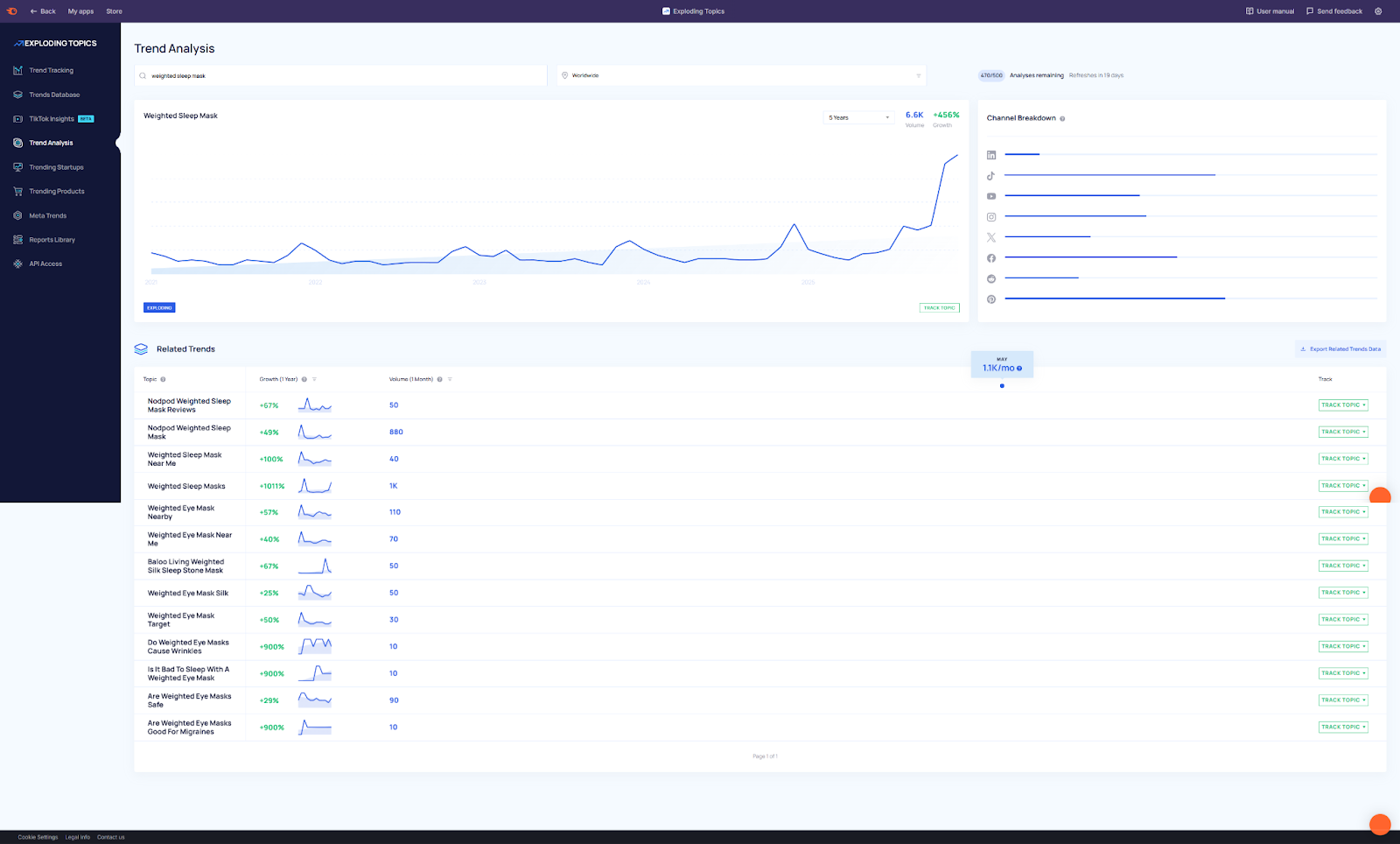
  "alt": "Trend analysis dashboard showing growth of weighted sleep mask interest over five years.",
  "caption": "The interest in weighted sleep masks is soaring, as shown in this comprehensive trend analysis dashboard.",
  "description": "This image displays a trend analysis dashboard from Exploding Topics, focusing on the growing interest in weighted sleep masks. Over a five-year span, the interest shows significant growth with a current volume of 6.6K and 4566% growth. The dashboard includes a line graph, related trends, and a channel breakdown, providing detailed insights into search volumes, growth rates, and related topics."
}
```
    nnn

    In an era shaped by AI Overviews, social SERPs, and shrinking organic real estate, arriving late means we risk competing within narratives already set by others.

    n nnn

    Exploding Topics stands upstream of this shift.

    n nnn

    It helps me uncover emerging themes, behaviors, and conversations while they are still forming – before they solidify into keywords, content clusters, and product categories.

    n nnn

    When used effectively, it’s more than just a trend tool. It’s a strategic companion for planning SEO, content, digital PR, and social-led search guides.

    n nnn

    This article shares how I use Exploding Topics to pinpoint future entities, validate them through social search, and build search visibility before demand peaks.

    n nn<!– wp:heading {

    Inspired by this post on Search Engine Land.


    crushpress.ai community screenshot
  • AI Dominance in Black Friday Shopping Unveiled

    AI Dominance in Black Friday Shopping Unveiled

    This past Black Friday and Cyber Monday, I delved into the fascinating insights from our Black Friday Index, crafted from a vast pool of 400 million genuine conversations. It was enlightening to see which brands stood out as AI’s top recommendations, especially as so many of us relied on Answer Engines to hunt down the best deals.

    As I explored the data, the impact of AI on shopping trends became crystal clear. The technology not only streamlined how we search for deals but also influenced brand visibility and consumer choices. The excitement of seeing how AI is reshaping shopping habits made this year’s Black Friday and Cyber Monday particularly intriguing for me.

    The findings from the Black Friday Index are a testament to the growing importance of AI in retail, showing us how indispensable it has become for both consumers and brands. Being part of this evolution makes me look forward to what future shopping events will bring, especially as technology continues to advance.


    Inspired by this post on Try Profound Blog.


    crushpress.ai community screenshot
  • Microsoft Ads Asset-Level Compliance Reviews: A Practical Workflow

    Microsoft Ads Asset-Level Compliance Reviews: A Practical Workflow

    You open Microsoft Advertising and find that one headline or image has been disapproved. Do not start by rewriting the entire ad. The useful question is narrower: which component failed, what can still run, and does the remaining creative still communicate what you intended?

    Asset-level compliance reviews make that diagnosis possible. Once you treat each component as its own reviewable unit, you can correct the actual problem, preserve compliant creative, and keep a small editorial issue from turning into an unnecessary campaign rebuild.

    Read the asset status before judging the whole ad

    Microsoft Advertising can review individual components such as headlines and images separately. A non-compliant component can be blocked without automatically preventing compliant components from continuing to run. This replaces the more disruptive all-or-nothing approach in which one problem could hold back the complete ad.

    That changes what a disapproval means. You now need to read the account at three levels:

    • Asset level: Identify the exact headline, image, or other component carrying the disapproved status.
    • Ad level: Confirm which compliant components remain available and whether the ad still has a usable creative set.
    • Campaign level: Decide whether the remaining components still represent the offer, required qualifications, and intended call to action.

    Do not confuse editorial approval with creative quality. A compliant asset has cleared the review represented by its status; it has not necessarily proved that it is persuasive, accurate for every audience, or strong enough to meet your performance goal. In the other direction, one disapproved asset does not mean that every other component is defective.

    The dashboard now flags the blocked element and provides an asset-specific status. Use that status as the starting point for your investigation instead of guessing from the ad’s overall performance.

    What you seeWhat to noticeWhat to do next
    One headline is disapproved while other components are compliantThe review outcome is localized to that headlinePreserve the compliant components and revise only the blocked headline
    One image is disapproved while copy remains compliantRewriting approved copy will not address the identified componentInspect or replace the image first
    Several blocked assets share similar wording or imageryA common characteristic may be causing repeated problemsCompare the blocked assets before making separate edits
    Assets are compliant but the campaign is not meeting its goalEditorial review is not a performance diagnosisInvestigate creative strength, targeting, bidding, measurement, and the offer separately

    Use a narrow workflow for every disapproved component

    An isolated ad component moves through symbolic diagnosis, policy review, correction, and verification steps while compliant components remain untouched.

    The fastest-looking response is often a broad rewrite. It is also the response that destroys the clearest evidence. If you change every headline and image together, you lose the distinction between the component that failed and the components that were already acceptable.

    Use this sequence instead:

    1. Locate the exact asset. Open the detailed status and identify whether the blocked item is a headline, image, or another component. Do not begin from a general impression that the entire ad was rejected.
    2. Record what the dashboard shows. Save the asset text or image filename, its location, the visible warning, and the date you noticed it. A screenshot can preserve context if the status changes later.
    3. Protect the compliant set. Leave approved components unchanged unless they have a separate accuracy or performance problem. Their continued eligibility is the operational benefit of asset-level review.
    4. Correct the smallest defensible unit. If the blocked item is a headline, work on that headline. If it is an image, inspect the visual rather than polishing unrelated copy. Make the correction substantive enough to address the apparent issue; a cosmetic near-duplicate is unlikely to improve your understanding of the problem.
    5. Check the revised status. Return to the asset view after the correction has been reviewed. Do not infer approval merely because other components are serving.
    6. Search for reuse. If the same wording or visual appears elsewhere in the account, inspect those locations before the issue creates repeated cleanup work.

    If the displayed warning is too broad to tell you what should change, stop editing at random. Preserve the exact status and creative, then use the review or support path available in your account. Random rewrites may eventually produce a compliant variation, but they will not teach your team what caused the original failure.

    Keep compliance corrections separate from performance experiments as well. When an asset is changed because of a review outcome, label that reason in your campaign notes. Otherwise, a later analyst may mistake a mandatory compliance change for a deliberate creative test and draw the wrong conclusion from subsequent performance.

    Build an asset ledger that turns disapprovals into reusable knowledge

    Asset-level review is most valuable when your internal records are equally granular. A campaign-level note such as “ad rejected” is no longer precise enough. It cannot tell the next person what failed, which components remained usable, or whether the same issue has appeared before.

    A simple asset ledger should capture:

    • The campaign and ad containing the asset
    • The asset type, such as headline or image
    • The exact copy or the image filename used by your team
    • The current status shown in Microsoft Advertising
    • The warning or explanation visible in the dashboard
    • The date the status was observed
    • The correction made and the reason for it
    • The revised version’s status
    • Other ads or campaigns that reuse the same message or visual

    Treat edited copy as a separate version in this ledger. If you overwrite the original wording in your records, you erase the comparison that could reveal why one variation was blocked and another was accepted.

    The ledger is operational history, not a substitute for the platform’s current status or Microsoft Advertising’s policies. Its purpose is to reveal patterns. Repeated problems attached to the same claim, visual treatment, or approval handoff deserve a process change upstream rather than another round of one-off fixes.

    Use those patterns to improve your preflight review. Before new creative is submitted, compare it with previously blocked assets, verify that required wording has not disappeared during editing, and confirm that image and copy versions belong together. This is more useful than a generic instruction to “check compliance” because it directs reviewers toward the failure modes your team has actually encountered.

    Check message coverage even when compliant assets keep running

    A strategist reviews active and inactive ad components, with a visible gap in the remaining creative message pathway.

    Reduced disruption does not mean zero business impact. The remaining components may continue serving while an important part of your message has disappeared. If the blocked asset carried the only clear explanation of the offer, a key qualification, or the intended call to action, the ad may still be active without doing the job you designed it to do.

    After any asset-level disapproval, check the remaining creative against a short coverage list:

    • Identity: Can a user still tell who is advertising?
    • Offer: Is the product, service, or proposition still clear?
    • Qualification: Are important limits or conditions still represented where your organization requires them?
    • Action: Does the remaining creative still tell the user what to do next?
    • Consistency: Do the surviving components make sense together rather than creating a misleading or incomplete combination?

    If a blocked component contains wording your legal or compliance team requires, do not assume that continued serving is automatically safe. The specific downside is that an ad could remain active without the language your organization considers necessary. Use the campaign controls available to prevent that exposure until a compliant replacement preserves the required meaning.

    Record the disapproval and correction in the same change log you use for campaign analysis. A component becoming unavailable changes the creative set that can run. If you omit that event from your notes, a later performance shift may be attributed to bidding, targeting, or seasonality when the message mix also changed.

    Once the revised asset is compliant, verify more than its status. Confirm that it restores the intended message, that it does not contradict the other components, and that your reporting period identifies when the asset set changed. Compliance recovery and performance recovery are related, but they are not the same checkpoint.

    Key takeaways

    • Microsoft Advertising reviews individual components such as headlines and images, allowing compliant assets to continue while a problematic component is blocked.
    • A disapproved asset is a localized diagnosis. Identify the exact component before editing anything else.
    • Preserve compliant assets and correct the smallest relevant unit instead of rebuilding the complete ad.
    • Track each asset, visible status, correction, and reused location so recurring issues can be fixed upstream.
    • Continued serving does not prove that the remaining creative still communicates the full offer or required qualifications.
    • Keep compliance changes in your campaign log so they are not mistaken for performance experiments.

    At the next disapproval, begin with the component named in the dashboard. Preserve what passed, document what failed, and inspect the message that remains. That small discipline is what turns asset-level review from a status display into a reliable compliance workflow.

    References