Profound has announced support for GPT-5.6, giving its users access to the model family through the platform’s existing AI workflows. The announcement emphasizes a choice among Sol, Terra, and Luna tiers rather than presenting GPT-5.6 as a single configuration for every task.
The practical significance is workload matching: teams can consider different tiers for demanding reasoning and production-scale activity while evaluating whether the reported gains in capability, reliability, and efficiency hold for their own use cases.
What GPT-5.6 support changes in Profound
According to Profound’s announcement, GPT-5.6 is now available directly within the workflows supported by the platform. Profound characterizes it as OpenAI’s newest flagship model family and identifies advanced AI performance as the central reason for adding it.
This is an integration announcement, not an independent benchmark. The source reports improvements in capability, reliability, and efficiency, but it does not provide test results, pricing, latency figures, context limits, or comparisons with earlier models. Those omissions matter when deciding whether the new option should replace an existing model or serve only selected workloads.
Sol, Terra, and Luna introduce a tier-selection decision
Profound says its GPT-5.6 support spans the Sol, Terra, and Luna tiers. It presents this range as a way to cover work extending from frontier reasoning to high-throughput production workloads, although the announcement does not assign detailed specifications or a fixed use case to each named tier.
For teams, the important shift is therefore operational: model selection can be treated as a workload decision. A demanding research or reasoning task may call for a different balance than a repeatable, high-volume process. Without tier-level measurements in the source, however, buyers should avoid assuming which option will deliver the best quality, speed, or cost for a particular application.
The workflows Profound expects to benefit
The announcement highlights four areas: agentic workflows, coding, research, and enterprise knowledge work. These categories share a need for dependable handling of instructions and context, but they create different evaluation requirements.
Agentic workflows: Evaluate whether the selected tier follows multi-step instructions consistently and handles failure conditions appropriately.
Coding: Test against the languages, repositories, review practices, and validation tools used by the organization.
Research: Check source handling, factual accuracy, uncertainty, and the usefulness of generated synthesis.
Enterprise knowledge work: Examine performance with internal terminology, access controls, document retrieval, and required approval processes.
These checks are general implementation practices rather than performance claims about GPT-5.6. Profound’s post identifies the target workflow categories but does not publish evidence for individual tasks within them.
Key takeaways
Profound reports that GPT-5.6 is supported within its AI workflows.
The integration includes the Sol, Terra, and Luna tiers.
Profound positions the model family for uses ranging from advanced reasoning to high-throughput production.
Agentic systems, coding, research, and enterprise knowledge work are the principal use cases named in the announcement.
The post reports capability, reliability, and efficiency improvements but supplies no benchmarks or tier-level specifications.
How teams can evaluate the integration responsibly
A sensible evaluation begins with representative tasks rather than a broad platform-wide switch. Teams can define the required output quality, acceptable error patterns, response-time needs, and operating constraints for each workflow, then compare the available tiers under the same conditions.
Select a small set of real tasks from each intended workflow.
Define pass criteria before comparing model outputs.
Record quality, consistency, failure modes, and human-review effort.
Compare tiers without presuming that the same option will suit every workload.
Expand adoption only where the results support Profound’s reported benefits.
GPT-5.6 support broadens the choices available inside Profound, but the integration’s value will ultimately depend on how clearly organizations match those choices to their own work. More detailed tier documentation and workload-specific evidence would make that decision easier.
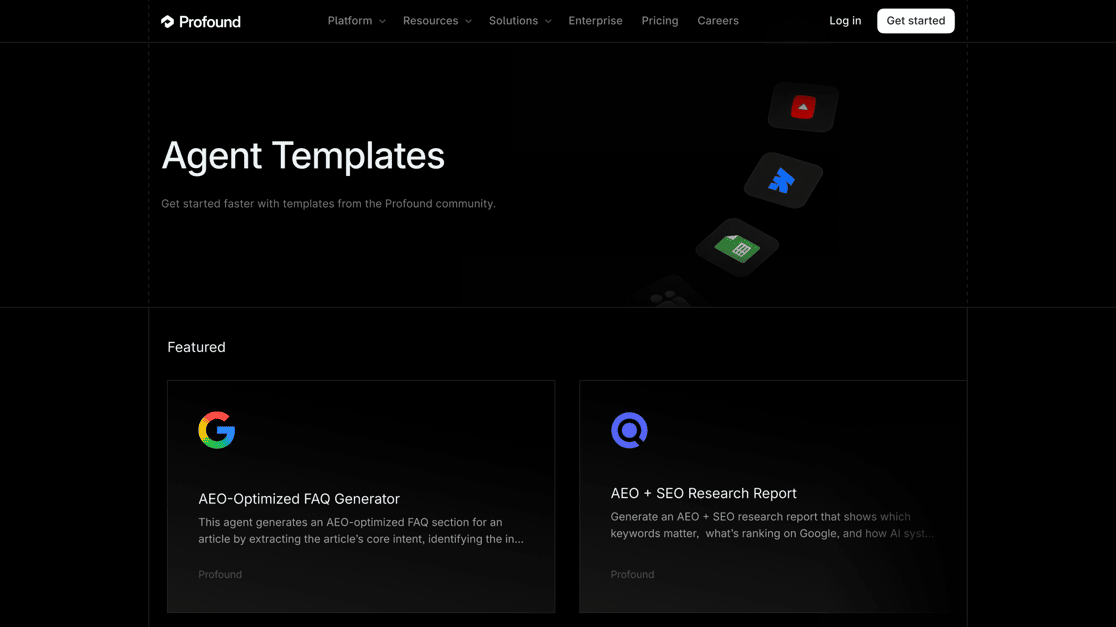
With Profound’s Agent Template Marketplace, I can start from pre-built AI agent workflows instead of building every process from scratch.
It gives me ready-to-clone templates designed for marketing, SEO, and AEO teams, so I can move from idea to live workflow in minutes.
For me, the biggest advantage is speed: I can choose a proven workflow, clone it, customize it for my team, and start using AI agents faster with less setup.
AI-era SEO is not simply conventional optimization with a new set of acronyms. It is an operating-model problem: companies must coordinate technical infrastructure, content, authority, product experience, analytics, automation and emerging discovery channels without turning every requirement into one impossible job or one sprawling tool.
The two source articles illuminate complementary sides of that problem. One examines the search leader capable of connecting functions; the other examines the technology decisions that support the work. Together, they suggest that durable performance depends less on finding a universal expert or building a universal platform than on establishing clear ownership, decision rights and maintenance standards.
Treat search as a connected business system
The leadership source describes employers seeking candidates who can span technical SEO, content, public relations, product, engineering, analytics, performance media and brand. Titles vary across SEO, AI search, AEO, GEO and agentic commerce, but the underlying demand is similar: someone must understand how decisions in one part of the organization affect discovery and growth elsewhere.
This interconnectedness matters because the apparent source of a search problem may not be its actual cause. The article notes that what looks like a content deficiency can originate in a product or technical constraint, while weak visibility can reflect insufficient authority rather than on-page optimization. Paid search can also reveal messaging problems that have consequences beyond the paid channel.
The tooling source reaches the same organizational boundary from a different direction. Its examples include workflows that evaluate content against personas, support translation and reporting, summarize activity from meeting notes, Slack and Jira, and turn recorded meetings into landing-page briefs. These are not isolated SEO tasks; they depend on information and participation distributed across teams.
An effective operating model therefore needs a connective layer. Its purpose is to identify where a discovery problem originates, assign it to the function able to resolve it and relate the result to a business outcome. This becomes especially important when generative systems provide answers directly and traffic is no longer the only meaningful expression of search visibility, as the leadership article argues.
Design the function before recruiting its leader
The leadership article reports substantial inconsistency between search job titles, descriptions, recruiter screening and interview expectations. It cites postings ranging from Head of SEO and Director of AI & Organic Search to AEO/GEO Manager and Agentic Commerce GEO Consultant. In some cases, an advertised SEO role reportedly emphasizes paid platforms or other responsibilities that do not match its title.
This is more than a naming problem. A company may need a specialist who executes, a manager who builds a team, an executive who integrates search with adjacent functions or a consultant who determines what should be done. Those are different mandates. Combining them without defining authority, resources and expected outcomes makes both hiring and subsequent performance management unreliable.
The practical response is to define the function before defining the candidate. The organization should decide which decisions the role owns, which work it performs directly and which capabilities remain with engineering, content, brand, analytics or media teams. The search leader can then serve as an integrator without being treated as a substitute for every specialist.
Selection should also test judgment rather than depend entirely on title history or software keywords. The leadership source emphasizes the ability to distinguish material technical issues from distractions, recognize when a content problem requires an external solution, and decide when to invest, automate, pause or advise against an initiative. It also warns that conventional applicant-tracking and recruiting processes may exclude candidates whose cross-functional experience appears nonlinear.
A scenario-based hiring process is better aligned with that need. Candidates can be asked to diagnose an ambiguous visibility decline, allocate ownership across functions or explain what evidence would justify a new automation investment. This tests the integrative capability the role actually requires while exposing whether the company has given the position enough support to succeed.
Build a portfolio of tools, workflows and services
The technology decision should begin with precise classification. The tooling source distinguishes a custom internal tool from a repeatable multi-application workflow, a custom layer built on a software-as-a-service platform and a more autonomous AI agent. Calling all four an agent or an AI tool conceals meaningful differences in cost, risk and maintenance.
AI has lowered the barrier to prototypes, according to that article, allowing SEO teams to assemble assistants, connect data and automate analyses with less engineering help. It has not eliminated the obligations that follow a successful experiment. Token consumption, API calls, infrastructure, engineering time, security reviews and ongoing upkeep can remain real costs even when they do not appear in the SEO budget.
The source’s prompt-tracking example demonstrates the gap between a prototype and an operational system. A colleague initially created a tracker, but manual trend visualization and changes among large-language-model tools produced a maintenance burden. The team ultimately moved to a specialist platform because dependable data presentation mattered more than preserving the internal build.
That experience supports a portfolio approach. Stable, business-critical capabilities such as crawling, rank tracking and AI-visibility monitoring may favor established platforms when the team cannot sustain them internally. Context-heavy processes tied to proprietary knowledge may favor custom workflows. A custom layer over purchased software can provide the middle ground by combining reliable external capabilities with analytics or prioritization based on internal data such as Google Analytics, Google Search Console or CRM information.
The decision is therefore not a permanent contest between building and buying. A small internal prototype can clarify requirements and reveal complexity before a purchase, while a purchased platform can supply dependable foundations for differentiated internal processes. The relevant question is which parts of the capability create unique value and which parts merely need to work consistently.
Govern initiatives from problem definition through maintenance
Clear intake criteria connect the leadership and tooling models. The tooling source recommends beginning with the problem, its expected value, the intended users, the relative cost of available approaches and the consequence of doing nothing. It also advises mapping the current workflow against the desired workflow, looking for revenue contribution, time saved, quick returns and benefits shared across teams.
Those questions should become a standing governance process rather than a one-time procurement exercise. Each initiative needs an accountable business owner, an operational owner and an explicit maintenance commitment. Reliability, data access, security and usage-based costs belong in the initial decision because they determine whether an experiment can become part of routine operations.
The search leader’s role in this process is not to approve every tool personally. It is to keep local automations aligned with the wider discovery strategy, surface dependencies and prevent teams from optimizing a narrow metric at the expense of the customer journey. Engineering and security can evaluate technical exposure; content and brand teams can protect accuracy and positioning; analytics can establish measurement; and operational users can determine whether a workflow remains useful.
This structure also creates a rational stopping rule. A pilot that produces insight but cannot meet reliability or maintenance requirements may still be valuable if it improves the specification for a purchased service. Conversely, a workflow that depends heavily on internal context and produces repeatable value may justify further investment even when a generic platform is available.
Key takeaways
Define search as a cross-functional system with explicit ownership, rather than a collection of isolated SEO tasks.
Separate the mandates of specialist, team leader, integrating executive and adviser before opening a search role.
Evaluate leadership candidates through judgment and cross-functional scenarios, not title matching alone.
Distinguish custom tools, workflows, software layers and autonomous agents before comparing costs or risks.
Treat prototyping, procurement, security, measurement and maintenance as one governed investment lifecycle.
As AI discovery develops, the most resilient SEO organizations will be those that can change tools and channel tactics without repeatedly redesigning accountability. A clear operating model makes that adaptation possible: leadership connects the system, specialists retain depth, and technology is selected according to the work it must sustain.
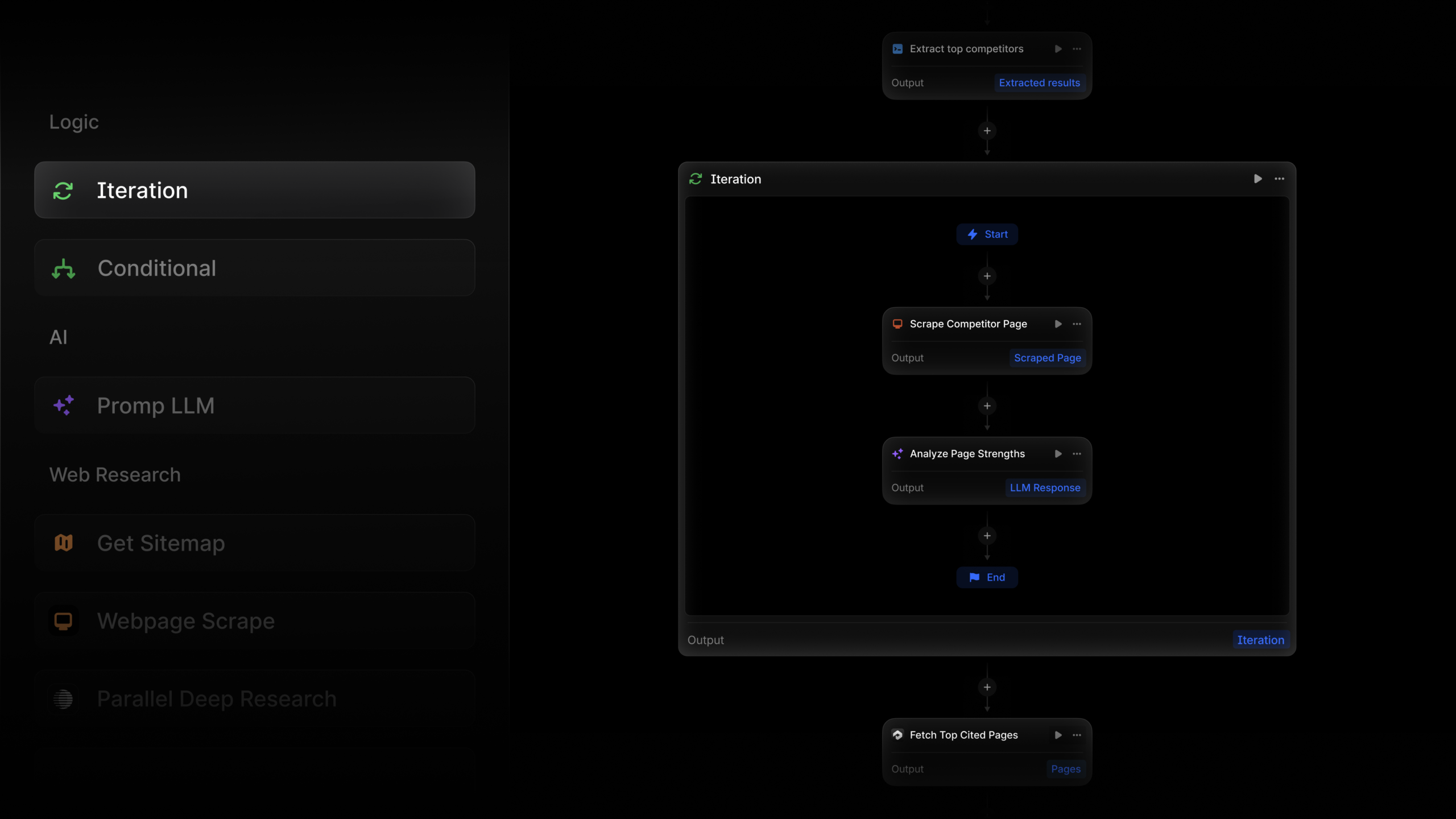
I’m excited to introduce you to the innovative iteration nodes in Profound Agents, designed to revolutionize the way we manage complex workflows.
The beauty of the iteration node lies in its ability to encapsulate a series of steps within your Agent. By setting up these steps just once, I can easily pass in a list of items, and watch as each item seamlessly progresses through the specified sequence, simultaneously.