Tag: wordpress seo

  • Unlock the Secrets of Gemini Answer Engine Optimization

    Unlock the Secrets of Gemini Answer Engine Optimization

    In the dynamic world of digital search, I’ve discovered that Gemini Answer Engine Optimization (GAEO) is a game-changer for businesses and content creators looking to excel in answer-driven results. Unlike traditional SEO, where the focus is on web page rankings, GAEO is all about crafting content that serves as the go-to answer for user queries on Gemini-powered platforms. This guide delves into effective strategies to master GAEO as of April 2025.

    Understanding Gemini’s answer engine has been crucial for me. It’s a leading AI-driven tool designed to deliver precise, accurate, and contextually relevant responses. By pulling information from reliable sources and creating real-time answers rather than depending on indexed pages, Gemini marks a significant shift in search optimization. To succeed, websites must aim to be the preferred source Gemini uses, focusing on clarity, authority, and user intent.

    One of the key strategies I’ve embraced is optimizing content for question-based queries. Gemini excels at resolving direct questions, and I’ve learned to target conversational, question-based prompts. Using resources like question-answer platforms and social media helps me identify common queries. I structure my content with clear and engaging headings like, “How does Y work?” It’s important to use natural language that mirrors everyday speech and provide concise answers that fit Gemini’s snippet-friendly format.

    Building topical authority is another strategy that enhances content optimization. Gemini favors sources with demonstrated expertise. I create content clusters around core topics and employ structured data to showcase my authority and topical relevance. For example, in a fitness context, linking related articles like “Best Dumbbell Exercises” back to a hub page helps Gemini recognize expertise.

    Leveraging structured data and schema markup is fundamental to GAEO success. By implementing JSON-LD types like FAQPage or HowTo, I make content machine-readable. This technique boosts the chance of Gemini extracting my content for specific queries, which is critical for increasing visibility.

    I prioritize content clarity and readability because Gemini favors easily digestible information. By breaking down complex ideas with short sentences and bullet points, I aim for a readability score of 60+ on Flesch-Kincaid tests. This approach ensures content appeals to both novices and Gemini’s advanced parsing algorithms.

    Enhancing E-E-A-T signals—Experience, Expertise, Authoritativeness, and Trustworthiness—is crucial for me to strengthen content credibility. By showcasing author credentials and citing reputable sources, I establish trust with readers and Gemini. Updated content reflects the latest data, keeping it relevant for time-sensitive queries.

    Performance monitoring and iteration are ongoing tasks. Using analytics, I track which pages Gemini references. Platforms like X offer insights into trending queries, allowing me to refine content by adding specific answers or improving schema. Consistent testing helps me understand what resonates most with Gemini’s logic.

    Staying adaptable is central to remaining ahead of the curve in GAEO as Gemini evolves. I monitor updates through tech blogs and engage in discussions to remain informed. Experimenting with multimedia formats like infographics can give content an edge, and by aligning with user intent, I maintain the authority and optimize content to drive traffic and engagement throughout 2025 and beyond.


    Inspired by this post on AnswerEngineOptimization.blog.


    crushpress.ai community screenshot
  • AI SEO Tactics: Step Beyond Traditional SEO in the AI Era

    AI SEO Tactics: Step Beyond Traditional SEO in the AI Era

    I’ve noticed that many people labeling things as “AI SEO” are just applying traditional SEO concepts dressed up with new buzzwords.

    AI SEO, however, stands apart.

    When I explore how AI tools like AI Overviews, ChatGPT, and Perplexity sort and condense information, it’s clear there are strategies available to us now that simply didn’t exist in the old Google 10-blue-links era.

    In this article, I’ll walk you through those unique AI SEO tactics, leveraging concrete data, not just hopeful speculation.

    Feeling the drop in clicks, right? Here are some compelling facts:

    • Research has shown that when Google’s AI Overviews were applied, the click-through rates to top organic results fell by about 30 to 35%. In some cases, publishers reported losing 40 to 80% of their search traffic.
    • According to an analysis with Similarweb data, news traffic from Google declined from around 2.3 billion to under 1.7 billion visits in just a year as zero-click searches increased from 56 to 69% after AI summaries were introduced.
    • From a Semrush study on 10 million keywords, AI Overviews now frequently appear, especially for informational queries, changing the visibility landscape by consolidating multiple sources into a single AI-generated response.

    Meanwhile, the AI market is expanding at a rate of over 30% CAGR, with projections suggesting that total AI spending will reach into the trillions by the early 2030s.

    AI SEO is about optimizing not just for clicks but for factual representations that earn places within AI-generated answers.

    Here are 12 exclusive tactics to thrive in this new landscape:

    1. Prompt Graph Coverage

    Traditional SEO treats a query as a single unit mapped to a page.

    AI engines deconstruct queries into graphs of subtasks and address each. Google mentions “multi-step reasoning” for tackling complex queries at once. Academic research on AI SEO also indicates that AI functions break down queries into sub-questions, synthesizing information across sources.

    AI SEO strategy: Model that graph personally.

    • Transform the primary query into predictable sub-questions.
    • Create detailed sections that fully address each subtask.
    • Ensure each section is self-contained and suitable for the specific micro-intent.

    When writing about “best project management software,” consider prompting for:

    • “criteria for agencies”
    • “comparison vs spreadsheets”
    • “pricing breakdown by seat”
    • “implementation timeline”

    Each needs its own precise, well-titled segment.

    2. LLM Seeding

    While traditional search engines don’t absorb all content into their algorithms, LLMs do.

    AI SEO shows a preference for neutral sources like Wikipedia and governmental documents over branded marketing pages, so contributing to factual and earned sources is key. Backlinko’s findings reinforce engaging in the right content surfaces for training and retrieval.

    AI SEO-only move:

    • Release definitions, glossaries, and FAQs publicly.
    • Contribute to places where models learn their foundational facts.
    • Sow Q&A style content in widely used forums.

    This is about showing where the model will find the canonical truth, making sure it’s your content.

    3. Passage-Level Retrieval Optimization

    Traditional SEO generally ranks entire pages. AI engines retrieve information at a passage level.

    Studies show that models cite specific highly structured passages, not entire pages.

    AI SEO-only move:

    • Treat each heading as a standalone answer.
    • Include all claims, qualifiers, and evidence within one passage.
    • Minimize the reader’s need to traverse the page for logic.

    Stand out as the model’s go-to reference for any particular question.

    4. Citation-Ready Evidence Packaging

    AI engines must justify their responses.

    Studies indicate pages commonly cited by AI engines have structured data, semantic HTML, and explicit evidence like tables. The absence of verifiable facts increases the tendency for models to hallucinate.

    AI SEO-only move:

    • Present data in machine-readable formats: tables, comparisons, glossaries, checklists.
    • Support each strong claim with solid statistics and a source.
    • Ensure the model can easily extract your “proof block.”

    You need to be verifiable and structured for easy reuse.

    5. Neutrality Engineering

    Models favor neutral, non-promotional sources over overtly commercial ones.

    According to research, Google’s definition of spam has widened to include content that lacks depth, especially in AI Overviews.

    AI SEO-only move:

    • Remove promotional language from pages aimed at being cited.
    • Ground your narrative in facts, comparisons, and third-party validations.
    • Create separate layers for opinion and positioning.

    Continue to sell, but ensure your main content remains neutral and evidence-based.

    6. Brand-Entity Memory Alignment

    While search engines focus on page-query matching, LLMs concern themselves with how well your entity is understood across the board.

    Studies suggest variance in how engines perceive brands, often favoring well-recognized and consistently presented entities.

    AI SEO-only move:

    • Clearly define your brand’s canonical facts: identity, operations, audience.
    • Ensure consistency across high-authority platforms.
    • Rectify outdated or conflicting information across channels.

    Train the model to understand who you are, not just what metadata say.

    7. Competitor Co-occurrence Hijacking

    A significant portion of buying intent lies in comparative prompts.

    AI engines synthesize answers by comparing multiple competitors. Research shows brands frequently appearing in comparative content often benefit in AI outputs.

    AI SEO-only move:

    • Position your brand in neutral, third-party comparison content.
    • Craft balanced comparisons that consider multiple competitors honestly.
    • Encourage inclusion in “shortlist” content likely used in category training.

    Traditional SEO hopes for a ranking opportunity. AI SEO embeds you within the model’s default competitive landscape.

    8. Source Blending Strategy

    In AI search, a “SERP” is a blend of diverse sources, not just a page.

    Semrush and others note that AI engines pull from a wide range of sources, favoring community and documentation in many sectors.

    AI SEO-only move:

    • Develop your presence into an ecosystem, beyond a single website.
    • Identify which non-Google platforms in your niche influence LLMs and establish credibility there.
    • Use consistent terminology to form a coherent online identity.

    Your goal is corpus optimization, not just ranking in an index.

    9. LLM-Friendly Specification Publishing

    Models excel at snapping structures into place.

    Content rich with detailed structures like definitions, lists, and stepwise instructions performs best in AI responses.

    AI SEO-only move:

    • Share your key frameworks as open specifications.
    • Convert ambiguous messaging into clear decision-making instruments.
    • Document methodologies in public, thorough formats.

    Offer the model a blueprint beyond just marketing speak.

    10. Training-Surface Expansion

    AI SEO is emerging as an industry on its own, backed by significant future investments.

    However, this investment is not focused on just one index.

    AI SEO-only move:

    • Explore potential training surfaces within your specialty like open datasets and public reports.
    • Place your best insights there openly, ready for retrieval or training.
    • Treat every public snippet as training material, not only lead generation.

    You are determining where and how models will encounter your reality.

    11. Anti-Hallucination Engineering

    Hallucination in AI isn’t hypothetical.

    Benchmarking and academic studies consistently show that AI can produce false details, particularly in low-coverage or vague topics.

    AI SEO-only move:

    • Distribute concise fact sheets about your entity across neutral sources.
    • Remove contradictory public claims wherever possible.
    • Monitor and adjust how AI systems portray your brand.

    While eliminating hallucinations is impossible, you can ensure the model opts for a well-documented version of you.

    12. Mention vs. Citation Optimization

    In AI searches, there are three distinct states:

    • Your brand is not mentioned.
    • Your brand is mentioned, without citation.
    • Your brand is both mentioned and cited.

    Research indicates that citation patterns relate closely to specific quality signals on the page and sites.

    AI SEO-only move:

    • Design pages that meet both narrative and citation criteria.
    • Grow earned media allowing third-party sites to be cited.
    • Map your current state across engines and craft campaigns to elevate your position.

    Just as traditional SEO distinguishes between impressions and clicks, AI SEO separates mentions from citations, and this is crucial for visibility.

    The Uncomfortable Balance

    We must face some key truths:

    • AI summaries are raising zero-click behavior, compressing publisher traffic, with click-through rate declines between 15 to 80% depending on the query.
    • Platforms claim higher quality clicks and satisfaction while expanding these features into search.
    • Despite advances, LLMs still hallucinate, reducing errors involves better grounding and evaluation.

    As individual brands, we cannot change these broad issues. But we can adapt to the current landscape:

    • Treat AI answers not as a novelty added to SEO but as a unique channel.
    • View AI SEO as a standalone channel with specific levers, measurements, and content styles.
    • Create content for retrieval, trustworthiness, and reuse by generative systems.

    Traditional SEO isn’t obsolete, but it is only part of the journey now.


    Inspired by this post on Search Engine Land.

  • Boost Product Visibility in AI-Driven Commerce

    Boost Product Visibility in AI-Driven Commerce

    As someone deeply invested in the fascinating world of agentic commerce, I’ve become curious about what really boosts product visibility in the AI shopping realm. It’s a topic worth diving into as AI rapidly transforms the way consumers make purchasing decisions.

    Have you ever wondered how platforms like ChatGPT, Perplexity, and Rufus determine which products grace the digital shelves? Uncovering this process offers valuable insights into AI decision-making and gives us a competitive edge in this new era of shopping.

    Let me share with you how these AI platforms evaluate and choose products, allowing us to strategically position our offerings and maximize their AI shelf presence. Understanding these dynamics empowers us to navigate and excel in AI-driven marketplaces effectively.


    Inspired by this post on HiGoodie Blog.

  • Version 4.2.42 released

    Version 4.2.42 released

    Official Launch of the First Public Stable Release

    Version 4.2.42 marks the first stable public release of the CrushPress AI Schema Optimization Suite — a complete, production-ready, end-to-end automation engine for Schema, FAQ, GEO/AEO, and Speakable JSON-LD generation for WordPress sites.

    Designed for agencies, WordPress hosting providers, and SMBs, this release transforms how websites implement structured data by replacing manual markup with a fully automated, cloud-connected, OpenAI-powered system.

    Below is the full breakdown of everything included in this flagship release.


    What’s New in 4.2.42 (First Public Release)

    This version consolidates years of development, covering schema automation, OpenAI content generation, multi-tenant account sync, Stripe billing, dashboard analytics, robust logs, privacy controls, and an enterprise-grade admin interface — all launching together.


    🚀 1. Complete AI-Driven Schema Automation (AEO + GEO + FAQ + Speakable)

    Hands-free JSON-LD generation for every WordPress site

    CrushPress automatically analyzes every published or updated page/post and generates:

    • Article / BlogPosting
    • WebPage
    • FAQPage
    • Speakable JSON-LD
    • GEO / AEO optimized markup for Google Search & AI Overviews

    All schema is generated using your OpenAI API key and persisted in the CrushPress cloud for reliability and long-term storage.

    Why it matters

    • Agencies eliminate manual schema creation across dozens of client sites.
    • SMBs get enterprise-grade structured data without any SEO expertise.
    • Hosting providers offer instant SEO enhancements to their customers.

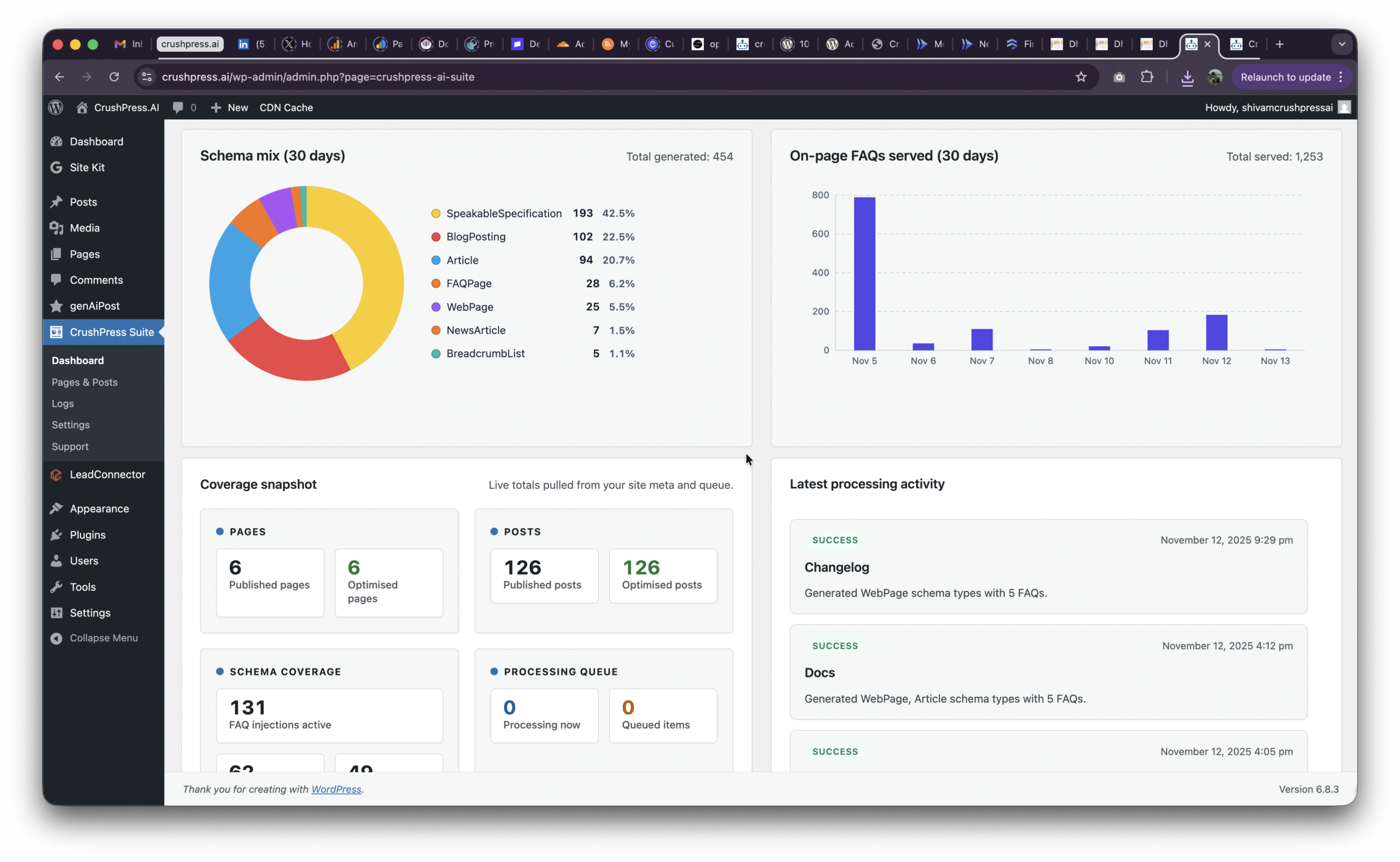
    📈 2. Real-Time Schema Analytics Dashboard

    A modern, polished dashboard built directly into wp-admin:

    • 90-day trend charts
    • Schema mix breakdowns (Article, BlogPosting, FAQs, Speakable, etc.)
    • Coverage snapshots (complete vs. needs attention vs. queued)
    • Queue health and processing statistics
    • Live “Latest Processing Activity” stream

    Data updates via AJAX polling — no page reloads needed.


    ⚙️ 3. Fully Automated Queue Engine

    Every content change triggers a structured process:

    • Auto-queue
    • Auto-processing
    • Retry logic
    • Weekly or monthly refresh cycle
    • Inline fallback when WP-Cron is stuck
    • Bulk rebuild tools for agencies managing migrations

    Why it matters

    No more babysitting schema jobs — automation takes care of everything.


    🧩 4. Rich Pages & Posts Insights Panel

    Every row in Pages & Posts now has an expandable insights panel showing:

    • Article/BlogPosting JSON-LD (pretty-printed)
    • FAQPage JSON-LD
    • Speakable JSON
    • On-page FAQ preview
    • “View live post”
    • “Validate in Google Rich Results”

    Per-post controls allow editors to disable:

    • On-page FAQs
    • FAQ JSON-LD
    • Main schema
    • Speakable markup
    • Entire schema injection

    Why it matters

    Agencies get precise per-post control without touching code.


    🔧 5. Feature Exclusion Rules (Global Controls)

    Create global rules that disable schema features based on:

    • URL patterns
    • Categories
    • Tags

    Useful for blogs, documentation sections, ecommerce funnels, or legal pages where schema must be restricted.


    🔒 6. Enterprise-Grade Privacy, Compliance & Security

    Dedicated Privacy tab

    Includes:

    • Connectivity toggle (full data sharing control)
    • Terms & Policies acknowledgement
    • Inline consent notices
    • Clear explanation of data flow

    Security Enhancements

    • Strict nonce verification
    • WordPress-native sanitization everywhere
    • Output escaping for all markup and JSON
    • SQL queries fully inside $wpdb->prepare()
    • No hidden files in plugin directory
    • Multi-site capable account/user sync

    Why it matters

    Agencies handling sensitive client data get an auditable, compliant SEO automation stack.


    💳 7. Full Stripe Billing Integration

    For the hosted cloud service:

    • In-plugin Billing tab
    • Plan selector + upgrades/downgrades
    • Usage meter with 70/80/90/100% warnings
    • Promo code support
    • Stripe Billing Portal
    • Quota & overage alerts
    • Billing-aware schema pause logic
    • Shimmer skeleton loaders for smooth UX

    👨‍💻 8. Multi-User, Multi-Site, Multi-Tenant Support

    The plugin syncs:

    • Accounts
    • WordPress users
    • Billing usage
    • Site metadata
    • Schema documents

    Why it matters

    Perfect for agencies managing hundreds of sites and users.


    🛠️ 9. Cloud-Connected Middleware & Firestore Storage

    CrushPress Cloud handles:

    • Schema storage
    • Account records
    • Billing calculations
    • Logs & telemetry
    • Support tickets
    • Promotion code logic

    OpenAI calls happen directly from your WordPress site — keys are never sent through CrushPress.


    🧾 10. Enterprise-Ready System Logs

    Full logging suite with:

    • Severity filters
    • Component filters
    • Time-range filters (2 minutes → 6 hours)
    • CSV export
    • Pagination up to 1,000 per page
    • 10,000-row retention cap
    • No “headers already sent” issues

    Why it matters

    Agencies can debug issues with real visibility.
    Hosts can investigate failures client-by-client.


    🎛️ 11. Powerful Settings & Controls

    AI Configuration

    • GPT-5 support
    • Responses API support
    • Reasoning effort
    • Verbosity
    • Max output tokens
    • Prompt management
    • FAQ min/max constraints

    Automation Controls

    • Auto queue
    • FAQ toggle
    • Speakable toggle
    • Weekly/monthly refresh
    • Queue-only mode

    Advanced, Support & Tools

    • Connection test
    • Purge cache
    • Support ticket submissions
    • Diagnostic notices

    🧹 12. Modern, Polished wp-admin UI

    A full redesign matching modern SaaS dashboards:

    • Clean card layout
    • Cohesive styling across all plugin screens
    • Anchored WordPress footer
    • Scrollable activity panel
    • Responsive on all screen sizes
    • Consistent hero headers
    • Accessible modals

    Why it matters

    Agencies get a professional tool they can confidently roll out to clients.


    🎉 Summary: Why 4.2.42 Is a Game Changer

    This release turns structured data — normally a slow, manual, expensive, error-prone task — into a fully automated SEO enhancement engine for any WordPress site.

    You get:

    ✔ 100% automated JSON-LD generation
    ✔ AI-powered FAQ, Speakable & AEO/GEO markup
    ✔ Full analytics visibility
    ✔ Enterprise-grade logs
    ✔ Agency-friendly controls and scalability
    ✔ Multi-site, multi-user, billing-aware sync
    ✔ Polished, accessible, modern UI
    ✔ Strong privacy and security guardrails

    This is not just a schema plugin —
    it’s a complete structured-data automation platform for WordPress.