
Tag: Spanish Market

  • Unlocking Spanish Market Potential with Cultural SEO

    Unlocking Spanish Market Potential with Cultural SEO

    I’ve noticed that AI systems are improving in generating Spanish language content, but they’re not quite grasping the nuances of Spanish markets.

    In fact, we often see a familiar trend: over 20 Spanish-speaking nations reduced to a single standard. Spain is typically the default, and Mexico might as well be interchangeable with any other country. The rest get simplified into statistical norms.

    The root of this problem is structural, involving dialect defaulting, format contamination, and regulatory hallucination. These issues are more pronounced in a generative search setup where one synthesized response replaces several search results.

    This misinterpretation acts as a barrier to visibility. Generative AI seeks clarity, and if my content doesn’t specify its market context, it defaults to an average—leading to missed opportunities and misapplication.

    To tackle this, I’ve developed a framework that ensures market context is clear across content, technical indicators, and retrieval systems, so AI systems don’t have to assume.

    What is Cultural SEO?

    Cultural SEO goes beyond mere multilingual support or localization. Its foundation is firm on locale precision—ensuring the market context is clear in retrieval and generation practices so that your Spanish content is associated with the specific country it was intended for.

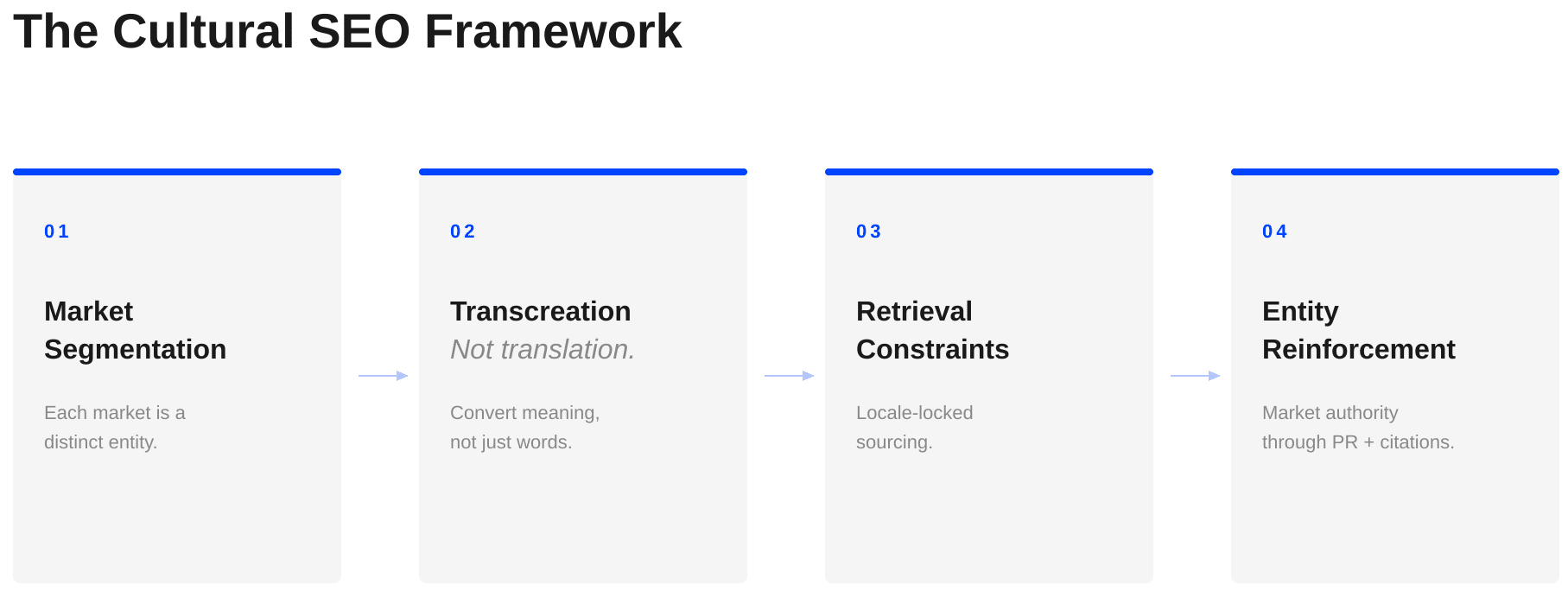
    Here’s a framework that proves effective when working around Spanish and Latin American markets.
    ```json
{
  "alt": "Cultural SEO Framework with steps: Market Segmentation, Transcreation, Retrieval Constraints, and Entity Reinforcement.",
  "caption": "Discover the Cultural SEO Framework: From Market Segmentation to Entity Reinforcement. This pathway guides you through effective cultural marketing strategies.",
  "description": "This image illustrates the Cultural SEO Framework, detailing four key stages: Market Segmentation, Transcreation, Retrieval Constraints, and Entity Reinforcement. Each stage emphasizes a unique aspect, from recognizing market distinctions to reinforcing authority through PR and citations. Ideal for those seeking comprehensive cultural SEO strategies."
}
```

    You can’t effectively optimize for a market you aren’t serving. Cultural SEO isn’t an afterthought; it’s the backbone of a strategic decision to genuinely operate within a market, encompassing logistics, customer service, compliance, and product-market alignment.

    If you ship from Spain to Mexico with unrealistic delivery times or lack local support, even the best hreflang configuration won’t suffice. Users will abandon such experiences, and as AI learns from these interactions, it will deprioritize similar content.

    Speaking the market’s language goes beyond spoken words—it’s about conveying trust, ensuring payment and delivery expectations are met, and adhering to regulatory standards.

    Assuming you’re committed to these standards, here are the four pillars: segmentation, transcreation, retrieval constraints, and entity reinforcement. Before applying any framework, ensure this commitment.

    Pillar 1: Market Segmentation at the Entity Level

    International SEO often considers segmentation as a mere folder structure: /es-es/, /es-mx/, /es-ar/, but that’s merely scratching the surface.

    In generative search, the challenge is ensuring the AI associates a page with a specific country like Mexico, and accumulates enough market-specific signals to prefer it over a general alternative. If the architecture simplifies differences, visibility diminishes equally.

    ```json
{
  "alt": "The CapmatchOne logo with a gradient circle and bold text.",
  "caption": "Discover innovation with the CapmatchOne logo, featuring sleek typography and a modern gradient circle.",
  "description": "The CapmatchOne logo features bold, modern typography coupled with a gradient circle, symbolizing connection and innovation. The sleek design conveys a sense of progress and creativity. This image can be used for branding or promotional purposes, appealing to audiences interested in innovative solutions and forward-thinking designs."
}
```

    Pillar 2: Transcreation, Not Just Translation

    Translation is about converting words, while transcreation is about interpreting meaning. Given two pages with 95% similar content, the AI merges them into one representation—defaulting to one perceived as standard. Therefore, differentiating with local examples or unique terminologies is essential.

    Pillar 3: Retrieval Constraints

    In constructing AI experiences like RAG (Retrieval-Augmented Generation), it’s crucial to establish clear boundaries about what content should be sourced for specific markets to avoid defaulting to “Global Spanish.”

    Pillar 4: Market Authority Through Entity Reinforcement

    AI models learn from both your site’s content and external perceptions. Thus, building location-specific authority through local media presence, partnerships, and consistent regional knowledge graph reinforcement is vital to establish market-specific authority.

    Ultimately, Cultural SEO ensures that content not only serves the market but resonates with it. By embracing these pillars, I can ensure my brand isn’t just another “Spanish” entity but a recognized authority in each targeted market.

    This journey isn’t about merely adapting your website but architecting systems to reflexively consider the market’s dynamics from the ground up.


    Inspired by this post on Search Engine Land.


    crushpress.ai community screenshot
  • Navigating ‘Global Spanish’ in AI for Better Search Visibility

    Navigating ‘Global Spanish’ in AI for Better Search Visibility

    I recently explored what many are calling the ‘Global Spanish’ issue in AI search visibility, and it’s been a revelation for understanding how AI can sometimes blur crucial distinctions in Spanish-speaking markets.

    Picture this: AI models often clump Spanish-speaking regions into one, mixing up local jargon, regulations, and context, resulting in answers that don’t truly fit any specific market.

    This challenge—commonly known as the ‘Global Spanish’ problem—manifests when AI search merges regional dialects and rules into a one-size-fits-none guidance.

    Consider asking AI in Spanish how to declare your taxes (cómo puedo declarar impuestos). It will deliver a grammatically accurate reply, equipped with references like ‘RFC, NIF, SSN, según país’—mixing up Mexican, Spanish, and American tax identification.

    While AI is gradually improving, moving from confidently incorrect Mexican tax advice in Madrid to a more hedged but jumbled response doesn’t equal localization. It’s more like broad-stroke thoroughness without precision.

    The core issue is AI’s struggle to pinpoint its targeted Spanish-speaking market, defaulting to overly generalized responses akin to a waiter asking a roomful what they’ll have and simply writing down ‘Food.’

    If I find that AI answers a Mexican with Spain’s tax logic, this isn’t just a translation hiccup—it’s a fundamental problem with geographical and jurisdictional inference, essential in AI-facilitated search.

    Traditional search already faced these complexities, and giants like Google spent years refining systems to accommodate regional intent and language variations—challenges that persist today.

    Generative AI, however, eliminates the wiggle room. Instead of multiple links allowing user choice, it delivers one synthesized answer, hitting home or missing the mark entirely.

    For many, ‘Spanish’ is a simple language toggle, but this view doesn’t hold for Hispanic markets. The distinctions between Spain and Latin America go beyond slang; they influence conversion rates, brand trust, and legal applicability.

    Cultural and regulatory differences exist, such as:

    ```json
{
  "alt": "The CapmatchOne logo with a gradient circle and bold text.",
  "caption": "Discover innovation with the CapmatchOne logo, featuring sleek typography and a modern gradient circle.",
  "description": "The CapmatchOne logo features bold, modern typography coupled with a gradient circle, symbolizing connection and innovation. The sleek design conveys a sense of progress and creativity. This image can be used for branding or promotional purposes, appealing to audiences interested in innovative solutions and forward-thinking designs."
}
```
    • Regulators like Hacienda vs. SAT.
    • Legal terms such as NIF vs. RFC.
    • Currency differences, such as EUR vs. MXN.
    • Decimal formatting like period vs. comma.
    • Tone variation for social distance (tú/vosotros vs. usted/ustedes).
    • Commercial expectations like payment options and shipping norms.
    • Search intent, where identical queries target different products depending on the country.

    All these affect international SEO, and in generative search, they become critical. The AI doesn’t present multiple links for user discretion; it condenses everything into a singular, presumptive authoritative answer, leading to what I recognize as ‘Global Spanish.’

    Studies term this bias as ‘Digital Linguistic Bias’ (Sesgo Lingüístico Digital), revealing how imbalanced Spanish variety representation in corpora ignores dialectal variations and cultural contexts due to structural bias.

    Spain, despite being a minority among global Spanish speakers, is overly represented in digital resources guiding language models’ default Spanish. Latin America, conversely, is under-represented in AI investment and data infrastructure, with just 1.12% of global AI funding while contributing 6.6% of global GDP.

    This naturally skews AI-produced Spanish towards sounding geographically particular, despite users not specifying a region. Because LLMs train on the most available web data, which often disproportionately represents certain locales, this bias emerges.

    A Mexican SaaS webpage, excellently drafted, competes against decades-old Peninsular Spanish content for AI’s attention and often loses, with ‘neutral Spanish’ considered efficient but ultimately impeding the scale.

    These shortcomings manifest as three distinct failure modes, each critical to SEO results, trust, and conversion rates.

    1. Dialect Defaulting: Often AI defaults to one Spanish variant, misleading users from other regions.

    Tested by Will Saborio, terms like ‘straw’ varied across countries—’pajilla,’ ‘popote,’ ‘pitillo,’ and ‘bombilla’—but AI typically defaulted to Mexican Spanish. Even detailed prompts for Colombian content didn’t localize the results consistently, a pattern echoed by studies evaluating multiple LLMs.

    Dialects involve vocabulary, product categorization, idioms, formality, and embedded cultural assumptions. A product page coded for Spain can alienate a Mexican user, with AI further reinforcing that outsider signal.

    ```json
{
  "alt": "Diagram showing the dialect defaulting issue with LLMs in Spanish across five countries, focusing on Mexico.",
  "caption": "Exploring the Spanish Dialect Default: How LLMs default to the Mexican variant, overlooking linguistic diversity across Spain, Argentina, Colombia, and Chile.",
  "description": "This diagram highlights the dialect defaulting problem with large language models (LLMs) when generating Spanish output. It compares regional word variations for 'straw,' 'car,' 'computer,' and 'apartment' across Spain, Argentina, Mexico, Colombia, and Chile. The chart emphasizes how LLMs default to Mexican Spanish, marked by checkmarks, while other regional terms are often ignored or misidentified, affecting accurate linguistic representation. Keywords: Dialect, Defaulting, Spanish, LLMs, Mexico, Spain, Argentina, Colombia, Chile."
}
```

    2. Format Contamination: Incorrect formats silently harm conversions, like a presence showing local format as incorrect.

    An issue documented in Unicode ICU4X shows Mexican Spanish uses periods as decimals, whereas default data might unintentionally apply European format, switching periods and commas. This leads to misinterpreted values e.g., 1.250 could mean one thousand two hundred fifty or one-point-two-five-zero based on locale defaults, which I have personally experienced with damaging mispricing for localized Black Friday deals.

    3. Legal and Regulatory Hallucination: AI errors in legal content can be detrimental to YMYL content, reducing Google’s E-E-A-T signals.

    Minority Spanish-speaking countries have distinct legal contexts; reporting incorrect legal framework advice can breach regulations, risking being omitted in AI answers.

    These issues highlight a pivotal AI geo-identification misstep: language is treated as a geographical hint. Without explicit signals, AI answers hover between multiple locales like Mexico, Spain, or Colombia, lumping distinct markets into ambiguous responses.

    Take for instance Blas Giffuni’s example of ‘proveedores de químicos industriales’—chirping back U.S. suppliers rather than Mexican relevant ones—showing geo-drift as AI mistakes linguistic tasks for informational needs.

    This is a pressing issue as Spanish AI-driven search visibility scales up, with Google’s AI Overviews rolling out across Spain, Mexico, and Latin countries, serving summaries often drawing from ‘generic Spanish,’ quite possibly eclipsing local terminology and legal references.

    Even with localized content prepared methodically, AI’s skewed training models amplify English over Spanish, perpetuating an idealistic U.S.-centric view as highlighted by Pieter Serraris through log analysis, showing AI preferring English corpus significantly more frequently than foreign counterparts.

    Additionally, tokenization taxes raise the cost of conducting AI tasks in Spanish due to longer word structures compared to English, leading to higher APIs bills along with limiting crucial context windows.

    Moreover, English domains intrinsically pick up stronger authority signals and wider reach causing retrieval bias, progressively edging out localized Spanish sites which slowly descend into digital obscurity.

    This shifts SEO priorities from simply ranking pages to modifying entity perception within AI frameworks, contrasting SEO’s traditional approach. The key takeaway is ensuring explicit context conveying where content belongs linguistically and geographically, becoming critically essential in this new generative search landscape.


    Inspired by this post on Search Engine Land.


    crushpress.ai community screenshot