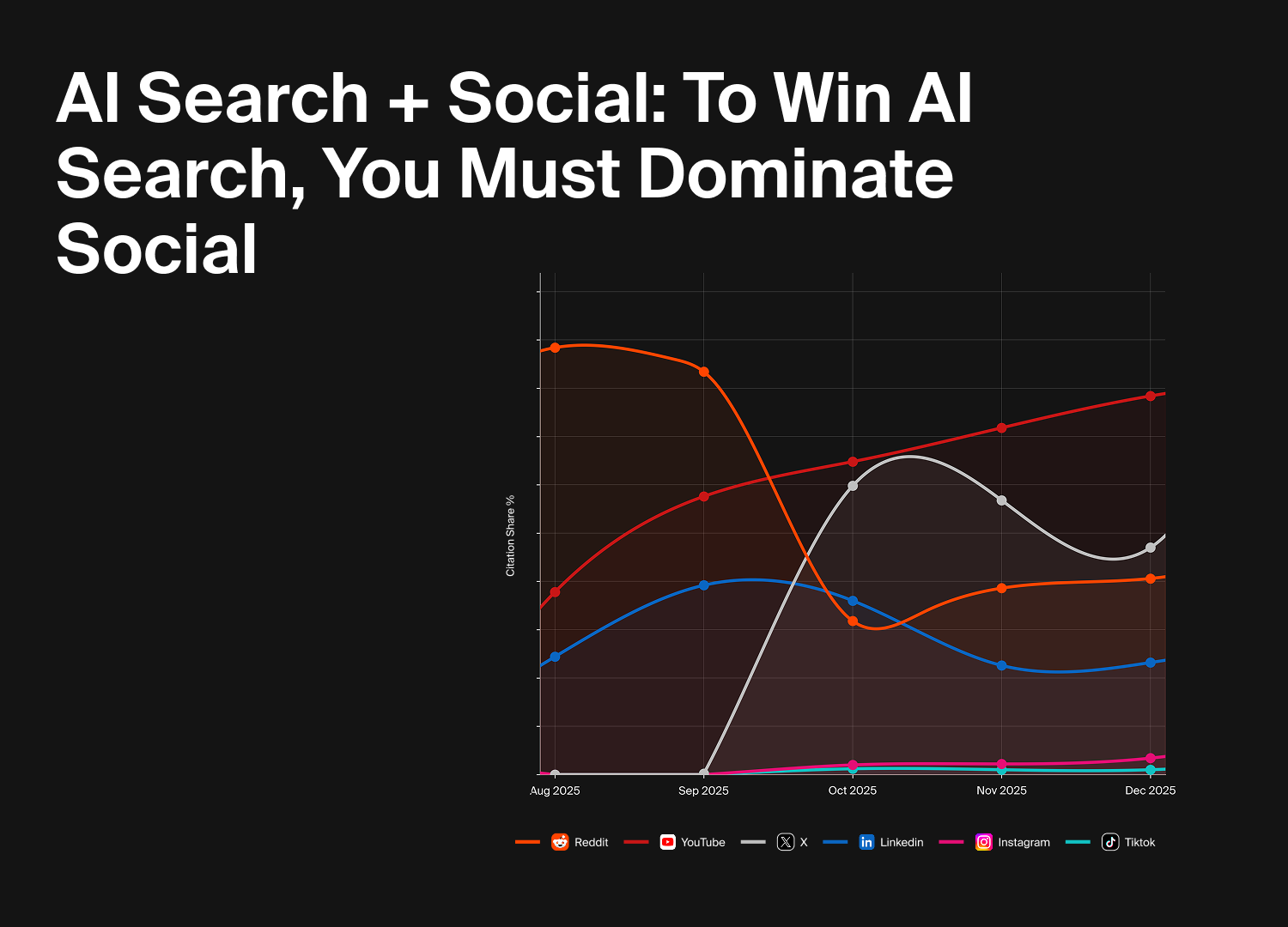
When diving into the complexities of AI search, I discovered that dominating social platforms is crucial. Recently, I explored a study of 6.1 million citations, which revealed an interesting trend: AI answers are increasingly influenced by social media.
Social platforms have become essential in the AI citation graph, and I’ve found that optimizing for this shift can significantly boost brand visibility. If you’re like me and want to stay ahead, integrating social strategy into AI search is a must.
By following these insights, I believe brands can enhance their online presence and ensure their content is favored by emerging AI technologies. Let’s embrace this evolution and maximize our impact in the AI-driven world.
I’m excited to share that Meta is set to expand Threads ads to all users worldwide beginning next week. This move opens up new opportunities for advertisers to engage with over 400 million users.
Threads, which rivals the platform X, has seen rapid growth since its debut in July 2023. With its soaring popularity, CEO Mark Zuckerberg has high hopes that Threads could reach 1 billion users in the near future.
Advertiser Access. Advertisers have already been testing Threads ads in the U.S. and Japan. As of last April, global advertisers gained access. Meta helps streamline campaign expansions to Threads through its Advantage+ program, supporting various ad formats like image, video, and carousel. This can all be managed alongside campaigns on Facebook, Instagram, and WhatsApp within Business Settings.
Third-Party Verification. Meta is ensuring brand safety by extending third-party verification tools from Facebook and Instagram to Threads. Although ad delivery will start modestly, this scaling should ensure more confidence in the brand’s safety across the platform.
Why This Matters. With Threads integrating into Meta’s vast ad ecosystem, there’s an exciting opportunity for you to leverage this dynamic social platform. Early participation can give brands an edge as Threads offers a range of advanced ad formats and verification measures to avoid challenges like deepfakes.
Bottom Line.Meta’s global rollout of Threads ads is a pivotal moment for advertisers. It not only offers a channel on a rapidly expanding platform but also includes enhancements like brand-safety verification, making early adoption a strategic advantage.
I’ve noticed a powerful effect when social content sparks curiosity, leading to branded searches. Let me share how measuring this ‘halo effect’ can benefit us.
As a search marketer, my focus often stays on the familiar elements: keywords, links, and page metrics. We’re experts at navigating our dashboards.
However, not all of our audience’s search behaviors are captured in analytics tools like GSC or GA4.
One influential factor lies outside typical SEO reports – the social media halo effect.
When a captivating social post gains traction, it does more than collect likes; it piques curiosity about the brand.
This curiosity often takes form in the search bar, but many SEO teams aren’t equipped to capture this moment.
We aren’t tracking or aligning with social teams in real-time, which creates a substantial blind spot in understanding intent and impact.
The case for measuring the social-to-search connection
Branded search provides a clear signal of demand and trust. Even if clients prioritize non-branded growth, recognition is key.
Searches for specific brands or products arise from awareness or interest sparked on social platforms.
Despite its significance, branded performance is often overlooked or vaguely attributed to marketing efforts.
The invisibility problem
Social influences search behavior more than SEO reporting indicates.
When a post goes viral, branded impressions spike but SEO reports rarely capture the reason behind it.
Missing links between social and search mean we overlook early signals, attribution opportunities, and the fast-moving momentum of social interest.
By capturing the social-to-search connection, we gain a more complete understanding of user intent and impact.
What the ‘halo effect’ actually looks like
The halo effect is evident in several scenarios. Let me illustrate a few I’ve observed.
Scenario 1: A TikTok post goes viral and drives product searches
A TikTok demo unexpectedly goes viral, causing a surge in branded searches without a traffic spike.
People remember the post and search the brand, even if they don’t immediately click on any links.
Scenario 2: A founder’s LinkedIn post sparks searches for his name
A CEO shares insightful content that leads users to search for interviews or podcasts featuring them.
Scenario 3: An influencer mention (without links) leads to a surge in brand name searches
An influencer mentions a brand, creating a rise in impressions without direct links or measurable conversions.
These branded keyword lifts are often the first signs of growing interest, indicating underlying curiosity fueled by social interaction.
To fully measure this effect and improve our strategies, it’s essential to understand these connections.
How to track the social halo effect
Tracking this isn’t about perfect attribution models—it’s about a consistent approach and expanding our perspectives beyond just SEO metrics.
1. Establish a branded baseline
To recognize increases, it’s important to understand your brand’s normal search volume first.
Create segmentation by analyzing terms related to your brand, product names, and key figures like founders.
2. Watch for spikes around social moments
Track branded impressions regularly, especially during social campaigns or after viral posts.
Correlate these changes with social activities to identify meaningful patterns and signals.
The goal is not pinpointing causation but finding credible correlations to enhance understanding.
3. Layer in social listening and engagement data
Incorporate social listening tools to refine SEO insights and draw connections between social engagement and search behavior.
Annotations within SEO data can significantly aid in understanding the broader narrative.
4. Correlate branded search with on-site behavior
Not all branded traffic is created equal. Consider metrics like time on site and conversion rates from branded searches.
Engagement levels often indicate the quality of user interest that originates from social interactions.
Be sure to assess whether users engage further with the content after they land on the site.
What to do with all this data
With comprehensive insights into the halo effect, I find we can better capitalize on these opportunities.
Prove the value of social to SEO (and vice versa)
This data is invaluable for showcasing the interdependency of social media and SEO to stakeholders.
Forecast content that wins in both channels
Analyzing successful content themes can guide content creation that excels in both social and SEO channels.
Build SEO support for social moments
Aligning your SEO strategy with anticipated social moments ensures consistency and maximizes interest.
Align brand messaging everywhere
Ensure consistent messaging across all online and social platforms to build brand confidence and drive conversions.
Why the social-to-search connection will only grow
With new technologies like AI shaping search behaviors, brand familiarity is becoming increasingly vital.
Recognizing the synergy between social and search allows us to effectively shape these experiences for maximum impact.
The future lies in a harmonized approach where discovery, curiosity, and search-driven intent are seamlessly integrated.
Trace the ripple
Staying siloed isn’t an option. Understanding pre-search discovery enhances our ability to engage search users effectively.
The next time you see a spike in branded searches, analyze its origins to fully understand and leverage the halo effect.
As I dive into optimizing content for Meta AI, it’s crucial to enhance brand visibility across its various platforms, including Instagram, Facebook, and the Meta AI chatbot.
Understanding the unique dynamics of each platform helps me tailor my content strategy effectively. Meta AI offers a vast ecosystem, and by leveraging its tools, I can easily increase my brand’s reach and engagement.
From structuring content to optimizing performance, I am committed to exploring the best practices that ensure my brand shines within this innovative environment. Join me as I uncover the secrets to mastering content optimization for Meta AI.
I’ve come to realize that social platforms are revolutionizing how we discover information. TikTok, Reddit, YouTube, and AI engines are now essential in shaping the way we search.
Understanding this shift, I’ve explored how brands can enhance their visibility by optimizing for social-driven Answer Engine Optimization (AEO). Let’s dive into these exciting developments!
Instagram recently unveiled a groundbreaking tool called Your Algorithm in the U.S., empowering me to discover what the algorithm thinks I prefer and even tweak it. This exciting feature could redefine how brands are found on Reels.
Why I care. This new capability could substantially change my content discovery experience. By indicating my interest in particular niches, like vintage fashion or fitness gear, Instagram might show me more content relevant to those interests, which is fantastic news for brands aiming to extend their reach through Reels.
How it works for me. A newly introduced Reels icon gives me access to a personalized array of topics Instagram’s AI believes I’m currently into, such as sports, horror movies, or skateboarding. Here’s what I can do:
Discover how to see more or less of any topic, or introduce my own suggestions.
Share my algorithm snapshot on Stories.
The future of exploration. Instagram plans to roll out this tool globally to other sections like Explore and the search tab, with controls broadening beyond Reels in due time.
Insights from Instagram. Tessa Lyons, Instagram’s VP of Product, expressed to Fast Company how they aim to enhance my Instagram experience by giving me more control: “We want our users to feel like they are in charge of their Instagram journey, tailoring what they see based on their evolving interests.”
Comparison to TikTok’s feature. Though TikTok previously introduced Manage Topics, its offerings are broader and less tailored to individual behavior compared to Instagram’s more personalized suggestions.
A declaration by Adam Mosseri. The head of Instagram, Adam Mosseri, shared the announcement directly on Instagram.
Recently, I’ve discovered that YouTube Shorts has updated its ads, making them more interactive and creator-focused. These enhancements are aimed at helping advertisers engage more effectively during those important holiday seasons.
I’ve noticed that the new advertising features are particularly designed for Shorts, offering brands a chance to maximize their holiday marketing budgets by riding the short-form video trend.
So, what’s new?
First, advertisers can now allow comments on eligible Shorts ads, which brings the ad experience closer to organic content. This opens up new ways for real-time engagement with audiences.
Additionally, creators who share branded content on Shorts can link directly to a brand’s website. This provides viewers with an easy path from discovery to action.
Finally, YouTube is expanding Shorts ad placement to the mobile web, allowing advertisers to reach viewers as they move across different devices, such as TV, desktop, and mobile apps.
Why does this matter? These updates make Shorts ads not only more engaging and native but also more actionable. This is crucial for improving performance in the crowded holiday market. Ads with comment features increase engagement signals and allow brands to understand audience reactions in real time.
Link-outs from creators can shorten the path from discovery to purchase, effectively transforming creator influence into measurable traffic. The expanded placement to mobile web ensures a broader reach during busy shopping periods.
The bigger picture? As more of us are watching short-form videos across various screens, YouTube is positioning Shorts as a platform that marries creator authenticity with measurable results. This strategy is directly aimed at advertisers planning for the holiday season.
Looking ahead, advertisers might find these new, more interactive Shorts ads on YouTube beneficial in cutting through the noise and converting viewer attention into holiday sales.
As a performance marketer, I’ve realized that leveraging AI is crucial for growth and efficiency, especially as we advance into 2026 and beyond.
Anyone not exploring new AI tools to enhance or streamline their PPC efforts is missing out on a significant opportunity for their brand or clients.
The rapid pace at which these tools evolve can make it feel like a full-time job to keep up, which is why my agency prioritizes AI in our knowledge-sharing sessions.
As a team, we’ve distilled our top picks for creative, campaign management, and AI search measurement tools.
This article will guide you through essential tools in each category, providing quick reviews and highlighting my current favorite.
One key piece of advice before diving in: Be cautious about long-term contracts with AI tools, as today’s sensation might be tomorrow’s obsolete tool.
AI Creative Tools for Paid Social Campaigns
With numerous tools available for generating creative assets, each offers unique benefits but also carries the risk of creating subpar AI content.
Whatever tool you choose, ensure it undergoes rigorous testing and is backed by a robust human-in-the-loop process to maintain quality, accuracy, and brand alignment.
Here’s a summary of tools we’ve evaluated:
AdCreative.ai: Generates images, video creatives, ad copy, and headlines efficiently, with data-backed scoring.
Creatify: Excels in video ads and supports diverse formats.
WASK: Merges AI creative generation with campaign optimization and competitor analysis.
Revid AI: Suited for story format creation.
ChatGPT: A familiar, free tool that gives marketers an edge in crafting effective prompts.
Currently, I favor AdCreative.ai. It simplifies brainstorming creative concepts and testing variations quickly.
It offers significant advantages like:
Creating multiple variants swiftly to keep creative fresh and combat ad fatigue.
Reducing dependence on external designers for repetitive or template-based content.
Experimenting with various creative elements rapidly to determine winning combinations.
Providing data-driven insights such as creative performance predictions.
However, always ensure you establish:
Guardrails to prevent off-brand outputs with clear voice guides and style rules.
Verification processes to catch errors in technical claims or data.
AI Campaign Management and Workflow Tools for Performance Campaigns
In the realm of workflow automation tools like Zapier, Workato, and Microsoft Power Automate, our agency prefers n8n for its flexibility in creating agentic workflows and integrations.
Our primary n8n use cases include:
Lead management: Enhance and route leads automatically with the integration of Clearbit and CRMs.
UTM cleanup: Normalize UTM parameters automatically for accurate CRM entry.
Data reporting: Fetch metrics, structure data, and use AI to summarize insights, sharing them via Slack or collaborative tools.
Be aware of potential challenges with n8n:
Requires technical knowledge of APIs, JSON, and authentication methods.
Security setups are necessary to protect data; misconfigured systems can pose risks.
Lacks some ad platform integrations which require more manual work.
While I strive for my content to remain relevant over time, I’m aware that this piece may become more of a historical reference.
Nonetheless, the need to:
Stay updated on AI developments.
Vigorously test new capabilities and features.
Foster strong knowledge-sharing within the team remains essential.
Though AI in performance marketing has grown rapidly, there’s still room for teams that adapt quickly, conduct strategic testing, and pivot effectively to differentiate themselves.
I’ve learned that off-page SEO has come a long way from just building links. It’s now about crafting strategies that enhance authority, reputation, and visibility across various platforms.
In today’s fast-evolving digital landscape, search has moved well beyond simple blue links. Now, people find information not just on Google but also on platforms like TikTok, Pinterest, Amazon, and YouTube, as well as AI systems that provide synthesized answers from trusted sources.
As search engine results pages (SERPs) shift towards rich results and AI summaries, users can get what they need without even clicking. This change means brand authority extends beyond your website’s domain; it crosses platforms and content formats, influencing how AI systems learn from and use your content.
Modern off-page SEO demands strategies that cater to both search engines and AI models that recognize and highlight your expertise. This guide delves into what off-page SEO tactics work today and offers best practices for 2026.
What is off-page SEO today?
Off-page SEO encompasses all efforts made beyond your website to elevate its ranking and visibility in search engines. It includes strategies to secure inbound links, citations, and brand mentions, each contributing to your site’s authority and search engines’ trust.
Over time, search algorithms have advanced. While earlier algorithms focused heavily on backlinks to assess domain authority, search engines like Google now use a diverse array of factors, including expertise, authoritativeness, trustworthiness, and experience, commonly referred to as E-E-A-T.
Enhancing E-E-A-T involves:
Producing content with actual subject-matter experts.
Being transparent about your information sources and company details.
Gaining citations and mentions from authoritative sites relevant to your industry.
Backlinks vs. inbound links
Throughout this discussion, I prefer using the term “inbound links” instead of “backlinks,” as it carries fewer negative connotations associated with outdated, manipulative practices. The focus is on earning connections that are authoritative and relevant, offering genuine value to users.
This approach reflects a broader strategy—link building as a content-driven initiative, not a manipulative shortcut.
How important is off-page in your overall SEO strategy?
Off-page SEO is critical to building your site’s credibility. Each link or mention serves as an endorsement of your brand, akin to word-of-mouth recommendations, thus influencing your online reputation positively.
The more high-quality, relevant endorsements from credible sources you receive, the more authoritative your website appears to search engines.
Off-page and the rise of answer optimization
In today’s AI-driven search landscape, off-page SEO’s importance is magnified. AI systems not only index content but also interpret, summarize, and generate answers based on reliable sources.
This means that off-page signals like brand mentions, links, and social sentiment shape not only Google rankings but also how AI models perceive your brand’s authority.
Structured data, a consistent brand identity, and third-party mentions are crucial for AI to connect your content with relevant topics, ensuring visibility and authority in AI-generated answers.
I’ve discovered that social media is now a more significant driver of traffic to small and medium-sized businesses than search engines. This shift has also made us aware of the growing importance of AI in our referral tracking. Many of us, including myself, see our competitors appearing in AI summaries as a potential threat. This insight comes from the latest survey data shared by WordStream by LocaliQ.
Why this matters to me. As a small business owner, these AI summaries are becoming an essential part of my strategy. They play a crucial role in influencing buyers’ initial decisions, and there’s a clear opportunity to steer them toward my products instead of competitors’. The AI referrals are also trackable, pushing me to optimize for these new channels.
The decline in Google traffic. About 40% of us SMBs have noticed a loss in traffic due to recent Google updates and AI-driven search adjustments. Larger companies among us have felt this impact most, with almost half admitting to seeing declines. Yet, a significant portion of us (72%) still believe in the effectiveness of our SEO efforts.
Social media leads the way. An impressive 64% of us list social media as our main traffic driver, surpassing organic search, which stands at 52%.
Solo entrepreneurs and small businesses like mine found social media to be the top source of traffic.
Interestingly, 35% of businesses without websites find that social channels and marketplaces bring in enough leads to forego having a website.
AI’s growing influence. Though AI search isn’t yet the top traffic source, it’s certainly on my radar and that of fellow SMBs:
The greatest frustration for me, and many others, is when competitors appear in AI summaries over our businesses. However, there’s an upside: these AI models pull from sources beyond Google’s typical top search results, presenting a rare chance for visibility.
Importance of key webpages. For those of us tracking AI-driven traffic, the most important pages are:
Homepages (57% of us rely heavily on these)
Product or service pages (48% highlight these)
Contact pages (34% consider these crucial)
Our adaptation strategies. In my quest to boost AI visibility, I’ve noticed that the top strategies align with SEO basics:
Using clear, descriptive headlines (35% of us are doing this)
Improving readability (a focus for 26%)
Addressing technical factors like speed and mobile performance (24% are prioritizing this)
Larger SMBs focus on building external brand mentions (33%) and adding structured data (30%)
About this data. This insight comes from a WordStream by LocaliQ survey, conducted with over 300 U.S. small businesses in 24 industries. It includes responses from various business sizes, from sole proprietors to companies with up to 100 employees.