I’m seeing Google expand merchant listing structured data with support for sale duration and the Product.category property. The update brings Google Search’s merchant listing structured data closer to the capabilities already available in Google Merchant Center feeds.
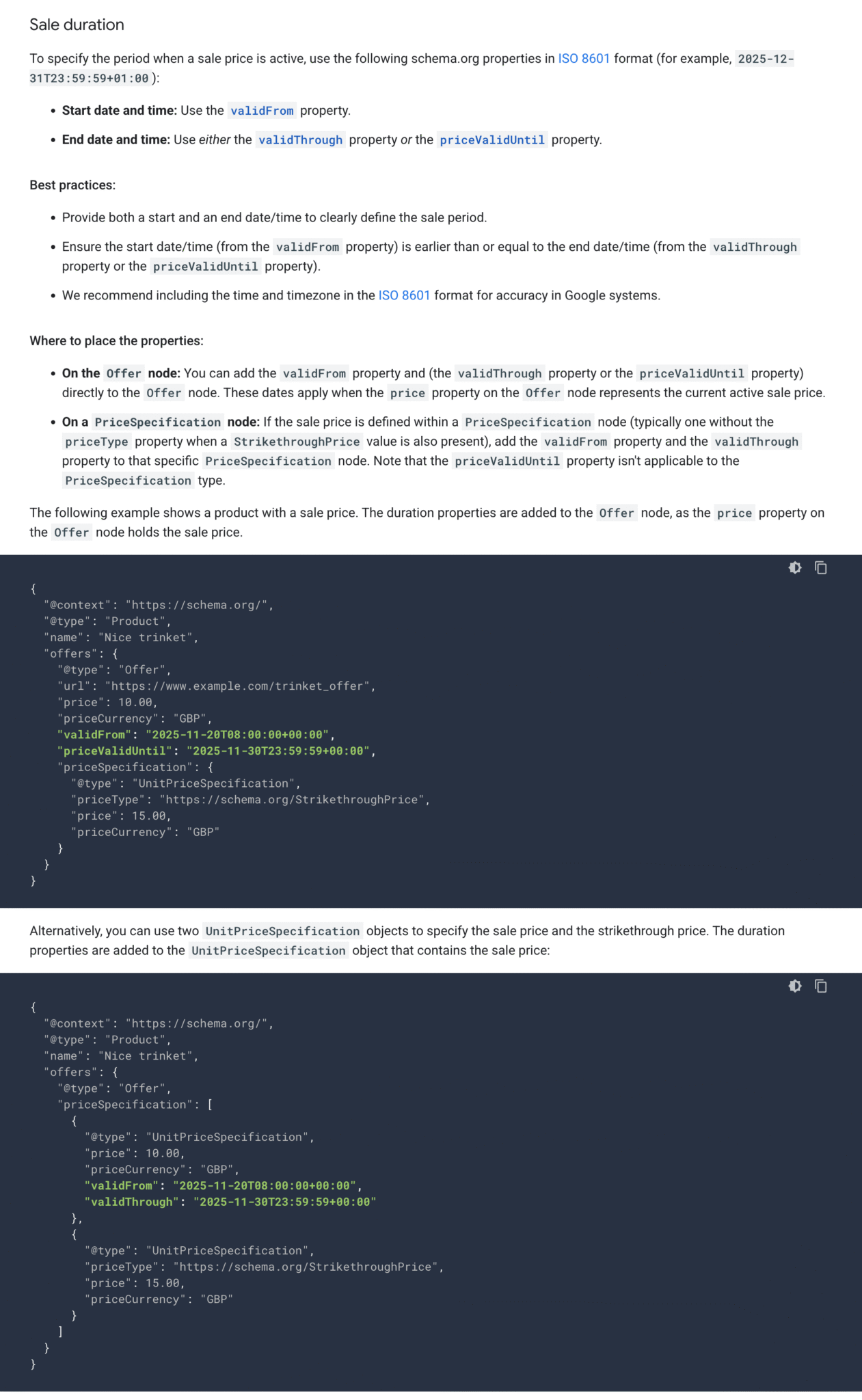
Sale duration. Google added a new Sale duration section to its Merchant listing structured data documentation. In that update, Google said the guidance explains how to use the validFrom, validThrough, and priceValidUntil schema.org properties to define the effective date range for sale prices.
I find this useful because Google’s guidance also covers best practices and examples for placing those properties on either Offer or PriceSpecification nodes. Google said the change aligns schema.org usage with the Merchant Center feed attribute sale_price_effective_date, giving merchants clearer instructions for handling sale price timing in structured data.
Google's sale duration guidance shows merchants how to define when a sale price starts and ends in structured data, including Offer and UnitPriceSpecification JSON-LD examples.
Here is the new sale duration section Google added:
Product category. Google also updated the same Merchant listing structured data documentation to include support for the Product.category property.
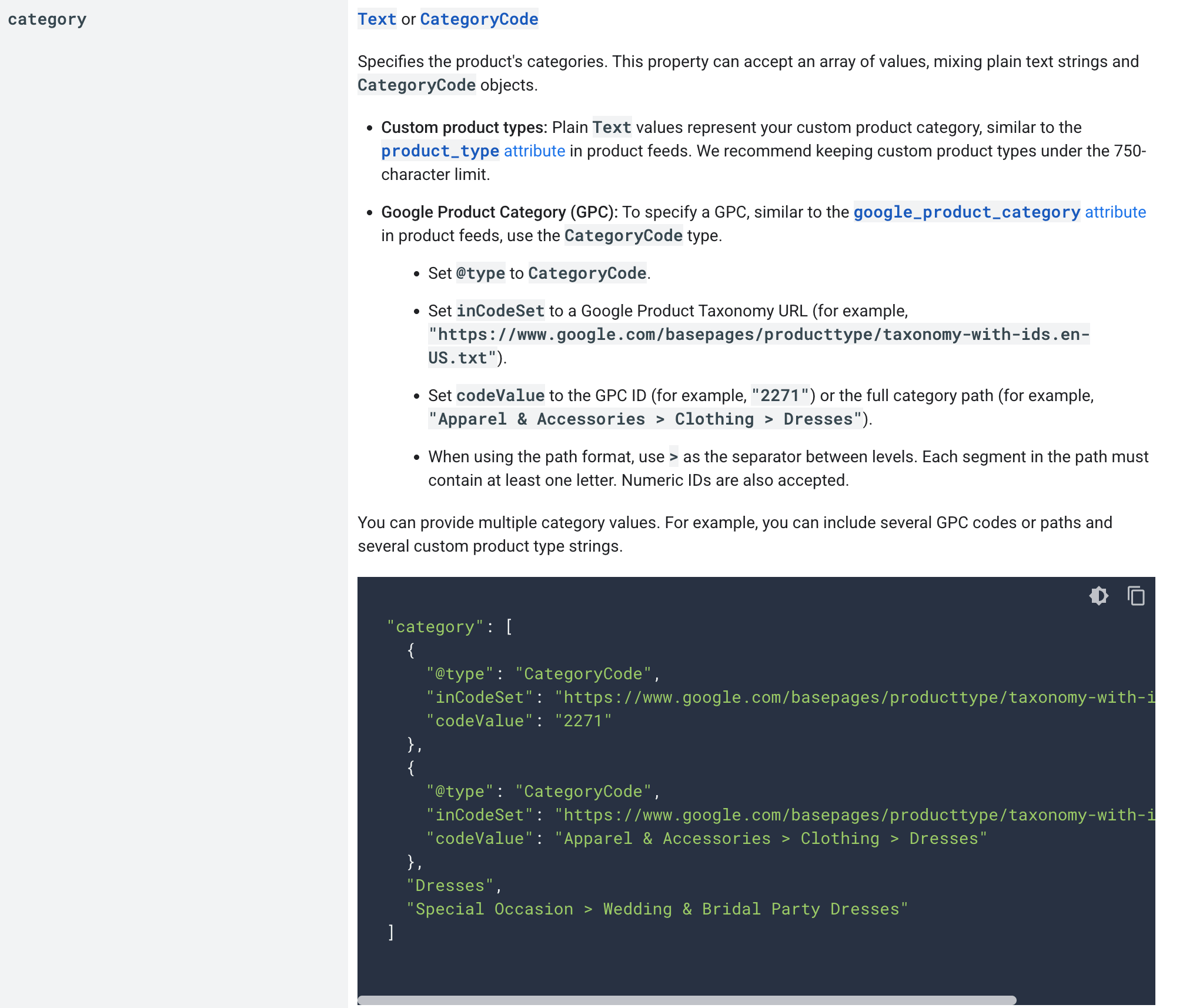
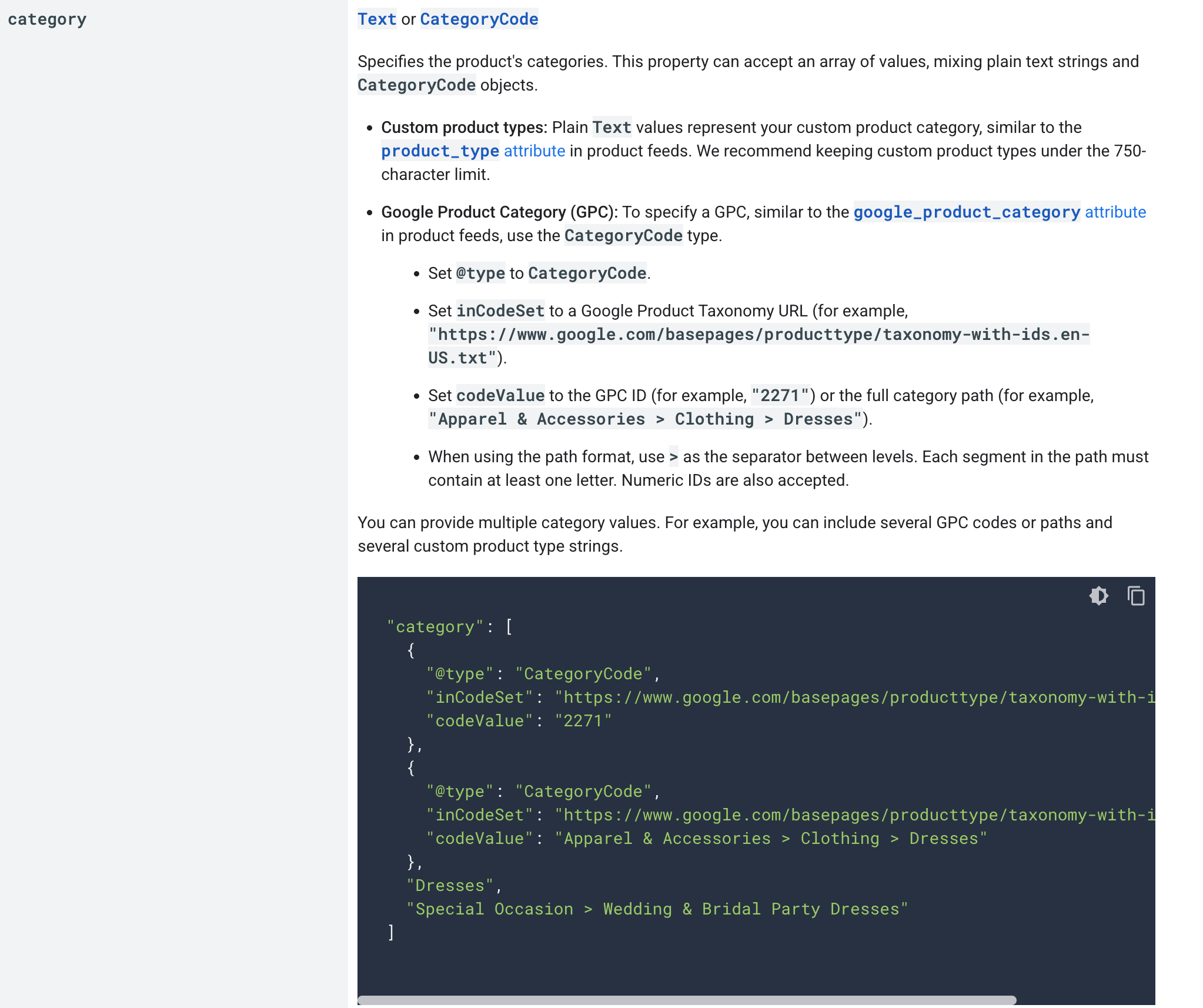
Google’s merchant listing guidance now shows how product categories can mix custom text labels with Google Product Category codes in structured data.
Google wrote that the documentation now explains how Product.category can be used with both Text and CategoryCode types. According to Google, this aligns with Google Merchant Center feed specifications for the product_type and google_product_category attributes.
From my perspective, this makes the structured data more practical for merchants because it lets them provide both merchant-defined and Google-defined category details directly in schema.org markup. Google said this can enhance product information for Google Search and Shopping.
A glowing Google search bar cuts through streams of digital data, capturing the fast-moving world of search, shopping visibility, and SEO innovation.
Here is what Google added for product category support:
Why I care. If I maintain merchant listing structured data for Google, these additions are worth reviewing. Product category support can help Google better understand the products being provided, which may improve how those products match relevant queries.
I also see sale duration support as a practical improvement for planning promotions. When I update merchant listing structured data, I can now define sale price timing more clearly and align that markup more closely with Google Merchant Center feed behavior.
Making a brand machine-readable and improving its odds of being selected for AI-generated answers are important, but I see them as only part of the larger shift. Under the surface, a retrieval layer is changing how AI systems identify entities, connect facts, and decide which brands deserve to be cited.
That layer is GraphRAG. Once I understand how it works, “optimize for AI” stops feeling like a vague instruction and starts looking like a practical SEO strategy.
What is GraphRAG, actually?
GraphRAG extends traditional retrieval-augmented generation (RAG) by adding a knowledge graph. That graph helps AI understand entities and the relationships between them, instead of treating content as disconnected text fragments.
Microsoft Research introduced GraphRAG in 2024, and a broader ecosystem has formed around it since then. Instead of pulling from a flat sea of text chunks, GraphRAG builds a map.
In that map, nodes are the entities: a company, product, person, certification, location, or concept. Edges are the relationships between those entities, such as “offers,” “is certified by,” “authored,” or “operates in.”
I think of it as a system of things and the lines connecting them. When a model works from a map instead of a pile of scraps, it does not have to guess its way toward an answer. It can follow the relationships.
If the map says Entity A holds Certification B in Region C, the system can follow that path with confidence instead of inferring the connection and hoping it is right. That is why graph-based retrieval can produce more complete, better-grounded answers to complex questions with fewer hallucinations.
Microsoft described this failure mode in its GraphRAG patent, “Knowledge Graph Extraction” (US20250131289A1). The patent calls out a recall problem in naive RAG: a less prominent entity can disappear inside chunk embeddings, which means the system may retrieve nothing useful.
It also describes one of the fixes: entity resolution. When duplicate spellings or variations of the same thing are merged, the system can treat them as one entity instead of scattering their authority across several weak signals. That is one of the core building blocks behind graph-based retrieval.
Traditional RAG works by chopping content into fixed chunks, turning each chunk into a vector, and storing those vectors in a database. When I ask a question, the system retrieves the closest chunks in vector space and passes them to a language model to generate an answer.
That can work for simple questions like “What is the capital of France?” It struggles with the questions that usually matter most in business: the multi-step questions.
If I ask a system to find a provider that offers a specific service, holds a specific certification, and operates in a specific region, naive RAG may stitch together an answer from scraps that merely sound related. It does not truly understand how the facts connect, so it guesses across the gaps.
When a system has to guess, the safer move is often to leave a brand out rather than risk saying something inaccurate about it. That is the part I think many SEO teams need to sit with.
This explains a common frustration: “Our content is strong, but AI systems still do not cite us.” The issue may not be content quality. GraphRAG consistently outperforms naive RAG on complex, multi-hop questions where vector search falls apart. That is where the visibility leak often starts.
In many cases, the machine could not reliably tell what the brand is, how its facts fit together, or whether it could trust those relationships enough to cite the brand by name.
The three problems GraphRAG is built to fix
I see GraphRAG lining up with three SEO problems that show up again and again: disambiguation, attribution, and relationships.
Disambiguation matters when the same entity appears under different names and gets counted as several weaker signals instead of one strong one. If “the firm,” “the agency,” and the actual brand name never resolve to a single entity, authority gets split.
Attribution matters when the fact survives but the credit disappears. When content is blended into an AI answer, the brand behind the original insight can easily vanish.
Relationships matter when the connections that give expertise meaning stay buried in prose instead of being declared in a way a machine can read.
If I have ever watched AI repeat something a company wrote without naming it, or credit a competitor for a specialty the company actually owns, I have seen all three problems in action.
What ties them together is simple: this is not only a content problem. It is an identity problem.
Same sentence, more machine-readable context
I want to make the idea of an entity concrete, because it can become abstract quickly. I will use one real-world example and one fictional example.
Start with Wayne Gretzky. Search his name in almost any AI client and I expect to see a confident summary: facts, former teams, records, and related links. That confidence is not luck. It is what a well-established entity looks like. His identity is nailed down and agreed upon across the web, so the system does not have to guess who he is.
Now imagine the opposite. Picture a goaltending coach in Moncton. I will call her Marie Tremblay. Her About page says: “Our head coach, Marie ‘Lefty’ Tremblay, has run elite goaltending camps across the Maritimes for 20 years.”
That is a good sentence. A parent understands it immediately. I would not rewrite it into robotic prose just to satisfy a machine. Optimizing for AI does not mean abandoning human voice.
The better move is to keep the sentence and add context around it. I need to make explicit what a human reader infers automatically.
That means clarifying that “Lefty” and “Marie Tremblay” are the same person. It means connecting Marie to the academy, to goaltending as a discipline, and to the Maritimes as the region she serves. It also means making “20 years” and “elite” verifiable claims rather than loose adjectives.
A human gets all of that from one sentence. A machine may not. My job is to close the gap between what the reader understands and what the system can verify, so Marie becomes as legible to AI retrieval systems as a famous entity like The Great One already is.
Why a flat triple is no longer enough
Knowledge graphs are built on triples: subject, predicate, object. “Acme offers consulting” is clean and useful, but it is flat. A bare triple cannot easily carry the high-stakes details that matter, such as whether the relationship is true, where it applies, who says so, and what evidence supports it.
The standards community is working on that gap. The W3C is extending the model with Resource Description Framework (RDF)-star, which allows site owners to make statements about statements. In practice, that means source, date, confidence, and other metadata can attach directly to a relationship instead of floating around as a disconnected claim. It is moving through the RDF 1.2 standardization process, with the RDF 1.2 Primer serving as a plain-English introduction.
Microsoft’s GraphRAG patent points in a similar direction. It pulls claims into a subject-action-object structure and weights relationships by how often they appear, instead of treating every stated link as equally reliable.
The practical lesson is clear to me: the future is not just saying two things are related. It is saying they are related and showing the proof in a form a machine can verify. A richer triple beats a flatter page.
The publishing layer is starting to respond
I am also watching the publishing layer, because that is where the shift is becoming visible outside the models themselves.
On June 1, the new open standard EntityMap launched a 33-day public consultation ahead of its July 1 launch. It was started by Fred Laurent, CTO of InLinks and Waikay, with backing from Dixon Jones. For anyone following entity SEO and the move from “strings to things,” those names matter.
The concept is deliberately familiar. Where sitemap.xml tells search engines which pages exist, an entitymap.json file tells AI systems what an organization knows: which entities it covers, how they relate, and where the evidence lives.
EntityMap aims at the same three problems: disambiguation, attribution, and relationships. It also builds in the richer-triple idea by allowing declared relationships to carry receipts, including a source URL, publisher, and timestamp.
I would treat it as a signal, not a mandate. EntityMap is a proposal in consultation, not a requirement. No major engine has committed to reading files like these, so I would not turn it into another box-checking exercise yet. The important point is that credible people are building entity-first publishing standards, and that direction is worth watching.
The honest state of GraphRAG
I do not think GraphRAG belongs in hype territory, because two realities keep it grounded.
First, GraphRAG is expensive. Building the map requires a language model to extract entities and relationships, and that is the costly part. By Microsoft’s own estimate, graph extraction accounts for roughly 75% of indexing costs. That LLM cost is one reason web-scale, real-time graph retrieval has not taken over everything overnight.
Second, the cost curve is bending. Recent research is attacking the infrastructure problem directly, including TurboQuant, a vector compression method from Google Research and NYU, presented at ICLR 2026. It reduces the memory footprint of vectors these systems traverse while preserving quality well enough to make the economics more interesting.
That does not mean every engine is running GraphRAG across the open web today. It means the economics are improving, which helps explain why entity-first standards are emerging now. I am cautious about anything framed as inevitable, but this shift makes practical sense.
Structured data still matters. Schema.org markup, a clean Knowledge Panel, consistent NAP, and strong entity signals are not going away. Entity-first work extends that discipline. It does not replace it.
My entity-first action plan
Here is how I would make this practical without betting everything on one standard.
Inventory entities, not just keywords. I would go beyond the search terms that historically brought traffic and list the things the brand genuinely knows about: products, services, people, methods, concepts, locations, and credentials. That becomes an entity map, whether or not it ever gets published as a formal file.
Disambiguate, then connect to the graph. I would claim and confirm the brand’s Wikidata entity and Google Knowledge Panel where possible. I would standardize naming, resolve variants, and keep sameAs links consistent across structured data. This is how “Lefty” and “Marie Tremblay” become one clear identity instead of two weak signals.
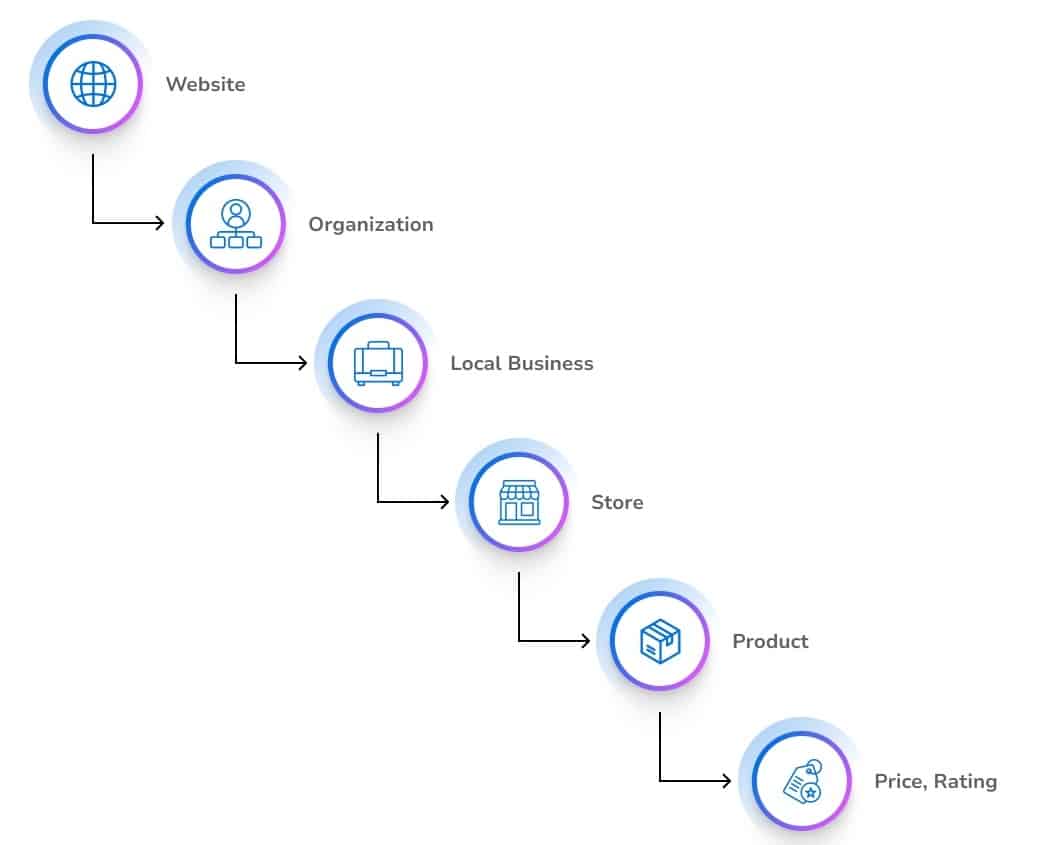
Make relationships explicit. I would use Schema.org types and properties such as Organization, Person, Product, knowsAbout, sameAs, and author so expertise is declared rather than implied. I would also mirror those relationships in internal linking.
Attach evidence to every claim. I would connect important facts to verifiable sources: named authors, first-party data, citations, documentation, and dated references. Graph-based systems increasingly need proof behind a relationship, not just the assertion.
Front-load defining facts. Retrieval still works through narrow windows, so I would place the clearest, most verifiable statement of what the brand is and what it does near the top of important pages.
Watch the publishing layer without overcommitting. I would read the EntityMap spec, follow how it develops, and decide later whether an entity index belongs in the stack. Schema.org work should continue either way.
Tie the entity map to revenue. I would map entity coverage to the queries and answer surfaces that influence leads, sales, margin, and retention. That helps leadership see entity work as revenue protection, not an academic exercise.
Measure what AI systems can recognize
Rankings and clicks still matter, but they describe the old search-page model. I would add metrics that show whether AI systems can recognize, trust, and cite the brand.
AI citation share measures how often the brand is named or cited in AI answers compared with competitors. I would track it monthly with an AI visibility tool.
Entity recognition asks whether priority entities have confirmed Knowledge Panels, Wikidata entries, and consistent identity signals. It is simple, but foundational.
Relationship completeness looks at how many priority entities have explicit, marked-up relationships and consistent sameAs links.
Attribution rate tracks how many core claims are backed by linked, verifiable evidence.
Answer-equity proxies include branded-query lift, assisted conversions from AI referrals, and lead stability as raw click volume softens. These business signals help show whether authority is compounding even when CTR is harder to read.
Where graph-based retrieval is heading
I expect graph-based retrieval to keep moving toward multimodal graphs, where text connects to images, audio, video, and structured data. I also expect more streaming and incremental indexing for live data, plus domain-specific ontologies for areas like medicine, finance, and law.
The move from strings to things is gaining momentum. The brands that stay visible will not simply be the ones publishing the most content. They will be the ones machines can understand without guessing, with clear entities, explicit relationships, and claims backed by evidence.
I do not need to wait for a new standard to launch before preparing. I can make a brand more legible now to systems that do not just read pages, but read what the brand knows. In the answer economy, I see the real battleground as identity, not just content.
I’m seeing a major shift in how people plan trips: 40% of travelers now use AI to research, compare, and organize their travel decisions.
That changes how I think about travel content. It is no longer enough to write only for traditional search results. I also need to make content clear, useful, and easy for AI systems and large language models to understand, summarize, and cite.
In this guide, I focus on practical travel AI optimization strategies, including stronger FAQs, schema markup, topical authority, and a content strategy built around the questions real travelers ask.
My goal is simple: create travel content that answers intent directly, builds trust, and gives AI platforms the structured context they need to reference my brand when travelers are planning their next trip.
Have you ever been curious about how many sites use a specific type of structured data? Now, you have the chance to find out.
I recently discovered that Schema.org is now sharing aggregated usage statistics for its terms across the public web. This means you can see exactly how many domains are using a particular schema or structured data element.
According to a Schema.org announcement, they are excited to offer a new dataset providing these statistics. Updated monthly, the data is aggregated at the domain level and categorized into popularity range buckets, which helps to filter daily noise while emphasizing meaningful adoption trends for researchers and tool developers.
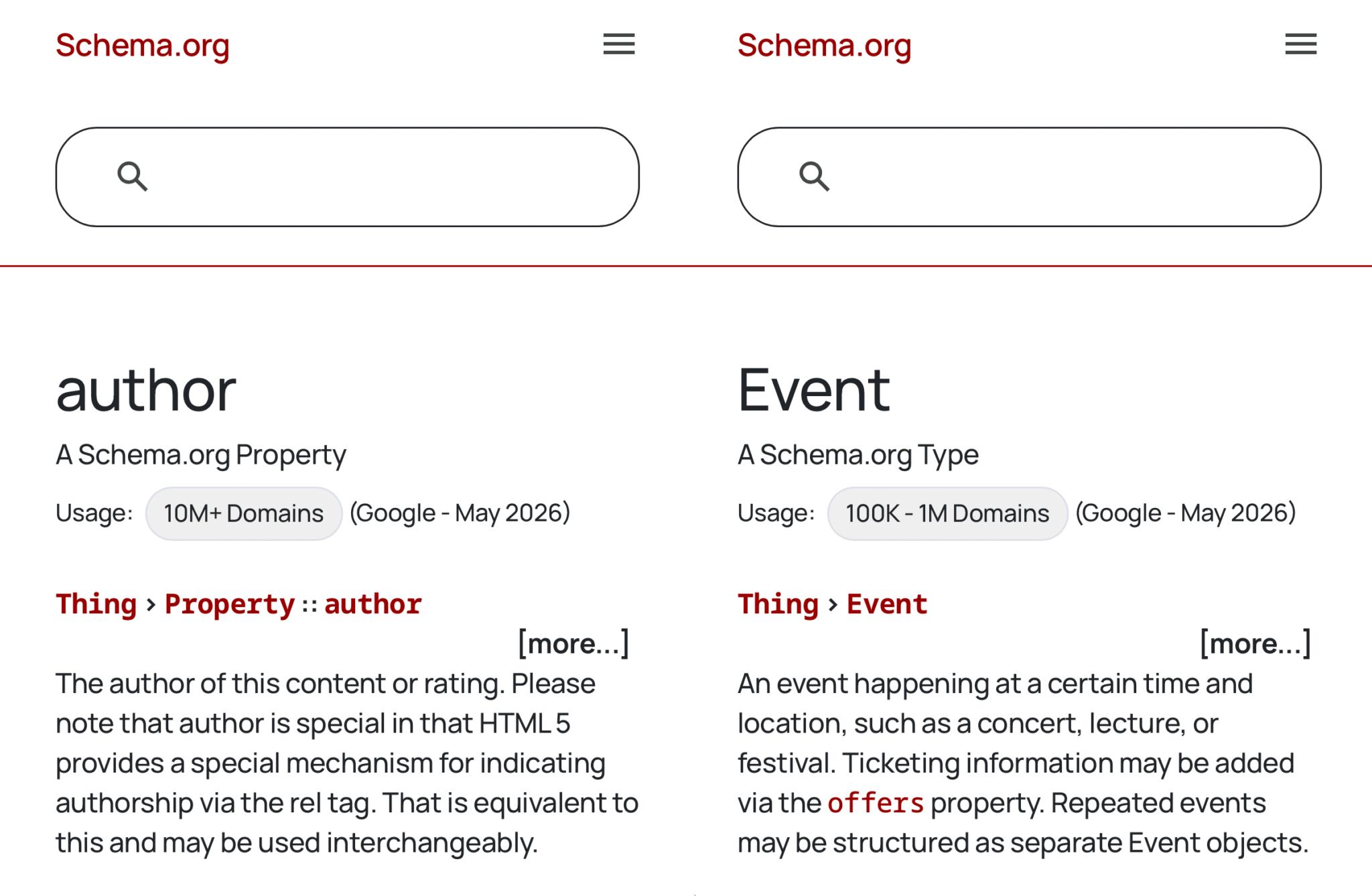
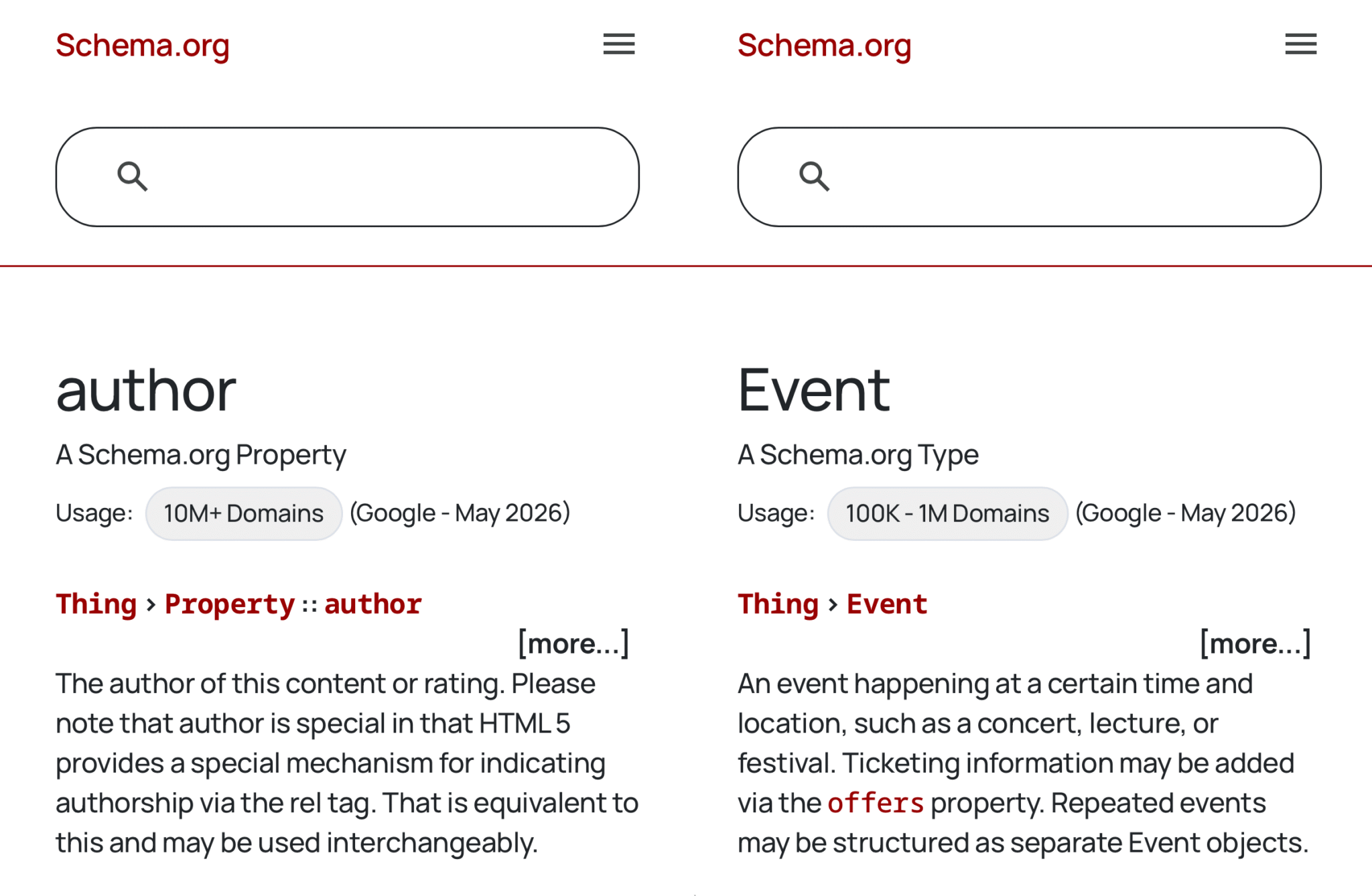
What’s the appearance like? Take a look at a snapshot of two Schema.org pages, featuring author schema and event schema, displaying the usage statistics prominently at the top:
Delving deeper into the data. Schema.org has further detailed the usage statistics. Here’s a brief overview:
Schema.org term frequencies are evaluated within Google’s public web crawling infrastructure. The aggregation occurs at the domain level (e.g., example.com), not page by page. If you use the same term on 100 pages, it still only counts as one domain using it.
Rather than displaying exact numbers, which can fluctuate daily, websites are categorized into range buckets (e.g., “10K – 100K” domains). This approach stabilizes the data and respects website privacy.
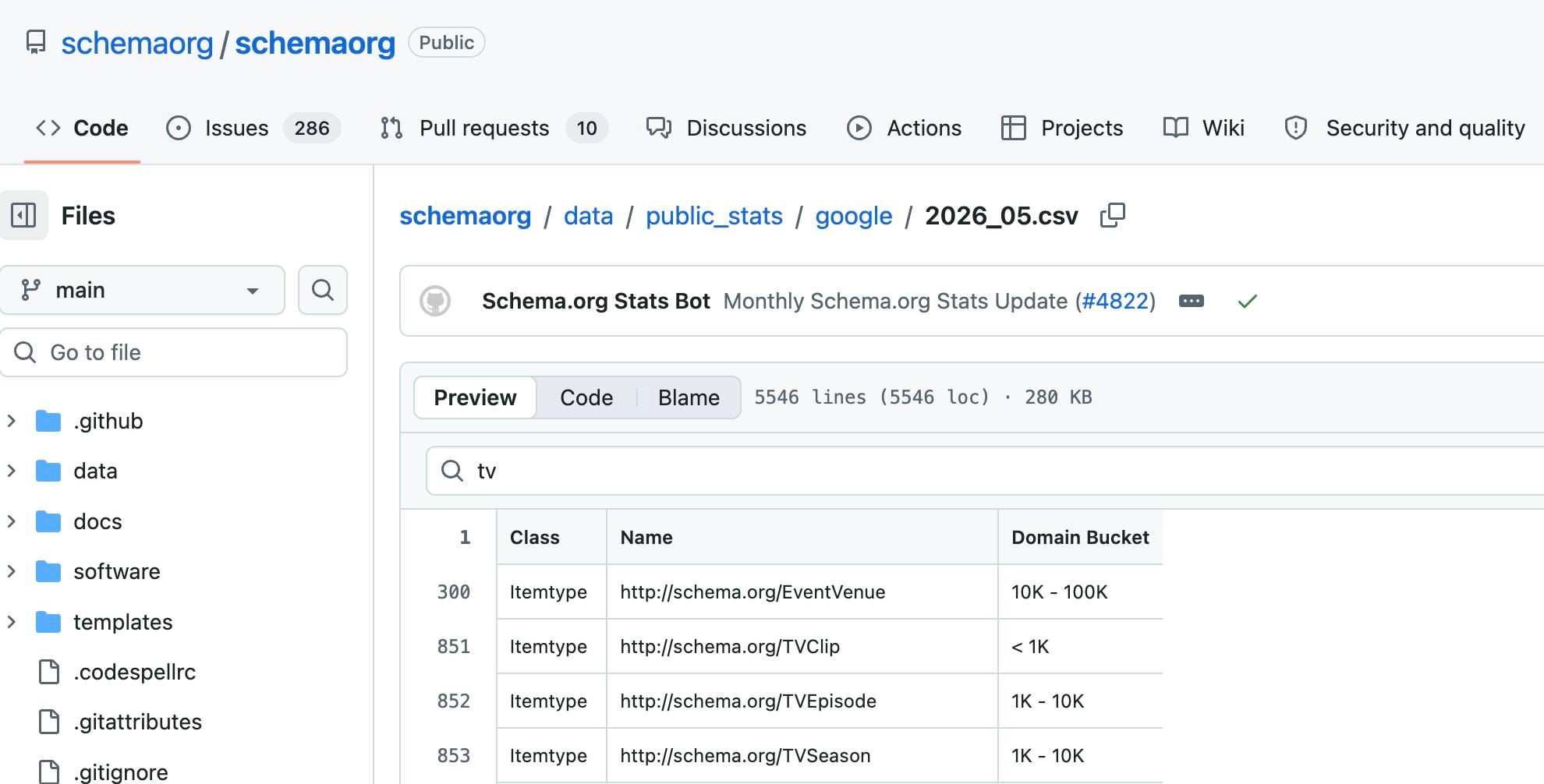
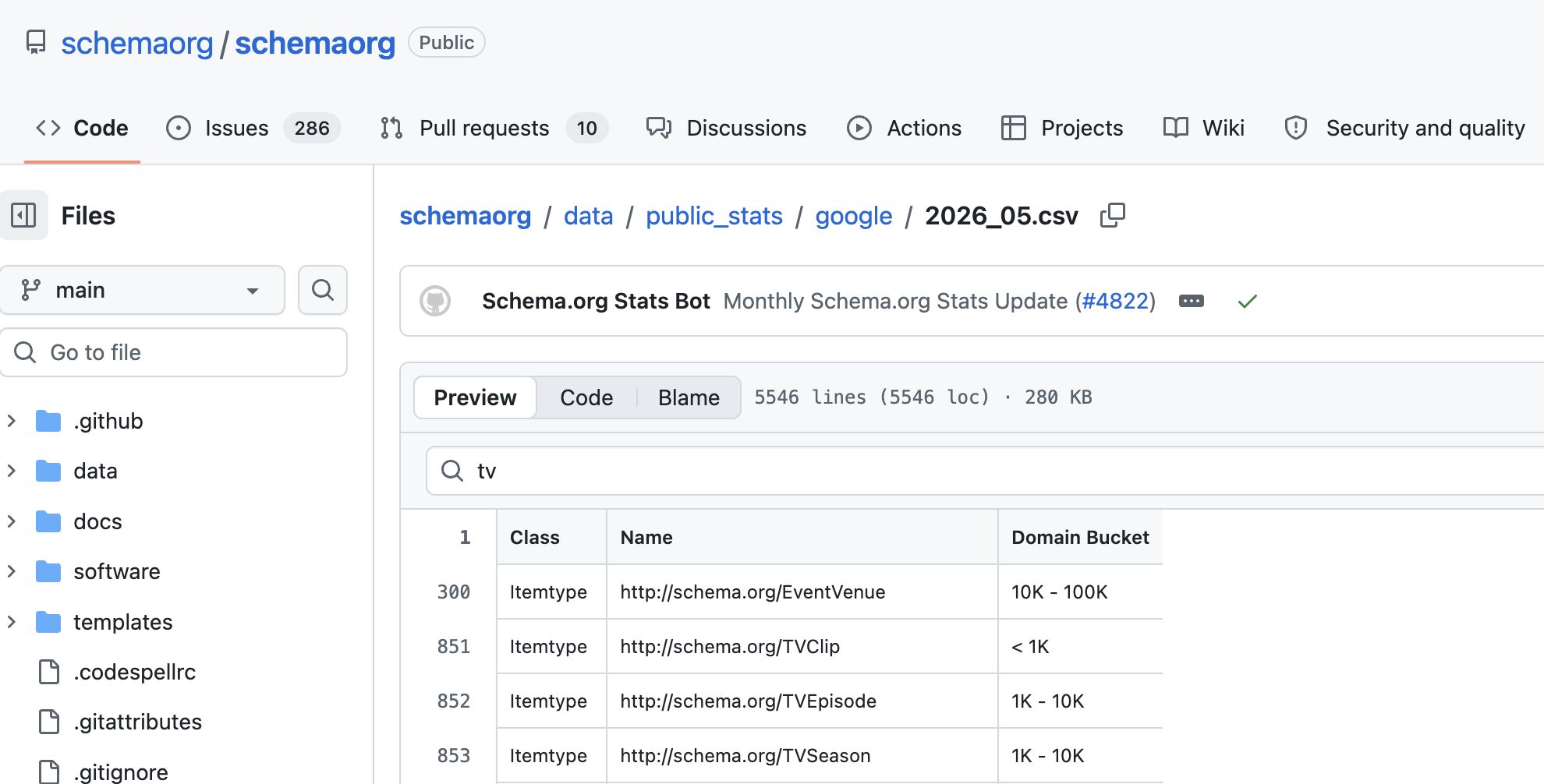
The raw data files can be accessed on GitHub under the Google Public Stats dataset. Both JSON and CSV formats are available, alongside a JSON summary format offering aggregated bucket distributions, all updated monthly.
Term Type: Specifies whether the term is a Type (e.g., “Person” or “Event”) or a Property (e.g., “price” or “telephone”).
URI: Shows the official URI of the term, such as http://schema.org/Person.
Domain Count Bucket: The range of unique domains utilizing the term, for instance, 100K - 1M domains.
If you’re interested, here’s a peek at GitHub:
Why is this important? Well, besides my love for data, understanding the popularity of a specific schema element might just convince your development team to incorporate that schema code on your site.
I’ve discovered that AI agents heavily rely on structured data to understand and interact with my content. Embracing schema markup is essential to thriving in the emerging agentic web.
Schema markup has become pivotal in SEO and Generative Engine Optimization (GEO) conversations. I learned that both Google and Bing utilize structured data to fuel AI overviews, and platforms like ChatGPT incorporate it for product suggestions.
The evolution towards the agentic web means AI systems interact directly with websites on our behalf. It’s not just about understanding content; they need schema markup to interpret and act on it. This makes it clear why schema is becoming an integral part of the agentic web’s infrastructure.
In the traditional search landscape, schema markup enhances visibility by making my content eligible for search engine results page (SERP) features. It aids search engines in understanding entities better, thereby influencing how results are presented to users.
AI agents go beyond by leveraging schema markup to understand relationships and relevance. They assess if content is actionable enough to be recommended or used for task completion. This knowledge helps them determine if my content is trustworthy.
With structured data, my website becomes easier and cheaper for AI systems to process. Parsing unstructured HTML is more costly compared to clean, structured data, especially as large language models (LLMs) work within finite context windows and escalating inference costs.
Sites that simplify content interpretation are more attractive to AI agents as these systems expand. This simplification becomes critical for ensuring my content is accessed and utilized effectively.
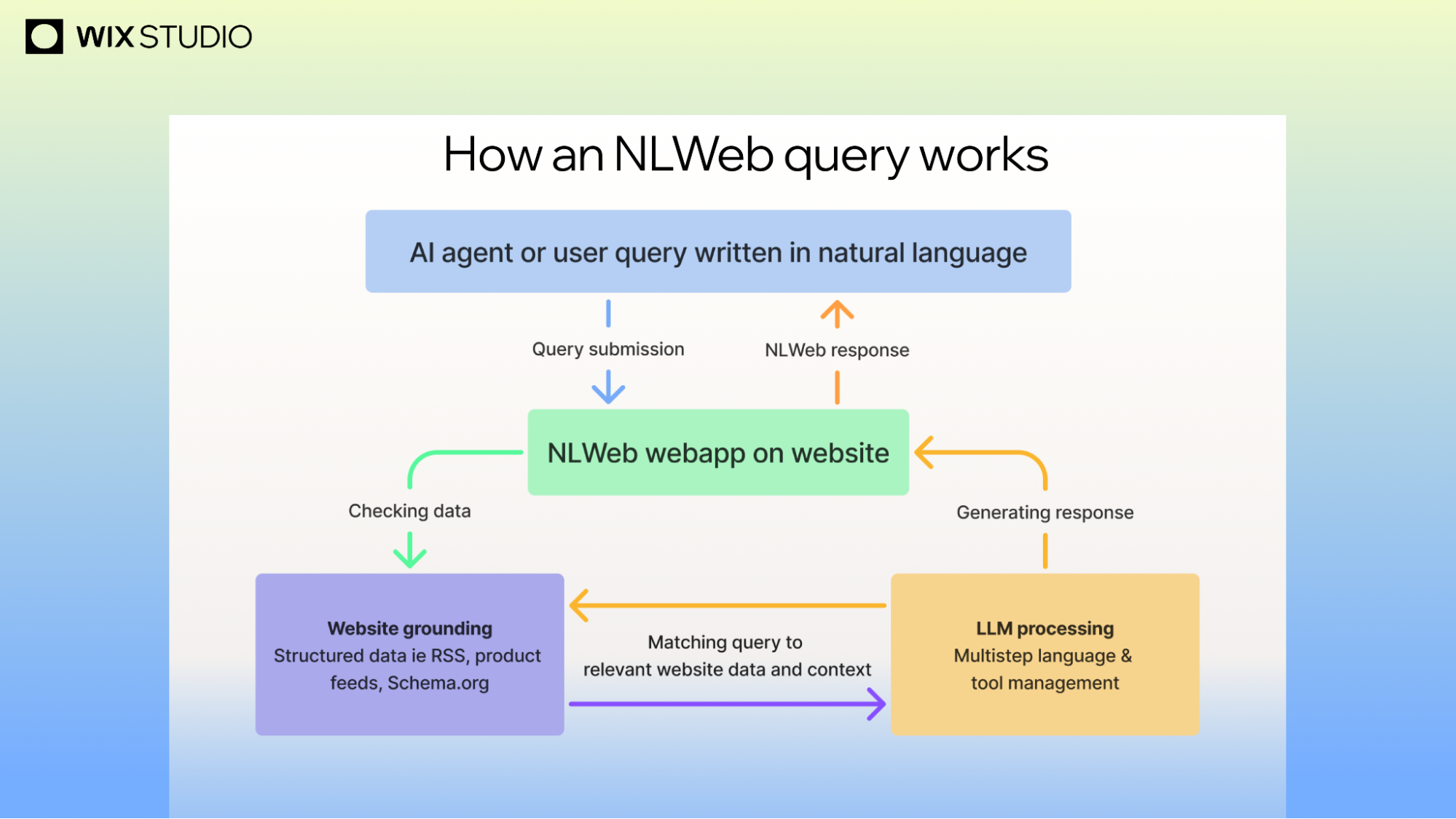
I understand that NLWeb, built on schema markup, plays a vital role in the agentic web’s infrastructure. Microsoft’s open-source initiative, NLWeb, enables websites to integrate AI-powered conversational interfaces, transforming them into AI apps for natural language queries.
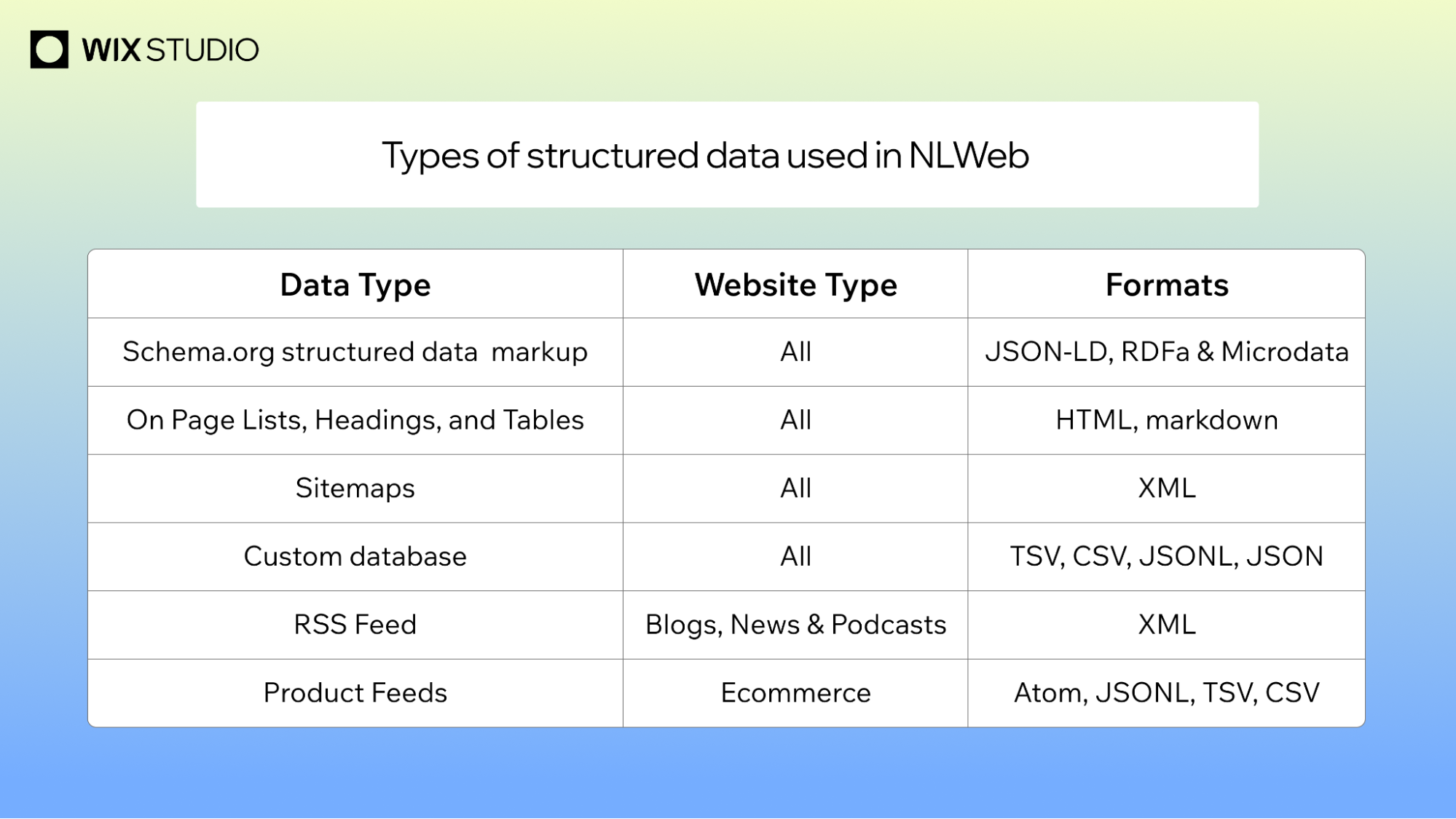
Developed by R.V. Guha, NLWeb connects with my existing schema markup, leveraging structured formats like Schema.org. This allows both humans and AI agents to interact seamlessly with the web.
Incorporating structured data like RSS with NLWeb ensures a real-time, interactive experience for AI agents, making my site truly ‘agentic’. The transition from humans browsing to AI agents querying underlines the significance of these initiatives.
For someone like me aiming to optimize for the agentic web, schema markup is a game-changer. It enables my site to be more than just readable, allowing for direct, real-time interactions through NLWeb’s capabilities.
NLWeb uses AI tools to create natural language interfaces, enhancing how my content can be queried and interacted with. It doesn’t require a complete rebuild of my existing content structure, just good order in my schema markup.
By prioritizing completeness, automating processes where possible, and utilizing JSON-LD, I can make steady progress in schema optimization. It’s crucial that I view schema as a comprehensive graph across my site, improving reliability and trust for AI agents.
Ultimately, adopting schema markup and understanding its evolving role in the agentic web is vital. As AI systems evolve, content that aligns with their preferences will reap ongoing benefits.
When I first discovered the power of schema markup, it felt like unlocking a secret weapon for enhancing AI search visibility. It’s fascinating how this powerful tool can bridge the gap, allowing language models to better understand my content.
Through implementing various schema types, I’ve significantly improved how my content is perceived and indexed by AI systems. Learning about these key schema types has been vital to my strategy.
Identifying the right schema types wasn’t easy at first. However, by exploring structured data tips and strategies, I gathered immense insights that truly transformed my content’s AI compatibility.
Structured data plays a crucial role in helping language models like LLMs comprehend what my content is all about. Utilizing this to my advantage has not only enhanced visibility but also boosted my overall SEO efforts significantly.
Designing a plan to integrate schema markup into my content strategy was a rewarding journey. Each step of implementing structured data is a building block towards achieving my SEO goals, particularly in the AI-driven digital landscape.
I’ve often wondered how much schema markup actually aids AI search optimization. There are claims it can increase citations or significantly enhance AI visibility, yet the truth is more complex and nuanced.
Let’s dive into separating facts from assumptions and explore how schema truly integrates into an AI search strategy.
How Schema Fits into AI Search Now
Search is evolving from simple SERP links to dynamic AI Overviews, with generative answers and chat-style summaries compiling content beyond just links. My goal is to ensure my content is recognized within this model, and that’s achieved by focusing on ‘entities’—distinct concepts such as a person, place, or event—not just strings of text.
Schema markup is a powerful tool I use to clarify these entities and their relationships, making them comprehensible to AI. For instance, identifying a person, their organization, the price of a product, or the author of an article.
AI systems focus on three key elements:
Entity definition: Identifying brands, authors, services, or SKUs on the page.
Attribute clarity: Distinguishing which properties relate to which entity (like prices or ratings).
Entity relationships: Understanding connections between entities (using tags like offeredBy or authoredBy).
By employing schema with stable values and structured methods, it begins to function like a mini knowledge graph. AI systems no longer guess who I am or how my content ties together; they follow explicit links between my brand, authors, and subjects.
Microsoft Bing Copilot: Microsoft’s product manager confirmed in March 2025 that schema aids Microsoft’s LLMs in understanding content for Copilot.
Exploring ChatGPT, Perplexity, and Other AI Search Platforms
The usage of schema by these platforms remains uncertain. They haven’t publicly clarified if they maintain schema during crawling or use it for data extraction. Though LLMs can technically process structured data, it doesn’t guarantee their search systems do.
It doesn’t negate schema’s value, but highlights that schema alone doesn’t drive citations. LLM systems prioritize relevance, authority, and clarity over structured markup presence.
LLMs excel when given a structured format to fill out instead of a blank canvas, minimizing errors when extracting defined data fields.
Schema markup resembles this structured format, providing clear entity, brand, and topic fields.
Interpreting the Research
The findings suggest that LLMs can better process structured data than unstructured text. However, we still lack confirmation on whether AI search systems preserve schema data during crawling or use it during extraction.
For Microsoft Bing and Google AI Overviews, schema likely improves data extraction accuracy, given their confirmed usage. Other platforms remain unverified regarding implementation.
Given the novelty of AI search—exemplified by ChatGPT’s launch in October 2024—companies haven’t revealed their indexing methods. Measuring impact remains challenging due to non-deterministic AI responses.
No peer-reviewed studies yet explore schema’s AI search visibility impact, nor are there controlled studies on LLM citation behavior with schema.
This gap persists as AI search is relatively new, with companies withholding indexing details and difficulties in assessing AI interactions.
Building an Entity Graph with Schema
In traditional SEO, schema is often limited to adding individual markup like Article or Organization. For AI search, connecting nodes into a cohesive graph through @id is more beneficial.
Create an Organization node with a permanent @id for your brand.
Develop a Person node for each author linked to your organization.
Form an Article node linking the author to the publication with detailed topics.
This interconnected pattern transforms schema into a useful entity graph. For AI systems preserving the JSON-LD, it clearly identifies brand ownership, human responsibility, and topic focus, unaffected by page changes over time.
Aspect
Traditional SEO schema
Entity graph schema
Structure
Single @type object per page
@graph array of interconnected nodes
Entity ID
None (anonymous)
Stable @id URLs for reuse across site
Relationships
Nested, one‑way (author: “name”)
Bidirectional via @id refs (worksFor, authoredBy)
Primary benefit
Rich snippets, SERP CTR
Entity disambiguation, extraction accuracy for AI
AI impact
Minimal (tokenization often strips)
Makes site a unified knowledge graph source if preserved
Schema markup acts as infrastructure rather than a miracle solution. Although it may not automatically raise citation rates, it’s an aspect I control that’s explicitly used by platforms such as Bing and Google AI Overviews.
The key isn’t just implementing schema in isolation, but integrating structured data with proper entity connections, high-quality authoritative content, and clear entity identity and brand signals. Strategic use of @graph and @id to build these connections is crucial.
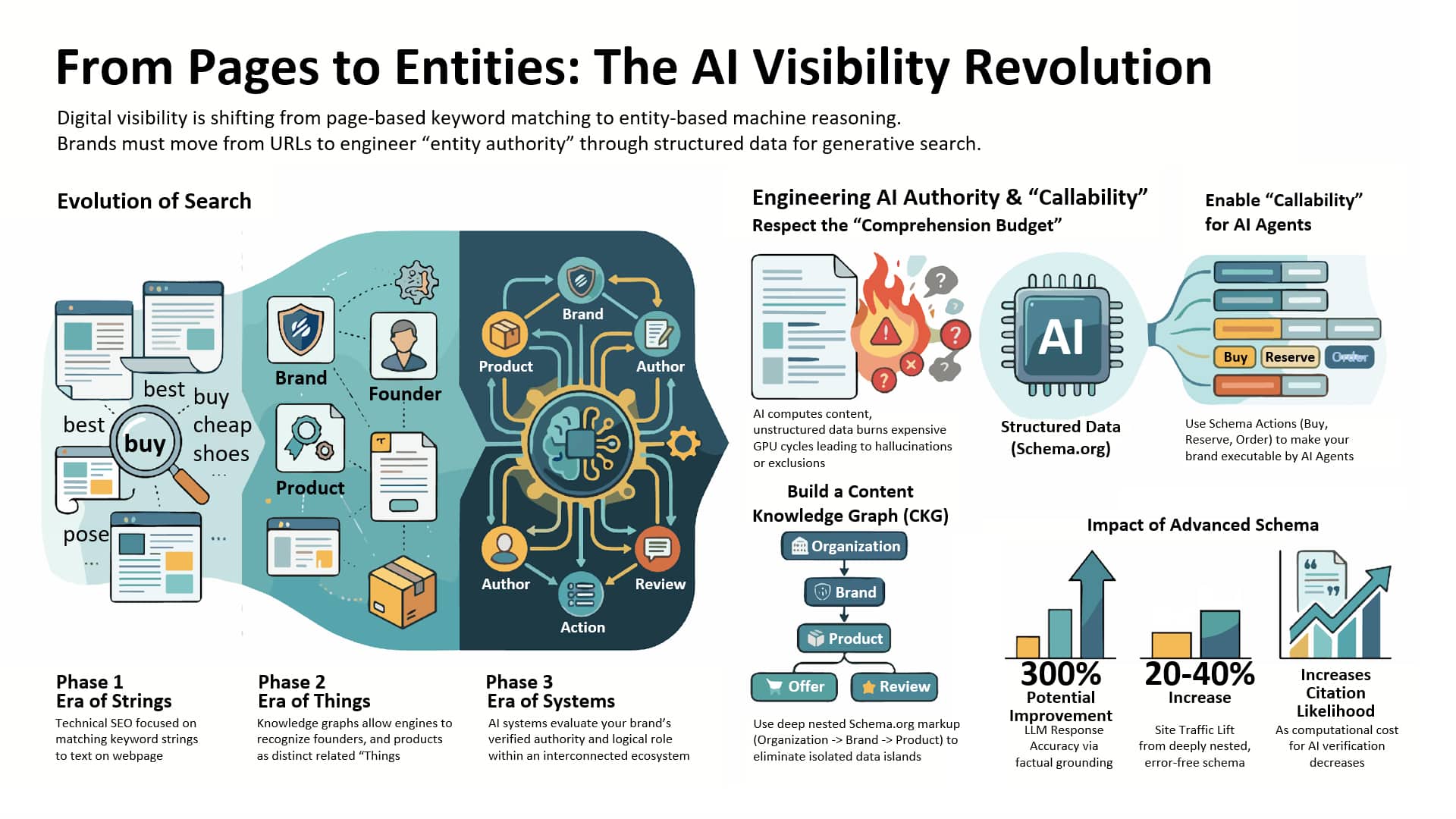
I realized that the traditional webpage is no longer the center of digital visibility. We’ve been relying on URLs and keywords, a structure made for a journey that AI now bypasses entirely.
In this era where search is everywhere, the entity—a precise, machine-readable concept of a product, organization, or individual—has become the core unit of power.
Brands that dominate now in the AI landscape are those creating strong entity authority. The key to surviving the shift to generative discovery is not merely about the page anymore. It’s about developing entity linkages to build the foundation of AI visibility.
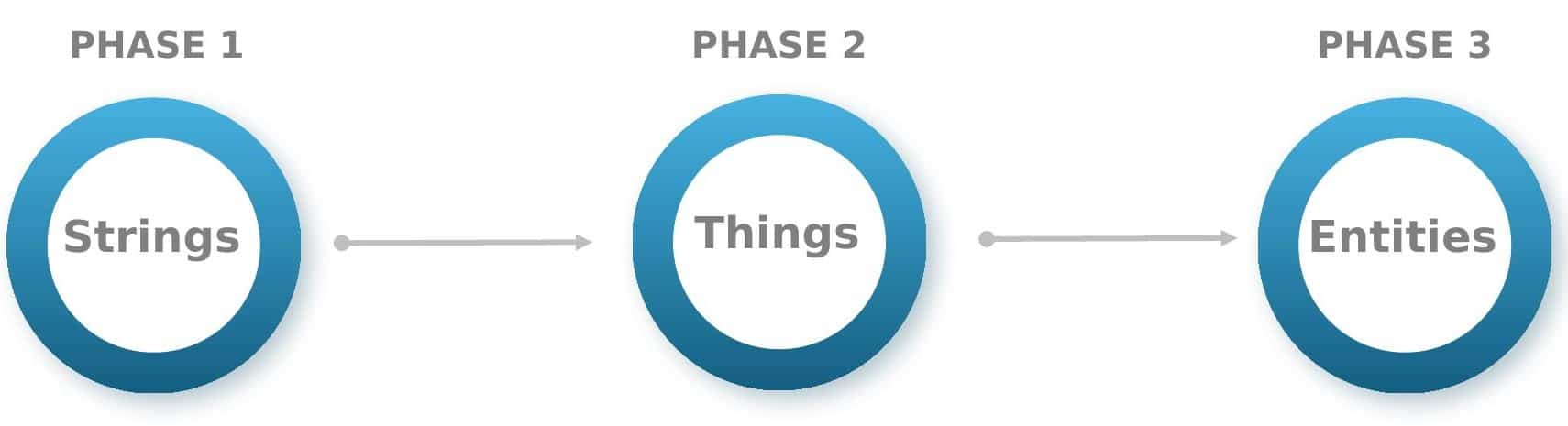
We need to acknowledge a profound transformation in how the web is indexed. We’ve moved beyond just retrieving information to a new three-stage evolutionary process.
Phase 1 (Strings): We focused on optimizing keyword strings in traditional SEO. The goal was to align queries with text on a page.
Phase 2 (Things): With modern search, we understand entities. Knowledge graphs now recognize brands, founders, and products as distinct entities.
Phase 3 (Entities): AI systems use structured entity ecosystems today. The aim is to become a verified authority within this interconnected network of entities and capabilities.
In this current phase, search engines evolve into reasoning engines, analyzing content and your brand’s ecosystem role.
The evolution is powered by economic necessity: the comprehension budget. AI systems are resource-intensive, processing content and calculating interpretations.
Whenever an engine clarifies a brand or assumes a relationship, it exhausts valuable resources. Unstructured or inconsistent data increases this computational load.
To optimize performance, I use a comprehension subsidy, employing Schema.org to make data more accessible to machines, reducing the inference needs for AI systems.
Shifting from traditional SEO to generative engine optimization (GEO), I focus on relevance engineering, structuring content to be part of AI-generated answers.
GEO is about making your brand’s information easily interpretable, verifiable, and useful in AI-generated responses across platforms like ChatGPT and Google’s AI Overviews.
Most enterprise sites have some structured data, but for AI, basic and fragmented schema is insufficient. It creates separate data islands and complicates the AI’s effort to form connections.
The correct approach is implementing a content knowledge graph, mapping entities hierarchically and ensuring they’re machine-readable through Schema.org and JSON-LD.
To be globally recognized, properties such as @id for consistency and sameAs for linking to reputable sources help in entity disambiguation, boosting credibility.
To maintain a strong AI relationship, move beyond simple tagging to entity governance—establishing verifiable sources of truth for AI platforms at scale.
As the AI experience evolves toward active agents managing user actions, I focus on schema actions that make my entity callable and ready to support AI-driven interactions.
If my entity isn’t clearly defined, AI may overlook it, turning to competitors prepared with actionable data pathways for users and AI systems.
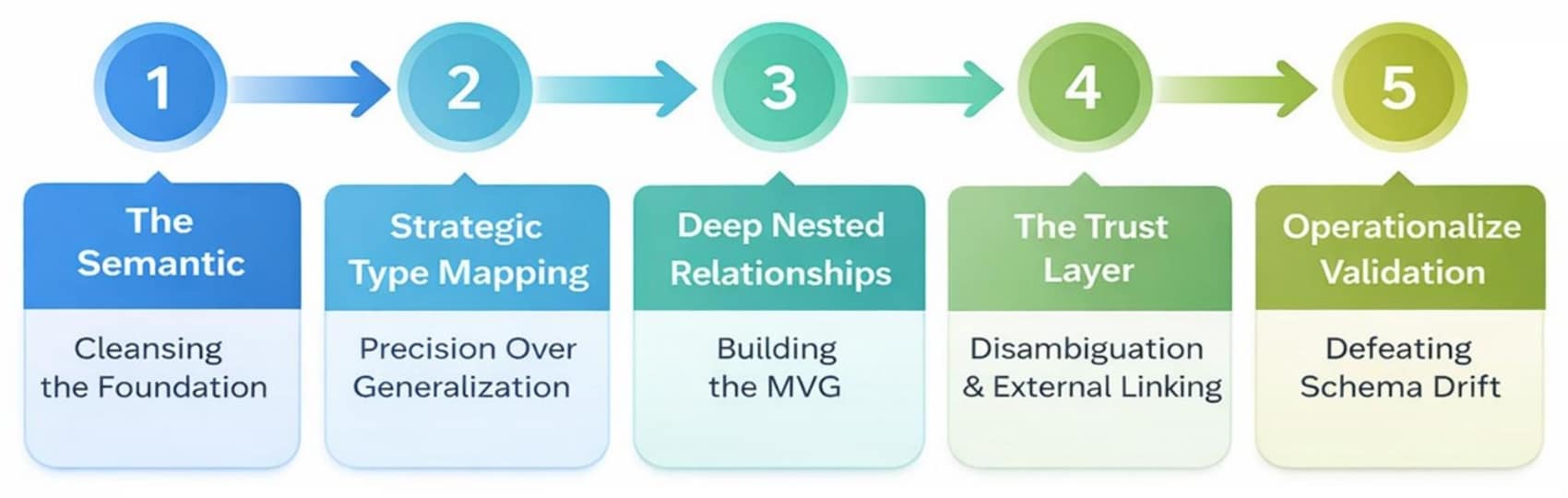
Schema drift is a risk: inconsistencies between human-visible content and machine-readable formats can lead to lower confidence scores, reducing citations.
Monitoring and continually updating schema with real-time signals ensure I remain present and operationally capable in the agentic web ecosystem.
The new key performance indicators in AI environments go beyond traffic metrics, emphasizing model share and citation value, ensuring AI reflects my brand accurately.
Maintaining AI trust requires precise alignment of schema with declared business specifics, preventing entity drift and supporting positive AI interactions.
Embracing entity-first strategies allows me to build credibility and presence in AI searches, where content knowledge graphs enhance my brand’s visibility.
Ultimately, it’s not just about being on the page — it’s about the confidence AI places in my entity, ensuring it remains a powerful tool for discovery.
Key Takeaways:
From strings to things to systems: Transition from keyword targeting to entity authority, focusing on overall concept dominance.
Efficiency is currency: Streamlined, structured data helps AI access your information more efficiently, enhancing citation potential.
Citations are the new clicks: Achieving top visibility now involves influencing AI recommendations rather than just page visits.
Governance is revenue protection: Avoid schema drift to maintain AI confidence and brand presence.
Callability = survival: Ensure your brand’s entities are ready for AI agent interactions with actionable schema.