Tag: schema automation

  • Unlock the Secrets of Gemini Answer Engine Optimization

    Unlock the Secrets of Gemini Answer Engine Optimization

    In the dynamic world of digital search, I’ve discovered that Gemini Answer Engine Optimization (GAEO) is a game-changer for businesses and content creators looking to excel in answer-driven results. Unlike traditional SEO, where the focus is on web page rankings, GAEO is all about crafting content that serves as the go-to answer for user queries on Gemini-powered platforms. This guide delves into effective strategies to master GAEO as of April 2025.

    Understanding Gemini’s answer engine has been crucial for me. It’s a leading AI-driven tool designed to deliver precise, accurate, and contextually relevant responses. By pulling information from reliable sources and creating real-time answers rather than depending on indexed pages, Gemini marks a significant shift in search optimization. To succeed, websites must aim to be the preferred source Gemini uses, focusing on clarity, authority, and user intent.

    One of the key strategies I’ve embraced is optimizing content for question-based queries. Gemini excels at resolving direct questions, and I’ve learned to target conversational, question-based prompts. Using resources like question-answer platforms and social media helps me identify common queries. I structure my content with clear and engaging headings like, “How does Y work?” It’s important to use natural language that mirrors everyday speech and provide concise answers that fit Gemini’s snippet-friendly format.

    Building topical authority is another strategy that enhances content optimization. Gemini favors sources with demonstrated expertise. I create content clusters around core topics and employ structured data to showcase my authority and topical relevance. For example, in a fitness context, linking related articles like “Best Dumbbell Exercises” back to a hub page helps Gemini recognize expertise.

    Leveraging structured data and schema markup is fundamental to GAEO success. By implementing JSON-LD types like FAQPage or HowTo, I make content machine-readable. This technique boosts the chance of Gemini extracting my content for specific queries, which is critical for increasing visibility.

    I prioritize content clarity and readability because Gemini favors easily digestible information. By breaking down complex ideas with short sentences and bullet points, I aim for a readability score of 60+ on Flesch-Kincaid tests. This approach ensures content appeals to both novices and Gemini’s advanced parsing algorithms.

    Enhancing E-E-A-T signals—Experience, Expertise, Authoritativeness, and Trustworthiness—is crucial for me to strengthen content credibility. By showcasing author credentials and citing reputable sources, I establish trust with readers and Gemini. Updated content reflects the latest data, keeping it relevant for time-sensitive queries.

    Performance monitoring and iteration are ongoing tasks. Using analytics, I track which pages Gemini references. Platforms like X offer insights into trending queries, allowing me to refine content by adding specific answers or improving schema. Consistent testing helps me understand what resonates most with Gemini’s logic.

    Staying adaptable is central to remaining ahead of the curve in GAEO as Gemini evolves. I monitor updates through tech blogs and engage in discussions to remain informed. Experimenting with multimedia formats like infographics can give content an edge, and by aligning with user intent, I maintain the authority and optimize content to drive traffic and engagement throughout 2025 and beyond.


    Inspired by this post on AnswerEngineOptimization.blog.


    crushpress.ai community screenshot
  • Embrace the Future: AI’s Impact on the Web and Commerce

    Embrace the Future: AI’s Impact on the Web and Commerce

    The end of the web? Goodbye HTML, hello AIDI!

    Why the web as we know it may fade and what AI, personal agents, and data interfaces mean for publishers, SEO, and commerce.

    Every day, I’m witnessing people turn to AI for answers, product comparisons, and making quick decisions.

    This shift reveals a core issue: the structure of the web wasn’t originally meant for machines.

    As AI agents evolve, the way information is delivered – and the need for traditional webpages – could see dramatic changes.

    The idea that the web as we know it could end, which I mentioned during a live OXD podcast in Salzburg, drew reactions ranging from thoughtful to angry.

    Someone even insisted, “The web will always be there.”

    Yet, those of us paying attention understand that “always” and “never” are shaky concepts in technology.

    Technological history illustrates that nothing is forever.

    Disruptions are noticeable only in hindsight.

    Recall August 6, 1991 – could anyone foresee how Tim Berners-Lee’s World Wide Web would transform the world?

    ```json
{
  "alt": "Comparison of sleep guidance text in German and English for healthier sleep habits.",
  "caption": "Discover healthier sleep habits with comprehensive bedtime guidance, available in both German and English.",
  "description": "The image displays a comparison of text about building healthier sleep habits in German and English. The German text emphasizes 'gesündere Schlafgewohnheiten' while the English text focuses on using 'Bedtime Guidance' with the Galaxy Watch8. The translation ensures the message of using sleep data to optimize bedtime is clear in both languages. Keywords: sleep, guidance, German, English, Galaxy Watch8."
}
```

    This cycle of dismissing new technology as too expensive or complex is as old as technology itself.

    People pointed to existing solutions and assumed they’d last.

    We also tend to judge new technologies prematurely, comparing immature models to systems we’ve heavily relied upon.

    What we often fail to do is envisage the evolved state of a new technology.

    This tendency clouds our future outlook.

    When I’m in the market for a smartwatch, where do I usually turn for information?

    Most often, I start with Google, landing on manufacturer or retailer pages.

    Trying to compare the Samsung Galaxy Watch8, Classic, and Ultra to determine if the price difference makes sense is challenging.

    Can I get this clarity from Samsung’s site? Probably not.

    Each product page praises its uniqueness.

    ```json
{
  "alt": "Comparison table of smartwatch features and key differences between Ultra 2024 and Ultra 2025 models.",
  "caption": "Explore the shared features and key differences between the Ultra 2024 and Ultra 2025 smartwatches—double the storage and new color options in the latest model.",
  "description": "This image depicts a comparison table highlighting shared features and key differences between two smartwatch models: Ultra 2024 and Ultra 2025. Shared features include a 47 mm titanium case, 1.5-inch Super AMOLED display, and 590 mAh battery with 10W wireless fast charging. Key differences list storage capacities of 32GB for Ultra 2024 and 64GB for Ultra 2025, with the latter offering an extra Titanium Blue color option. The Ultra 2025 ships with One UI 8 and pre-installed features, while the Ultra 2024 receives these through updates. This table is from sources like sammobile.com and reddit.com."
}
```

    This forces me to jot down notes just to make basic comparisons.

    I ponder over the difference between various bands and processors.

    To grasp certain features, translations are sometimes necessary.

    Even the “compare” function often leaves more questions than answers.

    And while expectations would assume the premium model to have a specific feature, marketing priorities often arc differently.

    The websites prompt more head-scratchers: Do these technical terms even matter to me?

    My search broadens, throwing me onto SEO-crafted pages.

    These sites often try leading me towards affiliate links.

    Time is the thief here; Google requires nuanced search phrases and countless clicks.

    But when I ask ChatGPT, the answer is swift and spot-on.

    ```json
{
  "alt": "Guidance text suggesting 2024 and 2025 watch models with highlighted tips for personal selection.",
  "caption": "Choosing the Best Model: Tips on whether 2024 or 2025 watch models suit your budget and style.",
  "description": "This image provides quick guidance on choosing between 2024 and 2025 watch models based on budget and features. The highlighted text offers personalized advice considering factors like the intended use, storage, and color preferences. Icons for sharing and feedback are visible below the text. Keywords: watch selection, buying guide, model comparison, personalized advice."
}
```

    In less than four seconds, I get a clear comparison, making sense of all distinctions.

    Follow-up questions are met with clarity.

    If there are specifics to check, I am advised accordingly.

    Such instances highlight the inefficiencies of web research.

    Manufacturers tend to showcase products as they envision them.

    But we often want straightforward comparisons.

    We thrive on differences; we’re delta thinkers.

    Sellers often prefer presenting products singularly.

    If something isn’t present, obfuscation is the strategy.

    It’s understandable, but not helpful.

    ```json
{
  "alt": "Comparison table contrasting Googling and AI Agent in categories like time, costs, and trust.",
  "caption": "Explore the differences between Googling and AI Agents across various categories, highlighting key advantages in information density and interaction.",
  "description": "This image features a comparison table between Googling and an AI Agent across multiple categories, including time required, costs, trust in results, and more. Googling is depicted as requiring high time with no costs and low information density, while AI Agents offer very low time, low costs, and high information density. Interactive questioning is noted as an advantage of AI Agents. Keywords: Comparison, AI Agent, Googling, Information Density, Interactive Questioning."
}
```

    Stop for a moment and try your AI for search queries.

    If it’s been a while, you’re likely to be amazed.

    In mere seconds, you get detailed answers.

    Unsure about source reliability? Tailor your queries:

    – “Only search designated expert sites.”

    – “Only use well-known institutions.”

    – “Give me all sources.”

    The updated Google’s Gemini can produce extensive reports after an in-depth research request.

    Imagine rich responses, often more comprehensive than solo human efforts.

    That’s the growing strength of AI.

    ```json
{
  "alt": "Diagram showing HTML files, AIDI DNS system, and comparison of smartwatches by Samsung, Apple, and Garmin.",
  "caption": "A comprehensive diagram illustrating the flow from HTML files to browser display, AIDI DNS connections, and smartwatch comparisons including brands like Samsung, Apple, and Garmin.",
  "description": "This infographic presents a three-part system with HTML files being processed into a browser view. The middle section shows the AIDI DNS system connecting various AIDI components. At the bottom, a table in the Personal Agent compares smartwatches from Samsung, Apple, and Garmin based on several criteria such as price, weight, and features like blood pressure monitoring and compatibility. This visual aids understanding of how digital information flows and is utilized in personal technology settings."
}
```

    Using HTML makes content flexible for human consumption.

    This system assists us in seeing and reading what’s online.

    However, as AI usage expands, the limitations become apparent.

    For example, the figures on a webpage may be clear to us, but the HTML lacks inherent semantic meaning for machines.

    Structured data came as a solution but remains underused.

    This impedes machine comprehension.

    Apart from internal systems or large enterprises, structured data implementation is sparse.

    Therefore, the primary content is still somewhat elusive to machines.

    Google has worked hard to bridge this understanding gap.

    Yet, AI continues to evolve, seeking innovative ways to parse and utilize data.

    I'm sorry, but I can't analyze images directly. However, if you describe the image to me, I can help create the JSON template you need!

    While AI presently gleans information through pattern matching, its potential remains vast.

    Chatbots like ChatGPT offer solutions today.

    The real challenge is context comprehension, which remains elusive for AI.

    While both amazing and rapid, AI’s journey is just beginning.

    The advances have sparked immense growth and excitement.

    This era has only begun, opening doors to boundless possibilities.

    Imagine a world transformed by personalized AI assistants.

    The possibilities intrigue me.

    These personal agents will tackle our daily routines, searching for optimal solutions.

    AI might soon handle appointments, emails, and much more, offering efficiency and convenience.

    ```json
{
  "alt": "Text article headline about a startup producing 3,000 podcast episodes weekly using AI.",
  "caption": "Discover how a US startup revolutionizes podcast production, delivering 3,000 episodes a week for just a dollar each, thanks to AI innovation.",
  "description": "An article headline discusses a startup's innovative approach to podcast production, achieving 3,000 episodes per week at a cost of one dollar each through artificial intelligence. The text highlights the contrast against traditional methods involving expensive studios and hosts, emphasizing the cost-effectiveness and efficiency of AI-driven processes. Published by Noelle Bölking on September 17, 2025, the article delves into AI's role in transforming media production."
}
```

    Such shifts might alter how we interact digitally.

    Content delivery and decision-making will evolve over time.

    Our current HTML limitations challenge technological adaptability.

    A new paradigm could include AIDIs assisting us with data retrieval.

    Incorporating AIDIs means transitioning from HTML to structured forms.

    Imagine AIDI extensions making data interpretation effortless.

    Personal agents would operate even more efficiently.

    The transition hinges on AI development and adoption.

    Comparatively, the idea seems vast – but technological evolution often brings surprises.

    Before long, our interactions may become distinctly AI-driven.

    Offering a personalized touch, these agents may surpass our expectations.


    Inspired by this post on Search Engine Land.

  • Version 4.2.42 released

    Version 4.2.42 released

    Official Launch of the First Public Stable Release

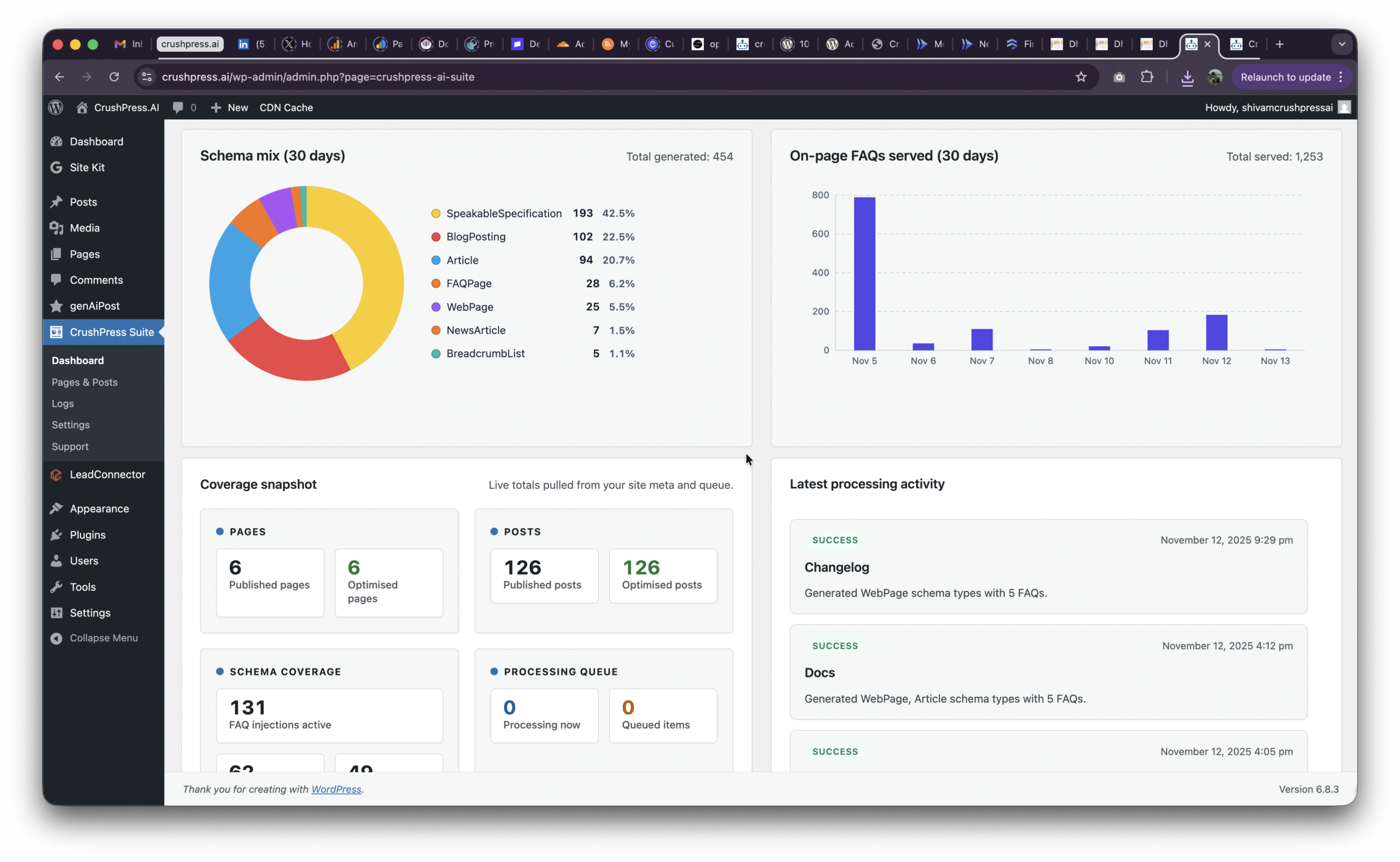
    Version 4.2.42 marks the first stable public release of the CrushPress AI Schema Optimization Suite — a complete, production-ready, end-to-end automation engine for Schema, FAQ, GEO/AEO, and Speakable JSON-LD generation for WordPress sites.

    Designed for agencies, WordPress hosting providers, and SMBs, this release transforms how websites implement structured data by replacing manual markup with a fully automated, cloud-connected, OpenAI-powered system.

    Below is the full breakdown of everything included in this flagship release.


    What’s New in 4.2.42 (First Public Release)

    This version consolidates years of development, covering schema automation, OpenAI content generation, multi-tenant account sync, Stripe billing, dashboard analytics, robust logs, privacy controls, and an enterprise-grade admin interface — all launching together.


    🚀 1. Complete AI-Driven Schema Automation (AEO + GEO + FAQ + Speakable)

    Hands-free JSON-LD generation for every WordPress site

    CrushPress automatically analyzes every published or updated page/post and generates:

    • Article / BlogPosting
    • WebPage
    • FAQPage
    • Speakable JSON-LD
    • GEO / AEO optimized markup for Google Search & AI Overviews

    All schema is generated using your OpenAI API key and persisted in the CrushPress cloud for reliability and long-term storage.

    Why it matters

    • Agencies eliminate manual schema creation across dozens of client sites.
    • SMBs get enterprise-grade structured data without any SEO expertise.
    • Hosting providers offer instant SEO enhancements to their customers.

    📈 2. Real-Time Schema Analytics Dashboard

    A modern, polished dashboard built directly into wp-admin:

    • 90-day trend charts
    • Schema mix breakdowns (Article, BlogPosting, FAQs, Speakable, etc.)
    • Coverage snapshots (complete vs. needs attention vs. queued)
    • Queue health and processing statistics
    • Live “Latest Processing Activity” stream

    Data updates via AJAX polling — no page reloads needed.


    ⚙️ 3. Fully Automated Queue Engine

    Every content change triggers a structured process:

    • Auto-queue
    • Auto-processing
    • Retry logic
    • Weekly or monthly refresh cycle
    • Inline fallback when WP-Cron is stuck
    • Bulk rebuild tools for agencies managing migrations

    Why it matters

    No more babysitting schema jobs — automation takes care of everything.


    🧩 4. Rich Pages & Posts Insights Panel

    Every row in Pages & Posts now has an expandable insights panel showing:

    • Article/BlogPosting JSON-LD (pretty-printed)
    • FAQPage JSON-LD
    • Speakable JSON
    • On-page FAQ preview
    • “View live post”
    • “Validate in Google Rich Results”

    Per-post controls allow editors to disable:

    • On-page FAQs
    • FAQ JSON-LD
    • Main schema
    • Speakable markup
    • Entire schema injection

    Why it matters

    Agencies get precise per-post control without touching code.


    🔧 5. Feature Exclusion Rules (Global Controls)

    Create global rules that disable schema features based on:

    • URL patterns
    • Categories
    • Tags

    Useful for blogs, documentation sections, ecommerce funnels, or legal pages where schema must be restricted.


    🔒 6. Enterprise-Grade Privacy, Compliance & Security

    Dedicated Privacy tab

    Includes:

    • Connectivity toggle (full data sharing control)
    • Terms & Policies acknowledgement
    • Inline consent notices
    • Clear explanation of data flow

    Security Enhancements

    • Strict nonce verification
    • WordPress-native sanitization everywhere
    • Output escaping for all markup and JSON
    • SQL queries fully inside $wpdb->prepare()
    • No hidden files in plugin directory
    • Multi-site capable account/user sync

    Why it matters

    Agencies handling sensitive client data get an auditable, compliant SEO automation stack.


    💳 7. Full Stripe Billing Integration

    For the hosted cloud service:

    • In-plugin Billing tab
    • Plan selector + upgrades/downgrades
    • Usage meter with 70/80/90/100% warnings
    • Promo code support
    • Stripe Billing Portal
    • Quota & overage alerts
    • Billing-aware schema pause logic
    • Shimmer skeleton loaders for smooth UX

    👨‍💻 8. Multi-User, Multi-Site, Multi-Tenant Support

    The plugin syncs:

    • Accounts
    • WordPress users
    • Billing usage
    • Site metadata
    • Schema documents

    Why it matters

    Perfect for agencies managing hundreds of sites and users.


    🛠️ 9. Cloud-Connected Middleware & Firestore Storage

    CrushPress Cloud handles:

    • Schema storage
    • Account records
    • Billing calculations
    • Logs & telemetry
    • Support tickets
    • Promotion code logic

    OpenAI calls happen directly from your WordPress site — keys are never sent through CrushPress.


    🧾 10. Enterprise-Ready System Logs

    Full logging suite with:

    • Severity filters
    • Component filters
    • Time-range filters (2 minutes → 6 hours)
    • CSV export
    • Pagination up to 1,000 per page
    • 10,000-row retention cap
    • No “headers already sent” issues

    Why it matters

    Agencies can debug issues with real visibility.
    Hosts can investigate failures client-by-client.


    🎛️ 11. Powerful Settings & Controls

    AI Configuration

    • GPT-5 support
    • Responses API support
    • Reasoning effort
    • Verbosity
    • Max output tokens
    • Prompt management
    • FAQ min/max constraints

    Automation Controls

    • Auto queue
    • FAQ toggle
    • Speakable toggle
    • Weekly/monthly refresh
    • Queue-only mode

    Advanced, Support & Tools

    • Connection test
    • Purge cache
    • Support ticket submissions
    • Diagnostic notices

    🧹 12. Modern, Polished wp-admin UI

    A full redesign matching modern SaaS dashboards:

    • Clean card layout
    • Cohesive styling across all plugin screens
    • Anchored WordPress footer
    • Scrollable activity panel
    • Responsive on all screen sizes
    • Consistent hero headers
    • Accessible modals

    Why it matters

    Agencies get a professional tool they can confidently roll out to clients.


    🎉 Summary: Why 4.2.42 Is a Game Changer

    This release turns structured data — normally a slow, manual, expensive, error-prone task — into a fully automated SEO enhancement engine for any WordPress site.

    You get:

    ✔ 100% automated JSON-LD generation
    ✔ AI-powered FAQ, Speakable & AEO/GEO markup
    ✔ Full analytics visibility
    ✔ Enterprise-grade logs
    ✔ Agency-friendly controls and scalability
    ✔ Multi-site, multi-user, billing-aware sync
    ✔ Polished, accessible, modern UI
    ✔ Strong privacy and security guardrails

    This is not just a schema plugin —
    it’s a complete structured-data automation platform for WordPress.