Tag: ROI

  • How I Build a Powerful SEO Budget Case My CFO Can’t Ignore

    How I Build a Powerful SEO Budget Case My CFO Can’t Ignore

    You're losing the SEO budget conversation before you walk into the room

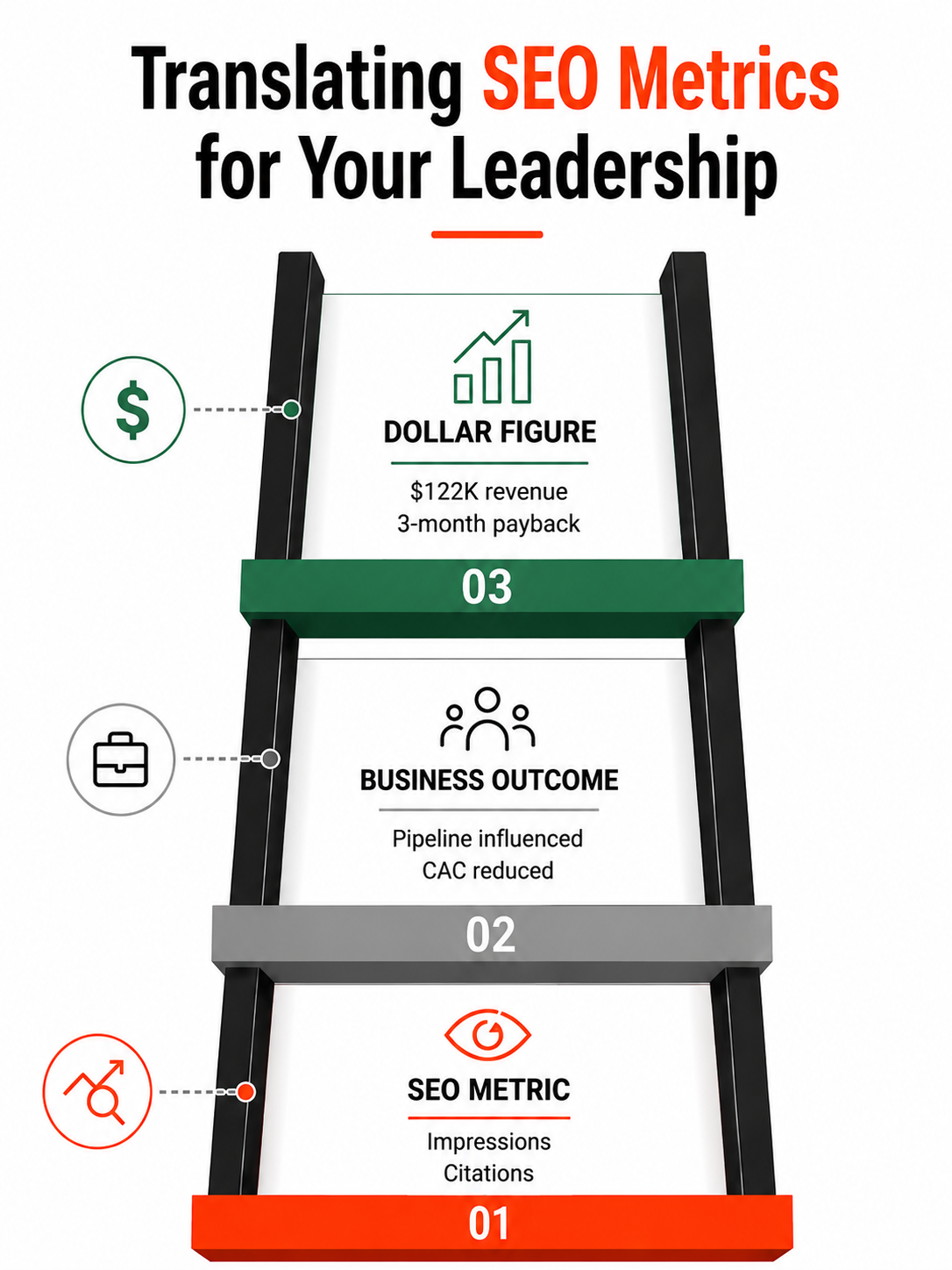
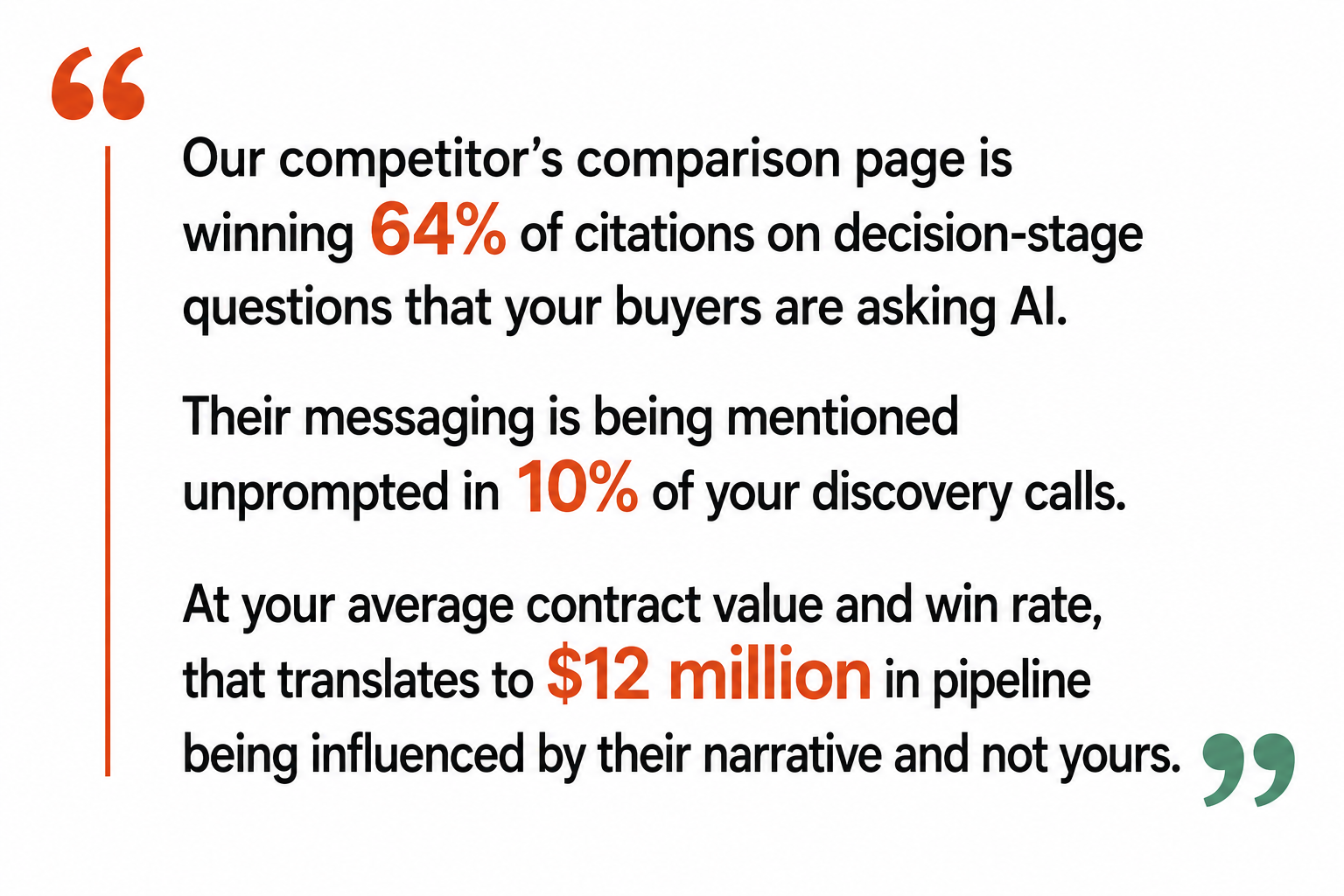
    If I walk into a budget meeting armed only with rankings, traffic, and keyword reports, I know I am making the wrong case. CFOs do not approve SEO budgets because channel metrics look encouraging. They approve investments that reduce business risk, improve commercial outcomes, and justify the way capital is allocated.

    As AI reshapes search economics and customer acquisition costs continue to climb, I believe translating SEO into business risk is becoming as important as the search strategy itself. This is how I prepare for that conversation before I enter the room.

    Why I see SEO budget conversations break down

    A global enterprise software company recently shared a revealing example with us, and I keep returning to it because it captures the problem so clearly.

    One of the company’s core product lines generated 291 inbound demo requests during a single month in 2008. In the corresponding month of 2026, it generated only 274. Nearly two decades later, and despite a digital marketing budget roughly eight times larger, the business was producing fewer qualified opportunities.

    I do not see that as a simple search strategy problem. I see it as a structural problem—and the CFO had already noticed it.

    The head of search entered the budget review with a 24-slide deck. Slide 3 documented ranking improvements. Slide 7 highlighted year-over-year organic traffic growth. Slide 12 outlined keyword opportunities.

    Every number was accurate, but none of them answered the question that mattered to the CFO: Why was the company spending more each year to generate roughly the same number of qualified opportunities?

    The CFO let the presentation continue. Then, at slide 19, she put down her pen and said, “This is all interesting. But I can’t see the connection to pipeline.”

    The head of search began to explain. The CFO looked toward the CMO, and the meeting was effectively over.

    The lesson I take from this is that many search leaders lose the CFO budget conversation before they enter the room. Their strategies may be sound, and their numbers may hold up, but they arrive speaking in sessions, rankings, and organic traffic share. That is not the language of financial decision-making.

    When I prepare for this kind of meeting, I assume the CFO wants to discuss the P&L, risk, payback periods, and opportunity cost.

    If I open with “organic traffic grew 23% year over year,” I risk telling the CFO, unintentionally, that I cannot connect my work to revenue. If the CFO has already seen cost per opportunity moving in the wrong direction, that disconnect does more than create skepticism. It creates a reason to cut the budget.

    The structural shift I diagnose first

    I start with the diagnosis before I discuss tactics. Without a clear diagnosis, everything else becomes a more polished way to lose the same argument.

    In 2008, paid search behaved like an undersupplied monopoly channel: high intent, limited competition, and relatively linear returns. A dollar invested could produce a reasonably predictable return. There was no AI layer absorbing clicks before they happened, no army of comparison aggregators siphoning away high-intent traffic, and no group of competitors with 18 years to build organic authority in the category.

    That environment is gone.

    Today, I operate in a search landscape where organic authority is fiercely contested. AI Overviews can intercept high-intent queries before users reach paid ads, while attribution models designed for the old environment are still being used to defend budgets in the new one.

    The message I bring to a CFO is not simply, “I need more budget,” or, “Our rankings are improving.” I explain that the structural conditions that once made search efficient have changed, show how those changes affect commercial performance, and present my plan for adapting.

    Why I do not lead with channel metrics

    I understand the temptation to showcase channel performance. After spending months building organic authority, improving rankings, and growing traffic, I naturally want that work to be visible. The problem is that presenting it without a commercial connection can undermine the very case I am trying to make.

    CFOs have been burned by marketing attribution models before. They have seen enough ranking charts and organic traffic reports to know that neither metric connects directly to the P&L without additional evidence.

    When I lead with channel metrics, I invite two immediate questions: “According to which model?” and “What does this mean for revenue?” Every slide that raises those questions before I have framed the argument spends some of my credibility.

    How I handle the counterfactual problem

    The deeper issue is the question I expect every CFO to bring into the room: “Would this revenue have happened anyway?”

    I consider that the hardest question in marketing attribution, yet many budget presentations never answer it. They treat the connection between organic performance and commercial outcomes as self-evident. It is not. A CFO who has watched the marketing budget expand for a decade while blended customer acquisition cost drifts upward is right to challenge that assumption.

    If I am asked, “How do we know those customers would not have found us anyway?” and I do not have a prepared answer, I have lost the thread. That is why I do not build my budget case on an attribution model I cannot defend under pressure. I build it around something much harder to dismiss: measurable business risk.

    Dig deeper: Stop paying for traffic: The enterprise CMO’s guide to ROI-driven SEO

    How I frame SEO as business risk

    I think of CFOs primarily as risk managers, not channel optimizers. Their job is to protect the business from downside scenarios, allocate capital efficiently, and prevent unpleasant surprises in the P&L.

    If I enter the room talking only about upside—what a larger budget might achieve—I am appealing to the wrong instinct.

    Instead, I lead with downside and focus on three risks that a CFO can price, model, and act on.

    1. Competitive displacement risk

    I never treat organic search positions as permanent assets. They are contested positions in a live market. If I reduce investment, competitors do not pause and reduce theirs to match. They usually accelerate.

    I also avoid saying only, “We will lose rankings.” Rankings are still a channel metric. I frame the risk in commercial terms:

    • “A 30% budget reduction will not create a simple 30% reduction in output. I expect it to trigger a compounding decline over the next three to 18 months as competitor content accumulates, our positions erode, and the cost of recovering those positions exceeds the cost of maintaining them.”

    I am presenting a deferred-liability argument, not merely a channel-performance argument. It gives the CFO a risk that can be modeled. For example, I can calculate how much a 20% decline in organic share of voice would add to CAC over 12 months if paid search had to compensate for the lost visibility.

    When I show that calculation, I can move the conversation from “Can we afford this investment?” to “Can we afford the cost of withdrawing it?”

    2. AI visibility risk

    I see AI visibility as the newest and least understood risk in many boardrooms. That gives me an opportunity if I can explain it clearly and connect it to financial outcomes.

    As AI Overviews and LLM citations become a primary discovery layer for high-intent queries, I no longer think of organic authority solely in terms of rankings. I also ask whether our brand appears in the AI-generated answer.

    A paid campaign can often be restarted next quarter by adding budget. AI citation share is different. It depends on content depth, structured data, brand signals, and domain authority built over months or years. I cannot rebuild that visibility with a quick media buy; I need a content and authority program measured in quarters rather than weeks.

    The commercial connection is crucial. If I lose AI visibility, I do not just lose traffic. The business may have to buy back those same high-intent users through paid search, often at CPCs inflated by competitors that continued investing and preserved their citation share.

    I do not treat this as a distant concern. For many organizations, declining AI visibility can be the trigger for a broader CAC blowout, so I price the risk explicitly.

    The framing I use with the CFO:

    • “We currently hold strong AI citation share across our 10 most important commercial queries. I do not expect that position to maintain itself. Here is what it cost us to build, what I estimate it would cost to recover if we lost it, and the quarterly investment I recommend to defend it.”

    Dig deeper: The bureaucracy tax: How disruptors are winning AI search visibility

    3. CAC blowout risk

    I find that this risk lands hardest because it is already materializing in many enterprise organizations.

    Glowing blue streams of people converge on a search bar and digital portal, symbolizing SEO traffic, AI visibility, and customer acquisition.
    As AI reshapes search, every glowing path to discovery carries commercial value—turning SEO investment into a conversation about pipeline, risk, and customer acquisition costs.

    When I return to the enterprise software example, the year-over-year picture is even more revealing than the 18-year comparison:

    • April 2025: Roughly $420,000 in Google spend, 681 inbound demo requests, and approximately $617 per opportunity.
    • April 2026: Roughly $310,000 in Google spend, 418 inbound demo requests, and approximately $741 per opportunity.

    Spend fell by 26%, qualified opportunities fell by 39%, and cost per opportunity increased by 20% in one year. The deterioration happened not simply despite the budget reduction, but partly because of it.

    I expect a CFO to test a simpler explanation: Perhaps performance was already declining and the budget was cut in response. That is a reasonable hypothesis, but it does not fully fit the data. Cost per opportunity had started rising before the reduction. The cut did not create the original efficiency problem; it exposed a structural problem that already existed.

    The search environment had changed, but the budget strategy had not. AI Overviews were absorbing high-intent category and solution queries before many of those searches became clicks.

    At the same time, the organic authority that took years to build was generating fewer visits as zero-click search expanded. When paid spend fell, the organic foundation was not strong enough to carry the load. Together, the two effects caused more damage than either would have caused independently.

    This is how I explain the CAC blowout mechanism: When organic visibility weakens and paid media has to compensate, blended CAC rises. If paid investment is then reduced before the organic gap is repaired, CAC can rise even further.

    The CFO sees a negative trend and may conclude that search no longer works. I see a different problem: The structural relationship between paid and organic was never actively managed.

    I do not consider this unique to enterprise software. It is a predictable outcome when paid and organic search are managed as separate budget lines with separate accountability, as they still are in many enterprise organizations.

    The framing I use with the CFO: I show the relationship between organic share of voice and blended CAC across the previous 18 to 24 months. If organic visibility declined while paid CPCs rose, I have direct evidence of the risk.

    If I have completed a cannibalization audit and redirected spend away from terms where paid ads competed with strong organic coverage, I also present that work. Moving the budget toward genuine demand gaps gives me a concrete example of the structural fix in action.

    Why I brief the CMO before the meeting

    One of the most valuable preparation steps I can take is briefing the CMO before I enter the budget meeting. I do this not simply to seek approval, but to stress-test my argument.

    The CMO has usually participated in more CFO conversations than I have. They know which objections carry the most weight, which risks currently concern the CFO, and which parts of my case are likely to receive the greatest scrutiny. I cannot gain that perspective if I build the deck in isolation.

    A CMO who has already challenged and strengthened my argument becomes an ally in the room. A CMO who hears the case for the first time alongside the CFO can become a liability. If the CMO hesitates over a number or qualifies a claim I presented with confidence, the CFO will notice.

    That is why I brief the CMO and enter the meeting aligned. In my experience, much of the budget conversation is won or lost before anyone sits down.

    How I prepare for three inevitable questions

    Before I prepare the answers, I plan my opening move.

    I do not spend the first 60 seconds summarizing last quarter’s performance, and I do not jump into risk without establishing common ground. Instead, I begin with the structural diagnosis.

    I might say:

    • “Before I walk through the data, I want to explain why we are having this conversation. The search environment has changed materially over the past three years. I want to show how that change is affecting our cost per opportunity and what I recommend we do about it.”

    From there, I present the evidence, explain the risks, and prepare for the questions. These questions are not hypothetical. Search leaders hear them repeatedly, so I want my answers ready before I enter the room.

    “What happens if we cut this by 30%?”

    I do not respond by declaring the cut unacceptable or catastrophic. A CFO asking this question may be testing how well I understand the program’s efficiency curve rather than announcing an actual reduction. If I become defensive, I signal that I have not modeled the scenario.

    I prepare a specific answer in advance:

    • “A 30% reduction applied evenly across the program would cost us approximately [X] in organic traffic within six months. At our current organic conversion rate, that represents [Y] in pipeline impact. If we need to remove 30%, I would make these specific cuts to minimize commercial damage. This is the threshold below which I believe the program becomes structurally unsustainable and the cost of recovery exceeds the savings.”

    With that answer, I demonstrate P&L literacy, anticipate the follow-up questions, and shift the meeting from budget defense to business problem-solving. I am not protecting a line item; I am helping the CFO make a better capital allocation decision.

    “How do we know these conversions would not have happened anyway?”

    I do not try to defend an attribution model as if it were indisputable. I am unlikely to win that argument, and fighting it can damage the credibility of everything else I have presented.

    Instead, I acknowledge the attribution problem and pivot to incrementality:

    • “I agree that last-click attribution overstates organic search’s contribution, so I do not use it as my primary evidence. Instead, I track periods when organic visibility declined across our most important commercial queries and paid CAC increased as paid search compensated. I consider that our most defensible proxy for organic search’s incremental contribution, and I have deliberately kept the estimate conservative.”

    I find that intellectual honesty about attribution limitations builds credibility with a financially trained audience. CFOs have seen too many models that appear designed to prove whatever the presenter wants to prove.

    By acknowledging the limitation first and offering a conservative proxy, I can earn more trust than I would by making an aggressive ROI claim.

    “What is the payback period?”

    I avoid answering with a broad argument about long-term brand equity or compounding authority. CFOs working within quarterly reporting cycles are unlikely to approve capital based only on a three-year organic growth narrative. If I lead with that answer, I suggest that I do not understand how the allocation decision is being made.

    I separate the investment into two components with different payback profiles.

    Maintenance spend covers the work required to preserve existing positions, keep content current, and maintain technical health. I frame its payback as immediate because it protects value the business has already created. The relevant comparison is the future cost of recovering the positions if they are lost.

    Growth spend covers new content, category expansion, and authority building. For content aimed at existing demand with known search volume, I model the payback across six to 12 months. I make the assumptions visible, including query volume, conversion rate, and revenue per conversion.

    I show my work. If the CFO stress-tests my assumptions and challenges specific numbers, I consider that constructive engagement with the model. It is a better outcome than polite agreement followed by a budget cut because my methodology failed to inspire confidence.

    The data I leave behind—and the data I bring

    Before I build the deck, I decide what to remove. Most search budget presentations do not fail because they lack useful data. They fail because the valuable evidence is buried beneath metrics that erode credibility before the important numbers appear.

    What I leave behind

    • Keyword rankings in isolation: Unless I can connect a specific ranking movement to pipeline impact, I treat it as another channel metric that invites the counterfactual question.
    • Organic sessions without market context: If my traffic grew by 15% while the market grew by 40%, I lost ground. Without an external benchmark, year-over-year traffic growth gives the CFO little basis for evaluation.
    • Metrics that require a glossary: If I have to explain what a metric means before I can explain why it matters, I leave it out of the meeting. Every definition delays the commercial argument.
    • Long-term brand equity arguments: I do not reject these arguments, but I recognize that they are difficult to act on within a quarterly budget cycle. Leading with them creates a mismatch between my timeline and the CFO’s.

    What I bring

    Before I finish the deck, I decide what deserves the most important slide. I do not choose a generic traffic graph or ranking summary. I begin with a commercially meaningful statement such as:

    • “I estimate that organic search offset $[X] in paid-search dependency this quarter.”

    I lead with the money the program saved the business, expressed in language the CFO already uses. The supporting evidence follows:

    • Blended CAC across the previous 18 to 24 months, segmented by channel. I use this chart to expose the relationship between paid and organic performance and connect search investment to the P&L.
    • Organic share of voice compared with the three leading competitors over time. I use this to make competitive displacement measurable. If a competitor gained ground while our investment remained flat, I show it.
    • Pipeline contribution by channel under a conservative, clearly labeled attribution model. I state whether the model is last-touch, position-based, or something else. I find that transparent disclosure builds more credibility than an optimistic number that invites a methodological dispute.
    • A pre-modeled 30% reduction scenario with specific commercial consequences. I consider this the most powerful analysis I can bring because it answers the likely budget question before it is asked.
    • AI Overview citation share across the 10 most important commercial queries. I use our own data to ground the AI visibility argument. It demonstrates that I understand the changing discovery landscape without relying on vague industry generalizations.

    How I turn the meeting into a capital allocation conversation

    I do not consider the enterprise software company in this example an outlier. I see the same pattern across enterprise search: budgets rise, efficiency declines, and CFO skepticism grows as AI Overviews absorb intent, paid and organic remain disconnected, and reporting continues to reward channel metrics instead of commercial outcomes.

    I have learned that winning this conversation does not depend only on having the best search strategy. It depends on translating SEO into business risk in language a CFO can evaluate and act on.

    Before I enter the room, I brief the CMO, model the commercial effect of a budget cut, prepare a conservative answer to the attribution question, and separate maintenance investment from growth investment. That preparation is within my control, even though the structural shift in search—and the CFO’s skepticism—are not.

    Ultimately, I choose which conversation I am ready to have. I can defend a collection of channel metrics, or I can help the CFO make a capital allocation decision. Only one of those approaches gives my SEO budget a compelling business case.


    Inspired by this post on Search Engine Land.


    crushpress.ai community screenshot
  • Why Frontloading Ad Spend Backfires—and How I Scale

    Why Frontloading Ad Spend Backfires—and How I Scale

    Why frontloading your ad spend usually backfires

    I don’t recommend launching most paid media campaigns with the biggest budget available.

    When I see advertisers spend aggressively before validating performance, the outcome is often predictable: acquisition costs rise, optimization slows, and stakeholder confidence weakens when the promised results fail to appear.

    I prefer a phased rollout because it gives a campaign time to generate meaningful data, improve bidding efficiency, and reveal which audiences, keywords, and creative ideas deserve more investment.

    Here, I’ll explain why frontloading ad spend usually backfires, when a more aggressive launch may be justified, and how I scale budgets without sacrificing long-term performance.

    Fire bullets before cannonballs

    For those of us who make a living driving growth through paid media, there’s one problem almost as frustrating as a tiny advertising budget: an advertiser determined to spend too much, too soon.

    I believe every paid media launch should follow a deliberate plan. As Jim Collins wrote in Great by Choice, successful companies fire “bullets” first, learn from the results, and then fire “calibrated cannonballs” with greater confidence.

    In my experience, most campaigns aren’t ready for a cannonball on day one. The algorithms are still learning, Quality Scores haven’t matured, and I don’t yet know which audiences, keywords, or creative assets will perform best. That is usually when acquisition costs and inefficiencies are highest.

    I recognize that exceptions exist. Years of relevant historical data or unusually strong evidence may occasionally justify a more aggressive launch, but I consider those situations rare.

    More often, I see frontloaded spending create expensive lessons instead of faster growth. The following scenarios illustrate why companies choose this approach and why I usually recommend a measured rollout instead.

    Your budget isn’t a KPI

    I never confuse the amount spent on advertising with actual performance, regardless of how an ad platform labels its reporting columns.

    The Modify Columns workflow in Google Ads. Its Performance bucket is… not actual performance.
    The Modify Columns workflow in Google Ads. Its Performance bucket is… not actual performance.

    From what I’ve observed, street-smart owner-operators tend to begin with careful ad budgets. Deep-pocketed decision-makers are more likely to focus on how much they are capable of spending.

    By deep-pocketed decision-makers, I mean anyone from a high-ranking Fortune-something executive or venture capitalist to a serial entrepreneur who has suddenly received an unusually generous investment from a single backer.

    When Nassim Taleb praises people with “skin in the game,” I take the point to be that risk looks different when I must personally bear its consequences. Risk asymmetry allows a splashy failure to hurt the company far more than it hurts the person who encouraged the gamble.

    Google Trends chart comparing U.S. searches for “bruno mars concert” and “concert near me” over the past year, with a sharp Bruno Mars spike in early 2026.
    Bruno Mars briefly steals the spotlight: Google Trends shows his concert query surging to peak popularity in early 2026, while “concert near me” maintains steadier interest across the year.

    Directly or indirectly, I’ve analyzed close to 1,000 ad accounts over the years. The pattern has been clear: advertisers that overspend early in pursuit of hypergrowth often flame out and lose stakeholder support.

    Dig deeper: PPC budgeting in 2026: When to adjust, scale, and optimize with data

    Four frontloading arguments—and why I question them

    1. “It’s a land grab. We need to spend aggressively to gain market share quickly.”

    I rarely consider this a prudent strategy, but I understand the motivation behind it.

    The goal is to capture market share and secure a first-mover advantage before new entrants catch up. I can think of plenty of fast-moving customer acquisition environments, particularly among technology startups, where that prospect feels irresistible.

    I once joined a project to help a startup with a greatly diminished, modest, incremental Google Ads campaign. What shocked me was how little the company had learned—and how little money remained after it had raised more than $250 million. Nearly all of that funding had been burned, including large sums spent on advertising, and there wasn’t going to be more where it came from.

    My team helped the company measure KPIs such as “new accounts that actually led to revenue” and “lifetime revenue from those accounts.” Despite three years of relentless nine-figure spending, no one had made those outcomes a serious measurement priority.

    I’ve also seen bootstrapped startups become carried away after celebrating their first $1 million to $2 million in “real” venture funding. They may have less money to burn, but the faulty logic is the same—and the risk can be even greater.

    Over the years, I’ve helped niche SaaS startups such as Clio in legal practice management and SuccessFactors in HR management achieve prominence without pretending they were already operating at their future scale.

    I don’t see small beginnings or cautious ad budgets as barriers to unicorn status. I can match customer acquisition spending to a company’s current growth stage without sentencing it to permanent smallness.

    For initial paid growth, I recommend defining the addressable market relatively tightly. I save the “huge addressable market” story for longer-horizon conversations with investors instead of using it to justify immediate overspending.

    To keep early-stage growth in perspective, I remind myself how a behemoth like Uber began. Its seed round was $1.25 million, and the company was valued at a modest $4 million.

    I’m happy to think big, but I don’t try to act bigger than the company really is when the money and product-market fit aren’t there yet. If the business establishes a meaningful lead, network effects and access to more capital can accelerate growth later.

    Futuristic rocket launches from an industrial ad campaign control center with gauges for budget, bids, conversions, optimization, and quality score.
    A paid media campaign blasts toward growth, but the glowing budget controls offer a warning: validate performance, optimize carefully, and earn the right to scale.

    I often wonder why founders race through essential growth stages by setting their newly raised—but finite—cash on fire. Sometimes investors encourage it. In other cases, the growth team treats fresh funding like permission to spend without restraint.

    I know what happens when the hangover arrives. Investors see high churn, stratospheric customer acquisition costs, or few tangible signs of customer acquisition at all. They react as though they have been mortally wounded, even when they helped create the strategy.

    I always return to unit economics because they still matter. Other founders may appear to have repealed the laws of economics, but I remember the familiar parental warning: “If Billy jumped off a cliff, would you do it too?”

    2. “We’ll learn faster.”

    I agree that predictive bidding algorithms perform poorly when conversion and value signals are sparse. More data can help them recognize the patterns associated with higher-value sessions.

    My team also needs to move through feedback loops to understand what works, what fails, and how the campaign should evolve.

    One genuine benefit of higher volume is that I can discover necessary negative keywords more quickly. With low query volume, many bad searches may remain hidden in “Other Search Terms” for a long time.

    Even so, I find that spending becomes counterproductive beyond a certain point. More money does not automatically turn incomplete data into reliable insight.

    • I consider the length and variability of the sales cycle. If two or three months normally pass between the first ad view and a sale, forcing too much budget into month one leaves me running ads almost blind, with little opportunity to learn and iterate before the money is gone.
    • I watch for self-inflicted CPC inflation. If I charge into an auction that has reached a workable equilibrium and bid too aggressively, I may raise my own costs and prompt competitors to bid higher as well.
    • I expect early metrics to be relatively weak because the campaign hasn’t established mature Quality Scores. In one account, CPCs eventually fell by 80% as Quality Scores developed and our optimizations took effect. I was relieved that the initial pilot had used a modest budget.

    I see little logic in pouring a flood of money into what may be the worst ROI environment the campaign will ever face. Even four to six weeks later, ROI is often substantially better as Quality Scores mature and statistical confidence improves.

    Dig deeper: Stop looking for the perfect PPC budget split

    3. “We’re pre-revenue, and our investor wants a quick market-size estimate.”

    Whenever I hear this argument paired with a hefty new check, I have to ask: What could possibly go wrong?

    To me, this takes the land-grab strategy even further into the intellectual ether. Customers—or almost any other concrete business outcome—may not be the immediate goal.

    From where I sit, the investor’s instruction often amounts to this: “We don’t care if we spend a huge amount of cash in the first month. Just get us a pile of data.”

    Glowing blue streams of people converge on a search bar and digital portal, symbolizing SEO traffic, AI visibility, and customer acquisition.
    As AI reshapes search, every glowing path to discovery carries commercial value—turning SEO investment into a conversation about pipeline, risk, and customer acquisition costs.

    When a powerful backer’s name comes up, it’s tempting for everyone to shrug and think, “Billionaire knows best.” I’ve watched teams dutifully throw money at a performance channel without asking it to perform, only to learn 35 days later that the investor won’t contribute another penny. The founder is then left without a credible Plan B.

    I can imagine the next investor arriving with a few basic questions.

    • “Q: What is the company, exactly? I mean, what product or service do you provide?”
    • “A: We’re still figuring that out, but we know there must be a gold mine in there somewhere, given how many music fans are searching for [music examples redacted to protect the innocent].”

    I don’t consider that a true launch because the project was never clearly defined in the first place.

    To be fair, I do believe fail-fast market research can be valuable. My team once spent about $10,000 over a short period for a client exploring a telecommunications business model. The test gave him a definitive answer about demand patterns, and he decided not to enter that vertical.

    I regard Google Ads as an invaluable market research tool when I use it with discipline. I define a meaningful business outcome and require potential customers to clear a credible threshold of intent. If I don’t need that level of evidence, I can explore the question with Google Trends, Google Analytics on a purpose-built content site, Semrush, or a dedicated market research company.

    Free Google Trends market research shows “bruno mars concert” giving “concert near me” a solid run for its money.
    Free Google Trends market research shows “bruno mars concert” giving “concert near me” a solid run for its money.

    In an unusual research scenario like this, my goal is to control waste. I may not be able to eliminate it entirely, but I can keep it proportional to the value of the answer I’m seeking.

    4. “A vendor won’t work with us unless we spend more immediately.”

    I know that some ad platforms, third-party software tools, and managed services impose steep minimums. I also understand why advertisers feel pressured by FOMO to overspend for entry into an exclusive club.

    I think the early OpenAI ad pilot offered a timely example. Steep minimums and uncomfortably high CPMs appeared to exclude the typical advertiser.

    I won’t twist myself into a pretzel to rationalize wildly overpaying for every ad interaction. Eventually, the market may become more accessible. I only have to compare how easy it is to begin with StackAdapt in programmatic advertising against the higher barriers associated with Google DV360 and The Trade Desk.

    When I advise a smaller company, I encourage it to grow first and enter a more demanding platform only when its size and budget justify the move. I see this as a version of The Millionaire Next Door logic: buying a house I can’t afford or driving a luxury car doesn’t make me wealthy. It might prevent me from ever getting there.

    Dig deeper: How to diagnose and fix the biggest blocker to PPC growth

    Earn the right to scale

    My core conclusion is that frontloaded ad spending often destroys the support a campaign needs to succeed. I don’t want to taint an entire channel—or the company’s broader growth function—by accelerating so hard that the campaign skids into a ditch. I can travel much farther after building solid traction.

    For an owner-operated business with real skin in the game, this is about more than stakeholder confidence. Severe waste isn’t merely bad optics; it can threaten the company’s future.

    So, when an overconfident investor or ad platform sales representative urges me to go from “zero to sixty in 3.5,” I’m inclined to tap the brakes. I would rather earn the right to scale than discover too late whether the airbags work.


    Inspired by this post on Search Engine Land.


    crushpress.ai community screenshot
  • How I Build SEO Strategies That Drive Real Revenue

    How I Build SEO Strategies That Drive Real Revenue

    I have watched the SEO industry become exceptionally strong at its technical craft. We have made real progress in crawl architecture, Core Web Vitals, content frameworks, entity optimization, and link acquisition at scale.

    Where I still see a gap is in how SEO connects that craft to the financial realities of the businesses it supports. Too often, SEO struggles to speak the language that gets budgets approved and strategies prioritized.

    If I want more funding and a stronger seat at the table, I have to change how I define what SEO is trying to achieve. That means moving beyond visibility alone and tying organic search to commercial outcomes.

    Here is how I make an SEO strategy more commercially aware.

    Why paid search often gets more funding

    Paid search usually frames its goals around clear commercial inputs and outputs. Money goes in, revenue comes out, and the difference helps determine whether investment should increase, decrease, or shift. Every campaign sits inside a financial framework.

    Even when paid search is expensive or inefficient, leadership can still see the goals, the numbers, and the tradeoffs. That makes resource decisions easier.

    SEO teams often present rankings as the final goal rather than a route to revenue. They report traffic without connecting it to transactions, or highlight technical improvements that matter to SEO but do not translate clearly into business value.

    When organic search does not get enough funding, it is easy to say leadership does not understand SEO. I think the more useful explanation is that SEO has not always made its commercial case clearly enough. Leadership needs to see organic search measured in sales, margins, and channel ROI.

    What commercial awareness requires

    Before I plan SEO work, I try to change the questions I ask.

    Instead of asking which topics have the highest search volume, I ask which categories and product lines carry the strongest margins. Then I evaluate search demand within those areas.

    Instead of asking where I should create new content, I ask which existing pages would generate meaningful revenue if they ranked better. From there, I work backward into the SEO plan.

    Instead of measuring success only in organic sessions, I measure it in organic profit. To do that, I need to know what the channel costs and what it returns.

    Financial metrics I use for commercial SEO

    When I run organic search as an acquisition channel, I pay close attention to these metrics:

    • Organic sales.
    • Organic revenue.
    • Organic profit.
    • Average order value from organic traffic.
    • Average margin per organic sale.
    • Channel ROI.

    These metrics are not exotic or especially difficult to calculate. They usually require connecting analytics data to backend transactional data, which most organizations can do with a modest investment in reporting infrastructure.

    One metric I keep returning to is organic profit per sale. I calculate it by dividing organic profit by organic sales.

    This turns organic search into a customer acquisition channel with a measurable cost per outcome. It also gives me a concrete benchmark I can compare against other channels.

    When I break that metric down by category, subcategory, and page, I can make strategic decisions using commercial data first, then layer SEO execution on top.

    Focus on value-side metrics

    Most SEO strategies lean heavily on demand-side metrics such as:

    • Search volume.
    • Keyword difficulty.
    • Current ranking positions.
    • Traffic estimates.

    I still need those inputs, but they only show half of the picture. They tell me where demand exists, not where value is strongest.

    To make better commercial decisions, I layer value-side metrics on top of demand data, including:

    • Categories with strong margins.
    • Pages that drive high transaction values.
    • Customer segments that stay profitable over time.

    From a revenue and profit perspective, a category with modest search volume can outperform a higher-traffic segment if it has stronger margins or a higher average order value.

    SEO tactics that move the commercial needle

    When I take a commercially aware approach, I evaluate strategic decisions against business outcomes rather than traffic projections alone. That includes decisions about informational content, authority building, and brand visibility.

    Informational content and topical authority still matter. A channel that only chases transactional queries will eventually hit a ceiling. The difference is that I want every major SEO initiative to have a clear commercial role.

    Score demand and business value together

    I apply a second filter that considers business value alongside search demand.

    That means I look at margin potential, average sale value by category, and current organic performance compared with where it needs to be. Then I weigh those signals against demand.

    The highest-priority work usually sits where meaningful demand and strong commercial signals overlap. In practice, that often produces a different priority list than traditional keyword research alone.

    Update commercial pages before creating more content

    Commercial pages naturally decay over time. Competitors improve their pages, SERPs change, and freshness signals fade. That decay can turn directly into lost revenue from pages that used to perform well.

    When I update commercial pages, I focus on a few practical moves:

    • I use keyword and competitor research to find content gaps.
    • I restructure information into formats that search engines and AI interfaces can easily extract, especially tables where they make sense.
    • I use a large language model to review first drafts and stress-test the content against competing pages.
    • I strengthen internal links to the pages that have revenue and margin potential.

    Increase internal linking

    Internal links from strong informational assets and high-authority pages to commercial pages can create direct business value when those destination pages have revenue and margin potential.

    Futuristic data archive with glowing server-like filing cabinets, stacked documents, and network lights symbolizing AI marketing data infrastructure.
    Rows of illuminated data cabinets and paper files stretch into the distance, capturing the pressure on marketers to turn fragmented customer data into a smarter performance engine.

    I spend significant time building internal links into commercial page clusters, especially when supporting content has authority but the connected commercial pages are underperforming in search.

    Borrow conversion intelligence from paid search

    SEO usually cannot see exactly which organic keywords drive conversions. I may have page-level conversion data, but the specific queries that create visits and purchases are often hidden.

    The best workaround I have found is to review recent PPC campaign data, usually from the last 30 to 90 days, and adjust for seasonality. This helps me identify keyword patterns that generate sales and high-value customers in paid search.

    I can then use those insights to prioritize organic landing pages, update commercial content, and decide where conversion optimization is most likely to pay off.

    Recover transactional terms just outside Page 1

    A valuable group of transactional keywords often sits in positions 10 through 20. These are commercial-intent terms where I am already in the conversation, but not yet visible enough to convert meaningful traffic.

    I identify these opportunities by filtering for commercial intent and business potential. Then I apply targeted improvements such as content updates, internal links, and relevant authority building.

    Build digital PR with commercial architecture

    Digital PR campaigns that exist only to acquire links rarely create meaningful commercial impact. I prefer to build a linking environment that supports the product categories I care about most.

    That means I structure campaigns around a few principles:

    • I focus on topics that are thematically relevant to important product categories.
    • I create an on-site asset that acts as the campaign destination and links back to relevant commercial pages.
    • I build the asset with internal links to the commercial page clusters it is designed to support.

    Treat branded search protection as a profit issue

    When affiliates rank for discount and voucher terms and capture that traffic, I may end up paying commission on customers who were already in the funnel and likely would have converted directly.

    The fix is straightforward. I improve on-site pages that target branded intent, strengthen internal signals, monitor branded click share, and enforce affiliate program terms around branded bidding.

    That can improve margins as well as revenue because it removes acquisition costs from conversions that should have been organic in the first place.

    Choose an attribution model

    Attribution is rarely clean. Organic sessions may appear as direct traffic, GA4 and backend systems may report different numbers, and multi-touch journeys can resist neat channel assignment.

    These problems are not unique to organic search. As AI-mediated search complicates referral paths further, attribution will become even harder.

    I choose an attribution model the organization can agree on, stay transparent about its limitations, and focus on growing the revenue attributed to organic search under that model.

    When leadership consistently sees organic search contributing meaningful and growing revenue, the finer attribution nuances become less important.

    Treat budget as a lever, not a constraint

    I view an SEO budget as a variable that can be adjusted based on commercial KPIs.

    The model is simple: SEO profit equals the business margin generated from organic search minus the cost of running the channel.

    When revenue growth is the priority, I can invest more aggressively in link acquisition, digital PR, and content production to expand visibility and capture incremental demand.

    When channel profitability matters more, especially during a business cycle where margin preservation is more important than top-line growth, I can reduce spending to improve short-term profit. I just need to be clear about the competitive risk of sustaining those reductions for too long.

    How I secure internal alignment

    Commercial SEO depends on cross-functional cooperation. To build alignment, I focus on the conversations that help other teams see SEO as part of the business growth engine.

    Speak the language of decision-makers

    Commercial and finance leaders care about growth, margins, and competitive position. I frame SEO in those terms, with revenue and margin projections tied to specific strategic initiatives.

    Generate proof before asking for major investment

    SEO takes time to show results, so I prefer to earn buy-in with a contained test before asking for a larger investment. That test might involve updating a group of commercial pages, completing a targeted internal linking project, or launching a branded search protection initiative.

    Use competitive visibility strategically

    I show leadership where competitors outrank us for high-value commercial terms, then quantify what that could mean in lost market share and revenue. Concrete numbers make the opportunity easier to understand.

    Build relationships that make execution faster

    When SEO is positioned as part of an integrated commercial growth engine, with shared data and coordinated prioritization, it becomes much easier to get work shipped. SEO touches paid search, content, product, and PR, so I treat those teams as allies rather than separate workstreams.

    Why commercial awareness should shape SEO strategy

    SEO has become technically sophisticated, but technical sophistication alone does not secure budget or influence priorities. I need to connect SEO work to the outcomes commercial leaders care about.

    I believe SEO should be held to the same standards of commercial accountability as other marketing investments. When that happens, organic search can become a cost-effective driver of growth and profitability.

    Commercial awareness does not require abandoning SEO fundamentals. It requires redefining success and having the discipline to organize strategy around revenue, profitability, and return on investment.


    Inspired by this post on Search Engine Land.


    crushpress.ai community screenshot
  • How I Make My Marketing Stack Work Harder With AI

    How I Make My Marketing Stack Work Harder With AI

    I see performance marketing under more pressure than it has faced in a decade. Budgets are flat or shrinking, expectations keep rising, and AI is quickly raising the standard for what “good” performance actually looks like.

    For years, I watched performance marketing rely on a familiar playbook. When performance plateaued, teams added another vendor. When targeting weakened, they bought another dataset. When activation became difficult, they layered on more technology. But as budgets tighten and the demand for immediate ROI grows, constantly expanding the stack is no longer sustainable.

    The challenge I see for enterprise marketers is not that they lack data. It is that they struggle to operationalize the data they already have.

    At the same time, AI is revealing a hard truth about modern marketing architecture. Most AI failures are not really model failures. They are data failures. Even the most advanced agent, model, or automation workflow cannot make up for fragmented customer profiles, disconnected activation systems, or stale audience definitions. Yet much of the customer data platform conversation still centers on launching more AI agents.

    I think that misses the point.

    The real question is not whether a platform has an AI agent. It is whether my data foundation can support the leap from automating tasks to partnering on strategic outcomes.

    For too long, the industry treated self-service as the north star. The goal was to help marketers avoid engineering tickets and data science queues. That made sense for the last decade, but it also turned marketers into manual operators of complex systems. The new bar is not just self-service. It is self-directed performance at scale.

    I see a fundamental shift in the marketer’s job-to-be-done. We are moving away from the operational burden of building and managing audiences and toward the strategic work of setting outcomes. Instead of spending the day wrangling segments, I can define the goal, whether that is maximizing customer lifetime value or reducing churn, and let the system suggest the best audience definitions and activation paths. When intelligent agents are connected to a clean data foundation, I move from managing technology to orchestrating outcomes. That is the new blueprint for performance.

    At mParticle, we describe this approach as a performance engine: a model where the data foundation and activation layer work as one connected system. The goal is not simply to collect customer data. It is to make that data immediately useful for performance outcomes.

    Futuristic data archive with glowing server-like filing cabinets, stacked documents, and network lights symbolizing AI marketing data infrastructure.
    Rows of illuminated data cabinets and paper files stretch into the distance, capturing the pressure on marketers to turn fragmented customer data into a smarter performance engine.

    Audience Agent is one example of that idea in action. I can describe what I want in plain language, such as high-value customers who have not repurchased in 60 days, and the agent proposes the underlying logic for me to review and approve.

    For me, the shift is not about handing everything over to automation. It is about working in a marketer-led workflow with an expert collaborator beside me. The longer I work with it, the better it understands the business, the data, the customers, and the patterns that actually move performance. That understanding is only as strong as the data foundation behind it, and ours was built for this long before AI made the need obvious. The marketer leads. The agent elevates and expands the work. Together, they push what is possible.

    That same philosophy shows up in capabilities such as Audience Expansion and Household Reach. Audience Expansion helps me identify additional high-potential users directly from first-party datasets, without depending on third-party lookalike audiences or outside data sources. It gives teams more precise control over the balance between scale and quality.

    Household Reach addresses one of digital marketing’s most persistent blind spots: buying decisions rarely happen in isolation. By using first-party customer data and enriching it with trusted third-party signals, Household Reach helps marketers engage the full decision-making unit, not only the individual who converted first.

    The key distinction is simple. I only need to bring my first-party data. The householding solution handles the rest, helping me reach more of the household without spending extra resources building additional audiences or manually configuring campaigns.

    What connects these approaches is a different mindset. Better performance should not require more vendors, more engineering resources, or more external data. It should come from extracting more value from the customer relationships brands already understand.

    In this era of intense performance pressure, I believe the advantage will go to marketers who stop looking for more vendors to solve every problem. Success will not come from adding more tools to the stack. It will come from using a stronger data foundation to meet rising expectations and activate more of the data we already own.


    Inspired by this post on Search Engine Land.


    crushpress.ai community screenshot
  • Why Technical SEO ROI Is So Hard to Prove and Fund

    Why Technical SEO ROI Is So Hard to Prove and Fund

    Technical SEO shield

    Six months ago, a core update could have crushed my website. But it did not.

    It did not because my team had already fixed canonicals, redirect problems, duplication issues, and JavaScript rendering gaps eight months earlier. It was the kind of unglamorous technical work that often lands with an engineer or developer because the ticket has been sitting at the bottom of the list.

    And I do not really have proof. What I have is experience from years in SEO and the ability to recognize that the site had the same warning signs I have seen on sites hit hard by similar updates.

    Traffic could have been cut in half. It was not.

    There is no parallel internet timeline where I skipped the work, so there is no clean way to confirm what would have happened. There is no record of the disaster that never arrived.

    That is why technical SEO ROI is so hard to prove. I see it as an inference problem with no control group, even though the industry often treats it like a reporting problem we can solve with one more tool.

    The internet doesn’t stop

    When I work in digital, I am working inside at least two open systems: the internet and the market. I could add a third if I count the maturity and expectations of internet users. I could add a fourth if I count my own website infrastructure. In reality, there are even more moving parts than that.

    The point is simple: the environment I am trying to measure is always shifting, expanding, shrinking, and changing shape. There is no fixed “before” state I can pin down, and there is no clean way to model what would have happened if I had done nothing. Bayesian forecasting and similar methods can help, but they are still educated guesses.

    A technical change might improve visibility today. If I make that same change six months later, it might do very little. That could happen simply because Google changed its crawl budget behavior or adjusted how it reads websites.

    Cause and effect do not always stay close together in SEO. Google recrawls and reindexes on its own schedule, so the impact of a technical fix may land long after the release. By then, the result is spread across a recrawl cycle and the clean before-and-after comparison I would want for a proper test has already blurred.

    As with SEO overall, there is a lot I cannot control. If I tried to track every change across the web that might influence my site, I would end up with sleepless nights and a lot more gray hair.

    Technical SEO adds another layer because these changes rarely ship in isolation. It is almost never, “I made one change to the website.” It is more often, “Thirty fixes from five teams are going live on Thursday so we still have people around on Friday if something breaks.” Please do not ship on Fridays.

    A lot of technical SEO also keeps the site above water. I am managing technical debt, staying current with regulations, and adapting to new releases of codebases, platforms, and frameworks. True enhancements matter, but even those can be difficult to isolate.

    Technical work is closer to insurance or public health than a standard growth campaign. I usually realize how important it was only when it stops working. Much of technical SEO is disaster prevention, not new-city construction. I cannot invoice for an earthquake that did not happen.

    The control group was never there

    Another reality is that many technical changes, whether SEO-led or not, are sitewide because they have to be. There is no control group. Render pipelines, crawl budget, and site speed touch everything at once, so there is no untouched slice of the site left to compare against.

    Two examples make this clear.

    • Sunsetting 301 redirects more than a year old: The server stops reading every redirect line on every page load. The benefit is crawl and resource efficiency, but that benefit is mostly invisible in analytics.
    • A migration done right: The win condition is “we did not lose traffic.” Maybe the line stays flat. Maybe it ticks up slightly. Migration work usually becomes obvious only when it fails.

    My only comparison is the past, and the past existed under different external conditions. Time becomes the problem. I can compare relative movement, incremental change, and long-term trends, but the outcome shifts based on which metrics I choose and which assumptions leadership brings into the conversation.

    When I can, I want to run a proof of concept. In practice, that means something close to SEO A/B testing: choose a segment, make the change there and nowhere else, measure the result, and decide what to do next. But that is not always possible, and it requires a different kind of buy-in.

    I am also working in a search environment where LLMs make more things probabilistic. Answers are personalized, discovery paths are less predictable, and many of the measurements I have relied on are less deterministic than they used to be.


    So I keep it relative

    There are two levels of relative thinking I come back to: how I prioritize technical work and how I measure its impact.

    The way I prioritize the work helps determine the impact I am trying to create.

    When I prioritize technical SEO, I start with impact. How much of the website does the issue affect? How much of that impact lands on priority sections or priority pages? After that, I move into the usual scoping and grooming conversations with development teams.

    For me, impact is the anchor.

    Measurement and reporting are harder. A lot of the SEO industry, myself included, is now rethinking how we measure almost everything, not just technical SEO. LLMs have accelerated that shift and left many of us in an uncomfortable middle ground.

    I do not have a perfect “what would have happened if…” comparison for my own website. But I do have competitors. Watching how competitor sites respond to global events, especially Google updates, is probably the closest I can get to that missing counterfactual in technical SEO. It is ROI by proxy, sitting close to share of voice.

    And the funding

    Technical SEO is infrastructure. It is insurance. If I am struggling to get it done or funded, I need to look closely at how I am framing the work.

    At its core, I see technical SEO as insurance against the shocks of an open system. I should treat it that way. It is not always a direct revenue driver.

    Yes, technical SEO can produce meaningful improvements and help the line move up and to the right. But the workhorse, the 80%, the majority of the discipline, is keeping the engine running. The work does not always promise upside. It lowers the odds and the cost of getting hit. The core update that did not sink the site is the claim that paid out.

    That is why I recommend talking to finance. I want to understand how finance teams quantify, value, and evaluate insurance, security, and infrastructure.

    Then I can start looking at technical SEO that way. More importantly, I can start talking about it that way.

    Technical SEO is growth resilience. It is the foundation my flywheel cannot move without, not an investment I should be apologizing for.


    Inspired by this post on Search Engine Land.


    crushpress.ai community screenshot
  • Unlocking SEO ROI: Boost Revenue with These 3 Strategies

    Unlocking SEO ROI: Boost Revenue with These 3 Strategies

    3 ways to build a more complete SEO ROI model

    When I dive into SEO attribution, it often feels like navigating a maze. Unlike paid search, organic search doesn’t offer the same level of tracking precision. Plus, there’s a delay between the work done and the observable results, largely because of factors like fluctuating rankings that are beyond our control.

    And just when I think I’ve got a handle on it, new challenges present themselves. With AI-generated answers monopolizing SERPs and LLMs that might not link back to our content, SEO attribution has become even muddier. But at the end of the day, businesses only care about one thing: tangible returns on their marketing investments.

    Here’s the silver lining: It’s still within my reach to craft a compelling ROI story through SEO. It requires nuanced thinking, deep data analysis, and more complex mathematics than ever. Let me guide you through the essentials to consider while building your next SEO ROI narrative.

    Let’s start with the tried-and-true formula we’ve always used for SEO ROI:

    • ROI = ((Incremental organic revenue − SEO costs) / SEO costs) x 100

    This formula is simple and executive-friendly, having served its purpose well before AI’s interference in search. But with the rise in zero-click searches and attribution challenges from LLMs, our traditional models are less effective.

    Organic traffic trends might seem stagnant or declining, yet visibility could be growing through impressions or AI enhancements. We need a fresh approach to authentically represent SEO’s value. Here are my three strategies for building a more comprehensive ROI model.

    1. Acknowledge All Organic Revenue, Not Just Incremental Gains

    With 60% of searches ending without a click—and that figure is growing—it’s crucial to see SEO as a defensive strategy as much as anything. Think of our efforts as protecting web traffic that might otherwise fall off the map.

    ```json
{
  "alt": "Line chart comparing branded and non-branded metrics over time, with linear trend lines.",
  "caption": "A dynamic comparison of branded versus non-branded metrics, showcasing trends from January 2025 to April 2026 through insightful line chart analysis.",
  "description": "This image features a line chart comparing branded and non-branded metrics from January 2025 to April 2026. The blue line represents branded metrics, showing overall decline with fluctuations, while the orange line represents non-branded metrics, indicating a gradual increase. Linear trend lines illustrate general trends for each category. The chart includes clear labeling and differentiates data using solid and dotted lines for visual clarity."
}
```

    Consider the analogy of judging a goalkeeper by goals scored; it’s more about preservation. Likewise, good SEO means defending existing traffic as much as chasing new clicks. Rather than focusing on new achievement only, remember the entire spectrum of organic revenue SEO helps secure.

    Segment Brand vs. Non-Brand Clicks

    Giving SEO credit for all organic revenue may seem dishonest if brand-led growth is driving results. Brand traffic can fluctuate due to multiple factors, from PR campaigns to word-of-mouth, and aren’t solely SEO’s doing.

    Since we can’t achieve a neat split in Google Analytics, my workaround is to extract branded versus non-branded data from Google Search Console. Here’s an example with real-world data:

    Segment out brand vs. non-brand clicks - Real-world example

    In this scenario, to fairly distribute credit, if 70% of traffic is branded and 30% is non-branded, we would attribute a portion (e.g., 10% for branded, 100% for non-branded) based on their respective impact.

    • (70% brand x 10% weight) + (30% non-brand x 100% weight) = 37% blended attribution weight

    With this model, a site generating $100,000 in monthly organic revenue translates to $37,000 credited to SEO, adequately recognizing its broader scope.

    2. Consider Assisted Conversions and First-Click Influence

    ```json
{
  "alt": "A table displaying channel group data for early, mid, and late touchpoints, including values and percentages for Organic Search, Paid Search, and more.",
  "caption": "Explore detailed channel performance: a breakdown of early, mid, and late touchpoint contributions across various marketing channels like Organic and Paid Search.",
  "description": "This image shows a table of marketing channel data divided into three touchpoint stages: early, mid, and late. Each stage lists channel groups such as Organic Search, Paid Search, and Referral, with metrics including values and percentages indicating their contribution. Organic Search leads in early and late touchpoints, highlighting its significant role. This table is useful for analyzing the effectiveness of different channels in a marketing strategy. Keywords: channel group, touchpoint data, Organic Search, Paid Search, marketing analytics."
}
```

    I’ve always considered last-click attribution as limiting for SEO insights. Organic is often the gateway to a consumer’s journey, and its role is foundational—even if there’s no direct click indicating it.

    It’s vital that we recognize when organic assists a conversion, despite another channel closing the deal.

    Account for assisted conversions and first-click influence

    GA4, albeit less straightforward than Universal Analytics, allows us to look at fractional credit using data-driven attribution to prop up the assist role SEO plays.

    • 1,345.69 (early) + 687.34 (mid) = 2,033.03 in conversion credit

    For illustrative purposes, calculating the value is as simple as multiplying these credits by $100, yielding $203,303 in attributed revenue, well above what SEO alone would capture via last-click metrics.

    3. Assess SEO Content’s Cross-Channel Impact

    The byproduct of our work on organic-optimized content is often overlooked in metrics. When SEO-led articles and research translate into usable material for ads or campaigns, it’s an extension of our influence across channels.

    I noticed a client benefiting from fresh articles and content updates within a mere month, catalyzing conversions on unrelated channels.

    ```json
{
  "alt": "Bar and line chart showing Invoca calls and leads from April 27 to May 31, 2026.",
  "caption": "Tracking Invoca trends: notice the spike in both calls and leads in late May 2026.",
  "description": "This chart displays Invoca data for weeks 18 to 22 of 2026, comparing total calls and qualified leads. The data shows fluctuations, with a notable increase in both calls and leads in the last week. Bars represent sessions, while lines show calls and leads trends, highlighting key weekly changes."
}
```
    Measure SEO content impact across other channels

    Even modest figures, like 29 calls and five qualified leads, spell opportunity for growth and recognition of SEO’s extended value.

    Adopting a system to track pages that have been utilized across multiple platforms is one way to give attribution where due:

    • 500 conversions (paid search) x $100 (conversion value) x 5% (from SEO pages) = $2,500

    This approach, despite more complex math, highlights SEO’s role in a bigger revenue picture. Always account for these values when quantifying SEO contributions.

    The Do’s and Don’ts of SEO ROI

    SEO’s impact shouldn’t be restricted to merely counting revenue leaps. Tailor your approach, collaborate with analytical thinkers, and make sure to:

    • Thank all organic performance, avoiding credit for every branded effort.
    • Consider varied attribution models; don’t confine yourself to the organic silo.
    • Value when SEO content is reused by others; track its downstream impact.
    • Try innovative angles to crack the ROI code without being bound by old metrics.

    The primary ROI model isn’t incorrect, merely lacking in scope. As search landscapes evolve, so must our methods of measuring success.


    Inspired by this post on Search Engine Land.


    crushpress.ai community screenshot
  • Is Your Ad Spend on ChatGPT Working? Here’s the Uncertain Truth

    Is Your Ad Spend on ChatGPT Working? Here’s the Uncertain Truth

    As I explore the burgeoning ad platform of ChatGPT, it’s clear that its potential isn’t quite ready to fulfill the demands of performance marketing just yet. Many early adopters, myself included, are facing challenges with proving the impact of our advertising dollars.

    The big picture. According to insights from The Information, ChatGPT’s advertising options offer scant data and are devoid of automated purchasing tools. This severely limits our ability to determine if the money we’re spending is making any significant difference.

    What advertisers are dealing with. I found digital marketer Glenn Gabe’s breakdown of the issues particularly telling:

    • No easy, automated method for buying ad space — everything from deals to negotiations still happens through traditional means like phone calls, emails, and spreadsheets.
    • Lack of substantial performance data to properly assess our campaigns.
    • Feedback from two agency executives mirrors my experience — there’s no measurable proof that these ads translate into business results for our clients.

    Why I care. Delving into ChatGPT as an advertising channel means leaping without a safety net. The absence of performance metrics leaves us in the dark when it comes to ROI validation. Although OpenAI plans to scale ads to all US free users soon, the essential measurement tools are sadly lagging behind.

    Jumping in at this stage requires one to manage expectations clearly — treating any foray as an experimental budget rather than a reliable performance avenue.

    What’s on the horizon. I’m informed that OpenAI intends to display ads to all US users on the free and affordable ChatGPT versions in the coming weeks — marking a notable expansion from its current pilot. Advertisers are also advised to boost performance by offering more text and visual creative variations.

    The irony. OpenAI, known for developing cutting-edge AI, still relies on basic tools akin to spreadsheets for ad reporting. It’s quite ironic and frustrating.

    The bottom line. Despite the soon-to-be-expanded audience reach of ChatGPT ads, the infrastructure necessary to prove their value remains lacking. Those of us currently involved are spending with limited insight — essentially paying to float in the unknown.

    Credit. Much appreciation to Gabe for sharing key points from The Information’s article on X.

    Dig deeper. For those eager for more detail, the full article ‘OpenAI’s First Advertisers Can’t Prove ChatGPT Ads Work’ is available (subscription needed) at The Information.


    Inspired by this post on Search Engine Land.


    crushpress.ai community screenshot