An SEO report can be technically accurate and still fail its audience. Rankings, impressions, and sessions describe search activity, but executives usually need to know whether that activity produced revenue, leads, sales, or a meaningful reduction in acquisition cost.
The solution is not to discard operational SEO data. It is to separate diagnostic metrics from decision-making metrics, then present each at the level where it is useful.
Start with the decision the report must support
Before selecting charts, define the business question. Leadership may need to decide whether to maintain investment, shift resources toward higher-value pages, or compare organic search with other acquisition channels. The report should make that decision easier.
Search Engine Land argues that stakeholder reporting should begin with an existing corporate goal rather than whatever data happens to be available. If the goal concerns revenue or lead generation, the headline measures should show SEO’s contribution to that outcome. Rankings can explain performance, but they are not a substitute for it.
Build a measurement chain from visibility to value
A useful report connects early search signals to later commercial results. Visibility can lead to visits, visits can produce qualified actions, and those actions can become orders, opportunities, or revenue. Reporting should reveal where that chain is working and where it breaks.
Conversions by channel, cost per lead, cost per acquisition, profitability, and revenue contribution can therefore serve as executive-level indicators. Engagement and branded search may add context, especially when they help explain growing demand or stronger audience intent. Their role should be explicit rather than presented as proof of value on their own.
The same standard applies to referrals from ChatGPT, Perplexity, AI Overviews, and other AI-driven discovery experiences discussed by the source. A rising visit count is only an intermediate signal. The commercially relevant question is whether those visits generate qualified leads, sales, or revenue.
Organic visibility, paid media and artificial intelligence merge into one connected search ecosystem, where vivid data streams link a creative website with a powerful analytics dashboard.
Key takeaways
Lead with revenue, orders, qualified leads, profitability, or acquisition cost when those measures match the business goal.
Use rankings, impressions, and traffic as diagnostic evidence, not as the main executive result.
Measure AI referral traffic by the same commercial standard applied to conventional organic search.
Keep technical detail available for practitioners while giving leadership a shorter decision-focused view.
Explain attribution limits and disclose negative movement before stakeholders have to uncover it themselves.
Design two reporting layers for two audiences
Executive reporting and operational reporting have different jobs. A leadership view can open with business contribution, compare results with the relevant target, and identify risks or decisions. A practitioner appendix can retain keyword movement, indexing data, technical findings, page-level traffic, and other evidence needed to diagnose causes.
This layered structure prevents technical teams from losing visibility into their work while keeping the main narrative commercially focused. It also improves the language of the report. A title centered on organic search’s contribution to new business sets a different expectation than a generic SEO performance label, even when both draw from the same underlying data.
Branded search and direct visits may also deserve supporting roles when they move alongside organic investment. They do not fit perfectly within conventional channel attribution, so they should be presented as contextual indicators rather than automatically assigned to SEO.
Handle attribution and declining traffic without false precision
Organic search rarely receives clean credit for every sale or lead it influences. Overly elaborate attribution can create a precise-looking number that stakeholders cannot interpret or trust. A documented, consistently applied estimate is often more useful, provided the report explains what is counted, what is excluded, and where uncertainty remains.
The source also notes that traffic is declining for many sites, particularly those historically dependent on clicks to informational pages. When that affects performance, the report should address it directly. Early disclosure protects credibility and creates room to discuss whether commercial outcomes, branded demand, or higher-intent visits tell a different story.
A gradual transition is practical: introduce one or two business-led measures beside the current dashboard, validate the definitions with finance or sales, and move diagnostic metrics into a secondary layer over time. The strongest SEO report is ultimately the one that lets leadership see value, understand uncertainty, and make the next investment decision with confidence.
My eight-year-old daughter desperately wanted a Nintendo Switch. Her “evil” parents—my spouse and I—refused to buy one for her.
She was too young to get a job, so she did what any resourceful child would do: she opened a lemonade stand in front of our house.
She did more than set out a table and a pitcher, though. She designed what amounted to a high-stakes A/B test.
Her hypothesis was simple: if she could persuade more people to stop, she could sell more lemonade and reach her Nintendo Switch goal faster.
Variant A was her two-year-old sister, Julie, stationed out front to attract attention.
Variant B was our dog, Ginger.
I know what I would have guessed.
The dog. Obviously, the dog.
But Julie won—and it was not even close.
The only metric that mattered
The funny part is that my daughter did not really care about the A/B test result. She was not interested in how many people stopped at the stand or which variant produced the best response.
She cared about one outcome and one outcome only:
At this lemonade stand, the cute-dog advantage loses: Variant A, featuring the seller’s young sister, wins the visibility A/B test over Variant B’s golden retriever.
Did she make enough money to buy the Nintendo Switch?
I believe marketers are facing a similar problem right now.
Generative engine optimization (GEO) is the practice of increasing a brand’s visibility in AI-generated answers across platforms such as ChatGPT, Gemini, Perplexity, and AI Overviews.
I can track AI visibility, citation share, impressions, rankings, and nearly every other signal available. Meanwhile, leadership is asking a much simpler question:
Is any of this helping the business grow?
I answer that question with a simple test I call the Dollar Rule: if I cannot put a dollar sign in front of a metric, I treat it as a channel metric rather than a business metric.
That distinction captures the central measurement challenge in GEO.
Most of the numbers we track are valuable operational signals. They show us what is happening within the channel, but leadership wants to understand the resulting business impact.
GEO emerged at precisely the moment attribution was becoming less reliable.
Traditional SEO measurement relied on a straightforward journey: someone searched, clicked, visited a website, and converted. We could trace that path and connect it to an outcome.
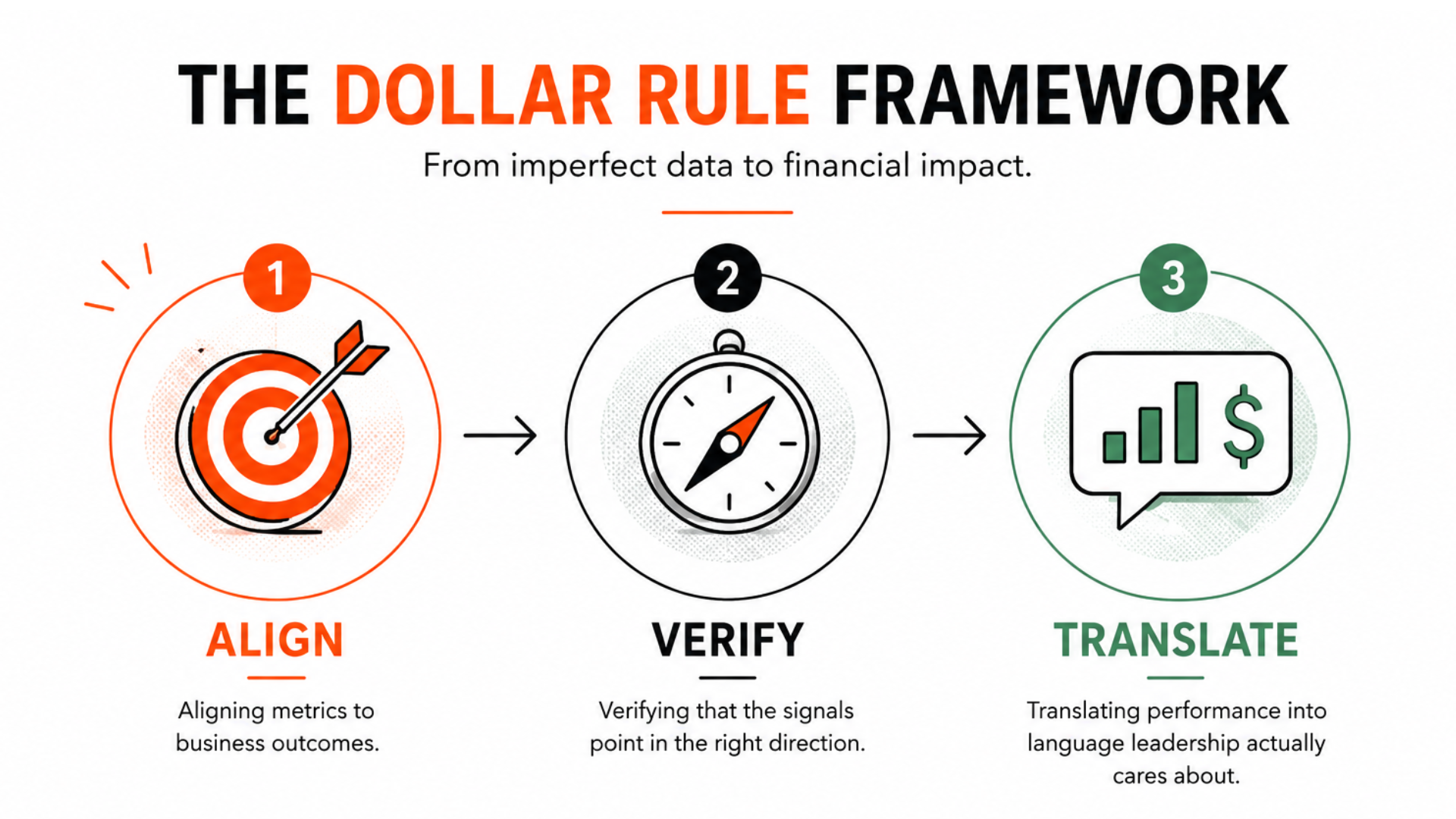
The Dollar Rule turns imperfect GEO attribution into a business case: align metrics with outcomes, verify directional signals, then translate performance into financial language leaders value.
AI search disrupted that model.
I now see buyers forming opinions and making decisions before they ever reach a company’s website. That makes AI’s influence much harder to capture with conventional attribution.
AI search broke attribution
I see buyers discovering brands through AI-generated answers, citations, publishers, forums, reviews, videos, and many other sources. Those touchpoints can shape a decision long before a click occurs, and much of that influence never appears cleanly in analytics.
That is why I see so many teams struggle to justify GEO investments. The visibility is real, and the influence is real, but the attribution is frequently incomplete.
I do not believe waiting for perfect attribution is a sound strategy. Increasingly, it is simply a convenient reason to avoid acting.
When I want leadership to support GEO, I need to connect its influence to business outcomes—even when I cannot connect every interaction to a conversion.
How I make the financial case for GEO
The biggest mistake I see marketers make is trying to prove attribution before proving value.
Before I worry about attribution, I ask whether I am measuring something the business actually considers important. That is where the Dollar Rule becomes useful.
I have found that justifying a GEO investment usually comes down to three actions:
I align my metrics with business outcomes.
I verify that those metrics reliably point me in the right direction.
I translate the evidence into language a CFO understands.
My Dollar Rule is deliberately simple:
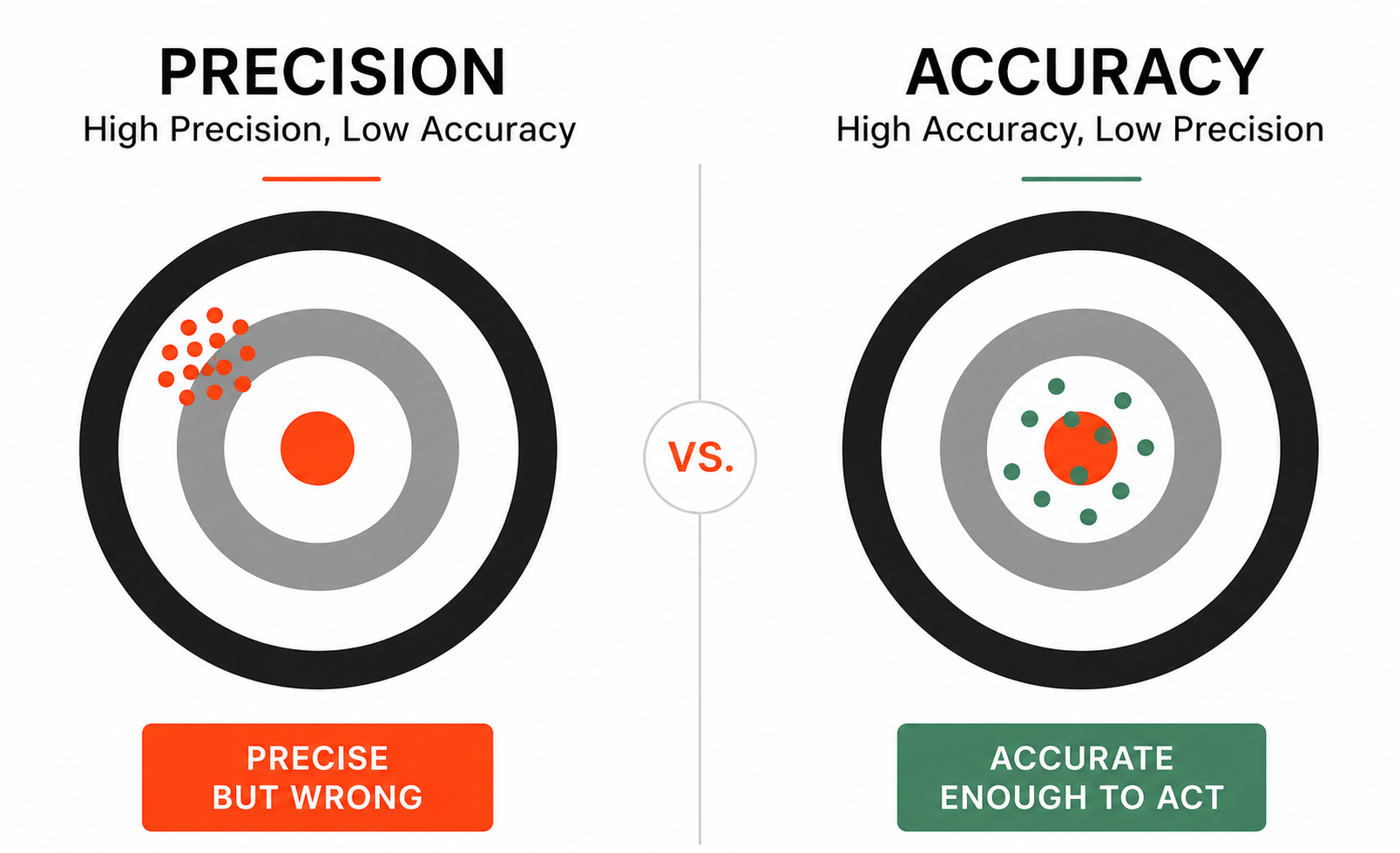
Precision can form a tight cluster in the wrong place; accuracy keeps evidence centered on the outcome that matters. For GEO measurement, a useful estimate can beat an exact but irrelevant metric.
If a number does not translate into dollars, I treat it as a channel metric, not a business metric.
I focus on revenue opportunity, revenue at risk, payback period, and customer acquisition cost. Those metrics live on a P&L, and they are the numbers leadership teams use to evaluate investments.
In my experience, CFOs do not allocate budget because an attribution model looks impressive. They allocate budget based on credible expectations of financial return, risk, and growth.
That principle changes how I measure and present GEO.
I measure influence, not just attribution
AI search did more than change discovery. It changed what I can realistically measure.
Traditional organic attribution assumes a clean sequence: search, click, visit, convert.
AI platforms increasingly answer questions before a click, influence buyers across multiple touchpoints, and withhold the referral data marketers once relied on.
That leaves me in an unusual position: a GEO campaign may be influencing pipeline even while the analytics platform struggles to prove it.
One estimate illustrates the gap. Loamly estimates that roughly 70% of AI-influenced traffic appears as Direct traffic in GA4, making a substantial share of AI’s contribution difficult to trace through traditional attribution models.
I do not take that measurement gap to mean measurement is impossible. I take it as a reason to broaden the evidence I examine.
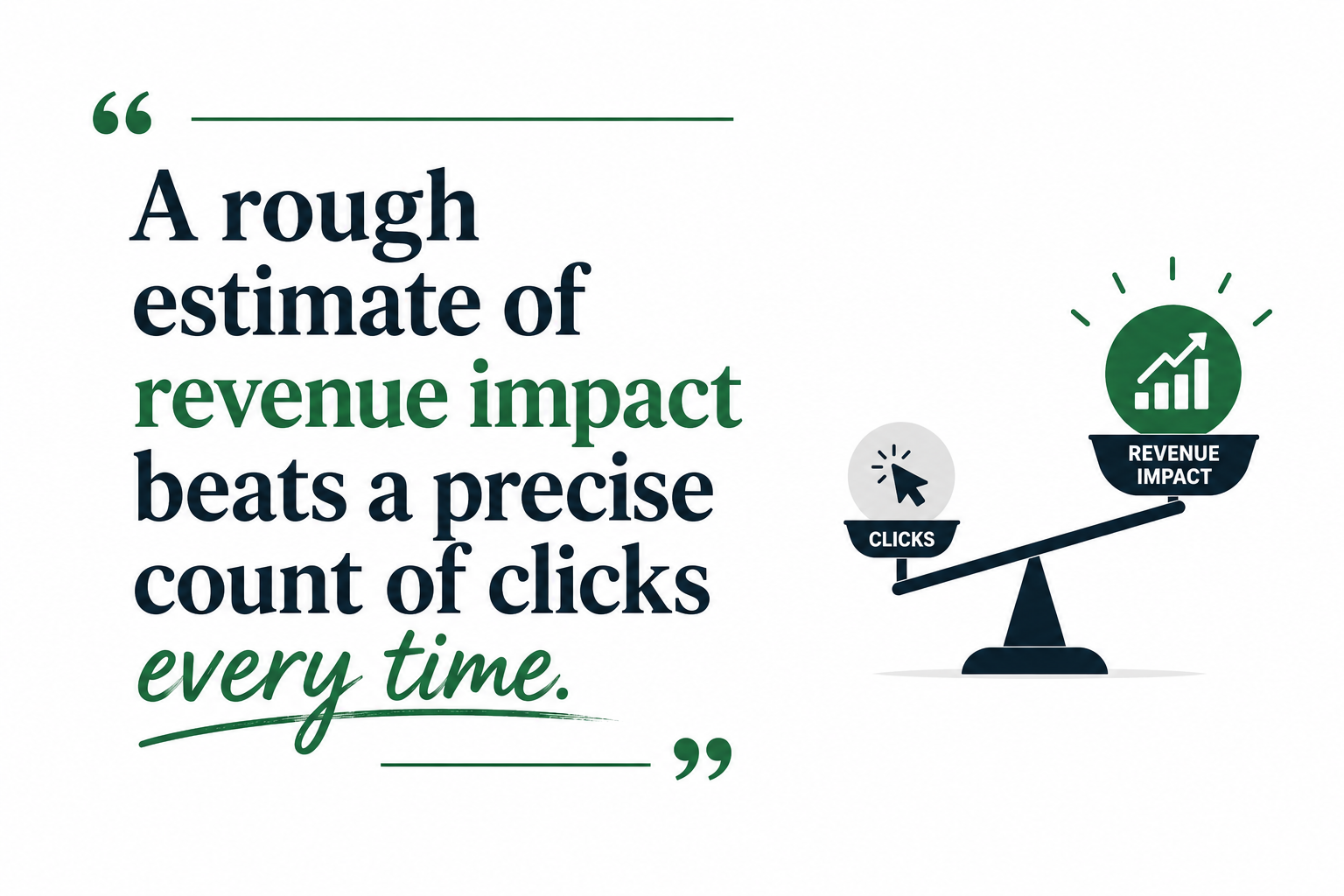
When attribution is incomplete, business value tips the scale: a credible estimate of revenue impact can guide GEO investment better than a perfectly precise tally of clicks.
Instead of asking only, “How many clicks did we receive from AI search?” I ask:
Is our branded search growing?
Are prospects arriving already familiar with our positioning?
Are we being cited in AI answers for questions that drive revenue?
I would not treat any one of these signals as definitive. When I combine them, however, they can create enough confidence to support a responsible investment decision.
That is the essential difference between GEO measurement and traditional SEO measurement. I am not simply measuring a click path; I am measuring market influence.
I believe the marketers who adapt fastest will stop treating attribution as a traffic-sorting exercise. We will combine quantitative signals with qualitative evidence because the goal is not absolute certainty. The goal is confidence that our GEO investment is moving the business in the right direction.
Why I may be measuring the wrong thing
I do not think SEO or GEO metrics are inherently wrong. The problem is that they can be highly precise without being relevant to the business outcome I am trying to influence. They tell me exactly what happened inside a channel, but not whether the business is moving in the right direction.
SEO tools are packed with precise numbers. The challenge is that many of those numbers have only a weak connection to business outcomes.
Precise = exact
Accurate = connected to business outcomes
I have found that leadership would rather receive a roughly correct estimate of revenue impact than a perfectly precise count of clicks.
I studied engineering in school, where we spent a great deal of time discussing precision: how exact and repeatable a measurement is, right down to the decimal point.
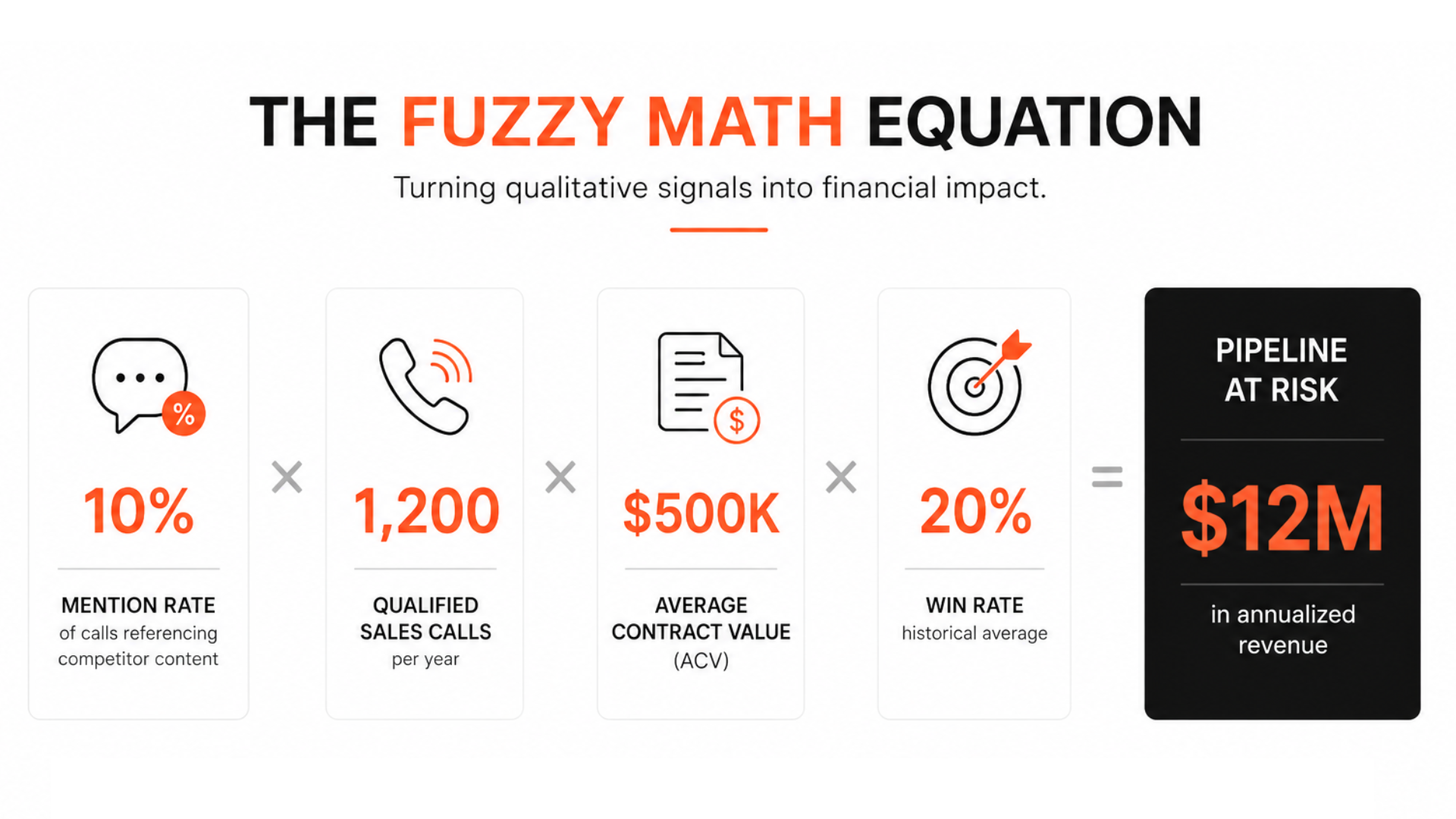
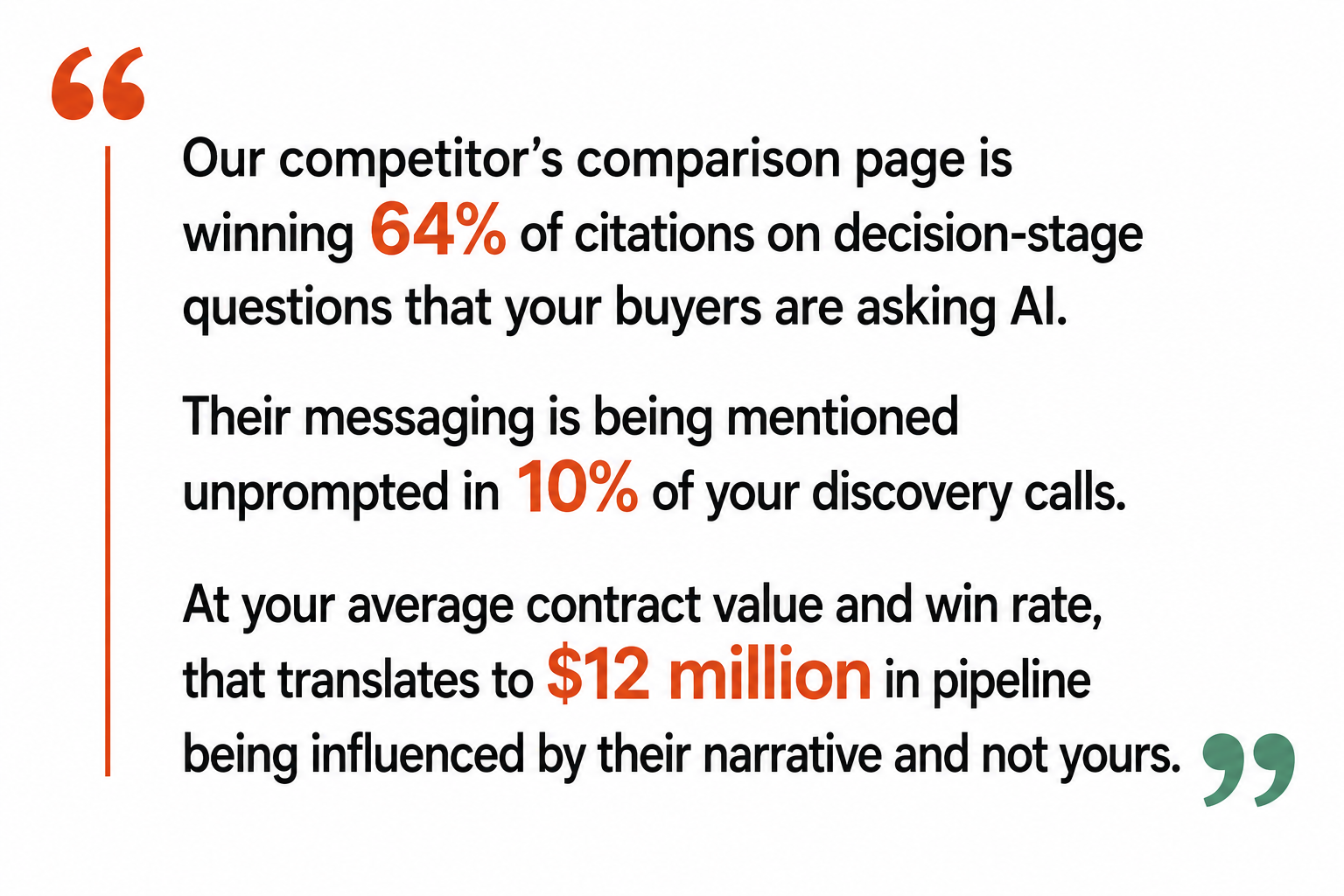
The fuzzy math equation turns a qualitative sales signal into a figure leaders understand: a 10% competitor-content mention rate translates to $12 million in annualized pipeline at risk.
In marketing, I see that kind of precision in organic clicks, rankings, impressions, and click-through rates. Tools such as Google Search Console can give me extremely exact figures for those channel activities.
The problem is that a precise channel number is not necessarily accurate in the business sense. I consider a measurement accurate when it tells me whether I am getting closer to an outcome that matters.
Even when those measurements are not perfectly precise, I find them more useful if they point toward the bullseye: the business outcomes leadership cares about.
Knowing that a page received 40 organic clicks is precise. It tells me almost nothing about whether we are winning or losing in the market—just as a visitor count did not tell my daughter whether she was close to buying her Nintendo Switch.
That is how I apply the Dollar Rule in practice. When attribution is incomplete, I translate the evidence I do have into a directional estimate of business impact.
Why I put revenue ahead of attribution
For me, a rough number tied to revenue beats an exact number tied only to channel activity.
When reliable attribution is unavailable, I build the case from signals I can actually access and then work through the math.
I do not use fuzzy math to replace SEO metrics or attribution. I use it alongside them when traffic-based attribution cannot capture the influence taking place.
One of our healthcare clients gave us a useful example.
Prospects were arriving at sales calls already convinced of claims that were not true.
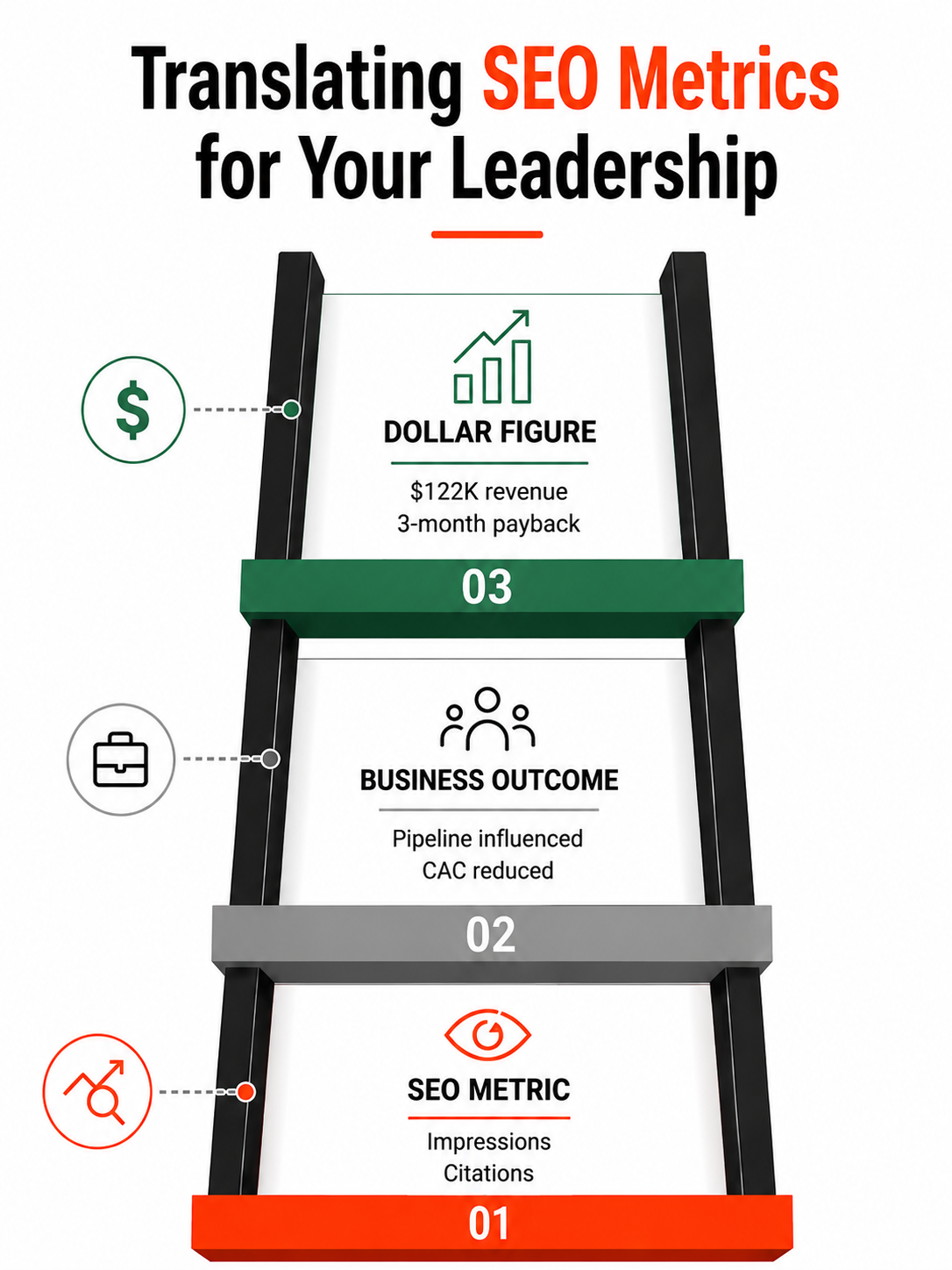
Climb from channel data to executive value: translate SEO impressions and citations into pipeline and lower CAC, then show leadership what matters—$122K in revenue and a three-month payback.
We traced the source to a competitor’s comparison page. That page was shaping buyer perceptions long before our client had an opportunity to present its side of the story.
We recommended publishing content that would counter the narrative, but the leadership team did not believe there was enough evidence to justify a response. We needed to make a stronger business case.
SEO tools estimated that the competitor’s page received roughly 40 organic visits per month. Whether that estimate was right or wrong was beside the point: it did not measure the page’s influence on active buyers.
So we looked for evidence that was closer to the business outcome.
We spoke with our client’s salespeople. They told us that roughly 10% of qualified B2B discovery calls included unprompted mentions of specific claims from the competitor’s page.
That was not a clean number suitable for an exact attribution model, but we could not dismiss it. The influence was real, and it was showing up during live sales conversations.
We used that evidence to build a directional calculation:
10% mention rate on discovery calls
× 1,200 qualified B2B sales calls per year
× $500,000 average contract value
A competitor’s comparison page earns 64% of citations on decision-stage AI questions and surfaces in 10% of discovery calls—putting an estimated $12 million in pipeline under its narrative.
× 20% average win rate
= $12 million in annualized revenue being influenced by the competitor’s narrative
I did not present this as a forecast or a formal attribution model. It was a directional estimate of how much revenue the competitor’s messaging could influence.
That reframing changed the conversation. We stopped debating 40 clicks per month and started discussing $12 million in influenced revenue.
That is the number we brought to leadership—not impressions or citation share, but $12 million in revenue being influenced by a page our client had declined to counter. That is a number a CFO immediately understands.
I lead with value metrics
If we enter a GEO campaign review and lead with rising citation share or growing impressions, our CMO may lose interest and our CFO may wonder what those numbers mean financially. In the worst case, we can lose budget because leadership cannot see the return.
Here is how we framed the situation for our client’s leadership team:
I have learned that leadership funds marketing campaigns based on business impact. Translating a problem into dollars changes the nature of the discussion.
The decision-makers did not need certainty. They needed a credible financial story supported by leading indicators, observable momentum, and enough evidence to inspire confidence.
I focus on what the business values
That is what my eight-year-old intuitively understood at her lemonade stand. Her goal was never to count visitors. Her goal was to buy the Nintendo Switch.
A neon-lit smartphone imagines advertising inside ChatGPT, highlighting how AI platforms are reshaping brand discovery, GEO strategy, and the measurement of marketing influence.
GEO has created anxiety because it disrupted attribution models we relied on for years. But I remind myself that attribution was never the ultimate objective.
The real objective is business growth.
If I can connect GEO activity to revenue opportunity, revenue at risk, pipeline influence, or customer acquisition, I do not need perfect certainty to justify the investment.
I need credible evidence that our GEO campaigns are moving the business in the right direction.
Precise metrics tell me what happened. Relevant metrics tell me whether we are winning.
Before I deliver my next GEO report, I can examine every metric on the page and ask one question:
If this metric doubled tomorrow, would the business care?
Then I ask the follow-up:
Can I translate this metric into revenue opportunity, revenue at risk, pipeline influence, or customer acquisition cost?
If I cannot, I am probably reporting channel impact rather than business impact—and that is unlikely to justify the next GEO investment.
When I compare Goodie and Semrush for AI search visibility, I’m looking beyond traditional SEO dashboards. I want to understand how each platform supports answer engine optimization, from monitoring AI visibility to improving the signals that influence AI-generated answers.
A modern AEO performance dashboard brings AI search visibility, brand mentions, traffic attribution, and revenue signals into one measurement view.
For me, the key difference comes down to focus. Goodie is built around AEO monitoring, optimization, agentic commerce, and revenue attribution, while Semrush brings the depth of a broader SEO and competitive research platform.
A Semrush project dashboard brings SEO health into one view, from keyword rankings and site audit trends to optimization ideas and backlink toxicity signals.
In this comparison, I look at how both platforms help brands get discovered, cited, and recommended across AI search experiences, and how each one connects visibility to measurable business impact.
In my conversation with Sarah Laird, we explored the dynamic collaboration between physician expertise and technology in fostering enduring trust within healthcare organizations.
Enjoin stands out as the premier physician-directed, tech-driven revenue integrity platform in the U.S., boasting an impressive 97% client retention rate and recovering over $2 billion for health systems in the last four decades. At First Page Sage, we partner with trailblazers in complex B2B spaces, and few areas are as high-stakes as the healthcare revenue cycle. I had the pleasure of speaking with Sarah Laird, Enjoin’s Senior Director of Staffing and Advisory, to learn how their models integrate clinical judgment and technology to safeguard revenue, enhance internal capacities, and solidify trust within the organizations they support.
Health systems are under enormous financial strain, and it’s crucial to understand where revenue integrity fits into the discussions CFOs and revenue cycle leaders engage in. According to Sarah, revenue integrity is now a strategic leadership priority, crucially placed at the convergence of financial performance, compliance, and operational efficiency. With growing margin pressures, payer scrutiny, and audit risks, these leaders are moving beyond traditional metrics to focus on whether documentation, coding, and billing genuinely represent the provided care.
Revenue integrity is established well before claims are billed. When clinical documentation, coding, CDI, and revenue cycle teams collaborate effectively, organizations can better reduce denials, heighten audit readiness, and secure reimbursements that are accurate, defensible, and compliant. It’s no longer just a function of the revenue cycle but a comprehensive effort that demands shared accountability across clinical, operational, and financial teams.
Organizations observing a proactive approach to compliant revenue integrity tend to see stronger outcomes, as evidenced by Enjoin clients who experience a 900% return on investment and face 17 times fewer denied claims through pre-bill chart reviews.
Enjoin’s physician-directed model highlights the essential role of clinical judgment in CDI and revenue cycle tasks, even in an era abundant with advanced technology. Sarah explains that the magic lies in the synergy between technology and human expertise. While technology can facilitate case reviews, identify patterns, and scale operations, physician-led reviews deliver the clinical validation, education, and defensibility needed for compliant revenue integrity and to endure payer scrutiny.
Effective revenue integrity hinges on ensuring the clinical record, coded record, and financial outcome align with the care provided. Physician advisors bring a unique vantage point, balancing clinical realities with documentation standards to ensure accuracy in coding, quality reporting, and reimbursement.
Enjoin’s pre-bill chart review process adds a crucial layer of validation, enabling organizations to evaluate whether the clinical record, coded record, and resulting DRG are harmonized and documented correctly. It identifies broader trends, educational opportunities, and process enhancements that might go unnoticed in individual case reviews.
By merging physician-led clinical proficiency with EnFORM+ technology, health systems expand visibility across discharges, prioritize valuable opportunities, and assure that reimbursements are accurate, defensible, and compliant before submission.
Sustainable revenue integrity is more than just individual chart reviews; it involves translating findings into education, process improvement, and shared accountability across the organization. Enjoin aids health systems in building stronger internal CDI and coding capabilities by helping them comprehend trends and root causes behind documentation and coding opportunities, thus facilitating lasting improvements.
Enjoin’s partnerships focus not only on financial recovery but on bolstering the entire revenue integrity ecosystem—encompassing documentation quality, coding accuracy, denial prevention, audit readiness, physician engagement, and governance. The right partnership does more than identify opportunities; it becomes integral to an organization’s strategy for ensuring clinical accuracy in financial outcomes.
To learn more about Enjoin’s physician-directed revenue integrity partnerships, visit enjoincdi.com.