Tag: Publisher Profiles

  • Yahoo Scout: Inside Yahoo’s Bold AI Search Comeback

    Yahoo Scout: Inside Yahoo’s Bold AI Search Comeback

    I’m looking at Yahoo! Scout as Yahoo’s most direct return to search and web discovery in years. The new AI-based answer engine is available at scout.yahoo.com, and Yahoo is also weaving it through its major properties, including Yahoo News, Yahoo Finance, Yahoo Mail and Yahoo Search. I think of it as a Yahoo-branded AI companion built to help people move through those familiar Yahoo experiences with more context and guidance.

    What Yahoo Scout is. To me, Yahoo Scout is Yahoo’s version of an AI search engine and assistant, similar in broad idea to Google’s AI Mode or OpenAI’s ChatGPT, but with Yahoo’s own personality layered in. Yahoo told me it wanted Scout to feel fun, approachable and easy for people of all ages to understand.

    When I first visited Yahoo Scout, the experience felt intentionally warm. The home page includes a search box, a playful slogan and an animated icon above it. Beneath the search box, Yahoo offers suggested searches that can be filtered by topics such as news, finance, sports, shopping and travel. On the left side, I could also see previous queries, making it easier to return to earlier searches and continue where I left off.

    ```json
{
  "alt": "Yahoo Scout interface with search bar, thread options, and news topics displayed.",
  "caption": "Discover what's trending with Yahoo Scout! Explore threads, ask questions, and stay informed with the latest updates in news, finance, sports, and more.",
  "description": "The Yahoo Scout interface features a central search bar asking 'What's the game plan?' with a cowboy hat illustration. Below, options to start a new thread and various news topics like finance, sports, and travel are displayed. Icons for different categories and sample questions suggest a versatile platform for staying informed and interactive browsing. The design is clean with a playful touch, reflecting the accessible nature of the tool."
}
```

    The home page also rotates through playful visual treatments. In one version I saw a cowboy hat, while other versions included a crystal ball, a gold medal, a walking cartoon brain and more.

    Yahoo Scout’s advantage. The Yahoo Search team gave me early access to try Yahoo Scout. While the interface will feel familiar to anyone who has used other AI answer engines, the Yahoo-specific pieces are what stood out most to me.

    ```json
{
  "alt": "Image explaining how SEO works on Google with stages of Crawling, Indexing, and Ranking alongside user roles.",
  "caption": "Unlock the mysteries of SEO! This image outlines Google's three-stage SEO process—Crawling, Indexing, and Ranking—along with what roles you can play.",
  "description": "This image illustrates Google's SEO process through three main stages: Crawling, where Google bots discover pages; Indexing, where content is analyzed and stored; and Ranking, where pages are matched to search queries. It also highlights user roles, emphasizing the importance of site structure, schema markup, and optimization for user experience. Useful for understanding SEO fundamentals."
}
```

    Yahoo’s biggest advantage is its existing reach. The company already has a large audience across Yahoo Mail, Yahoo News, Yahoo Finance and Yahoo Search. Yahoo told me it has more than 500 million user profiles, stores signals such as queries, usage and intent, has more than one billion entities in its knowledge graph and processes 18 trillion consumer events and signals across its properties. That gives Yahoo a lot of context it can use to personalize AI search and better categorize queries.

    Yahoo also told me it is the second-largest email company and the third-largest search engine.

    ```json
{
  "alt": "Five mobile screens displaying Yahoo Scout features for mail, news, finance, sports, and search.",
  "caption": "Experience seamless integration with Yahoo Scout, bringing insights and analyses across mail, news, finance, sports, and search right to your fingertips.",
  "description": "The image showcases five smartphone screens, each illustrating different features of Yahoo Scout. From left to right: email interface with schedule details, news digest on various topics, finance analysis summary, sports game breakdown, and search results for memory improvement. This visual highlights Yahoo Scout's diverse functionality, offering users instant access to tailored insights, updates, and summaries, enhancing productivity and information accessibility in daily use. Ideal for users seeking centralized information management and streamlined digital experiences."
}
```

    Because Scout is connected to Yahoo’s own properties, it can bring Yahoo Finance widgets, financial data, tables, citations, weather results, news results and other rich content directly into answers.

    “Search is fundamentally changing, and our team has been inspired to use our decades of experience and extremely rare assets to create something uniquely useful for Yahoo’s hundreds of millions of monthly users,” said Jim Lanzone, CEO of Yahoo. “This beta launch is just the starting point. From search to our industry-leading verticals, Yahoo Scout will help our users accomplish their goals online faster and better than ever before.”

    ```json
{
  "alt": "Screenshot explaining how SEO works on Google, including stages like crawling, indexing, and ranking, and the four pillars of SEO.",
  "caption": "Discover how SEO works on Google, from crawling and indexing to ranking. Explore the four pillars and learn how to optimize your site effectively.",
  "description": "This screenshot outlines how SEO works on Google, detailing the stages of crawling, indexing, and ranking. It delves into the four pillars of SEO: On-Page SEO, Technical SEO, Off-Page SEO, and Local SEO. Each section explains key actions like optimizing content, improving site speed, creating backlinks, and enhancing local visibility. Keywords like 'SEO process,' 'crawling,' 'indexing,' and 'Google ranking' are highlighted for search optimization."
}
```

    Sending traffic to publishers. Jim Lanzone told me Scout is closely tied to Yahoo’s original mission of being a trusted guide to the internet. Because of that, Yahoo says it designed Scout with the open web in mind, including ways to send traffic downstream to content creators and publishers.

    In Yahoo Scout responses, I saw large blue highlights over portions of the answer text. When I hovered over those highlights, I could click through to the source. Each response also includes a visible “featured source” area, along with tables, imagery, related news articles and other source-driven elements meant to make publisher links more prominent.

    ```json
{
  "alt": "Table of the best SEO blogs to follow in 2026, with features from sites like Google Search Central and Moz Blog.",
  "caption": "Discover the top SEO blogs to keep you ahead in 2026. From Google's own insights to industry trends, find the best resources for every skill level.",
  "description": "This image showcases a table of the best SEO blogs to follow in 2026. Listed blogs include Google Search Central Blog, Search Engine Journal, Backlinko, Ahrefs Blog, Moz Blog, and Search Engine Land. Each blog is highlighted for its unique strengths, ranging from official Google updates and data-driven research to industry news and link-building tactics. Essential for those seeking to stay informed on SEO strategies and algorithm changes. Ideal for beginners and advanced users alike."
}
```

    Lanzone told me early AI answer engines have not done enough to send traffic back to the sources behind their answers. Yahoo wants Scout to be an example of how that relationship can work better. Since there is not enough licensing revenue for every publisher to make deals with AI companies, Yahoo is leaning into the historical search model: give users answers, but also send meaningful traffic to the sites that produced the underlying content.

    CTR expectations. I asked Yahoo what click-through rate it expects from Yahoo Scout to publishers. The honest answer was that it does not know yet. Yahoo expects to learn from real user data after launch and then iterate to improve downstream clicks.

    ```json
{
  "alt": "Screenshot showing how to access the Search Engine Roundtable website with various options like direct site visits, email feed subscriptions, and mobile apps.",
  "caption": "Discover the easiest ways to access the Search Engine Roundtable for the latest on SEO discussions, algorithm updates, and expert insights, whether via direct site visits, email feeds, or mobile apps.",
  "description": "The image is a guide for accessing the Search Engine Roundtable, detailing options like visiting seroundtable.com directly, using email subscriptions, RSS feeds, and mobile apps. It highlights how the site provides SEO news, algorithm updates, and expert insights from industry leaders. Additionally, there's information on using sources and buying SEO traffic. This informational layout is part of Yahoo's Scout Explorer beta interface, designed for organized content access."
}
```

    Yahoo expects queries in Scout to be longer than queries in Yahoo Search. It also expects ad loads to be lighter, and the team hopes click-through rates will be higher than the industry average.

    Yahoo also told me it plans to build a way for publishers to see impression and click data in the future. I see that as something like a Yahoo Webmaster Tools-style reporting experience, though crawling and indexing data would still be tied to Microsoft Bing because Bing powers the underlying search index.

    ```json
{
  "alt": "Image describing the four pillars of Google SEO with details about on-page, technical, off-page, and local SEO.",
  "caption": "Unlock the secrets of Google SEO with the four essential pillars: on-page, technical, off-page, and local strategies. Enhance your site's ranking through strategic optimization.",
  "description": "This image outlines the four pillars of Google SEO: On-Page SEO involves optimizing pages with high-quality content; Technical SEO focuses on site architecture and SSL certificates; Off-Page SEO includes signals of trustworthiness; Local SEO optimizes your Google Business Profile for local relevance. A pop-up details a beginner's guide to ranking higher on Google with guidance from Semrush. Keywords: SEO, on-page, technical, off-page, local, Google, Semrush."
}
```

    Yahoo Scout across Yahoo properties. I expect Scout to show up throughout Yahoo’s ecosystem. Yahoo Search will use Scout-powered AI summaries. Yahoo News will provide article highlights and may include daily digest audio summaries. Yahoo Finance will add an Analyze button powered by Scout. Yahoo Mail will summarize emails and extract action items, such as adding events to a calendar.

    Examples of Yahoo Scout in action. Yahoo Scout is not perfect, but for something Yahoo says was built in about six months, I came away impressed.

    ```json
{
  "alt": "Yahoo Scout screen displaying Bridgerton season 4 release details and schedule.",
  "caption": "Excited for Bridgerton Season 4? Catch the exciting split-release format starting January 2026 on Netflix. Discover unexpected twists and captivating romance!",
  "description": "The Yahoo Scout page offers detailed information on the release of Bridgerton Season 4. The season premieres on Netflix in January 2026 and is split into two parts with four episodes each. It follows Benedict Bridgerton and a Cinderella-inspired storyline. The page also highlights news articles related to popular shows and events, and features images from the series, sparking anticipation and excitement for its debut."
}
```

    When I asked Yahoo Scout for help understanding how SEO works, it returned a useful response with citations throughout the summary. SEO is complex, and not everyone would agree with every part of the answer, but the citation structure made the experience more transparent.

    I then asked it for sources I could use to find more content on the topic. There were clearly missed opportunities to link out more often, and I shared that feedback with Yahoo. The team agreed there was room to improve.

    ```json
{
  "alt": "Screenshot of Yahoo Scout about the best-performing stock of 2025, highlighting Regencell Bioscience Holdings with a 16,053% return.",
  "caption": "Discover the top-performing stock of 2025, with biotech leading the charge. Regencell Bioscience Holdings surged with a remarkable 16,053% return, showcasing the power of innovation.",
  "description": "The image is a Yahoo Scout screenshot detailing the top-performing stock of 2025, Regencell Bioscience Holdings, with a staggering 16,053% return. It includes a ranked list of top stocks in sectors like biotech and pharma, discussing industry trends and analyst warnings. Western Digital and Lumentum Holdings were noted for significant returns due to AI market demand, making this a go-to visual for understanding stock market highlights of 2025."
}
```

    When I followed up by asking how I could navigate to the sources it had mentioned, Scout did provide links at that point. I also saw citation previews appear when hovering over linked highlights.

    I tried several other types of searches as well. For entertainment queries, Scout pulled in news articles with larger graphics and clickable card-style formats. For finance queries, Yahoo brought in Yahoo Finance, though I was not able to generate stock charts during my own testing, even though I saw that capability in a demo. It may still have been in progress at the time.

    ```json
{
  "alt": "Yahoo Scout interface listing resources to find stock charts for 2025 performance.",
  "caption": "Discover where to access comprehensive stock charts for 2025's top performers using Yahoo Scout's suggested resources.",
  "description": "This image shows a Yahoo Scout interface, highlighting resources for finding stock charts. It directs users to platforms like Yahoo Finance, Google Finance, TradingView, and Morningstar to view performance charts for the top stocks of 2025. A small graphic titled 'The 10 Best Performing Stocks of the Last 25 Years' is also visible, adding context to the listing of chart resources."
}
```

    For weather, I tested Scout on a Sunday morning as a major snowstorm was touching down in New York. I was able to get a Yahoo Weather chart, along with practical tips on how to stay warm.

    For sports, I asked about Super Bowl predictions. As a lifelong Jets fan, I also asked whether the Jets had any chance of winning the Super Bowl in the next 10 years. The answer was not especially encouraging, but I was glad to see a chart embedded directly in the response.

    ```json
{
  "alt": "Weather forecast for West Nyack, NY shows snow accumulation between 7 and 11 inches on Sunday.",
  "caption": "Brace yourself, West Nyack! Snowfall of 7-11 inches expected on Sunday, turning into a snowy spectacle.",
  "description": "The image displays a weather forecast for West Nyack, NY, dated January 25, 2026. It predicts a significant snowfall with 7 to 11 inches expected on Sunday, with another 3 to 5 inches on Sunday night. Key details include heavy snow beginning around sunrise and potential snowfall rates of 1-2 inches per hour. The report highlights storm timing and intensity, and notes the broader regional impact, suggesting this storm may be one of the largest in recent years. Keywords: West Nyack, snow forecast, snowfall accumulation, storm intensity."
}
```

    For shopping, Scout gave me advice on how to dress for the weather. That is where Yahoo’s commerce strategy becomes more visible.

    Ads and commissions. Yahoo Scout will show ads at the bottom of some responses. Commerce-related queries will also be monetized through affiliate commissions, which is already a common revenue model across the web.

    ```json
{
  "alt": "Weather forecast for Spring Valley, NY showing 8°F temperature and ongoing snowstorm with 72% humidity.",
  "caption": "Bitterly cold in Spring Valley, NY with temperatures at 8°F. Snow continues amidst a major winter storm, creating hazardous conditions.",
  "description": "The image displays a weather update for Spring Valley, NY, indicating a severe winter scenario with a temperature of 8°F and 72% humidity. A winter storm warning is active, with snow continuously falling and a wind speed from NW at 10 mph. Charts detail hourly forecasts, predicting low temperatures through the week. The situation suggests extreme cold and potential hazards, highlighting the need for caution."
}
```

    Yahoo told me the ads are still powered by Microsoft Advertising, but Yahoo controls how those ads appear inside the Scout experience.

    Those ads will be charged on a CPC basis, not on an impression basis like some other AI engines have announced. I also saw product results labeled with “Yahoo may earn commission from these links.”

    ```json
{
  "alt": "Web page discussing how to stay warm during cold snaps, with tips for indoors and outdoors.",
  "caption": "Stay warm during the upcoming cold snap with essential tips for indoors and outdoors safety and comfort.",
  "description": "This web page from Yahoo provides guidance on staying warm during an imminent cold snap. It covers strategies for keeping warm indoors, such as using space heaters safely, dressing in layers, and sealing unused rooms. For outdoor warmth, it advises wearing layered, water-repellent clothing, including wind-resistant coats and mittens. The page includes a structured table with key strategies and priorities for indoor, outdoor, and vehicle settings. Keywords include cold weather safety, winter clothing, and frostbite prevention."
}
```

    How Yahoo Scout came together. Yahoo has been hinting for about three years that it wanted to return to the search game. In 2009, Yahoo made a deal with Microsoft to have Microsoft power Yahoo Search, which effectively ended Yahoo’s work on its own search technology. Since then, Yahoo has outsourced search technology until this new Scout effort.

    About six months ago, Yahoo acquired Eric Feng’s company to lead consumer search at Yahoo. Feng co-founded the online video platform Mojiti, which Hulu acquired in 2007. He then became Hulu’s founding CTO and head of product. Before that, he worked in Microsoft Research on search-related problems.

    ```json
{
  "alt": "Screenshot of Yahoo! Scout article detailing Super Bowl 2026 team predictions and matchups.",
  "caption": "Excitement builds for Super Bowl 2026 as final teams compete for a spot, with Patriots, Broncos, Seahawks, and Rams in the running. Odds favor Seahawks.",
  "description": "This image is a screenshot of a Yahoo! Scout article about the 2026 Super Bowl. It outlines predictions and matchups with the New England Patriots, Denver Broncos, Seattle Seahawks, and Los Angeles Rams vying for a spot. The AFC Championship features Patriots vs. Broncos, and the NFC Championship features Rams vs. Seahawks. The Seahawks are favorites at +150 odds. Super Bowl 60 kicks off on February 8 on NBC, with halftime performances by Bad Bunny and Green Day."
}
```

    “Yahoo’s deep knowledge base, 30 years in the making, allows us to deliver guidance that our users can trust and easily understand, and will become even more personalized over the coming months,” said Eric Feng, Senior Vice President and General Manager of Yahoo Research Group, the creators of Yahoo Scout. “Yahoo Scout now powers a new generation of intelligence experiences across Yahoo, seamlessly integrated into the products people use every day.”

    Lanzone, who also has a long history in search from his years as CEO of Ask.com, told me Feng has been instrumental in building Yahoo Scout over the past six months. Yahoo says this first public release is only the beginning, and more iterations and improvements are expected.

    ```json
{
  "alt": "Yahoo Scout page discussing the New York Jets' likelihood of winning the Super Bowl in the next decade, featuring team statistics and challenges.",
  "caption": "Amidst a tough season, the New York Jets face significant challenges in their quest for a Super Bowl win in the next decade, with a struggling record and critical team issues.",
  "description": "This image shows a Yahoo Scout webpage analyzing the New York Jets' chances of winning a Super Bowl in the next decade. It highlights the Jets' dire situation, including a 3-14-0 record with a recent 8-35 loss against the Bills. The page outlines structural barriers such as quarterback instability, poor draft positioning, and a weak offensive line. The image includes team stats and critical insights on the franchise's current crisis and future outlook. Keywords: New York Jets, Super Bowl, NFL, team analysis."
}
```

    Anthropic and Claude. Yahoo Scout is not built on Yahoo’s own LLM. Yahoo partnered with Anthropic and uses Claude as Scout’s primary foundational AI model. Anthropic, founded in 2021 by former OpenAI employees including Daniela Amodei and Dario Amodei, has become one of the leading AI companies. Amazon announced an investment of up to $4 billion in September 2023, Google committed $2 billion the following month, and as of November 2025 Anthropic had an estimated value of $350 billion.

    Even though Scout uses Anthropic’s foundational AI models, Yahoo has customized the experience and combined it with proprietary Yahoo data. Running the same searches directly on Anthropic’s tools would not produce the same Yahoo Scout experience.

    ```json
{
  "alt": "Webpage advising on clothing for a winter storm in Spring Valley, NY, including a layering guide and winter gear recommendations.",
  "caption": "Stay warm this winter with expert gear advice for the approaching storm in Spring Valley, NY. Learn about layering techniques and essential winter clothing.",
  "description": "This webpage from Yahoo Scout provides detailed recommendations for staying warm during a significant winter storm in Spring Valley, NY, on January 25, 2026. It includes a table outlining clothing layers from base to outer layers and accessories for optimal warmth and waterproofing. The page features essential gear like insulated parkas and boots, along with a lifestyle section displaying product recommendations such as The North Face McMurdo Parka and Patagonia Tres 3-in-1 Parka. Keywords: winter clothing, layering strategy, winter storm, insulated parka."
}
```

    “When you’re serving hundreds of millions of users, you need AI that can do more than retrieve information – it has to reason, synthesize, and explain. Yahoo is building toward a more personalized, trustworthy kind of search, and Claude’s ability to deliver that quality of guidance at scale is at the heart of Yahoo Scout,” said Ami Vora, Head of Product at Anthropic.

    Microsoft Bing. Microsoft Bing data is also part of Yahoo Scout. Bing provides the underlying search index, but Yahoo says the responses, ranking and overall experience are Yahoo’s. Yahoo wrote that Scout builds on its long-standing Microsoft relationship by using Microsoft Bing’s grounding API, combining that API with Yahoo’s trusted data and content ecosystem so answers are informed by authoritative sources across the open web.

    ```json
{
  "alt": "Yahoo! Scout search result for car insurance in New York City with Progressive ad.",
  "caption": "Exploring car insurance options in NYC on Yahoo! Scout, highlighting Progressive's rates starting at $75/year.",
  "description": "The image displays a Yahoo! Scout Beta search result for 'i need car insurance in new york city.' It shows a suggestion for users to look for discounts by bundling home and auto policies. An advertisement from Progressive is featured, offering insurance as low as $75/year. The interface includes a sidebar mentioning 'Car insurance in NYC' and has options for interacting with the search. The design is sleek, with options to share and explore more information via linked sources, like The Zebra and NerdWallet."
}
```

    Yahoo is also joining Microsoft’s Publisher Content Marketplace pilot. Microsoft says that marketplace can help support publisher revenue, and Yahoo described the move as “reflecting a shared commitment to expanding publisher reach, connecting original work with new audiences, and supporting sustainable revenue opportunities for publishers.”

    Hallucinations. I asked Yahoo about hallucinations, and the company told me it has added many guardrails to reduce them as much as possible. Yahoo says its entity graph, news content and other Yahoo-specific data help ground the answers. The team believes Scout’s hallucination rate should be “very low” compared with other AI engines.

    Yahoo Scout shopping results screenshot showing winter parka product cards, ratings, retailer logos and a sources panel for cold weather gear tips.
    Yahoo Scout blends AI search with commerce, surfacing winter parka recommendations, affiliate shopping cards and trusted weather sources in one answer-style interface.

    Agents. Many AI engines are moving toward agentic experiences that can complete tasks for users. Google, OpenAI and Microsoft are all investing heavily in this area.

    Yahoo Scout already includes some agent-like elements, especially inside Yahoo Mail, where it can help add calendar events, support smart compose features and surface action items. Yahoo says more is coming on that front.

    Why I care. Search is changing quickly, and I find it exciting to see Yahoo step back into the space in a meaningful way. As someone who has followed search for more than 20 years, I appreciate seeing Yahoo try to make search feel fresh again.

    Seeing people such as Jim Lanzone, Eric Feng and Brian Provost work on AI search at Yahoo makes this feel like more than just another answer engine launch. I’m interested to see what Yahoo does next.

    Yahoo Scout is available in beta for U.S. users at Scout.Yahoo.com and in the Yahoo Search app on iOS and Android.

    For more about Yahoo Scout, see this help document.


    Inspired by this post on Search Engine Land.


    crushpress.ai community screenshot
  • Unlocking the Power of Google Discover Publisher Profiles

    Unlocking the Power of Google Discover Publisher Profiles

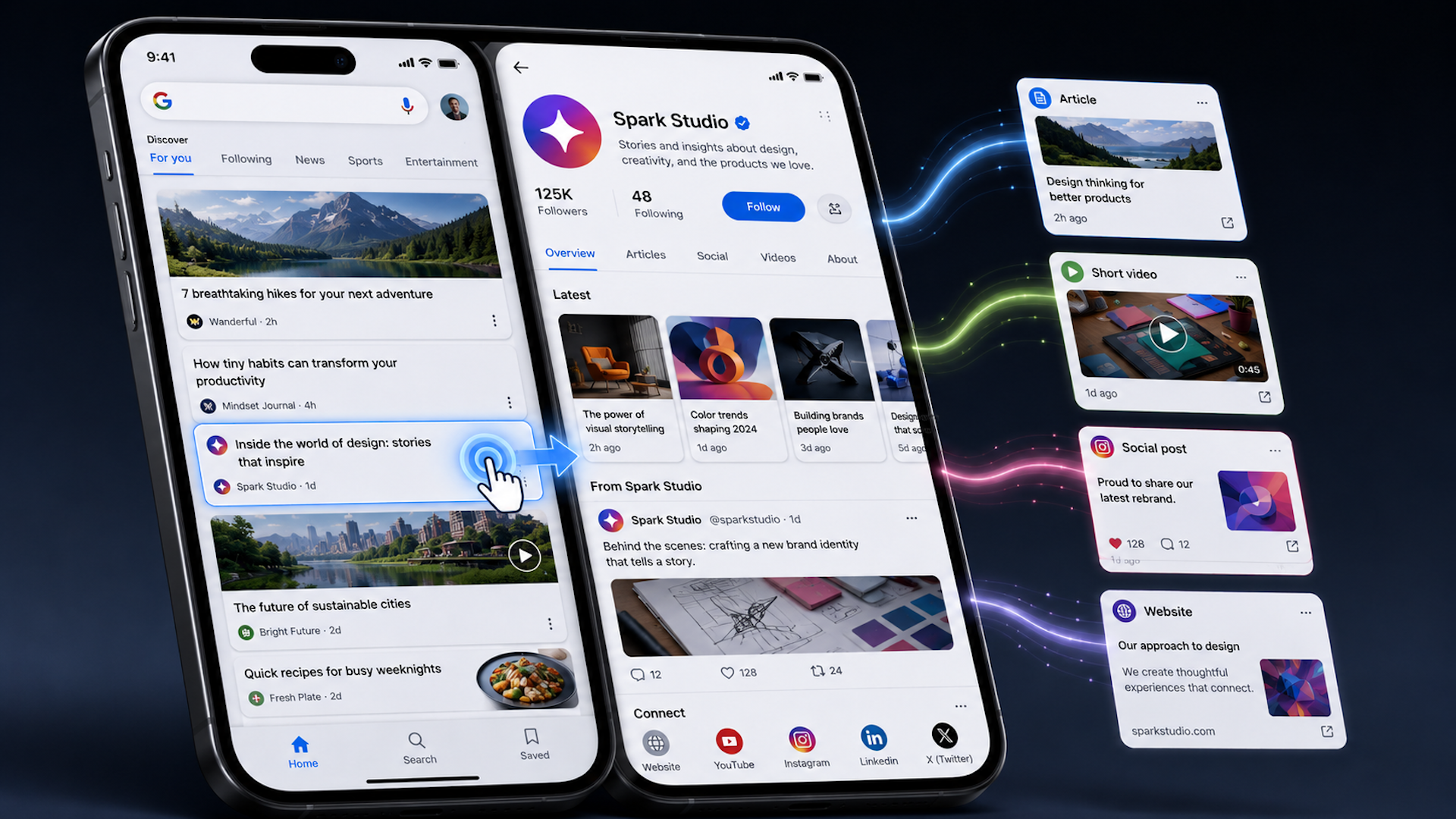
    I find it fascinating how Google Discover has evolved with the introduction of publisher profiles and follow features. These profiles have started making waves, yet they remain a bit enigmatic due to limited documentation.

    More publishers, creators, and social-first accounts are now visible through these profiles. Let me take you through how these profiles work, how they connect with social accounts and the Knowledge Graph, and why some publishers already enjoy enhanced customization features.

    As a technical SEO enthusiast, I’m quite accustomed to Google glossing over details in their documentation. And with Discover publisher profiles, that mystery deepens.

    Google barely mentions these profiles in their official Discover documentation, though they seem to play an increasingly significant role in the visibility of publishers and creators.

    ```json
{
  "alt": "The CapmatchOne logo with a gradient circle and bold text.",
  "caption": "Discover innovation with the CapmatchOne logo, featuring sleek typography and a modern gradient circle.",
  "description": "The CapmatchOne logo features bold, modern typography coupled with a gradient circle, symbolizing connection and innovation. The sleek design conveys a sense of progress and creativity. This image can be used for branding or promotional purposes, appealing to audiences interested in innovative solutions and forward-thinking designs."
}
```

    It’s intriguing to see how Discover profiles let users manage the publishers they follow while gathering content from various websites and social platforms.

    Because Google has been reticent about the inner workings of these profiles, I’ve taken upon myself to study their patterns across different accounts. Here’s what I’ve noticed about:

    Google rolled out substantial updates to Discover in September 2025, vastly altering how we engage with content through publisher follows and profile pages.

    ```json
{
  "alt": "Text explaining how to follow publishers or creators on Google Discover.",
  "caption": "Discover new content on Google by following your favorite publishers and creators. Preview their posts before following to tailor your feed.",
  "description": "An informative text image from Google detailing how users can follow publishers or creators directly on Discover. It highlights the ability to preview content, such as articles and YouTube videos, before following. Users are advised to sign in to their Google Account to explore this feature. Ideal for those looking to customize their content consumption on Google Discover."
}
```

    The update granted publishers dedicated landing pages for content aggregation, offering users a streamlined way to interact with preferred publishers and seamlessly integrating social content into Discover.

    The most eye-catching aspect of this update is how it empowers users to have greater control over publisher visibility while enabling brands to reach their audience more effectively.

    Publishers can’t typically alter the layout of these pages, but some recently gained access to customize their profiles, an option part of a limited beta test.
    ```json
{
  "alt": "Liverpool FC social media profile overview with follower counts and recent posts.",
  "caption": "Discover Liverpool FC's expansive online presence with millions of followers across platforms and stay updated with the latest posts and news.",
  "description": "This image showcases the Liverpool FC social media profile, highlighting 173 million total followers. It features follower counts across platforms like Facebook, Instagram, TikTok, and Twitter, along with a brief description about the club. At the bottom, recent posts are displayed with options to filter by platform. Keywords: Liverpool FC, social media, followers, football club, recent posts."
}
```

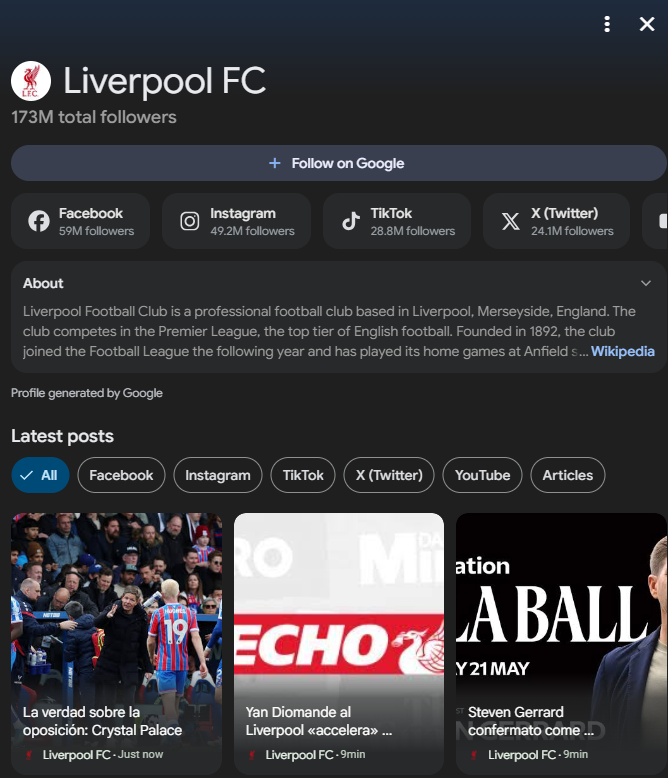
    Common to most publisher profiles are features like a profile photo, usually sourced from the Knowledge Graph or a YouTube profile, which also counts total social followers, and integrates various social media handles.

    The social connections catered to include platforms like YouTube, TikTok, Instagram, Facebook, X, and LinkedIn. The ‘About’ section is succinct, often derived from a Wikipedia entry or something similar.

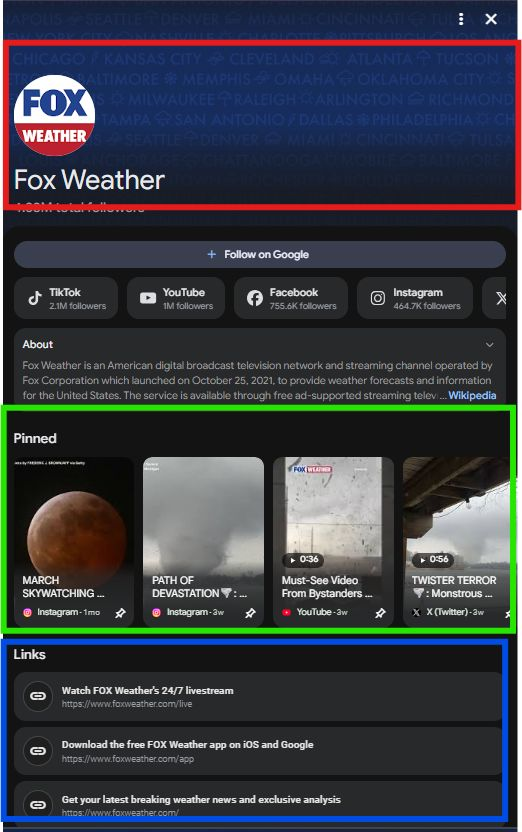
    Some editable profiles offer additional features like customized banners, pinned posts, and external links that could direct users to apps or livestreams, further enhancing content reach.
    ```json
{
  "alt": "Fox Weather page with social media links, about section, pinned videos, and navigation links.",
  "caption": "Explore the dynamic Fox Weather page, featuring live updates, pinned videos, and easy access to their apps and social media platforms.",
  "description": "The Fox Weather page displays their logo and title prominently at the top. Below are quick-follow options for TikTok, YouTube, Facebook, and Instagram. An 'About' section provides details about their services, while a set of pinned videos showcase various weather events. Navigation links at the bottom offer access to their livestream, mobile app downloads, and news updates. This comprehensive setup ensures users stay connected with the latest weather information."
}
```

    There are two main types of Discover publisher profiles: ones for entities with websites and others solely focused on social media publishers.

    Web-focused publishers’ profiles tend to be more comprehensive, often including the About section, logos, social accounts, and website links—although social links might sometimes need a manual push to be included.

    On the other hand, profiles for social media publishers focus on prominent journalists, notable figures, and those solely identifiable through social media.

    These profiles are generally less complete unless they are tied to a Knowledge Graph, missing elements like profile pictures or descriptions, frequently needing aid from connected YouTube accounts for better appearance.

    Looking forward, I anticipate Google may broaden access to these editable profiles, though I suspect customization will remain selective, likely reserved for well-established publishers and creators.


    Inspired by this post on Search Engine Land.


    crushpress.ai community screenshot
  • Inside Google’s Exclusive Discover Profiles Program

    Inside Google’s Exclusive Discover Profiles Program

    As I delved into Google’s exclusive Discover profiles program, I discovered an intriguing behind-the-scenes look at what 54 publishers did with their newfound control.

    Google Discover’s publisher profiles are housed at profile.google.com/cp/ and appear when a user interacts with a publisher name on a Discover card. While these profiles have been around since August 2025, it was only recently that Google secretly offered enhanced profile capabilities to a select few. This privilege includes customizable banner images, an optional link shelf, and the ability to pin posts for better content engagement.

    While most of the over 47,000 monitored pages remain auto-generated with basic information and a label stating “Profile generated by Google,” the select few who’ve gained this access enjoy advanced control over their profiles.

    Google’s approach appears highly selective; no public documentation or application process exists to apply for this feature. Throughout our monitoring, 54 U.S.-based, English-speaking publishers were identified as part of this exclusive cohort.

    Our analysis of profile features is comprehensive, tracking 46,926 publishers across various languages. From this dataset, we narrowed down those displaying enhanced features, offering clues into Google’s intentions and priorities.

    The skew toward local news and community publishers is evident, with nearly half of these publishers being regional newspapers and local TV stations. This focus is consistent with Google’s commitment to supporting local journalism.

    Google operates under a two-tier profile system. Most publishers have standard profiles automatically generated, while the lucky few have claimed profiles with enhanced control over elements like social media links and content prioritization.

    Through our investigation, we uncovered the actions of these privileged publishers, offering insights that could direct future adopters when Google decides to roll out this feature more broadly.

    The use of professional banner images was a common thread, with participants investing in high-quality design to enhance their branding. From brand-patterns to local landmarks, each choice reflects deliberate design strategies to communicate their identity.

    When exploring the links feature, local TV stations actively used this for site navigation, while national publishers were less engaged, suggesting differing strategic priorities.

    Interestingly, many within the cohort failed to track profile link performance through UTM parameters, indicating an opportunity most have yet to seize.

    Ultimately, this special program allows publishers to fine-tune their brand presence on a Google-owned platform, a tool for presence rather than ranking influence. The strategic implications for publishers are significant as they prepare for potential future rollout.

    In considering methodology, insights were derived from the 1492.vision Profile Features Monitor, underscoring that the cohort’s composition reflects Google’s selection preferences rather than a random sample, highlighting important trends for those in the publishing industry to watch closely.


    Inspired by this post on Search Engine Land.


    crushpress.ai community screenshot