Tag: Measurement

  • Transform Your Marketing Measurement from Basic to Brilliant

    Transform Your Marketing Measurement from Basic to Brilliant

    I’ve discovered that measurement is truly the cornerstone for all we achieve in performance marketing. Without precise measurement, everything I recommend, implement, and optimize becomes mere speculation. Today, maintaining accurate measurement is more challenging than ever—and it’s only getting more difficult.

    With regulatory crackdowns and growing privacy concerns, paired with elongated multi-touch journeys, we face a measurement crisis. Brands that still rely on outdated tactics are missing the mark when it comes to modern measurement challenges.

    If your brand falls into this category, it’s time I help you rebuild your measurement foundation—from integrating first-party data (crawl), to creating cross-channel reporting for actionable insights (walk), to advanced media mix modeling (MMM) and incrementality testing for true media lift (run).

    The crawl: Building a first-party data foundation

    By integrating first-party data into our performance marketing channels, I can move beyond reliance on third-party signals. While those metrics offer surface-level insights, they don’t reveal how channels impact our business goals.

    Audience integration

    The first step involves integrating CRM data into our paid media platforms. This includes:

    • Remarketing to abandoners.
    • Creating exclusion lists for current subscribers or recent purchasers.
    • Compiling priority contact lists.

    I might be uploading lists today, but integration enhances targeting by connecting to up-to-date audience lists for media platform targeting.

    Offline-conversion tracking

    For lead-gen businesses like ours, setting up offline conversion tracking (OCT) is crucial. It reveals the bottom-line impact of our media on sales, passing sales data back to platforms for campaign attribution.

    Once OCT is in place, we can optimize for lower-funnel, higher-quality conversion steps in the sales cycle or even begin optimizing toward revenue to enhance our return on ad spend.

    To progress from crawl to walk, I need to move from client-side to server-side tracking.

    By adopting server-side tracking, we bypass browser-based tracking and instead rely on our first-party data. This approach ensures data accuracy and resilience as privacy restrictions increase and cookies become obsolete.

    • Partner integration uses pre-built connectors for setup through platforms like Shopify or Google Tag Manager.
    • Direct API requires a development team to handle complex data or custom backends.

    The walk: Cross-channel reporting integration

    ```json
{
  "alt": "The CapmatchOne logo with a gradient circle and bold text.",
  "caption": "Discover innovation with the CapmatchOne logo, featuring sleek typography and a modern gradient circle.",
  "description": "The CapmatchOne logo features bold, modern typography coupled with a gradient circle, symbolizing connection and innovation. The sleek design conveys a sense of progress and creativity. This image can be used for branding or promotional purposes, appealing to audiences interested in innovative solutions and forward-thinking designs."
}
```

    With a robust measurement foundation, my next step is breaking down platform silos to understand the full ecosystem.

    Going beyond last click

    After implementing server-side tracking, I created a clean data pipeline. Yet, traditional attribution models neglect the full-funnel customer journey.

    To address this, I recommend using data warehousing solutions like BigQuery to centralize your data and apply custom logic, thereby gaining insights across the ecosystem.

    Unified reporting dashboards

    Integrating evolved attribution with unified reporting dashboards, like Looker Studio, allows me to visualize data across the funnel and obtain actionable insights into what platforms are truly driving volume and conversions.

    The run: Media mix modeling and incrementality testing

    With a comprehensive, everyday view of performance, significant questions persist about growth potential and offline performance measurement.

    By employing media mix modeling and incrementality testing, I can discern the full impact of media investments at a macro level to make informed decisions.

    The holistic view through MMM

    I view MMM as my compass, providing a holistic, quantitative guide for paid media investments, helping me analyze the relationship between inputs and business outcomes.

    Pulse checks with incrementality testing

    Incrementality testing offers validation for MMM and helps evaluate if specific tactics or channels are driving true incremental lift by comparing test and control groups.

    The sprint: Clean, integrated, and validated first-party data

    With first-party data integrated through server-side tracking and cross-channel reporting, I’ve built a robust measurement foundation. Guided by MMM and validated by incrementality testing, I’m now ready to sprint towards a more informed and successful marketing strategy.


    Inspired by this post on Search Engine Land.


    crushpress.ai community screenshot
  • Unlocking Revenue: The AI Visibility Advantage

    Unlocking Revenue: The AI Visibility Advantage

    Hey there! I’m excited to share some insights into a groundbreaking partnership between Profound and Partnerize. It’s all about using AI to turn visibility into verified revenue. Trust me, this is a game-changer for any brand eager to scale up their AI investments smartly.

    AI Search is evolving at lightning speed, and as brands, we need to do more than just monitor our AI visibility. The key is figuring out how to measure its value effectively. Those who master this will be the ones leading the pack in scaling their spending efficiently.

    Partnerize’s powerful payment infrastructure, which already handles billions in partner transactions, gives us a robust platform to ensure these measurements translate into real financial gains. Imagine being able to track and verify revenue directly tied to AI visibility—sounds like a win, right?


    Inspired by this post on Try Profound Blog.


    crushpress.ai community screenshot
  • PPC Challenges: AI’s Limited Impact and Growing Platform Opacity

    PPC Challenges: AI’s Limited Impact and Growing Platform Opacity

    PPC is becoming an increasingly difficult landscape to navigate, and even though AI provides some help, it doesn’t save the day. Meanwhile, platform transparency continues to decline, leaving us in the dark about budget management.

    The latest survey of PPC professionals reveals a challenging environment characterized by less transparent platforms, diminishing effectiveness of traditional measurement methods, and AI tools that have yet to revolutionize our daily routines.

    Why I care. As someone deeply invested in PPC, it’s notable that over half of practitioners (53%) believe PPC has become tougher compared to two years ago. The issue isn’t just competition; it’s the increasing number of decisions being made by platforms out of advertisers’ view, which contributes to this growing complexity.

    Considering that a whopping 89% of digital ad spend goes to just three companies, those of us who don’t have private measurement tools are essentially navigating without a compass.

    By the numbers:

    ```json
{
  "alt": "Doughnut chart showing PPC campaign difficulty change over two years. 53% find it harder, 16% find it easier.",
  "caption": "Over half of marketers find managing PPC campaigns harder than two years ago, while 16% think it's easier.",
  "description": "This image features a doughnut chart depicting survey results on PPC campaign management difficulty over the past two years. The chart shows 53% of respondents reporting it as harder, while 16% find it easier. The remaining respondents are split, with 31% stating it feels about the same. The chart is color-coded, with dark red indicating 'much harder' at 12%, red for 'somewhat harder' at 41%, light green for 'somewhat easier' at 13%, and dark green for 'much easier' at 3%. This visual provides insight into the shifting challenges of PPC management."
}
```
    • 1,306 respondents participated in the survey conducted between November and December 2025, representing agency, freelance, and in-house roles.
    • 62% identified platform opacity as the main reason for increased PPC complexity, with 53% pointing to the loss of effective measurement tools.
    • 5.2 hours/week are saved on average with AI tools, though the majority of us (55%) save only 1–5 hours; almost nobody reports saving over 20 hours.
    • 59% are now using LLMs for ad copy, up significantly from 42% the previous year, marking it as the fastest-growing AI use case.
    • 73% of in-house teams now manage PPC entirely in-house, a significant increase from 44% two years ago.
    • 20% of clients are considering replacing agency work with AI, compared to just 12% planning to switch agencies.
    • $1 trillion was spent globally on digital ads in 2025, with 89% directed towards Google, Meta, or Amazon.

    What they’re saying. Among PPC features, exact match keywords remain the most reliable, with 75% of us using them frequently. However, AI Max for Search sees minimal adoption, with 34% never having used it, possibly due to it being one of Google’s newest updates. Across the board, auto-apply recommendations are viewed with skepticism.

    Between the lines. The underlying theme in the report revolves around agency survival. Many of us (62%) highlight the challenges of finding talent and increasing revenue, with the real threat being clients opting to manage PPC internally using AI.

    The big picture. We’ve developed a cautious yet practical approach to incorporating AI — leveraging it for tasks like copywriting and research while being wary of its ability to make autonomous decisions. The more pressing issue that remains unaddressed is that platforms are gaining control and giving us less control over visibility, with no easy solution on the horizon.

    Dig deeper. For more insights, check out The State of PPC Global Report 2026.


    Inspired by this post on Search Engine Land.


    crushpress.ai community screenshot
  • Mastering PPC Measurement in a Privacy-First World

    Mastering PPC Measurement in a Privacy-First World

    Why PPC measurement works differently in a privacy-first world

    I often find myself reflecting on the challenges of PPC measurement in this privacy-driven era. As browser restrictions tighten, our reliance has shifted from perfect tracking to methods like redundancy, modeling, and inference.

    Managing PPC accounts has shown me firsthand that something has changed. The signs are everywhere:

    Missing GCLIDs, delayed conversions, and reports that are harder to explain have become routine.

    Initially, it feels like something broke—perhaps a tracking update or a platform shift. Yet, it’s simpler than that. We often assume identifiers will persist from click to conversion, but that’s no longer a reliable expectation.

    Measurement hasn’t ceased to function; what has changed are the conditions it relies on. These changes have been creeping up, gradually becoming the norm.

    Why this shift feels so disorienting

    Having dealt with this issue for most of my career, I find the evolution quite disorienting. Before native conversion tracking in Google Ads, I crafted my tracking pixels and parameters for affiliate campaigns. Moving towards automation and less control can feel unsettling compared to the traditional methods.

    The things I once depended upon for PPC data interpretation don’t apply in the same way anymore. Adjusting my mindset is key to navigating this evolved landscape, as restoring the old assumptions won’t work.

    Dig deeper: How to evolve your PPC measurement strategy for a privacy-first future

    The old world: click IDs and deterministic matching

    Predictability was the hallmark of Google Ads measurement. A click led to a gclid being stored in a cookie and matched back upon conversion, creating an easy-to-explain deterministic system.

    This depended heavily on things like parameters passing through browsers and cookies persisting. Thankfully, these conditions were favorable back then.

    Why that model breaks more often now

    Today’s browsers impose stricter limitations on identifiers. Apple’s Intelligent Tracking Prevention and similar techniques significantly reduce tracking data’s shelf life, directly impacting how data is stored, or even if it can be stored.

    On occasions, click IDs fail to reach the site, and the behavior of browsers today necessitates adapting, rather than attempting to cling to outdated deterministic systems.

    The adjustment isn’t just technical

    On my team, GA4 poses challenges not because it’s ineffective, but because it suits a reality where some data is presumably missing. This experience is shared industry-wide; we must acknowledge that measurement now requires a new mentality.

    Ultimately, surviving in this privacy-centric era demands refocusing energy on resolving data problems rather than merely optimizing ad settings.

    Dig deeper: Advanced analytics techniques to measure PPC

    What still works: Client-side and server-side approaches

    The question now is how we can thrive under current constraints, and the answer involves both client-side and server-side measurement practices.

    Pixels still matter, but they have limits

    Though these pixels provide valuable data and instant feedback, their efficacy is limited by browser constraints and consent banners blocking data.

    Relying solely on pixels for measurement affects both our reporting and optimization efforts. While they’re not obsolete, they no longer cover every base.

    Changing how pixels are delivered

    In search of better solutions, some focus on improving pixel delivery, such as Google Tag Gateway, which routes tags through the same-origin setup. This minimizes failures but does not define better measurement logic by itself.

    There’s a distinction between improved infrastructure and improved measurement logic—we must remember that proper data collection and event definition are crucial.

    Offline conversion imports: Moving measurement off the browser

    Using offline conversion imports moves measurement away from browsers to backend systems, mitigating browser-imposed privacy restrictions and extending its efficacy to longer sales cycles.

    Combining offline imports with pixel tracking ensures a complete view of customer interactions.

    Dig deeper: Offline conversion tracking: 7 best practices and testing strategies

    How Google fills the gaps

    Matching when click IDs are missing

    Even without click IDs, Google Ads utilizes other inputs to match conversions, although we must be aware that modeled data fills gaps when consent is denied or IDs are missing.

    Even with complete information from pixels or offline imports, conversions sometimes remain elusive.

    Determining how this aligns with privacy restrictions and user consent requires ongoing refinement and a strategic approach.

    Designing for partial data

    Partial data is now the status quo, and including multiple sources of input can create a robust strategy to overcome discrepancies in systems like CRMs and Google Ads.

    By learning to accept this tension and strategically managing incomplete data, we can optimize campaigns for the current data landscape.

    Dig deeper: Auditing and optimizing Google Ads in an age of limited data

    Making peace with partial observability

    As we embrace a privacy-focused measurement strategy, perfect tracking is no longer feasible. Building useful measurement systems requires recognizing differing operational views and aligning accordingly.

    Ultimately, strategic thinking, redundant data systems, and careful evaluation are essential components in adapting to a partially observable data world.

    Today’s measurement landscape demands a strategic approach instead of recreating past perfection.

    Get the newsletter search marketers rely on.

    MktoForms2.loadForm(“https://app-sj02.marketo.com”, “727-ZQE-044”, 16298, function(form) { });


    Inspired by this post on Search Engine Land.


    crushpress.ai community screenshot
  • Measure PR Success: SEO, PPC, and GEO Strategies Unveiled

    Measure PR Success: SEO, PPC, and GEO Strategies Unveiled

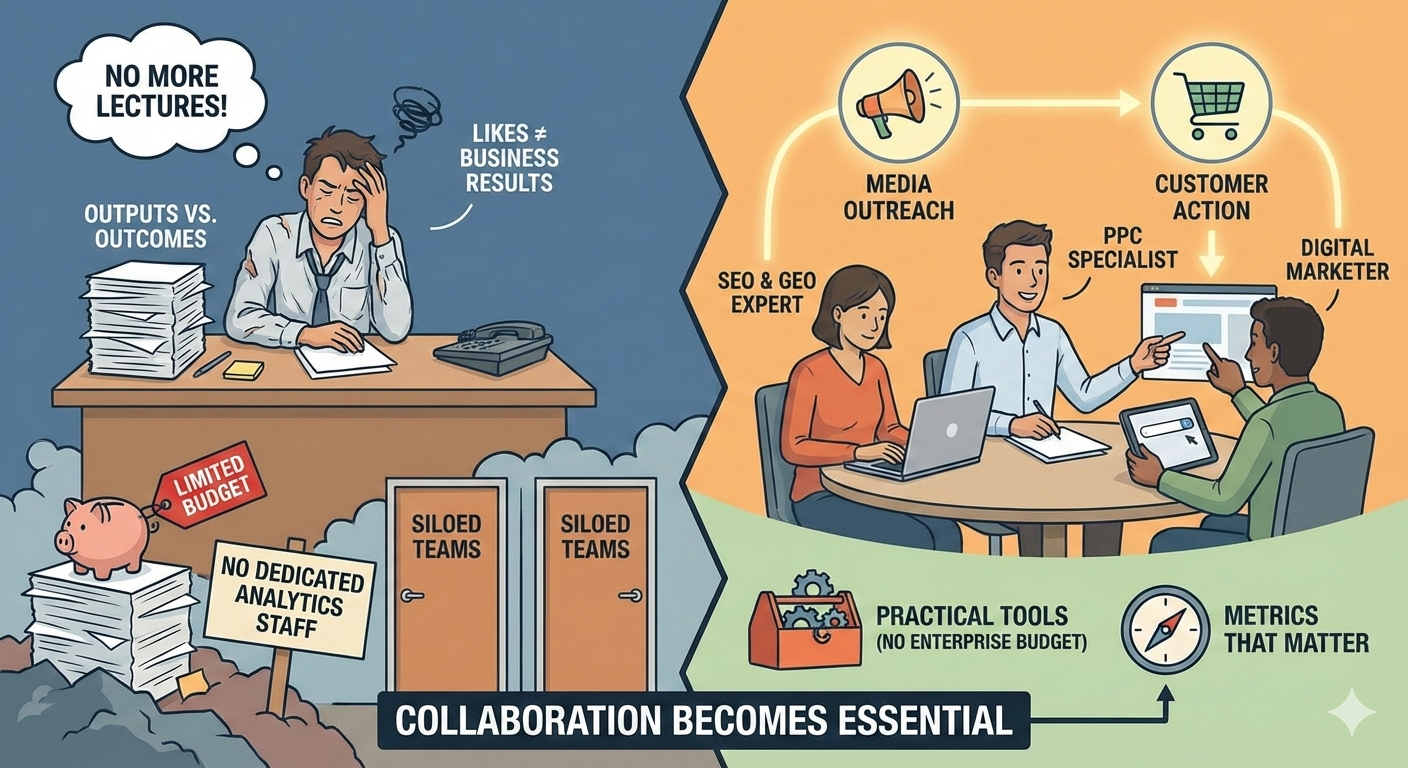
    As I reflect on the challenges of PR measurement, it becomes clear that many hurdles exist. Limited budgets and siloed teams often make it tough to connect our media efforts with tangible results.

    That’s why I’m convinced that collaboration with SEO, PPC, and digital marketing teams is key. Together, we can achieve what feels impossible on our own:

    Specifically, by linking media outreach with customer actions, integrating SEO and GEO into our measurement, and choosing the right tools, we can truly measure impact.

    This piece offers a practical roadmap for achieving this without needing an enterprise budget or specialized analytics team.

    Our digital age of communication isn’t linear. Audiences often engage with content across various channels before taking action, if they do at all. Understanding this loop is essential for measurement.

    ```json
{
  "alt": "Illustration highlighting challenges and solutions in business strategy with a frustrated man and a collaborating team.",
  "caption": "From Isolation to Integration: Transforming Business Outcomes Through Collaborative Strategy.",
  "description": "This illustration contrasts two business scenarios: a frustrated individual overwhelmed by limited resources, siloed teams, and ineffective outcomes, against a collaborative team utilizing practical tools and expertise for media outreach, SEO, and digital marketing to drive customer action. The image emphasizes the importance of collaboration and practical action over isolated efforts in achieving business success, underscoring the importance of metrics and strategic teamwork."
}
```

    I’m reminded of how SEO and PPC professionals focus on actions like searches, clicks, and conversions. We in PR should adopt this action-oriented mindset to enhance our measurement strategies.

    First, we need to prove the link between media outreach and customer actions. This often requires cross-departmental collaboration to access valuable data currently scattered across different systems.

    By incorporating PR touchpoints into analytics tools like Google Analytics 4, I can see our earned media’s influence on downstream behavior, turning PR from a cost center into a demand-creation channel.

    Second, while SEO is widely accepted, understanding its measurement in PR is less clear. Traditional metrics like coverage volume or sentiment don’t fully capture SEO’s impact.

    ```json
{
  "alt": "SEMRUSH ad promoting AI optimization with brand share of voice chart at 70%.",
  "caption": "Explore the future of search with SEMRUSH's AI Optimization. Discover if your brand will be seen in the changing digital landscape.",
  "description": "This SEMRUSH advertisement highlights the importance of AI optimization in modern search strategies. The image features a brand share of voice chart indicating 70%, along with a list of AI tools like Perplexity, Gemini, ChatGPT, and Claude. A call-to-action button invites users to get a demo. The vibrant purple design emphasizes innovation and technology. Keywords: AI optimization, SEMRUSH, brand visibility, search tools, digital marketing."
}
```

    GEO presents a new frontier, focusing on whether our content is a source for AI-generated answers. Tools like Profound and Semrush’s AI Visibility Toolkit offer insights into this new layer of measurement.

    Lastly, it’s crucial that we select tools based on strategic goals, not just what’s trendy. This involves working backward from the desired audience actions to choose the right measurement tools.

    In collaboration, PR, SEO, and PPC teams can integrate their strategies, avoid duplication, and create comprehensive insights that inform and improve future campaigns.

    Ultimately, this collaborative approach gives us the edge, allowing us to adapt swiftly to evolving measurement tactics and strengthen our collective impact.


    Inspired by this post on Search Engine Land.


    crushpress.ai community screenshot