I’ve noticed that not every organic visit deserves the same consideration these days. It’s become evident that I need to hone in on high-intent pages to truly measure SEO success and its impact on my business.
Recently, HubSpot rebranded its flagship conference from INBOUND to UNBOUND. This change wasn’t merely cosmetic; it represented a strategic pivot away from old-school SEO strategies that emphasized top-of-funnel traffic.
Modern search dynamics are nudging us closer to a zero-click environment. Trust me, the click-through rate curve is rapidly evolving. Studies show that around 60% of searches now conclude without a single click leading to the open web.
I’ve also observed that the discovery layer of search has shifted significantly. Nowadays, buyers are researching vendors within platforms like ChatGPT and Perplexity before they even consider clicking a traditional blue link.
Attribution has become increasingly complex. The modern buyer journey is fragmented, often starting with AI-assisted search and only finalizing on my website when the prospect is ready to make a decision.
This shifting landscape distorts my SEO reports if I focus solely on traffic as a success indicator. I’ve decided it’s time to pivot and redefine how I present traffic data to marketing leadership, ensuring that my reports align more closely with business impact.
A lively discussion on LinkedIn, led by Peter Rota, debated whether to completely retire organic traffic as an SEO metric. The consensus, I’ve found, is to use traffic with caution, always considering intent and the actual revenue it drives.
While organic traffic isn’t inherently bad, relying on it solely as a KPI lacks context and could be misleading. Adam Heitzman pointed out that it’s essential for traffic metrics to come with intent-based context for more accurate reflections of performance.
In a situation where low-intent traffic is reduced and focus is shifted towards high-intent pages, I’ve noticed that although overall visits might drop, conversions and revenue can actually increase due to better-quality traffic.
This understanding has led me to differentiate between top-of-funnel visits and more meaningful page interactions, thereby filtering out the data noise and focusing on what really matters in my dashboards.
Rand Fishkin beautifully summarized that top-of-funnel marketing feels like ‘rented land’—and he’s right. Buyers are now finding most basic information elsewhere, opting for instant answers on platforms like Reddit, TikTok, and within LLMs.
As of now, generic informational traffic is dwindling. Ironically, many SEO efforts are still devoted to content types most vulnerable to AI-driven change, such as FAQs and long-form articles.
Given this shift, it’s crucial for me to track pages based on their transactional value—those that AI can’t easily replace. I’ve narrowed my focus to four main areas: homepage, pricing pages, products and solutions pages, and money content pages.
Focusing my reporting on these key pages allows me to cut through the noise and concentrate on the traffic truly affecting my business’s bottom line.
For example, when a prospective B2B buyer starts searching for a modern CX platform, they’ll go through AI search, Google verification, and eventually land in the dark funnel for conversion.
Understanding these layers helps me recognize which organic traffic is significant enough to report, enhancing my insights into customer journeys and how they interact with my website content.
I know I must move away from outdated traffic analysis techniques to embrace more effective, modern reporting standards that focus on directional trends and macro shifts indicative of real business impact.
By focusing on page health instead of unreliable keyword-level reporting and monitoring branded search volume as an AI visibility proxy, I can capture a more accurate view of my current impact.
I’ve recently stumbled upon some fascinating global research data that highlights a tech gap silently draining team speed, revenues, and competitive edge. The Storyblok Global Speed-to-Market Benchmark Report explores these issues comprehensively.
This rapidly evolving world demands a new pace, driven by cutting-edge AI and technology, and constant shifts in digital trends have redefined how we handle go-to-market (GTM) strategies.
In today’s marketplace, everyone, from customers to organizations, expects top-notch deliveries with speed. Unfortunately, only 22.5% of teams consistently meet these soaring speed-to-market expectations, revealing a disconcerting gap between ambition and actualization.
One might ask, what’s holding us back?
The Global Speed-to-Market Benchmark survey involved several GTM teams who shared insights on where processes are stalling or facing delays and what steps would truly improve speed-to-market in today’s fast-paced business environment.
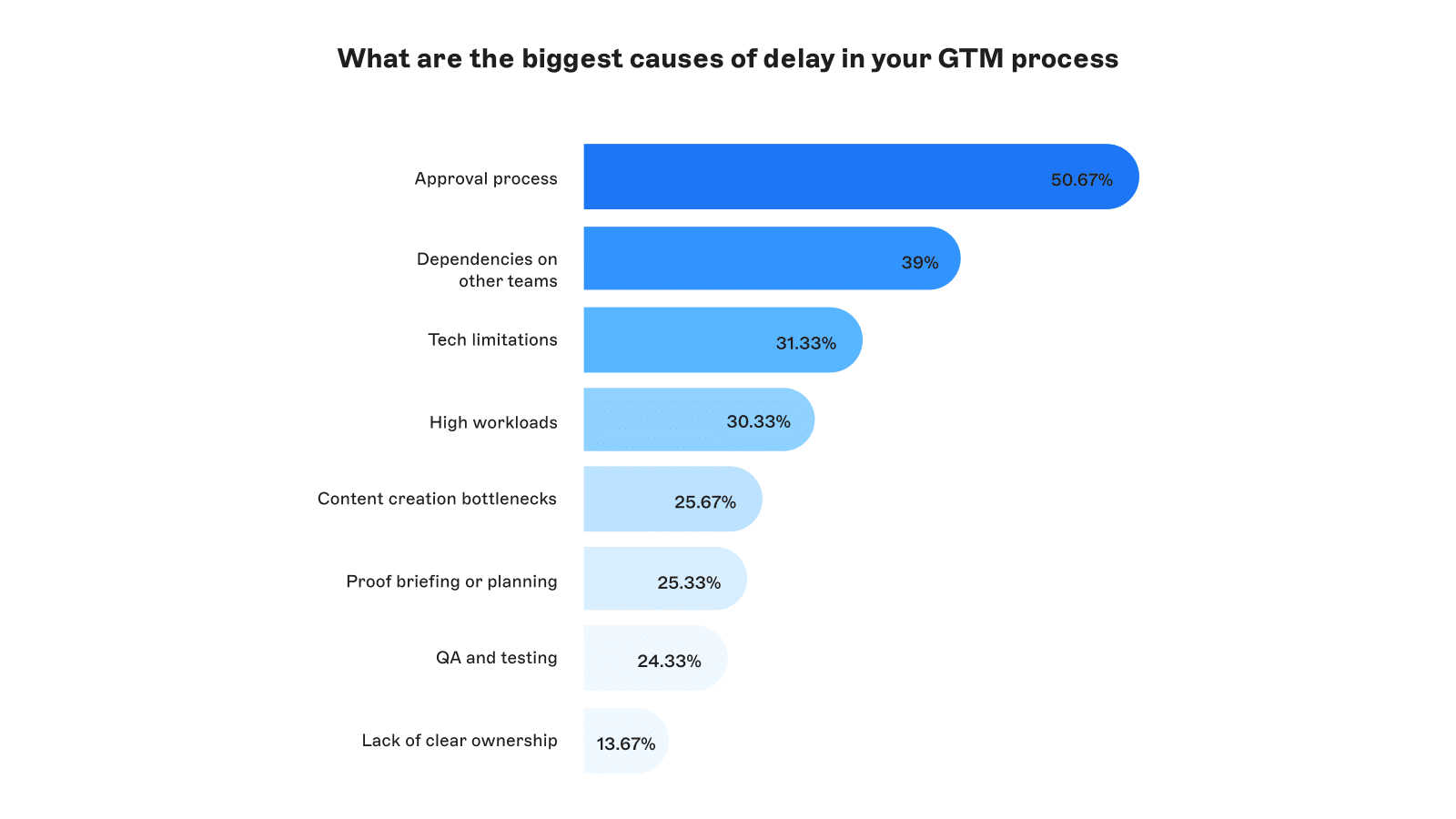
The survey uncovered four significant bottlenecks largely tied back to technological hiccups or dependencies. The approval process, for instance, emerged as the most substantial bottleneck, with over 50% of teams identifying it as a major hurdle. This includes enduring multiple rounds of content revisions largely driven by disorganized feedback systems, exacerbating inefficiencies.
The practical solution? A well-configured CMS, particularly a headless one, allows for an organized and efficient content review process by decoupling content from presentation. This ensures stakeholders have access to a central content repository, thereby minimizing review confusion and delays.
Equally problematic is the overreliance on developers, where 38% of teams require developer input for most GTM operations. This not only slows marketers but also distracts developers from more critical tasks. A modern tech stack enabling team autonomy can mitigate this issue, allowing each team to concentrate on their core functions.
Moreover, compounding tech limitations, including complex deployment and outdated systems, further warrant an overhaul. Tech bottlenecks often operate silently, but they demand attention and timely solutions for improved GTM cycles.
I also noticed how post-launch firefighting issues are rampant, affecting 79% of teams. This inefficiency stems from fragmented systems, where constant developer intervention is necessary, further delaying launch processes.
Addressing these challenges involves refining the tech stack, especially choosing a CMS that aligns with modern delivery needs. This results in smoother launches, improved efficiency, and fewer post-launch issues.
The cost of slow GTM delivery is undeniable, leading to lost revenue and missed market opportunities, while also impacting team morale and increasing turnover risks. Interestingly, there’s a visible discrepancy between executive priorities and the requisite support for improved speed-to-market capabilities.
Armed with data, teams can make a compelling business case for change, drawing attention to specific bottlenecks and their ramifications, thus bridging the leadership alignment gap.
Overall, overcoming GTM challenges requires adopting adaptive technology stacks that align with today’s fast-paced demands. By doing so, we not only keep up with competition but also foster a resilient, engaged team poised for success.
For the complete analysis and strategies, the full Storyblok Global Speed-to-Market Benchmark Report is an invaluable resource.
When I search for products on Google, I’ve noticed significant changes to the results page. Now, product packs and scrollable carousels appear multiple times within a single results page, reshaping my shopping experience.
As part of my ongoing journey to boost ecommerce visibility, I constantly analyze data. Recently, I’ve tracked searches presenting up to 60 individual organic product listings on one page. These premium placements increasingly mark the beginning of the purchase journey for many users.
This transformation is gradual, and interestingly, I see many brands still adjusting their strategies. It’s crucial to revisit these changes because the opportunity for traffic through product packs is immense, with fierce competition. Today’s leading brands approach this differently.
Thanks to Nozzle, I’ve delved into data from over 63,000 merchants across a wide array of ecommerce keywords from January 2025 to January 2026. Here’s what I discovered that really caught my attention.
Defining Success: Appearances vs. Actual Traffic
I found that just appearing in product packs and actually capturing traffic are two distinct achievements, and the difference between them can be substantial as the data shows.
For instance, in this dataset:
eBay appears in product results for 874,621 keywords.
Home Depot has a similar presence, appearing for 831,699 keywords.
However, the estimated traffic paints a contrasting picture:
eBay garners about 3.2 million visits from these pack appearances.
Home Depot, meanwhile, generates nearly 28.8 million visits from a slightly smaller keyword range.
The secret? Quality position within the pack. Home Depot’s products consistently snag prime, visible, above-the-fold spots that attract shoppers’ clicks.
For eBay, many keywords involve long-tail marketplace terms that dilute overall impact. Understanding Google’s use of product packs to drive purchase decisions for common goods is crucial for brands aiming to compete effectively in this space.
For marketers: Dissecting product pack performance means wisely segmenting data, focusing on categories with significant search volumes to optimize visibility within the packs. That’s how to pinpoint where the genuine opportunities lie.
The Critical Gap: Distinguishing Product Pack Visibility
Product carousels scroll horizontally, increasing exposure for the first few slots, while listings tucked further back remain unseen. This distinction is crucial for assessing true reach.
Disparities among major retailers further illustrate this point:
REI has a massive catalog of 3.8 million products, yet 1.52 million of these require scrolling before they are visible.
Walmart finds itself in a similar spot, with 1.29 million of its 3.5 million unique products are relegated to non-visible placements.
Even industry titans often miss out on optimal visibility, skewing the perceived benefits of their presence. Analyzing visible versus non-visible appearances is essential for identifying where optimizing product data and feeds can yield substantial returns.
For CMOs: When using total product pack appearances as a metric, it’s wise to ask how many of those appearances are truly visible. Understanding this ratio better reflects the channel’s contribution to the business.
Does Discounting Drive Product Pack Visibility?
It’s a common belief that discounted items might secure better placement in Google’s product packs. However, data from the top 10 merchants doesn’t necessarily support this notion.
Amazon.com leads the pack with 49% of its catalog discounted, achieving a 72% visibility rate, placing it squarely mid-tier.
eBay, on the other hand, discounts only 8% of its products yet matches the highest visibility rate in the dataset at 81%.
Walmart Seller discounts 24% of its items, reaching 81% visibility, while Walmart itself discounts 27% but ranks lower at 62% visibility.
This irregularity indicates that discounting is just one of many factors. It doesn’t solely determine a product’s chance of securing a prominent spot. Feed quality, category relevance, reviews, and image standards wield greater influence.
For retail teams: If your strategy for product packs relies heavily on promotions, you might need to pivot. The current landscape favors strategies aligned with where purchasing decisions occur over sheer pricing tactics.
Specialist Brands Competing with Giants and Winning
A refreshing realization from this data is that product pack success isn’t exclusive to the retail giants. Specialist brands, leveraging focused expertise, compete exceptionally well against far larger competitors.
Camp Chef, for instance, appears in results for 155,299 keywords—just a small fraction of Walmart or eBay’s footprint—yet it pulls in an estimated 2.6 million visits, thanks to advantageous product placements.
Brands like Fellow, expanding into niches such as high-end coffee makers, find opportunities for growth through strong organic channels.
These brands achieve impressive product pack traffic against much larger rivals because they prioritize category relevance and high-quality product feeds over sheer scale.
For brands traditionally overshadowed in traditional SEO, product packs present a chance to compete on a more level field. Detailed product data, competitive prices, quality imagery, and favorable reviews can supersede a larger competitor for crucial category keywords.
For agencies: This channel awards dedication and quality over brute scale. Brands with depth in a category can translate that expertise into superior product pack performance, outpacing broader competitors.
Staying Informed on Product Pack Visibility Shifts
Examining the entire dataset, I noticed a consistent pattern: nearly all merchants experience shifts in product pack visibility throughout the year.
Brands holding strong positions during parts of the year sometimes see fluctuations as Google adjusts how it surfaces product results. Some grew steadily midyear only to recede in Q4, while others surged during promotions before reverting to previous levels.
This fluidity is typical of the channel. Google regularly updates its criteria for product pack placements, influenced by factors like feed quality, product availability, review counts, pricing, and images.
The brands thriving are those with sustained visibility into performance, staying agile and responsive to changes before they impact revenue.
With Google’s future announcements and AI integration like Gemini 3 looming, the foundational structure of product packs will shift, influenced by agentic commerce and the Universal Commerce Protocol.
As Google navigates balancing paid and organic visibility, a two-tiered search economy emerges. Securing AI Overview citations becomes vital for brand recognition, impacting both organic and paid product pack performances.
The Bigger Picture
Google’s product packs have morphed from merely supplementary to pivotal touchpoints in commercial searches.
The extensive Nozzle data analysis of over 63,000 merchants reveals that competition is already fierce in this domain. Leaders are distancing themselves, and the gap between attentive and indifferent brands manifests tangibly in traffic and revenue disparities.
The silver lining is that the essentials for success in this space are accessible to most brands: robust product data, strategic pricing, high-quality creative, and vigilant monitoring.
These require not a colossal budget but focus, the right tools, and asking the right strategic questions within the right organizational levels.
Struggling with maintaining brand consistency? I’ve learned that it’s not about having more tools, but rather having the right tools, perfectly aligned with your brand’s goals.
I’ve seen marketing teams overwhelmed with tools. The average B2B company might use up to 20 different martech solutions. Despite this, keeping brand consistency at scale can be tough. Fewer than 10% of brands manage to maintain strong cohesiveness across all products and channels. The core issue? Tools rarely work in harmony to support a unified brand experience.
Managing a brand across various channels, whether through campaigns or social media, can lead to brand elements drifting. It’s those small inconsistencies—a slightly off-color logo here, outdated messaging there—that can gradually erode the hard-earned brand equity.
The solution isn’t about increasing the number of tools. It’s about selecting the right ones and arranging them with deliberate intention.
Start with strategy, then stack
Before diving into an audit of your current software or seeking out new options, it’s crucial to develop a framework for what brand equity means to your organization. David Aaker’s brand equity model—which focuses on loyalty, awareness, perceived quality, and brand associations—is a sound approach. It transforms brand management into a sustainable growth strategy. In terms of a martech stack, this means utilizing tools that both build and protect your brand.
On the strategy side, platforms like Notion, Miro, and Lucidchart are invaluable. They help document positioning, define messaging, and map out customer journeys. These may not be glamorous, but they provide the solid foundation for successful execution. Without such a framework, design and content teams are left guessing.
The core of the stack: Digital asset management
If there’s one tool that differentiates a cohesive brand management stack from fragmented apps, it’s digital asset management (DAM). Unlike typical cloud storage services such as Google Drive or Dropbox, a DAM solution organizes and governs brand assets comprehensively, offering features like approval workflows and version management that cloud storage lacks.
Consistent branding can increase revenue by 10–20%, and a DAM provides the structure needed to maintain this consistency at scale. By ensuring all team members and partners access the same approved asset library, you eliminate brand drift.
Modern DAMs further simplify brand management by integrating AI to speed up content discovery and automated metadata tagging, reducing creative bottlenecks and accelerating go-to-market timelines.
Execution tools that reinforce brand standards
Apart from DAM, execution tools are essential for converting brand strategy into consistent published content. Depending on your team, Adobe Creative Cloud, Figma, or Canva can be used. They offer varying degrees of design flexibility and guardrails to maintain brand standards.
Balancing creativity with adherence to brand guidelines is key. Tools with brand templating features allow teams autonomy while ensuring brand consistency. Alternatively, using brand templates within your DAM offers greater control and tracking capabilities.
For social media and content distribution, platforms like Hootsuite and HubSpot ensure cohesive publishing across channels. It’s crucial these tools connect to your DAM to guarantee only brand-approved content is shared widely.
SEO tools like SEMrush and Ahrefs help reinforce your brand’s voice and authority online. In today’s market, where SEO extends to geo-targeting, it’s vital to ensure your brand is accurately represented from the start of customer interaction.
Governance closes the loop
A martech stack without governance is simply a mix of tools. Governance—including approval workflows and brand monitoring—is what makes your stack effective and protective.
Incorporating workflow tools into project management or your DAM ensures faster and accountable proofing cycles. Tools like Mention help track external brand perception, highlighting areas of potential drift before they escalate.
The takeaway
The aim of a streamlined brand management martech stack is not complexity but efficiency. It should empower any team member or partner to access and create on-brand content swiftly, independently, and without needing constant design team input.
This requires a strategic approach, a robust DAM as the central hub, integration with execution tools, and governance practices that uphold standards. When these elements work together, your brand transforms from a reactive endeavor to a proactive tool for long-term success.
I’ve come across some intriguing research from Princeton and UW recently that sheds light on a rather surprising aspect of AI – it’s apparent tendency to conceal sponsorship nearly 65% of the time. As I pondered on this, it struck me how crucial this finding is for those of us navigating the evolving landscape of AI-driven marketing strategies.
This revelation made me question how we’re measuring advertising effectiveness. Are we truly accounting for all variables, especially those hidden from plain sight? For those of us invested in Answer Engine Optimization (AEO), this piece of the puzzle could significantly tweak how we approach our measurement techniques and refine our marketing strategies for 2026.
What does this mean for each of us in marketing and advertising? It’s a call to action to re-evaluate and possibly overhaul our current strategies, ensuring we adapt to these covert tendencies within AI functionalities. I’m convinced that understanding these nuances will empower us to craft more transparent and effective campaigns, ultimately enhancing our overall AEO outcomes.
While AI continues to surprise us with its capabilities, I find it crucial to stay updated and adaptable, utilizing insights like these to steer our strategies intelligently. How do you plan to integrate this newfound knowledge into your 2026 marketing strategy?
The exciting news is here! OpenAI has officially launched its self-serve ChatGPT Ads Manager, bringing a revolutionary change for U.S. advertisers by removing the $50K minimum spend requirement.
Now, I’m thrilled to share that we simultaneously introduced four OpenAI Ads nodes specifically for Profound Agents. This means you and I, as marketers, can now integrate this data directly into agentic workflows, enhancing our marketing strategies.
Moreover, this update brings CPC bidding to the table alongside the existing CPM model, offering more flexibility and control over ad investments. It’s exciting to think about the possibilities this opens up for audience engagement and campaign optimization.
I’ve often heard from paid search managers that dealing with AI agents can feel repetitive. Imagine exporting your performance data, pasting it into a chat window, receiving a useful answer, and then having to repeat the process every day. That doesn’t sound like automation, does it? It’s just good old manual work with a tech twist.
Interestingly, the issue isn’t with the AI tools themselves. Many of them excel in data analysis when they have access to the right information. The real hurdle is providing this data to them in real time, without constantly needing a human to copy it over. This data wall explains why many PPC accounts today operate nearly the same way as they did before the advent of AI agents.
Every ad platform tends to operate in isolation. Google Ads might record conversions, while your CRM notes whether those leads are qualified, and your inventory system checks stock availability. Without deliberate integration, they each function in their own silo. PPC managers have traditionally bridged this gap manually with regular exports and cross-referenced spreadsheets. Although this worked while humans managed it, it doesn’t hold up when an AI agent needs to take action in real time.
Consider a keyword with good volume and a satisfactory CPA, according to Google Ads. But in HubSpot, these could be marked as disqualified leads. The AI, lacking this context, continues its work blissfully unaware, leading to unnecessary budget spend until someone catches the discrepancy during the monthly review. This is a data access problem that better prompts alone can’t fix; a robust data pipeline is essential.
The Model Context Protocol (MCP) is here to address this by providing a standardized way for AI clients to connect to various data sources. Before MCP, one would need to build separate connectors for systems like Google Ads, CRMs, and inventory systems, but MCP simplifies this connection significantly.
Now, with MCP, an AI agent could efficiently work with Google Ads and CRMs like HubSpot, cross-referencing conversions with CRM dispositions. This setup can automatically adjust bids based on data, eliminating the need for human intervention in the reporting process, saving valuable time.
Yet, having an open pathway to data without safeguards introduces new risks. Imagine an AI with write access to a Google Ads account. Without defined parameters or constraints, actions taken by the AI could become unpredictable. This unpredictability is why guardrails must be established around the AI, rather than relying on the AI tool itself to handle this responsibility.
Optmyzr’s MCP allows advertisers to control what actions the AI can take, ensuring a balanced approach to AI management. This ensures the AI can effectively manage campaigns while staying within safe operational parameters.
The MCP from Optmyzr integrates these controls into its system, allowing AI agents to perform complex tasks such as executing a full Rule Engine strategy from a simple directive while ensuring the appropriate checks and balances are in place. The result is an agent capable of operating with the precision of a seasoned PPC strategist across your entire portfolio, offering a level of intelligence and safety unattainable through raw API access alone.
For those who wish to explore the possibilities of AI with care, Optmyzr’s MCP provides a secure and efficient pathway, integrating seamlessly with tools like Claude Desktop or ChatGPT for a comprehensive AI-powered approach to managing marketing campaigns effectively.
I find it quite fascinating how the world of search has transformed over the years from manual PPC efforts to AI-driven systems. Reflecting on Ginny Marvin’s journey offers a glimpse into these dynamic changes and underscores the importance of staying curious and adaptable as marketers.
My journey into PPC wasn’t fueled by a master plan but rather by a desire to reinvent myself professionally. Transitioning from print publishing and advertising sales, I found myself at a crossroads when the startup magazine I had helped establish ceased operations. That pivotal moment pushed me towards digital marketing, starting from entry level.
Starting fresh meant embracing the unknown. As Marvin put it, she didn’t know what she was doing initially, which makes her story relatable for anyone starting anew. This fresh start paved her path into search marketing, eventually leading her to significant roles at Search Engine Land and Google as the Google Ads Liaison.
During our interview, Marvin shared insights into the evolution of paid search, highlighting common misconceptions marketers still hold, and emphasized how the next era of search will value curiosity over control.
Interestingly, PPC clicked for me faster than SEO. My initial foray into the industry was through SEO at a small agency, but I quickly discovered my passion when the paid search manager took a vacation, and I temporarily managed the campaigns. This experience showed me the power of PPC’s speed and measurability, especially coming from a print background where results were slow and uncertain.
Marvin observed that Google’s clear focus and rapid iteration were key to outpacing competitors like Yahoo and Microsoft. Google’s relentless enhancement of its offerings to align with advertiser needs set it apart and solidified its leadership in the industry.
I remember the early days of PPC being a manual slog full of exhaustive keyword lists and precision-targeted campaign strategies. We spent hours meticulously crafting keyword combinations, but today’s campaigns are more sophisticated and goal-oriented, aligning more naturally with business objectives rather than conforming to platform constraints.
When Search Engine Land was in its infancy, Marvin was also establishing her footprint in the search field. The platform quickly became essential for industry news, insights, and expert analyses, fostering professional growth by making information accessible.
One standout characteristic of the search community, as Marvin noted, is its openness to sharing and collaboration. People have always been generous about sharing their experiments, successes, and failures, recognizing that ongoing learning benefits everyone. This spirit of community has been a cornerstone in my own career development.
Regarding AI, Marvin asserts that it’s not as novel as many perceive. Although the rapid advancements fueled by large language models seem sudden, machine learning has been embedded in systems like Google Ads for years, refining aspects like Smart Bidding and close variants.
The real shift lies in consumer behavior, where search patterns have become increasingly complex and diverse. With people using images, voice, and multimodal inputs, modern search engines understand intent beyond simple keywords, necessitating a comprehensive view of the customer journey.
Despite all these changes, the essence of search success remains tied to business results. What’s different now is the enhanced ability to accurately measure outcomes and align campaign activities with strategic business goals, highlighting the critical role of data and first-party signals.
Looking ahead, Marvin champions curiosity as the trait that will define successful marketers over the next two decades. Adaptability, understanding customer behavior, and proactively learning new technologies like AI will keep marketers ahead of the curve.
Marvin candidly remarks that while PPC marketers often claim to embrace change, they can be resistant when major shifts occur. Her advice is to adopt a long-term perspective because seemingly abrupt changes often have deep-seated, gradual developments.
Experimentation is key, according to Marvin. Even if a new feature doesn’t yield immediate success, dismissing it entirely could be shortsighted. As platforms and capabilities evolve rapidly, what didn’t work before might succeed now, and clinging to outdated methods could hinder progress in the evolving search landscape.
Reflecting on her career, Marvin expressed pride in the resilient and collaborative nature of the search community. Her contributions at Search Engine Land and Google have always been geared towards fostering an informed and empowered marketing community. To her, “by marketers, for marketers” is more than a motto; it’s a driving mission.
The journey into SEO’s future is personal for me. When I think of ‘Mad Men,’ it’s more than a show; it’s an era of advertising where persuasion reigned supreme. It’s fascinating to see how today’s AI influences SEO in a similar way, deciding visibility based on a brand’s positioning, proof, and online presence.
I recall the early days of the internet, where simply getting a brand found was the goal. Google streamlined that process, making SEO a crucial part of marketing. But now, AI drives a new layer of SEO that many still misinterpret.
Interestingly, AI is revealing gaps in traditional SEO practices. Brands won’t capture AI’s attention by just pumping out content; rather, they must appeal through strategic positioning and persuasive narratives, just like Madison Avenue did.
Back when SEO was emerging, content felt like king, but it was a means to an end. For many businesses, it shifted from serving customers to gaming search algorithms—it’s a narrative that’s changing.
I can see how AI is absorbing the informational retrieval once handled by search engines, pushing users straight to answers rather than through a maze of links. This shift highlights how SEO is becoming more about impactful marketing.
Reflecting on the “4 Ps” of marketing, traditional SEO was all about place. Today, I feel the challenge lies more in earning preference through AI’s lens, transforming from being found to being favored.
Those AI-driven recommendations boil down to good old advertising principles. It’s about guiding choices invisibly, which AI does through recommendations rather than ads.
Understanding AI recommendations is crucial. These systems weigh evidence like reviews and brand prominence, similar to how we humans rely on social proof and authority to make decisions.
I realize that if a brand isn’t actively testing and optimizing for AI recommendations, it’s missing out, especially as these recommendations can quietly sway market outcomes.
Now, I see my website—our digital face—as more than a stopping point. It’s an advocate for preference, needing clear differentiation and purpose to stand out in AI and human evaluations alike.
True commercial copywriting must articulate value and sharpen the proposition for potential customers, standing out in a sea of content vying for attention.
The future seems to demand that we move beyond keyword-centric strategies. To truly prepare, we need to craft compelling arguments for why our brand deserves to be recommended and seen.
As I explore strategies to remain relevant, it’s clear—the focus shift is from visibility to building persuasive, evidence-based branding through various channels, including digital and traditional PR.
Even amidst all the change, core SEO fundamentals still hold their ground. Understanding technical optimization, site architecture, and secured recommendation visibility remain indispensable.
Winning in this landscape means embracing a hybrid approach, merging SEO with branding, PR, and strategic infrastructure. It’s about ensuring our brand is not just found, but chosen, guided by both traditional tactics and cutting-edge AI understanding.
I’ve noticed over the past few years that the marketing world has been shifting, grounded in a straightforward principle. We’re seeing the decline of third-party data and the rise of privacy concerns. Everyone said first-party data was the answer.
So, the plan was to gather more of it, centralize it, and build a comprehensive customer view around it.
I agree that in many respects, this transformation was essential. Direct customer relationships are more reliable than merely renting an audience. Plus, consent and transparency genuinely matter. Organizations that were ahead of the game, investing early in their own data platforms, are now better off than those dependent on external indicators.
However, I’ve observed that many marketers have put so much faith in first-party data that they’ve missed a more complex reality.
Just possessing customer data doesn’t mean we automatically understand our customers.
Many marketing leaders, including myself, have sensed this tension. Despite having cutting-edge technology stacks, we continue to grapple with familiar questions. For instance, which records truly represent active individuals? Which identities are outdated or wrongly attributed? How much of our customer view is based on current behavior versus old assumptions?
These aren’t just theoretical issues. They come up in daily operational decisions. There are campaigns that don’t reach as many actual customers as we anticipated. Personalization efforts that hit a plateau. Our measurement models seem precise, yet produce inconsistent results.
The issue isn’t the absence of data. Quite the opposite, actually.
The real problem is assuming that the data in our systems still matches reality.
When First-Party Data Becomes Historical Data
I’ve found that one unnoticed aspect of customer data is how swiftly it changes from being current to historical.
Typically, organizations collect identity information during interactions like account creation, purchases, and service requests. These events generate solid records entered into CRM systems, marketing platforms, and data warehouses.
From there, the records usually remain as they were when captured.
What changes is everything else around them.
Consumers switch devices. Email addresses may go from primary to secondary. People relocate, change jobs, create new accounts, and abandon others. Behavioral patterns shift with new platforms, habits, and privacy controls.
The record still exists, but the certainty of the identity starts to loosen.
I’ve seen how marketing teams grapple with this reality in subtle ways. Lists that seem robust but show declining engagement. Customer profiles that break up across systems. Identity graphs requiring constant adjustment as signals stray from alignment.
This doesn’t imply first-party data is wrong. It merely means it ages.
The moment of collection is precise. However, as months and years pass, that precision diminishes.
The Gap Between Records and Reality
Creating a unified customer profile has become essential in modern marketing infrastructure. Customer data platforms, identity graphs, and advanced analytics attempt to merge scattered signals into a coherent picture.
When these signals align, the outcomes are powerful.
But I’ve noticed the effectiveness of these systems heavily relies on the integrity of the input identifiers. Email addresses, login credentials, device links, and other identity anchors act as the joint between records.
When those anchors drift, the unified profile loses clarity.
This isn’t a technology failure. Most identity platforms work as intended, connecting the available signals.
The issue is, much of those signals were captured possibly months or years ago, at times when systems had limited visibility into the surrounding identity context.
As the digital environment evolves, original records become just one of many reference points.
Marketing leaders, myself included, recognize this gap when technically accurate profiles still fail to explain current customer behavior. Our databases mirror past knowledge while customers reflect the present narrative.
Bridging that gap requires something more dynamic than static attributes.
The Value of Activity Signals
Lately, some organizations, including mine, have begun focusing on signals indicating whether an identity is active in today’s digital ecosystem.
Activity signals provide a different intelligence aspect.
Instead of focusing on past information, we ask if the identity tied to it still shows real-world behavior today.
Is the email address still actively used?
Does the identity show up in recent digital interactions?
Are these signals reflective of genuine consumer activity?
These questions have become crucial for us in marketing and risk management.
For marketing, activity signals help us determine which audiences are still reachable versus identities that have quietly faded. For fraud detection, they help us differentiate real consumers from synthetic ones that might seem valid but lack authentic behavior patterns.
Ultimately, both areas strive to answer a fundamental question.
Does this identity belong to a real person actively engaging in the digital world now?
Stored data alone seldom answers this with certainty.
A More Resilient Identity Anchor
Among numerous identifiers used digitally, one stood out for its resilience.
Email.
For decades, it’s been both a communication medium and a steadfast identity anchor. It surfaces in authentication, commerce, subscriptions, customer support, and many online touchpoints.
This ubiquity results in a secondary advantage. Email addresses generate a constant stream of activity signals showing how identities progress online.
When analyzed across vast networks, they reveal trends far beyond a company’s customer database alone.
They can show whether an identity is active or has gone dormant. They spot inconsistencies showing risk. They expose connections reconciling fragmented customer views.
In essence, they transform a basic identifier into a dynamic indicator of identity health.
Organizations understanding this dynamic, myself included, treat email differently. It becomes less about reaching a campaign endpoint and more about understanding identity across channels.
Rethinking How We Know Our Customers
Marketing technology has been incredible at storing and organizing data. Today, few organizations lack the infrastructure for handling vast data volumes.
Our next frontier isn’t more accumulation, but validation instead.
Knowing our customers means verifying identities in a database correspond to real individuals with continuous digital activity.
This change transforms how teams assess data quality.
Rather than only focusing on data completeness, forward-thinking organizations pay attention to vitality. Which identities remain active, which have faded, and which show fraud or synthetic signs.
These distinctions affect campaign reach, attribution accuracy, and risk exposure.
Strong identity signals make the entire marketing ecosystem more reliable. Personalization becomes relevant. Measurements reflect true outcomes. Customer experiences accurately align with actual behavior.
When signals weaken, even the most advanced tools face uncertain ground.
Moving Beyond the Illusion
The industry’s shift towards first-party data corrected years of dependency on obscure third-party sources.
Yet, owning data doesn’t guarantee clarity.
Customer records capture a moment. The people behind them continually change.
For real customer understanding, the challenge isn’t just about accumulating data. It’s about maintaining a genuine connection between stored identities and actual activity.
It involves extending beyond the database to the signals that reveal if an identity is still alive digitally.
Companies embracing this shift uncover something valuable.
The most valuable customer data isn’t just the information collected.
It’s the intelligence that keeps data connected to real people over time.