Tag: Macro Measurement

  • Navigating AI Visibility: Macro Strategies for Success

    Navigating AI Visibility: Macro Strategies for Success

    AI visibility has transformed into a macro measurement challenge, and I’m here to guide you through building a foolproof framework to track recommendation trends effectively.

    Through my experiences, I’ve learned that the funnel query pathway (FQP) is the ideal framework for measuring AI visibility. By assessing the FQP quarterly, I can derive actionable strategic insights.

    I’ve coined this transformation the micro-macro shift. Traditional micro (ranking) metrics from search engines are no longer sufficient to measure AI visibility due to the opaque nature of AI engines.
    ```json
{
  "alt": "Diagram illustrating Brand-User-Algorithm Opacity with three opacities and a fourth claim level opacity in a detailed layout.",
  "caption": "Understanding the opaque layers between brand, user, and algorithm with an additional claim-level factor, highlighting the hidden complexities in digital interactions.",
  "description": "This image presents a diagram titled 'Brand-User-Algorithm Opacity,' detailing three types of opacity between brands, users, and algorithms, plus a fourth at the claim level. The three opacities are: 1. Brand to Engine, 2. User to Self, and 3. Engine to Self, each with its own unique challenges in understanding and communication. The fourth, 'Brand to Claim-level abstentions,' highlights the lack of signals from algorithms when contradictions arise. The layout uses a grid format with text boxes and arrows for clarity, emphasizing the intricacies of modern digital ecosystems."
}
```

    In the AI-driven world, we must embrace a macro measurement approach, akin to economics evolving new measurement disciplines for broader economic systems.

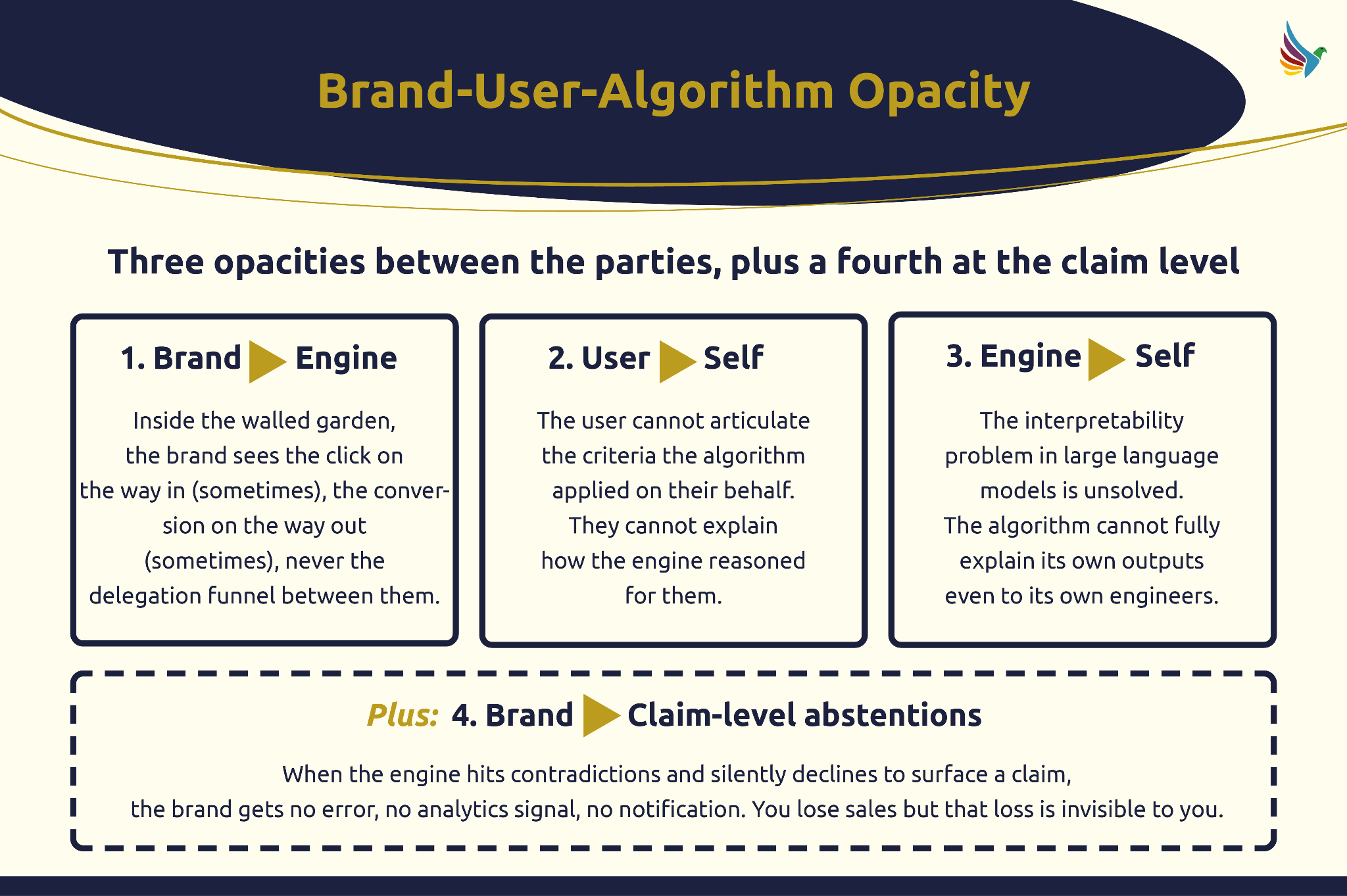
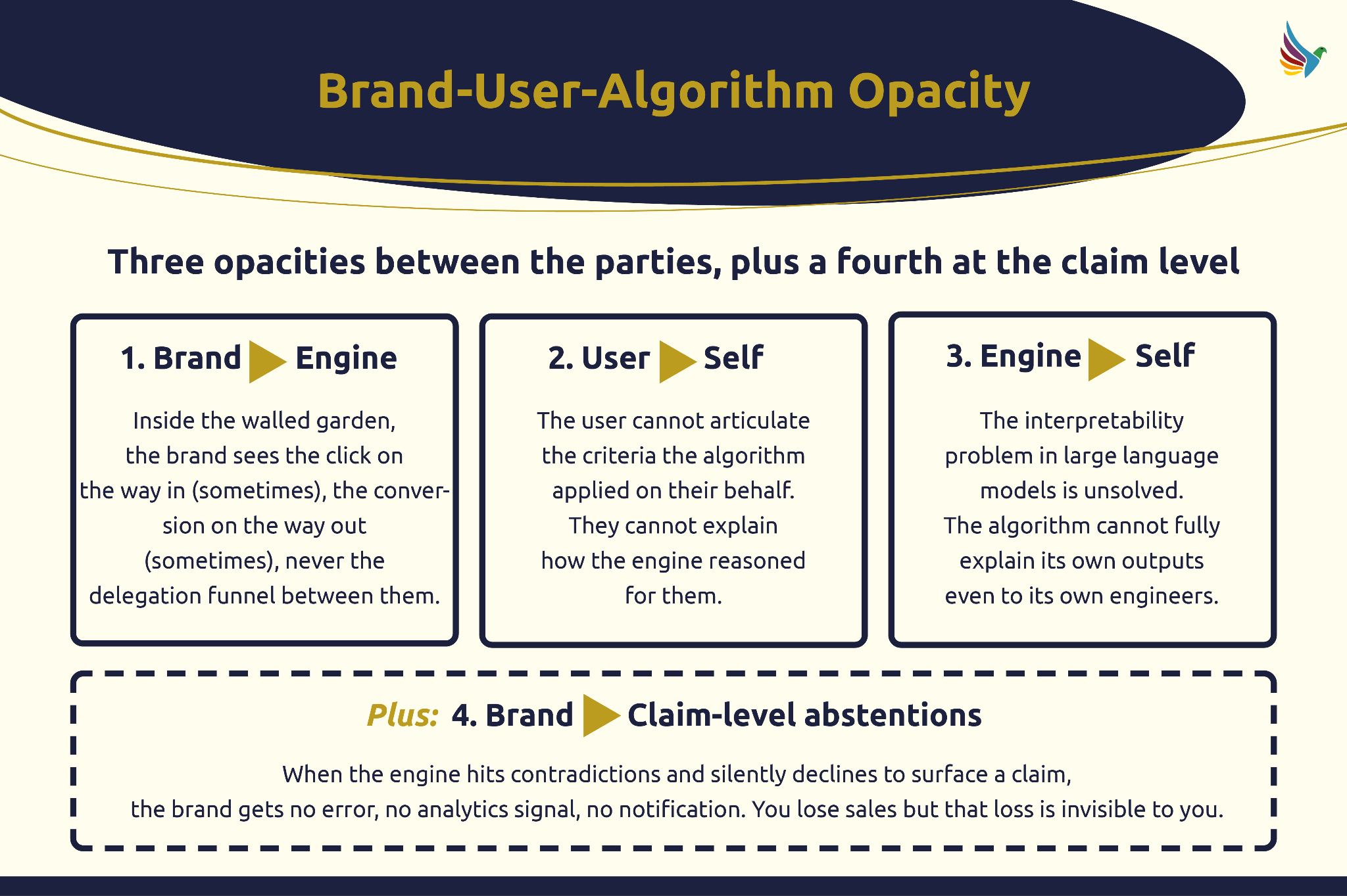
    The AI landscape operates under a brand-user-algorithm (BUA) opacity, where four layers veil every AI-era brand recommendation process.

    ```json
{
  "alt": "The CapmatchOne logo with a gradient circle and bold text.",
  "caption": "Discover innovation with the CapmatchOne logo, featuring sleek typography and a modern gradient circle.",
  "description": "The CapmatchOne logo features bold, modern typography coupled with a gradient circle, symbolizing connection and innovation. The sleek design conveys a sense of progress and creativity. This image can be used for branding or promotional purposes, appealing to audiences interested in innovative solutions and forward-thinking designs."
}
```

    The multi-layered opacity impacts everything from brand perception to conversion rates, and understanding this opacity is crucial.

    Utilizing micro-strategies in an AI environment is futile. Instead, my focus shifts to macro-level insights, acknowledging that consistency over time is key, not momentary precision.
    ```json
{
  "alt": "Comparison of search, assistive, and agentic technologies highlighting their coexistence and different needs.",
  "caption": "Explore how search, assistive, and agentic engines coexist to fulfill distinct needs, from making decisions to providing recommendations and acting on behalf.",
  "description": "This graphic illustrates the coexistence of three types of engines: search (SEO), assistive (AIEO), and agentic (AAO). Each fulfills distinct needs—search engines empower decision-making, assistive engines provide recommendations, and agentic engines act independently. Presented at Google Marketing Live 2026 by Jason Barnard of Kalicube, it emphasizes the varied roles and future of these technologies in digital marketing."
}
```

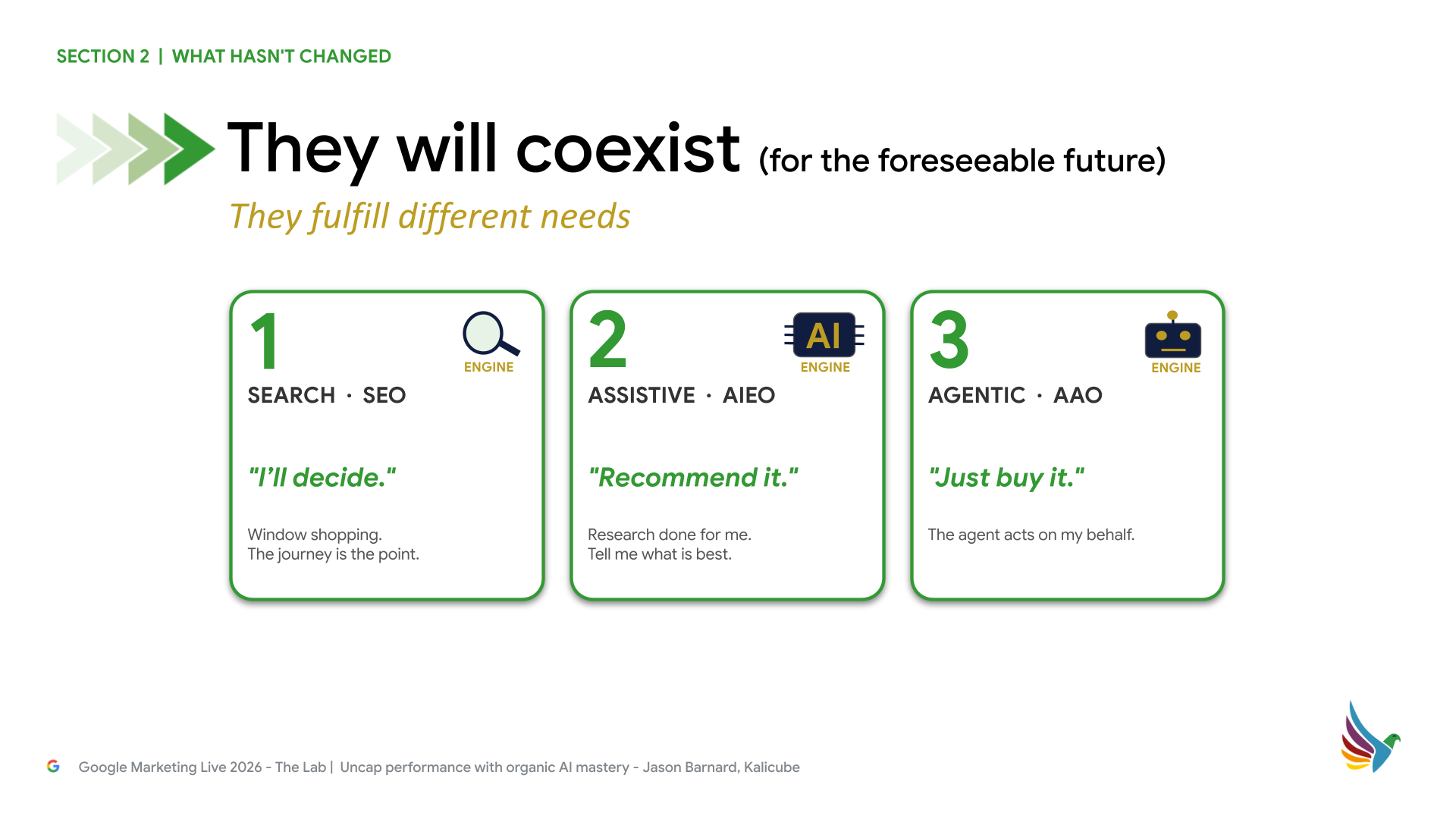
    In 2026, search remains micro, while assistive and agent modes adopt macro approaches. The right measurement strategy for your business hinges on understanding each mode’s environment and data.

    Search enables user control with clear metrics. Having been trained in this mode, I recommend maintaining micro strategies for search-based operations, supplemented by macro methodologies.
    ```json
{
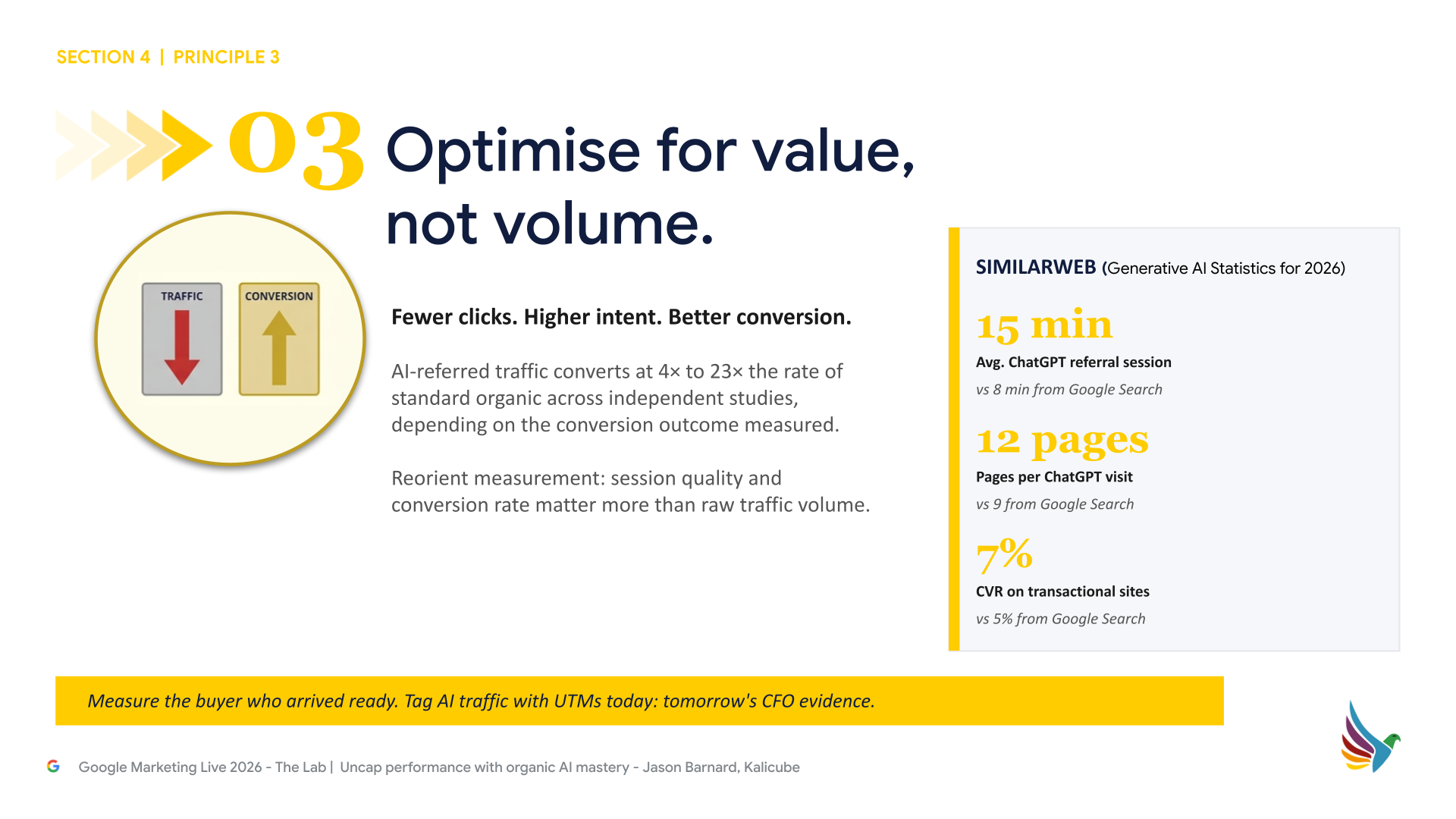
  "alt": "Infographic on optimizing for value, not volume, with statistics from Similarweb on AI-driven traffic.",
  "caption": "Unlock the power of AI-driven traffic with a focus on value, not volume. Insights reveal better conversion rates with fewer clicks.",
  "description": "This infographic highlights the principle of optimizing for value over volume in digital marketing. It includes statistics from Similarweb for 2026, showing AI-referred traffic results in longer sessions and higher conversion rates compared to Google Search. Key details suggest focusing on quality sessions and conversion rates. Use AI insights for effective marketing strategies."
}
```

    Assistive recommendations come from engines like ChatGPT. Unfortunately, I can’t see the decision data, making micro assessments impossible and macro the only viable option.

    Agents autonomously make purchases, providing a clear but limited view of their decision-making. The conversion insight remains macro, even if initiation is observable.
    ```json
{
  "alt": "Infographic illustrating Brand-User-Algorithm Opacity with four opacities between parties, highlighting communication gaps.",
  "caption": "Exploring the hidden complexities in brand, user, and algorithm interactions, this infographic unveils the layers of opacity and communication breakdowns.",
  "description": "This infographic titled 'Brand-User-Algorithm Opacity' outlines communication gaps in digital interactions. It highlights three opacities: Brand to Engine, User to Self, and Engine to Self, each describing challenges in understanding and communication. A fourth opacity at the claim level is also presented, emphasizing issues with algorithmic decision-making and brand awareness. The visual uses simple text boxes with dashed outlines to represent these complex ideas, aiming to shed light on the unseen issues in modern digital ecosystems. Keywords: Brand, User, Algorithm, Opacity, Communication."
}
```

    Given buyers’ ever-changing reliance on different surfaces, adopting a macro approach remains inevitable, ensuring I stay adaptable to any environment they opt into.

    As I shift forward with macro metrics, measuring becomes more about trends. Tracking consistent methodologies over eight quarters offers reliable strategic clarity.

    In the busy world of AI decision-making, patience and consistency are key to staying ahead. I prioritize stable methodologies to gain competitive insights over time.


    Inspired by this post on Search Engine Land.


    crushpress.ai community screenshot
  • Mastering AI Visibility: A New Framework for Success

    Mastering AI Visibility: A New Framework for Success

    I often get asked in 2026, “How do we measure this?” when it comes to AI visibility.

    People want to know if their brand is appearing in ChatGPT or if Perplexity is recommending them. They also wonder if their work on AI grounding last quarter made any impact.

    The truth is, the solution doesn’t exist yet. Anyone offering a straightforward dashboard for tracking your brand’s presence in AI spaces across search, assistive, and agent modes is just making an educated guess.

    Tracking queries we assume users might ask, or adapting search keywords as a best guess, won’t cut it. These prebuilt lists often miss the mark as they choose easily mapped or ideal scenarios that don’t reflect reality.

    ```json
{
  "alt": "The CapmatchOne logo with a gradient circle and bold text.",
  "caption": "Discover innovation with the CapmatchOne logo, featuring sleek typography and a modern gradient circle.",
  "description": "The CapmatchOne logo features bold, modern typography coupled with a gradient circle, symbolizing connection and innovation. The sleek design conveys a sense of progress and creativity. This image can be used for branding or promotional purposes, appealing to audiences interested in innovative solutions and forward-thinking designs."
}
```

    The visibility question itself is valid, but the precise answer everyone seeks simply isn’t feasible.

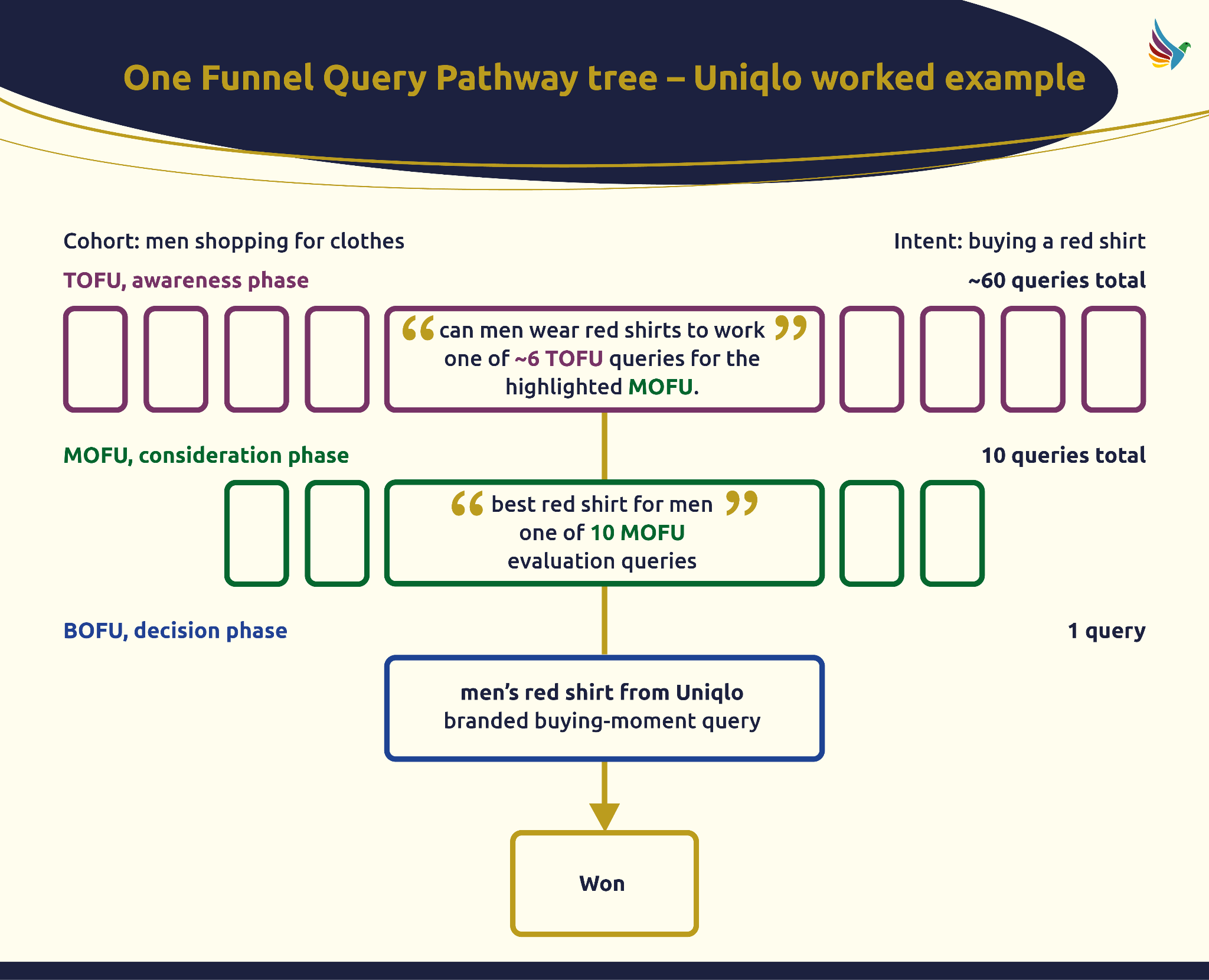
    Brands looking for perfect AI-era visibility KPIs are chasing a mirage. Instead, we need a methodology inspired by economic measurement of complex systems—this is where my Funnel Query Pathway comes in.

    This unique approach serves as strategy, measurement, and analysis, unlike traditional metrics that were reliable when search rankings were predictable and measurable.

    ```json
{
  "alt": "Flowchart of One Funnel Query Pathway for Uniqlo showing awareness, consideration, and decision phases for buying a red shirt.",
  "caption": "Explore the buyer's journey with Uniqlo through the funnel stages: awareness, consideration, and decision, to find the perfect red shirt.",
  "description": "This image illustrates the One Funnel Query Pathway tree specific to a Uniqlo example, focusing on the process of buying a red shirt. The chart outlines three key phases: TOFU (Top Of Funnel) awareness phase with about 60 queries, MOFU (Middle Of Funnel) consideration phase with 10 queries, and BOFU (Bottom Of Funnel) decision phase with one query. It highlights customer intent and the transition from general clothing interest to a specific Uniqlo product. Keywords: Uniqlo, funnel, query pathway, buyer's journey, clothing purchase process."
}
```

    Now, we must rethink our approach in a complex AI landscape, asking new questions and measuring different signals.

    I studied economics at Liverpool John Moores University, which gives me a unique perspective on measurement challenges where traditional tools fail at larger scales.

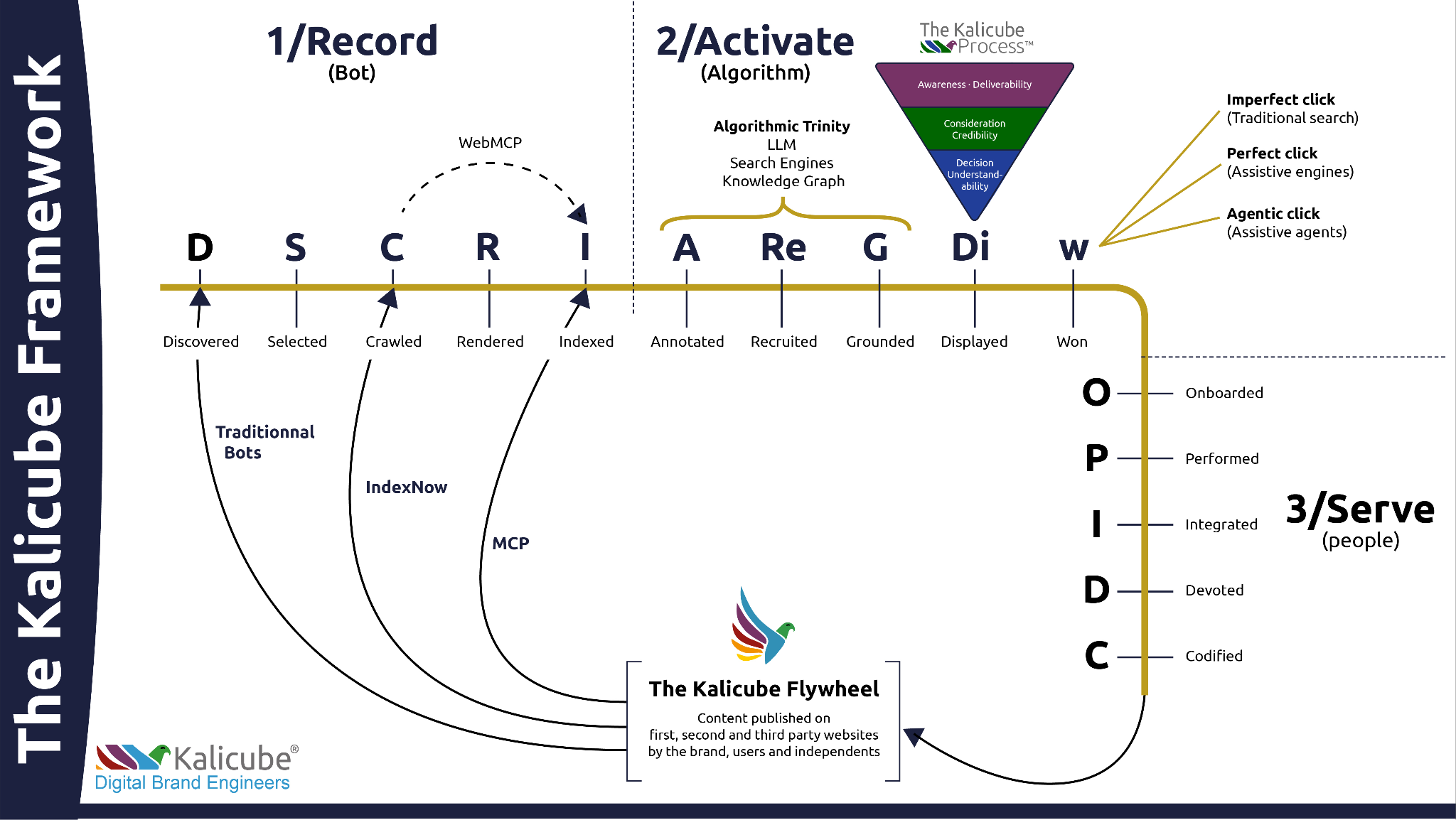
    As with macroeconomics dealing with vast, unobservable systems, AI visibility is too opaque and personalized for old tools. We need macro principles to guide AI-era brand measurement.

    ```json
{
  "alt": "Kalicube Framework diagram illustrating the process from Record, Activate to Serve.",
  "caption": "Explore the Kalicube Framework: a strategic process from recording data to activating algorithms and serving people.",
  "description": "This image presents the Kalicube Framework, detailing a process divided into three phases: Record (bots), Activate (algorithm), and Serve (people). It includes stages such as discovery, rendering, indexing, and final delivery, with emphasis on algorithmic trinity—LLM, search engines, and knowledge graph. Accompanied by concepts like traditional and perfect clicks, the framework highlights the evolution of digital engagement strategies. Keywords: Kalicube, digital branding, algorithm, framework."
}
```

    AI systems have similar structural complexities as macroeconomics:

    Opacity hinders visibility into the system’s state, with AI algorithms operating like a black box. Personalization means users receive unique outputs from the same inputs, influencing the visibility paths.

    With expanding possibilities across apps, systems, and devices, AI environments now introduce variables that weren’t present in traditional search models.

    The Funnel Query Pathway methodology focuses on these macro aspects, shifting away from keyword mapping to a broader approach focused on cohorts and intent at the node level.

    AI-era acquisition begins at the conversion moment projected upward, contrary to traditional funnel methods.


    Inspired by this post on Search Engine Land.


    crushpress.ai community screenshot