Job listings have a timing problem: they can change or expire before ordinary crawling catches up. Google’s Indexing API appears to solve that problem by accepting notifications when eligible pages are created, updated, or removed.
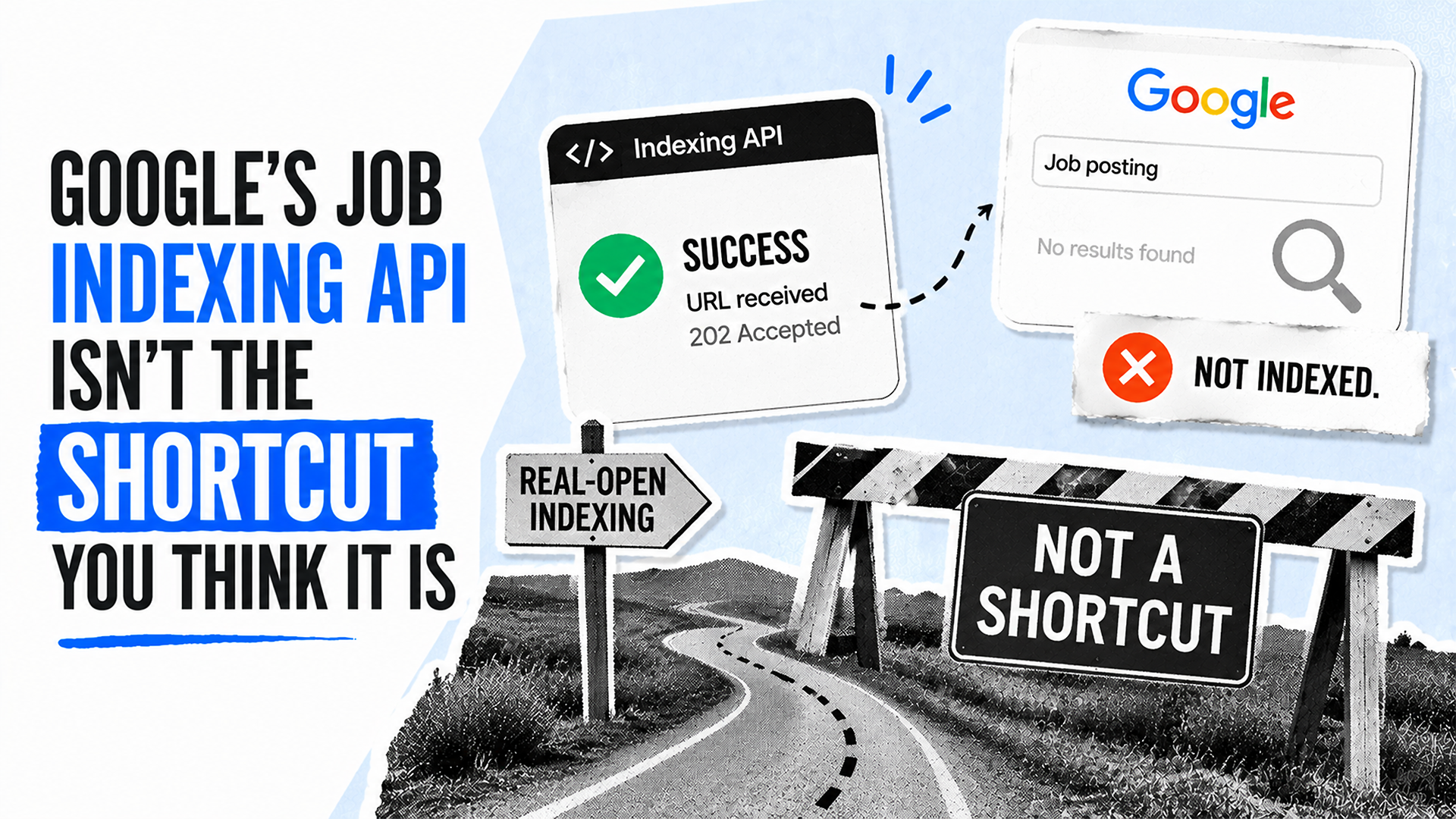
The important limitation is that an accepted request confirms delivery of a notification, not the outcome a job board ultimately needs. Understanding that distinction helps teams measure the API accurately and avoid treating clean server responses as proof of search visibility.
A notification is only the first event in the chain
According to Search Engine Land, a successful API request means Google received the submission. It does not establish that Google crawled the page, added it to the index, displayed it in the Google Jobs experience, or generated traffic from it.

Those are separate stages with separate evidence requirements:
- Submitted: The site’s system sent a notification.
- Accepted: Google returned a successful response to that request.
- Crawled: Google fetched the page.
- Indexed: Google made the page eligible to appear in search.
- Visible and productive: The listing earned impressions, clicks, or conversions.
A reliable reporting setup should preserve these distinctions. Otherwise, an operational metric such as API acceptance can be mistaken for an SEO result.
Key takeaways
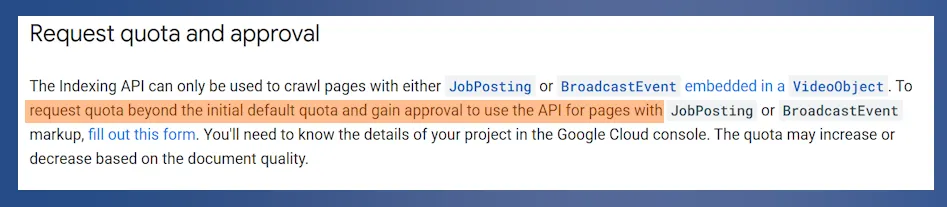
- The Indexing API is restricted to eligible job-posting and livestream pages; it is not a general acceleration tool for arbitrary URLs.
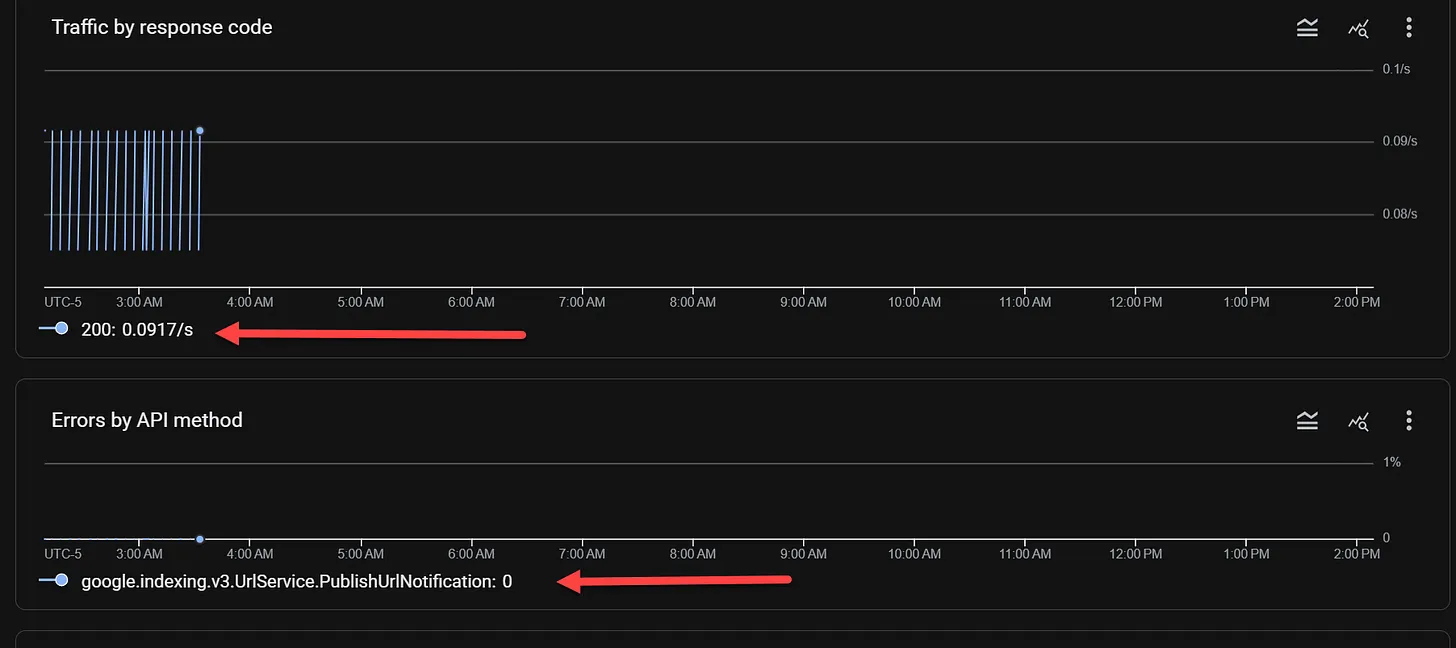
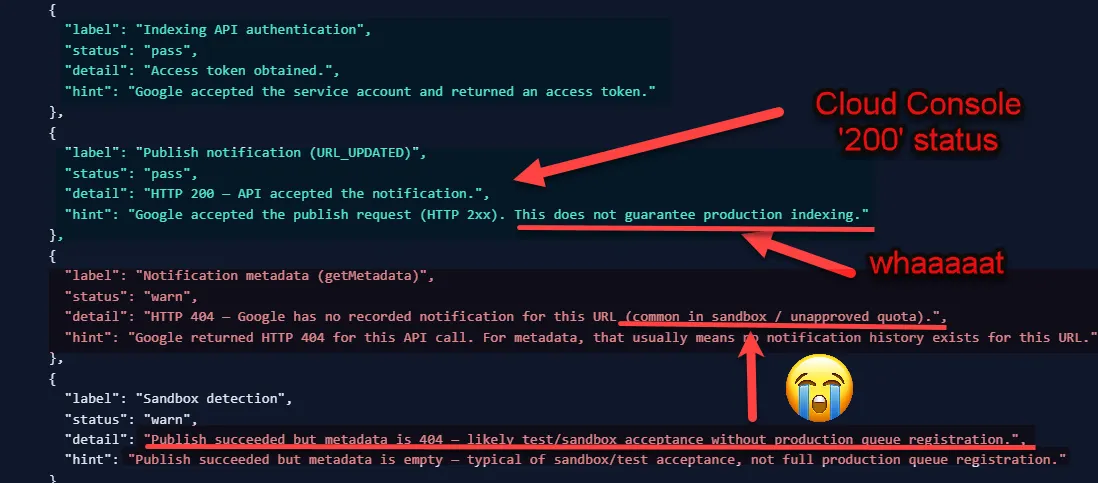
- An HTTP 200 response confirms receipt, not crawling, indexing, removal, ranking, or traffic.
- Notification metadata describes submissions rather than the current index status of a page.
- Quota availability and successful test requests do not necessarily prove that an account has production access.
- Job boards should validate structured data, API behavior, and search status as separate layers.
The API has a narrow, defined scope
Search Engine Land reports that Google permits the API for pages carrying JobPosting structured data and for livestream pages using BroadcastEvent within a VideoObject. Blog posts, product pages, category archives, service pages, and other ordinary URLs are outside that stated use.
For an eligible job page, the two relevant notification types are straightforward. URL_UPDATED can be sent when a listing is published or meaningfully changed. URL_DELETED can be sent when the listing has been removed and should no longer remain indexed.
Even here, the request is not a command. The source notes that Google’s documentation says the company may recrawl a URL after an accepted update request and may remove one after an accepted deletion request. That wording preserves Google’s control over what happens next.
Metadata, sandbox access, and quotas require careful reading
The API’s getMetadata capability can help confirm the history of update and deletion notifications for a URL. It cannot answer the larger question of whether that URL is currently crawled, indexed, removed, or receiving exposure. Metadata is therefore useful for diagnosing the submission pipeline, but it is not an index-status report.

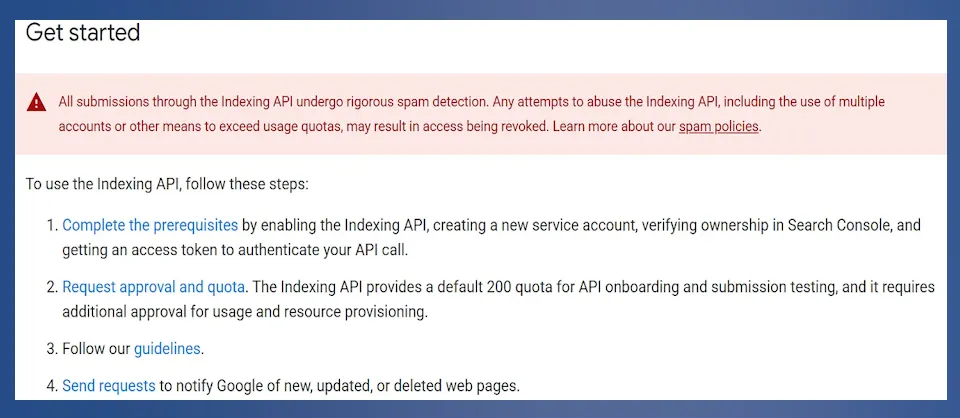
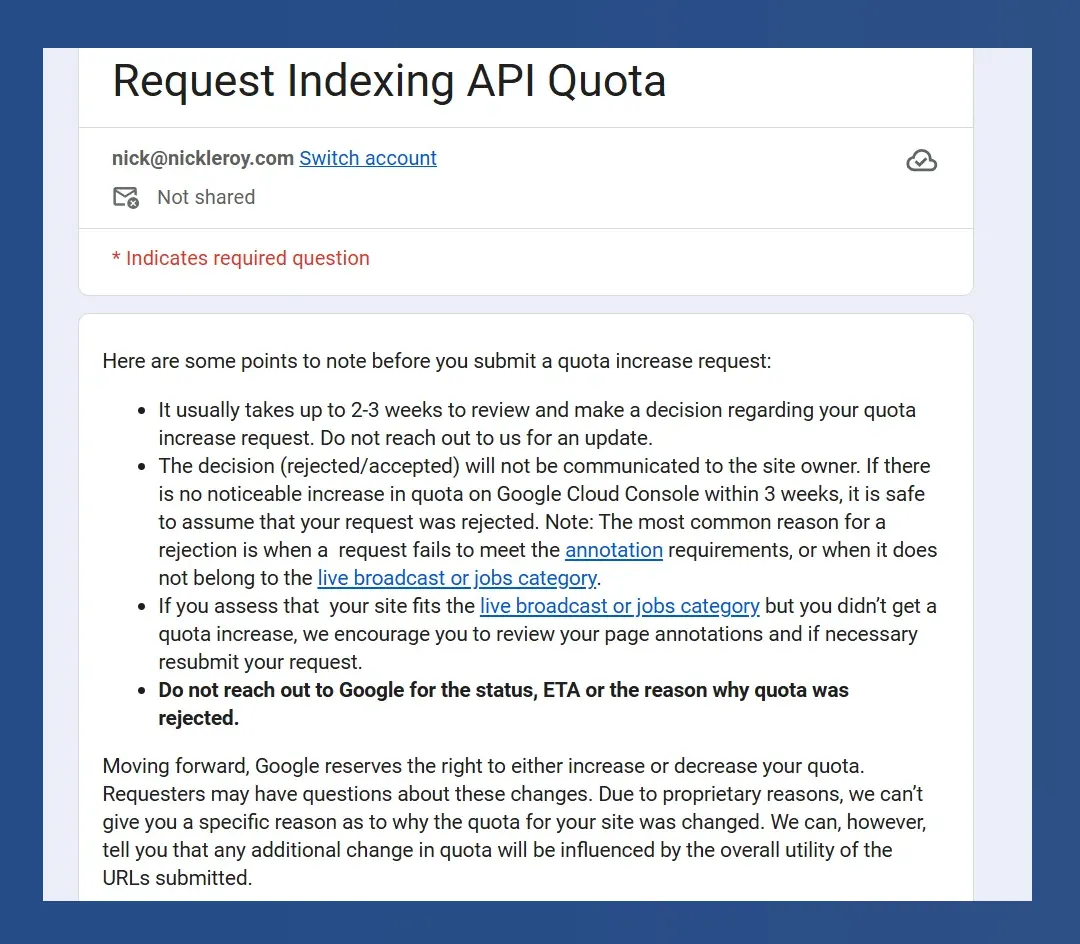
Access also has an onboarding dimension. Search Engine Land says Google’s quickstart documentation describes a default quota of 200 requests for onboarding and submission testing, with further approval required for usage and resource provisioning. A visible quota or apparently successful test can therefore create confidence without demonstrating full production service.

The source also reports approval delays, but the evidence should be treated as observational rather than definitive. The article’s author said two job-board requests had received no response after six months in 2026. Alexander Chukovski reportedly said none of the job boards he worked with over roughly 10 to 12 months received a response. These accounts suggest that approvals may have become harder to obtain, but they do not prove that Google has stopped processing every request.
How job boards can validate the system responsibly
A practical audit should test the implementation in layers rather than seeking one all-purpose success signal:
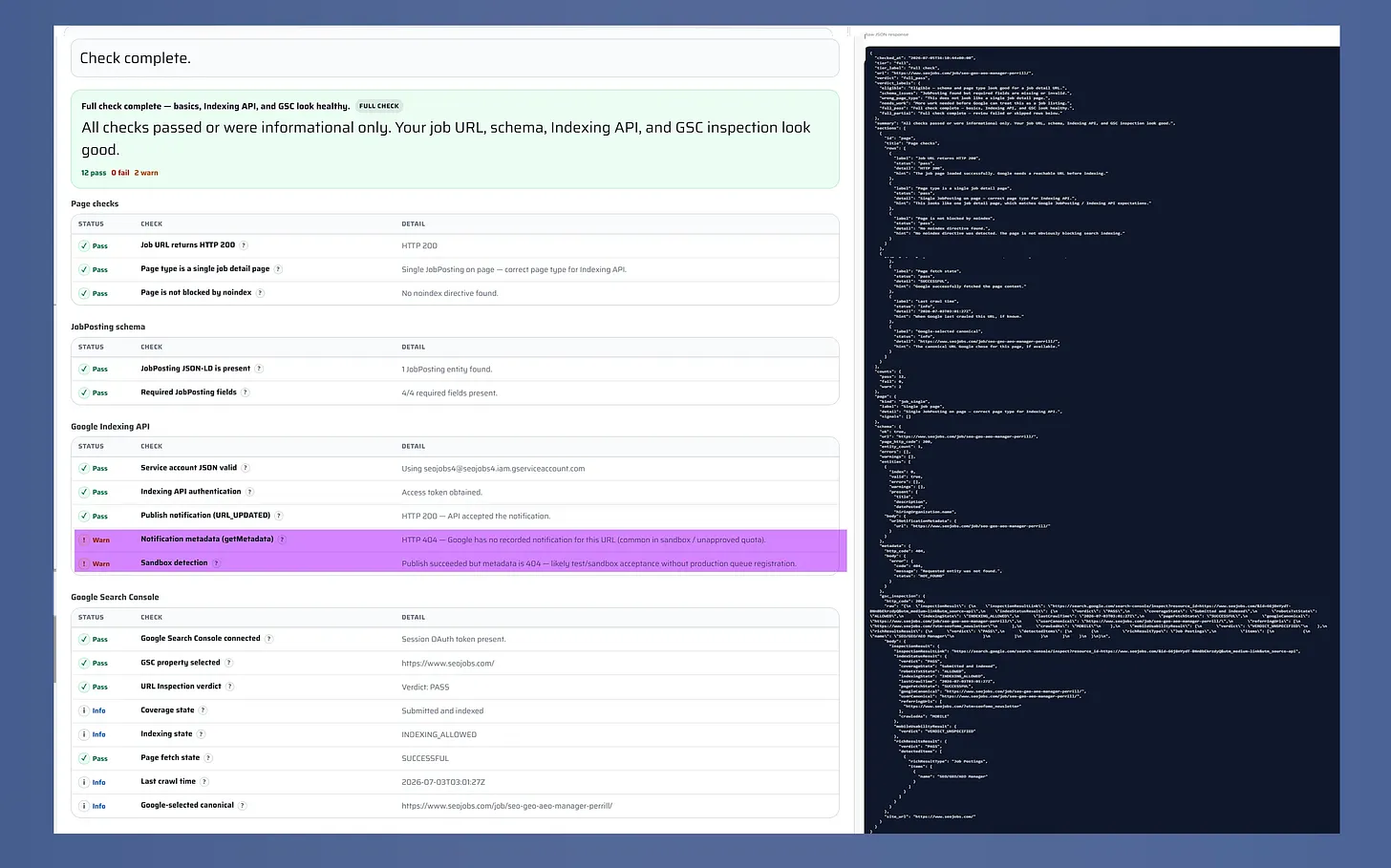
- Confirm that the URL represents a supported job posting and contains the required structured data.
- Verify that update and deletion requests use the appropriate notification type.
- Record response codes and notification metadata as evidence of API delivery only.
- Check crawling, indexing, and search performance through appropriate search diagnostics instead of inferring them from the API response.
- Track expired listings separately so removal can be verified rather than assumed.
The source highlights a free Job Indexing Health Check on SEOJobs.com that can review job schema and, in its fuller mode, API and Google Search Console responses. Whether teams use that tool or their own diagnostics, the sound approach is the same: measure each stage according to what its evidence can actually prove.
For job boards, the API can remain a useful notification channel. Its value becomes clearer, not weaker, once acceptance is treated as the beginning of verification rather than the finish line.
Inspired by this post on Search Engine Land.