
Have you ever felt like there’s a disconnect between what your webpage is saying and what your audience is actually searching for? You’re not alone. This mismatch has always existed, but the stakes have become much higher now.
When your page doesn’t align with user intent, it risks not appearing on AI-powered search platforms. Instead, search engines will prioritize pages that fulfill user needs more precisely. Although the gap is apparent, quantifying it can be challenging. Luckily, Google’s Search Console holds the key to unlocking this data.
Analyzing your pages can reveal how well your content aligns with the searches your audience is conducting. Here, I’ll guide you through the process of measuring these intent gaps using a free tool.
The tool uses your Google Search Console data to compare the positioning of your page with real search demand. It gives you insight into where your content aligns or falls short, helping you identify areas for improvement.

Now, let’s dive into how we can measure the gap between your page’s positioning and audience demand.
Measuring the Gap Between Positioning and Demand
I’ve noticed that most web content today is designed to cater to multiple target audiences, sometimes aiming for tens or hundreds of keywords alongside brand positioning. This can cause the content to drift away from addressing the problems people are trying to solve.
Numbers can create urgency and inspire action in a way that observations alone cannot. The data you need is right there in your Google Search Console. The intent gap analysis tool will harness that data, providing you with numbers and insights.

This tool captures what your audience searches for when they find each page, comparing it with the page’s meta description. It scores the distance between these elements, giving you a clear picture of how well your content aligns with audience queries.
Connecting Positioning to Demand
Meta descriptions should indeed serve as a compelling pitch, convincing users that your page holds what they’re seeking, as outlined in Google’s Search Central documentation.
For AI ecosystems, achieving durable visibility requires consistent use of metadata, provenance, and trust signals interpretable by search crawlers and generative engines. An anchor in audience behavior, like those found in Google Search Console, is crucial for evaluating meta descriptions accurately.

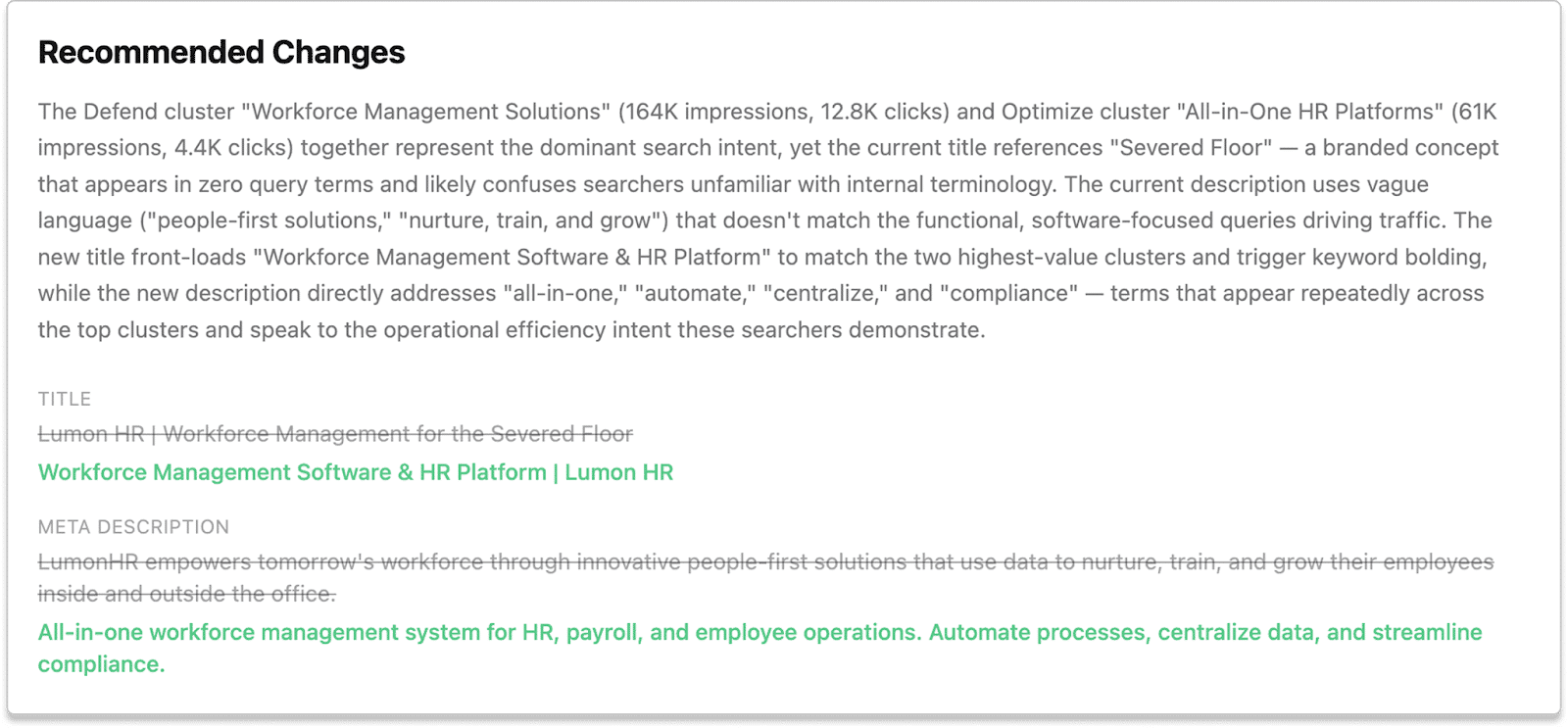
The intent gap analysis tool expresses this gap with a score, helping you to see exactly where your page aligns with demand—and where it doesn’t. An example from a fictional SaaS platform showed that vague language in the meta description failed to attract the intended software-focused audience.
Why Intent Is Measurable Now
Search engines now rely heavily on vector embeddings to match content with queries, focusing on meaning rather than just keywords.
These embeddings provide a glimpse into how search engines perceive content, using semantic similarity as a key factor to determine which pages should be shown to users.

Where Existing Tools Stop
Traditional tools like N-gram analysis and TF-IDF have their limitations, as they focus on matching words rather than understanding intent.
While these methods can highlight repeated phrases or important terms, search engines are more concerned with meaning. This means that relying solely on word-matching puts you at a disadvantage.
Measuring Meaning, Not Words
Vector embeddings allow us to plot meta descriptions and audience queries on the same map. This helps us measure the distance between them, revealing gaps where the demand isn’t being met.
By understanding this distance, we can ensure our content addresses what the audience is actually searching for.
Your Data, Your Score: Running the Intent Gap Analysis
To run the analysis on your own pages, you’ll need to follow a few steps with the provided tool.
The process involves exporting your page data from Google Search Console and uploading it to the tool for scoring. You can then explore a detailed map of alignment and demand, review the breakdown by cluster, and receive rewrite recommendations to better capture your audience’s attention.
Understanding this data allows you to make informed decisions about your content strategy, ensuring you’re meeting audience demand more effectively.
Turning the Score into a Decision
The intent gap score translates the gap into actionable insights. It helps guide conversations around either modifying or defending specific page elements.
By closely monitoring these signals, you can adapt and ensure that your content continues to meet evolving audience needs. The tool created by Robin Tully, co-founder at Forecast.ing, empowers us to bridge these gaps effectively.
Inspired by this post on Search Engine Land.
