Tag: Google Reviews

  • Google Review Glitch: Missing Reviews Under Investigation

    Google Review Glitch: Missing Reviews Under Investigation

    I’m tracking a growing Google Business Profile issue after several days of complaints from businesses that say reviews have disappeared from their local listings. Google has now confirmed that it is investigating the reports, and in some cases, review submissions on affected profiles appear to be paused.

    What Google said. Google told us that when its systems detect suspicious review activity, it may take several actions, including removing reviews and temporarily pausing reviews on a profile to prevent further abuse. Google also said it is investigating the issue and will restore any reviews that were incorrectly removed.

    What I’m seeing. As I documented on the Search Engine Roundtable, there are dozens of complaints in the Google Business Profile Forums from business owners and local SEOs who say their reviews have mysteriously vanished. In some cases, businesses are also unable to receive new reviews on their local listings.

    From what I can tell, Google’s review spam detection systems may be identifying certain patterns and aggressively removing or blocking reviews on suspected Google Business Profiles. What remains unclear is whether this is tied to spammers abusing some profiles, a recent algorithmic adjustment, or Google’s systems becoming overly sensitive.

    More details. Amy Toman, a volunteer Google Product Expert for Google Business Profiles, shared on LinkedIn that businesses or clients affected by this issue can post in the forum if they want to, but Google is already aware of the problem and working on it. She also noted that no timeline for a resolution has been provided yet.

    She said she is seeing a new pattern where, after fake or spam reviews are reported, some Google listings receive a review block and all reviews are hidden. In at least one case, she said the rating was reduced to 0.

    Why I care. If I noticed a sudden drop in reviews or stopped receiving new reviews this week, I would consider this issue a likely explanation. For local businesses, reviews can directly affect trust, visibility, and customer decisions, so even a temporary review disruption can be frustrating.

    Google is investigating, and I’m watching to see whether missing reviews are restored and whether affected Google Business Profiles can begin receiving new reviews again.


    Inspired by this post on Search Engine Land.


    crushpress.ai community screenshot
  • Google Ask Maps SEO: Earn Visibility Through Trust

    Google Ask Maps SEO: Earn Visibility Through Trust

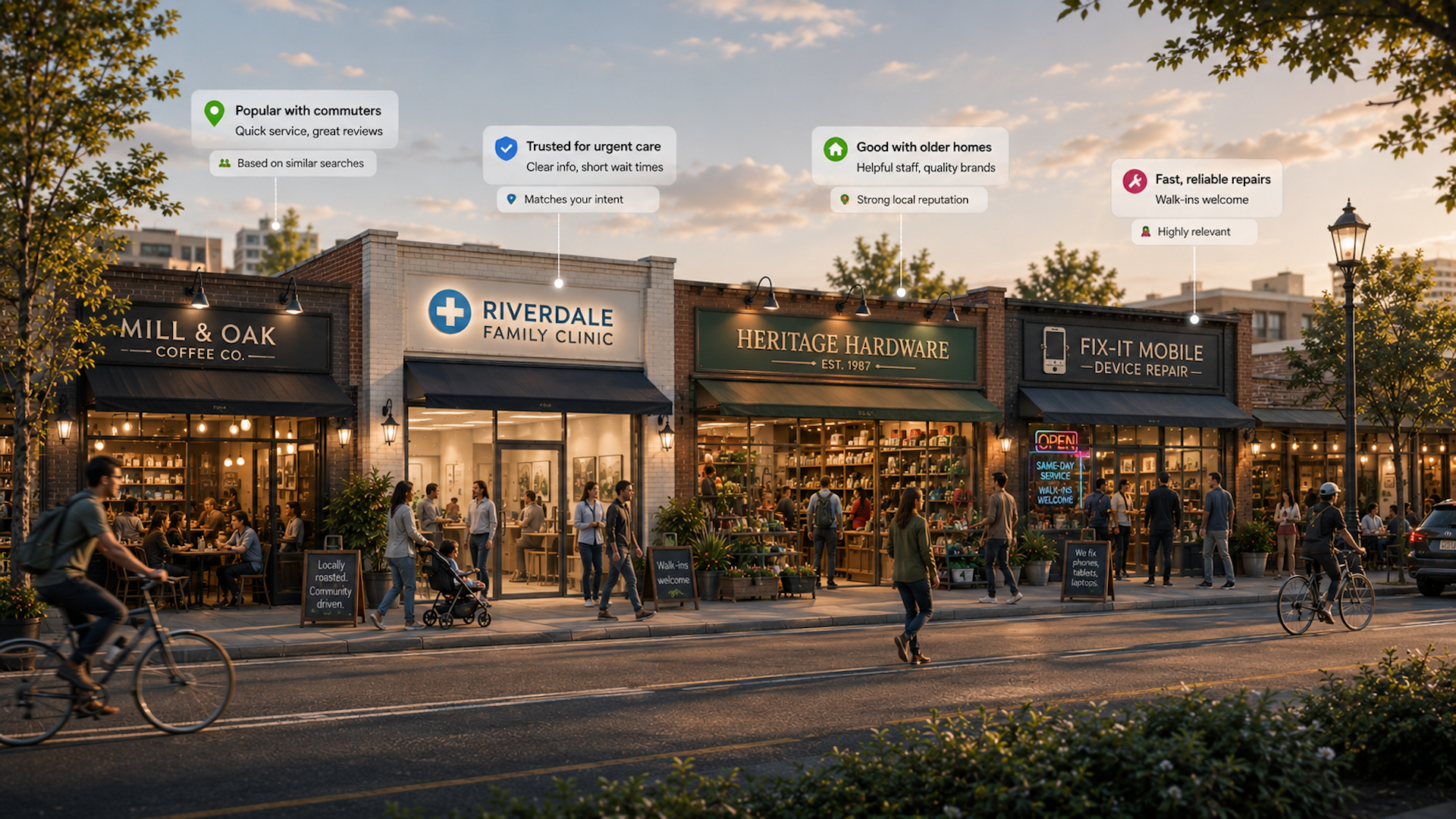
    I see Google Ask Maps changing local visibility in a meaningful way. Instead of showing people a long list of nearby businesses and leaving them to sort through everything, Ask Maps narrows the options, interprets the searcher’s intent, and explains why certain businesses look like a strong fit.

    That changes how I think about local SEO. Visibility is no longer only about ranking somewhere near the top of a long results list. It is increasingly about whether Google understands a business well enough to recommend it with confidence.

    I would not treat Ask Maps as a separate optimization channel or a brand-new tactic to chase. I would focus on making the business easier for Google to understand, easier to match to real customer situations, and easier to trust. The foundations of local SEO still matter, but the way those signals work together matters even more.

    Visibility in Ask Maps starts with filtering

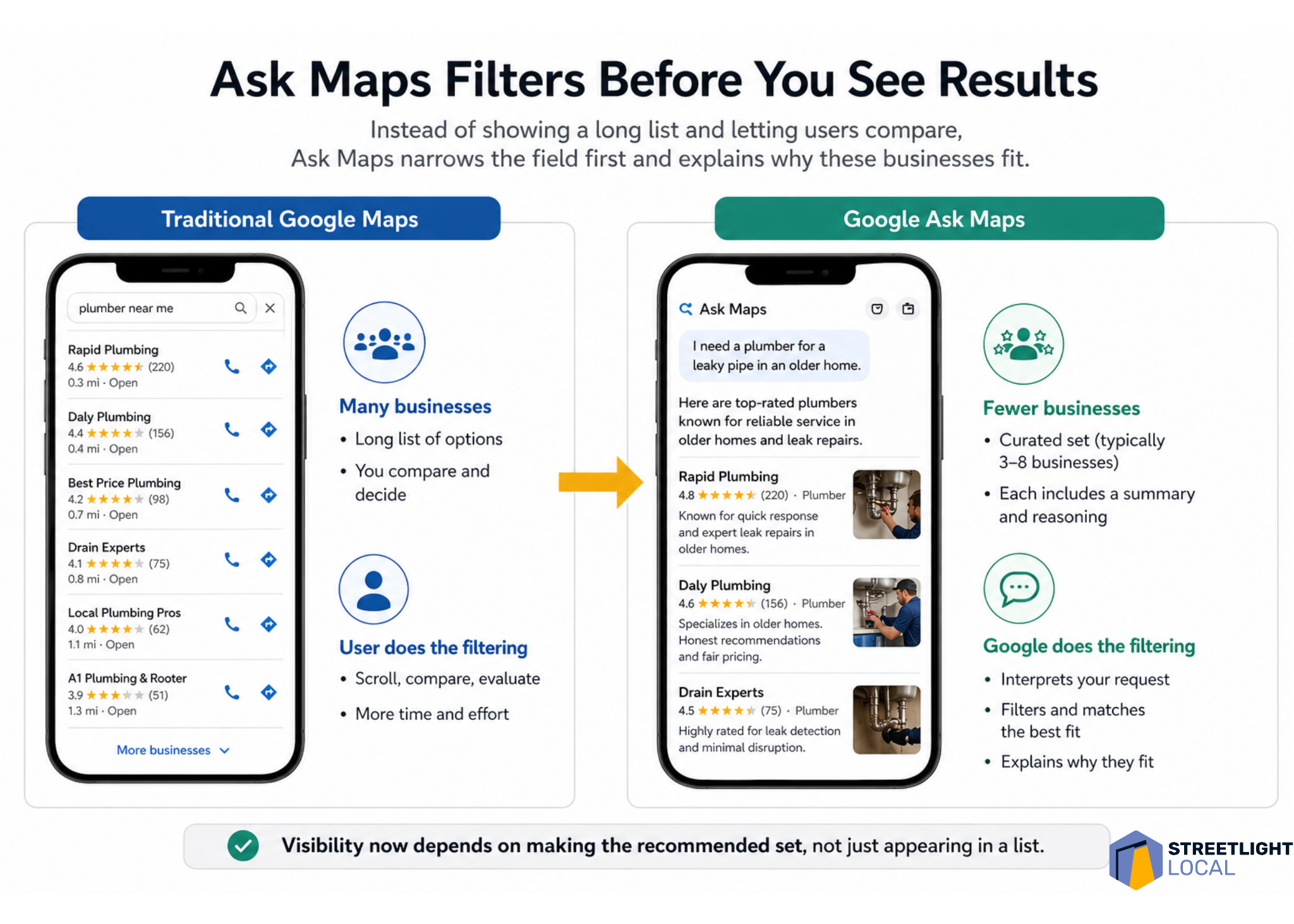
    One of the first things I notice about Ask Maps is how small the result set can be. In testing, it often showed around three to eight businesses, depending on the query. That feels very different from traditional Google Maps, where people can scroll through dozens of options and compare them on their own.

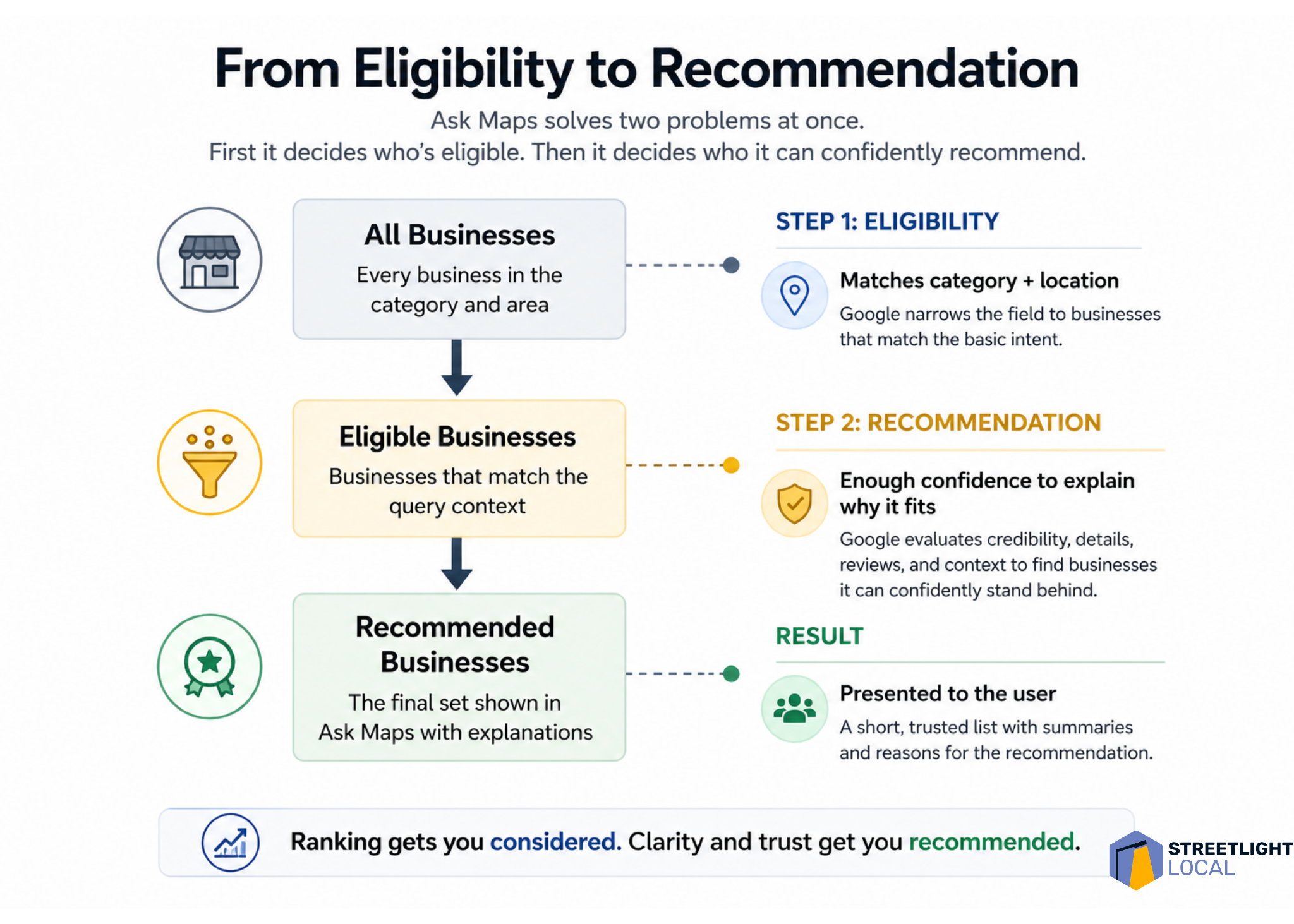
    With Ask Maps, much of that comparison happens earlier. Google filters the market first, interprets what the person is really asking for, and then presents a smaller group of businesses with an explanation of why each one fits.

    That means I have to think beyond the question of whether a business ranks. I also have to ask whether Google has enough confidence to include that business in a short recommendation set and explain why it belongs there.

    ```json
{
  "alt": "Flowchart illustrating Ask Maps process from eligibility to recommendation for businesses.",
  "caption": "Discover how Ask Maps efficiently determines business recommendations, ensuring clarity and trust in every listing.",
  "description": "This infographic explains the Ask Maps process from selecting eligible businesses to making confident recommendations. It shows three stages: all businesses, eligible businesses, and recommended businesses, detailing how Google evaluates category, location, credibility, and reviews. This visual provides a step-by-step guide to how trust and clarity improve business rankings and recommendations, branded by Streetlight Local."
}
```

    I think of this as a two-step problem. First, Google decides which businesses are eligible for the query. Then, it decides which eligible businesses it can confidently recommend.

    Ask Maps needs enough detail to explain the business

    Ask Maps does more than list businesses. It interprets and describes them. Even for simple searches, I often see businesses framed around qualities such as responsiveness, experience, specialization, professionalism, or the kinds of situations they seem best suited for.

    That creates a different optimization challenge. It is not enough for Google to know that a business exists or that it offers a basic service. Google needs enough information to answer a more practical question: when should this business be recommended?

    To support that, I want Google to understand the types of jobs the business handles, the situations it commonly deals with, the concerns customers usually have, and how the business approaches those situations.

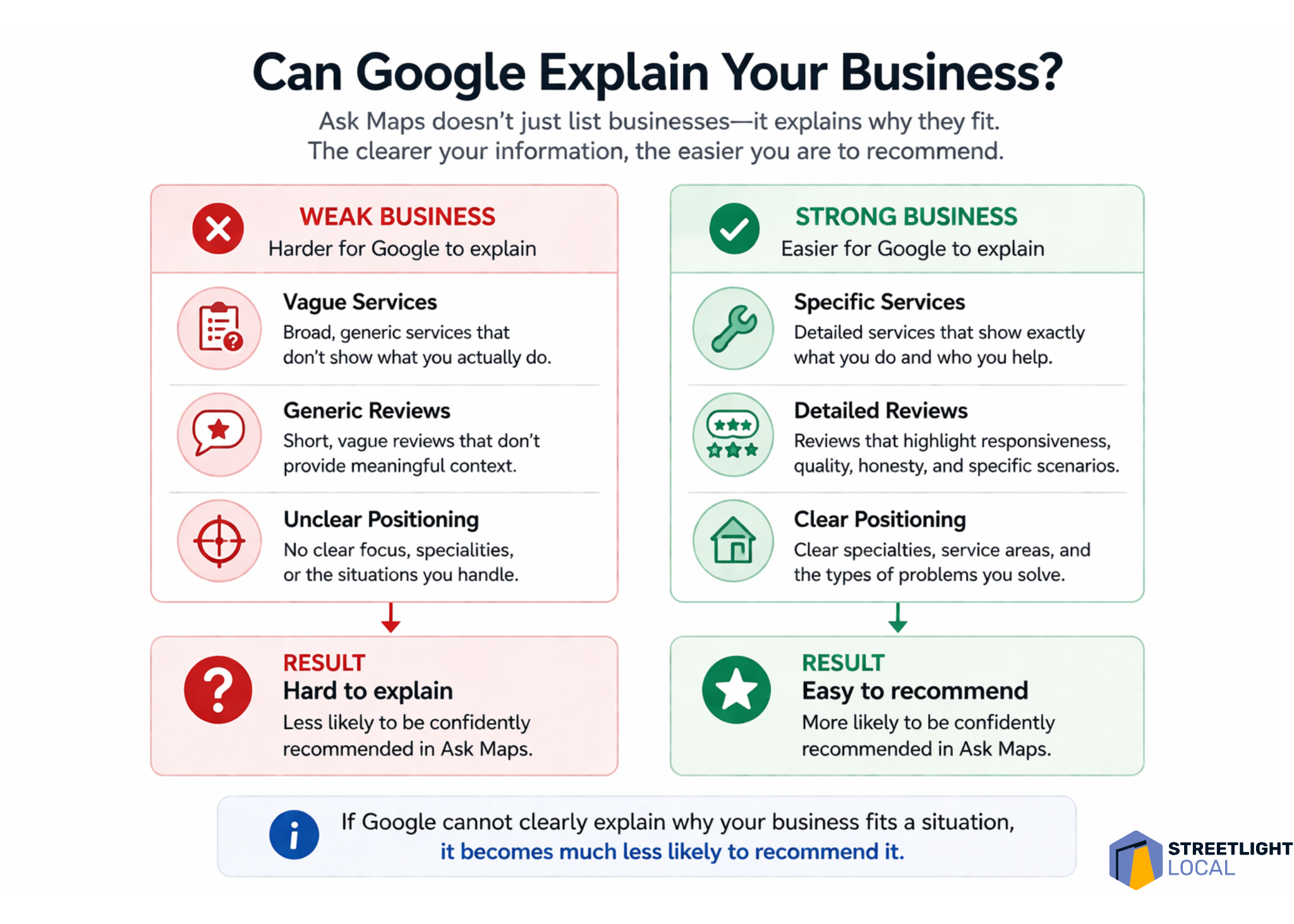
    If that information is vague, scattered, or inconsistent, Ask Maps has less to work with. When Google cannot clearly explain why a business fits a specific situation, I would expect that business to be less likely to appear as a recommendation.

    ```json
{
  "alt": "Comparison between Traditional Google Maps and Google Ask Maps with highlighted features and filtering process.",
  "caption": "Discover the efficiency of Google Ask Maps, a tool that pre-filters search results, providing users with top-rated options and reasons for selection.",
  "description": "This image illustrates the difference between Traditional Google Maps and Google Ask Maps interfaces. Traditional Maps display a long list of business options, requiring user filtering. In contrast, Ask Maps pre-filters results to show a curated list of top businesses with rationales. The image features two smartphones displaying both app interfaces and icons highlighting user experience differences. It emphasizes Ask Maps' efficiency in offering tailored recommendations, saving users time and effort."
}
```

    Google Business Profile becomes the identity layer

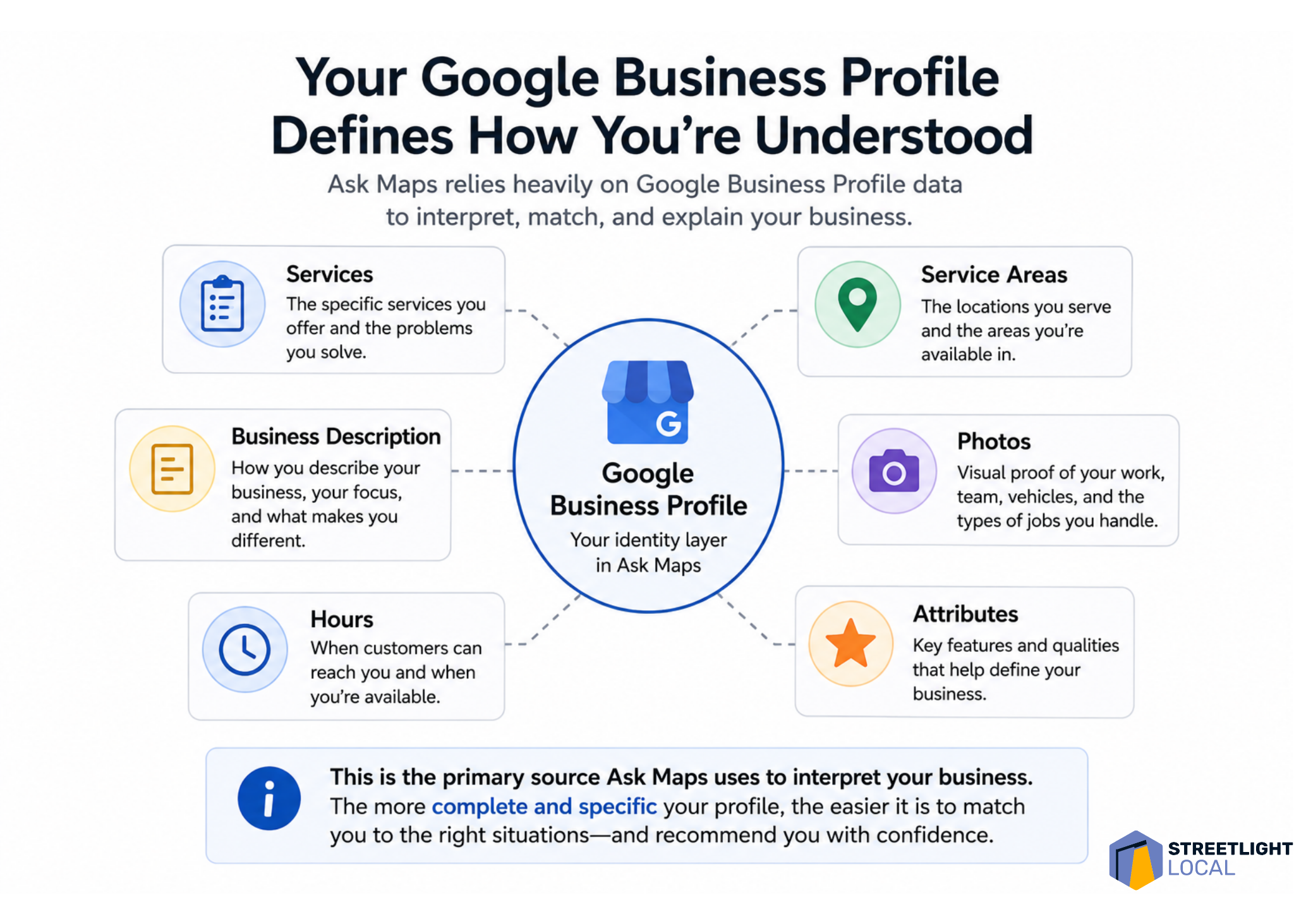
    For me, the Google Business Profile sits at the foundation of this whole process. In earlier-stage queries, Ask Maps appears to rely heavily on profile data, including business descriptions, services, reviews, ratings, hours, and operational details.

    Many businesses still treat their profile like a basic listing to fill out and keep current. That is necessary, but I do not think it is enough for an environment where Google is trying to describe and recommend businesses. The profile needs to communicate a clear, specific identity.

    A generic profile might say that a business offers plumbing, HVAC, electrical work, or another broad service. A stronger profile clarifies the kinds of problems it handles, the situations it is built for, and the details that make it useful to specific customers.

    For example, I would use the profile to reinforce details such as emergency availability, response times, specific repair or installation types, experience with older homes, complex systems, or common customer problems the business solves.

    That level of specificity gives Google more direct evidence. Instead of forcing the system to infer what the business is known for, I want the profile to make that identity clear.

    ```json
{
  "alt": "The CapmatchOne logo with a gradient circle and bold text.",
  "caption": "Discover innovation with the CapmatchOne logo, featuring sleek typography and a modern gradient circle.",
  "description": "The CapmatchOne logo features bold, modern typography coupled with a gradient circle, symbolizing connection and innovation. The sleek design conveys a sense of progress and creativity. This image can be used for branding or promotional purposes, appealing to audiences interested in innovative solutions and forward-thinking designs."
}
```

    Reviews shape positioning, not just credibility

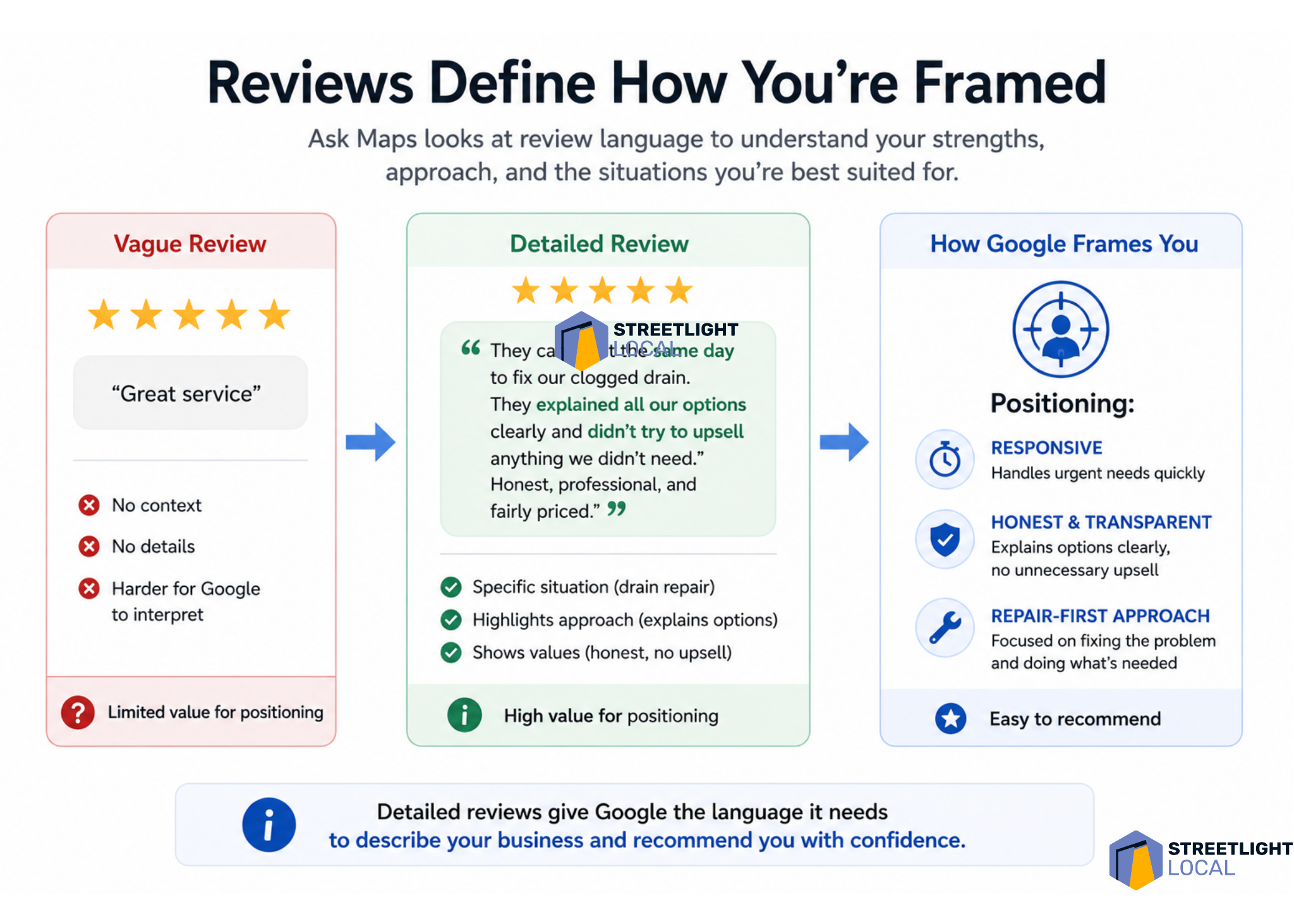
    Reviews have always mattered in local search, but I see them playing a more structured role in Ask Maps. Review language can show up in the way Google describes a business, especially around themes like responsiveness, honesty, communication, professionalism, and quality of work.

    That tells me reviews are doing more than supporting credibility. They are helping define how the business is positioned.

    I would still pay attention to rating, volume, and recency. But I would also look closely at what customers actually say. The language inside reviews can give Google useful context about what the business does, how it works, and what customers value about the experience.

    A vague review such as “great service” signals satisfaction, but it does not explain much. A detailed review that mentions a same-day response, a drain backup, clear communication about options, and a repair-focused solution gives Google several stronger signals about the business.

    Over time, those patterns accumulate. In that sense, I view reviews as one of the main ways Google learns what a local business is known for.

    ```json
{
  "alt": "Infographic contrasting weak versus strong business descriptions for Google explanations.",
  "caption": "Optimize your business presence on Google by crafting clear, specific descriptions and reviews. Strong positioning makes your business easier to recommend.",
  "description": "This infographic compares weak and strong business profiles for Google explanations. Weak businesses show vague services, generic reviews, and unclear positioning, leading to a 'hard to explain' result. In contrast, strong businesses provide specific services, detailed reviews, and clear positioning, resulting in an 'easy to recommend' status. Keywords include business clarity, Google explanation, and online presence optimization."
}
```

    Website content matters more when decisions get harder

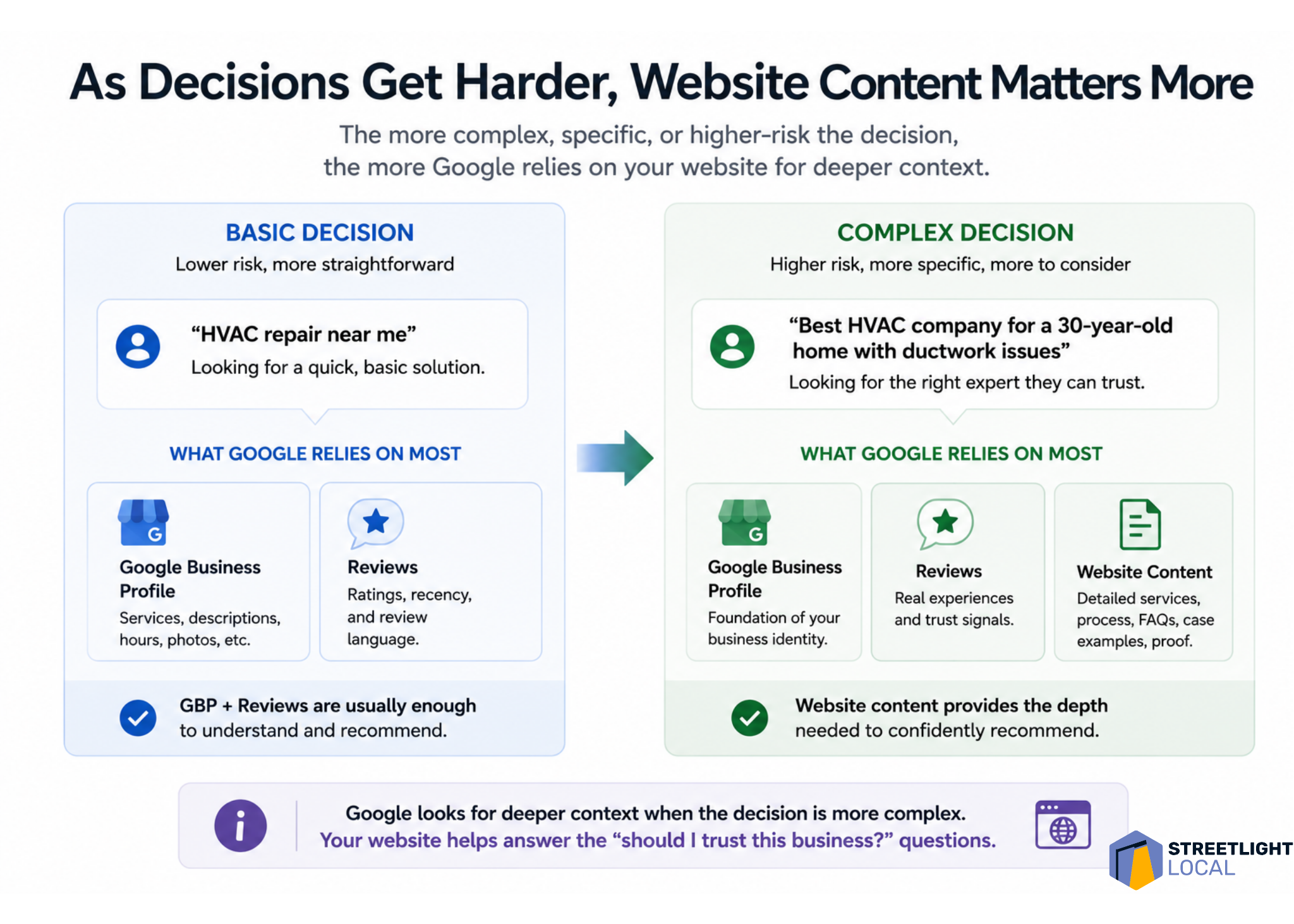
    I also see website content becoming more important as queries become more complex. For basic service searches, the Google Business Profile and reviews may carry a lot of the weight. But when the search involves higher cost, uncertainty, or trust, Google appears to look for deeper supporting evidence.

    That is where the website can help. Many service pages explain what a business offers and why it is qualified. That still matters, but it does not always match how people search when they are trying to make a difficult decision.

    In more situational searches, people are not just looking for a service. They are trying to understand a problem, compare options, reduce risk, and decide what to do next.

    That is why I would build content around the customer’s situation, not just around the service name. Stronger pages explain what leads to the problem, how to recognize it, what options are available, how to think through the decision, and what outcomes to expect.

    For example, a furnace repair page can go beyond a basic list of services. It can cover common symptoms, when repair makes sense, when replacement might be worth considering, and how a homeowner can evaluate the decision. That kind of content lines up more closely with the prompts Ask Maps is trying to interpret.

    ```json
{
  "alt": "Diagram illustrating the elements of a Google Business Profile, such as services, areas served, photos, and business description.",
  "caption": "Explore how your Google Business Profile shapes public understanding, highlighting services, service areas, and more for improved visibility.",
  "description": "This image presents a detailed diagram of a Google Business Profile, emphasizing how it defines business perception. Central to the diagram is the profile, surrounded by elements like Services, Service Areas, Business Description, Photos, and Attributes. Each component is essential for building a comprehensive profile that helps businesses stand out on Google Maps. The image underscores the importance of specificity and completeness in business profiles for improved match and recommendation accuracy."
}
```

    I also see a strong fit for jobs-to-be-done pages. Instead of organizing every page around a service category, I would create pages around the situation the customer is trying to solve and the decision they are working through.

    Trust signals matter more as risk increases

    As searches move from simple service needs into decision-making, trust becomes more important. When people mention cost, honesty, uncertainty, or fear of making the wrong choice, Ask Maps tends to highlight qualities such as transparency, fairness, careful workmanship, and clear communication.

    That makes sense to me because it reflects how people actually think in those moments. When someone faces an expensive repair or an unexpected issue, they are not only asking who can do the work. They are asking who they can trust to handle it correctly.

    I would support that trust with evidence across the business’s online presence. Reviews can show that customers felt respected and informed. Website content can explain the process. Examples of completed work can show experience. Clear “what to expect” sections can reduce uncertainty.

    The higher the perceived risk, the more supporting evidence matters. I want Google to see a consistent pattern that the business explains options clearly, avoids unnecessary pressure, handles similar situations, and leaves customers confident in the outcome.

    Infographic showing how detailed Google reviews help Ask Maps frame a local business as responsive, honest and repair-focused.
    Detailed customer reviews do more than boost ratings. They give Google Ask Maps the context it needs to understand, position and confidently recommend a local business.

    External signals should reinforce the same story

    For more complex or trust-heavy queries, Ask Maps may look beyond the Google Business Profile, reviews, and website. Third-party platforms, directories, and other public sources can help reinforce how Google understands a business.

    I do not take that to mean every external mention is equally important. I take it to mean consistency matters. If a business is described one way on its website, another way in reviews, and differently across directories or social platforms, the overall picture becomes harder to interpret.

    When those signals align, they strengthen each other. Business descriptions, services, customer experiences, types of work handled, and overall positioning should tell the same story wherever they appear.

    From a practical standpoint, I would not try to appear on every possible platform. I would make sure the important sources are accurate, credible, and consistent.

    I would optimize for evidence, not just keywords

    Infographic comparing basic and complex HVAC local searches, showing Google relies more on website content as decisions get harder.
    As local search decisions become more specific and higher risk, Google needs deeper signals from business profiles, reviews, and website content to recommend the right provider.

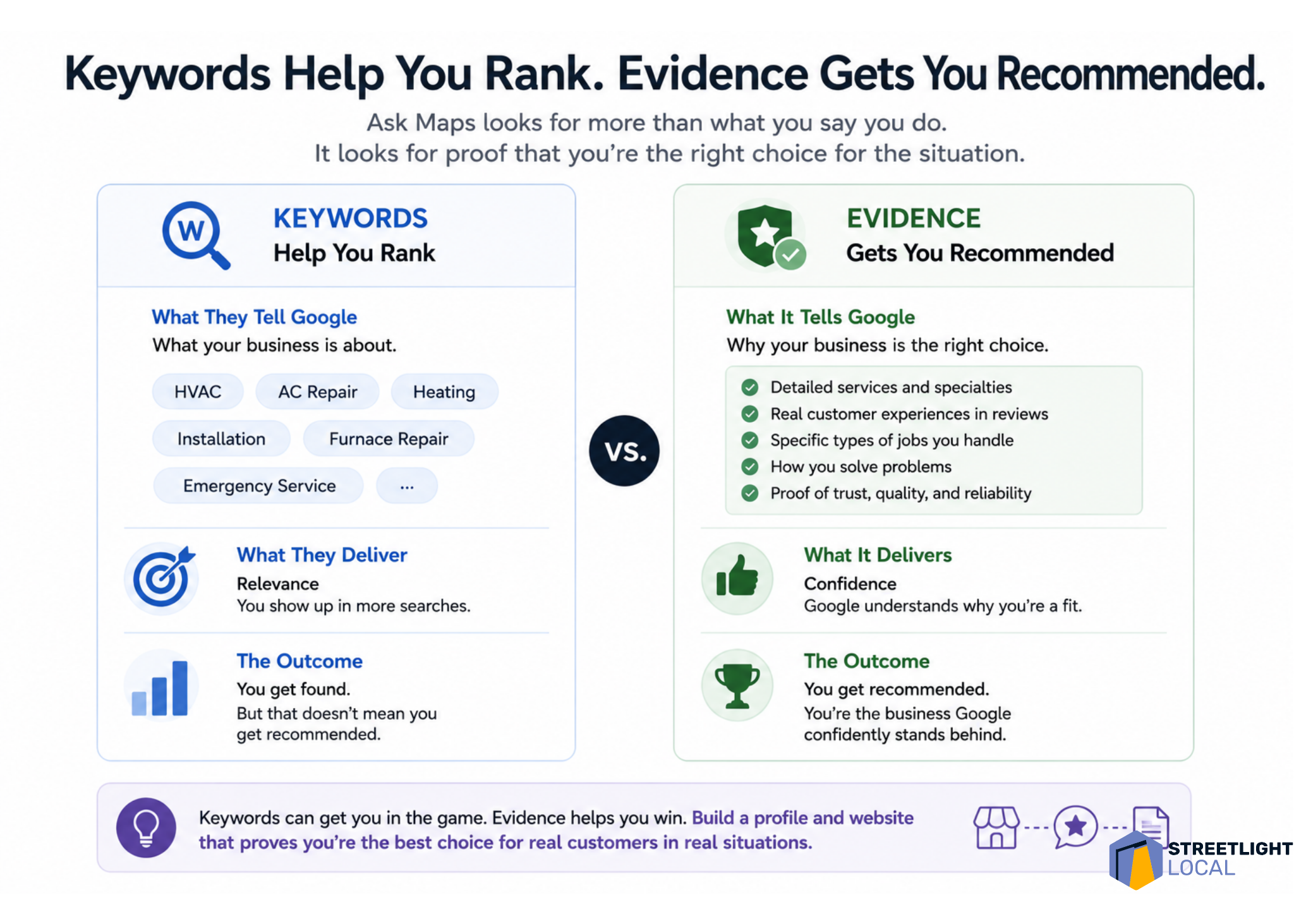
    Taken together, these patterns push me to think differently about optimization. Traditional local SEO often starts with keywords and rankings. Those still matter, but they do not fully explain what Ask Maps is doing.

    I find it more useful to think in terms of evidence. For a business to be recommended, Google needs enough information to understand what it does, what types of jobs it handles, what situations it fits, how customers experience it, and whether it can be trusted in higher-stakes decisions.

    Each source contributes something different. The Google Business Profile establishes the baseline identity. Reviews add real-world context. Website content provides depth and explanation. External sources help confirm the same picture.

    Individually, none of those elements tells the whole story. Together, they create a clearer and more consistent understanding of the business. That is where the shift from ranking to recommendation becomes most obvious: keywords can support relevance, but evidence supports recommendation.

    My practical framework for Ask Maps visibility

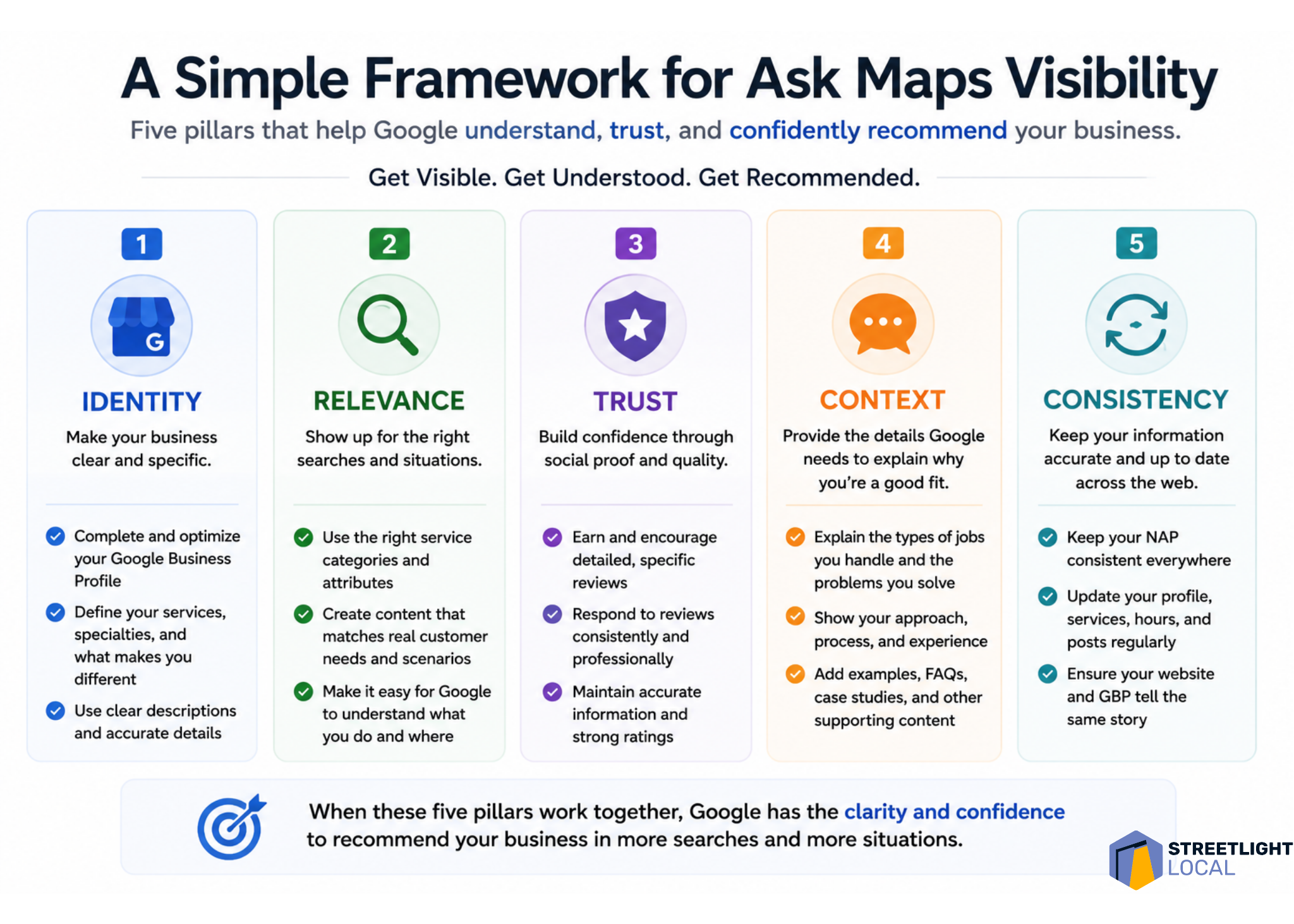
    When I evaluate a business for Ask Maps visibility, I would look at five areas: identity, relevance, trust, context, and consistency.

    Infographic comparing keywords and evidence for Google Ask Maps visibility, showing keywords help local SEO rankings while evidence earns recommendations.
    Google Ask Maps rewards more than keyword relevance. This visual shows why reviews, service details, trust signals, and real proof help local businesses get recommended.

    Identity asks whether Google can clearly understand what the business does and where it operates. Relevance asks whether the business can be matched to specific services and situations. Trust asks whether there is enough proof that customers feel confident choosing it.

    Context asks whether the content reflects the decisions customers are actually trying to make. Consistency asks whether different sources reinforce the same understanding of the business.

    I do not see this as a checklist to complete once. I see it as a practical way to evaluate how clearly and consistently a business is represented across the sources Ask Maps appears to use.

    What I would avoid

    With any new search feature, it is easy to overcorrect. I would avoid treating Ask Maps as an isolated channel that needs thin content, unnatural profile language, generic service-page duplication, or review language that feels forced.

    Those tactics may create more content, but they do not necessarily create more useful evidence. The better approach is to align more closely with how customers actually search, evaluate options, and make decisions.

    Infographic outlining five pillars for Google Ask Maps visibility: identity, relevance, trust, context, and consistency for local SEO recommendations.
    A practical local SEO framework shows how businesses can earn visibility in Google Ask Maps by clarifying identity, proving relevance, building trust, adding context, and staying consistent online.

    When the business presence reflects real customer needs clearly and consistently, it naturally creates the kinds of signals Ask Maps seems to rely on.

    What I still do not know about Ask Maps

    I would treat all of this as directional, not definitive. Ask Maps is still being tested and refined, and the system is not fully documented.

    The result structure can vary by query and test environment. The feature’s usability is also still changing. In many cases, users may still need to click into a Google Business Profile to call, book, or engage, rather than acting directly from the Ask Maps response.

    Measurement is another open issue. Right now, I do not see a clean way to isolate Ask Maps visibility or performance inside standard reporting tools. That makes it difficult to attribute calls, traffic, or conversions directly to this experience.

    I also would not assume the same signal weighting applies to every query. Google Business Profile data, reviews, website content, and external sources may all matter, but their relative importance likely changes based on the search intent and the complexity of the decision.

    The real shift is from ranking to recommendation

    I see Ask Maps as a version of local search where retrieval, evaluation, and decision support are moving closer together. Instead of making users search, compare, research, and decide across several steps, Google is trying to guide more of that process inside one experience.

    That changes the meaning of visibility. In Ask Maps, it is not enough for a business to simply appear. The business needs to be understood well enough for Google to explain why it fits the situation and trusted enough to be recommended.

    For businesses and SEOs, I would not respond by chasing a narrow trick. I would build a clearer, more complete, and more consistent representation of the business across the sources that shape Google’s understanding.

    The businesses most likely to benefit are the ones that are easiest to interpret, easiest to trust, and easiest to match to real-world customer needs.


    Inspired by this post on Search Engine Land.


    crushpress.ai community screenshot
  • Mastering Healthcare Reviews: Stay Compliant and Dominate Local SEO

    Mastering Healthcare Reviews: Stay Compliant and Dominate Local SEO

    I’ve spent a lot of time understanding how online reviews, especially Google reviews, are essential for businesses that depend on local clients. It’s more than just gathering feedback; it’s a strategic move to enhance visibility and credibility.

    A recent Whitespark survey revealed that four of the top 15 factors influencing Google Maps rankings are linked to reviews, including their quantity, quality, recency, and consistency. More than 80% of consumers rely on Google reviews to make judgments about local businesses, according to other studies.

    For typical businesses, collecting and responding to reviews might seem simple. But working within healthcare, I know firsthand the complexity due to ethical standards and federal regulations. By navigating these challenges, you can still position yourself as a leader without breaking the rules.

    Having been in the healthcare domain for over a decade, I’m excited to share the obstacles I’ve encountered and the innovative solutions I’ve discovered.

    The Catch-22 in Mental Health

    At one point, I helped a therapist’s private practice improve their local SEO. I noticed he had only a couple of reviews and suggested he should get more. It was then I learned, according to the American Psychological Association’s code of ethics, therapists aren’t permitted to solicit testimonials from clients, as it risks exerting undue influence.

    This ethical guideline understandably impacts review numbers, but online visibility in Google remains crucial for mental health professionals. Those adhering to these rules often have less visibility, which doesn’t seem fair.

    But there’s hope! You can still collect reviews creatively and ethically.

    ```json
{
  "alt": "The CapmatchOne logo with a gradient circle and bold text.",
  "caption": "Discover innovation with the CapmatchOne logo, featuring sleek typography and a modern gradient circle.",
  "description": "The CapmatchOne logo features bold, modern typography coupled with a gradient circle, symbolizing connection and innovation. The sleek design conveys a sense of progress and creativity. This image can be used for branding or promotional purposes, appealing to audiences interested in innovative solutions and forward-thinking designs."
}
```

    A Case Study in Mental Healthcare Reviews

    When a new competitor overshadowed an addiction treatment center I was working with, I realized we had to strategize to compete without crossing ethical lines. The goal was to secure 50 to 100 reviews while maintaining at least one review per week.

    The Solution

    We decided the alumni, particularly those not in active treatment, could be asked for reviews by non-clinical staff. Building an alumni program helped improve experiences and gave us a new avenue for review requests.

    • Assigned the task of generating reviews to an alumni coordinator, making it part of their job without incentivizing based on quantity.
    • Created an online alumni group and used QR codes to stay in touch and ease access to review links.
    • Leveraged verbal commitments by sending direct review links via text, streamlining the process.

    The Result

    Within a year, more than 100 new reviews were added, and the rating improved from 4.6 to 4.8. This surpassed the competitor and dovetailed into 500 total reviews by February 2026—all ethically and efficiently.

    ```json
{
  "alt": "Graph showing total reviews and average rating growth over time, highlighting a jump in reviews from February 2023.",
  "caption": "A rapid increase in reviews and ratings since starting new alumni initiatives in February 2023 marks a turning point.",
  "description": "This image displays a line graph depicting the increase in total reviews and average ratings from 2015 to 2025. The graph shows a significant jump in both metrics starting February 2023, after implementing alumni-related strategies like check-ups and online groups. Annotations highlight this change with a current average rating of 4.6 and 196 reviews. Keywords: reviews, ratings, growth, alumni, graph."
}
```

    If you’re considering a similar strategy, remember to:

    • Designate a non-clinical staff member for review management.
    • Trigger review requests through alumni interactions.
    • Use person-to-person and digital methods to solicit reviews.
    • Monitor and discuss progress when necessary.

    Review Replies and HIPAA Compliance

    Responding to reviews while maintaining HIPAA compliance is just as crucial. Even acknowledging a reviewer as a patient can risk breaching patient confidentiality.

    In your responses, focus on policies or encourage offline discussions without acknowledging if they were your patient. For example, use phrases like:

    • “Due to privacy laws, we can’t confirm any individual as a patient. But we value your feedback and welcome direct discussions about policies or practices.”
    • “Thank you for your feedback. We appreciate you taking the time to write a positive review.”

    Reporting Reviews and HIPAA Compliance

    ```json
{
  "alt": "Graph showing total reviews and average rating from December 2016 to January 2026, with a significant increase noted.",
  "caption": "An upward trend is observed in total reviews and average rating, peaking in January 2026 with an impressive 4.8 average rating.",
  "description": "This line graph depicts the trend of total reviews and average rating over time from December 2016 to January 2026. The graph shows a steady increase in review count, reaching 468 in January 2026 with an average rating of 4.8. The timeline along the x-axis highlights key increases in reviews, with a notable rise beginning around June 2022. This image is useful for understanding review growth patterns over time."
}
```

    While you might want to report misleading reviews, be careful not to disclose patient status to Google. Focus on misinformation or explicit violations of Google’s review policies instead.

    For example, if a review falsely claims unsafe practices about an FDA-approved medication, highlight this point to Google without discussing patient relationships.

    • Emphasize evidence against offensive content, PII, or other unrelated and repetitive reviews.

    Keep your submissions focused by identifying the correct policy category and providing compelling evidence without alluding to the relationship between the reviewer and the facility.

    Building a Compliant and Effective Review Engine in Healthcare

    Navigating the complexities of healthcare review management doesn’t mean compromising on compliance or local SEO success. Create a structured and compliant process to secure continuous and genuine feedback while respecting all ethical guidelines. That way, local visibility will improve, patient privacy will be protected, and the review system will remain sustainable in the long term.


    Inspired by this post on Search Engine Land.


    crushpress.ai community screenshot
  • Boost Your Google Business Profile with AI-Driven Review Replies

    Boost Your Google Business Profile with AI-Driven Review Replies

    I’ve been intrigued by Google’s latest test in the Google Business Profile: AI-generated responses to customer reviews. This innovative tool offers businesses the ability to create suggested replies to reviews, which I can then review, tweak, and manually submit.

    Why It Matters to Me. Engaging with customer reviews significantly impacts conversions and trust. However, I’m aware of the risks associated with generic AI replies, especially for negative reviews where sincerity is crucial. Personalized, quality responses are more influential than merely replying for the sake of it.

    What I Saw. Here’s a sneak peek of how the feature appears:

    AI-driven review reply screenshot

    The Details I’ve Discovered. It seems Google is conducting a limited roll-out of this ‘Reply to reviews with AI’ feature within the Google Business Profile.

    ```json
{
  "alt": "Screenshot showing Google features like 5-star reviews, ad creation, and AI review replies.",
  "caption": "Harness the power of Google with AI-driven replies, ad creation, and insights on 5-star reviews to boost your business presence.",
  "description": "This image displays a Google interface with options for responding to reviews using AI, creating ads, and acknowledging 5-star reviews. The highlighted section features 'Reply to reviews with AI', suggesting personalized replies to build trust. This tool aims to enhance business engagement and customer interaction. Keywords: Google, AI, reviews, ads, business tools."
}
```
    • It generates proposed responses to customer reviews.
    • I can review and modify these suggestions before submitting.
    • The availability fluctuates across different accounts and reviews.
    • The feature is spotted in the U.S., Brazil, and India, but not yet widely in Europe.

    Initial Impressions. Some users, like me, noticed prompts targeting older, unanswered negative reviews.

    • In one test I observed, it’s possible to generate AI responses in bulk.
    • I’ve read mixed reports on automation—some claim bulk responses still need a review, while others experienced fully automated replies that require no edits.

    How I First Learned About It. This feature caught my attention first through LinkedIn, thanks to Chandan Mishra, a freelance local SEO specialist, and it was further amplified by Darren Shaw, founder of Whitespark.


    Inspired by this post on Search Engine Land.


    crushpress.ai community screenshot
  • Google’s Surge in Review Deletions: What It Means for Your Business

    Google’s Surge in Review Deletions: What It Means for Your Business

    In 2025, I’ve noticed Google is removing reviews at an unprecedented rate, and this isn’t by chance.

    According to our industry analysis of 60,000 Google Business Profiles, review deletions are driven by several factors:

    • Automated moderation techniques.
    • Industry-specific risk considerations.
    • Greater enforcement against incentivized reviews.
    • Local regulatory pressures.

    Together, these elements greatly impact business visibility in local search.

    Review Deletions Are Increasing Globally

    Data from tens of thousands of Google Business Profile listings show a notable rise in deleted reviews between January and July 2025.

    The increase gained momentum toward the end of Q1, with more locations seeing at least one review removed weekly.

    This isn’t confined to negative reviews alone.

    Five-star reviews are now frequently removed, indicating Google’s stricter enforcement to maintain authenticity and trust.

    ```json
{
  "alt": "Line graph showing weekly deleted reviews from January to July 2025, with marked data points indicating fluctuations.",
  "caption": "Tracking the rise and fall: Weekly deleted reviews soar in early 2025, peaking in July. A visual insight into the dynamic trends of online reviews.",
  "description": "This image is a line graph illustrating the number of weekly deleted reviews from January to July 2025. The graph highlights significant fluctuations with notable peaks, such as 1100 deletions in early July. Key data points are marked, providing an informative overview of the trends in deleted reviews over the months. This visualization aids in understanding the dynamics of content moderation and review management in the digital space."
}
```

    Google is also asking its Local Guide community about incentivized reviews, likely triggered by AI-flagged suspicious activities.

    Industry Variations in Review Treatment

    Patterns of review deletions differ significantly depending on the business sector.

    Restaurants lead in review deletions, followed by home services, retail, and construction. Both recent and older reviews are subject to removal.

    By contrast, medical, beauty, and professional services experience fewer deletions, but unique patterns are consistent within these categories.

    What Review Ratings Reveal

    Review deletion patterns reveal clear moderation trends. In sectors like restaurants, reviews are deleted across all star ratings.

    Medical and home services show a bias toward removing five-star reviews, indicating more scrutiny in regulated industries.

    This variation is not due to manual policies but reflects Google’s automated adjustments based on perceived industry risks.

    ```json
{
  "alt": "Bar chart showing the share of deleted reviews by rating across top 10 meta categories including restaurants and home services.",
  "caption": "Explore the share of deleted reviews for various industries. This bar chart reveals the blend of 1 to 5 star ratings from deleted reviews across key sectors.",
  "description": "This bar chart illustrates the share of deleted reviews across the top 10 meta categories, such as restaurants, home services, and travel. Each category is represented with stacked bars showing different ratings, from 1 to 5 stars. Red indicates 1-star reviews, with green for 5-star reviews. This visualization helps in understanding the proportion and distribution of deleted reviews in various industries."
}
```

    The Timing of Review Deletions

    The age of a review often determines when it’s removed. In medical and home services, many reviews are deleted within six months.

    In restaurants and retail, older reviews are frequently removed, suggesting ongoing improvement in detection systems.

    For businesses, this means reviews might disappear long after being posted, often without warning.

    Geographical Differences in Review Deletions

    Location adds complexity to review deletion trends. In many English-speaking countries, five-star reviews face increased scrutiny.

    However, in Germany, low-rated reviews are more commonly deleted shortly after being posted, aligning with strict defamation laws.

    In summary:

    • AI-driven enforcement is prevalent in English-speaking markets.
    • Legal challenges are more impactful in Germany.
    ```json
{
  "alt": "Bar chart showing top 10 meta categories by deleted reviews with ratings from 1 to 5 stars.",
  "caption": "Analyzing deleted reviews across categories, restaurants lead with the highest count. The chart stacks ratings from 1 to 5 stars, revealing consumer feedback trends.",
  "description": "This bar chart illustrates the top 10 meta categories by the number of deleted reviews, stacked by rating from 1 to 5 stars. The 'Restaurant' category shows the highest number of deleted reviews, followed by 'Brick & Mortar' and 'Home Services.' Each category's bar is subdivided into colored segments representing different star ratings, illustrating the distribution of consumer feedback across sectors. Key insights can be drawn on which areas face most scrutiny and variability in customer satisfaction."
}
```

    Implications for Local SEO and Business Owners

    Increased review deletions pose two major challenges:

    • Trust erosion: Disappearing legitimate reviews weaken confidence in platforms.
    • Data distortion: Removed reviews alter performance metrics essential for SEO.

    For businesses, monitoring review activity is crucial. Understanding removal patterns is now as vital as acquiring new reviews.

    The Future of Review Visibility

    Three key developments are shaping how reviews are managed:

    • Greater reliance on automated moderation.
    • Legal influences in regions with strict defamation laws.
    • Increased use of third-party monitoring tools for independent tracking.

    As moderation practices evolve, recent and detailed reviews will continue to be critical for SEO authority signals.

    Maintaining a strong reputation now requires constant vigilance.


    Inspired by this post on Search Engine Land.


    crushpress.ai community screenshot
  • Discover New Features on Google Maps: Insider Tips and More!

    Discover New Features on Google Maps: Insider Tips and More!

    I’ve recently discovered that Google Maps has introduced some exciting new features to better inform us about local businesses and events. Now, we can also choose to leave reviews using nicknames, giving us a bit more privacy when sharing our thoughts.

    Know Before You Go. One of the highlights is the ‘know before you go’ feature now available on Google Maps. I remember seeing this tested earlier, but it’s great to see it officially rolled out now.

    When I search for places, I can easily access ‘know before you go’ tips, showing me crucial details like parking tips, secret menu items, and ideal reservation methods. This information comes from user reviews and other online resources.

    These tips, dubbed ‘insider tips’ by Google, are now available in the U.S. on both Android and iOS. I’ve found them quite helpful in planning my visits more efficiently.

    Here’s a glimpse of how it looks:

    Trending Nearby in Explore Tab. There’s also a new addition to the Explore tab, highlighting trending restaurants, activities, and attractions nearby. I can simply swipe up on the explore tab to discover these popular spots.

    This feature sources trends from platforms like Viator, Lonely Planet, and local influencers, including Sisterssnacking. It’s been a fantastic way for me to stay updated on what’s happening around me.

    This update is available globally this month on both Android and iOS devices.

    Here’s what the new Explore tab looks like in action:

    Nicknames for Reviewers. One feature I particularly like is the option to use nicknames when leaving reviews. According to Google, “If you’d prefer not to use your real name, you can now choose a nickname and profile.”

    While there might be concerns about spammy reviews, Google assures us that their systems are equipped to monitor and detect fake reviews continuously, linking our reviews to our Google Accounts.

    This feature is rolling out globally this month on Android, iOS, and desktop.

    Here’s a quick look at how to set up a profile with a nickname:


    Inspired by this post on Search Engine Land.


    crushpress.ai community screenshot
  • Boost Local SEO with Keyword-Rich Google Reviews

    Boost Local SEO with Keyword-Rich Google Reviews

    Discover how keyword-rich Google reviews can significantly enhance your local visibility, engage more customers, and boost conversions. Let’s dive into the strategies, complete with handy templates to get you started.

    As someone exploring the impact of keywords in reviews, I’ve noticed that while their influence on local rankings is debated, the value they bring extends well beyond just visibility. Here are seven compelling reasons why encouraging keyword-rich reviews is beneficial.

    ```json
{
  "alt": "Map view of plumbing services in Seattle area with highlighted customer reviews.",
  "caption": "Explore top-rated plumbing services in Seattle with positive customer feedback highlighted for quick insights.",
  "description": "Image showcasing a map view of various plumbing services around the Seattle area. The left side lists top-rated services like Craftsman Plumbing, Bee's Plumbing and Heating, and Gene Johnson Plumbing, with highlighted customer reviews praising their work. The map on the right pinpoints locations for easy navigation. Keywords: Seattle, plumbing, map, customer reviews."
}
```

    If your reviews consistently highlight specific keywords relevant to your business, the chance of your profile getting a Review justification in search results improves rapidly. This added visibility can directly enhance click-through rates and potentially elevate your standings in search results.

    ```json
{
  "alt": "List of food and activity names with numbers, including cacio e pepe and fresh pasta.",
  "caption": "Discover your next delight with 'cacio e pepe' leading the favorite list, closely followed by 'fresh pasta.' What will you choose?",
  "description": "This image displays a list with names and numbers beside each: 'cacio e pepe 43,' 'fresh pasta 41' with a smiley, 'gnocco fritto 30,' 'swings 21,' 'fried bread 16,' and 'tartufo 15.' It appears to categorize items based on popularity or frequency, potentially for a survey or menu selection. Keywords: cacio e pepe, fresh pasta, popular food, activity list."
}
```

    Google crafts clickable Place Topics from the keywords found in reviews. These topics not only stand out and attract potential customers by showcasing your expertise but also filter reviews efficiently, increasing engagement with your profile.

    ```json
{
  "alt": "Three unverified restaurant reviews with a prompt to write a review.",
  "caption": "Dive into these friendly and tasty reviews of a cozy spot renowned for its delicious pasta and wonderful service!",
  "description": "The image displays three unverified reviews of a restaurant, each praising different aspects such as food quality, service, and the dining experience. Words like 'place,' 'food,' 'service,' and 'staff' are highlighted. Reviewers mention 'creamy chicken,' 'mushroom pasta,' and 'amazing pasta quality.' A call-to-action button invites users to 'Write a review,' encouraging engagement. Perfect content for SEO about restaurant reviews and customer experiences."
}
```

    Terms frequently mentioned in your reviews are bolded in three review snippets on your Business Profile. This subtle emphasis can captivate users searching for these terms, likely boosting click-through rates to your profile.

    ```json
{
  "alt": "Maestro Pasta menu overview featuring popular dishes like Bolognese, Cacio e Pepe, and Tartufo, alongside a glass of wine.",
  "caption": "Explore Maestro Pasta's popular selections, from hearty Bolognese to creamy Cacio e Pepe, paired perfectly with a glass of fine wine.",
  "description": "This image showcases the menu highlights from Maestro Pasta, displaying popular pasta dishes such as Bolognese, Cacio e Pepe, and Tartufo. Featured in metal pans, these mouthwatering meals are labeled 'Popular.' A glass of red wine is also visible, suggesting a perfect pairing option for the dishes. The layout is part of the restaurant's digital menu interface, emphasizing a modern dining experience. Keywords: Maestro Pasta, Bolognese, Cacio e Pepe, Tartufo, wine, menu highlights."
}
```

    For restaurants, Menu Highlights are curated from customer reviews and photos, similar to Place Topics. An analysis shows that these sections influence rankings, implying that mentions of menu items in reviews can enhance your visibility for those terms.

    ```json
{
  "alt": "Basta Pasta restaurant in New York with a focus on Italian-Japanese fusion dishes, map and details visible.",
  "caption": "Discover the Italian-Japanese culinary delights at Basta Pasta, a New York gem, where unique twists like roe pasta tantalize taste buds. Opens at noon!",
  "description": "Image shows Basta Pasta, an Italian restaurant in New York City noted for its fusion of Italian and Japanese cuisine. The interface displays a map, customer reviews, and options to get directions or reserve a table. The restaurant serves innovative dishes, such as pasta with roe or sea urchin, alongside Caesar salads and grilled items. Located at 37 W 17th St, NY, the venue opens at 12:00 PM and promises a distinctive dining experience with its high-ceilinged ambiance."
}
```

    Google’s AI-generated summaries draw from review content to describe your business attributes, such as “cozy”. While you cannot directly edit these summaries, encouraging detailed, keyword-rich reviews can guide the AI to highlight beneficial aspects of your business.

    ```json
{
  "alt": "Review summary showing a 4.6-star rating from 1,470 reviews for an Italian restaurant.",
  "caption": "With a 4.6-star rating from 1,470 reviews, this Italian restaurant is praised for its delicious pasta, cozy atmosphere, and attentive service.",
  "description": "An image featuring a review summary for an Italian restaurant, boasting a 4.6 out of 5-star rating based on 1,470 reviews. Highlighted features include homemade pasta and flavorful sauces, a cozy and welcoming ambiance, and friendly, attentive staff. Unique aspects like swing seats add to the authentic Italian experience. The image captures ratings and excerpts from customer feedback, emphasizing the dining experience's quality."
}
```

    Review summaries created by Google’s AI analyze frequent sentiments from customer feedback. By prompting customers to include specific keywords, your review summary can resonate more with potential clients.

    ```json
{
  "alt": "Skyway Roofing information on Google Maps with options to ask questions and review ratings.",
  "caption": "Explore Skyway Roofing on Google Maps: Discover services, ask questions, and see what others are saying with a stellar 4.9 rating from 300 reviews.",
  "description": "This image shows Skyway Roofing on Google Maps, offering users interactive features like asking questions about siding replacement, installation, roof cleaning, and family ownership. The company boasts a 4.9-star rating from 300 reviews, with keywords like siding, skylights, nails, and debris frequently mentioned. This interface encourages user engagement and easy access to specific inquiries."
}
```

    Google is transitioning from the Q&A section to a feature allowing customers to ask questions about your business. This new feature draws answers from reviews, meaning that comprehensive, keyword-laden reviews become incredibly valuable.

    Asking customers directly to insert specific keywords in their reviews may seem odd and forced. Instead, consider upgrading your review request templates to guide your customers naturally towards providing relevant, detailed feedback.

    For example, Miriam Ellis has developed a helpful guide on acquiring keyword-rich reviews, complete with three templates tailored for different scenarios, each facilitating descriptive and keyword-rich content from your clients.

    Implementing these improvements in your review requests will yield richer, more detailed customer feedback. This can enhance your local SEO benefits and possibly improve your Google rankings for related keywords, though that shouldn’t be your primary objective here.


    Inspired by this post on Search Engine Land.


    crushpress.ai community screenshot