Tag: Google Cloud

  • Google Revives Data Studio: A Central Hub for Data Analysis

    Google Revives Data Studio: A Central Hub for Data Analysis

    I’m excited to share that Google is bringing back Data Studio as a streamlined platform for analyzing marketing and business data across its ecosystem. It’s aimed at helping us easily delve into and act on the data that powers our daily decisions.

    Why the switch back? The new Data Studio will serve as our go-to central hub, encompassing a wide range of assets—from traditional reports and dashboards to advanced data applications created in Colab and BigQuery conversational agents. This single platform will enable us to access all the tools and insights essential for shaping our businesses.

    Looking back. Three years ago, Data Studio was merged into Google’s analytics efforts with a rebranding as Looker Studio. Now, Google’s responding to evolving customer needs by separating these products again.

    Two versions available. Google is introducing two variations of Data Studio:

    • Data Studio remains free for individuals and small teams seeking quick analysis and visualization capabilities.
    • Data Studio Pro is designed for larger organizations, providing enhanced security, compliance, management controls, and AI features. Licenses can be purchased through Google Cloud and Workspace admin consoles.

    Why it matters to us. This revamped Data Studio can significantly ease the process of gathering campaign, audience, and performance data from Google’s ecosystem into one place. This means quicker reporting, more straightforward analysis, and faster responses—often eliminating the need for analysts or engineering support for everyday tasks.

    Integrating Looker. Under the new setup, Looker will continue to be Google Cloud’s enterprise-level business intelligence platform, focusing on managed data, semantic modeling, and large-scale analytics. In contrast, Data Studio is geared towards more flexible personal exploration, ad hoc reporting, and accessible dashboards via services like BigQuery, Google Sheets, and Ads.

    What’s on the horizon. For those of us already using Data Studio, the transition should be seamless. Reports, data sources, and assets will automatically transfer without requiring any action on our part.

    Google plans to reveal more details about the relaunch and its expansive analytics strategy at Google Cloud Next ’26 later this month. I’m looking forward to discovering what’s next!

    Dig deeper. For more in-depth information, check out this article on the new Data Studio.


    Inspired by this post on Search Engine Land.


    crushpress.ai community screenshot
  • Google Enhances Tagging with New Cloud Integration

    Google Enhances Tagging with New Cloud Integration

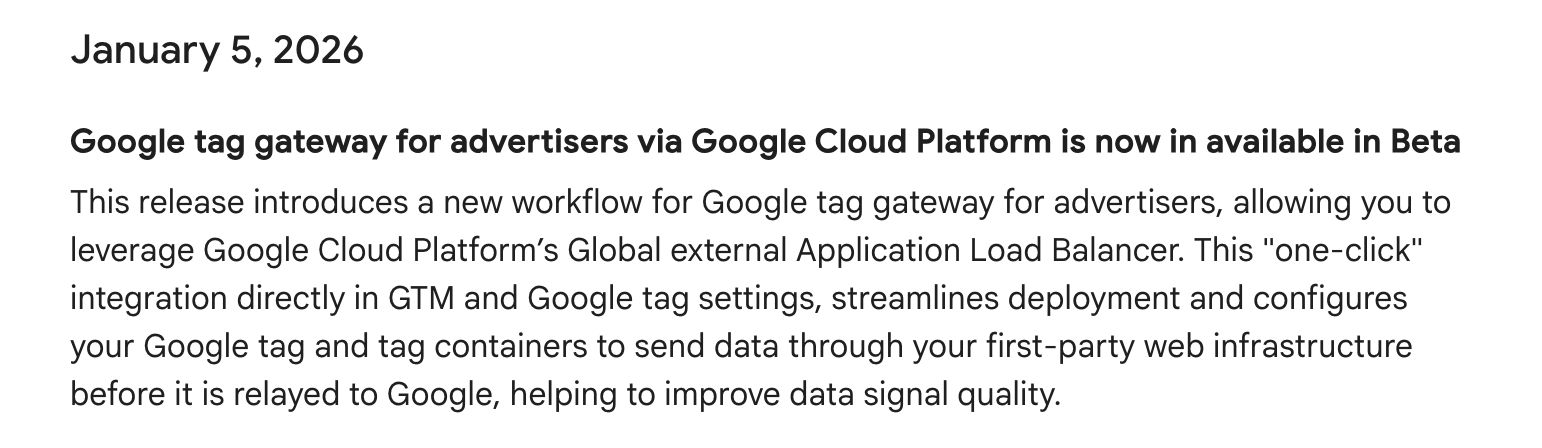
    Google just introduced a beta integration for the Google Tag Gateway, allowing advertisers, like myself, to deploy it effortlessly through the Google Cloud Platform (GCP). The process is now simplified with a new one-click workflow available in Google Tag Manager and Google tag settings.

    What’s really exciting is how the GCP integration leverages Google Cloud’s Global External Application Load Balancer. This tool routes tag traffic through our own first-party domain before sending it off to Google, which enhances the deployment process. This strategic approach not only improves data signal quality but also boosts resilience against ad blockers and features like Apple’s Intelligent Tracking Prevention.

    Why does this matter to us? As third-party tracking faces increasing limitations from browsers and platforms, advertisers like us need reliable ways to protect measurement signals. By directing Google tags through our infrastructure, we can maintain the integrity of our measurement signals against ad blockers and browser privacy constraints.

    For those of us already using Google Cloud, this one-click setup significantly reduces the barriers to achieving more resilient and future-proof tracking.

    What are others saying? Digital marketer and Simmer co-founder Simo Ahava highlighted this advancement on LinkedIn. According to him, the integration facilitates a seamless GCP deployment. It automatically configures an External Application Load Balancer with rules to direct Google Tag Gateway traffic to our backend services handling these requests.

    ```json
{
  "alt": "Google tag gateway for advertisers via Google Cloud Platform beta release announcement with details.",
  "caption": "Discover the new beta release of Google tag gateway, enhancing data signal quality with seamless integration via Google Cloud Platform.",
  "description": "The announcement dated January 5, 2026, introduces the beta release of Google tag gateway for advertisers, leveraging Google Cloud Platform's infrastructure. This feature allows for easy integration with Google Tag Manager settings, optimizing data transmission efficiency via first-party web infrastructure to improve data signal quality."
}
```

    Ahava also noted that Google Tag Gateway positions Google’s tagging infrastructure behind a same-site, same-origin first-party host, ensuring that tags endure in restrictive browser environments.

    The broader perspective here is that previously, Cloudflare was the only automated option for deploying Google Tag Gateway, with other CDNs requiring manual setups. By adding GCP, Google reduces the friction for us advertisers already committed to their cloud ecosystem, thus promoting first-party tagging strategies.

    The bottom line? Google is simplifying first-party tagging deployment, and while the GCP integration is still in its beta stage, it represents a significant stride toward robust measurement solutions in our increasingly privacy-focused digital landscape.


    Inspired by this post on Search Engine Land.


    crushpress.ai community screenshot