Tag: Google AI

  • Discover Google’s Revolutionary Intelligent Search Box

    Discover Google’s Revolutionary Intelligent Search Box

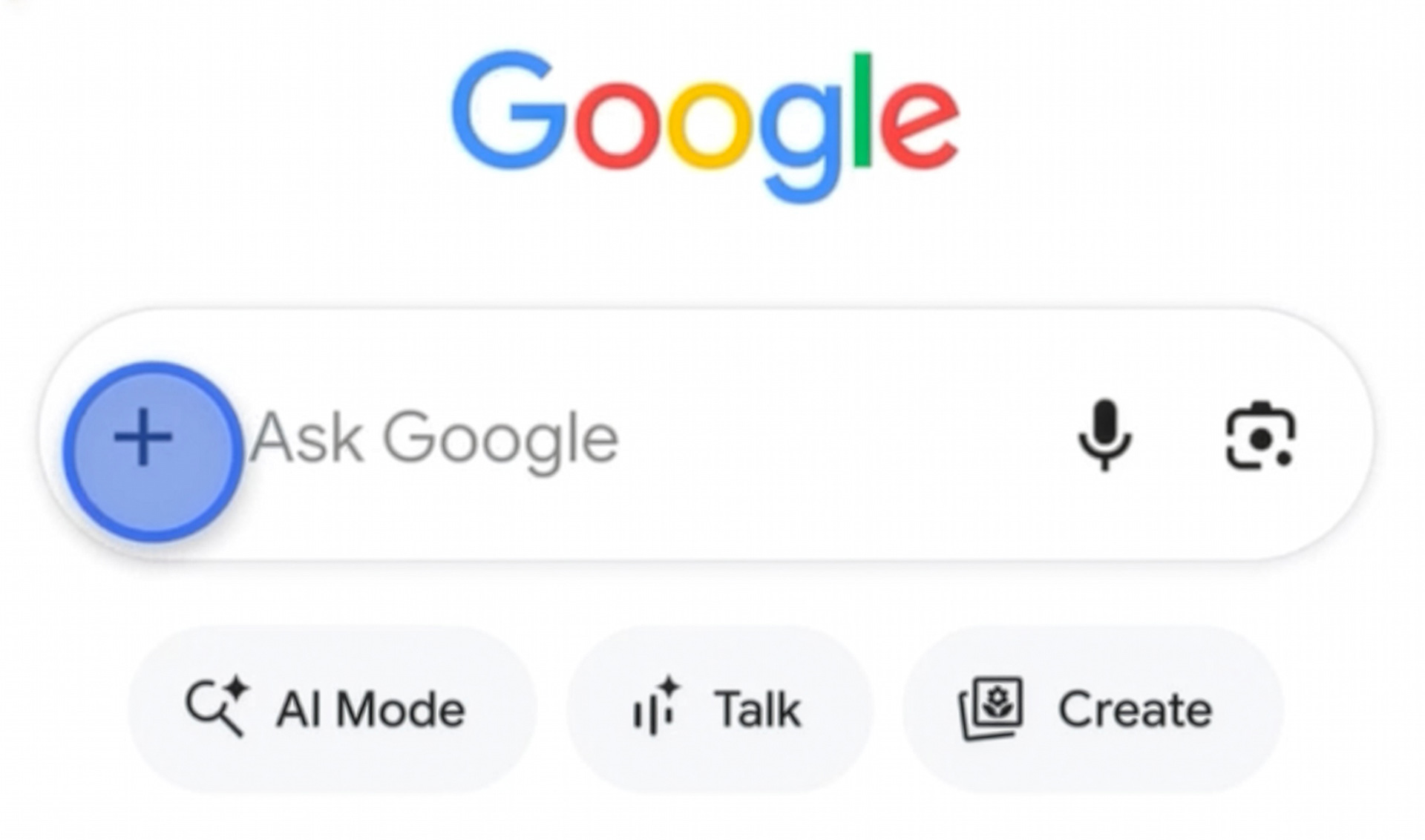
    Today, I want to share some exciting news. Google has unveiled its most significant change to the search box in 25 years. This new feature, known as the “Intelligent Search Box,” is designed to provide us with an easier way to access AI search capabilities.

    This innovation is powered by the latest technology, the Gemini 3.5 Flash.

    Here’s How It Looks. Google completely redesigned the search box to give us more space for longer and deeper queries. As I type my search, the box will expand, supported by an AI-powered suggestion tool that goes beyond simple autocomplete, according to Google’s Head of Search, Liz Reid.

    What’s even more impressive is the ability to search with text, images, files, videos, and even my Chrome tabs. It’s truly versatile!

    Let me show you what this looks like:

    This innovation puts Google’s most powerful AI tools right at our fingertips, enabling us to ask questions more easily, as explained by Liz Reid from Google.

    Seamless Transition to AI Mode. Google also made it easier to switch to AI Mode with their new AI Overviews feature, which is now available globally on both desktop and mobile. Initially launched to many in January, it’s now fully operational.

    Here’s how it works:

    Why It Matters to Us. The transformation of the Google Search Box impacts how we search and potentially changes the type of traffic Google sends our way. It may encourage more users like me to switch to AI Mode for deeper answers, possibly leading to fewer direct clicks on our websites.

    While change can be challenging, it’s also inevitable. Google’s CEO Sundar Pichai emphasized how our expectations from Google Search evolve—from individual queries to ongoing conversations and now to agentic workflows. As the world’s most-used product, Google is determined to stay ahead of our needs.


    Inspired by this post on Search Engine Land.


    crushpress.ai community screenshot
  • Master Google’s Generative AI Optimization: A Step-by-Step Guide

    Master Google’s Generative AI Optimization: A Step-by-Step Guide

    I recently came across Google’s fresh guide on optimizing for its generative AI features, highlighting key tools like AI Mode and AI Overviews. This guide compiles insights from previous Google communications into a comprehensive help document titled Optimizing your website for generative AI features on Google Search.

    Inside the Guide: This document delves into multiple essential topics, which include:

    – SEO’s continued relevance for AI search, adhering to Google’s SEO best practices.

    – Creating valuable, non-commodity content for your audience.

    – Offering a unique perspective

    – Developing content that is helpful, reliable, and prioritizes users

    – Organizing content effectively for reader assistance

    – Incorporating high-quality images and videos

    – Focusing on user needs, avoiding unnecessary complexity

    – Ensuring AI tools comply with Google’s guidelines

    – Maintaining a clear, technical site structure:

    – Meeting technical search requirements

    – Adhering to best practices for web crawling

    – Emphasizing human-readable semantic HTML

    – Following Google’s guidelines for JavaScript

    – Providing an excellent page experience

    – Reducing duplicate content

    – Focusing on optimizing local business and e-commerce details.

    – Dispelling myths around AI optimization:

    – No need for LLMS.txt files

    – Avoidance of special markup

    – Refraining from ‘chunking’ content

    – No content rewrites for AI systems required

    – Avoid seeking inauthentic mentions

    – Not overly focusing on structured data

    – Exploring agentic experiences and what steps to take next.

    Why It Matters to Me: This guide is a comprehensive resource that summarizes Google’s past advice across various platforms and events. It’s invaluable for understanding how to align my site with Google’s expectations for AI-powered search engines.

    You can read the full guide here.


    Inspired by this post on Search Engine Land.

    crushpress.ai community screenshot
  • Google Targets AI Spam in Latest Search Policy Update

    Google Targets AI Spam in Latest Search Policy Update

    Recently, I discovered that Google has updated its search spam policies, explicitly stating that these rules also apply to generative AI responses within Google Search. This update clarifies that using spammy tactics to get your site or brand featured in AI Overviews, AI Mode, or other AI-based responses now classifies as spam. Google warns that it will take action against such practices.

    What changed. Google revamped a key line in their policy:

    “In the context of Google Search, spam refers to techniques used to deceive users or manipulate our Search systems into featuring content prominently, such as attempting to manipulate Search systems into ranking content highly or attempting to manipulate generative Al responses in Google Search.”

    Originally, it said:

    ```json
{
  "alt": "Google spam policies description highlighting manipulation of search systems.",
  "caption": "Explore Google's spam policies, designed to prevent manipulation of search systems and ensure high-quality, reliable search results.",
  "description": "This image displays a section of Google's spam policies for web searches. It defines spam as techniques that deceive users or manipulate search systems, specifically highlighting attempts to make content rank prominently. The text emphasizes Google's commitment to maintaining high-quality search results through strict policies. Highlighted text stresses manipulative practices impacting search rankings and AI responses. Keywords: Google, spam policies, search manipulation, AI, content ranking."
}
```

    “In the context of Google Search, spam refers to techniques used to deceive users or manipulate our Search systems into ranking content highly.”

    I came across a visual representation of this policy addition:

    Why I care. I’ve noticed there’s a lot of advice circulating about optimizing for AI search engines. Some strategies might conflict with Google’s updated spam policies. It’s important for me, and anyone else trying to optimize their presence in AI responses, to carefully review these policies and ensure compliance, avoiding any spam techniques that could harm visibility on Google.


    Inspired by this post on Search Engine Land.

    crushpress.ai community screenshot
  • Unlock Local Visibility: Harness AI in Local Search Now

    Unlock Local Visibility: Harness AI in Local Search Now

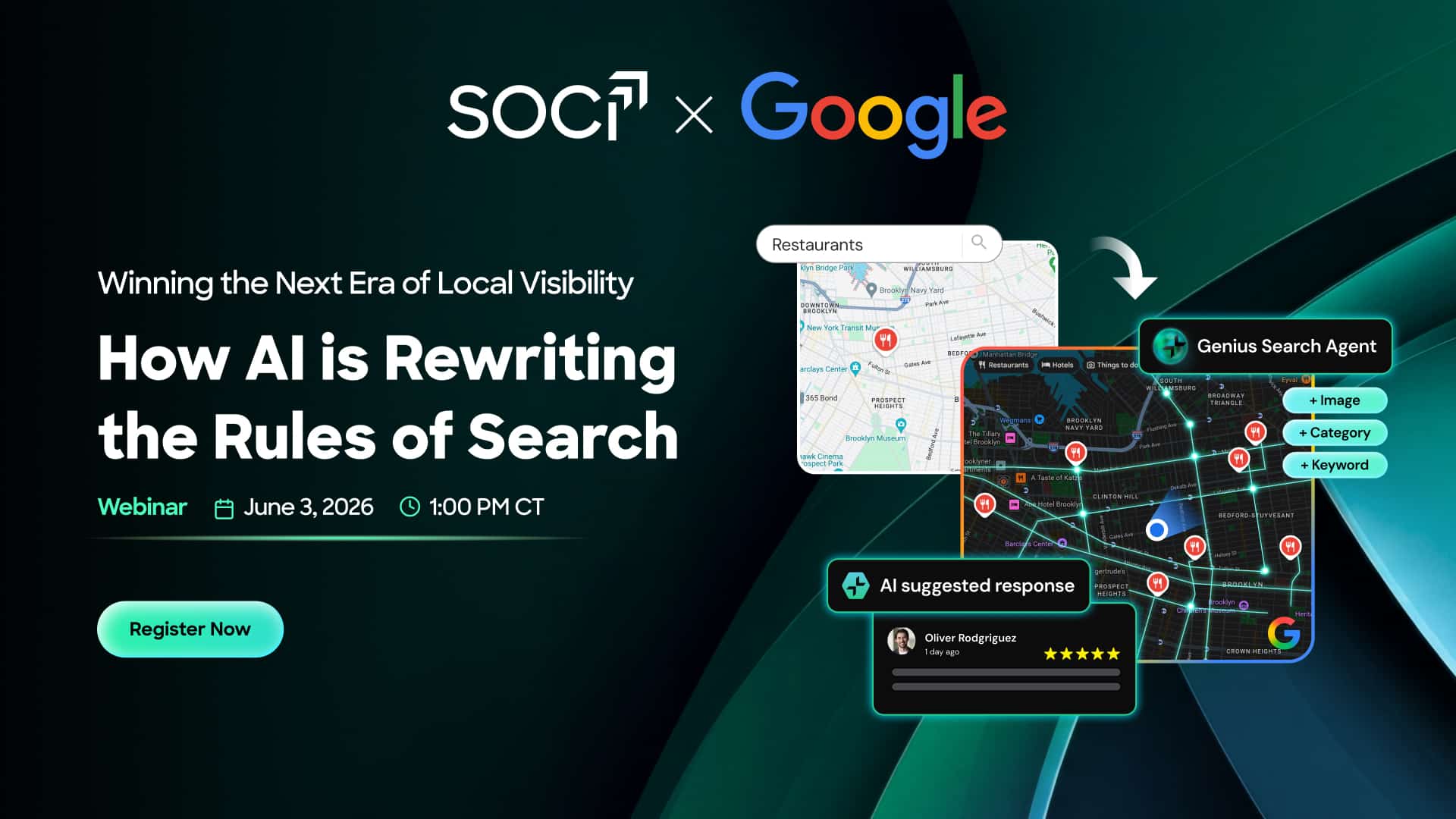
    I recently discovered how AI is revolutionizing the way customers find local businesses. Tools like Google AI Overviews, Gemini, and Ask Maps are paving the way for more detailed, conversational searches.

    It’s clear to me that traditional search rankings are no longer the sole factor in gaining visibility. Ensuring your business details are complete and accurate—like your Google Business Profile, reviews, and local content—can make a big difference.

    I’m excited to join SOCi and Google for an exclusive webinar, Winning the Next Era of Local Visibility, on June 3. It’s a golden opportunity for anyone looking to stay ahead of the curve.

    During this webinar, I look forward to learning:

    • How AI is transforming local search dynamics.
    • The types of signals that AI considers for recommendations.
    • Strategies to boost visibility on Search, Maps, and Gemini.
    • The implications of Ask Maps for your brand.

    I’m convinced that AI is already shaping customer discovery, so it’s crucial to ensure your business isn’t left behind.

    Register now to secure your spot.


    Inspired by this post on Search Engine Land.


    crushpress.ai community screenshot
  • Unlocking AI-Powered Bidding: Google Elevates Ad Efficiency

    Unlocking AI-Powered Bidding: Google Elevates Ad Efficiency

    Have you ever wished there was an easier way to optimize advertising spend in real-time? Well, Google is stepping up its game, and I’m here to share all the exciting details with you.

    Recently, Google has introduced new, AI-driven bidding and budgeting features across platforms like Search, Shopping, and Performance Max. The goal? To help us advertisers capture more demand with less manual effort.

    What’s happening. With updates such as Journey-aware Bidding and demand-led budget pacing, Google is expanding its automation stack. These tools are designed to let our campaigns adapt swiftly to changing consumer behaviors.

    Ultimately, the focus is on allowing AI to identify and seize opportunities we might otherwise miss.

    Why it matters to us. These updates are about pulling in more conversions without bogging us down with extra manual work. Google’s AI can now find new demand and adjust our spending real-time. By enhancing bid responsiveness and budget adaptability, our campaigns are set to become significantly more efficient.

    It’s all about extracting greater value from our budgets while remaining competitive in a rapidly shifting search landscape.

    Smarter bidding with better context. With Journey-aware Bidding in beta, advertisers like us can now include more of the customer journey — such as non-biddable conversions — into optimization. This gives Google AI a comprehensive view of factors leading to sales, beyond initial actions like form fills.

    Meanwhile, Smart Bidding Exploration is extending beyond Search. Already boosting unique converting users by 27%, it’s about to roll out to Performance Max and Shopping campaigns.

    Demand-responsive budgets. On the budgeting front, Google’s innovations allow us to set spend over defined periods without stressing over daily limits. The demand-led pacing takes it further, automatically adjusting spend based on what’s currently demanding attention, increasing our budgets during high-opportunity days and conserving funds when things slow down.

    Those of us using total budgets have already enjoyed a remarkable 66% drop in manual budget tweaks.

    Why this matters. Historically, budget management has been labor-intensive. Now, with automated pacing, we can reduce constant monitoring and increase campaign efficiency.

    Things to watch:

    • How much control we’re prepared to hand over to automation
    • If exploration’s incremental gains lead to profitable growth
    • The transparency of these scaling systems

    The bottom line. Google is nudging us towards AI for both bidding and budgeting, shifting our role from manual optimization to guiding inputs while trusting the system to drive growth.


    Inspired by this post on Search Engine Land.


    crushpress.ai community screenshot
  • Explore Google’s New AI Search Link & Citation Updates

    Explore Google’s New AI Search Link & Citation Updates

    Have you noticed a change in how Google displays links and citations in its AI search features? I recently learned about five key updates that aim to enhance our experience with AI Mode and AI Overviews.

    According to Hema Budaraju, VP, Product Management at Google, these upgrades are designed to help us connect with authentic voices and access valuable information across the web. She detailed these updates in a recent article.

    Let’s dive into the updates rolling out:

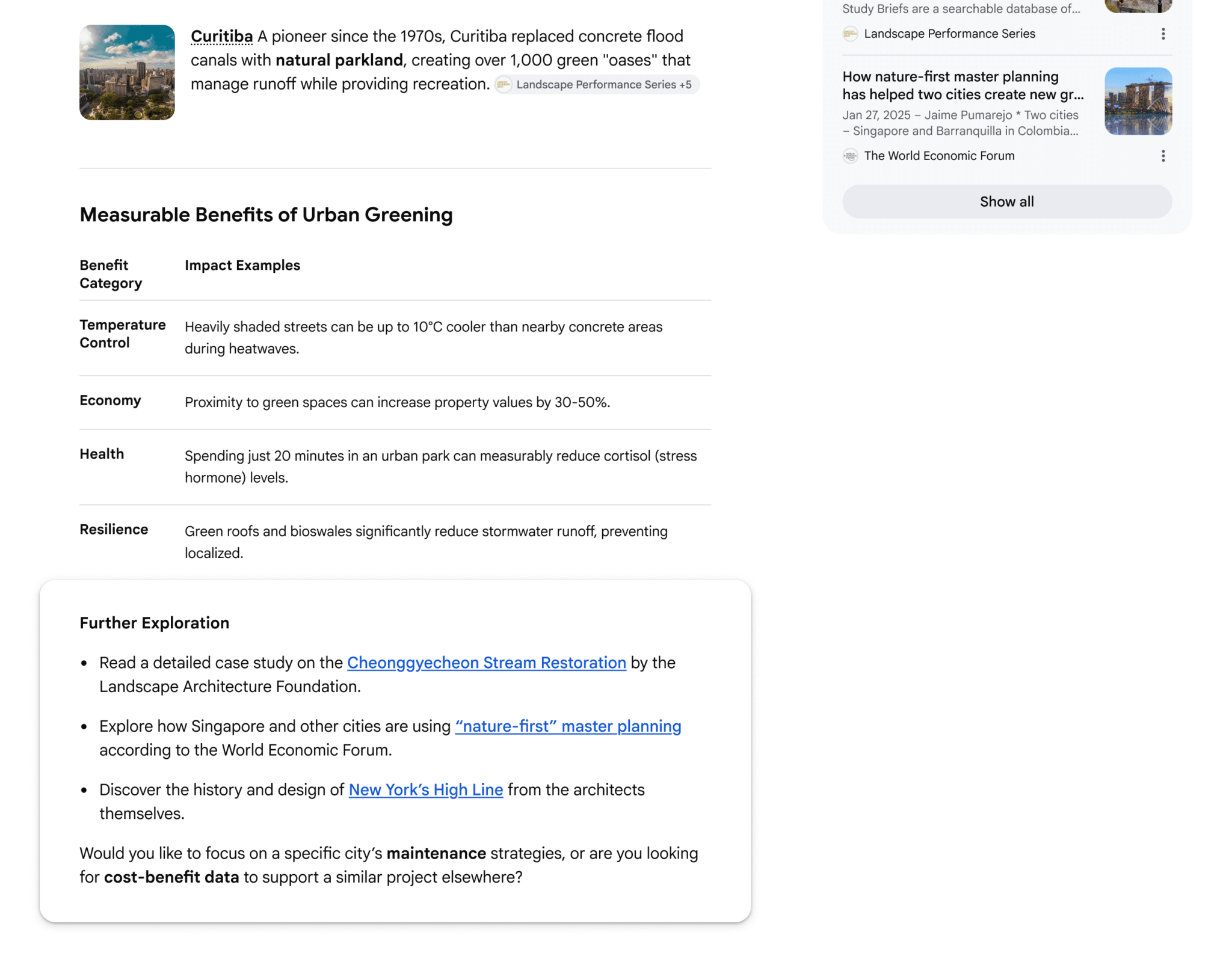
    (1) Suggested angles at the end of AI responses. Google now suggests further reading options at the end of AI responses. These link to unique articles or analyses that deepen our understanding of the topic. It’s like having a roadmap to satisfy our curiosity!

    ```json
{
  "alt": "Document discussing the benefits of urban greening with a focus on Curitiba and nature-first planning.",
  "caption": "Discover how urban greening strategies in Curitiba revolutionize city living, offering cooling, economic, health, and resilience benefits.",
  "description": "This image highlights a document on urban greening benefits, titled 'Measurable Benefits of Urban Greening'. Curitiba's transformation to include over 1,000 green oases is discussed, showing the positive impact on temperature control, economy, health, and resilience. Key benefits include reduced heat, increased property values, health improvements, and decreased stormwater runoff. Additionally, it encourages exploring successful nature-first urban projects in global cities like Singapore and New York through recommended readings."
}
```

    Here’s a preview of this feature:

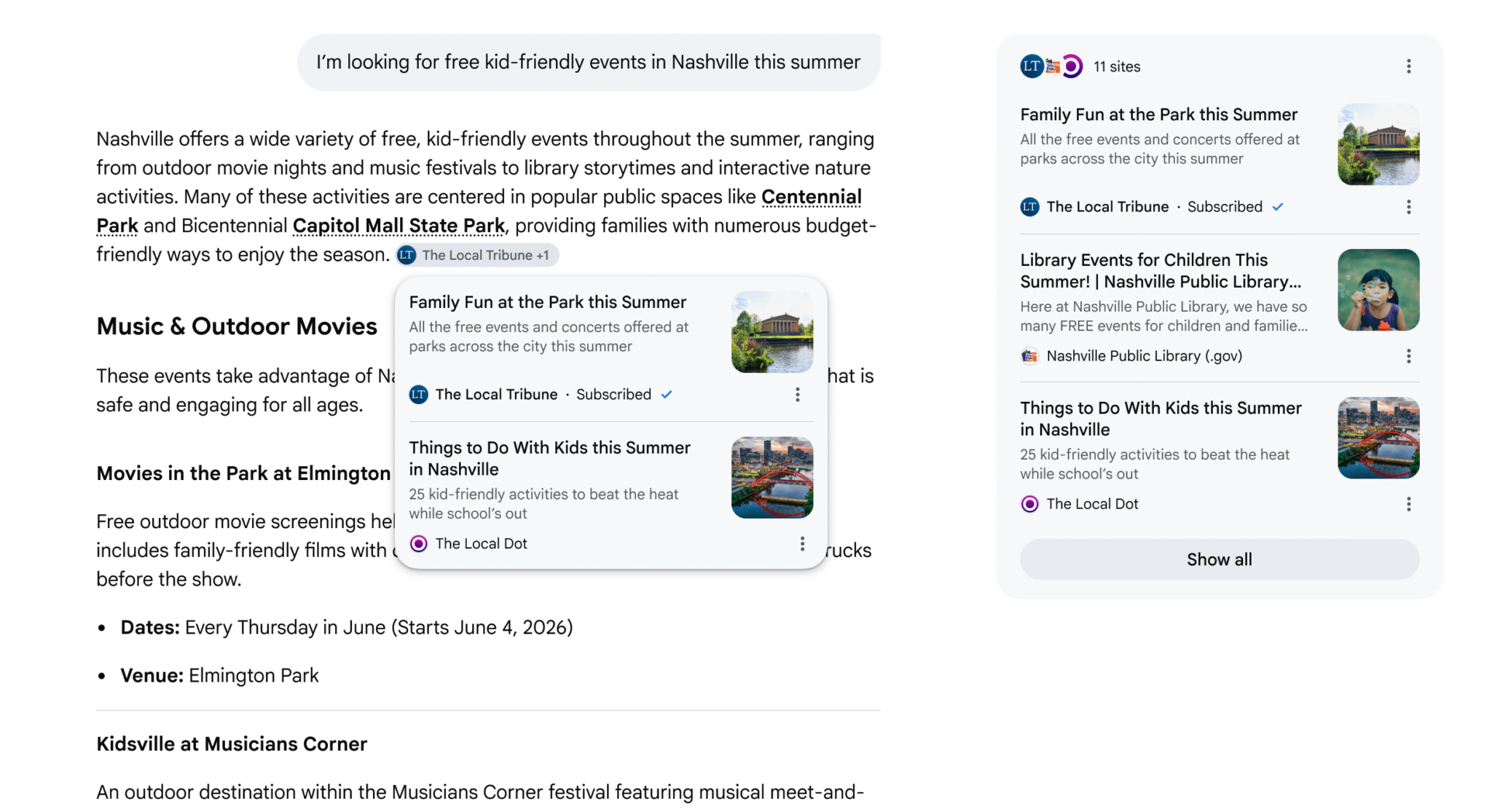
    (2) Easier access to your news subscriptions. With this update, Google displays links from our news subscriptions prominently. This means I can quickly access content I trust, maximizing the value of my subscriptions. During Google’s early tests, these subscription links significantly boosted click-through rates.

    ```json
{
  "alt": "Search results listing kid-friendly events in Nashville with descriptions and images.",
  "caption": "Discover a summer of fun in Nashville with activities ranging from outdoor concerts to library storytimes, perfect for families seeking budget-friendly adventures.",
  "description": "The image displays search results for free kid-friendly events in Nashville, showcasing a variety of activities like park concerts, library events, and more. It mentions locations such as Centennial Park and Bicentennial Capitol Mall State Park, emphasizing family-friendly entertainment. Results include detailed event descriptions and small preview images to engage users looking for summer plans for kids in Nashville."
}
```

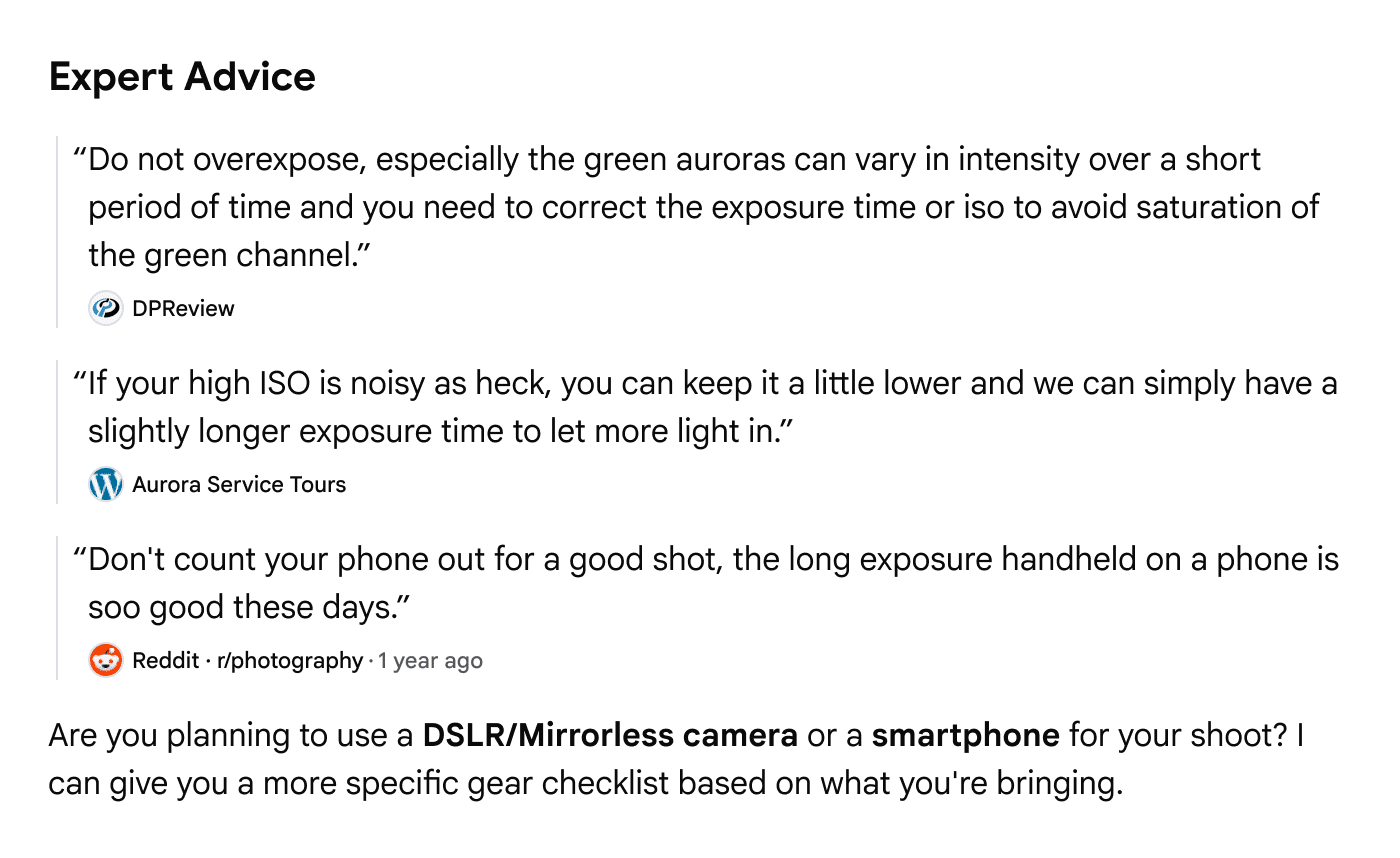
    If you’re a publisher, check out the documentation to enable this feature.

    Here’s what this looks like in action:

    ```json
{
  "alt": "Image featuring expert advice text on photography exposure settings and camera choices.",
  "caption": "Unlock your photography potential with expert tips on exposure settings and choosing between DSLR and smartphone cameras.",
  "description": "This image presents expert advice on photography including managing exposure settings for auroras and choosing between DSLR and smartphone cameras. Quotations from DPReview, Aurora Service Tours, and a Reddit photography forum offer insights such as avoiding overexposure of green auroras, balancing ISO and exposure time, and leveraging the capabilities of modern smartphones for long exposure shots. This serves as a guide for photographers in optimizing their equipment and settings for better shots."
}
```

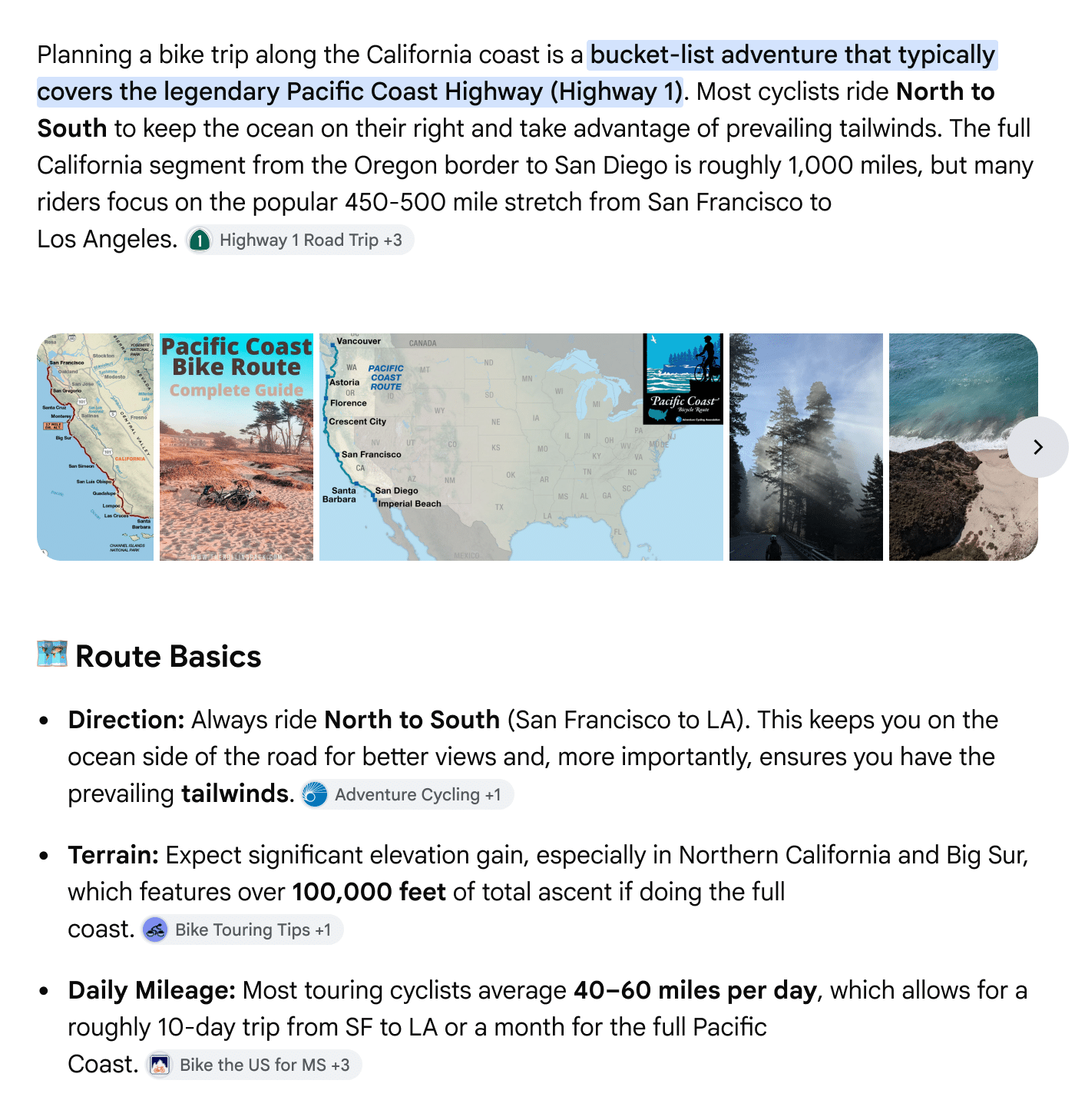
    (3) Social media and online discussions now include creator details. When AI features cite social media, Google includes not only the website’s name but also the creator’s name, handle, and community name. This transparency helps me spot firsthand sources at a glance.

    Here’s a glimpse of how this plays out:

    ```json
{
  "alt": "Infographic on planning a bike trip along California's Pacific Coast Highway.",
  "caption": "Embark on a stunning journey along California's iconic Highway 1, a cyclist's paradise offering breathtaking coastal views and adventurous terrain.",
  "description": "This infographic outlines a cycling trip along California's Pacific Coast Highway, detailing the route from San Francisco to Los Angeles. It highlights route basics such as direction, terrain, and daily mileage, emphasizing riding north to south for scenic ocean views and favorable tailwinds. Often characterized by significant elevation gains, particularly in Northern California and Big Sur, the journey requires an average of 40 to 60 miles of cycling per day. Keywords: bike trip, California coast, Pacific Coast Highway, cycling route."
}
```

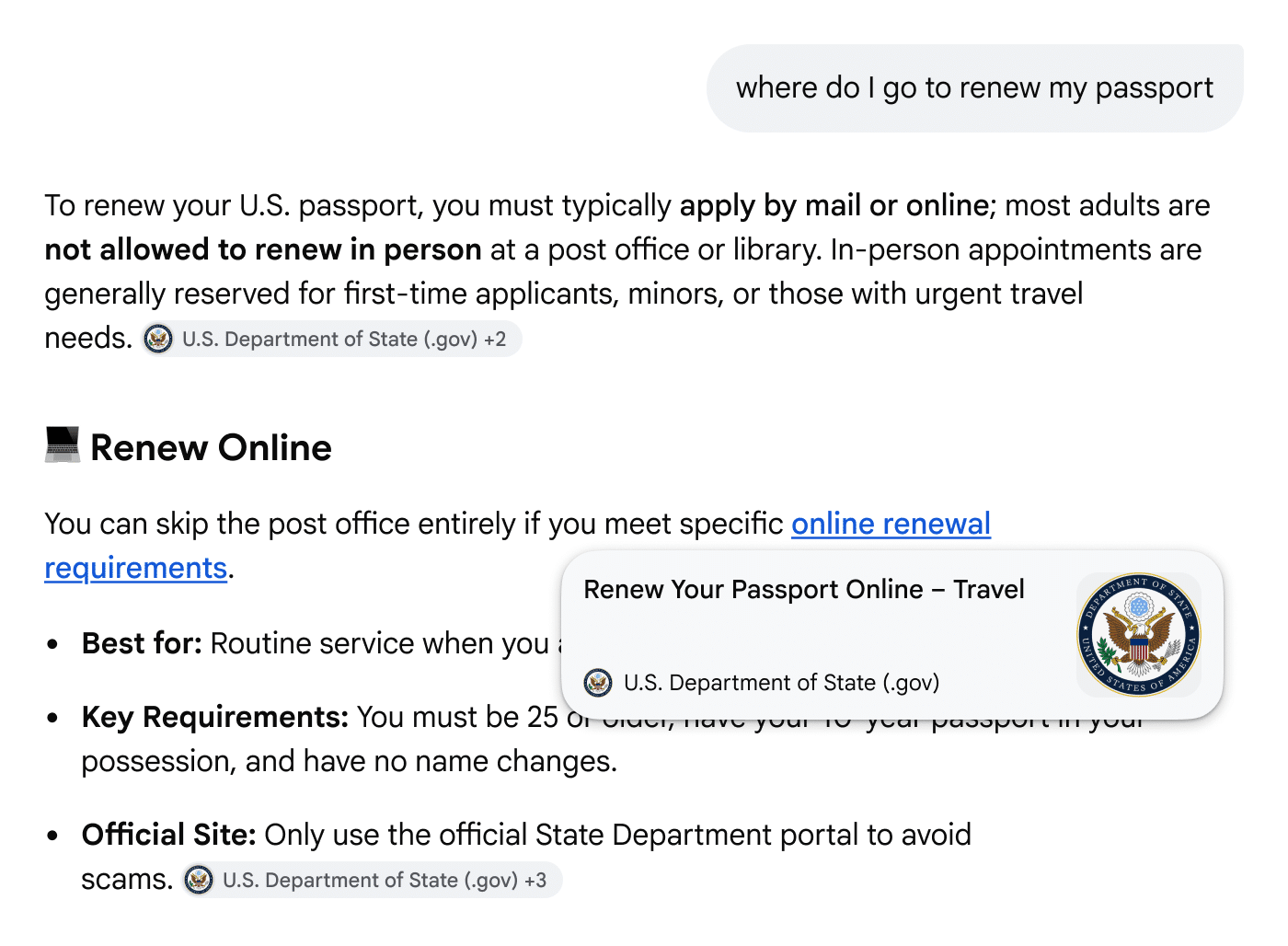
    (4) More links, next to relevant text. Google is increasing the number of links shown directly within AI responses, strategically placing them next to relevant text. This makes it tempting for me to explore these sources further.

    Here’s what it looks like:

    ```json
{
  "alt": "Instructions on renewing a U.S. passport online or by mail from the U.S. Department of State.",
  "caption": "Discover how to renew your U.S. passport easily by mail or online, as highlighted by the U.S. Department of State guidance.",
  "description": "This image displays a guide on renewing a U.S. passport, emphasizing that applications are typically by mail or online and in-person renewals are restricted. It highlights the benefits of online renewal and lists the State Department's official instructions. Key details include eligibility for online renewal and the importance of using the official portal to avoid scams."
}
```

    (5) Hover over inline links for a quick look. Now when I hover over an inline link in Google’s AI features, I get a sneak peek of the website. This could just be the nudge I need to click through and explore further. I remember seeing Google test this back in February and thought it was a brilliant idea.

    Here’s an example of the feature:

    Why this matters. Google is committed to ongoing testing and refinements, ensuring these features serve us better. I truly believe these changes will promote more engagement with the cited pages, presenting an exciting step forward for both users and the web ecosystem. The real question is, will they meet my expectations?


    Inspired by this post on Search Engine Land.

    crushpress.ai community screenshot
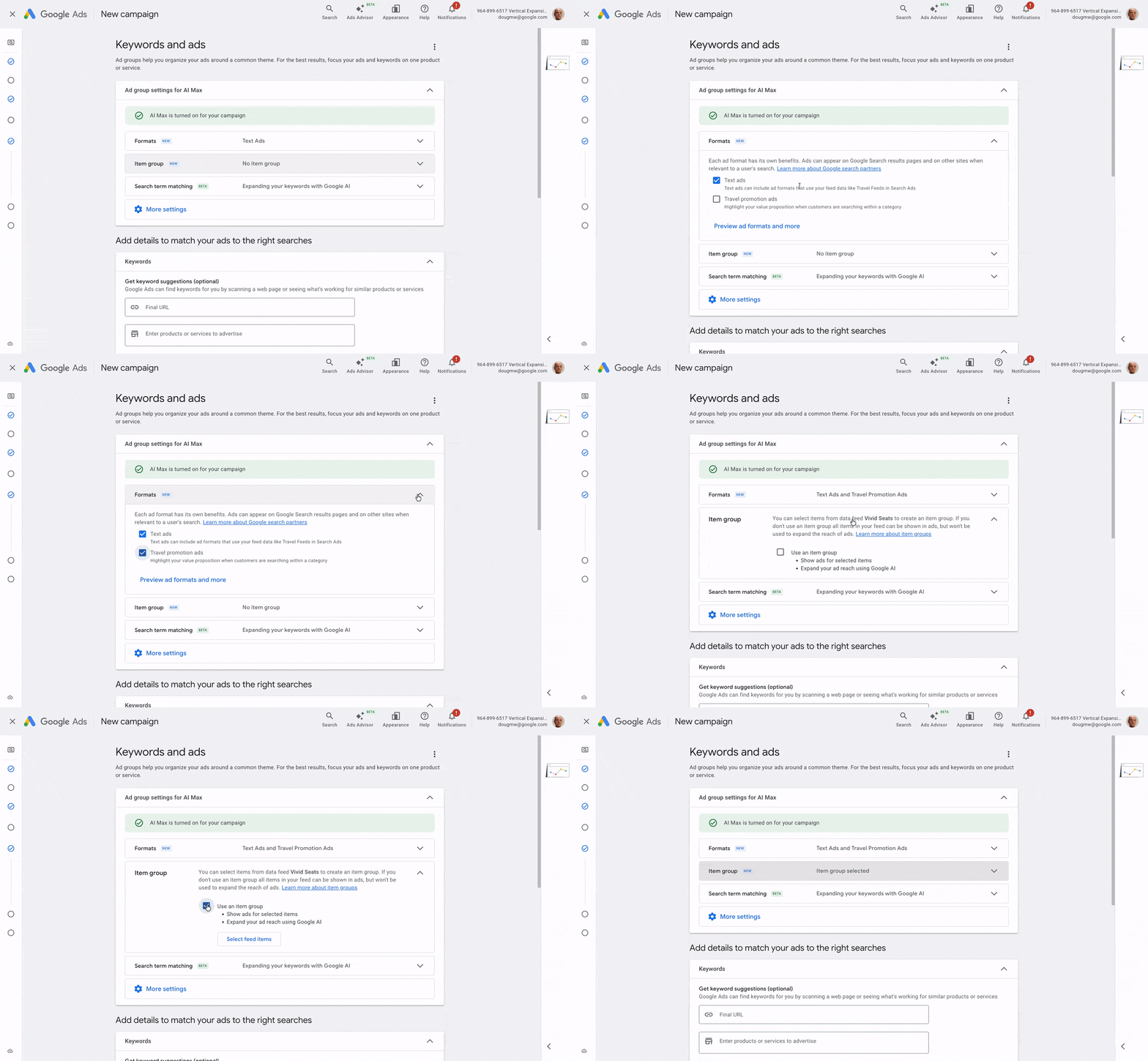
  • Mastering Google AI Max: New Controls and Exciting Expansions

    Mastering Google AI Max: New Controls and Exciting Expansions

    I’ve recently explored fascinating updates in the world of Google AI Max, and I’m thrilled to share how these changes are reshaping online advertising

    Google is significantly expanding AI Max across more campaigns, offering advertisers like us enhanced control over AI-driven targeting and messaging. This comes just as user search behaviors are leaning more towards conversational queries.

    What’s new?

    AI Max Expansion: It’s exciting to see AI Max moving beyond just Search, now rolling out to Shopping campaigns and travel-specific formats. This broadens the reach across various advertiser types.

    Introducing AI Brief (Powered by Gemini): A remarkable new interface is here, allowing advertisers like us to guide AI using natural language inputs, providing an unprecedented level of control.

    ```json
{
  "alt": "Google Ads interface showing AI Max for Shopping campaigns settings.",
  "caption": "Explore Google's AI-driven Shopping campaign features designed to optimize ad performance and expand reach.",
  "description": "The image displays the Google Ads interface focused on AI Max for Shopping campaigns. It highlights features such as asset optimization, text customization, and URL expansion. The interface is intended to expand ad reach and improve performance through tailored AI-powered suggestions. Settings for brand exclusions are also visible, allowing users to refine targeting by controlling which brands appear in search queries. This tool is crucial for digital marketers seeking to maximize their advertising impact."
}
```

    Compliance Features: Text disclaimers paired with URL automation help us stay compliant while leveraging automated landing page selection.

    Why it Matters: AI Max is not just adding automation; it’s becoming a foundational aspect across Search, Shopping, and Travel. This means automation is increasingly key in matching ads to user intent, capturing demand earlier in the customer’s journey.

    The AI Brief and other compliance features empower us with more control, ensuring our campaigns don’t feel like a “black box.”

    Smarter Shopping: By using Merchant Center data, AI Max for Shopping creates adaptive ads that respond to long-tail and exploratory queries, helping brands appear earlier in the discovery phase.

    ```json
{
  "alt": "Google Ads new campaign setup interface showing AI Max settings and keyword suggestions.",
  "caption": "Setting up a new campaign in Google Ads with AI Max for improved keyword matching and targeted advertising.",
  "description": "The image depicts the Google Ads interface for setting up a new campaign, featuring the AI Max settings. Options include text ad formats and search term matching with AI. The section for adding details contains a keyword suggestion tool, which can scan web pages for relevant terms. This setup aids in organizing ad groups and optimizing ad strategies using AI-driven insights."
}
```

    Travel Consolidation: For travel advertisers, the consolidated Search Campaigns for Travel simplify operations by bringing fragmented formats together, reducing complexity with AI Max capabilities.

    More Control: AI Brief addresses a major concern: compliance control in automated systems. I can define messaging rules and prioritize queries, ensuring feedback before campaigns launch.

    Automation Meets Compliance: The final URL expansion uses AI for optimal landing page relevancy, while new text disclaimer features keep legal messaging intact, making AI viable in regulated sectors.

    The Bottom Line: AI Max is transitioning from a search add-on to a core Google Ads component, blending automation with advertiser input to suit an AI-driven search landscape.


    Inspired by this post on Search Engine Land.


    crushpress.ai community screenshot
  • Google AI CTR Rebound: Promising 85% Increase in Two Months

    Google AI CTR Rebound: Promising 85% Increase in Two Months

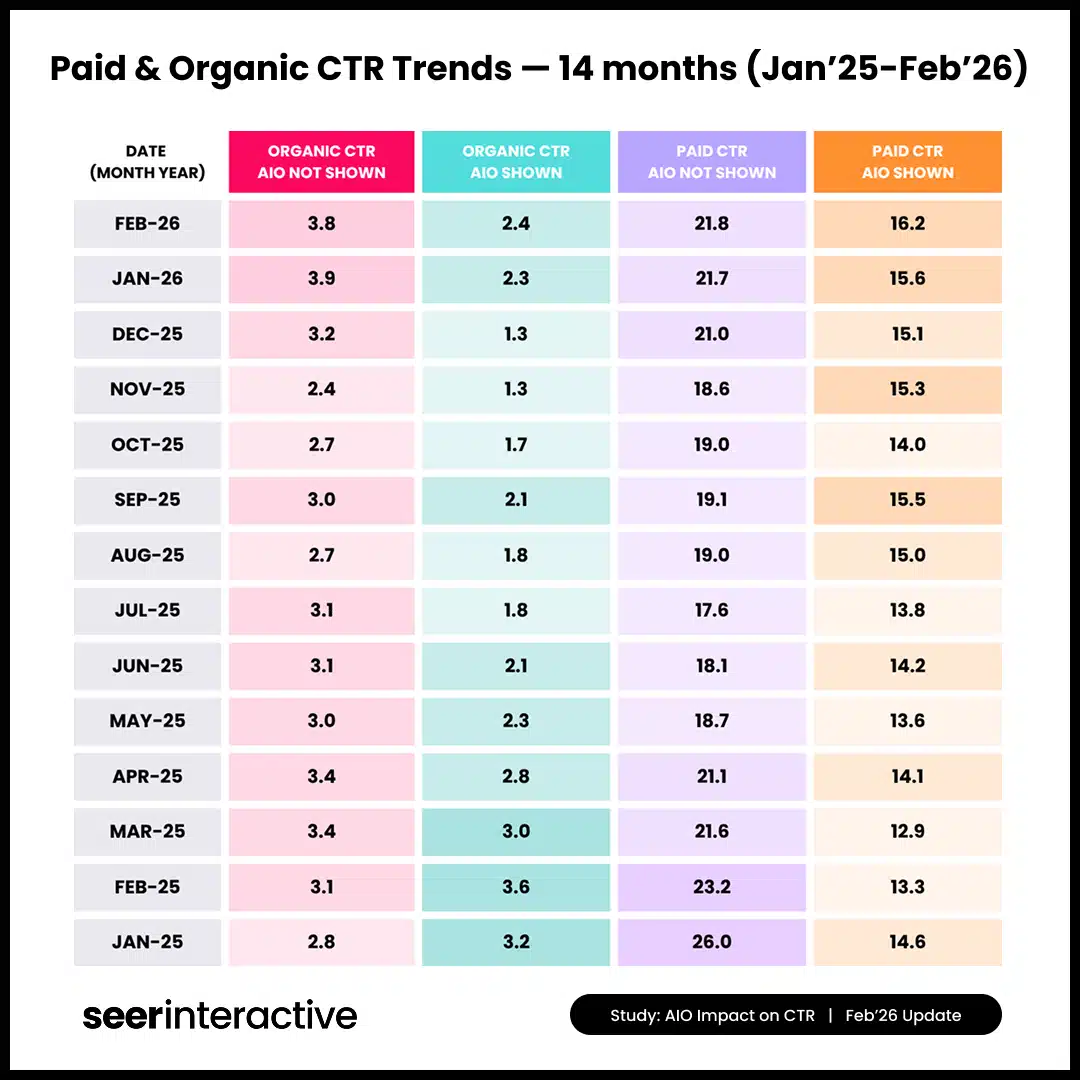
    I’ve been following the shift in Google’s AI Overviews, and it’s exciting to see the organic click-through rate on these searches finally on the rise. After a year-long slump, the CTR is showing promising signs of recovery. But could this mean the end of click losses?

    Back in December 2025, the CTR had hit a low of 1.3%, but by February 2026, it had climbed to 2.4%. That’s an impressive 85% jump in just two months, according to the latest data from Seer Interactive.

    Understanding CTR Movement. When AI Overviews are part of a search, pages that are cited see a significant increase in clicks compared to pages that aren’t cited, yet they still garner fewer clicks than searches without any AI Overviews.

    Here’s a breakdown of the CTR percentages:

    • No AI Overview: ~3.3% CTR
    • AI Overview with citation: ~2.1% CTR
    • AI Overview without citation: ~0.9% CTR

    Where are the clicks going?. Interestingly, searches that don’t include AI Overviews are seeing an increase in value. Their CTR rose from 2.8% at the start of 2025 to 3.8% by February 2026.

    • One factor: AI Overviews are handling quick answers, leaving users with more complex questions to search deeper.

    AI Overviews Depend on Query Intent. The presence of AI Overviews varies greatly depending on the type of query:

    ```json
{
  "alt": "Chart displaying CTR trends for organic and paid AIO shown and not shown from Jan 2025 to Feb 2026.",
  "caption": "Explore 14 months of CTR trends comparing organic and paid results in scenarios with and without AIO shown, revealing key insights into audience engagement shifts.",
  "description": "This table visualizes 14 months of CTR trends from January 2025 to February 2026. It includes metrics for organic and paid CTR with scenarios of AIO shown and not shown. The data is categorized by month, displaying variations in organic and paid click-through rates over time. This study by Seer Interactive offers insights into digital marketing performance analytics. Keywords: CTR, AIO, Seer Interactive, digital marketing trends."
}
```
    • Informational: ~36% feature AIOs
    • Transactional: ~5%
    • Comparison: ~95%
    • Question: ~86%

    A nuanced perspective. It’s important to note that a lower CTR doesn’t always equate to poor results. In instances where clicks remained stable but impressions grew, brands may have appeared more frequently in AI Overviews even as CTR percentages dropped.

    The stability of paid search. I noticed that when Google presents an AI Overview, the paid CTR increases slightly from 14.6% to 16.2%. Without AI Overviews, the CTR drops from 26% to 21.8%.

    Why this matters. Google’s AI Overviews are not just reducing overall clicks; they’re shifting them. This means you need to aim for your site being cited in AI Overviews and focus on queries where users are more likely to click.

    About the Research. Seer analyzed data from 53 brands, 5.47 million queries, and 2.43 billion impressions between January 2025 and February 2026.

    See the full report here: AIO Impact on Google CTR: 2026 Update


    Inspired by this post on Search Engine Land.

    crushpress.ai community screenshot
  • Unlocking the Power of Google’s New AI Safety Features in Ads Advisor

    Unlocking the Power of Google’s New AI Safety Features in Ads Advisor

    I’ve recently discovered that Google has introduced some exciting AI safety features in their Ads Advisor, which could really transform how we manage campaigns. This update promises to automate policy fixes, enhance security, and expedite certifications, all to help us run our campaigns more efficiently.

    As someone who spends a lot of time tackling policy issues and managing certifications, this news is music to my ears. With advertising campaigns becoming increasingly complex, having AI handle these time-consuming tasks could significantly boost our productivity and performance.

    What’s New. The latest update brings proactive troubleshooting, continuous security monitoring, and immediate certifications. Thanks to AI and Google’s Gemini capabilities, these features promise to be a real game-changer.

    Zoom In:

    Ads Advisor can now automatically flag and resolve policy violations before they even catch our attention. This proactive approach ensures we stay ahead of potential issues.

    The new security dashboard is always on the lookout for risks such as suspicious domains or dormant users. It’s like having an ever-vigilant guard protecting our accounts 24/7.

    Imagine getting certifications that used to take weeks, approved instantly with just a click. This means we can focus on strategy rather than paperwork.

    How It Works. Ads Advisor proactively scans accounts and sites, offering up fixes and confirming resolutions without the need for manual intervention. On the security front, it continuously checks account health and even supports passkey use, reducing our dependency on passwords.

    Why We Care. These features save us hours that were once spent fixing issues, upping our security game, and dealing with certifications. This proactive system reduces delays and risks, ultimately enhancing campaign speed and efficiency.

    What to Watch. Google plans to roll out these features for English-speaking accounts over the coming months, with additional languages to follow.

    Bottom Line. Google is transforming Ads Advisor into an active operator, making ad management safer, quicker, and far less labor-intensive. I’m eager to see how these changes will impact the way we work.


    Inspired by this post on Search Engine Land.

    crushpress.ai community screenshot
  • Explore Google’s AI-Powered Chrome: Seamless and Efficient

    Explore Google’s AI-Powered Chrome: Seamless and Efficient

    I’ve recently discovered that Google’s latest update to Chrome now offers an ingenious AI Mode, designed to make my browsing experience more streamlined and efficient. With this new enhancement, I can dive deeper into searches with fewer tabs, making my workflow smoother than ever before.

    What’s new? Let me walk you through the three exciting features in Chrome’s AI Mode. First up is the ability to search side-by-side. Now, when I click on a link in AI Mode on my desktop, the related webpage opens right next to it. This setup allows me to easily compare details, visit relevant sites, and ask follow-up questions without losing the context of my search. Here’s how it looks:

    Another fantastic addition is the ability to search across my tabs. Whether on desktop or mobile, I can now tap the new “plus” menu on the New Tab page or within AI Mode to incorporate recent tabs into my search. This feature helps AI Mode provide more customized responses and suggest additional sites worth exploring.

    Lastly, there’s the multi-input and easy tool access feature. I can mix and match various tabs, images, or files such as PDFs, and bring that context directly into AI Mode. Plus, tools like Canvas and image creation are readily accessible wherever I see the new plus menu in Chrome.

    Understanding why this matters to us as users is crucial. These Chrome-specific features launched initially for U.S. English users unlock greater AI Mode capabilities. While currently limited to Chrome users, they clearly indicate Google’s forward-thinking direction in AI integration.


    Inspired by this post on Search Engine Land.


    crushpress.ai community screenshot