
I believe the lines between paid media, PR, and SEO have officially disappeared.
When I look at baked-in YouTube sponsorships, native UGC, and third-party review incentives, I no longer see them as separate from SEO. I see them as the modern equivalent of buying a high-DA backlink. When I fund these channels, I am investing in the information sources that shape how AI systems understand, evaluate, and recommend a brand.
A recent social media screenshot made this shift especially clear to me. A B2B brand was offering a $250 Amazon voucher to anyone who wrote a review on G2.
To a growth marketer, that may look like a familiar user acquisition tactic. But as an SEO, I saw something more important: a direct investment in the semantic infrastructure AI systems use to judge brands.
The evolution of the authority signal
To understand why I consider a $250 G2 voucher or a paid YouTube sponsorship an SEO strategy, I have to look at how LLMs now define authority.
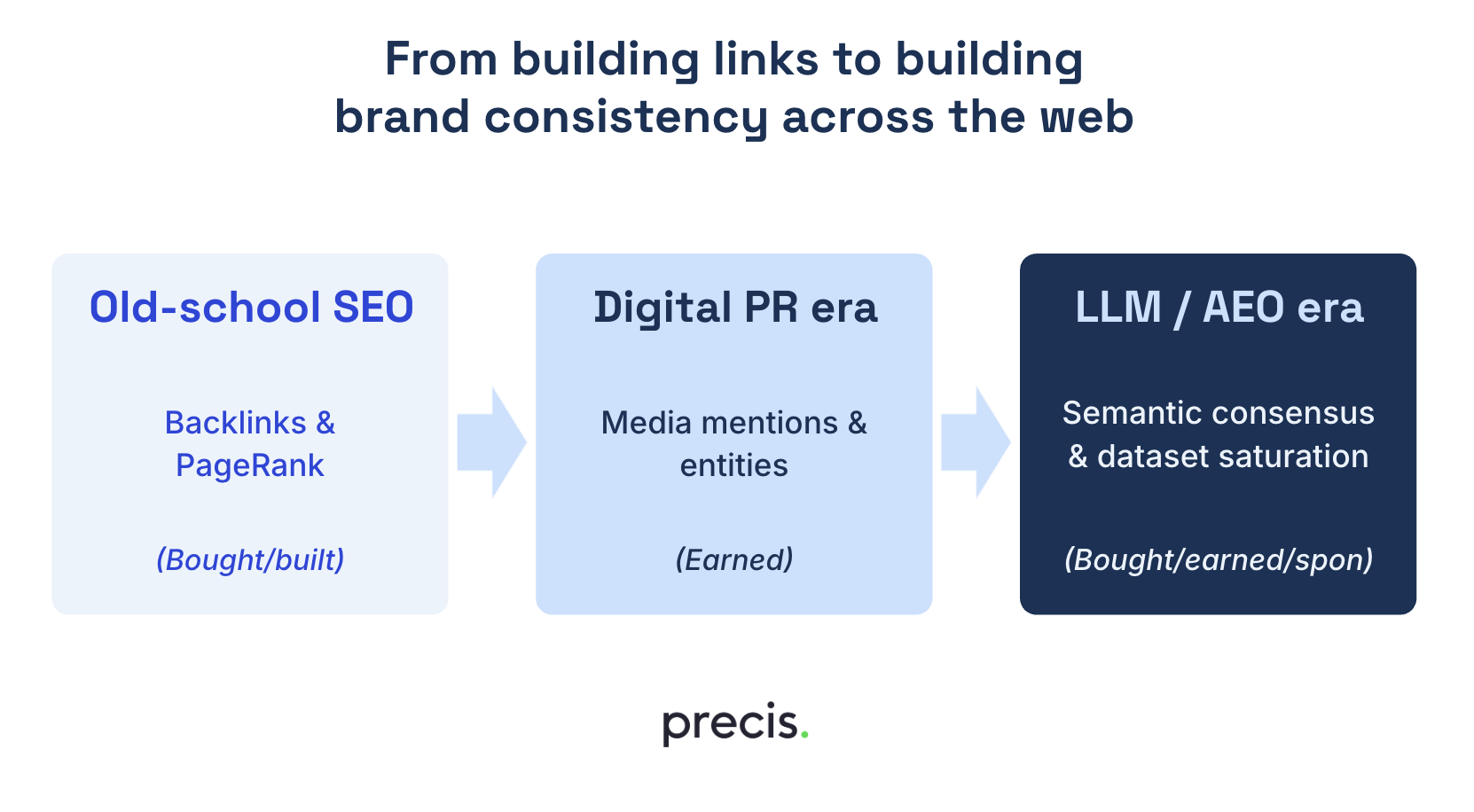
Authority used to feel transactional and mathematical. You built or bought hyperlinks, and those links helped determine how trusted a page or brand appeared to search engines.
When I moved from link building into digital PR and influencer marketing, I realized Google was getting smarter. I could not rely on links alone. I needed unlinked brand mentions, high-tier media coverage, and contextual relevance. In many ways, I was optimizing for Google’s Knowledge Graph.
Today, retrieval-augmented generation (RAG) systems and LLMs do not just count links or parse knowledge graphs. They look for semantic consensus across the web.
When an AI engine like Perplexity or ChatGPT answers a user query, it crawls the data ecosystems it trusts most for that specific topic. For software, that often means G2 and Reddit. For consumer products, it may mean TikTok transcripts, YouTube, and forums.
So when I pay $250 for a G2 review, I am buying a dense, text-based data point that an LLM can use to understand my brand’s sentiment, use cases, and vector positioning. I am strengthening the signals AI systems may use when deciding whether to recommend my brand.
The permanent ad: Why sponsorships and UGC are the new organic infrastructure
This reality breaks the traditional separation between paid media and SEO.
Historically, paid ads were temporary. I turned off the budget, the traffic stopped, and SEO had to carry the long-term work. If I run a dynamic programmatic ad on YouTube or a banner ad on a website, that old model still applies because LLM web scrapers generally ignore dynamic ad placements.
But baked-in influencer sponsorships, native user-generated content, and podcast reads behave differently because they become part of the content itself.
First, there is the hardcoded transcript. When a YouTuber reads a native sponsor segment such as, “I use Brand X to manage my business taxes,” that message is baked into the video file, and YouTube automatically transcribes it.
Then comes LLM ingestion. When an LLM crawls the web, or when a multimodal AI watches the video, those spoken words can be indexed. The AI can associate the brand with the semantic concept of business taxes.
That creates a new half-life for paid media. Long after the campaign ends and the initial views slow down, the transcript can remain part of the information an LLM can access.
As someone who spent years bridging the gap between digital PR and SEO, I used to judge a campaign’s ROI by immediate referral traffic, brand search lift, and backlink quality. Now, I also have to think about the algorithmic half-life of my creative assets.
Activating the convincer: Bringing paid and PR into the visibility supply chain
The visibility supply chain treats content like an industrial product that passes through strict organizational “gates” before it enters the digital ecosystem. In that model, companies need a strategic duo: the hacker, or technical architect, and the convincer, or cross-departmental visibility advocate.
This convergence of paid media and AI visibility is exactly where I believe the convincer has to step in.
If my paid media team is buying YouTube sponsorships based only on demographic reach, or if my product marketing team is buying G2 reviews just to hit a quarterly quota, we may be damaging LLM visibility without realizing it.
The reason is simple: LLMs need information density and semantic alignment.
If a user writes a rushed, generic review like “Great tool, highly recommend!” just to receive a $250 voucher, it may pass the human layer, but it fails the machine layer. To a RAG system, that sentence is low-density noise.

The convincer’s job is to realign the review strategy and help internal teams understand how every initiative can build LLM visibility.
For example, I would rather incentivize users to write detailed, context-rich problem-and-solution statements, such as: “We used Brand X to solve our cross-border compliance issues in Europe.” That gives AI the entity-relationship mapping it needs to recommend the brand for cross-border compliance.
The new marketing playbook: Optimizing dataset partnerships
If I want a brand to be recommended by AI systems, I have to study where the major AI players are getting their data.
We know OpenAI and Google have struck multimillion-dollar deals to train on Reddit’s real-time firehose. We know Grok trains on X. We also know Apple and others are licensing major journalistic archives.
That means target audience research is no longer just about finding where customers spend time. For me, it is also about dataset matching.
If I am planning an influencer campaign, a digital PR push, or a community-building initiative, I need to ask one critical question: Is this content entering a data pipeline that the primary LLMs trust and crawl in real time?
Stop optimizing pages. Start optimizing budgets.
I no longer believe SEO can be isolated inside a technical department or limited to a content blog. That does not reflect how AI visibility is built anymore.
The next time I sit in a budget allocation meeting and see a line item for influencer marketing, podcast sponsorships, or third-party review incentives, I will not treat it as temporary media buying.
I will reframe it as infrastructure. I am building the digital foundation of a brand’s AI persona. I am buying the AI equivalent of backlinks. If I do not intentionally structure those paid assets to feed the visibility system, I am leaving the brand’s future visibility up to chance.
Inspired by this post on Search Engine Land.

