I recently came across some important news from Google that I felt compelled to share with you. As of May 7, 2026, Google will no longer support FAQ rich results. This change means that these helpful snippets will no longer appear in Google Search results.
Additionally, Google Search Console will cease reporting on FAQ structured data, impacting how we track and analyze our content’s performance in search engines.
What Google said: Google has posted a notice on the FAQ structured data developer documentation. They state: FAQ rich results are no longer appearing in Google Search. By June 2026, Google plans to fully drop the search appearance, rich result report, and support in the Rich results test. To provide some adjustment time, support for the FAQ rich result in the Search Console API will be removed by August 2026.
Remove code: You might be wondering what to do with your existing FAQ structured data. The choice is yours—you can remove it from your code, but leaving it might still benefit you if other search engines use it for their own purposes.
Why we care: For me and many others, rich results have been instrumental in increasing web pages’ click-through rates and attracting additional traffic. The discontinuation of FAQ rich results could impact this dynamic.
To gauge the effect on your website, monitor pages with FAQ structured data closely and pay attention to any shifts in your traffic from Google.
In the rapidly changing world of search, I’ve discovered that Answer Engine Optimization (AEO) is becoming essential for content creators and marketers like me. Unlike traditional search engines, platforms such as Grok, Google’s featured snippets, and voice assistants focus on delivering precise and prompt answers to user questions. To stand out, I’ve found that using structured data is truly transformative. It enables answer engines to comprehend the content better, boosting the chances of my site appearing in instant answers, rich snippets, or voice search outcomes. Here’s my guide to leveraging structured data for AEO triumph.
Structured data, to me, is like a format template that simplifies how search and answer engines interpret my webpage’s content. Utilizing schema.org markup, structured data organizes details into machine-readable formats, such as JSON-LD, which describe elements like articles, products, events, or FAQs. This clarity is vital for answer engines, as they rely on well-structured data to provide fast, relevant responses.
Why does structured data matter for AEO? Well, I’ve observed that answer engines aim to furnish direct answers, frequently extracting information from structured data for featured snippets, knowledge panels, or voice responses. Without employing structured data, my quality content might be ignored. For instance, a blog post like “how to bake a chocolate cake” with proper recipe schema markup stands a better chance of being highlighted as a step-by-step guide than one without. Structured data bridges the disparity between my content and the algorithmic processes powering answer engines, making it indispensable for visibility.
Here’s how I’ve learned to harness structured data for AEO:
First, I identify the relevant schema types that suit my content. Common types for AEO include FAQPage for question-and-answer content, HowTo for tutorials or guides, Article for enhancing blog posts, and specific schemas like Recipe, Product, or Event for niche areas. I utilize tools like Google’s Structured Data Markup Helper to explore suitable schemas.
Then, I implement JSON-LD markup, the preferred format for structured data, due to its simplicity and compatibility with answer engines. I add JSON-LD scripts to my website’s <head> or <body> sections. For example, an FAQ schema can look like this snippet I’ve used:
Testing the markup using Google’s Rich Results Test is a step I never skip, ensuring everything is error-free.
Optimizing for conversational queries is next. Answer engines flourish on natural language queries. I structure content to answer questions clearly and employ schema to highlight those answers, boosting chances in voice search or answer boxes.
Finally, monitoring and refining is key. After integrating structured data, I track performance metrics like impressions, clicks, or appearances in featured snippets using Google Search Console. Continually updating the schema and experimenting with new types keeps my content competitive.
I’ve identified a few common pitfalls to dodge: using incorrect schema types, overloading with irrelevant markup, and neglecting updates to schema.org as it evolves.
In conclusion, I find that structured data is a formidable resource for unlocking the potential of answer engines. By implementing it strategically, optimizing for natural queries, and actively monitoring performance, I can position my content to thrive in instant answers and voice search results. As answer engines continually influence search dynamics, mastering structured data positions me ahead, driving valuable traffic and engagement to my site.
Inspired by this post on AnswerEngineOptimization.blog.
Official Launch of the First Public Stable Release
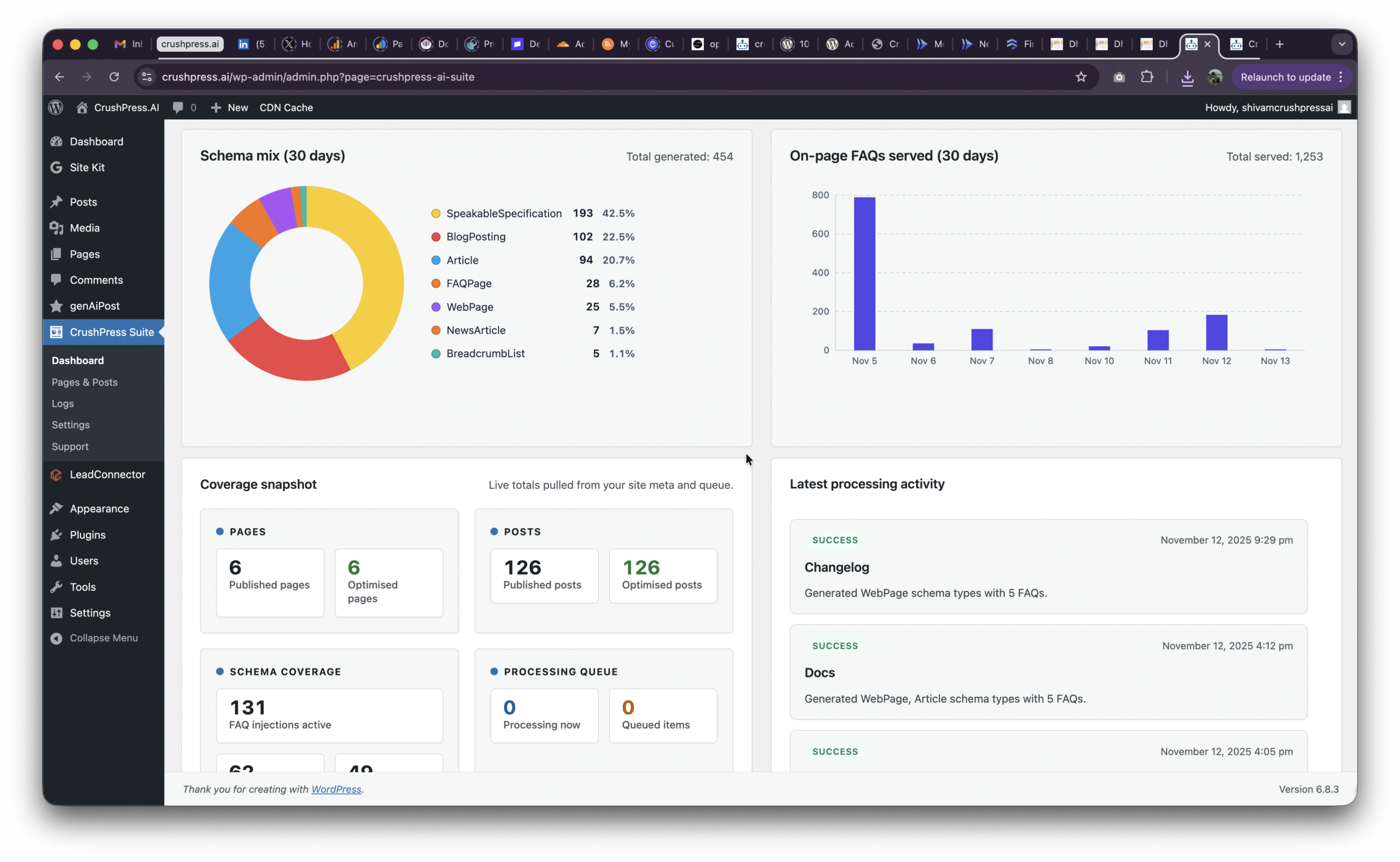
Version 4.2.42 marks the first stable public release of the CrushPress AI Schema Optimization Suite — a complete, production-ready, end-to-end automation engine for Schema, FAQ, GEO/AEO, and Speakable JSON-LD generation for WordPress sites.
Designed for agencies, WordPress hosting providers, and SMBs, this release transforms how websites implement structured data by replacing manual markup with a fully automated, cloud-connected, OpenAI-powered system.
Below is the full breakdown of everything included in this flagship release.
⭐ What’s New in 4.2.42 (First Public Release)
This version consolidates years of development, covering schema automation, OpenAI content generation, multi-tenant account sync, Stripe billing, dashboard analytics, robust logs, privacy controls, and an enterprise-grade admin interface — all launching together.
OpenAI calls happen directly from your WordPress site — keys are never sent through CrushPress.
🧾 10. Enterprise-Ready System Logs
Full logging suite with:
Severity filters
Component filters
Time-range filters (2 minutes → 6 hours)
CSV export
Pagination up to 1,000 per page
10,000-row retention cap
No “headers already sent” issues
Why it matters
Agencies can debug issues with real visibility. Hosts can investigate failures client-by-client.
🎛️ 11. Powerful Settings & Controls
AI Configuration
GPT-5 support
Responses API support
Reasoning effort
Verbosity
Max output tokens
Prompt management
FAQ min/max constraints
Automation Controls
Auto queue
FAQ toggle
Speakable toggle
Weekly/monthly refresh
Queue-only mode
Advanced, Support & Tools
Connection test
Purge cache
Support ticket submissions
Diagnostic notices
🧹 12. Modern, Polished wp-admin UI
A full redesign matching modern SaaS dashboards:
Clean card layout
Cohesive styling across all plugin screens
Anchored WordPress footer
Scrollable activity panel
Responsive on all screen sizes
Consistent hero headers
Accessible modals
Why it matters
Agencies get a professional tool they can confidently roll out to clients.
🎉 Summary: Why 4.2.42 Is a Game Changer
This release turns structured data — normally a slow, manual, expensive, error-prone task — into a fully automated SEO enhancement engine for any WordPress site.
You get:
✔ 100% automated JSON-LD generation ✔ AI-powered FAQ, Speakable & AEO/GEO markup ✔ Full analytics visibility ✔ Enterprise-grade logs ✔ Agency-friendly controls and scalability ✔ Multi-site, multi-user, billing-aware sync ✔ Polished, accessible, modern UI ✔ Strong privacy and security guardrails
This is not just a schema plugin — it’s a complete structured-data automation platform for WordPress.