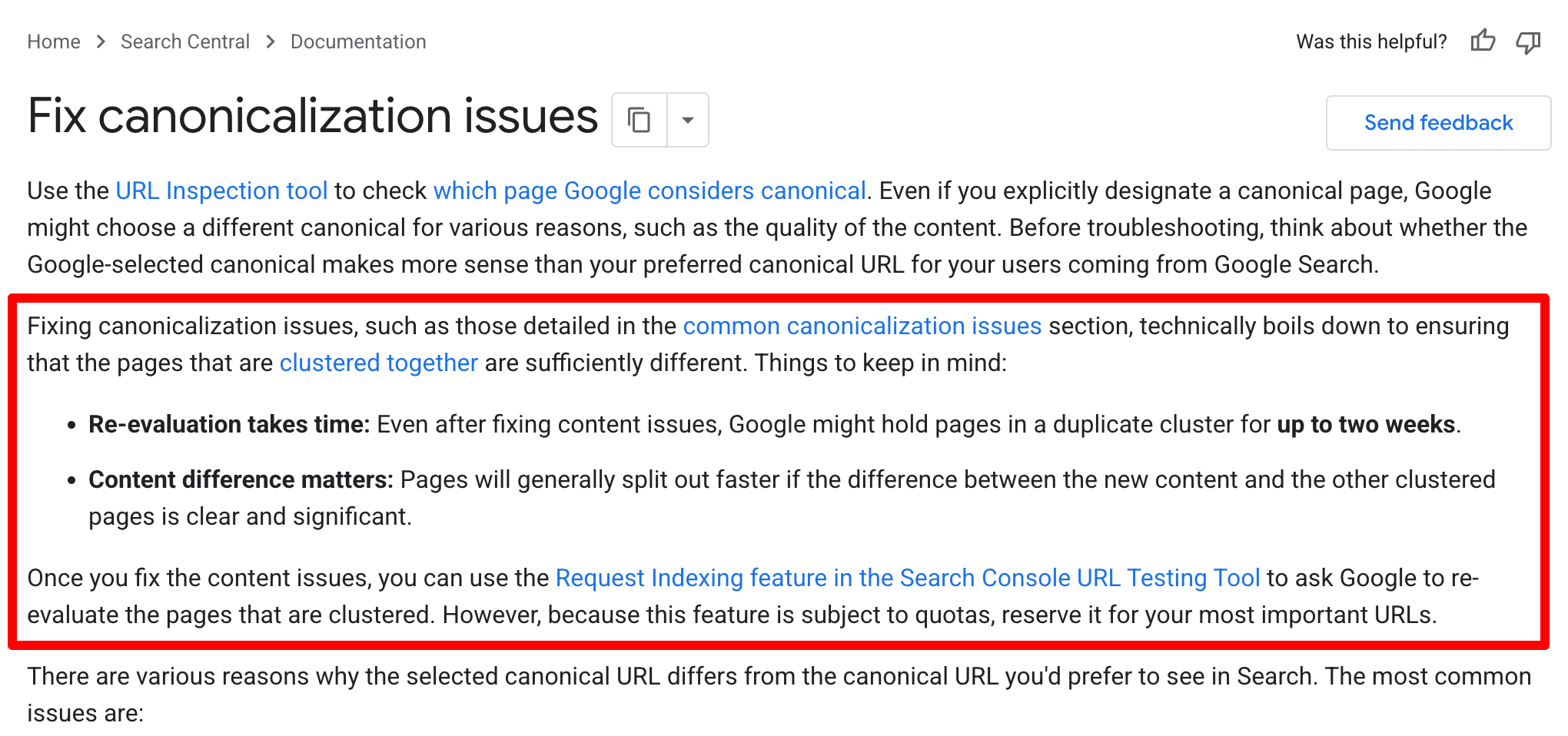
I noticed that Google updated its canonicalization troubleshooting guide to clarify how long it may take for fixes to appear in Google Search results. According to the revised guidance, Google might keep pages in a duplicate cluster for up to two weeks after content issues have been fixed.
What changed. I found a new section at the top of the guide that explains the expected timeline for canonicalization fixes. Google now makes it clear that the process can take up to two weeks.
I also saw additional technical details about clustering. Google explains that pages need to be sufficiently similar before its systems can group them into a duplicate cluster and select one version as the canonical page.
Google’s updated canonicalization guidance sets expectations for SEOs: fixed pages may remain in a duplicate cluster for up to two weeks, while clearer content differences can speed reevaluation.
Here is the section Google added:
Why I care. This clarification gives me a more realistic timeline when monitoring canonicalization fixes. Once Google has processed an update, I know I may need to wait the full two weeks before deciding whether the change worked.
As AI reshapes search, every glowing path to discovery carries commercial value—turning SEO investment into a conversation about pipeline, risk, and customer acquisition costs.
That waiting period can help me avoid making unnecessary page changes while Google is still consolidating duplicate URLs and evaluating the appropriate canonical version.
When I ran a crawl on my website, the report flagged hundreds of technical issues, all marked as high priority by my chosen tool. Sketching out a plan based on best practices, I felt the dread of impending communication with my developers.
But here’s the twist: Not all those ‘critical errors’ are really significant. I could spend weeks fixing high-priority technical issues and still not see a meaningful rise in traffic or conversions.
Some fixes seem urgent yet irrelevant, like a 404 error buried deep in the site architecture. It probably doesn’t deserve all the fuss.
Conversely, a minor issue in internal linking on high-value category pages might be holding millions of potential revenue back.
The real challenge in technical SEO isn’t in the fixes themselves but in understanding that not all issues hold the same weight. The myth that every fix is equally important persists. They simply aren’t.
Understanding the shift from issue-based to impact-based SEO is crucial for growth. Fixing everything isn’t the goal; fixing what truly moves the needle is.
Technical SEO tools are invaluable yet often create unnecessary anxiety. Crawl reports and health dashboards with flashing red flags often give the impression that every issue must be addressed immediately.
Yet, labeling something as a ‘critical issue’ due to a best practice violation doesn’t necessarily mean it impacts organic performance.
Time is often lost confusing technical correctness with search impact.
A site doesn’t need to be technically perfect to perform well in search engines. Equally, having an excellent CWV score doesn’t guarantee success if the wrong problems are prioritized. Some issues are cosmetic, some matter only at scale, and some relate to outdated best practices.
For me, successful technical SEO should focus on outcomes, not scores from various tools.
I often ask myself: Do this issue impact crawlability or indexing? Does it affect key sections of my site, like top-performing pages? Is there tangible evidence that it’s suppressing traffic or rankings? These questions help me prioritize effectively.
Equipped with the answers, I use a prioritization matrix to strategize effectively.
Some high-effort, low-impact fixes often drain my time without real benefits, such as fixing 404 errors that don’t affect user journeys or chasing minor Core Web Vitals changes that don’t benefit key pages.
By focusing on strategic internal linking or fixing canonical issues, I achieve low-effort, high-impact wins that significantly enhance discoverability and performance.
I’ve realized that the context of every site differs. Factors like business models and site architecture change the impact of specific SEO practices.
There’s no universal checklist for SEO priorities. What matters is understanding the impact of a fix on my site’s unique structure and content, and how it generates value from search.
A crawl report might show thousands of errors, but not all spell opportunity. At times, a single fix like a canonical correction or rendering issue overshadows everything else.
The essence of real SEO expertise is distinguishing between insignificant noise and impactful changes.
Have you ever considered how duplicate content might be impacting your visibility in AI search results? Fabrice Canel and Krishna Madhavan from Microsoft recently discussed how duplicate content complicates AI search systems, reducing the chances of selecting the correct version for summarization.
Much like traditional search engines, AI search platforms such as Bing and Google rely on consistent intent signals. When your content appears in duplicate forms, it can confuse these systems, making it difficult for them to interpret signals accurately.
The Impact of Duplicate Content on AI Search. Here are key takeaways from the Bing blog about the impact of duplicate content:
AI search utilizes traditional SEO signals while also adding layers to understand user intent.
Repeated content across multiple pages weakens intent signals, complicating AI interpretation, and selection.
If several pages contain similar content, AI cannot easily identify which aligns with user intent, reducing preferred page selection chances.
Large Language Models (LLMs) cluster near-duplicate URLs, often selecting outdated versions if variations are minimal.
Campaign pages and localized versions must differ meaningfully; identical content provides less matching signal.
AI favors updates, but duplicates can slow the process of updating system information.
The Challenge of Syndicated Content. Many might not realize syndicated content—articles republished on various sites—can also be problematic. Microsoft considers this duplicate content because identical articles across domains make it difficult for search engines and AI to identify the original source.
Strategies to Minimize Duplicate Content. If you deal with syndicated content, ask partners to:
Use canonical tags directing to the original version on your site.
Rework content for uniqueness.
Noindex republished articles to prevent search engine indexing.
Organizing Campaign Pages for Clarity. Microsoft warns that campaign pages with only minor changes can still be considered duplicates. To manage this:
Designate a primary campaign page for interaction.
Apply canonical tags to variations without unique intent.
Maintain separate pages for distinct intents like seasonal offers or local pricing.
Redirect outdated or redundant pages to consolidate content.
Handling Localization Pages. Localization can also produce duplicate content if differences are minimal. Microsoft suggests:
Introduce meaningful local variations with examples, terminology, or regulations.
Avoid multiple same-language pages for identical purposes.
Use hreflang to define language and regional targeting accurately.
Addressing Technical SEO Concerns. Technical issues can lead to URL duplication, often managed automatically by search engines. However, it’s best to prevent this by maintaining a single URL per content piece. Common problems include:
Utilize 301 redirects for URL consolidation.
Apply canonical tags when accessible versions are necessary.
Ensure consistent URL structures site-wide.
Restrict crawler access to staging or archived URLs.
Why This Matters. While duplicate content is not a new issue in SEO, its importance extends into AI search. Familiarity with its impact on indexing and ranking can guide strategies for improved visibility.