
Tag: Data Analysis

  • Boost Your Funnel: Tackle Signal Decay & Maximize Performance

    Boost Your Funnel: Tackle Signal Decay & Maximize Performance

    Have you ever wondered why those campaigns designed to introduce customers to your brand seem to get the least credit when it comes to driving revenue? Let me walk you through how to reclaim those lost conversion signals.

    In today’s digital world, conversion signals are fading from our marketing data. Personally, I’ve noticed it’s costing businesses money.

    Factors like ad blockers, strict privacy laws, and the decline of cookies are hiding crucial conversion data. According to a Deloitte study, this can cost businesses as much as $203 million annually. That’s a staggering figure!

    For most brands, the journey from discovery to purchase is obscured, and this isn’t just an irritating data issue. If left unaddressed, it can prevent new customers from discovering your brand.

    It surprised me how many marketers don’t realize they’re basing decisions on incomplete data. They see top-of-funnel campaigns underperforming and shift budgets elsewhere, unaware that this could trigger a negative cycle.

    When traffic diminishes further due to algorithmic reactions, ad investments dwindle, and new customer acquisition slows, it results in a downward spiral that’s tough to reverse.

    To avoid this, rather than focusing solely on creative strategies or bigger budgets, I believe prioritizing data hygiene will offer a competitive edge by 2026. Feeding better data to Google’s algorithm can transform those top-of-funnel activities into effective customer acquisition channels.

    Why Signal Loss Hurts Discovery Channels First

    YouTube usually sits at the top of the funnel, where attribution is weakest. Unfortunately, this makes it an easy target for budget cuts because of incomplete performance data, despite its crucial role in product discovery and brand research.

    According to Google research, “YouTube is the No. 1 platform viewers turn to for brand or product research.”

    • “YouTube is the No. 1 platform viewers turn to when they want to research, vet, or make a decision about a brand or product.”

    Yet, the decay of conversion signals detrimentally impacts YouTube’s performance as a marketing channel. It often acts as the initial touchpoint, with users making purchases off-platform, disrupting the signal flow.

    Haus Research found that Google’s advertising tools underreport YouTube’s true impact by 70% or more. With improved measurement setups, advertisers can capture those missing signals, allowing for a more accurate assessment of YouTube and similar platforms.

    Closing the Cross-Device Gap with Enhanced Conversions

    Think about how often you watch TV while holding your phone. You might see a commercial, Google it on your phone, and complete the purchase on desktop days later. This cross-device journey complicates tracking with standard cookie-based tagging methods.

    Enhanced conversions tackle this issue by adding a layer of hashed first-party data, like an email, which Google uses to connect conversions to ad interactions securely.

    Incorporating enhanced conversions into analytics provides insights into purchase paths that begin on YouTube and conclude off-platform, highlighting YouTube’s effectiveness in driving conversions that might otherwise be missed.

    ```json
{
  "alt": "The CapmatchOne logo with a gradient circle and bold text.",
  "caption": "Discover innovation with the CapmatchOne logo, featuring sleek typography and a modern gradient circle.",
  "description": "The CapmatchOne logo features bold, modern typography coupled with a gradient circle, symbolizing connection and innovation. The sleek design conveys a sense of progress and creativity. This image can be used for branding or promotional purposes, appealing to audiences interested in innovative solutions and forward-thinking designs."
}
```

    Training the Algorithm with Offline Conversions

    Consider viewing a YouTube ad for an expensive item—something you’re not comfortable purchasing online. You close the ad only to call the seller later. Cookie-based tagging often fails to track such valuable conversions back to their origin.

    This tracking gap extends to lead generation campaigns too. Offline conversions connect CRM and call data back to Google, training the algorithm to follow which leads convert rather than just form completions, enabling smart bidding to optimize for actual revenue outcomes.

    Get the newsletter search marketers rely on.


    Defining New Top-of-Funnel Signals with Micro Conversions

    Enhanced conversions and offline tracking can retrieve lost signals, but sometimes, top-of-funnel campaigns like YouTube lack sufficient conversion data for the algorithm. That’s where micro conversions come in, feeding necessary data for ad optimization.

    Micro conversions provide early signals—like video views, adding items to a cart, or time spent on a page—allowing campaigns that lack purchase-level data to still improve performance. Depending on the campaign’s position in the funnel, you might prioritize engagement signals or actions like cart additions.

    Without these intermediate signals, distinguishing effective upper-funnel activities from wasted efforts becomes challenging. Micro conversions empower you to treat top-of-funnel actions like any other campaign, enabling data-driven decisions on what’s working.

    Recovering Lost Signals with Google Tag Gateway

    The final piece in maintaining data hygiene is recovering blocked conversion signals before they reach Google. Browsers like Safari and Firefox restrict third-party tracking, contributing to massive signal decay during online purchases.

    Google introduced Google Tag Gateway (GTG) to help reclaim lost data. GTG uses server-side technology to load tracking tags from your site’s domain instead of Google’s, bypassing some blockers.

    Google reports an 11% signal uplift for GTG users compared to advertisers not using the tech. GTG also benefits advertisers with faster page speeds, enhancing Google’s landing page experience score and reducing click costs.

    Setting up GTG is straightforward, especially if you’re on a content delivery network like Cloudflare, and it can significantly enhance your data infrastructure.

    Your Data Infrastructure is Your Competitive Advantage

    Conversion signal decay affects every brand selling online, but recognizing the real underlying problem is crucial: signal distortion from cross-device behavior, offline conversions, ad blockers, and low top-of-funnel signal volume distorts actual purchase behavior.

    Armed with inaccurate data, many opt to tweak creatives, cut budgets, or inadvertently drop channels like YouTube, which secretly contribute to discovery. This leads to a detrimental downward spiral.

    In 2026, those excelling won’t merely skirt around issues but will implement advanced data hygiene methods to feed lost data back into Google’s algorithm, gaining an edge over competitors.

    To run more successful ads, prioritizing data improvements is key. Everything else tends to fall into place thereafter.


    Inspired by this post on Search Engine Land.


    crushpress.ai community screenshot
  • Unleash Real-Time Insights with Google Ads’ AI Dashboards

    Unleash Real-Time Insights with Google Ads’ AI Dashboards

    I’ve always found it exciting when Google Ads updates its features. Now, they’ve integrated Gemini into Ads dashboards, transforming data analysis into an engaging, interactive experience.

    What’s happening. Google Ads is introducing a new Dashboards feature, designed to provide advertisers with performance data through visually appealing charts, graphs, and tables, all powered by Gemini.

    What makes this even more fascinating is how users can effortlessly customize their views by typing prompts. The dashboard dynamically updates in real-time based on these input queries.

    Why we care. Traditionally, data analysis in Google Ads required manual setups and navigating countless reports. This update shifts towards a more intuitive approach, letting advertisers ask questions and receive immediate visual feedback.

    Zoom in. These new dashboards will showcase crucial metrics such as impressions, clicks, video views, and costs. You’ll also find them breaking down performance data across various dimensions like devices, audiences, and campaign types.

    ```json
{
  "alt": "Google Ads dashboard displaying video views, cost, impressions, and audience performance graphs.",
  "caption": "Explore your Google Ads dashboard: Track video views and costs, analyze audience performance, and gain insights to optimize your campaigns effectively.",
  "description": "This image shows a Google Ads dashboard featuring statistics such as video views, average cost per view, total cost, impressions, and clicks. It displays various graphs and charts, including viewable impressions for video campaigns, audience performance, and spend distribution by campaign type. A text field at the bottom inquires about audience engagement and conversion, enhancing the strategic insights for marketing professionals."
}
```

    The main goal is to empower advertisers with a clearer and faster way to understand what’s happening within their accounts.

    What to watch. I’m curious to see how broadly this prompt-driven reporting will be adopted and if it will lessen the need for custom reports and additional analytics tools.

    What’s next. Google has promised to reveal more details at Google Marketing Live.

    Bottom line. Google is reshaping reporting into a conversation — using AI to accelerate how quickly advertisers receive data-driven answers, enabling swift actions.


    Inspired by this post on Search Engine Land.


    crushpress.ai community screenshot
  • Unlock More with Microsoft’s Customizable Conversion Metrics

    Unlock More with Microsoft’s Customizable Conversion Metrics

    As someone exploring the ins and outs of Microsoft Advertising, I’ve discovered an update that’s sure to enhance our campaign analysis. Microsoft is now allowing us to customize columns with all conversion metrics, providing us with deeper insights and aligning reports with our unique business goals.

    What does this mean for us? Well, according to Navah Hopkins, our go-to expert at Microsoft, we can now build custom metrics by leveraging the full spectrum of conversion data available in the platform. This means we can track all conversions and primary conversions, enabling us to tailor our reporting to meet our specific objectives more closely.

    Please note the new image showcasing Microsoft’s enhanced custom columns feature. It’s a visual reminder of how these updates can transform our analytical capabilities.

    Why am I excited about this? Because the standard reporting often doesn’t mirror how we truly measure success. By giving us the tools to expand custom columns, Microsoft allows us to define metrics that truly matter—be they lead quality, revenue, or a combination of conversion actions.

    This flexibility is crucial for managing a variety of conversion types or navigating complex marketing funnels. Now, I can create custom columns, using ratios and metric combinations such as cost per qualified lead or conversion rates focused on primary goals.

    Moreover, I appreciate that the revenue and ROAS calculations will now reflect the values that align with my conversion goals, providing more accurate insights directly linked to business outcomes.
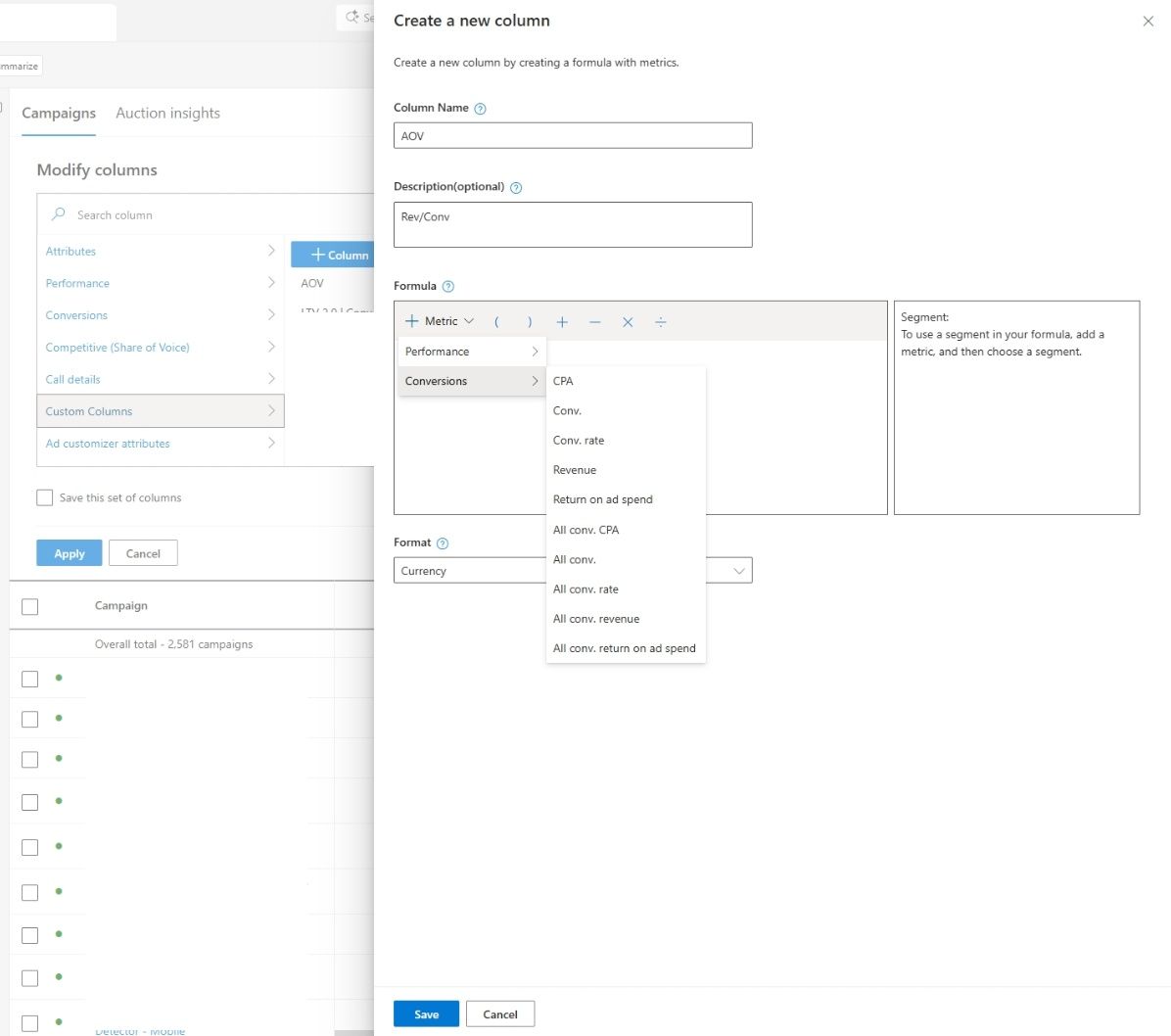
    ```json
{
  "alt": "Screenshot of a campaign management interface showing options for creating a new column with metrics and performance criteria.",
  "caption": "Exploring campaign metrics has never been easier with this detailed interface for customizing columns and viewing performance data.",
  "description": "This image displays a campaign management interface used for customizing and modifying columns. It includes options to name a new column, add an optional description, and formulate its metrics. The interface allows users to select metrics such as CPA, conversion rates, and revenue, as well as specify the format, in this case, currency. A list of campaigns is visible on the left, indicating a total of 2,581 campaigns, with options to apply saving or cancelling at the bottom."
}
```

    What does this change imply for us in a broader sense? It represents a shift toward a more flexible and advertiser-defined measurement approach, instead of relying solely on standardized platform metrics.

    This update highlights the ongoing demand for improved reporting customization as campaigns become increasingly automated and intricate.

    So, what should we keep an eye on? I’ll be observing how advertisers like us utilize these custom metrics to guide optimization decisions, whether consistency in reporting improves across teams, and if similar flexibilities will roll out in other areas of the platform.

    Bottom line? With Microsoft giving us more control over how we measure success, custom columns are evolving into a vital asset for campaign analysis. Read more about this update here.


    Inspired by this post on Search Engine Land.


    crushpress.ai community screenshot
  • Unleashing Data-Driven Insights with Profound’s Prompt Research Reports

    Unleashing Data-Driven Insights with Profound’s Prompt Research Reports

    I’m excited to introduce you to a game-changing development in the world of research and data analysis. With Profound’s Prompt Research Reports, I have the power to pull insights from a staggering 1.5+ billion real user prompts. This transformative tool utilizes a proprietary ranking and clustering model, paving the way for data-driven decision making. Now, I no longer have to rely on guesswork when choosing prompts.

    The system we use classifies and ranks user prompts, enabling me to access the most relevant data quickly and efficiently. This innovation not only optimizes my research process but also significantly enhances its accuracy and impact. By integrating such cutting-edge technology, I am able to stay ahead of the curve and meet my data needs with precision.


    Inspired by this post on Try Profound Blog.


    crushpress.ai community screenshot
  • Mastering the Art of Delivering Tough SEO News to Executives

    Mastering the Art of Delivering Tough SEO News to Executives

    I’ve learned that executives don’t crave SEO jargon. What they need is clarity, honesty, and a clear path forward. Here’s how I deliver just that when faced with disappointing results.

    Traditional SEO metrics haven’t been reassuring, and while more studies could affirm this, the existing data already does. Organic traffic is dropping for many of my clients, with studies like Seer Interactive’s showing a 61% drop in CTR for queries with AI Overviews. Executives notice these downward trends on their dashboards, often for extended periods.

    Many consultants I’ve spoken with find themselves unprepared for these tough conversations. Diagnosing the traffic drop is one thing, but sitting across from a CMO and explaining not just what’s happened, but why it happened and what you propose to do about it, requires a whole different skill set. This skill is crucial, yet often overlooked.

    Having spent 13 years in SEO and the last six managing an agency, where I personally lead strategy and present to senior executives, I’ve discovered five key lessons on breaking bad news in what I consider one of the most challenging times to be an SEO consultant.

    1. Executives are more predictable than you think

    A while back, a client expressed concerns after isolating our SEO work from the rest of their site’s organic traffic. Our reported overall numbers looked fine, but the performance of our specific work hadn’t improved over eight months.

    Upon reviewing, I found my team indeed avoided acknowledging the underperformance, opting instead to present only the numbers that looked good. No one wants to admit failure in a meeting, yet concealing it often proves more damaging.

    The client eventually finds out, and it’s not the underperformance that breaches trust, but the omission. Revealing issues early allows us to address what executives value most: problem-solving capability, diagnosis, and a strategic plan for recovery.

    This experience transformed our client engagement approach. We now rigorously separate and analyze our work’s performance, ensuring any underperformance is flagged early along with a proposed solution. Every executive I’ve met has been burned by vendors hiding results; they value the rare consultant who promptly addresses and plans for solutions.

    2. Diagnose before you communicate

    A prospect once approached me about a traffic decline, assuming AI Overviews were to blame. Instead of presuming, I thoroughly diagnosed the issue. My investigation revealed a PR-induced traffic spike had skewed the comparison, and once adjusted, current performance was actually solid growth.

    This diagnosis turned the discussion from a crisis into a positive affirmation of growth—within minutes. Conversely, I’ve also encountered genuine issues. For example, technical errors causing crawl waste impacted a client’s performance. Recognizing the pattern from past experience, I proposed a tried-and-tested solution.

    Executives don’t need to understand every technical detail; they need assurance of a diagnosed problem and a plan. Confidence stems from the quality of diagnosis and the specificity of the corrective plan, not the delivery itself.

    ```json
{
  "alt": "The CapmatchOne logo with a gradient circle and bold text.",
  "caption": "Discover innovation with the CapmatchOne logo, featuring sleek typography and a modern gradient circle.",
  "description": "The CapmatchOne logo features bold, modern typography coupled with a gradient circle, symbolizing connection and innovation. The sleek design conveys a sense of progress and creativity. This image can be used for branding or promotional purposes, appealing to audiences interested in innovative solutions and forward-thinking designs."
}
```

    3. Surprise bad news and failed experiments are different conversations

    Surprises

    The worst kind of bad news, surprises arise from work done without strategic anchoring. Without a defined plan, diagnosing a traffic dip becomes impossible, as no hypotheses were being tested—only tasks executed.

    Failed experiments

    In contrast, a failed experiment implies a deliberate strategy and defined expectations. While outcomes may disappoint, assessing performance and proposing informed next steps provides clarity and direction.

    Organizing work into structured cycles with specific bets and outcomes avoids surprise dips, fostering a culture of planned experiments. Clients are then prepared for any result, seeing it as a learning opportunity rather than an unexpected issue.

    4. Never arrive without a recommendation

    When clients ask, “What’s next?” after receiving bad news, an immediate, concrete recommendation is crucial. Lack of one heightens the perceived severity of issues. A seamless answer shows preparedness and instills confidence.

    I ensure thorough diagnostic and recommend two realistic paths, helping clients choose solutions rather than dwell on problems. This proactive approach shifts focus to resolution rather than dissatisfaction with setbacks.

    5. The tough conversation builds the relationship

    Strong client relationships often stem from overcoming difficulties, demonstrating capability under pressure. Being upfront and strategic when challenges arise consolidates trust more than perpetual smooth sailing.

    Clients appreciate honest, smart communication over avoiding tough topics. I’ve found that taking ownership of mistakes, providing diagnoses, and recommending solutions earns more respect and confidence.

    The conversation is part of the work

    As SEO becomes more challenging and results fluctuate, my conversations with clients have grown in importance. Providing clear diagnoses, backed by actionable plans, ensures we manage setbacks effectively.

    Clients now assess not just outcomes, but how I handle them, emphasizing the role of strategic, honest communication as an indispensable element of effective SEO consultancy.


    Inspired by this post on Search Engine Land.

    crushpress.ai community screenshot
  • Transforming PPC: From Tactics to Strategic Profit Engineering

    Transforming PPC: From Tactics to Strategic Profit Engineering

    Roll back the clock by five, 10, or even 15 years, and I can tell you that a PPC specialist’s value was primarily based on tactical skills. That’s all changed.

    Nowadays, platforms like Google and Microsoft have automated much of the tactical work. Machine learning and AI now handle bid management, creative testing, and audience targeting far more efficiently than any human could hope to.

    This shift has left many experienced practitioners grappling with a mid-career identity crisis. If the algorithms are doing the heavy lifting, what role do I play, and how do I continue to add sustainable value to the business?

    Let’s explore what this evolution means in practice and how it has transformed the critical skills within my PPC toolbox.

    From Tactical Execution to Strategic System Design

    Having spent 24 years in the paid search trenches, I’ve seen everything from the wild early days of Overture to the advent of Google AdWords and the mobile shift, and now, the complete domination of algorithms over ad platforms.

    In the past, my value came from painstakingly researching keywords, micromanaging bids, split-testing every piece of ad copy, and crafting a meticulous exact-match account structure. I was a lean, mean PPC machine.

    If I rely solely on tactical execution, I risk becoming obsolete, merely a behind-the-scenes lever-puller. Today’s top practitioners are not just media buyers; they’re architects of revenue and profit.

    Rather than blindly manipulating levers, I design systems. The true value I offer is in configuring the system to guide the machine effectively. To become an engineer of revenue and profit, I need to:

    • Master data analysis and signaling.
    • Develop a deep understanding of how my company or clients generate income.
    • Enhance my presence in the executive landscape to confidently convey strategies to the C-suite.

    This confluence is my career’s golden ticket. Here’s a roadmap to achieving just that.

    Dig deeper: 10 keys to a successful PPC career in the AI age

    1. Linking the Account to Profit & Loss

    Entering an interview, client pitch, or meeting with simply, “I’ll re-examine your metrics,” makes me sound like any other media buyer. It’s essential to stand out.

    Instead, imagine saying, “I’ll align your paid search campaign directly with your profit and loss statement. Each dollar spent is maximized for optimal margin.” That sets me apart as the most valuable person in the room, shifting focus from selling clicks to selling a business advantage.

    Traditional PPC accounts often mimic a website’s navigation—with separate campaigns for shoes, shirts, etc. While not wrong, it shows limited thinking. I aim to create a nuanced account structure that aligns with what impacts the P&L, moves inventory, or generates the highest-value leads.

    How to Implement This

    Each business has unique needs, but the process to achieve this follows a typical framework.

    • Margin Interrogation: Collaborate with clients or finance teams to understand profit margins on core products. It’s often revealed that the high-volume product has the lowest margin, while niche services may yield greater profitability.
    • Architectural Shift: Update campaigns by margin tier and business value rather than by product category alone. This may mean setting different target ROAS (tROAS) or target CPA (tCPA) based on financial capacity to acquire a specific customer.

    Equating a low-margin conversion with a high-margin one in account structures results in revenue and profit leaks, regardless of stellar in-platform metrics.

    Segregating Metrics for Different Audiences

    ```json
{
  "alt": "The CapmatchOne logo with a gradient circle and bold text.",
  "caption": "Discover innovation with the CapmatchOne logo, featuring sleek typography and a modern gradient circle.",
  "description": "The CapmatchOne logo features bold, modern typography coupled with a gradient circle, symbolizing connection and innovation. The sleek design conveys a sense of progress and creativity. This image can be used for branding or promotional purposes, appealing to audiences interested in innovative solutions and forward-thinking designs."
}
```

    Once mapped, it’s crucial to separate metrics accordingly.

    • In the “engine room” (daily platform optimizations), I still consider click-through rates (CTR) and costs per click (CPC), crucial indicators for navigating campaigns.
    • However, when in the “boardroom” (leadership reporting), I lead with insights into outcomes: “We reallocated budget to high-margin tiers, maintaining our $150 CPA target and safeguarding overall profitability.”

    Dig deeper: Why PPC teams are becoming data teams

    2. Mastering Signal Engineering

    This is the most pivotal skill for a modern PPC profit engineer like myself. Algorithms need input but inherently lack intelligence and judgment. They understand only what I tell them.

    In our automated bidding era, appropriately “feeding the machine” delineates experts from the obsolete. If I supply Google Ads only with data on who filled out a form, the algorithm will pursue more form-loving but non-converting leads.

    Today, a significant part of my role involves understanding and using first-party backend data to inform machine learning for superior outcomes. I am now an optimizer of signals, not just bids.

    How to Implement This

    It’s time to move beyond basic pixel tracking by employing robust offline conversion tracking (OCT) or direct CRM integrations like HubSpot or Salesforce into Google Ads.

    In managing larger programs, tools like Search Ads 360 (SA360) present enormous advantages for signal engineering, enabling seamless data management across search engines.

    For Lead Generation

    It’s time to stop optimizing for generic leads. Instead, map client sales stages into ad platforms, assigning monetary values to stages based on historical closure rates.

    For instance, consider a raw lead worth $10, a marketing-qualified lead (MQL) worth $50, and a closed/won deal worth $500, then switch bidding strategies to value-based bidding (Target ROAS). This programs AI to focus on lead quality and revenue, not just form completion.

    For Ecommerce

    Ecommerce stands apart with unique complexities. Tracking revenue to meet basic ROAS is foundational. For true profit engineering, I work with signals about inventory, margins, and lifetime value.

    • Feed Engineering: The modern e-commerce specialist doesn’t just upload a product feed; they methodically engineer it. Using Custom Labels, I segment products based on business concerns like inventory status or return rates. A product with a 40% return rate, if pushed hard, destroys profitability despite impressive ROAS data.
    • Profit Margin Bidding: Tracking gross revenue alone isn’t enough. Integrating profit margin data via custom conversion variables reshapes bidding strategies. Algorithms bid differently in auction when differentiating a $100 sale with varied margins.
    • New Customer Acquisition (NCA): Algorithms often take the easiest path—crediting returning loyalists. First-party customer lists differentiate new buyers from repeat customers, allowing aggressive market share bids for the former while protecting margins for the latter.

    Dig deeper: Why better signals drive paid search performance

    The journey continues as I enhance my career by focusing on creating profitable business solutions beyond mere clicks.


    Inspired by this post on Search Engine Land.


    crushpress.ai community screenshot
  • PPC Teams Evolving into Data-Driven Powerhouses

    PPC Teams Evolving into Data-Driven Powerhouses

    Automation and AI are revolutionizing the PPC landscape. Now, PPC teams are transforming into data teams, mastering data infrastructure, measurement, analysis, and experimentation.

    Like many people, I worry about AI taking over jobs. Where do my ‘old school’ PPC skills fit in an AI-dominated landscape?

    Relax. It’s not a binary situation. The shift is towards data and strategy. Media buying might look automated from the outside, but don’t be misled. The role is simply evolving once more.

    Having been in PPC for over 15 years, I’ve learned that there’s nothing to fear. The real question is: am I riding the wave or getting left behind?

    Let’s explore what the current PPC landscape looks like with ad network automation, and more importantly, where today’s PPC teams truly add value.

    The Return of the Technical PPC Team

    A decade ago, technical PPC agencies distinguished themselves by developing scripts, managing data on a large scale, and overseeing complex structures. As automation matured, many teams pivoted towards strategy and creativity.

    Now, with AI’s help, producing quality creatives or analyzing massive datasets to create strategies is easier than ever. However, these outputs aren’t flawless.

    From a client’s perspective, the typical creative-centric or strategy-focused agency might be out of the game. Therefore, rejoice, PPC folks: the technical edge is back, albeit in a different form. It’s time to bring back the spreadsheet enthusiasts from the 2010s who can now drive the PPC industry forward.

    Still skeptical? Let’s rewind and get a clearer view of the necessary skill sets.

    The PPC Edge: From Spreadsheet Skills to Data Nerds

    Today, successful PPC agencies sell something vastly different than a decade ago, though the core mindset remains the same.

    Why? Let’s consider the key performance drivers nowadays:

    • Integrating down-funnel data into strategy.
    • Building a data infrastructure to support strategy.
    • Providing accurate signals to ad algorithms.
    • Building systems to scale operations, including creative tasks.

    See the pattern? A broken data model can’t be solved just by prompts. This is your advantage, what clients value most. Automation enhances the value of technical literacy rather than diminishing it.

    Who do you turn to for technical literacy? The seasoned PPC marketers who thrived on manipulating paid search ads using custom Excel macros or managing extensive product feed items. They have the mindset: a love for automation, data, and math.

    1. Data Engineer

    The data engineer builds and maintains the infrastructure. Although they might come after the tracking specialist in the data chain, they are central, which is why we mention them first.

    In today’s multi-platform world, think of CRM integration with Google Ads or blending online and offline data sets to strategize effectively.

    Without a comprehensive data model, strategies become vague gut feelings needing constant reality checks. The data engineer’s role is to set a strong foundation to prevent such situations.

    Without this role, you face repetitive manual exports and inconsistent numbers across teams, leading to sluggish decision-making.

    ```json
{
  "alt": "The CapmatchOne logo with a gradient circle and bold text.",
  "caption": "Discover innovation with the CapmatchOne logo, featuring sleek typography and a modern gradient circle.",
  "description": "The CapmatchOne logo features bold, modern typography coupled with a gradient circle, symbolizing connection and innovation. The sleek design conveys a sense of progress and creativity. This image can be used for branding or promotional purposes, appealing to audiences interested in innovative solutions and forward-thinking designs."
}
```

    What is the Data Engineer’s Scope?

    Building a data infrastructure follows an ETL process: extract data, manipulate it, and make it usable in tools like Looker Studio, Power BI, or Tableau.

    • Build data pipelines from ad platforms, analytics, or CRM tools into the warehouse for data like spend and revenue.
    • Structure tables for these sources and merge them for specific use cases.
    • Maintain datasets and perform automated QA, including refresh schedules.

    What Skill Sets and Tools Does the Data Engineer Use?

    In a Google-centric world, we often hear about BigQuery, but there are alternatives like Microsoft Azure. The essential skills are coding, particularly SQL and Python.

    These languages are used to structure tables within the data warehouse (using SQL) and to create data pipelines (using Python).

    2. Tracking and Measurement Architect

    Some might think this role overlaps with data engineers, but I strongly disagree. This person focuses solely on maintaining signal quality within tight deadlines when issues arise.

    Tracking failures mean lost conversion data, impacting ad platforms’ performance because they’re built on conversion data insights.

    Notice this when CPAs fluctuate unexpectedly or in-platform data varies drastically from your ‘source of truth’ (GA, CRM, others). These architects help stabilize bidding and improve event match quality for better data in Google Ads.

    What is the Tracking Architect’s Scope?

    They design comprehensive, regulation-compliant data collection mechanisms, making sure everything is aligned with privacy compliance.

    • Align tracking with privacy regulations.
    • Design client- and server-side tracking.
    • Implement GTM and server containers.
    • Co-manage Conversions API integrations with the data engineer.
    • Co-ensure deduplication logic with the media buyer.

    What Skill Sets and Tools Does the Tracking Architect Use?

    While many PPCs have used Google Tag Manager, few have set up server-side tagging. This role needs a deep understanding of Consent Mode frameworks, CAPI, among other tools.

    3. Data Analyst

    If data engineers build the pipes and tracking architects secure the signals, data analysts interpret what the data implies. It’s a role quite affected by AI, yet crucial due to the risk of misinterpretation.

    Wrong interpretations can lead to costly errors. Fully relying on AI over data analysts could be a grave mistake, as misinterpreted metrics like ROAS versus actual contribution margins or CPA disparities can derail strategies.

    What is the Data Analyst’s Scope?

    While outsiders might think they only build dashboards, data analysts handle much more, like designing models aligned with KPIs and rigorous analysis, all while questioning platform narratives.

    • Align data models with business KPIs.
    • Analyze performance cohorts, churn rates, and profitability.
    • Challenge existing platform narratives critically.

    What Skill Sets and Tools Does the Data Analyst Use?

    Think of data analysts as translators; understanding numbers doesn’t mean you’re ready to interpret them correctly. They need SQL for warehouse queries and modeling skills for strategic planning, along with strong statistical reasoning.

    4. CRO and Experimentation Lead

    Once data is cleaned and analyzed, CROs leverage insights to enhance visitor economics. A low conversion rate can mean higher CPA, which no one wants. Their expertise helps scale operations efficiently rather than throwing money at inefficient processes.

    What is the CRO’s Scope?

    CRO roles are not just about landing pages but full-funnel optimizations, identifying friction points, structuring tests, and working with creative teams to position offers effectively.

    • Navigate from impression to revenue.
    • Utilize heat maps to locate friction points.
    • Use proper methodologies instead of random experiments.
    • Coordinate with creative and product teams for best offer placements.

    What Skill Sets and Tools Does the CRO Lead Use?

    Core tools include GA4 and heat mapping software, with options to scale based on needs. Critical skills involve a firm grasp of statistical reasoning and translation of business metrics into actionable insights.

    From Media Buyers to Data Teams

    Today’s PPC teams resemble hybrids of marketing, data, and product roles rather than mere media buyers. Successful teams deliberately build capabilities around understanding algorithms, data dynamics, and economics, enabling AI to become a strategic asset rather than a threat.


    Inspired by this post on Search Engine Land.


    crushpress.ai community screenshot