
I’ve noticed that AI systems are improving in generating Spanish language content, but they’re not quite grasping the nuances of Spanish markets.
In fact, we often see a familiar trend: over 20 Spanish-speaking nations reduced to a single standard. Spain is typically the default, and Mexico might as well be interchangeable with any other country. The rest get simplified into statistical norms.
The root of this problem is structural, involving dialect defaulting, format contamination, and regulatory hallucination. These issues are more pronounced in a generative search setup where one synthesized response replaces several search results.
This misinterpretation acts as a barrier to visibility. Generative AI seeks clarity, and if my content doesn’t specify its market context, it defaults to an average—leading to missed opportunities and misapplication.
To tackle this, I’ve developed a framework that ensures market context is clear across content, technical indicators, and retrieval systems, so AI systems don’t have to assume.
What is Cultural SEO?
Cultural SEO goes beyond mere multilingual support or localization. Its foundation is firm on locale precision—ensuring the market context is clear in retrieval and generation practices so that your Spanish content is associated with the specific country it was intended for.
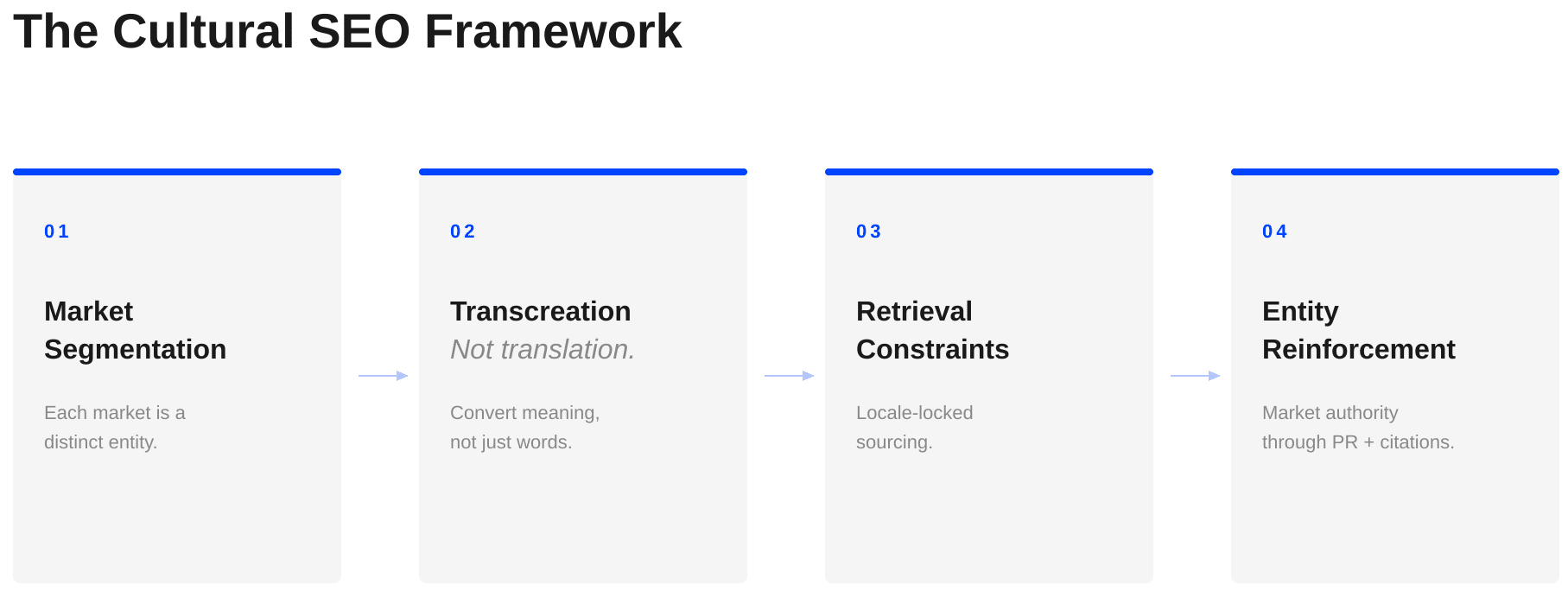
Here’s a framework that proves effective when working around Spanish and Latin American markets.
You can’t effectively optimize for a market you aren’t serving. Cultural SEO isn’t an afterthought; it’s the backbone of a strategic decision to genuinely operate within a market, encompassing logistics, customer service, compliance, and product-market alignment.
If you ship from Spain to Mexico with unrealistic delivery times or lack local support, even the best hreflang configuration won’t suffice. Users will abandon such experiences, and as AI learns from these interactions, it will deprioritize similar content.
Speaking the market’s language goes beyond spoken words—it’s about conveying trust, ensuring payment and delivery expectations are met, and adhering to regulatory standards.
Assuming you’re committed to these standards, here are the four pillars: segmentation, transcreation, retrieval constraints, and entity reinforcement. Before applying any framework, ensure this commitment.
Pillar 1: Market Segmentation at the Entity Level
International SEO often considers segmentation as a mere folder structure: /es-es/, /es-mx/, /es-ar/, but that’s merely scratching the surface.
In generative search, the challenge is ensuring the AI associates a page with a specific country like Mexico, and accumulates enough market-specific signals to prefer it over a general alternative. If the architecture simplifies differences, visibility diminishes equally.

Pillar 2: Transcreation, Not Just Translation
Translation is about converting words, while transcreation is about interpreting meaning. Given two pages with 95% similar content, the AI merges them into one representation—defaulting to one perceived as standard. Therefore, differentiating with local examples or unique terminologies is essential.
Pillar 3: Retrieval Constraints
In constructing AI experiences like RAG (Retrieval-Augmented Generation), it’s crucial to establish clear boundaries about what content should be sourced for specific markets to avoid defaulting to “Global Spanish.”
Pillar 4: Market Authority Through Entity Reinforcement
AI models learn from both your site’s content and external perceptions. Thus, building location-specific authority through local media presence, partnerships, and consistent regional knowledge graph reinforcement is vital to establish market-specific authority.
Ultimately, Cultural SEO ensures that content not only serves the market but resonates with it. By embracing these pillars, I can ensure my brand isn’t just another “Spanish” entity but a recognized authority in each targeted market.
This journey isn’t about merely adapting your website but architecting systems to reflexively consider the market’s dynamics from the ground up.
Inspired by this post on Search Engine Land.
