Tag: Authority

  • How to Diagnose Google Search and Discover Visibility Changes

    How to Diagnose Google Search and Discover Visibility Changes

    Your Google traffic dropped, but the aggregate line does not tell you what broke. Search and Discover can move for different reasons, and treating them as one channel can send you toward the wrong fix.

    Separate the surfaces first. Then inspect timing, geography, impressions, clicks, queries, and affected page groups. That sequence will tell you whether to investigate distribution, content-market fit, measurement, or a broader site problem.

    Start by separating Search from Discover

    Google Search begins with an expressed query. Discover recommends content around a user’s inferred interests. A page can therefore lose Discover distribution while retaining Search demand, rankings, and clicks. The reverse can also happen.

    The distinction became especially important during Google’s February 2026 Discover core update. Its rollout ran from February 5 through February 27 and applied, at completion, only to Discover for U.S. users viewing English content. It was the first confirmed update announced specifically for Discover. Search fluctuations during the same period were not confirmed as part of that update.

    SurfaceWhat starts the experienceWhat to inspect firstCommon diagnostic mistake
    Google SearchA query expressed by the userQueries, landing pages, countries, devices, impressions, and clicksAttributing a Search decline to a Discover-only update
    Google DiscoverA personalized recommendation based on interestsDiscover pages, countries, devices, impressions, and clicksTreating a feed-distribution change as a sitewide Search loss

    Use the February scope only when interpreting that rollout window. Google said it planned to expand the update to other countries and languages later, so the original U.S.-English boundary should not be assumed for subsequent periods without verification.

    Diagnose the change before editing content

    An analyst compares abstract traffic panels, a calendar grid, a world map, and groups of web pages at a diagnostic workspace.

    Do not start by rewriting pages. First establish exactly where visibility changed. Otherwise, a Discover decline can trigger unnecessary Search edits, while a measurement fault can be mistaken for an algorithmic loss.

    1. Verify the measurement. Compare your analytics platform with Search Console. If analytics traffic fell while Search Console impressions and clicks remained consistent, investigate consent, tagging, reporting, and attribution before changing content.
    2. Split Search and Discover. Review each performance surface independently. Record the start of the change rather than relying on the combined organic traffic line.
    3. Mark relevant rollout dates. If the movement began around February 5 through February 27, 2026, note that window. Timing creates a hypothesis; it does not prove a cause.
    4. Segment the exposed audience. Compare the United States with other countries. Because Search Console does not give you a simple content-language diagnosis, also isolate the page groups serving your English-language U.S. audience.
    5. Separate reach from response. Falling impressions indicate that the content was shown less often. If impressions are relatively stable but clicks fall, investigate placement, presentation, headline fit, and intent before concluding that visibility disappeared.
    6. Find the affected page cluster. Group pages by subject, format, geography, creator, and publishing pattern. A concentrated decline is more actionable than a sitewide average.

    If Search is stable and Discover falls, keep the investigation inside Discover until the evidence points elsewhere. Review which topics and geographic audiences lost impressions. Do not change title tags or Search-focused copy merely because the combined organic total declined.

    If Discover falls mainly for U.S.-facing English pages around the rollout window while other markets remain steadier, the update is a plausible contributor. It is still not proof. Check whether the loss is concentrated in sensational headlines, thin coverage, non-local material, or topics where your site has little sustained expertise.

    If Search declines but Discover remains stable, investigate Search demand, query visibility, landing pages, indexing, and technical conditions. The February Discover update is not an adequate explanation for that pattern.

    If both surfaces decline, widen the scope. Confirm tracking, crawling, indexing, templates, site changes, demand, and the affected directories. A simultaneous decline may be broad, but the shared timing alone does not identify the cause.

    Use long Search queries to expose conversational demand

    A person directs a detailed spoken question into a blank search field as connected topic symbols and content cards branch outward.

    Traditional keyword lists often miss the way people now phrase complex tasks, comparisons, and concerns. Search Console gives you a useful first-party proxy: the longer queries for which your pages already received impressions or clicks.

    You can filter for queries containing at least 10 whitespace-separated words with this process:

    1. Open Search Console and go to Performance > Search queries.
    2. Select Add filter > Query.
    3. Choose Custom regex.
    4. Enter ^(?:S+s+){9,}S+$.
    5. Apply the filter and export the resulting queries with their available performance data.

    The expression looks for at least 10 non-whitespace terms separated by whitespace. It is a practical threshold for finding prompt-like language, not a definition of an AI prompt.

    That caveat matters. Search Console can contain data connected with AI Mode, and unusually conversational searches may resemble prompts used in an assistant. But a long query does not reveal where or how it originated. The user may have typed it directly into Google. Treat the data as evidence of conversational demand, not proof of ChatGPT, AI Mode, or another platform.

    After export, cluster the queries by the behavior they reveal:

    • User job: planning, comparing, troubleshooting, learning, checking, or choosing.
    • Entity: your brand, a competitor, a product, a location, or a named problem.
    • Decision context: constraints, desired outcome, use case, audience, or risk.
    • Unresolved concern: reputation, an old incident, compatibility, trust, or a reason not to buy.
    • Current destination: the page that received the impression and whether it actually resolves the full request.

    A spreadsheet works for a small export. A language model can accelerate a larger clustering task, but preserve every original query so you can audit its grouping. A useful instruction is: Group these queries by user job, entity, decision context, and concern. Preserve each original query, name the likely content gap, and do not infer which platform generated the query.

    Treat query exports as potentially sensitive. Conversational strings can contain personal information. Remove or mask identifiable details before uploading the file to an external analysis tool, and follow your organization’s data-handling rules.

    The result should not be an enormous list of literal sentences to monitor. Build a smaller prompt-tracking set around recurring themes. Prioritize a theme when it repeats, has a meaningful commercial or reputational consequence, intersects with a page already receiving visibility, and can be answered with credible content.

    For example, several differently worded queries may all ask whether your company is a safe alternative to a better-known competitor. Track representative comparison and risk-objection prompts, then create or improve the page that should answer them. The theme is durable even when the exact wording changes.

    Build the topical signals Discover is trying to reward

    The February 2026 update was designed to surface more locally relevant material, less sensational content, and more original, timely, in-depth work from sites with subject-specific expertise. Those are editorial directions, not a checklist that guarantees feed placement.

    Build a recognizable topical footprint

    Discover’s expertise assessment can operate topic by topic. A broad publisher can establish a strong specialist section, while a site with one unrelated page offers much weaker evidence of sustained knowledge. You do not need to turn the whole domain into a single-topic publication, but the section you want recognized must be coherent.

    Audit that footprint directly:

    • Name the subject for which you want the site or section to be recognized.
    • Label existing URLs as core coverage, genuinely supporting coverage, or unrelated material.
    • Connect related pages through clear navigation and internal links so the section is understandable as a body of work.
    • Use long-query clusters to find missing questions that belong naturally inside the subject.
    • Resist publishing a one-off page merely because a neighboring topic is popular.

    The aim is not volume. It is continuity. Each new page should deepen the same audience’s understanding or help that audience complete the next related task.

    Make originality, depth, and timeliness visible

    Calling content original is not enough. The distinct contribution should be easy to identify. Before publishing, ask what the page adds that a competent reader could not get from a generic summary.

    • Originality: include your own reasoning, evidence, process, examples, or decision criteria rather than merely restating familiar advice.
    • Depth: answer the follow-up questions, constraints, tradeoffs, and failure cases implied by the main query.
    • Timeliness: explain what changed and why the change affects the reader. Do not refresh a date when the substance is unchanged.
    • Actionability: give the reader a next step, setting, filter, check, or decision they can actually use.

    The conversational-query export can guide this work. If users repeatedly add the same constraint to a broad query, that constraint belongs in the content. If they keep asking about an old reputational issue, silence does not make the concern disappear; a current, factual answer may be necessary.

    Treat local relevance as audience fit, not decoration

    The update placed more weight on locally relevant content from domestic websites. A non-U.S. publisher serving a U.S. audience could therefore have experienced reduced Discover traffic during the initial U.S. rollout.

    Segment that audience before reacting. If the decline is limited to U.S.-facing pages, examine whether the material genuinely reflects the market’s places, rules, products, terminology, and context. Do not disguise the site’s origin or add superficial location phrases. If your strongest expertise belongs to another market, preserve it and make the geographic scope explicit.

    Remove the gap between the headline and the page

    Discover’s move away from sensational content makes the headline-content relationship a practical audit point. The title should communicate the real value of the page without withholding the central fact or overstating the evidence.

    • Put the actual subject and consequence in the headline.
    • Remove unsupported superlatives, manufactured urgency, and curiosity gaps.
    • Deliver the promised answer near the beginning, then add context and depth.
    • Check that the headline still makes sense when separated from the image and surrounding feed.
    • If a restrained headline makes the content seem uninteresting, improve the substance instead of restoring the hype.

    Google also said its systems would continue personalizing Discover around favored creators and sources. You cannot force that preference, but consistent subject expertise and dependable promises give readers a coherent reason to recognize and return to your work.

    Key takeaways and your next move

    • Diagnose Search and Discover separately; a change in one surface does not establish a change in the other.
    • The February 2026 Discover core update ran from February 5 through February 27 and initially covered U.S. users viewing English content.
    • Use the 10-word Search Console regex to find conversational demand, but do not label every long query as an AI prompt.
    • Track recurring prompt themes rather than every literal query variation.
    • For Discover, strengthen sustained topic expertise, original depth, genuine timeliness, honest local relevance, and headline-content alignment.
    • Make changes only after you have identified the affected surface, audience, metric, and page cluster.

    Your next visibility review should end with one explicit hypothesis. Write down the surface, change window, country, affected pages, impression pattern, click pattern, proposed change, and metric that would support or weaken the hypothesis.

    Then change the smallest relevant layer. Fix measurement when the data disagrees, improve a page when conversational demand exposes an answer gap, or strengthen a coherent topic section when the Discover loss is concentrated there. Evaluate the result on the same surface and segment that led you to act.
    References

  • Unlocking SEO Success: AI’s Role in Authority Building

    Unlocking SEO Success: AI’s Role in Authority Building

    In an AI-driven search world, authority outweighs optimization

    As someone deeply immersed in the world of SEO, I’ve witnessed a fascinating evolution. In the early 2000s, if you were like me, you probably focused on gaming PageRank with enough links and keywords to achieve visibility. It was a mechanical process, and frankly, relatively simple to exploit.

    Fast forward two decades, and the search landscape has radically transformed. Algorithms have become sophisticated, mirroring Google’s deeper understanding of brands, individuals, and reputations. This transformation, driven by AI-powered discovery, means authority is now the cornerstone of search rankings. The journey culminates in an era where brand legitimacy is sustained through genuine visibility.

    ```json
{
  "alt": "Google Hotel Finder review snippet on Hallam Internet by Susan Hallam.",
  "caption": "Discover Susan Hallam's insights on Google Hotel Finder's UK launch. Her verdict? A thumbs up! Dive into the detailed review.",
  "description": "This image displays a snippet from Hallam Internet featuring a review of Google Hotel Finder by Susan Hallam. The service has recently launched in the UK, and the review is positive, with a recommendation to try it. The snippet includes the website link, author photo, and mentions Google+ circles."
}
```

    I witnessed Google’s first significant stand against manipulation with the Penguin update, prompting many of us to rethink our link-building strategies. “Digital PR” began to replace traditional notions, while Google’s experiments with entity-based understanding introduced innovations like author photos in search results and knowledge panels.

    Although Google eventually phased out some features like authorship, the message was clear: authority assessment was being redefined. Instead of asking, “Who links to this page?” Google’s algorithms started considering “Who authored this content, and how is this author recognized?” This shift, propelled by AI-driven search enhancements over the past year, is now impossible to ignore.

    ```json
{
  "alt": "The CapmatchOne logo with a gradient circle and bold text.",
  "caption": "Discover innovation with the CapmatchOne logo, featuring sleek typography and a modern gradient circle.",
  "description": "The CapmatchOne logo features bold, modern typography coupled with a gradient circle, symbolizing connection and innovation. The sleek design conveys a sense of progress and creativity. This image can be used for branding or promotional purposes, appealing to audiences interested in innovative solutions and forward-thinking designs."
}
```

    Helpful content and the end of synthetic authority

    When Google integrated the helpful content system into its core algorithm, it marked a turning point for us in SEO. Sites that once thrived on over-optimization saw their performance crumble. In contrast, brands demonstrating authentic expertise and brand authority began to rise.

    It’s now vital that search systems accurately evaluate whether content reflects true expertise. As someone who’s navigated the core updates, I’ve seen larger brands with robust reputations consistently outperform technically proficient but less well-known sites. Authority has evolved from being a differentiator to a necessity.

    ```json
{
  "alt": "Line graph showing top cited domains in ChatGPT with Wikipedia and Reddit as leading sources.",
  "caption": "A visual dive into ChatGPT's source preferences reveals Wikipedia and Reddit as predominant domains before a notable mid-September drop.",
  "description": "This line graph illustrates the percentage of times specific domains were cited as sources in ChatGPT responses from July to September 2025. Wikipedia.org and Reddit.com show initial dominance with citation rates over 40%, followed by a significant decline around mid-September. Other domains like Medium, Forbes, and LinkedIn remain low. Based on a Semrush study of 230K prompts in October 2025, sourced from semrush.com."
}
```

    Authority in an AI‑mediated search world

    In diving into resources about large language models (LLMs), I’ve learned that they source their information from diverse platforms—journalism, forums, reviews, and video transcripts. It’s through these platforms that reputation is built, highlighting the power of consistent, positive mention of your brand.

    This revelation has profound implications for our SEO strategies. Platforms like Reddit, Quora, LinkedIn, YouTube, and trusted review platforms such as G2 are regularly cited in AI search responses. These platforms organically reflect what people genuinely think about brands, rather than what we aim to claim.

    ```json
{
  "alt": "Bar chart comparing factors correlating with AI mentions among ChatGPT, AI Mode, and AI Overviews.",
  "caption": "Explore how ChatGPT, AI Mode, and AI Overviews differ in correlation factors related to AI mentions, based on a study of 75,000 brands by Ahrefs.",
  "description": "This image features a bar chart that compares correlation factors with AI mentions among ChatGPT, AI Mode, and AI Overviews. The data includes metrics such as YouTube mentions, branded web mentions, and URL rating, derived from a study of approximately 75,000 brands by Ahrefs Brand Radar and Site Explorer. The chart reveals varying correlation levels, providing insights into digital presence and AI-related discussions."
}
```

    This doesn’t mean the end of Google

    Despite AI’s growing integration, Google continues to dominate with over 90% of global search usage. Even among frequent AI platform users, reliance on Google persists. Google’s interfaces now absorb AI-style answers, meaning users experience AI directly within Google platforms. This hybrid presence offers an exciting opportunity for building cross-platform authority.

    Brand building is the new SEO multiplier

    As someone who bridges the gap between paid and organic strategy, I’ve seen that effective authority signals often emerge from outside traditional search channels. Digital PR, brand advertising, events, and offline activities increasingly shape organic performance. This sphere where paid and organic strategies converge enhances your brand’s legitimacy.

    ```json
{
  "alt": "Graphic showing three types of authority: Category, Canonical, and Distributed, with descriptions and examples.",
  "caption": "Exploring the pillars of authority: Learn how Category, Canonical, and Distributed Authority help shape perceptions and build credibility across various platforms.",
  "description": "This graphic illustrates three essential types of authority: Category Authority, Canonical Authority, and Distributed Authority. Each type offers unique methods to build credibility. Category Authority involves defining the narrative with POV, thought leadership, and research. Canonical Authority focuses on creating trusted, reusable content like pillar pages and guides. Distributed Authority emphasizes credibility through external channels like PR, social media, and partnerships. © 2026 Hallam."
}
```

    Brand awareness significantly boosts click-through rates, with familiar names drawing references across various media. I’ve noticed mentions in YouTube videos or long-form journalism reinforcing topical authority that simple links cannot. The digital ecosystem now validates authority externally, and this multiplication effect is constantly evident in the results I oversee.

    A practical framework: The three pillars of authority

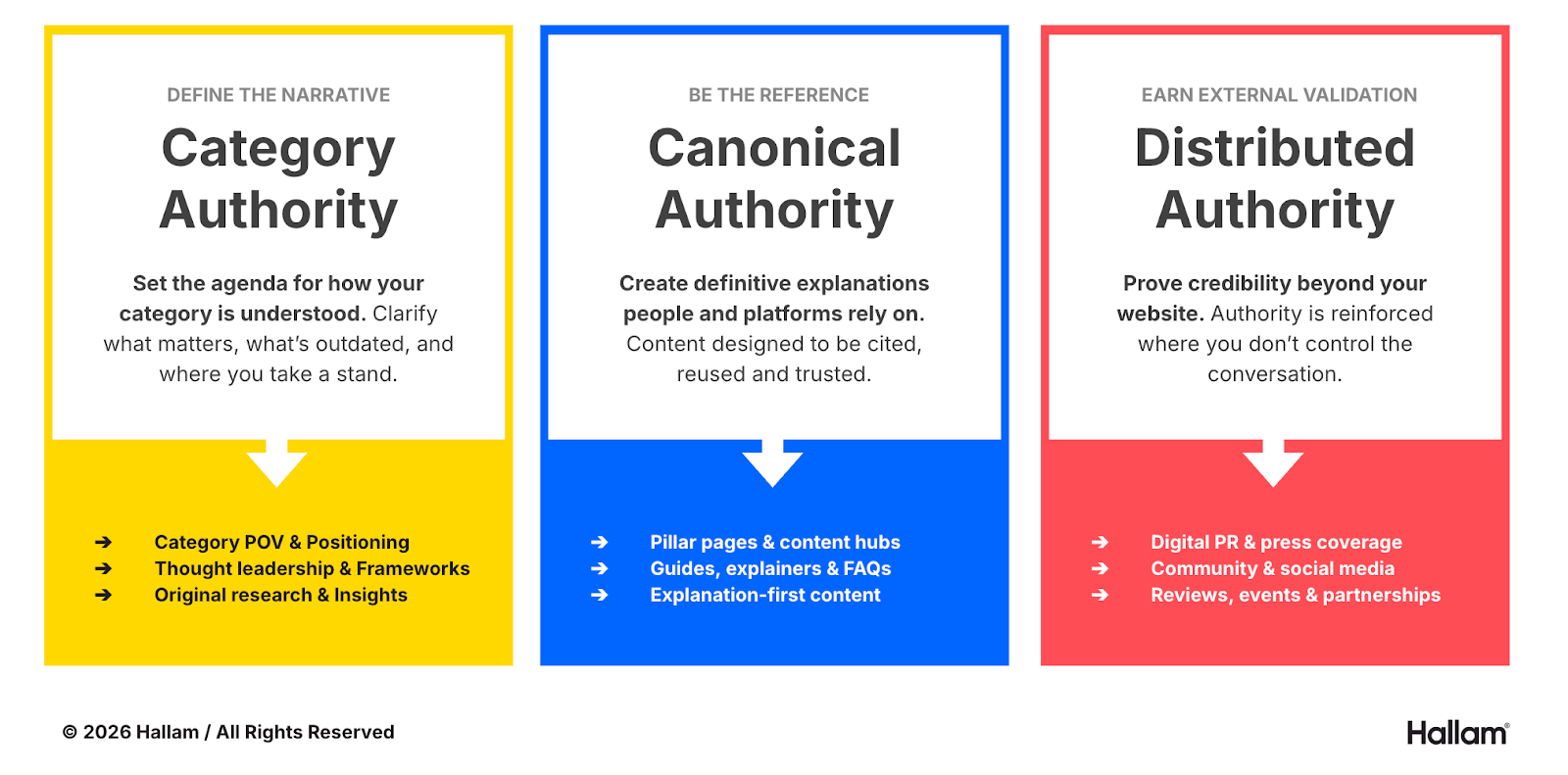
    Building enduring authority requires an integrated approach. Drawing from my experience, I’ve devised a framework focusing on three core areas: Category, Canonical, and Distributed authority. Each pillar strengthens your position as an industry leader, beyond mere SEO tactics.

    1. Category authority: Owning the truth, not just the traffic

    It begins with shaping how the category is defined. Instead of chasing keywords, the focus is on establishing your brand as the reference point others turn to for clarity. This strategy cultivates an authentic authority that search engines and AI increasingly reward.

    2. Canonical authority: Creating the definitive explanations

    This involves crafting explanation-focused content that thoroughly answers queries, becoming the go-to resource cited across various platforms. The content serves as the backbone across the digital landscape, ensuring enduring visibility through AI and future technologies.

    3. Distributed authority: Proving legitimacy beyond your website

    Genuine authority thrives through widespread credibility on platforms outside your control, including PR coverage, social media mentions, and product experiences. These elements amplify your brand’s presence and solidify trustworthiness.

    Ultimately, focusing on brand authority ensures durability amidst evolving algorithms. It’s about becoming the undisputed leader in your niche, where authority extends beyond traditional SEO into the realm of comprehensive digital engagement.


    Inspired by this post on Search Engine Land.


    crushpress.ai community screenshot
  • Google Search Constraints: Audit Content and Crawl Limits

    A ranking loss can look like one problem when it is really two. Google may be unable to process part of a file, or it may process the page perfectly and find the content too self-serving to deserve visibility.

    You need to test those failure modes separately. Start with crawl and file constraints because they are measurable. Then examine whether the page gives searchers an independent, evidence-based answer or merely dresses a sales claim as editorial advice.

    Google Search applies a technical gate and a trust gate

    A page must clear two distinct gates before it can compete consistently in Google Search.

    1. Retrieval and processing: Googlebot must be able to fetch the file and reach the information that matters within the applicable processing limit.
    2. Selection and ranking: The processed content must satisfy the query with enough originality, evidence and credibility to merit visibility.

    Passing the first gate does not imply that a page deserves to rank. A technically clean comparison can still be an undisclosed advertisement. Passing the second gate in principle does not help when the decisive text sits beyond the portion of a file that Google processes.

    This distinction gives you a useful diagnostic rule: do not begin a ranking investigation by rewriting everything, and do not begin by compressing everything. Establish which gate is failing first.

    Check the exact Googlebot file limits before changing content

    Googlebot’s limits are generous enough that an ordinary page is unlikely to reach them. They still matter for oversized templates, generated documents, data-heavy responses and pages carrying large blocks of embedded information.

    File typeAmount Googlebot processesWhat to inspect
    Web pageFirst 15MBThe fetched page file, especially large inline data, repeated markup and content placement
    PDFFirst 64MBDocument size and whether essential information appears early
    Other supported file typesFirst 2MBEach supported file that you expect Google Search to process

    Content after the applicable cutoff is not indexed because Googlebot stops processing the file at that boundary. The relevant ceilings are 15MB for web pages, 64MB for PDFs and 2MB for other supported file types.

    Measure the fetched file, not merely the total number shown for a browser visit. A page can request HTML, CSS, JavaScript, images and other resources as separate files. Treat each relevant file as its own inspection target instead of adding the entire browser transfer into one supposed HTML allowance.

    If a web page is comfortably below 15MB, the file ceiling is not your explanation. Record the result and move to indexability, rendering and content quality rather than continuing to optimize an irrelevant number.

    If a file approaches or exceeds its limit, make the response smaller and move essential information earlier. For a web page, that means prioritizing the title, main answer, differentiating evidence and primary body copy ahead of bulky repeated markup or embedded data. For a PDF, put the document’s purpose, conclusions and key supporting material near the beginning instead of relying on appendices at the end.

    A crawlable best-of page can still be a weak search result

    Technical accessibility becomes a distraction when the real problem is editorial credibility. This is particularly important for SaaS and B2B companies publishing pages for queries such as “best project management software” while naming their own product as the top choice.

    Visibility losses observed after the December 2025 core update affected blog, guide and tutorial directories at several brands. Some declines reached roughly 30% to 50% within weeks. A common pattern was a large collection of self-promotional best-of pages, often refreshed by adding “2026” without making a substantial change.

    That pattern is not proof of a specific Google penalty. Google had not confirmed a separate 2026 update, and the affected sites also showed other risk factors, including rapid content expansion, automation and aggressive year-based refreshing. Treat self-promotion as a serious audit signal, not a complete diagnosis.

    The underlying weakness is easier to establish than the cause of any individual ranking loss. A vendor has a financial interest in the result. If it presents its own product as the objective winner without a disclosed methodology, firsthand evaluation or meaningful limitations, the page asks the reader to trust a conclusion that the publisher designed to reach.

    You have two defensible ways to fix that mismatch:

    • Make the commercial perspective explicit. Frame the page as a product comparison, alternatives page or buyer’s guide from the vendor’s point of view. Do not imitate the voice of an independent review publisher.
    • Earn the editorial claim. Define the audience and criteria before ranking products, apply the same criteria to every option, disclose your affiliation, show how the evaluation was conducted and explain where your own product is not the right choice.

    A year in the title is useful only when the page contains a meaningful update. Record what changed: products considered, features evaluated, test conditions, limitations or selection criteria. If the only revision is replacing one year with another, remove the recency claim or complete the work it implies.

    This matters beyond conventional blue-link rankings. A loss of Google visibility may also reduce exposure in AI experiences that use Google results, including Gemini and some ChatGPT discovery paths. That is a plausible downstream risk rather than a guaranteed one, so measure Google and AI visibility separately.

    Run one audit that isolates technical and editorial causes

    Do not audit a site as one undifferentiated collection of URLs. Ranking problems often cluster in a directory or template family, while file-size problems are usually tied to a particular output pattern.

    1. Segment the loss. Compare affected and stable URLs by directory, template and query intent. Separate best-of pages, tutorials, product pages, PDFs and other supported documents.
    2. Inspect the fetched file size. Check representative URLs from every affected template against the 15MB, 64MB or 2MB limit that applies. Inspect referenced CSS and JavaScript as separate files when they are unusually large.
    3. Locate the primary answer. Confirm that the information needed to understand the page appears before any applicable cutoff. Do not assume Google will process material beyond the limit.
    4. Test the commercial premise. Ask whether a reasonable reader can identify who made the recommendation, how products were evaluated, what evidence supports the order and how the publisher benefits.
    5. Review update substance. Compare the current version with the previous one. A changed year, introduction or publish date is not evidence that the evaluation was repeated.
    6. Look for compounding patterns. Rapid publishing, automation, thin variations and self-ranking lists can coexist. Fixing one visible symptom may not repair a directory built around the same weak premise.
    7. Choose the smallest adequate remedy. Reduce an oversized response when the file limit is genuinely involved. Rebuild, consolidate or reposition a page when credibility is the problem. Do both only when the evidence supports both.

    For every revised comparison, keep a short editorial record containing the intended reader, inclusion rules, evaluation criteria, evidence reviewed, affiliation disclosure and material changes. That record makes future updates substantive and helps prevent a neutral-sounding guide from slowly turning into an unsupported sales page.

    After publishing a revision, monitor the affected directory rather than declaring success from one URL. The original visibility pattern appeared heavily in blog, guide and tutorial subfolders, so directory-level movement is more informative than an isolated ranking fluctuation.

    Key takeaways

    • Googlebot processes the first 15MB of a web page, the first 64MB of a PDF and the first 2MB of other supported file types.
    • The cutoff applies to files, so inspect the fetched page and relevant referenced resources individually rather than relying on total browser page weight.
    • Most ordinary pages will not approach these ceilings. If your file is comfortably below its limit, move the investigation forward.
    • A crawlable page can still fail because its recommendation is biased, thin or unsupported.
    • Self-promotional best-of pages are a credible risk pattern, but the observed visibility losses do not establish a confirmed, standalone Google penalty.
    • Substantial updates require new evaluation or evidence. Changing the year alone does not improve the underlying value of the page.

    Start with ten URLs: five that lost visibility and five stable controls from the same template families. Record file size, content placement, query intent, commercial affiliation, evaluation method and update substance. That worksheet will tell you whether to reduce bytes, rebuild the argument or investigate a different cause entirely.

    References

  • YouTube in Google AI Health Answers: A Publisher Playbook

    YouTube in Google AI Health Answers: A Publisher Playbook

    If you publish health information, YouTube’s lead among domains cited in Google AI health answers can trigger the wrong response: produce more videos, copy the format already being cited, and assume visibility will follow. That conclusion goes beyond the evidence and creates real risk when the subject is treatment, cancer diets, laboratory results, or another decision that could affect someone’s care.

    A better response is to make every important health claim inspectable. You need to know what the AI answer says, whether its citation supports that exact wording, which qualifiers survived summarization, and whether your own video and page tell the same medically reviewed story. Here is a practical way to do that without treating YouTube as either a shortcut to AI visibility or an inherently unreliable format.

    Read the YouTube number without drawing the wrong conclusion

    Across 50,807 health-related searches in Germany, AI Overviews appeared for more than 82% of the inquiries examined. That level of coverage matters because an AI-generated summary can become the first layer of health information a searcher sees, before any hospital page, journal, association, or video is opened.

    YouTube accounted for 4.43% of all citations and was the most-cited individual domain. The percentage and the ranking need to be read together. YouTube led a fragmented field; it did not supply most health citations. A 4.43% citation share is evidence of meaningful visibility, not evidence that Google prefers every video over every medical page.

    The credibility mix is more consequential. Only 34.45% of citations came from sources classified as more reliable medical sources, while nearly two-thirds were classified as lacking strong medical or evidence-based credibility. Academic journals and government health organizations together represented only about 1% of citations. Those classifications do not prove that every citation outside the medical group was wrong, but they expose a large verification problem.

    AI citations also followed a different pattern from conventional rankings. YouTube placed first by AI citation frequency but only 11th in organic results, and just 36% of pages cited by AI appeared in Google’s organic top 10. You therefore cannot use top-10 rankings as a complete proxy for AI visibility. You also cannot assume that an AI citation proves a page or video is the strongest medical result.

    These figures are observational. They do not reveal a YouTube ranking factor, prove why a particular citation was selected, or establish a permanent worldwide pattern beyond the German query set examined. Google has also disputed whether selected examples of risky advice were fairly represented in context and maintains that AI Overviews generally link to trustworthy material. For publishers, that disagreement makes context checking more important, not less.

    Key takeaways

    • YouTube was the leading cited domain, but its 4.43% share does not mean video supplied most health information.
    • AI citation visibility and top-10 organic visibility are related measures, not interchangeable ones.
    • A platform is a container, not a medical credibility signal. Evaluate the speaker, evidence, wording, scope, and review process.
    • Your goal should be a claim that remains accurate when extracted, summarized, and separated from the rest of the page or video.

    Audit the health claim, not just the cited domain

    A magnifying glass examines an abstract claim across layered video, research paper, and AI response materials on a clinical review desk.

    A domain-level report can tell you where citations concentrate. It cannot tell you whether a specific AI sentence is supported. That requires a claim-level audit. Use the following process for queries tied to diagnosis, treatment, medication, diet during a serious illness, test interpretation, or another decision with a meaningful health consequence.

    1. Capture the complete answer. Record the exact query, wording of the AI Overview, locale, capture date, every citation, and the sentence or passage attached to each citation. Do not save only the part that mentions your brand.
    2. Break the answer into individual claims. Separate definitions, causal statements, recommendations, thresholds, and statements about who is affected. One paragraph may contain several claims even when Google attaches only one citation.
    3. Map every claim to its alleged support. Ask whether the cited destination supports the exact statement, merely discusses the same topic, or contradicts the summary once its qualifications are restored.
    4. Inspect the video beyond its title. Identify the speaker, relevant credentials, publisher, publication or review date, transcript, references, and the surrounding segment. A title or short extracted passage can sound more certain than the full explanation.
    5. Check the missing qualifiers. Look for the population, condition, stage, exclusions, uncertainty, and boundary between general education and individualized advice. A summary can preserve the main clause while dropping the words that made it safe.
    6. Compare AI and organic visibility separately. Record whether the cited URL appears in the top 10, but do not automatically reject it when it does not. With only 36% overlap in the examined results, organic position is useful context rather than a verdict on the AI citation.
    7. Assign a risk owner. SEO can document the extraction problem, but a qualified medical reviewer should decide whether a consequential health claim is clinically supportable. Keep that approval attached to the exact claim and version reviewed.

    A simple red, amber, and green workflow helps you decide what to fix first:

    • Red: The answer could prompt someone to start or stop treatment, alter a medically significant diet, treat a laboratory result as a diagnosis, or delay professional care, and the citation does not clearly support the action. Escalate it for medical review and do not amplify the claim while that review is unresolved.
    • Amber: The central point may be supportable, but the AI answer loses a population, limitation, uncertainty, or other qualifier. Rewrite the source material so the qualifier travels with the claim rather than appearing several sentences later.
    • Green: The claim is narrow, educational, supported by the destination, and represented with its material context intact. Continue monitoring it because the wording or citation set can change.

    These colors are editorial priority labels, not clinical validity scores. If you are personally deciding whether to change a treatment, cancer-related diet, or interpretation of a liver blood test, an AI Overview and its cited video are not substitutes for a qualified clinician who knows your situation.

    Build a claim package that remains credible outside YouTube

    The useful unit of health publishing is not the video, page, or schema record. It is the claim package: a bounded answer, the evidence supporting it, the person accountable for reviewing it, the people to whom it applies, and the caveats required to keep it accurate. Video can carry that package well, but only if its authority survives outside the platform.

    Make the spoken answer safe to extract

    • State the question and answer in the narration. Do not leave the key qualification only in the description, a pinned comment, or an end card.
    • Keep the caveat beside the claim. If a recommendation applies only to a defined group or depends on professional assessment, say that in the same spoken passage. Distance makes it easier for summarization to separate the claim from its boundary.
    • Identify who is speaking and reviewing. Give relevant, verifiable credentials and distinguish the presenter from the medical reviewer when they are different people.
    • Separate education from individualized direction. Explain what a term, test, or treatment generally means without implying that the viewer has a diagnosis or should change care based on the video alone.
    • Expose the evidence trail. Put supporting references in the description and make clear which reference supports which major claim. A generic reading list is harder to audit.
    • Correct the transcript and captions. Names of conditions, tests, treatments, and qualifications are precisely where automated transcription errors can distort meaning. The transcript should match the reviewed spoken version.
    • Review clips as independent objects. A short clip may circulate without the full video’s introduction or disclaimer. It must retain any qualifier necessary to prevent the excerpt from becoming misleading.

    Give the video a companion page with the same accountable answer

    The companion page should not be a thin transcript built only to host an embed. It should let a reader verify the claim without watching the video and let an editor detect when the page and video have drifted apart.

    • Place the reviewed answer and its material limitation in the same section as the embedded video.
    • Show who wrote, presented, and medically reviewed the material. Do not collapse those roles into one vague byline.
    • Display the review date and update both assets when a substantive claim changes. A fresh page date attached to an unchanged old video creates false alignment.
    • Attach evidence to the claim it supports. Avoid sending readers through a long references list to guess which item belongs to which statement.
    • Use headings that reflect real questions, then answer each question directly before expanding on it. This improves clarity even when no AI system cites the page.
    • Check that the video’s title, thumbnail, description, transcript, page summary, and structured data all describe the same scope. A broad title paired with a heavily qualified answer invites misinterpretation.

    JSON-LD can clarify the visible video’s title, creator, publication details, and relationship to the page. It cannot turn an unsupported claim into medical evidence. Keep every structured value consistent with what a user can see, and never mark up credentials, reviewers, dates, or medical relationships that the page does not truthfully establish.

    Measure AI citations without manufacturing a success story

    A researcher reviews abstract citation nodes on a monitoring board beside a balance scale holding verified and uncertain evidence tokens.

    A citation dashboard becomes misleading when several different denominators are labeled citation rate. Define each metric before you compare a page, video, competitor, or reporting period.

    MetricCalculationWhat it tells you
    AI Overview coverageQueries showing an AI Overview divided by all queries checkedHow often the feature appears for your tracked query set
    Owned citation presenceQueries citing one of your assets divided by queries showing an AI OverviewHow often your content enters an available AI answer
    Owned citation shareYour citation appearances divided by all citation appearances capturedYour portion of the citation pool under the same counting method
    Video citation mixCited videos divided by all cited assets in your datasetWhether video is over- or underrepresented in your own topic set
    Context fidelityOwned citations represented accurately divided by all owned citation appearances reviewedWhether visibility preserves the meaning and limitations of your content
    Organic overlapAI-cited URLs also appearing in the organic top 10 divided by all AI-cited URLsHow much AI sourcing overlaps with conventional ranking visibility

    The reported 4.43% YouTube figure used all citations as its denominator. Do not compare it with the percentage of queries containing a YouTube link or the percentage of cited domains that are video platforms; those answer different questions. Preserve citation appearances, unique URLs, unique domains, and queries as separate counts.

    Track the same query set and locale with a consistent capture method. Record the page and video independently, even when they belong to one claim package. When visibility changes after an update, treat the result as an observation rather than proof that a transcript edit, schema field, embed, or review note caused the change.

    Most importantly, do not count every citation as a win. An AI answer that cites your asset while stripping away a crucial limitation can create more reputational and health risk than no citation at all. Context fidelity belongs beside visibility in every report sent to editorial, medical, legal, or leadership teams.

    Choose the next publishing move by consequence, not format

    You do not need to convert your entire health library into video. Start with a bounded set of ten queries where a misleading answer could affect treatment, diet during a serious illness, test interpretation, or a decision to seek professional care. That set is small enough for claim-level review and important enough to reveal whether your current process protects users.

    1. Capture each AI Overview, its citations, and the corresponding organic top 10.
    2. Split every answer into claims and apply the red, amber, or green editorial label.
    3. Select the highest-consequence unsupported or decontextualized claim, regardless of whether its current citation is a video or page.
    4. Create or revise one medically reviewed claim package: spoken answer, transcript, companion page, evidence mapping, reviewer ownership, and accurate structured data.
    5. Recheck the same query set after publication, keeping the denominator and locale unchanged.
    6. If the asset gains a citation, verify the summarized wording before reporting success. If it does not, keep the improved content; the safety and clarity gains still matter to every person who reaches it directly.

    YouTube’s citation lead is a reason to inspect video more carefully, not a reason to imitate it blindly. Make your next health answer narrow enough to verify, complete enough to survive extraction, and accountable to a qualified reviewer. Then measure whether Google cites the right claim in the right context.

    References

  • How to Build Trust in AI-Driven Financial Research

    How to Build Trust in AI-Driven Financial Research

    You can make financial research easy for an AI system to find, summarize, and cite. The harder question is whether the answer remains trustworthy after the system compresses it. A careful analysis can become a dangerously confident sentence when its evidence, assumptions, or limits disappear.

    Your job is therefore larger than increasing AI visibility. You need to publish answers whose meaning survives extraction: the claim stays connected to its evidence, the reasoning can be inspected, and the boundary between general research and personal financial advice remains unmistakable.

    Key takeaways

    • Optimize financial research for verification before visibility. Search exposure cannot make an unsupported conclusion reliable.
    • Place the evidence, reasoning, relevant date, and limiting condition close to every consequential claim.
    • Connect technical signals, fundamentals, alternative data, and portfolio context without forcing them into artificial agreement.
    • Write important qualifiers into the sentence an AI system is most likely to extract, not into a distant disclaimer.
    • Use structured data and on-page optimization to describe trustworthy content, never to manufacture the appearance of authority.

    Trust begins where the answer can be checked

    Financial information has a short trust fuse because weak or inaccurate research can produce fast, measurable consequences. A vague answer about an ordinary purchase might waste time. A vague answer that influences a trade, allocation, credit decision, or risk assessment can lose money.

    That changes the minimum standard for a useful page. A reader should be able to identify what you know, how you know it, what you inferred, and what could invalidate the inference. An AI-generated summary should preserve those distinctions instead of presenting every sentence as an equally established fact.

    Use a six-field answer card

    Before drafting a financial answer, complete these six fields. They can live in your editorial brief, content management system, or review checklist:

    1. User question: Record the exact decision or uncertainty the page will address. A broad topic such as market risk is not yet a usable question.
    2. Bounded answer: Write the shortest conclusion the available evidence can support. Include the market, asset, period, or scenario that limits the claim.
    3. Evidence: Identify the underlying observations and where they came from. Preserve relevant dates, units, definitions, and methodology.
    4. Reasoning: Show how the evidence leads to the conclusion. Name any assumption that the argument needs in order to hold.
    5. Limit: State what the evidence does not establish, which alternative explanation remains possible, and what would change the conclusion.
    6. Ownership: Assign responsibility for reviewing, updating, correcting, or withdrawing the answer when its basis changes.

    If you cannot complete the evidence or limit field, do not ask a language model to fill the gap. Its fluent transition may disguise the absence of support. Publish a narrower answer, label the uncertainty, or withhold the conclusion until it can be checked.

    Separate observation, calculation, and interpretation

    A trustworthy answer distinguishes three layers that are often blended together:

    • Observation: What was measured, reported, or recorded?
    • Calculation: What transformation or comparison did you apply to those observations?
    • Interpretation: Why might the result matter, and which assumptions connect it to that meaning?

    Labeling these layers prevents an interpretation from inheriting the apparent certainty of the underlying data. It also gives an AI system clearer units of meaning to retrieve. Instead of receiving a paragraph that mixes facts and forecasts, the system encounters an explicit evidence chain.

    Keep the safety boundary close to the consequential statement. If a conclusion could influence an individual’s financial decision, present it as general research and direct the reader to a qualified financial professional for advice based on their circumstances. A footer disclaimer does not repair personalized or overly certain language in the main answer.

    Connect the evidence without hiding disagreement

    Blue and amber evidence trails remain visibly separate while connecting to a shared transparent model on a research table.

    Trust weakens when readers have to assemble an answer from unrelated dashboards, definitions, charts, and commentary. Each extra handoff introduces another opportunity to misread the period, use a different definition, or miss an important qualification. Fragmentation also makes it harder to demonstrate that you understand how the pieces relate.

    A stronger research experience connects technical signals, fundamentals, alternative data, and portfolio analysis in context. This does not mean squeezing every available metric onto one screen. It means giving the user a coherent route from question to conclusion.

    For a consequential research question, organize that route in this order:

    1. Answer: Give the bounded conclusion and its main limitation.
    2. Change: Show what happened and the comparison that makes the change meaningful.
    3. Drivers: Explain the mechanisms that could account for it.
    4. Cross-checks: Show which other evidence supports, weakens, or contradicts the interpretation.
    5. Relevance: Explain how the finding may affect a general research or portfolio question without turning it into personal advice.
    6. Method: Make definitions, provenance, calculations, and update information available where the reader needs them.

    The cross-check stage matters. Connected research is not research in which every indicator agrees. If a technical signal points one way while fundamentals or alternative data point another, preserve the disagreement. Explain whether the measures cover different time horizons, definitions, or mechanisms. If you cannot reconcile them, say that plainly.

    Clarity does not mean removing complexity. It means helping the reader distinguish relevant complexity from clutter. Even an experienced investor benefits when you explain why a development is significant rather than merely reporting that it occurred.

    A useful explanation answers five questions: What happened? Compared with what? Through which mechanism could it matter? What else could explain it? What evidence would make us revise the conclusion? Those questions turn a data display into reasoning the reader can inspect.

    Centralization can be achieved without creating an enormous page. Use shared definitions, consistent labels, visible dates, stable identifiers, and direct links between related modules. The goal is continuity of meaning. A reader moving from a chart to a methodology note should not have to guess whether the same term, period, or calculation still applies.

    Optimize for AI retrieval without manufacturing authority

    Keyword coverage can help a page become discoverable, but it cannot establish financial expertise. In AI-driven discovery, visibility increasingly depends on being consistently useful and demonstrating depth, consistency, and reasoning. That requires three separate layers of work.

    LayerQuestion to askWhat to doWhat it cannot fix
    Technical accessCan a search or AI system reach and read the main answer?Keep the substantive answer in accessible page content, maintain clear internal links, and make machine-readable descriptions consistent with what users can see.Missing evidence or an unsupported conclusion.
    Semantic extractionCan a passage retain its meaning when removed from the page?Use descriptive headings, stable terminology, explicit relationships, and short passages that keep claims beside their qualifiers.Ambiguous reasoning or conflicting definitions.
    Epistemic credibilityCan a reader inspect why the claim should be believed?Expose provenance, calculations, assumptions, counterevidence, limitations, and review ownership.Stale, inaccurate, or fabricated inputs.
    Decision safetyCould the answer be mistaken for individualized advice?Define the intended use, avoid prescriptive language about personal circumstances, and place warnings beside the relevant conclusion.A risky claim hidden behind a general disclaimer.

    Apply these layers in order. Making weak analysis easier to crawl only distributes the weakness. Adding structured data to vague content only describes the vagueness more efficiently. Technical optimization should expose a sound evidence structure that already exists on the page.

    At the page level, use these rules:

    • Lead with the bounded answer. State the conclusion, scope, and main qualification before expanding the analysis.
    • Use headings that describe the reasoning. A heading such as “Why the indicators disagree” carries more information than “Analysis.”
    • Keep one main claim per paragraph. This makes extraction cleaner and reduces the chance that a qualifier will attach to the wrong conclusion.
    • Put evidence links beside the supported claim. A generic bibliography forces readers and machines to reconstruct the relationship.
    • Keep critical qualifiers in the same sentence. Write “under these assumptions” or “for this period” where the conclusion appears.
    • Define terms once and use them consistently. If two metrics sound similar but differ, explain the distinction before comparing them.
    • Make visible content and machine-readable markup agree. Structured data should reflect the answer, authorial responsibility, and other information actually available to the reader.

    Avoid producing thin pages for every wording of the same query. Financial authority emerges from linking concepts and showing their relationships in a comprehensive answer. One well-maintained explanation with clear subtopics is usually a stronger foundation than a collection of near-duplicates that omit context.

    Run a trust audit before the page becomes an AI answer

    Three analysts inspect linked evidence nodes, blank source documents, and output layers during a research trust review.

    Your final review should test more than grammar, keyword use, and formatting. It should simulate what happens when a search engine, assistant, analyst, or hurried reader extracts only the most quotable part of the page.

    1. Build a claim ledger. Copy each consequential claim into a review sheet. Label it as an observation, calculation, interpretation, scenario, or recommendation. If the label is unclear, the sentence probably blends categories.
    2. Trace the evidence. Confirm that every observation has identifiable provenance and that the relevant date, definition, unit, and scope remain available. Do not accept a citation that merely discusses the same topic.
    3. Reperform the reasoning. Follow the path from evidence to conclusion without relying on the prose’s confidence. Check whether a missing assumption or alternative explanation breaks the chain.
    4. Test the qualifier. Copy the key conclusion into a blank document. If it becomes misleading without a nearby paragraph, rewrite the sentence so its essential boundary travels with it.
    5. Look for forced agreement. Identify evidence that conflicts with the conclusion. Explain the disagreement, narrow the claim, or state that the result is unresolved.
    6. Check the decision boundary. Ask whether a reasonable reader could mistake general research for an instruction tailored to their finances. If so, revise the language and position professional-help guidance next to the risk.
    7. Assign the next review. Record what type of change would trigger reassessment and who can correct or withdraw the conclusion. Trust depends on how you handle changed information, not only how carefully you launch a page.

    Use a simple release gate. Publish when the evidence, reasoning, scope, and limits are all inspectable. Revise when the evidence is sound but the extracted answer could mislead. Hold the page when a consequential conclusion cannot be verified. Do not let polished AI-generated prose turn that third condition into the second.

    Start with one financial page that already attracts an important question. Rebuild it around the six-field answer card, connect the evidence that a reader would otherwise have to assemble, and run every key sentence through the extraction test. Once it passes, use that page as the editorial pattern for your wider AI search strategy.

    References

  • How to Choose an AI Search and GEO Expert in 2026

    How to Choose an AI Search and GEO Expert in 2026

    You’re not really hiring for a new marketing label. You’re deciding whether someone can turn a volatile, partly observable search channel into a disciplined program that your content, SEO, public relations, analytics, and engineering teams can execute.

    A candidate should be able to explain what they will inspect, what they can change, how they will measure progress, and what they cannot guarantee. You can use a curated roster of AI search and GEO experts to watch to build an initial candidate pool. Then evaluate every candidate against the same brief, evidence requirements, and pilot scope.

    Start with the decision your visibility must influence

    “Improve our AI visibility” is not a usable assignment. It leaves the expert free to choose convenient prompts, report flattering mentions, and produce activity that may never affect a customer decision. Define the business problem before you discuss tactics.

    Your brief should identify:

    • The audience: Name the people whose questions matter. A procurement lead comparing vendors has different information needs from a practitioner troubleshooting a problem.
    • The decision: State what the person is trying to choose, verify, understand, or do. This keeps the program focused on useful answers instead of vanity visibility.
    • The prompt families: Group representative questions by problem discovery, category education, comparison, validation, implementation, and branded research. Do not simply turn a keyword export into questions.
    • The intended representation: Write down the facts, attributes, limitations, differentiators, and relationships that an answer should communicate accurately.
    • The relevant surfaces: Specify the answer engines, generative search experiences, markets, and languages that matter to your audience. Results from one surface should not be treated as a universal view of AI search.
    • The desired action: Decide whether success means an accurate recommendation, a citation, a qualified visit, a product evaluation, a lead, or another observable business event.

    Keep four outcomes separate from the start. A mention means the brand appears in an answer. A citation means the answer displays a reference or link to a page. A referral is a visit you can identify in analytics. A business outcome is the action that visit or exposure eventually supports. None of these automatically proves the next one occurred.

    Decide what kind of help you are buying as well. A strategist may be right for diagnosis, prioritization, and team education. An implementation partner may be needed when the work crosses templates, structured data, editorial workflows, analytics, and digital PR. A measurement specialist may be useful when your main problem is building a defensible baseline. If several parties will contribute, require one accountable owner for the program.

    A practical brief can be written in one sentence: “Help this audience find and accurately understand this entity or offering when they ask these prompt families in these markets, with progress judged by these visibility, accuracy, citation, referral, and business measures.” Fill in every part before requesting a proposal.

    Score demonstrated capability, not the GEO job title

    Hands compare unlabeled work samples, source tokens, and connected evidence objects on a structured evaluation table.

    GEO, AEO, AI SEO, and AI search optimization are overlapping labels. The title tells you very little about the candidate’s operating depth. Ask for sanitized work products and explanations that show how the person moves from an observed problem to a change and then to verification.

    CapabilityEvidence to requestWeak substitute
    Prompt and intent modelingA representative prompt set grouped by audience, decision, intent, and expected answer form, with a clear inclusion methodA broad keyword export relabeled as AI prompts
    Technical discoverabilityPage-level findings covering crawl access, indexability, canonical signals, rendering, internal links, and structured-data accuracyA sitewide score with no affected URLs or validation steps
    Entity and evidence designA map connecting important claims and attributes to authoritative pages, consistent names, supporting evidence, authorship, review, and conflicting factsAdvice to repeat the brand name or add more keywords
    Answer-ready contentA sample revision that gives a direct answer, defines its scope, includes necessary caveats, explains the comparison basis, and supports the next decisionA blanket recommendation to make every page longer
    Authority and distributionClear relevance criteria for third-party coverage, expert participation, and other credible mentions, plus a plan for earning and maintaining themA promised volume of placements without audience or editorial context
    Measurement and experimentationThe raw prompt log, answer records, cited-URL log, baseline method, change log, and definitions behind every reported metricA proprietary visibility score with no underlying observations

    JSON-LD belongs inside the technical and entity work; it is not the entire strategy. Accurate structured data can make explicit facts and relationships easier for machines to interpret. It cannot make an unsupported claim trustworthy, repair contradictory information across the web, or guarantee that an answer engine will cite the page. An expert who presents schema as a switch for AI visibility is skipping the harder work.

    Content volume is another poor proxy for expertise. The useful question is not how much AI-assisted content a candidate can publish. It is whether they can identify missing answers, resolve factual inconsistency, improve evidence, consolidate duplication, and make each page serve a distinct user decision. Sometimes the correct recommendation will be to update, merge, or remove content rather than add more.

    No individual needs to perform every discipline personally. They do need enough range to identify dependencies and bring in the right owner. A content recommendation that ignores rendering, a schema recommendation that ignores the visible page, or a PR plan disconnected from the entity’s core claims will break at the handoff.

    Use a paid diagnostic to test the working method

    A consultant and client team conduct a focused diagnostic workshop using content pages, source nodes, answer pathways, and organized action cards.

    A bounded diagnostic reduces the cost of choosing badly while giving the candidate room to demonstrate judgment. It should produce assets your team can inspect and use, not merely a presentation designed to lead into a larger retainer.

    Require the diagnostic to deliver:

    • A measurement brief defining audiences, prompt families, surfaces, markets, metrics, and known limitations.
    • A reproducible baseline with the exact prompts, observed answers, brand representations, citations, cited URLs, and collection context.
    • An entity and content map showing which pages support priority facts, questions, comparisons, and claims.
    • A technical issue register tied to affected URLs, templates, or systems rather than a generic checklist.
    • A prioritized change backlog that distinguishes quick corrections, larger implementation work, and hypotheses that still need testing.
    • A verification plan describing what will be checked after each change and what result would support, weaken, or falsify the hypothesis.
    • A handoff that gives your team the raw observations, definitions, and implementation details needed to continue without the consultant.

    Make every recommendation answer the same operational questions:

    1. What exactly was observed?
    2. Which entity, claim, URL, template, or workflow is affected?
    3. Why could the issue influence discovery, interpretation, trust, or citation?
    4. What precise change is proposed?
    5. Who owns the change, and what dependencies could block it?
    6. How will the team verify the implementation and evaluate the result?

    The measurement plan should report distinct layers rather than blending them into one visibility score:

    • Access and eligibility: Can the relevant page be crawled, rendered, interpreted, and indexed where those concepts apply?
    • Presence: Does the monitored answer mention the brand, product, person, or organization for the intended prompt?
    • Representation: Are important attributes, relationships, limitations, and claims stated accurately?
    • Citation: Does the answer cite a relevant page, and is it a brand-owned page or a third-party page?
    • Referral: Do identifiable visits arrive from the monitored experience, and what landing pages receive them?
    • Outcome: Do those visits or influenced journeys produce qualified actions that matter to the business?

    A mention rate is the share of monitored prompt runs in which the brand appears. A citation rate is the share that includes the defined type of citation. Those measures are useful only when the prompt set and collection method remain visible. A consultant should not add easy branded prompts, remove unfavorable prompts, or combine unrelated intents without showing how the change affects comparability.

    Generative answers can vary between otherwise similar checks. Save the exact prompt, answer, citations, date, surface, language, market, account context when relevant, and any other setting used during collection. Repeat the method consistently and retain the raw records. A screenshot of one favorable answer is an example, not a baseline.

    Keep a change log beside the answer log. Record content updates, structured-data changes, technical releases, major authority-building activity, and changes to the monitored prompt set. When practical, stage changes or use comparable page groups so that every possible intervention is not launched at once. You still may not prove that one change caused an external generative system to respond differently, but you will have a much stronger basis for deciding what to continue.

    Reject guarantees and other expensive shortcuts

    An expert can control the quality of the diagnosis, the work shipped on properties you own, the rigor of measurement, and the clarity of reporting. They cannot control whether an independent answer engine includes, describes, ranks, or cites your brand for every user. Treat a guarantee of those outcomes as a sales claim, not a delivery plan.

    Walk away or investigate further when you see these warning signs:

    • Guaranteed citations, rankings, recommendations, or inclusion in generated answers.
    • A secret visibility score without the prompts, raw answers, cited URLs, calculation rules, and collection context behind it.
    • One favorable answer presented as proof of broad visibility across audiences, intents, markets, or surfaces.
    • Brand mentions, citations, visits, and conversions discussed as if they were interchangeable.
    • Schema markup sold as a complete GEO strategy or a direct route to guaranteed citations.
    • A mass publishing plan proposed before the candidate inventories existing pages, duplication, factual conflicts, and evidence gaps.
    • Recommendations to imitate cited pages without asking why those pages are relevant, authoritative, or useful to the answer.
    • A proposal that never assigns implementation owners or accounts for editorial, engineering, analytics, legal, or public-relations dependencies.
    • Production-level access requested before the diagnostic scope, data needs, security controls, and revocation process are agreed.
    • Case-study outcomes presented without the starting condition, intervention, measurement method, or plausible alternative explanations.

    Use interview questions that force operational answers:

    1. Show us your workflow from audience research and prompt selection to implementation and verification.
    2. Which parts of the outcome do you regard as controllable, influenceable, and outside your control?
    3. How do you keep a baseline comparable while prompts, interfaces, and generated answers vary?
    4. How would you investigate an inaccurate statement about our brand, and how would you decide where to correct it?
    5. What raw records and working files will we receive?
    6. Which recommendations normally require content, technical SEO, engineering, analytics, public relations, or legal review?
    7. What finding would cause you to stop, narrow, or reverse a tactic?
    8. How do you distinguish a change in monitored visibility from a change that matters to the business?

    Agree in writing who owns the prompt library, answer records, dashboards, content, code, accounts, and other deliverables. Grant only the access needed for the defined work, prefer staging or limited roles where practical, and document how access will be revoked. Unclear ownership can leave you paying to regain your own measurement history; excessive access creates avoidable security and operational risk. If contract, confidentiality, or data-handling terms are unclear, pause before granting access and have the appropriate procurement, security, or legal owner review them.

    Key takeaways

    • Define the audience, decision, prompt families, relevant surfaces, intended representation, and business action before evaluating experts.
    • Judge candidates by inspectable work products across prompt modeling, technical discoverability, entities, content, authority, and measurement.
    • Use a bounded paid diagnostic to test the candidate’s reasoning and produce a reusable baseline before committing to broader work.
    • Report mentions, accuracy, citations, referrals, and business outcomes separately; movement in one does not prove movement in another.
    • Preserve exact prompts, raw answers, cited URLs, collection context, metric definitions, and a change log so results remain auditable.
    • Reject guaranteed placement and other claims that depend on systems the consultant does not control.

    Your next move is to write the brief, choose a representative prompt set, and send the same diagnostic request to each serious candidate. Compare the specificity of their method, evidence, deliverables, and limitations. The right expert will make the work easier to inspect and govern before asking you to scale it.

    References

  • AEO Foundations: How to Build Content for Search Features

    AEO Foundations: How to Build Content for Search Features

    Your page can explain a subject accurately and still be passed over for a featured snippet, spoken answer or entity result. The usual problem is not a missing trick. It is that the page makes the answer engine infer too much: which question it answers, where the complete response begins, which entity the facts describe and how the information should be classified.

    Good answer engine optimization removes that ambiguity. You choose the search feature you are preparing for, build a self-contained answer unit, make entities and relationships explicit, add only the structured data the visible content supports, and measure whether the result improves. That sequence is the foundation of AEO.

    Pick the answer surface before you edit the page

    Do not begin with a broad keyword and a blank document. Begin with the job the searcher is trying to complete. A person asking for a definition needs a compact explanation. A person trying to complete a task needs ordered steps. A person searching for an organization, product, place or public figure may need an entity summary rather than another general paragraph.

    This distinction matters because search features present information differently. A featured snippet can extract a paragraph or list. People Also Ask can expose a self-contained response to a follow-up question. A voice assistant needs an answer that makes sense when spoken without the rest of the page. A Knowledge Panel is built around an entity and its relationships, not simply a matching phrase.

    Searcher jobSurface to prepare forUseful answer shape
    Get one fact or definitionFeatured snippet or spoken answerA direct paragraph that names the subject and answers immediately
    Complete a taskStep-based answerAn ordered list with one action per step
    Understand a person, organization, place or productKnowledge Panel or entity resultExplicit facts, attributes and relationships tied to the named entity
    Investigate the next questionPeople Also AskA question heading followed by a response that stands on its own
    Find an option in a specific areaVoice or local answerConversational wording with an accurate place qualifier

    These are editorial targets, not promises that a particular feature will appear. Their value is that they force you to decide what a successful answer looks like before you add more copy.

    Entity-oriented features require a different mental model from keyword matching. Google introduced the Knowledge Graph in 2012. It represents real-world things as connected entities, with attributes and relationships that help distinguish one meaning from another. Its basic workflow includes entity extraction, relationship mapping and knowledge integration. If a query could refer to several things, repeating the query phrase will not resolve the ambiguity. Clear names, types and relationships will.

    Write a one-page intent brief before revising the content. It only needs five fields:

    • Primary question: the complete question, written as the reader would ask it.
    • Required qualifier: the audience, location, product, condition or context without which the answer would be misleading.
    • Target surface: paragraph snippet, list, table, follow-up answer, spoken response or entity result.
    • Answer shape: the shortest format that can still give a complete and accurate response.
    • Next question: the useful follow-up that justifies the reader continuing beyond the extracted answer.

    If you cannot complete those fields, you do not yet have an AEO writing problem. You have an intent problem. Resolve that before changing headings or adding schema.

    Build a self-contained answer before adding depth

    A compact group of interlocking blocks forms a complete unit in front of a longer pathway of supporting layers.

    An answer engine should not have to assemble the response from five paragraphs. Put a descriptive question or task heading on the page, then answer it immediately below. The first sentence should state the conclusion. The next sentences can add the minimum qualification, condition or definition needed to prevent a misleading extraction.

    A 50- to 100-word answer is a useful editorial starting range for many straightforward questions. It is not a platform rule, and some answers need fewer or more words. Use the range as a forcing function: if the response cannot become clear within that space, the question may be too broad or the essential answer may still be buried.

    Example answer unit: Answer engine optimization, or AEO, is the practice of shaping web content so search and assistant systems can identify a question, understand the entities involved and extract a complete response. It combines intent-focused writing, an appropriate answer format, consistent facts and relevant structured data. AEO complements the technical and authority work that makes a page discoverable.

    That paragraph can sit at the top of a much deeper page. AEO favors brevity at the answer level, not shallowness at the page level. Once the direct response is complete, you can explain exceptions, evidence, implementation and related decisions. The short answer earns attention; the supporting material earns trust and helps the reader act.

    Use this sequence for each important question:

    1. Name the question. Use a natural heading that reflects the actual intent, not a fragment built only around a keyword.
    2. Lead with the answer. Do not open with background, history or a promise that the answer is coming.
    3. Repeat the subject where necessary. A sentence such as “It improves visibility” may lose its meaning when extracted. Name what “it” refers to.
    4. Add the decisive qualifier. Include the condition that changes the answer, especially when location, audience or content type matters.
    5. Choose the native format. Use prose for definitions and explanations, ordered lists for procedures, bullets for criteria and tables only for genuine comparisons.
    6. Expand below the answer. Add the reasoning, examples and next action without rewriting the same response several ways.

    Conversational language is particularly important for spoken and question-based searches. That does not mean filling every heading with awkward phrases such as “what is the best way to.” It means using the words a person would understand when hearing the answer once. Replace internal abbreviations, unexplained acronyms and vague category labels with plain terms.

    Do not manufacture an FAQ section merely to repeat facts already covered on the page. Split material into separate questions only when each heading represents a distinct intent and each response remains useful outside the surrounding section. Ten near-identical questions create ambiguity rather than coverage.

    Make entities and relationships explicit to people and machines

    Answer extraction works at the passage level, but entity understanding works across facts and relationships. A system needs to know whether a name refers to a company, person, product, place, concept or event. It also needs to connect attributes to the correct subject.

    Review the page as if the reader arrived without your site navigation, brand knowledge or previous paragraph. Then make these relationships explicit:

    • Use the entity’s full, consistent name near the beginning of the page.
    • State what kind of thing it is. A name alone does not establish whether it is an organization, service, method or product.
    • Attach each important fact to a named subject. Avoid a chain of pronouns when several entities appear in the same section.
    • Explain the relationship between entities in plain language, such as who created something, which organization operates it or which place an event belongs to.
    • Distinguish similarly named entities with an accurate qualifier instead of relying on capitalization or context clues.
    • Keep foundational facts consistent across the page and other important pages on the same site. Contradictory names, descriptions or relationships make the entity harder to interpret.

    This is not an invitation to repeat a brand name in every sentence. The goal is referential clarity. A reader should always know which entity owns the attribute or performs the action. If that is clear to the reader, you have also made the page easier for a machine to parse.

    Use structured data as a label, not a substitute for content

    Structured data describes visible information in a machine-readable form. JSON-LD can identify a content type, its properties and the entities it concerns without forcing those labels into the prose. Useful Schema.org types depend on the material: Article, FAQPage, HowTo, Recipe, Product and Event serve different purposes.

    Choose the closest accurate type. A tutorial is not automatically a HowTo merely because it contains advice. A page is not an FAQPage merely because question marks appear in its headings. The markup must describe what the reader can actually see, and every value should agree with the visible name, description, steps, dates or other facts.

    A reliable implementation sequence is:

    1. Identify the page’s primary content type and main entity.
    2. Select the most specific schema type that truthfully describes that content.
    3. Add only properties for information that is present and accurate on the page.
    4. Place the JSON-LD in the page head or body without changing the visible answer.
    5. Check that names, URLs, dates and relationships match the rendered page.
    6. Test the markup with Google’s Rich Results Test and resolve errors before publication.
    7. Recheck the markup whenever the visible facts or page purpose change.

    Passing a validator confirms that the markup can be parsed. It does not confirm that the content is correct, that the schema type is appropriate or that a search feature will select the page. Adding more unrelated schema will not repair a vague answer. Fix the content and entity relationships first, then use markup to describe them.

    Voice-oriented pages need the same discipline. Use a complete, natural response; include a location only when the question has local intent; and make the page usable on a phone. Conversational phrasing and mobile usability support question-based and voice-search behavior, but neither justifies adding a false local qualifier or rewriting every sentence as a question.

    Diagnose the missing feature instead of adding more copy

    A magnifying lens reveals an empty connector slot in a modular search-result mechanism beside unused stacks of blank cards.

    AEO improvement should be a controlled editing process. Record the page, target question, intended feature, current answer block and current search performance before you revise anything. Change the smallest element that addresses the observed failure. If you rewrite the answer, change the heading, replace the page structure and add several schema types at once, you will not know which decision helped or hurt.

    What you observeLikely communication problemNext edit to test
    The page receives relevant impressions but no direct-answer visibilityThe response is buried, incomplete or split across sectionsPut one complete answer immediately below a specific question heading
    The page appears for a broader or different questionThe heading or opening answer lacks a decisive qualifierAdd the audience, location, entity or condition that changes the meaning
    The answer is understandable on the page but confusing when isolatedIt relies on pronouns, prior definitions or surrounding contextRepeat the subject and include the minimum context needed to stand alone
    The structured data validates but no enhancement appearsValid syntax has been mistaken for guaranteed selectionVerify that the type matches the visible content; do not add unrelated markup
    Important brand or product facts are interpreted inconsistentlyNames, entity types or relationships vary between sections or pagesChoose canonical wording and correct the conflicting high-value pages
    A local or spoken query underperformsThe response sounds written rather than spoken, lacks an accurate place qualifier or is difficult to use on mobileRewrite the answer for one-pass comprehension and fix the specific local or mobile gap

    Use Google Search Console to monitor impressions and clicks for the relevant pages and queries. Record observed appearances in featured snippets or other answer surfaces separately, then compare them with the content change you made. Monitoring impressions, clicks and answer-feature visibility matters because validation alone cannot tell you whether the page is communicating the answer more effectively.

    Do not treat every impression increase as proof of AEO success. Check whether the page is appearing for the intended question and whether the extracted wording remains accurate. A larger audience for the wrong intent is not an improvement. If visibility rises while clicks do not, inspect the result itself and make the next step on the page genuinely useful; do not weaken the answer simply to withhold information.

    Key takeaways

    The foundations of answer engine optimization are a matched intent, an extractable response, clear entities, truthful structured data and disciplined measurement.

    • Choose the intended search feature before choosing the content format.
    • Place a direct, self-contained answer immediately below a specific heading.
    • Use paragraphs for definitions, ordered lists for procedures and tables for real comparisons.
    • Name entities, attributes and relationships clearly enough to survive extraction from the page.
    • Add the most specific accurate schema type, and keep its values aligned with visible content.
    • Measure one controlled change at a time using the target query and page, not sitewide traffic alone.

    For your next revision, choose one page built around a recurring question. Write the question in full, replace the opening response with a complete 50- to 100-word answer, check every important entity name, add only matching schema and record the baseline before publishing. Once that page has a clear question-to-answer path, you have a repeatable AEO process rather than a collection of search-feature guesses.

    References

  • Google Content Quality: A Publisher Accountability Framework

    Google Content Quality: A Publisher Accountability Framework

    If you approve sponsored pages, let partners contribute content, publish at AI speed, or operate an acquired domain, your quality risk starts before anyone writes the copy. It starts with why the page exists, why it belongs on your site, and who is answerable for it.

    A polished page can still be vulnerable when its main purpose is to borrow a trusted domain’s ranking signals for an unrelated query. A byline, disclosure, or human edit doesn’t automatically fix that mismatch. You need a publishing system that can distinguish legitimate monetization from reputation exploitation before the distinction is made for you.

    Quality is a publishing-system decision, not a copy score

    Google’s site reputation abuse policy targets content that uses an established site’s reputation to gain search visibility it would struggle to earn on its own. The policy was introduced in March 2024 and refreshed in November 2024. The later clarification matters: involvement or oversight by the host publisher doesn’t necessarily resolve the problem if exploiting the host’s ranking signals remains the main purpose.

    That makes readability a weak proxy for safety. An accurate, well-edited page can still have a reputation-abuse problem. A poorly written page can be low quality without being reputation abuse. A sponsored page can provide genuine audience value, but its commercial label alone tells you neither whether it belongs nor whether it deserves search visibility.

    The practical question is not merely, Is this content good? Ask, Why is this content being published here? That forces you to inspect audience fit, editorial value, commercial intent, operational control, and dependence on the host site’s authority.

    Publisher accountability and platform accountability must also remain separate. A reported European Commission investigation was being prepared under the Digital Markets Act around allegations that Google’s enforcement disadvantages news publishers that rely on promotional or sponsored content. Those allegations do not establish that every affected page was legitimate, or that every enforcement action was wrong. They do show why publishers need defensible practices while platforms need clear, consistent boundaries.

    Key takeaways

    • Judge content by its purpose, audience fit, and added value, not by polish alone.
    • Sponsored, affiliate, partner, and white-label content need explicit ownership and the same factual standards as editorial work.
    • Human review and disclosure are controls, not automatic exemptions from reputation-abuse concerns.
    • AI scale and acquired-domain history create different risks, so audit them separately.
    • Keep a decision record for commercially sensitive content so you can explain why it belongs, who approved it, and what evidence supports it.

    Run a purpose test before revenue content enters production

    The cheapest time to reject a risky page is before a partner brief, keyword list, or AI prompt becomes a finished asset. Add a purpose gate to intake and make the requester answer the following questions in writing.

    1. Does the topic match the audience promise? A regular reader should understand why this subject appears under your brand. Domain fit is an internal governance test here, not a claim that Google publishes a numerical relevance threshold.
    2. Would you still publish it without the site’s existing search reputation? This counterfactual exposes pages whose business case depends almost entirely on borrowed visibility. It is a diagnostic question, not an official safe harbor.
    3. What value does the publisher add? Identify the reporting, analysis, expert judgment, original data, useful tool, or editorial transformation that would disappear if the page were moved to a generic host.
    4. Who selected the topic and target query? Record whether the idea came from your newsroom, an advertiser, an affiliate team, a lead-generation partner, or an outside vendor. The origin does not decide quality by itself, but hidden control makes accountability impossible.
    5. Can the commercial relationship be understood immediately? State who funded, commissioned, supplied, or benefits from the content. Disclosure protects reader understanding, though it does not repair weak relevance or unsupported claims.
    6. Who has final authority? Name the person who can demand evidence, reject the draft, correct it after publication, or remove it even when doing so conflicts with a revenue commitment.
    7. Is the page part of a broader pattern? A single defensible page can look different from a scaled directory targeting unrelated, lucrative queries. Review the program, vendor, template, and folder rather than approving each URL in isolation.

    No answer should operate as a standalone pass or fail. The strongest warning pattern is weak audience fit, little publisher-added value, and a business case that collapses without the host domain’s reputation. Better prose cannot solve that combination.

    Use the completed gate to choose an explicit outcome. Publish through the normal editorial workflow when the page serves the established audience and adds defensible value. Revise when the value is real but ownership, disclosure, evidence, or positioning is unclear. Decline or relocate the concept when the only persuasive reason to place it on the site is the site’s ability to rank.

    Do not reduce this decision to whether a page is sponsored. Advertising can support legitimate publishing. The accountability failure occurs when the commercial arrangement changes what gets published while obscuring who made the decision, what the reader receives, or why the content belongs on that property.

    Build an evidence trail into the editorial workflow

    An editor and reviewer trace blank content cards to source documents, an interview recorder, a camera, and approval records.

    A policy that lives in a slide deck will fail when a sales deadline, vendor backlog, or traffic opportunity arrives. Put the decision fields inside the workflow used to request, draft, approve, publish, update, and retire content.

    Every commercially sensitive or externally produced URL should have a release record containing:

    • the requesting team or partner;
    • the intended reader and the reader’s actual task;
    • a short explanation of why the topic belongs on the site;
    • the commercial arrangement and beneficiaries;
    • the publisher-added value;
    • the evidence checked for factual claims;
    • the use of AI, syndication, templates, or outside production;
    • the accountable editor and final approver;
    • the corrections contact; and
    • the condition that would trigger revision, deindexing, or removal.

    Separate contribution from publication authority. A partner may submit a draft, but that does not require giving the partner direct publishing access. An editor may improve style, but someone must also approve the claims, audience fit, and commercial framing. On a small team, one person may hold several roles; the decisions still cannot be anonymous.

    Review at the program level as well as the page level. Track live URLs by partner, author, directory, template, and business model. Flag pages with no active owner, unusual growth in output, repeated corrections, unresolved factual questions, or a commercial relationship that is missing from the visible page. These indicators tell you where to inspect; they should not be blended into a fictional universal quality score.

    Keep Search and Discover performance separate in reporting. A burst of distribution does not prove that a page is accurate, original, or aligned with your audience. Treat sudden success as a reason to inspect the production pattern, especially when it follows a new vendor, template, topic cluster, or domain acquisition.

    Structured data belongs to the same accountability system. JSON-LD should reflect the visible page and the real publishing relationship. It cannot turn a misleading page into a trustworthy one, and it should not identify an author, publisher, date, or content type that the reader cannot reconcile with what is on the page. Validate markup, but also verify that the entities and relationships represented by it are true.

    Corrections complete the loop. Give readers and staff a clear route to report an error, assign the report to an owner, record the decision, and update every place where the claim appears. If the same mistake repeats across a template or partner feed, fix the production mechanism rather than patching URLs one at a time.

    Control AI scale and inherited domain reputation separately

    AI-generated spam and acquired-domain abuse can appear together, but they fail in different ways. AI increases the speed and volume at which unsupported or fabricated claims can be published. An expired domain can provide the appearance of inherited trust even when its new subject, ownership, and editorial operation have little connection to the property people previously encountered.

    The distribution risk is not theoretical. Fake AI stories were documented receiving tens of millions of Google Discover views within a week. A database tracking the wider pattern had more than 8,300 French entries, alongside 300 English and 150 German entries. The suspected playbook included buying expired domains with previously trusted reputations and filling them with fabricated material.

    For AI-assisted production, make review capacity the constraint on output. A draft should not move directly from generation to publication. Require an accountable editor to inspect factual assertions, names, dates, quotations, links, and the relationship between the headline and body. Record what was checked and what changed. If the team cannot review the additional volume, reduce the volume rather than silently lowering the release standard.

    Set operational stop conditions. Pause a prompt, template, vendor, or automated workflow when errors repeat, corrections begin clustering, supporting evidence cannot be located, or pages are shipping without assigned reviewers. A halt should apply to the mechanism producing the risk, not merely to the latest URL caught with an error.

    For an acquired or expired domain, complete a separate due-diligence record before publishing at scale:

    • Document the domain’s former topic, audience, ownership, and publishing identity.
    • Map legacy URLs and redirects, especially those receiving links or visits for a subject the new operation no longer covers.
    • Identify whether the new business plan depends on preserving signals from unrelated historical content.
    • Do not redirect unrelated legacy URLs wholesale to new commercial pages merely to retain visibility.
    • Review sudden changes in topic, publishing volume, authorship, templates, and monetization as one combined pattern.
    • Keep access, ownership, and security records so an unexplained publishing change can be investigated quickly.

    Google said its systems keep most spam out of Discover while acknowledging that a more specific fix was being developed for the reported fake-AI pattern. That is a useful warning for publishers: enforcement can lag a new tactic on a particular surface. Your controls must protect readers even during that gap; temporary distribution is not evidence that the tactic is acceptable.

    Respond to a visibility change without destroying good content

    A publishing team inspects and sorts modular web-page tiles while preserving healthy pages and isolating others for review or repair.

    When traffic drops, broad panic edits can erase evidence and damage pages that were not part of the problem. Find the boundary first. Your goal is to identify the shared production decision behind affected URLs, not to rewrite every headline on the site.

    1. Locate the affected surface. Separate ordinary Search from Discover, then compare directories, templates, content types, authors, partners, publication periods, and commercial models.
    2. Map the pattern. Review affected and unaffected pages from the same workflow. That comparison helps distinguish a program-level issue from a weak individual URL.
    3. Freeze the implicated mechanism. Pause new output from the relevant partner, prompt, template, or directory while you inspect it. Preserve briefs, drafts, approvals, change histories, and access logs.
    4. Classify the failure. Decide whether the main problem is factual accuracy, absent editorial value, audience mismatch, hidden commercial control, scaled off-topic publishing, or reliance on an acquired domain’s former reputation.
    5. Choose the remedy that matches the cause. Correct demonstrable errors, add missing value where the topic legitimately belongs, clarify real relationships, consolidate duplication, or remove content whose purpose cannot be defended. Cosmetic rewrites will not fix a purpose problem.
    6. Repair the workflow. Change permissions, intake requirements, review ownership, vendor terms, prompts, templates, or monitoring so the same mechanism cannot immediately recreate the pages you just addressed.

    Keep the evidence even when the platform gives you little explanation. For every disputed group of pages, you should be able to show its intended audience, commissioning path, commercial relationship, factual support, editorial contribution, accountable owner, and corrective action. That packet is useful for internal decisions whether or not it produces a platform remedy.

    Google still carries responsibility for defining its boundaries, applying them consistently, addressing false positives, and distinguishing manipulation from ordinary publishing models. The reported European scrutiny is important precisely because legitimate publisher revenue and search-quality enforcement can collide. Publisher governance does not settle that dispute, but it prevents a weak internal process from becoming the only available explanation.

    Before your next partner campaign or AI-scaled batch goes live, audit the directory with the clearest mismatch between site audience and commercial topic. Give each page an owner and a written purpose. Pause anything that cannot explain both why it belongs and what your publication adds. That is a manageable change, and it moves quality accountability to the point where you can still act.

    References