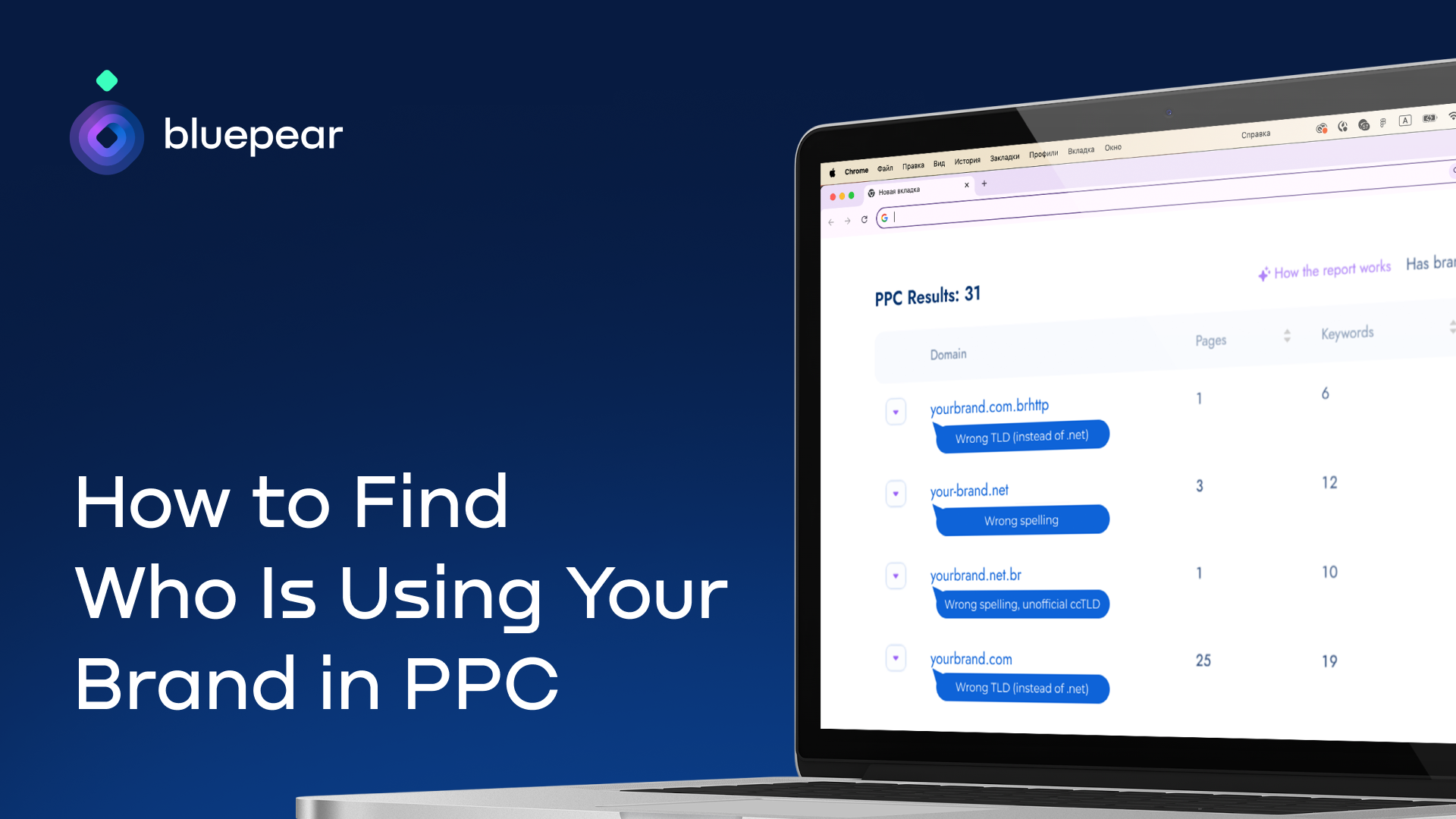
I know competitive brand bidding is now a common PPC tactic, but that does not mean I treat it as harmless background noise. When competitors, affiliates, coupon sites, or misleading advertisers show up on branded searches, they can inflate CPCs, divert high-intent traffic, and confuse people who were already looking for my brand.
I have seen how much difference visibility can make. Industry examples show that brands often uncover meaningful CPC inflation once they start tracking competitor bidding, affiliate activity, and trademark misuse. In documented cases, brands reduced branded CPCs by 25% to 75% after identifying infringing advertisers and enforcing their policies.
In this guide, I walk through how I monitor branded keywords, identify who is advertising on them, and decide what actions may be available based on the evidence I find.
Choosing Keywords So I Do Not Miss Hidden Activity
When I want to find out who is using my brand in search ads, I start by deciding which keywords I need to monitor.
The biggest mistake I try to avoid is watching only my exact brand name. That is a useful starting point, but it rarely shows the full picture. Some advertisers deliberately target brand-related coupon, discount, review, or alternative queries because those searches often come from high-intent users and attract less scrutiny.
For example, someone searching for “Brand coupon” or “Brand discount code” may be much closer to buying than someone searching for the brand alone. Those queries often attract coupon affiliates, loyalty sites, and unauthorized advertisers trying to intercept branded traffic.
I also pay attention to searches that include terms like “reviews” or “alternatives,” because those queries can bring in competitors and comparison sites that position themselves directly against my brand.
Misspellings matter too. Some advertisers target spelling variations because they are less likely to be monitored and may face less competition.
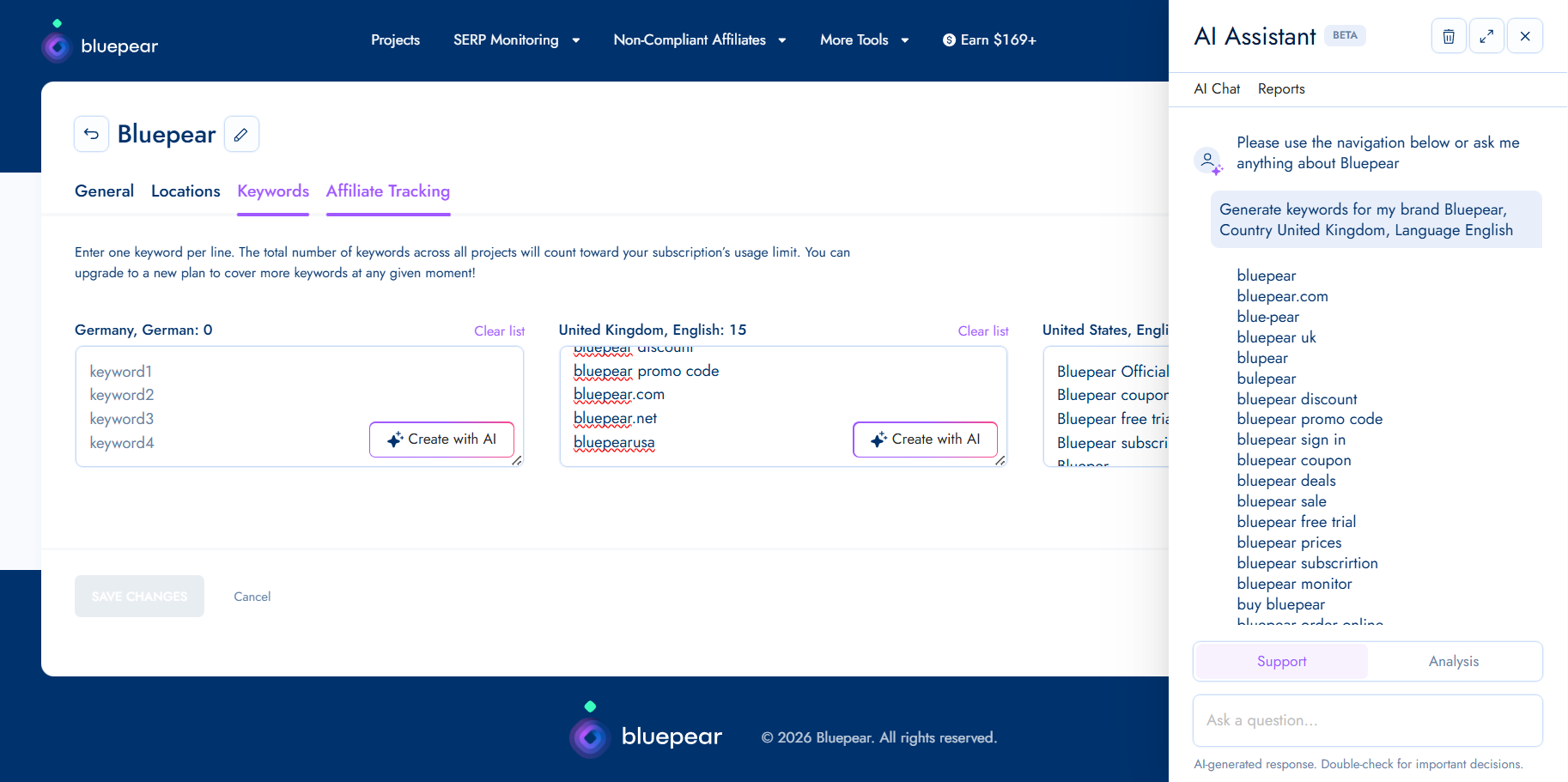
For a solid monitoring setup, I include my core brand name, “official page” and “login” variations, coupon and promo-code searches, review and alternative searches, commercial terms such as “buy,” “order,” and “sign up,” common misspellings, and localized versions of my brand name.
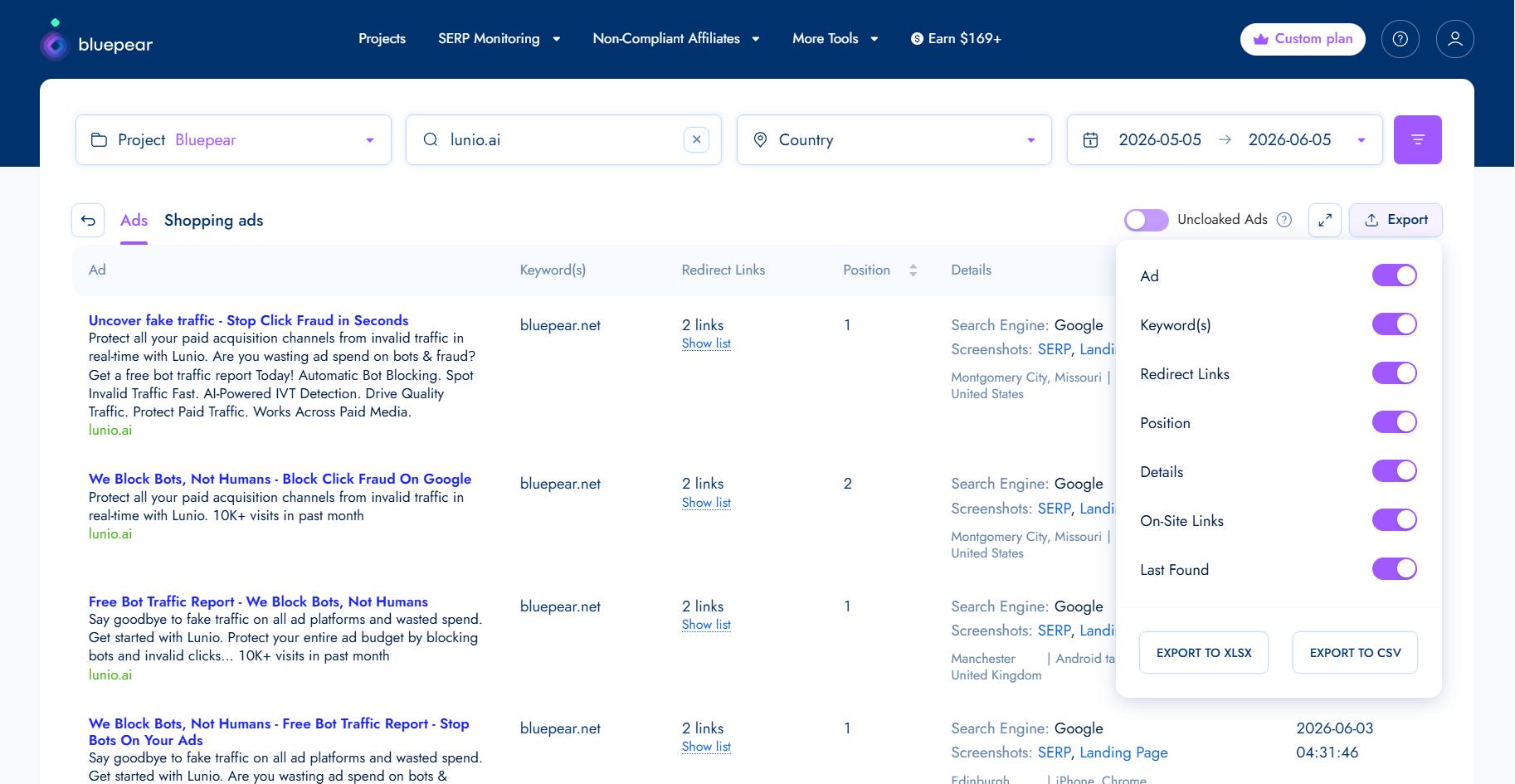
If I am using Bluepear, its built-in AI assistant can generate keyword suggestions from this kind of list and help me expand coverage faster.
The number of terms I monitor depends on the size of the brand portfolio, including trademarks, local branches, and product names. For many small to medium-sized brands, I would start with about 20 keywords and then expand as new risks, markets, and opportunities appear.
Choosing Locations and Monitoring Frequency
I do not rely on a single search from my office, on my device, at one moment in time. Search results are too dynamic for that. Two people searching the same branded keyword can see completely different ads and organic listings depending on their location, device, timing, and other variables.
I also assume that some advertisers may be trying to hide their activity. A fraudster or an affiliate violating my PPC policy might run ads outside normal business hours to reduce the chance of being caught. If I only check manually during the workday, I may never see those ads.
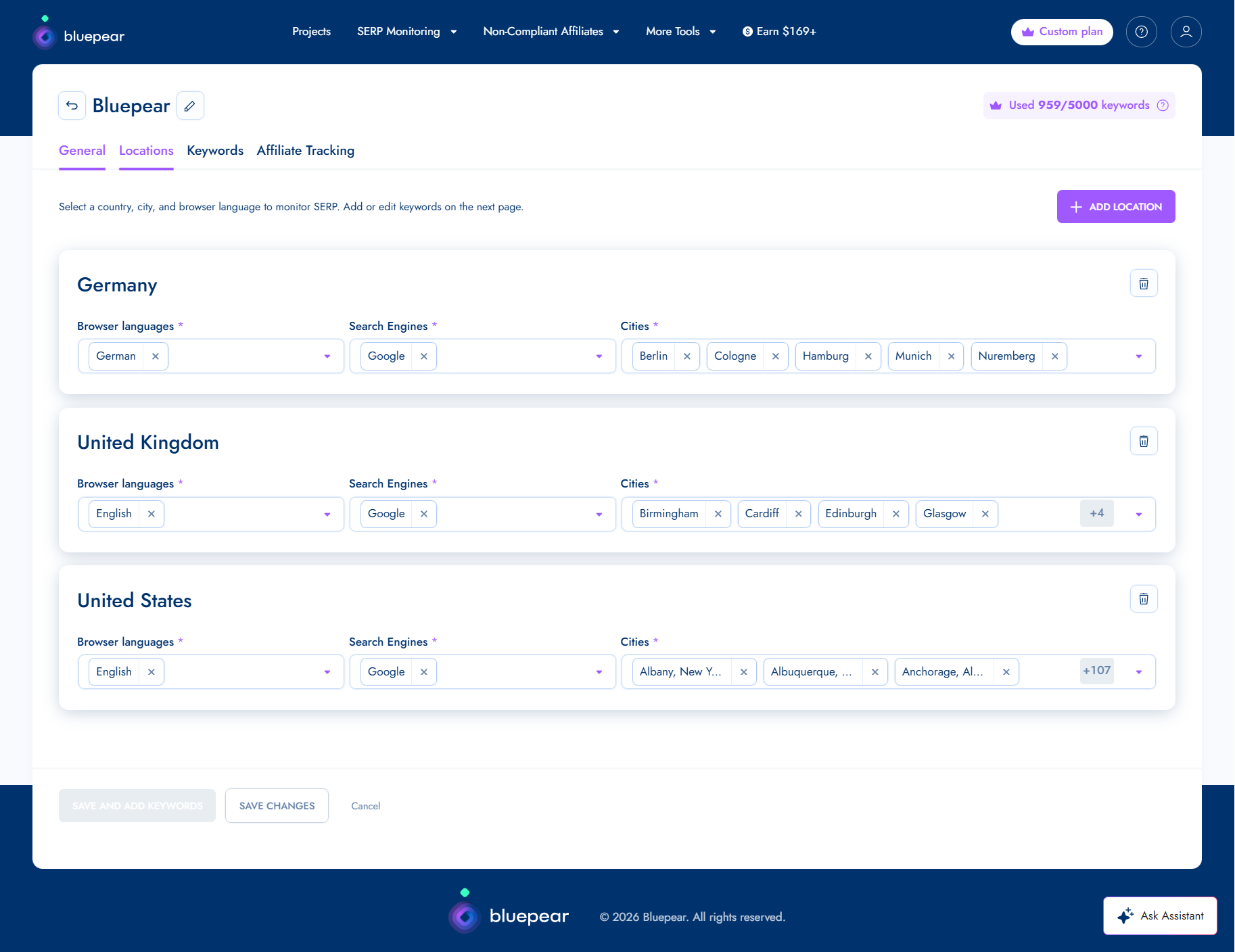
When I monitor branded search results, I look across the countries and markets where my brand operates, regional differences within those markets, mobile and desktop results, different times of day, and weekday versus weekend activity.
Frequency matters just as much as coverage. Some violations appear briefly and then disappear. Running checks multiple times throughout the day gives me a better chance of capturing activity that would otherwise go unnoticed.
Tracking all of these variables manually can become tedious, especially when a brand operates across multiple markets. Bluepear accounts for locations, devices, time zones, and redirects that can obscure the true destination of traffic. I can set the parameters once and gain continuous visibility without turning monitoring into a weekly time sink.
Reviewing Search Results and Recording Evidence
I do not assume every advertiser bidding on my branded keywords is breaking a rule. Competitors may be allowed to bid on branded keywords if they do not use my trademark in their ad copy. Affiliates may also be authorized to promote my brand under specific program conditions.
Still, I need to know when an advertiser’s behavior crosses the line from legitimate brand bidding into trademark misuse, policy violations, or customer deception.
The first signal I investigate is trademark use in ad copy. If the ad mentions my brand name in the headline or description, and my trademark rules or affiliate policies restrict that use, I treat it as a possible compliance issue.
I also look for misleading claims. Phrases that imply the advertiser is “official,” references to exclusive offers, or language that suggests authorization when none exists can confuse users and deserve review.
Coupon and discount promotions need special attention. I verify whether the advertised discount, promo code, or offer is legitimate, because some affiliates use expired, misleading, or fabricated offers to win clicks.
I also watch for impersonation signals. Some ads and landing pages are designed to resemble a brand’s official website. Even if the advertiser does not directly claim to be my company, that kind of presentation can still confuse users and divert branded traffic.
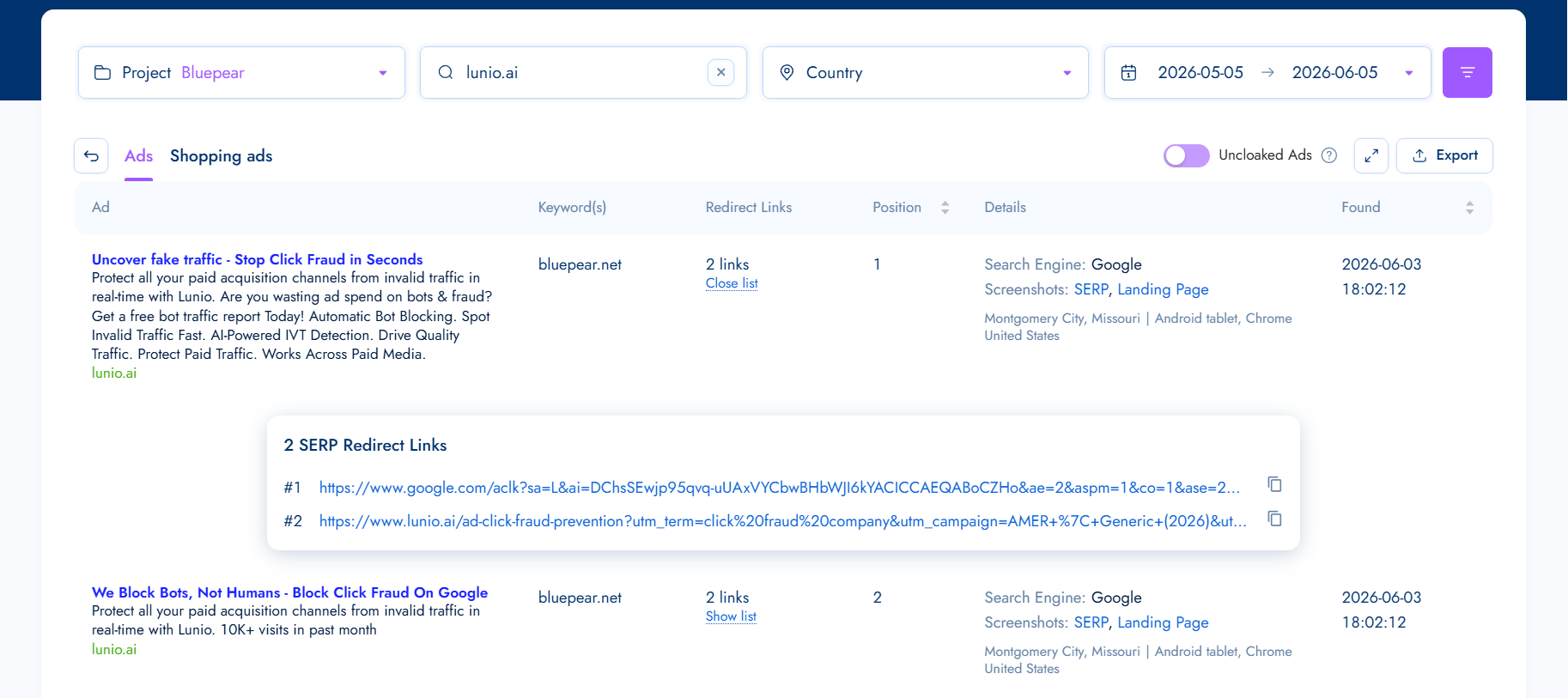
Because advertisers can change ad copy, pause campaigns, or remove landing pages at any time, I collect evidence quickly. I record the ad copy, SERP position, triggering keyword, location, URLs, redirects, landing page content, and timestamps.
Bluepear can handle this automatically by compiling a report with the relevant details, which makes follow-up easier when I need to contact an affiliate, review a competitor’s behavior, or escalate a trademark issue.
Identifying Who Is Behind the Activity
Sometimes I cannot immediately tell whether an advertiser is a competitor, an affiliate, a coupon site, or something riskier. Branded search results often include multiple participants with different motivations, so I need to understand who I am dealing with before I decide what to do next.
I look for patterns. A direct competitor domain usually points to competitor bidding. A coupon or cashback page may indicate an affiliate, coupon site, or loyalty site. Affiliate network tracking links often suggest affiliate activity, although they can also appear in more questionable setups. Product comparison pages often point to competitors or comparison publishers.
Other signals raise the risk level. If an ad uses my trademark, claims to be “official,” sends users through multiple redirects, promotes coupon codes I cannot verify, or lands on a page that imitates my brand’s design or messaging, I investigate more carefully.
No single signal gives me a definitive answer. I combine multiple pieces of evidence before drawing conclusions. Once I know who is advertising on my brand terms, I can move beyond detection and decide whether their activity aligns with my policies and business goals.
What I Do Next
After I identify who is advertising on my brand terms and review their ads, the next step is choosing the right response.
Competitor Brand Bidding
Not every competitor bidding on my branded keywords requires immediate intervention. Before acting, I ask how often the competitor appears, which keywords they are targeting, whether they are using trademarked terms in ad copy, and whether they are sending users to comparison content or direct offers.
In many cases, I monitor the activity and evaluate its business impact over time. Documenting patterns helps me establish a baseline, which can support future compliance reviews or legal conversations if escalation becomes necessary.
Affiliate Violations
If an affiliate is bidding on restricted branded keywords or violating program rules, I gather evidence and contact the affiliate or network. My workflow is straightforward: document the violation, verify the affiliate ID, share the evidence, request removal or corrective action, and apply program enforcement measures if needed.
Screenshots, timestamps, and redirect data make those conversations much easier because I can show exactly what happened, where it happened, and when it was detected.
Trademark Misuse
Trademark-related issues require careful review. I look for unauthorized trademark use in ad copy, ads that create confusion about brand affiliation, impersonation attempts, and misleading claims that the advertiser is an official brand representative, partner, or reseller.
The right response depends on the circumstances, internal policies, and applicable laws. In many jurisdictions, competitors are generally allowed to bid on trademarked keywords. However, ads that confuse users about the advertiser’s relationship with my brand may raise trademark or unfair competition concerns, depending on the facts and local law.
The advertising platform’s policies matter too. Google allows advertisers to bid on trademarked keywords, but it may restrict trademark use in ad text when a valid trademark complaint is submitted. Google also prohibits ads that use trademarks in a confusing, deceptive, or misleading way.
Before I take action, I collect as much evidence as possible, including screenshots, detection timestamps, URLs, redirects, and landing page content. Once the facts are documented, I may contact the advertiser directly, submit a trademark complaint to the advertising platform, send a cease and desist letter, or escalate through legal channels if necessary.
Why I Keep Monitoring Brand Search
The main lesson is that branded search protection is not a one-time audit. Affiliates can activate and pause campaigns throughout the month. Some violations appear only on weekends, outside business hours, or in specific markets. An advertiser that disappears today may return next week with new ad copy, a new domain, or a different affiliate account.
That is why I treat brand protection as an ongoing process. Occasional searches are not enough. I need consistent monitoring and a repeatable investigation workflow that shows who is appearing on my brand terms, how they operate, and whether action is warranted.
If I want easier visibility into my branded search landscape, Bluepear helps identify issues earlier, respond faster, and make more informed decisions about protecting traffic and advertising investments.
SEO and affiliate teams often influence the same metrics, such as revenue, rankings, and visibility in the digital landscape. By aligning these teams, we can cut costs and significantly enhance brand performance.
In many businesses, SEO teams and affiliates—partners promoting our products for commissions—operate separately. While the SEO team focuses on rankings and organic traffic, the affiliate team is busy cultivating partner relationships and handling commissions. However, rarely do these teams collaborate, missing out on boosting their collective impact.
Cross-departmental cooperation is essential for business growth. Collaborating with other teams helps me understand their views on success, expands my perspective beyond SEO, and reveals new opportunities for leveraging initiatives for SEO advancements.
A harmonious relationship between SEO and affiliate teams is crucial. Let’s explore the importance of this alignment for brand protection, LLM visibility, and tool sharing, and how this synergy can enhance efficiency, save costs, and bolster business performance.
Protect Your Brand and Search Terms
It’s crucial to maintain control over brand-related search terms and not let affiliates dominate them. With my clients, anything affecting organic performance falls under the SEO team’s domain.
Consider high-intent terms like:
[brand] + discount code
[brand] + promo code
And many other variations
Allowing affiliates to rank for these terms can redirect your branded traffic and sales back to you, incurring unnecessary commissions. This costly situation can be easily avoided.
Brands can lose their conversions to affiliates as well, like Trainline. The term “trainline promo code” garners 17,000 monthly searches in the UK, yet Trainline fails to optimize their promotional page for this term, losing traffic and conversions to affiliates.
The fix is simple: a focused adjustment of the meta title, H1, and main content to reflect these terms effectively.
By reclaiming control over these rankings, we:
Increased organic revenue.
Reduced affiliate expenses.
Enhanced overall business profitability.
For instance, one brand we manage saw a boost in Share of Voice from 14% to 31% after a strategic content update, all overnight.
These victories benefit the entire business, not just SEO. This is the true purpose of SEO — driving business growth through insight and strategy.
How SEO and Affiliate Teams Can Work Together to Compound Returns
Affiliates generally produce content that enhances reputational signals like “Best of” and comparison articles. LLMs heavily weigh these signals, increasing our brand’s authority when mentioned in numerous reputable articles across our niche.
Educating affiliates on including our brand in such articles can provide:
Increased affiliate visibility, leading to traffic and conversions from those placements.
Enhanced LLM visibility, boosting reputational signals that inform AI models recommending our brand.
Technically, we need to manage affiliate tracking URLs correctly. No-indexing these URLs prevents them from being indexed in search results, avoiding potential indexing issues.
I monitor this with SEOTesting, which alerts me about newly indexed URLs, allowing us to swiftly address any tracking URLs that slip through.
SEO and affiliate teams should not work in silos. Their synergy can save money and increase visibility. Affiliates can boost LLM visibility, while SEO data can empower affiliate decisions, driving business success together.
The closer these teams operate, the more beneficial the results for the business.
Reflecting on my journey in search marketing, I’ve embraced the evolution while recognizing that human creativity remains at the core of an AI-driven world.
Embarking on this career back in 1996, I initially dived into SEO and expanded to paid search by 1998. After a period of burnout in a different sector, I plunged into website design and became an at-home affiliate marketer for giants like Amazon and eBay.
Back in 1998, the launch of Goto.com marked the real start of the pay-per-click era, introducing a groundbreaking model where clicks had monetary value instead of just impressions.
Google’s dominance wasn’t solidified until 2006-2007, when advertisers were compelled to engage with its complex systems, transitioning us from sporadic advertising efforts to comprehensive digital campaign management.
The broader industry shifted significantly, evolving from grassroots operations to a corporate environment driven by venture capital, high salaries, and extravagant events.
Reflecting on the changes, two major milestones transformed paid search: the complexity introduced by Google’s organic algorithm updates and the efficiency brought by automated bidding, freeing time for strategic creativity.
Discussing past strategies, I’m not nostalgic about Single Keyword Ad Groups (SKAGs), but I do miss features like the original Enhanced Cost-Per-Click and specific geo-targeting tools that once offered greater control.
As we look ahead, it’s clear that AI can’t wholly take over advertising accounts; human creativity will continue to play a pivotal role in connecting with our inherently illogical nature.
Reflecting on the past, I made some incorrect predictions, like overestimating the speed of mobile adoption, while correctly assessing that voice search would integrate into regular queries rather than becoming a separate entity.
If I could advise my younger self, it would be to invest more in Google stock – a simple yet significant insight looking back over two decades.
Are you looking to elevate your affiliate marketing efforts? With Profound and PartnerStack, I’ve been able to efficiently activate the right affiliate publications on a larger scale than ever before.
Through this powerful collaboration, I’ve discovered new ways to enhance my campaigns and drive significant growth by engaging with the right audiences at the right time.
I recently stumbled upon a report about Clickout Media, a company that’s notoriously transforming reputable news sites into hubs of AI-driven gambling content. Google refers to this practice as ‘site reputation abuse’. Essentially, it involves using legacy news brands, adding fabricated bylines, embedding casino links, and eventually abandoning these sites after they incur penalties from Google.
According to PressGazette, Clickout Media has been buying sports, gaming, and tech sites only to pivot them from authentic editorial content to topics saturated with casinos and cryptocurrency. Former employees revealed that original reporting gets stripped and replaced with AI-generated articles that promote offshore gambling links.
The approach leverages existing domain authority to manipulate Google rankings. Initially, legitimate content is maintained to preserve the site’s credibility. However, as time passes, gambling content takes over, with human writers being replaced by AI-generated articles and fake author profiles. The revenue stream mainly comes from affiliate deals with casino operators, often linked to player losses.
It’s disheartening to see the impact—several previously active publications are now deindexed, with repercussions including layoffs and closures. Alarmingly, even charity websites have been repurposed to host gambling content.
In Google’s view, publishing content at such a scale purely to manipulate rankings is a breach of their policies, labeled ‘site reputation abuse.’ This can result in manual actions and the removal of these sites from Google’s search index.
As someone who cares about the integrity of SEO, it’s clear this isn’t search engine optimization in any authentic sense. It’s a blatant manipulation of reputation to deceive and gain at scale.
When I hear the terms “incremental” and “incrementality” in affiliate marketing, I sometimes wonder if they truly reflect their intended meaning. Often, they don’t indicate an actual increase in sales, new customers, or revenue. Many affiliate marketers seem to focus only on the affiliate channel, overlooking the broader company impact.
I’ve learned to question whether sales would occur without an affiliate program to assess true incrementality. This helps me determine if a partner genuinely brings new customers and revenue or just diverts those already heading towards checkout.
High-intent traffic is frequently mistaken for incremental value. But just because someone is ready to make a purchase doesn’t mean this touchpoint wouldn’t exist without affiliates. For instance, a coupon site might target consumers already at checkout, simply searching for brand discounts on Google.
Closing an affiliate program today might mean touchpoints still occur without extra costs like commissions and fees. Sure, this traffic involves high intent—it’s consumers in the checkout line. Nonetheless, I might be losing money if the touchpoint provides low or no value.
Note: Not all coupon or deal sites are detrimental. Some might genuinely add value, so I always ensure to test if sales remain consistent without the program before deciding.
The more customers heading to my checkout, the more top-ranking affiliates on Google earn. They depend on intercepting my traffic, which is why they’re sometimes labeled as parasitic. This is where incrementality becomes crucial.
Do touchpoints that consistently occur without your program constitute incremental sales? It’s vital for me to define incremental sales and value clearly.
Incremental sales are those driven by partners, which wouldn’t occur without them. Incremental value arises when affiliates enhance customer value through means your company couldn’t achieve, like increasing cart size or building trust for more conversions.
As a brand, I can offer discounts without an affiliate program. Even without the program, I could submit deals to sites that rank for my brand + coupons, achieving similar sales without incurring network fees, commissions, or salary costs.
If partner-exclusive deals drive sales through unique platforms, it demonstrates incremental value. That’s something unattainable without them, making the affiliate an asset.
Here are some content types and programs adding real incremental value.
Product and brand comparisons
Product and brand comparisons represent two key areas where affiliates can drive value. The affiliate decides which brand or retailer secures the sale, influencing customer choices. For smaller brands, appearing in comparisons with major players can establish credibility and drive incremental revenue.
Affiliates who present unbiased comparisons and reviews cultivated trust, adding value and potentially broadening my customer base.
Tip: Utilizing non-affiliates for brand comparisons can be a more cost-effective strategy.
For instance, I might pay a one-time fee for an independent comparison versus ongoing affiliate commissions, potentially saving money long term.
Moreover, for a smaller brand, being included in comparative reviews can be a significant opportunity to weave into larger brand traffic and attract their customer base.
Types of partners that can offer this value include:
Review and comparison websites.
Listicle sites (SEO and PPC).
YouTubers.
Communities and forums with user-generated content and shopping guides.
When it comes to creators, both those who review and those who don’t, they possess unique content styles that can enhance incrementality.
Some creators add significant value simply through brand mentions and their trusted recommendations—whether they produce detailed reviews or provide other engaging content.
Ultimately, I’ve found that detailed data analysis and testing help me navigate what incrementality means for my business. This involves discerning between true incremental partners and those who merely capitalize on existing customer journeys.
The real insight is not just that Google cracked down on spam or that affiliate content marketing is less effective. It’s that businesses reliant on one easily mimicked distribution channel are vulnerable when that channel shifts.
The future of content will challenge businesses using search as their sole channel.
Instead of focus on broadly applicable topics, many within the industry are emphasizing verticalized research and benchmarks to inspire genuine community dialogues.
Content is evolving beyond simple pages meant to rank, becoming a blend of discovery, discourse, and thought leadership across various channels.
Discovery, discourse, and thought leadership
Hypothetical: Imagine running a SaaS company in the fintech domain, offering advanced financial forecasting.
Rather than creating landing pages targeting “best financial forecasting software” or its affordable counterpart, consider delving into insightful discussions with industry leaders imparts significant wisdom.
Leverage their expertise to pinpoint the most significant financial forecasting gaps in 2026 and verify: Does my offering genuinely address this?
If yes, you’ve likely found a perfect entry to the community.
If not, there’s your direction.
Utilize these insights to craft interactive assessment-based landing pages, supporting them with benchmarking reports derived from top-tier industry organizations.
The intent is for the content to aid organizations in understanding their present state and aims.
These assessments or studies may not dominate Google for high-volume queries, but leveraging owned channels, partnerships, paid media, and other strategies can ensure they reach ideal clients.
These insights act as a springboard for sharing authentic insights from unique dialogues, spanning multiple channels, amplifying your impact.
If executed effectively, you’ll not only enrich the community but also achieve previously elusive growth.
Indexation was swift, and pages appeared for long-tail queries surprisingly quickly.
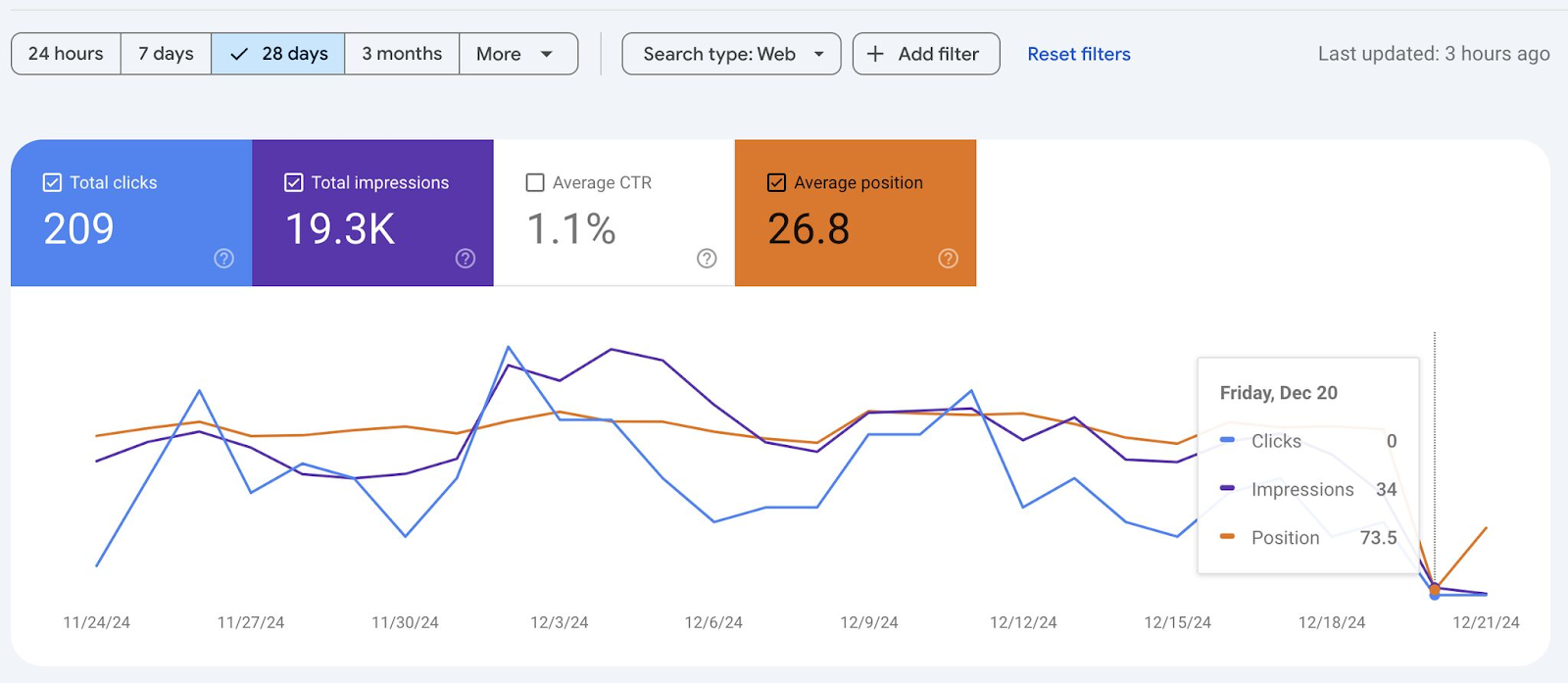
Within a couple of months, each site was generating around 200 in-market clicks.
However, the December spam update changed the game as clicks dropped to zero.
I attempted data updates and performance-enhancing plugins, which proved futile.
While I can’t pinpoint any single tactic’s failure, collectively, they resulted in sites whose only merit was temporary ranking. Once Google no longer found that useful, the sites were left bare.
The lesson here isn’t the failure of these websites; it’s that Google allowed them just enough time to learn from them.
Does affiliate content marketing still work?
Affiliate content marketing remains a viable monetization strategy but not a growth engine on its own.
There are many websites that offer a valuable user experience, adhere to best practices, and successfully generate affiliate income.
For further guidance, consult Google’s information on creating helpful and people-first content to assess if your website is publishing content “created primarily for people, not to manipulate search engine rankings.”
“If the ‘why’ behind your content is to primarily draw search engine traffic, it’s not aligned with what our systems aim to reward. Using automation, AI-generated content to manipulate rankings violates our spam policies.”
Even with best practices, factors such as the rise of AIO and other disruptions have tempered affiliate marketing’s past successes.
The real insight is not just that Google cracked down on spam or that affiliate content marketing is less effective. It’s that businesses reliant on one easily mimicked distribution channel are vulnerable when that channel shifts.
The future of content will challenge businesses using search as their sole channel.
Instead of focus on broadly applicable topics, many within the industry are emphasizing verticalized research and benchmarks to inspire genuine community dialogues.
Content is evolving beyond simple pages meant to rank, becoming a blend of discovery, discourse, and thought leadership across various channels.
Discovery, discourse, and thought leadership
Hypothetical: Imagine running a SaaS company in the fintech domain, offering advanced financial forecasting.
Rather than creating landing pages targeting “best financial forecasting software” or its affordable counterpart, consider delving into insightful discussions with industry leaders imparts significant wisdom.
Leverage their expertise to pinpoint the most significant financial forecasting gaps in 2026 and verify: Does my offering genuinely address this?
If yes, you’ve likely found a perfect entry to the community.
If not, there’s your direction.
Utilize these insights to craft interactive assessment-based landing pages, supporting them with benchmarking reports derived from top-tier industry organizations.
The intent is for the content to aid organizations in understanding their present state and aims.
These assessments or studies may not dominate Google for high-volume queries, but leveraging owned channels, partnerships, paid media, and other strategies can ensure they reach ideal clients.
These insights act as a springboard for sharing authentic insights from unique dialogues, spanning multiple channels, amplifying your impact.
If executed effectively, you’ll not only enrich the community but also achieve previously elusive growth.
Indexation was swift, and pages appeared for long-tail queries surprisingly quickly.
Within a couple of months, each site was generating around 200 in-market clicks.
However, the December spam update changed the game as clicks dropped to zero.
I attempted data updates and performance-enhancing plugins, which proved futile.
While I can’t pinpoint any single tactic’s failure, collectively, they resulted in sites whose only merit was temporary ranking. Once Google no longer found that useful, the sites were left bare.
The lesson here isn’t the failure of these websites; it’s that Google allowed them just enough time to learn from them.
Does affiliate content marketing still work?
Affiliate content marketing remains a viable monetization strategy but not a growth engine on its own.
There are many websites that offer a valuable user experience, adhere to best practices, and successfully generate affiliate income.
For further guidance, consult Google’s information on creating helpful and people-first content to assess if your website is publishing content “created primarily for people, not to manipulate search engine rankings.”
“If the ‘why’ behind your content is to primarily draw search engine traffic, it’s not aligned with what our systems aim to reward. Using automation, AI-generated content to manipulate rankings violates our spam policies.”
Even with best practices, factors such as the rise of AIO and other disruptions have tempered affiliate marketing’s past successes.
The real insight is not just that Google cracked down on spam or that affiliate content marketing is less effective. It’s that businesses reliant on one easily mimicked distribution channel are vulnerable when that channel shifts.
The future of content will challenge businesses using search as their sole channel.
Instead of focus on broadly applicable topics, many within the industry are emphasizing verticalized research and benchmarks to inspire genuine community dialogues.
Content is evolving beyond simple pages meant to rank, becoming a blend of discovery, discourse, and thought leadership across various channels.
Discovery, discourse, and thought leadership
Hypothetical: Imagine running a SaaS company in the fintech domain, offering advanced financial forecasting.
Rather than creating landing pages targeting “best financial forecasting software” or its affordable counterpart, consider delving into insightful discussions with industry leaders imparts significant wisdom.
Leverage their expertise to pinpoint the most significant financial forecasting gaps in 2026 and verify: Does my offering genuinely address this?
If yes, you’ve likely found a perfect entry to the community.
If not, there’s your direction.
Utilize these insights to craft interactive assessment-based landing pages, supporting them with benchmarking reports derived from top-tier industry organizations.
The intent is for the content to aid organizations in understanding their present state and aims.
These assessments or studies may not dominate Google for high-volume queries, but leveraging owned channels, partnerships, paid media, and other strategies can ensure they reach ideal clients.
These insights act as a springboard for sharing authentic insights from unique dialogues, spanning multiple channels, amplifying your impact.
If executed effectively, you’ll not only enrich the community but also achieve previously elusive growth.
The real insight is not just that Google cracked down on spam or that affiliate content marketing is less effective. It’s that businesses reliant on one easily mimicked distribution channel are vulnerable when that channel shifts.
The future of content will challenge businesses using search as their sole channel.
Instead of focus on broadly applicable topics, many within the industry are emphasizing verticalized research and benchmarks to inspire genuine community dialogues.
Content is evolving beyond simple pages meant to rank, becoming a blend of discovery, discourse, and thought leadership across various channels.
Discovery, discourse, and thought leadership
Hypothetical: Imagine running a SaaS company in the fintech domain, offering advanced financial forecasting.
Rather than creating landing pages targeting “best financial forecasting software” or its affordable counterpart, consider delving into insightful discussions with industry leaders imparts significant wisdom.
Leverage their expertise to pinpoint the most significant financial forecasting gaps in 2026 and verify: Does my offering genuinely address this?
If yes, you’ve likely found a perfect entry to the community.
If not, there’s your direction.
Utilize these insights to craft interactive assessment-based landing pages, supporting them with benchmarking reports derived from top-tier industry organizations.
The intent is for the content to aid organizations in understanding their present state and aims.
These assessments or studies may not dominate Google for high-volume queries, but leveraging owned channels, partnerships, paid media, and other strategies can ensure they reach ideal clients.
These insights act as a springboard for sharing authentic insights from unique dialogues, spanning multiple channels, amplifying your impact.
If executed effectively, you’ll not only enrich the community but also achieve previously elusive growth.
Indexation was swift, and pages appeared for long-tail queries surprisingly quickly.
Within a couple of months, each site was generating around 200 in-market clicks.
However, the December spam update changed the game as clicks dropped to zero.
I attempted data updates and performance-enhancing plugins, which proved futile.
While I can’t pinpoint any single tactic’s failure, collectively, they resulted in sites whose only merit was temporary ranking. Once Google no longer found that useful, the sites were left bare.
The lesson here isn’t the failure of these websites; it’s that Google allowed them just enough time to learn from them.
Does affiliate content marketing still work?
Affiliate content marketing remains a viable monetization strategy but not a growth engine on its own.
There are many websites that offer a valuable user experience, adhere to best practices, and successfully generate affiliate income.
For further guidance, consult Google’s information on creating helpful and people-first content to assess if your website is publishing content “created primarily for people, not to manipulate search engine rankings.”
“If the ‘why’ behind your content is to primarily draw search engine traffic, it’s not aligned with what our systems aim to reward. Using automation, AI-generated content to manipulate rankings violates our spam policies.”
Even with best practices, factors such as the rise of AIO and other disruptions have tempered affiliate marketing’s past successes.
The real insight is not just that Google cracked down on spam or that affiliate content marketing is less effective. It’s that businesses reliant on one easily mimicked distribution channel are vulnerable when that channel shifts.
The future of content will challenge businesses using search as their sole channel.
Instead of focus on broadly applicable topics, many within the industry are emphasizing verticalized research and benchmarks to inspire genuine community dialogues.
Content is evolving beyond simple pages meant to rank, becoming a blend of discovery, discourse, and thought leadership across various channels.
Discovery, discourse, and thought leadership
Hypothetical: Imagine running a SaaS company in the fintech domain, offering advanced financial forecasting.
Rather than creating landing pages targeting “best financial forecasting software” or its affordable counterpart, consider delving into insightful discussions with industry leaders imparts significant wisdom.
Leverage their expertise to pinpoint the most significant financial forecasting gaps in 2026 and verify: Does my offering genuinely address this?
If yes, you’ve likely found a perfect entry to the community.
If not, there’s your direction.
Utilize these insights to craft interactive assessment-based landing pages, supporting them with benchmarking reports derived from top-tier industry organizations.
The intent is for the content to aid organizations in understanding their present state and aims.
These assessments or studies may not dominate Google for high-volume queries, but leveraging owned channels, partnerships, paid media, and other strategies can ensure they reach ideal clients.
These insights act as a springboard for sharing authentic insights from unique dialogues, spanning multiple channels, amplifying your impact.
If executed effectively, you’ll not only enrich the community but also achieve previously elusive growth.
Do you remember when partial-match domains and headings could easily rank for commercially intended search queries? I do, and those were simpler times.
With the right strategies and conversion-optimized widgets, I was able to quietly generate tens of thousands of dollars in affiliate revenue each month with minimal upkeep.
Maintaining success was as simple as updating articles for relevancy and freshness signals.
Pressure-testing Google’s spam update
Before launching the experiment, I dedicated several months to scaling an affiliate initiative on a revered website within a YMYL category.
We succeeded by hiring subject matter experts to craft informative content that genuinely educated our readers.
While the newly created content targeted keywords with commercial intent, it wasn’t the sole purpose of the website. We also featured thousands of pages of user-generated content that guided the new writing and encouraged conversions.
Our site boasted brand trust, original research, and expert insights—elements you’d anticipate from a reputable publisher.
This was a perfect combination: a legacy of verticalized user-generated content, numerous earned backlinks, and a commercial element that met existing demand while complying with industry practices. It provided a genuinely helpful user experience.
The experiment: Scaling AI without trust
The initial model was founded on trust and earned authority, but this new venture removed those signals entirely.
During this period, many LinkedIn influencers were employing AI to mass-generate pages by scraping, rewriting content, or programmatically collating public data.
Inspired, I scrounged a few dollars, purchased three domains, and tuned them to match these queries: “best welding schools,” “best plumbing schools,” and “best electrical schools.”
The objective? To test a collection of low-trust, high-scale strategies popular online and observe how long they’d last.
I used AI to enhance the websites visually, fetched public data through a vibe-coded Python API, and crafted templates for subheadings and paragraph text with ChatGPT based on what typically ranks online.
Within hours, thanks to liquid content, I published thousands of bottom-funnel pages across three websites. It allowed me to integrate public data, target specific program types and states with superlatives, and offer a directory with individual pages for each school.
I even utilized aggressive internal linking tactics that favored crawl coverage over user intent.
This arrangement ignored nearly every long-term trust signal, providing a valuable test of system reactions.
The real insight is not just that Google cracked down on spam or that affiliate content marketing is less effective. It’s that businesses reliant on one easily mimicked distribution channel are vulnerable when that channel shifts.
The future of content will challenge businesses using search as their sole channel.
Instead of focus on broadly applicable topics, many within the industry are emphasizing verticalized research and benchmarks to inspire genuine community dialogues.
Content is evolving beyond simple pages meant to rank, becoming a blend of discovery, discourse, and thought leadership across various channels.
Discovery, discourse, and thought leadership
Hypothetical: Imagine running a SaaS company in the fintech domain, offering advanced financial forecasting.
Rather than creating landing pages targeting “best financial forecasting software” or its affordable counterpart, consider delving into insightful discussions with industry leaders imparts significant wisdom.
Leverage their expertise to pinpoint the most significant financial forecasting gaps in 2026 and verify: Does my offering genuinely address this?
If yes, you’ve likely found a perfect entry to the community.
If not, there’s your direction.
Utilize these insights to craft interactive assessment-based landing pages, supporting them with benchmarking reports derived from top-tier industry organizations.
The intent is for the content to aid organizations in understanding their present state and aims.
These assessments or studies may not dominate Google for high-volume queries, but leveraging owned channels, partnerships, paid media, and other strategies can ensure they reach ideal clients.
These insights act as a springboard for sharing authentic insights from unique dialogues, spanning multiple channels, amplifying your impact.
If executed effectively, you’ll not only enrich the community but also achieve previously elusive growth.
Indexation was swift, and pages appeared for long-tail queries surprisingly quickly.
Within a couple of months, each site was generating around 200 in-market clicks.
However, the December spam update changed the game as clicks dropped to zero.
I attempted data updates and performance-enhancing plugins, which proved futile.
While I can’t pinpoint any single tactic’s failure, collectively, they resulted in sites whose only merit was temporary ranking. Once Google no longer found that useful, the sites were left bare.
The lesson here isn’t the failure of these websites; it’s that Google allowed them just enough time to learn from them.
Does affiliate content marketing still work?
Affiliate content marketing remains a viable monetization strategy but not a growth engine on its own.
There are many websites that offer a valuable user experience, adhere to best practices, and successfully generate affiliate income.
For further guidance, consult Google’s information on creating helpful and people-first content to assess if your website is publishing content “created primarily for people, not to manipulate search engine rankings.”
“If the ‘why’ behind your content is to primarily draw search engine traffic, it’s not aligned with what our systems aim to reward. Using automation, AI-generated content to manipulate rankings violates our spam policies.”
Even with best practices, factors such as the rise of AIO and other disruptions have tempered affiliate marketing’s past successes.
The real insight is not just that Google cracked down on spam or that affiliate content marketing is less effective. It’s that businesses reliant on one easily mimicked distribution channel are vulnerable when that channel shifts.
The future of content will challenge businesses using search as their sole channel.
Instead of focus on broadly applicable topics, many within the industry are emphasizing verticalized research and benchmarks to inspire genuine community dialogues.
Content is evolving beyond simple pages meant to rank, becoming a blend of discovery, discourse, and thought leadership across various channels.
Discovery, discourse, and thought leadership
Hypothetical: Imagine running a SaaS company in the fintech domain, offering advanced financial forecasting.
Rather than creating landing pages targeting “best financial forecasting software” or its affordable counterpart, consider delving into insightful discussions with industry leaders imparts significant wisdom.
Leverage their expertise to pinpoint the most significant financial forecasting gaps in 2026 and verify: Does my offering genuinely address this?
If yes, you’ve likely found a perfect entry to the community.
If not, there’s your direction.
Utilize these insights to craft interactive assessment-based landing pages, supporting them with benchmarking reports derived from top-tier industry organizations.
The intent is for the content to aid organizations in understanding their present state and aims.
These assessments or studies may not dominate Google for high-volume queries, but leveraging owned channels, partnerships, paid media, and other strategies can ensure they reach ideal clients.
These insights act as a springboard for sharing authentic insights from unique dialogues, spanning multiple channels, amplifying your impact.
If executed effectively, you’ll not only enrich the community but also achieve previously elusive growth.
The real insight is not just that Google cracked down on spam or that affiliate content marketing is less effective. It’s that businesses reliant on one easily mimicked distribution channel are vulnerable when that channel shifts.
The future of content will challenge businesses using search as their sole channel.
Instead of focus on broadly applicable topics, many within the industry are emphasizing verticalized research and benchmarks to inspire genuine community dialogues.
Content is evolving beyond simple pages meant to rank, becoming a blend of discovery, discourse, and thought leadership across various channels.
Discovery, discourse, and thought leadership
Hypothetical: Imagine running a SaaS company in the fintech domain, offering advanced financial forecasting.
Rather than creating landing pages targeting “best financial forecasting software” or its affordable counterpart, consider delving into insightful discussions with industry leaders imparts significant wisdom.
Leverage their expertise to pinpoint the most significant financial forecasting gaps in 2026 and verify: Does my offering genuinely address this?
If yes, you’ve likely found a perfect entry to the community.
If not, there’s your direction.
Utilize these insights to craft interactive assessment-based landing pages, supporting them with benchmarking reports derived from top-tier industry organizations.
The intent is for the content to aid organizations in understanding their present state and aims.
These assessments or studies may not dominate Google for high-volume queries, but leveraging owned channels, partnerships, paid media, and other strategies can ensure they reach ideal clients.
These insights act as a springboard for sharing authentic insights from unique dialogues, spanning multiple channels, amplifying your impact.
If executed effectively, you’ll not only enrich the community but also achieve previously elusive growth.
Indexation was swift, and pages appeared for long-tail queries surprisingly quickly.
Within a couple of months, each site was generating around 200 in-market clicks.
However, the December spam update changed the game as clicks dropped to zero.
I attempted data updates and performance-enhancing plugins, which proved futile.
While I can’t pinpoint any single tactic’s failure, collectively, they resulted in sites whose only merit was temporary ranking. Once Google no longer found that useful, the sites were left bare.
The lesson here isn’t the failure of these websites; it’s that Google allowed them just enough time to learn from them.
Does affiliate content marketing still work?
Affiliate content marketing remains a viable monetization strategy but not a growth engine on its own.
There are many websites that offer a valuable user experience, adhere to best practices, and successfully generate affiliate income.
For further guidance, consult Google’s information on creating helpful and people-first content to assess if your website is publishing content “created primarily for people, not to manipulate search engine rankings.”
“If the ‘why’ behind your content is to primarily draw search engine traffic, it’s not aligned with what our systems aim to reward. Using automation, AI-generated content to manipulate rankings violates our spam policies.”
Even with best practices, factors such as the rise of AIO and other disruptions have tempered affiliate marketing’s past successes.
The real insight is not just that Google cracked down on spam or that affiliate content marketing is less effective. It’s that businesses reliant on one easily mimicked distribution channel are vulnerable when that channel shifts.
The future of content will challenge businesses using search as their sole channel.
Instead of focus on broadly applicable topics, many within the industry are emphasizing verticalized research and benchmarks to inspire genuine community dialogues.
Content is evolving beyond simple pages meant to rank, becoming a blend of discovery, discourse, and thought leadership across various channels.
Discovery, discourse, and thought leadership
Hypothetical: Imagine running a SaaS company in the fintech domain, offering advanced financial forecasting.
Rather than creating landing pages targeting “best financial forecasting software” or its affordable counterpart, consider delving into insightful discussions with industry leaders imparts significant wisdom.
Leverage their expertise to pinpoint the most significant financial forecasting gaps in 2026 and verify: Does my offering genuinely address this?
If yes, you’ve likely found a perfect entry to the community.
If not, there’s your direction.
Utilize these insights to craft interactive assessment-based landing pages, supporting them with benchmarking reports derived from top-tier industry organizations.
The intent is for the content to aid organizations in understanding their present state and aims.
These assessments or studies may not dominate Google for high-volume queries, but leveraging owned channels, partnerships, paid media, and other strategies can ensure they reach ideal clients.
These insights act as a springboard for sharing authentic insights from unique dialogues, spanning multiple channels, amplifying your impact.
If executed effectively, you’ll not only enrich the community but also achieve previously elusive growth.