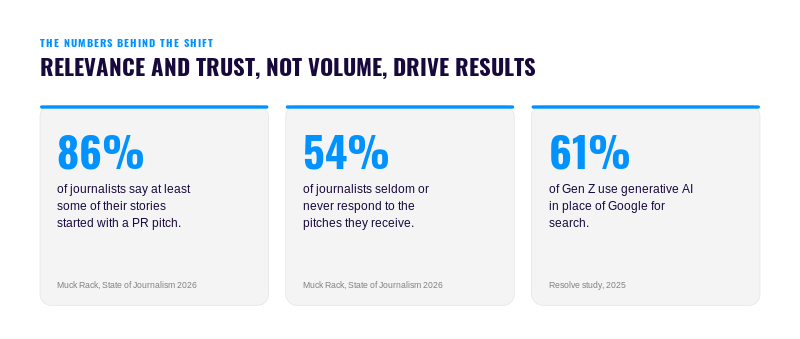
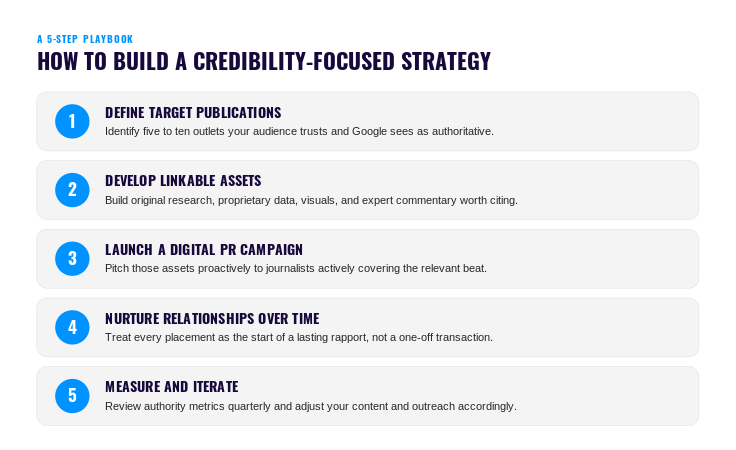
If your link building plan still begins with a target number of backlinks, 2027 is going to be expensive. You may fill a report with placements while earning little attention, trust, referral traffic, or visibility in the searches that influence buyers.
A stronger plan starts with a different question: what can your brand publish, reveal, or explain that an editor would independently choose to reference? That shift turns link building from an inventory exercise into a disciplined combination of content strategy, digital PR, audience research, and relationship building.
Key takeaways
- Treat a backlink as one possible result of earning editorial attention, alongside brand mentions, referral traffic, social discovery, journalist relationships, and leads.
- Build campaigns around original evidence, useful expertise, or a timely consequence. A company announcement is not automatically a story.
- Evaluate publications by topical relevance, audience fit, editorial standards, and narrative fit. A third-party authority score cannot replace those checks.
- Use competitor backlinks to find publications and recurring interests, then develop an angle competitors cannot reproduce.
- Use AI to accelerate research, organization, and controlled drafting. Keep story selection, factual review, personalization, and final approval under human judgment.
- Measure business and editorial outcomes separately from link counts. A placement should have a credible route to attention, trust, discovery, or demand.
Set the outcome before choosing the link tactic
Links still matter, but a link is not the whole return. A genuinely earned placement can expose your brand to a publication’s audience, create a relevant brand mention, attract referral visits, support social discovery, and associate your expertise with a subject. That is why earned placements can produce value beyond the hyperlink itself.
Choose a primary campaign outcome before you create anything. If the goal is authority in a category, you need relevant editorial association. If the goal is qualified referral traffic, you need a publication read by potential buyers and a natural reason for them to continue to your site. If the goal is leads, the referenced page must help a visitor take the next step. If the goal is AI-search visibility, you need clear, public, topical evidence about your brand, while recognizing that no individual link can guarantee a citation in an AI-generated answer.
This distinction changes prospecting. A site with an impressive authority metric but no real editorial process, topical connection, or relevant readership is not equivalent to a respected publication that covers the problem you solve. The first may add a row to a spreadsheet. The second can make your brand easier for people and systems to understand in context.
| Decision factor | Proceed when | Reject or revise when |
|---|---|---|
| Topical relevance | The publication regularly covers the question your campaign answers. | The only attraction is a high third-party domain metric. |
| Audience fit | Its readers include people who influence, use, or recommend your category. | You cannot explain why its audience would care. |
| Editorial credibility | Editors select, shape, and verify what appears. | Placement is effectively for sale and editorial scrutiny is absent. |
| Story fit | Your evidence or expertise advances an existing beat or timely conversation. | The pitch merely announces that your company did something. |
| Compounding value | The coverage can earn referrals, mentions, relationships, reuse, or demand as well as a link. | The placement has no plausible value after the backlink is logged. |
Write these criteria into the campaign brief. They give your team permission to decline an irrelevant placement even when it looks attractive in a link report.
Build an asset around a story someone else can use

The hardest part of link building is not sending the email. It is creating a defensible reason for the email to exist.
A new hire, product launch, funding event, or executive profile is an announcement until you connect it to a consequence that matters outside your company. The usable story might be a problem the product exposes, an unexpected change visible in company data, a practical answer from a qualified expert, or a timely pattern affecting the publication’s readers. Product praise is not evidence, and an executive biography is not a reader benefit.
Apply the story test before producing the asset
- Reader value: What can the publication’s audience understand, decide, or do after seeing this?
- Novelty: What does your brand know, observe, or possess that is not already available in interchangeable articles?
- Proof: Can an editor inspect the underlying data, method, example, or expert reasoning?
- Timing: Why is this useful in the current conversation rather than at an arbitrary publishing date?
- Editorial independence: Would the central insight remain interesting if the company description were reduced to a short attribution?
- Reference value: Is there a specific chart, finding, explanation, tool, or page worth citing?
If the idea fails several of these checks, polishing the pitch will not rescue it. Improve the evidence or choose a more useful angle before outreach begins.
Originality does not require spectacle. Your strongest inputs are often the ones already inside the organization: proprietary data, recurring customer questions, specialist knowledge, product usage patterns, or a company decision that reveals a broader market change. The important condition is that you can support the claim and explain why it matters to someone who is not buying from you.
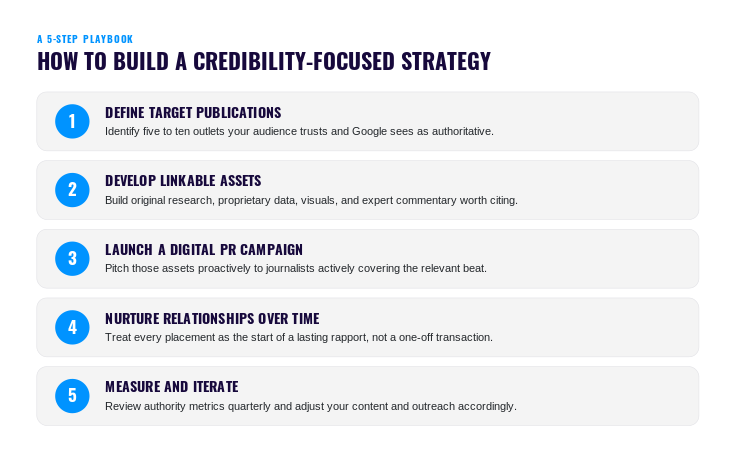
Run a deliberate production sequence
- Write the reader’s question in plain language.
- Identify the evidence or expertise that can answer it.
- Check what has already been published so you do not recreate a familiar asset with a new headline.
- Define the finding, consequence, and appropriate limitations before drafting promotional copy.
- Create the referenceable page, including enough context for an editor to verify and accurately describe the point.
- Develop distinct pitch angles for the relevant publication types and beats.
- Prepare a concise fact sheet so every pitch, interview, social post, and follow-up uses consistent claims.
Do not manufacture overlapping assets merely to maintain a publishing cadence. Repeating the same idea across multiple weak pages divides attention and leaves journalists with no clear canonical resource to cite. A durable asset that can be refreshed when new evidence or a relevant news event appears is usually more useful than a queue of near-duplicates.
Schema markup can clarify the entity, author, dates, and content type represented on your own page. It cannot turn recycled material into original evidence or convert a purchased placement into an editorial endorsement. Structured data supports clarity; the story still has to earn attention.
Prospect for editorial fit, then pitch with restraint

Competitor backlink profiles remain useful, but treat them as maps rather than instructions. They can reveal publications covering your market, journalists with relevant beats, recurring story formats, and subjects that attract citations. They cannot give you a distinctive reason to be covered.
For every promising competitor placement, ask what was actually newsworthy. Then look for the missing question, newer evidence, stronger method, different audience consequence, or expert perspective your organization can credibly supply. The direction is supported by a reported survey in which 66.6% of SEO professionals favored finding unique opportunities over replicating competitors’ backlink profiles.
Your prospect list should record why each contact belongs on it. Capture the journalist’s beat, relevant previous coverage, the audience connection, the angle you intend to offer, and the evidence that makes the pitch credible. If the only personalization available is a first name and publication name, the prospecting is not finished.
Put AI behind an editorial gate
AI can help cluster coverage themes, organize prospect notes, extract common questions, compare angle variants, and turn an approved brief into draft outreach. That speed is useful only after the strategy is sound.
Do not let an automated system invent personalization, infer facts about a journalist, or send unreviewed pitches at scale. Inboxes already contain large volumes of similar machine-written outreach. Increasing output without improving relevance scales rejection and can damage the relationships you need for future campaigns.
- Give the system an approved evidence pack rather than unrestricted permission to create claims.
- Require every draft to state the finding and reader consequence before mentioning the company.
- Remove empty compliments, generic trend language, exaggerated adjectives, and invented familiarity.
- Verify names, beats, publication fit, claims, and links before sending.
- Keep the final decision with a person who can judge whether the pitch deserves the recipient’s attention.
A strong pitch makes the editorial decision easy to evaluate. Lead with the relevant finding or consequence. Explain why that contact’s readers are affected. State what evidence, expert access, or usable material is available. Then stop. A long company history, feature list, or generic offer to collaborate forces the recipient to search for the story you should already have identified.
Relationship building happens through repeated relevance, not repeated reminders. Record useful feedback, respect a clear rejection, and return only when you have a genuinely suitable angle. A journalist who trusts your accuracy and restraint is a more durable asset than a large list of contacts receiving interchangeable messages.
Measure whether the campaign earned real authority
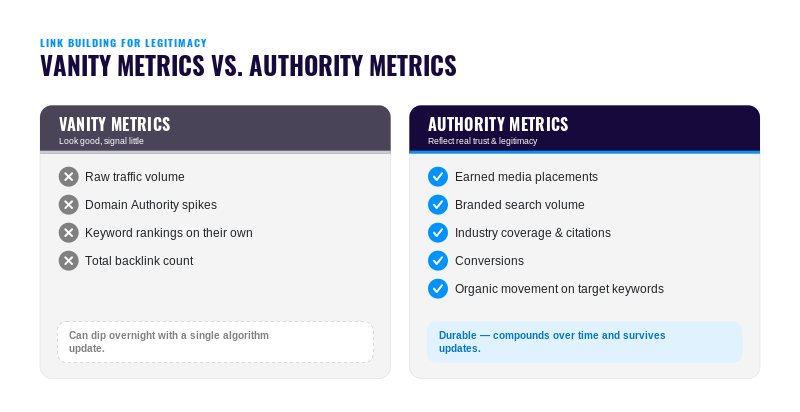
A raw link count cannot tell you whether a campaign worked. It treats an editorial citation read by your market as equivalent to a placement on a site created to sell links. Your reporting should preserve the difference.
Record the immediate editorial result: publication, topical context, linked or unlinked brand mention, destination page, publication audience fit, and whether the placement produced referral activity. Then track the outcomes tied to the campaign brief, such as qualified visits, leads, branded discovery, subsequent coverage, social distribution, or reuse of the asset.
For AI-search monitoring, use a stable set of relevant questions and record whether your brand, domain, or campaign evidence appears. Treat movement as a visibility observation, not proof that a particular backlink caused an answer to change. AI outputs vary, and an isolated appearance is not a reliable attribution model.
Also measure what the team learned. Note which angles earned replies, which evidence editors questioned, which publications produced useful audiences, and which relationships opened a credible path to later coverage. Feed those observations into the next campaign. The value of disciplined digital PR compounds partly because your team stops repeating weak ideas and begins recognizing the structures that work for its market.
Use clear stop and continue rules
- Continue: The asset remains accurate, distinctive, and useful, and new events create legitimate reasons to revisit it.
- Revise: Well-matched contacts understand the topic but consistently cannot see the finding, consequence, or evidence.
- Consolidate: Multiple campaign pages compete to explain the same idea and none is the obvious reference. Preserve valuable URLs and existing search equity when planning any consolidation.
- Stop: The tactic depends on undisclosed purchasing, fabricated authority, irrelevant placements, or volume that the team cannot review responsibly.
Purchased links can create impressive-looking metrics while providing no genuine audience, editorial judgment, or relationship. Sites with backlink profiles dominated by purchased placements were among those reported as hardest hit during the second wave of Google’s March 2026 spam update. Even before algorithmic risk enters the calculation, a placement with no reader or editorial value is a poor use of budget.
Start your 2027 plan with the market question your organization is best equipped to answer. Build the most defensible version of that answer, choose publications whose readers genuinely need it, and give editors a precise reason to reference it. When the story, evidence, audience, and outreach align, the link becomes evidence of authority rather than a substitute for it.
References