Category: News

  • How Google Ads’ AI Updates Impact Advertisers in 2026

    How Google Ads’ AI Updates Impact Advertisers in 2026

    As I dig into Google’s latest updates to the Google Ads Terms of Service, I’m struck by the emphasis on AI-driven automation and what it means for us as advertisers. These changes raise some intriguing questions about control and oversight.

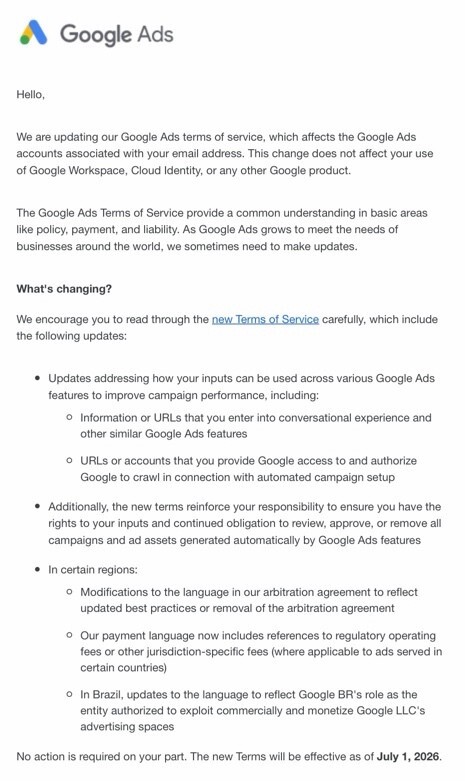
    The big picture? These updates, effective from July 1st, apply solely to Google Ads accounts, leaving other Google products like Workspace untouched. Conveniently, we don’t need to take any immediate action.

    What’s Changing? It seems Google aims to bolster the role of automation and AI in its advertising platform. Let’s unpack the key changes.

    First, there’s updated language regarding how our inputs might be utilized across Google Ads features to enhance campaign performance. Additionally, there’s clarity on how Google’s systems may leverage information from conversational tools.

    Importantly, provisions concerning the URLs and accounts we’ve authorized for Google’s automated campaign setups have been refreshed.

    Why This Matters The broader implications here hint at Google assuming wider authority for using AI to craft and optimize ad elements for us. This doesn’t relieve us from our responsibility to review and approve campaigns, keeping us accountable.

    For brands worrying about transparency and control, these revisions play a crucial role in compliance and performance accountability.

    A Significant Shift There’s notable new language around automated campaign management. It suggests that unlike before, where opting in or out of automation features was straightforward, we’re now inherently authorizing Google to deploy automated processes for ads on our behalf.

    Yet, we remain accountable for final campaign results, holding onto the reins of responsibility.
    ```json
{
  "alt": "Google Ads Terms of Service update notification detailing changes effective July 1, 2026.",
  "caption": "Stay informed: Google Ads is updating its Terms of Service with changes effective from July 1, 2026. Be sure to review the updates to understand their implications.",
  "description": "This image is a notification from Google Ads regarding updates to their Terms of Service, effective July 1, 2026. It highlights changes that affect campaign performance inputs, includes regional-specific updates, and underlines new responsibilities for users. It encourages users to review the updated terms for a better understanding of policy changes. Keywords: Google Ads, Terms of Service, update, notification, campaign performance, policy changes."
}
```

    What Critics Say Some voices in the industry are skeptical. Anthony Higman, founder of AdSQUIRE, voices concerns that these updates dilute two core tenets of Google Ads: relevance and control. He particularly points to the nuances giving Google greater leeway in automated ad management while maintaining our accountability.

    Higman feels this erodes our ability to opt into automation features, hinting at a shift in decision-making power towards AI systems.

    Between the Lines We need to pay attention to our responsibilities. This includes ensuring we hold the necessary rights to any inputs shared with Google Ads and staying vigilant in overseeing auto-generated campaigns and assets.

    Regional Updates Google isn’t stopping at universal terms. It’s also introducing region-specific changes in several markets involving arbitration agreements and legal compliance.

    This includes adjustments reflecting recent legal practices and specifics on arbitration or fees that apply depending on location.

    Advertisers from Brazil, for instance, face clarified language about Google BR’s authority in their transactions.

    What’s Next Come July 1st, the updated Google Ads Terms of Service will be in place. While no immediate account actions are needed, reviewing these terms is advisable.


    Inspired by this post on Search Engine Land.


    crushpress.ai community screenshot
  • Google’s New AI-Powered Healthcare Ads: What You Need to Know

    Google’s New AI-Powered Healthcare Ads: What You Need to Know

    Hi there! Today, I’m thrilled to share some intriguing news about Google and its latest venture into AI-powered search advertising. Google has kickstarted testing for healthcare ads in AI Mode. This exciting development gives us a glimpse into the future of advertising within AI-based search environments.

    The scope of this test is currently narrowed to healthcare advertisers in the United States and focuses only on English-language queries in AI Mode, as confirmed by Google Ads Liaison Ginny Marvin.

    Amidst swirling industry rumors, it has now been officially confirmed that healthcare ads have indeed begun appearing in AI-generated search results.

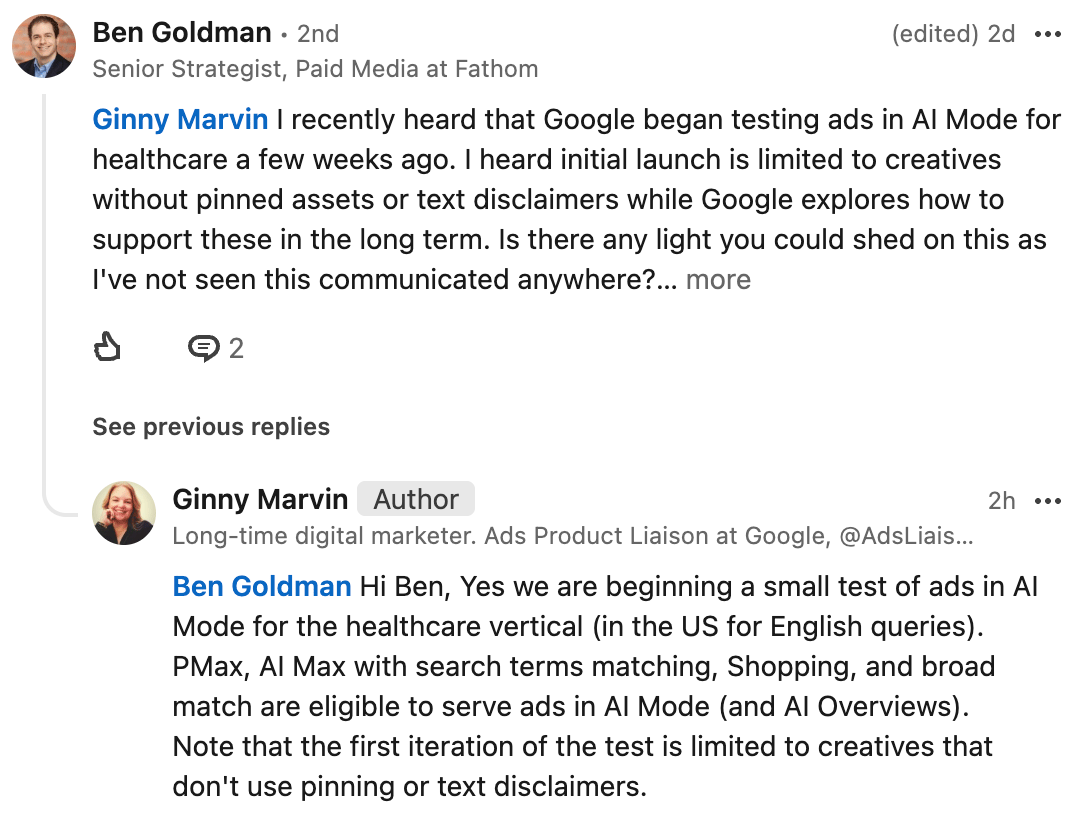
    What Google is saying. Addressing inquiries on LinkedIn, Marvin highlighted that Google has “begun a small test of ads in AI Mode specifically for the healthcare sector.” It’s an intriguing move, isn’t it?

    She mentioned that a variety of campaign types can participate, including:

    • Performance Max (PMax)
    • AI Max with search term matching
    • Shopping campaigns
    • Broad match campaigns

    These campaign types can also show ads within AI Overviews.

    ```json
{
  "alt": "LinkedIn conversation about Google testing healthcare ads in AI Mode.",
  "caption": "Exploring the future of ads: A LinkedIn dialogue on Google's AI Mode for healthcare advertising.",
  "description": "A LinkedIn exchange between Ben Goldman and Ginny Marvin discussing Google's test of AI Mode ads in the healthcare sector. Ben Goldman inquires about the testing scope, seeking clarity on initial restrictions like creatives without pinned assets or text disclaimers. Ginny Marvin confirms the test's scope, highlighting that it's limited to the US for English queries and involves PMax and AI Max. The conversation reveals insights into Google's advertising innovations."
}
```

    Why we care. As healthcare stands as one of Google’s stringently regulated advertising sectors, this test is crucial for understanding how Google might monetize AI-driven search results. If the test expands, healthcare marketers could gain a new platform for visibility, and advertisers in similarly regulated industries might get a sneak peek of future ad appearances in Google’s AI-generated search.

    The fine print. This initial testing phase comes with some creative boundaries. Marvin noted that ads devoid of pinned assets or text disclaimers are presently the only eligible healthcare advertisements.

    What to watch. It’s just the beginning, and we’re curious to see if Google will broaden the eligibility for more healthcare ads, introduce other ad formats, or extend into other regulated fields.

    Such developments could provide early clues about Google’s strategy to harmonize monetization and user trust as AI Mode starts to play a more significant role in the search experience.

    First spotted. Interestingly, it was Senior Strategist Ben Goldman who first noticed this test, which he shared in response to her GML 2026 summaries on LinkedIn.


    Inspired by this post on Search Engine Land.


    crushpress.ai community screenshot
  • Discover Google’s New Tool for Tracking Invalid Click Credits

    Discover Google’s New Tool for Tracking Invalid Click Credits

    Google Search

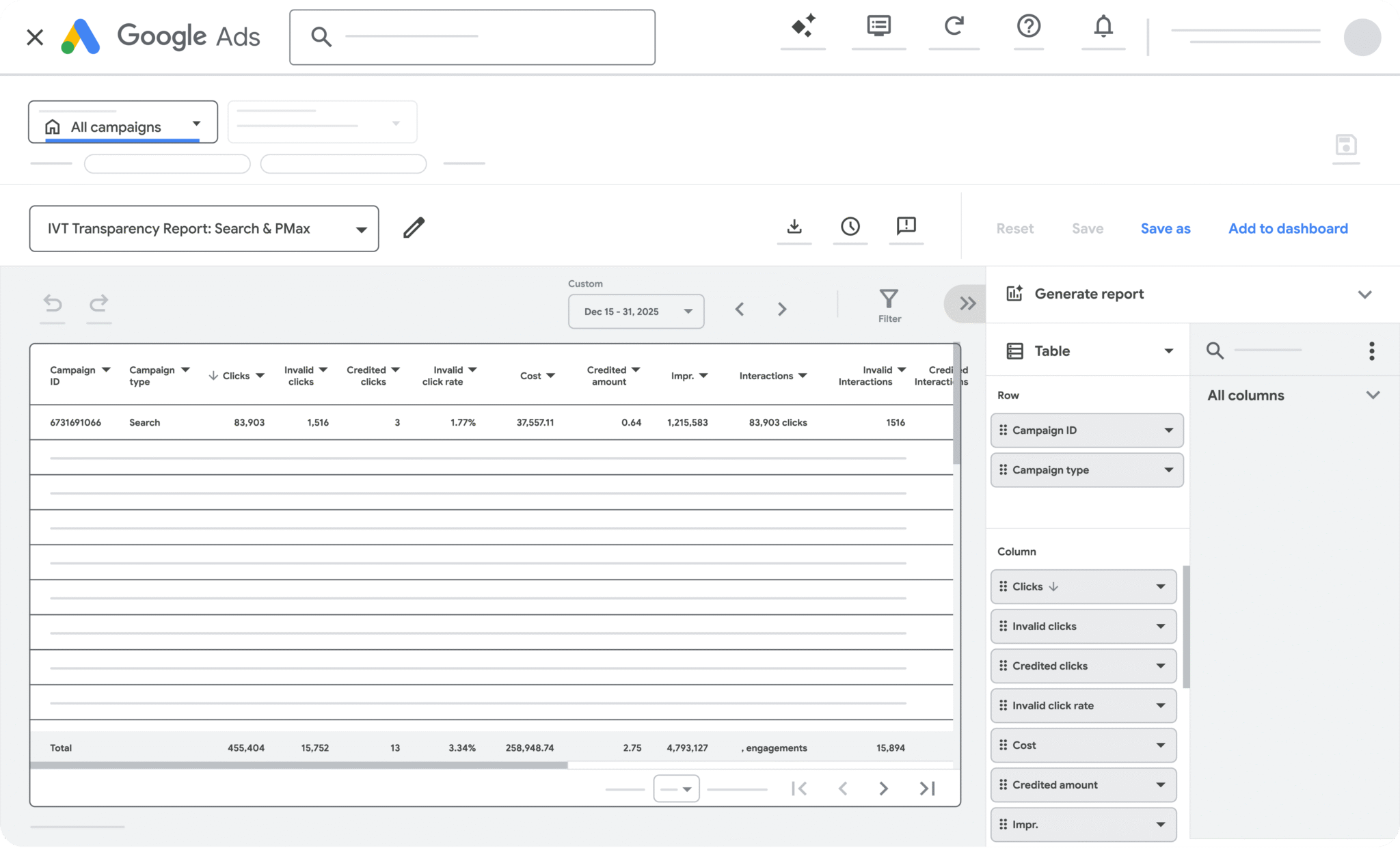
    Recently, I stumbled upon Google’s new documentation that sheds light on a handy tool called the Invalid Activity Credit Report. It’s designed to give us advertisers a clearer picture of refunds issued for those pesky invalid clicks and interactions.

    The big picture. Although it’s not entirely clear if the report itself is brand new, it’s definitely showcasing some metrics we’ve seen before, like the invalid click rate. What’s exciting is that the documentation provides a detailed view of credits issued for invalid traffic in both Search and Performance Max campaigns.

    How it works. Google mentions that they use automated systems to detect and filter out invalid traffic before it costs us anything. However, if any invalid activity slips through, these credits come to the rescue post-billing.

    In such cases, Google might issue credits to cover the associated spend.

    While I’ve seen these credits in billing and transaction histories before, this new report breaks down:

    • Credited clicks
    • Credited interactions
    • Credited spend
    • Campaign-level impact
    • Adjusted performance metrics after credits are applied

    Why we care. Having a transparent view of how much of our campaign budget is being refunded due to invalid activity helps me understand my true performance and costs much better. Plus, this new documentation is a gem for raising awareness about a tool many of us might not have known about.

    Google’s goal with this report seems to be providing a better understanding of campaign performance after these adjustments.

    ```json
{
  "alt": "Google Ads dashboard showing a report on campaign performance metrics such as clicks, cost, and impressions.",
  "caption": "Dive into your campaign insights with Google Ads! Explore detailed metrics like clicks, costs, and impressions for better performance analysis.",
  "description": "This image displays a Google Ads dashboard featuring a report titled 'IVT Transparency Report: Search & PMax'. The report presents detailed campaign performance metrics including clicks, invalid clicks, credited clicks, cost, impressions, and interactions. The dashboard allows for customization of the report view, filtering, and saving options, providing comprehensive insights into the advertising campaign's efficiency. This helps advertisers analyze and optimize their digital marketing strategies effectively."
}
```

    They say that it helps us:

    • See costs, clicks, and interactions post-credits.
    • Reduce the hassle of manually reconciling billing credits with campaign performance.
    • Gain insights into how Google’s invalid traffic protections affect each campaign.

    How to access it. Finding this report is straightforward through the Report Editor in Google Ads.

    Just go to the Template Gallery, and select “Invalid Activity Credit Report: Search & PMax” to generate a report with standard campaign metrics, alongside new columns for credited clicks, interactions, and amounts.

    You can even add performance metrics to see how campaigns fare after credits adjustment.

    What to watch. The report could soon become invaluable for those of us running large budgets, especially if we’re meticulously examining traffic quality and discrepancies in reported performance versus billing.

    As AI-driven campaign automation grows, insights into invalid traffic and refunded spend will likely become critical in our campaign strategies.


    Inspired by this post on Search Engine Land.


    crushpress.ai community screenshot
  • Elevate Your Commerce Media with Demand Gen on Google Platforms

    Elevate Your Commerce Media with Demand Gen on Google Platforms

    I’ve discovered an exciting update that expands the possibilities for brands in commerce media, now allowing access beyond just retail sites.

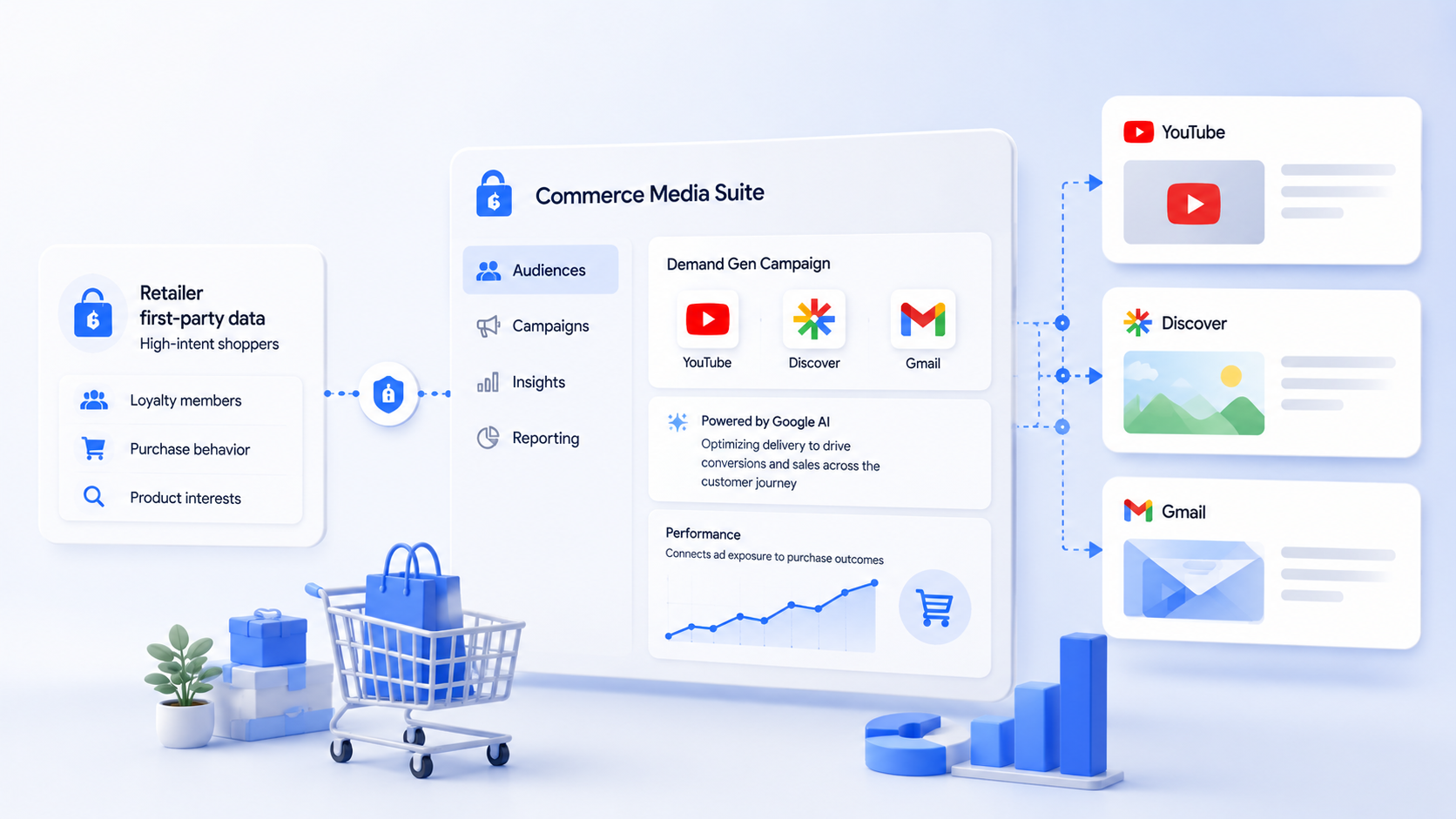
    Brands can harness retailer first-party data to seamlessly run Demand Gen campaigns across platforms like YouTube, Discover, and Gmail through the Commerce Media Suite. It’s a remarkable expansion that takes retail media far beyond its traditional boundaries.

    What’s happening: Google has broadened its Commerce Media Suite to support Demand Gen inventory, paving the way for enhanced collaboration between brands and retailers through shared audience data.

    With this update, advertisers can activate retailer audiences across Google’s visual and discovery-driven channels, while still leveraging the insights that fuel powerful retail media campaigns.

    Why it matters: This development integrates retailer first-party data with the vast reach of YouTube, Discover, and Gmail, ensuring brands can connect with high-intent shoppers even beyond retailer websites, and link ad exposure directly to actual sales figures.

    How it works: Retailers provide their first-party audience data through the Commerce Media Suite, enabling brands to run Demand Gen campaigns across Google’s services.

    Google’s AI optimizes delivery to boost conversions and sales along the customer journey. It also enhances reporting, linking ad exposure to purchase outcomes, giving advertisers greater insight into campaign success and business impact.

    Key benefits:

    • Utilizes retailer first-party data to reach relevant customers on a large scale.
    • Harnesses Google AI to optimize for conversions and sales.
    • Simplifies campaign management with a shared data activation framework.
    • Improves reporting by tying digital engagement to final purchases.

    The bottom line: The integration of Demand Gen inventory signifies a significant advancement in commerce media. As retail media networks expand beyond their own channels, brands now have the opportunity to merge retailer audience insights with Google’s impressive reach across YouTube, Discover, and Gmail.


    Inspired by this post on Search Engine Land.

    crushpress.ai community screenshot
  • Google Unveils Enhanced Data Manager API for Seamless Ad Integration

    Google Unveils Enhanced Data Manager API for Seamless Ad Integration

    I’ve recently discovered that Google is taking major strides in helping advertisers streamline their measurement workflows and enhance audience match rates throughout its advertising ecosystem. Exciting times lie ahead for us marketers!

    By incorporating new capabilities into the Data Manager API, Google enables us to send offline conversion data seamlessly across multiple Google Marketing Platform destinations. This can significantly boost Customer Match performance through IP-based matching.

    What’s happening. The enhanced Data Manager API now accepts offline conversion event uploads to platforms like Campaign Manager 360, Search Ads 360, and Display & Video 360. This represents an expanded role for the API as a central data ingestion layer in Google’s advertising universe.

    We can now rely on a single schema to distribute conversion data across several Google products, which is a game-changer compared to our previously disjointed workflows requiring individual integrations. Additionally, this API supports encrypted user identifiers, including email and phone numbers, enabling event routing to multiple destinations with just one request.

    Between the lines: Google is urging us who still use the Campaign Manager 360 API for conversions to transition to the Data Manager API. They assure us that the new framework not only simplifies implementation but also offers more flexibility in measurement and attribution capabilities.

    What’s new and fascinating is the introduction of IP ingestion support for Google Ads Customer Match through a new CompositeData field. This means alongside traditional identifiers like email and postal addresses, we can now upload IP addresses as well.

    Starting in Q3 2026, incorporating IP addresses with corresponding observation timestamps promises us enhanced Customer Match rates, potentially widening audience reach and elevating match precision.

    Why we care. These updates simplify the unification of conversion measurement across Google’s ad products and improve audience matching. For those of us managing large-scale data programs, the benefits could include better attribution and more effective audience targeting.

    The bottom line. With the Data Manager API being positioned as the ultimate hub for conversion and audience data, Google offers us a more cohesive system to manage measurement and improve Customer Match across its platforms. Check it out for yourself through Google’s official blog post.


    Inspired by this post on Search Engine Land.


    crushpress.ai community screenshot
  • Unlock DV360 API’s New Demand Gen Features for Enhanced Campaigns

    Unlock DV360 API’s New Demand Gen Features for Enhanced Campaigns

    As a digital marketer, I’m thrilled about the new tools that will soon enhance the way I automate campaign management and targeting through existing DV360 workflows. The opportunities for advertisers and developers are about to expand significantly.

    Demand Gen campaigns are now more intricately woven into Google’s advertising stack. From June 10th, I’ll have the chance to manage Demand Gen resources directly via the Display & Video 360 API, aligning campaign automation and management workflows more closely with other DV360 inventory types.

    What’s happening. Google is set to roll out Demand Gen resource support to Display & Video 360 API partners beginning June 10, with the rollout expected to be fully available by June 24.

    The upgrade introduces support for Demand Gen line items, ad groups, and ad formats. This expansion allows developers and advertisers like me to retrieve, create, update, and delete Demand Gen resources through the API. Once enabled, Demand Gen resources will seamlessly appear alongside standard line item and ad group list responses with existing DV360 campaign objects.

    Between the lines. For those of us who depend on API integrations, a major immediate effect is that our existing list queries might start returning additional Demand Gen line items and ad groups. Google’s advice to developers is to update integrations before June 10 to ensure our systems can handle these new resource types.

    Why I care. This update simplifies automating Demand Gen campaign management within my current DV360 workflows, diminishing the necessity for separate tools or manual processes as I explore YouTube and other discovery-focused inventory.

    The bottom line. Demand Gen is transitioning from a beta feature to a standard component of the DV360 API, offering increased flexibility for advertisers and partners like me to programmatically manage campaigns at scale.


    Inspired by this post on Search Engine Land.


    crushpress.ai community screenshot
  • Maximize Lead Management with Google Ads’ New AI-Powered Dashboard

    Maximize Lead Management with Google Ads’ New AI-Powered Dashboard

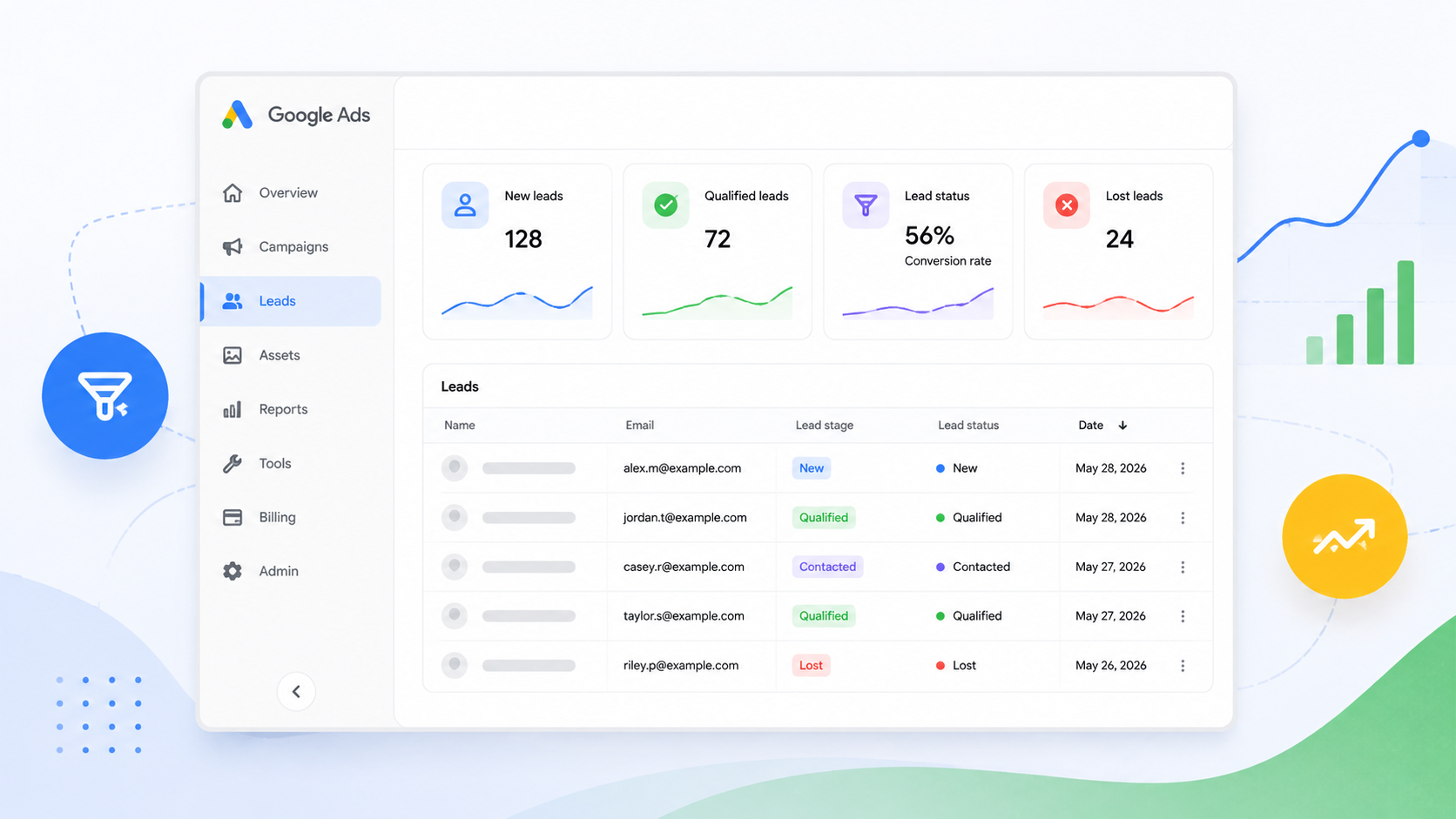
    I’ve just discovered that Google Ads has introduced a built-in lead management dashboard, which is incredibly useful for advertisers like me who are keen on optimizing lead quality and enhancing bidding performance with AI insights.

    Google has integrated lead management directly into Google Ads, which means I can now track, qualify, and manage leads from Google-hosted forms all in one place. This system not only streamlines the process but also feeds higher-quality conversion signals back to Google’s AI bidding technology.

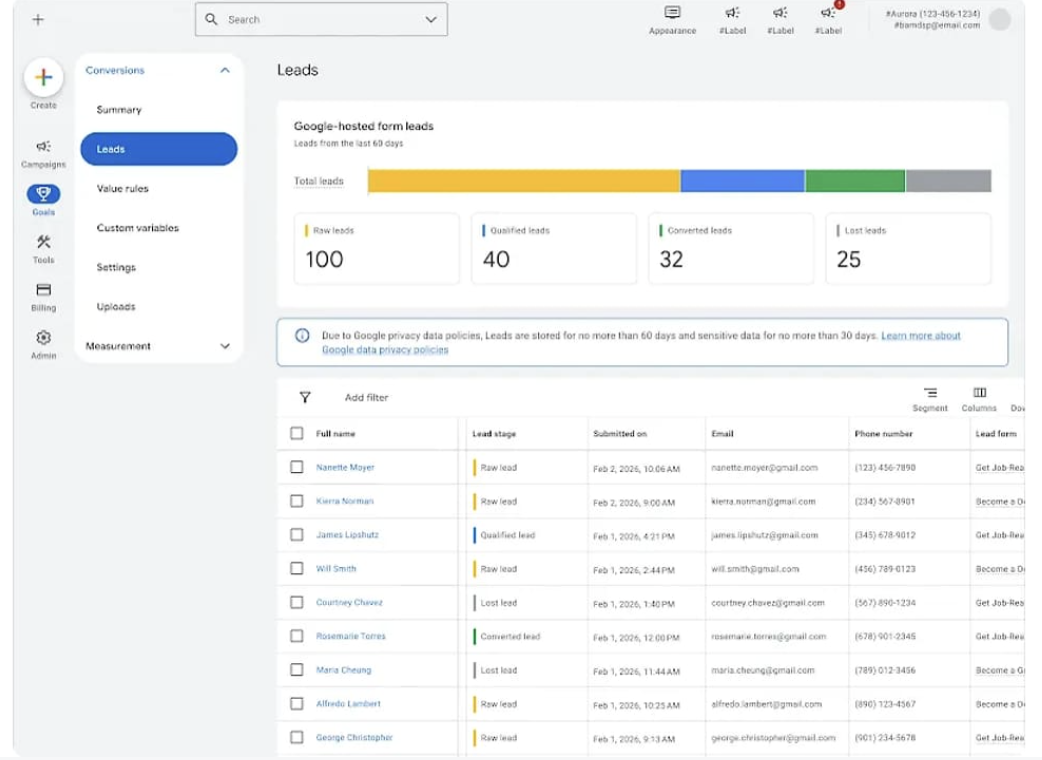
    What’s new. I’ve found that Google Ads now features a dedicated lead management interface designed specifically for organizing and acting on leads generated through Google-hosted forms, making my job as an advertiser so much easier.

    The dashboard gives me a comprehensive view of lead activities, which include:

    • Total leads
    • New leads
    • Qualified leads
    • Lost leads
    • Lead status and progression through the funnel

    From a single interface, I can also review individual lead records, including contact information and lead stage, making it incredibly efficient to keep up with potential customers.

    Why we care. This new feature allows me to sync lead-quality signals directly with Google Ads, which significantly helps Smart Bidding in identifying leads that are more likely to convert into actual customers, rather than merely increasing form submissions.

    The dashboard simplifies my workflows by providing a centralized view of lead status, enabling my marketing and sales teams to prioritize high-value prospects and ultimately boost conversion rates.

    Key benefits:

    ```json
{
  "alt": "Google Ads dashboard showing leads statistics with raw, qualified, and converted leads.",
  "caption": "Dive into your Google Ads dashboard to track the journey from raw to converted leads effortlessly.",
  "description": "This image displays a Google Ads dashboard focused on the 'Leads' section. It shows statistics for raw, qualified, and converted leads over the last 60 days, with a total of 100 raw leads, 40 qualified leads, 32 converted leads, and 25 lost leads. The interface includes additional user information like names, lead stages, submission dates, emails, and phone numbers. This setup aids in effective lead management and tracking. Keywords: Google Ads, leads, dashboard, statistics, lead management."
}
```

    Centralized lead management

    • Manage Google-hosted form leads all in one place.
    • Reduce the risk of losing track of potential customers.

    Better AI optimization

    • Share lead-quality and conversion signals with Google Ads.
    • Help bidding algorithms focus on high-value prospects.

    Faster sales cycles

    • Identify and prioritize qualified leads faster.
    • Move prospects through the funnel more efficiently.

    Simplified workflows

    • Enjoy a lightweight, integrated CRM experience without having to leave Google Ads.

    What to watch. The enhanced reporting features within the dashboard also offer greater insights into sales funnel performance, including numbers of qualified leads and conversion rates.

    As Google continues expanding its AI-powered advertising tools, direct access to lead-quality data is becoming increasingly crucial for advertisers like me who aim to enhance lead volume and improve downstream revenue.


    Inspired by this post on Search Engine Land.


    crushpress.ai community screenshot
  • Unlocking New Controls in Google AI Max for Branded Searches

    Unlocking New Controls in Google AI Max for Branded Searches

    I recently came across a fascinating development in Google Ads that’s really worth discussing. Google seems to be testing new branded search controls within AI Max campaigns, which might just give advertisers a better way to separate branded from non-branded traffic.

    If you’re like me, you’ve probably faced challenges with AI Max campaigns capturing branded searches, especially since their launch. It seems Google might finally be addressing this common concern by offering more control over how these campaigns interact with branded queries.

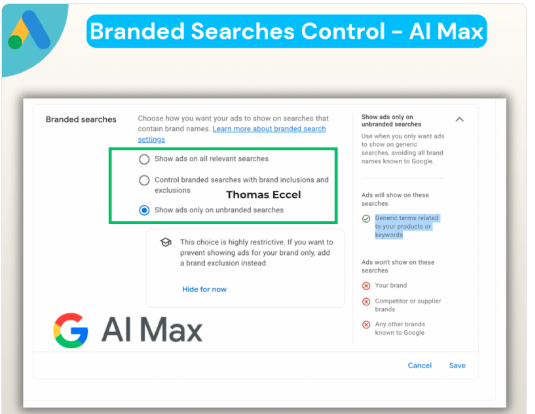
    What’s happening. Some advertisers have reported a fresh ‘Branded Searches’ control option within AI Max campaigns. This feature potentially allows us to dictate how the campaigns handle brand-associated searches.

    The option includes three settings:

    • Show ads on all relevant searches (default strategy)
    • Manage branded searches via inclusions and exclusions
    • Restrict ads to only appear on unbranded searches

    Why we care. For those of us managing campaigns, one major critique of AI Max has been its tendency to capture branded traffic. This traffic is often already covered by dedicated brand campaigns, leading to complications.

    Campaigns that pull in branded traffic can pose several issues:

    • Increased costs for likely conversions
    • Complexities in attribution across different types
    • Diminished clarity on incremental gains
    • Worries of AI Max overshadowing branded efforts
    ```json
{
  "alt": "Screenshot of Branded Searches Control in Google AI Max with options for ad display.",
  "caption": "Explore the new Branded Searches Control in AI Max, allowing you to tailor where your ads appear in branded search results for optimal reach.",
  "description": "The image shows a Branded Searches Control interface in AI Max. Users can choose how their ads appear on searches that include brand names. Options include showing ads on all searches, controlling branded searches with specific inclusions or exclusions, or displaying ads only on unbranded searches. A detailed box explains the restrictive nature of unbranded search ad placement. Google AI Max logo is prominently displayed."
}
```

    The ability to focus on purely unbranded searches, newly introduced, could help direct AI Max towards fresh demands and new prospects.

    Between the lines. Up until this point, preventing AI Max from engaging in branded queries required exclusion lists. A native setting would simplify this and potentially offer more insight into brand intent handling.

    The big picture. Google seems committed to adding more oversight to automated campaigns, reacting to our calls for greater transparency and control over AI.

    If these controls are deployed widely, it could indicate Google’s acknowledgment of our traffic management concerns, as they forge ahead with AI automation.

    What to watch. Whether this is a full release, a selective test, or just an experiment is still unclear. Keep an eye on your AI Max settings and stay alert for updates from Google regarding branded search controls.

    Bottom line. This new control in AI Max might soon empower advertisers to distinctly separate branded and non-branded traffic—something many of us have long requested. But for now, it’s an observation rather than a confirmed rollout.

    First spotted. This development was originally highlighted by Paid Search specialist Thomas Eccel, who shared his discovery on LinkedIn.


    Inspired by this post on Search Engine Land.

    crushpress.ai community screenshot
  • Brad Geddes: Unveiling 20 Years of Paid Search Transformation

    Brad Geddes: Unveiling 20 Years of Paid Search Transformation

    Reflecting on my journey in search marketing, I’ve embraced the evolution while recognizing that human creativity remains at the core of an AI-driven world.

    Embarking on this career back in 1996, I initially dived into SEO and expanded to paid search by 1998. After a period of burnout in a different sector, I plunged into website design and became an at-home affiliate marketer for giants like Amazon and eBay.

    Back in 1998, the launch of Goto.com marked the real start of the pay-per-click era, introducing a groundbreaking model where clicks had monetary value instead of just impressions.

    Google’s dominance wasn’t solidified until 2006-2007, when advertisers were compelled to engage with its complex systems, transitioning us from sporadic advertising efforts to comprehensive digital campaign management.

    The broader industry shifted significantly, evolving from grassroots operations to a corporate environment driven by venture capital, high salaries, and extravagant events.

    Reflecting on the changes, two major milestones transformed paid search: the complexity introduced by Google’s organic algorithm updates and the efficiency brought by automated bidding, freeing time for strategic creativity.

    Discussing past strategies, I’m not nostalgic about Single Keyword Ad Groups (SKAGs), but I do miss features like the original Enhanced Cost-Per-Click and specific geo-targeting tools that once offered greater control.

    As we look ahead, it’s clear that AI can’t wholly take over advertising accounts; human creativity will continue to play a pivotal role in connecting with our inherently illogical nature.

    Reflecting on the past, I made some incorrect predictions, like overestimating the speed of mobile adoption, while correctly assessing that voice search would integrate into regular queries rather than becoming a separate entity.

    If I could advise my younger self, it would be to invest more in Google stock – a simple yet significant insight looking back over two decades.


    Inspired by this post on Search Engine Land.

    crushpress.ai community screenshot
  • Unraveling Google Search Console: A Chat with Vanessa Fox

    Unraveling Google Search Console: A Chat with Vanessa Fox

    From the super early days of Google through using AI today for SEO – we covered a lot in this interview.

    Vanessa Fox was the individual who was instrumental in what we call Google Search Console today. I sat down with Vanessa Fox for a one-on-one interview to discuss the early days of Google, how Search Console came about, and the industry’s evolution to what it is now.

    We spoke about what it was like to work at Google in the early days, how XML Sitemaps turned into Webmaster Tools, which then evolved into Search Console, and what it was like collaborating with Matt Cutts. We also delved into the story of how she sold her Google stock options too early and her journey from Google to writing at Search Engine Land, this site.

    Vanessa shared insights into the early days of SEO misconceptions, her Panda SEO audits and recoveries, and the fascinating ways AI is transforming search and SEO.

    Here is the interview:

    Here is an outline of what we spoke about:

    • The early days of XML sitemaps and the beginnings of Google Search Console.
    • Vanessa’s professional background in UX and technical writing before joining Google.
    • Joining Google: The Kirkland office culture and working with 200 employees worldwide.
    • Collaborating with Matt Cutts and using help center data to educate site owners.
    • A “sad story” about selling Google stock options too early due to a past experience at AOL.
    • Leaving Google in 2007 and joining Search Engine Land to provide a unique technical perspective.
    • Debunking early SEO misconceptions: The reality of the Google spam team vs. “”sneaky”” tactics.
    • Investigating Super Bowl search trends and the disconnect between brands and searchers.
    • Deep dive into the Panda algorithm: Analyzing sitewide quality over individual pages.
    • Thoughts on outdated tactics: Subdomains, parameters, and the rise of “”bad”” SEO advice on TikTok.
    • The impact of AI Overviews (AIO) on publisher traffic and searcher behavior.
    • Is SEO ending? Why AI is an evolution of search, not its demise.
    • Frustrations with Search Console data: The lack of metrics for Featured Snippets and AI Overviews.
    • How Vanessa uses AI (Claude) today for structural tasks while maintaining human expertise.
    • Proudest moment: Institutionalizing a culture at Google that listens to and supports site owners.
    • The long-term impact of Search Engine Land and the Search Engine Roundtable on the industry.”

    You can learn more about Vanessa Fox on her site over here.


    Inspired by this post on Search Engine Land.

    crushpress.ai community screenshot