Category: Generative Engine Optimization (GEO)

  • How to Measure Brand Visibility in AI-Mediated Journeys

    How to Measure Brand Visibility in AI-Mediated Journeys

    You may already be appearing inside AI answers while your organic dashboard says little has changed. Or AI bots may be crawling your site without your brand ever making the shortlist. If you count only clicks, both situations become an attribution mystery.

    You need to separate machine access, brand selection, human handoff, and business outcome. That gives you a measurement system that can locate the weak point in an AI-mediated journey and tell you what to test next.

    Decide what brand visibility means before scoring it

    A visit is no longer the only useful sign that a brand won. Depending on how much of the journey a person delegates, a win can be a click, an AI recommendation, or an action completed by an agent. A single traffic metric cannot represent all three.

    Start by classifying the journey into search, assistive, and agentic modes. These modes can coexist within the same purchase. Someone might discover a category through search, ask an assistant to compare the options, and then let an agent find a qualifying seller. Your measurement should follow that movement instead of assigning the whole journey to its last observable click.

    Journey modeWhat visibility looks likePrimary evidenceCommon misreading
    SearchYour page or brand is presented as an option the user can inspect.Search impressions, result position, clicks, landing sessions, and subsequent actions.Treating a high position as proof that the result influenced a decision.
    AssistiveAn AI answer names, explains, compares, cites, or recommends your brand.Observed mentions, recommendation role, cited URLs, claim accuracy, and answer-engine referrals.Counting an incidental mention as a recommendation.
    AgenticAn agent recruits your brand as an eligible option, selects it, or completes an action through it.Selection records where available, agent referrals, API or commerce events, and confirmed business outcomes.Assuming a bot request means the agent selected your brand.

    Define a qualifying visibility event before collecting data. At minimum, the brand must be correctly identified and relevant to the prompt. Record whether it was merely named, used as supporting evidence, included in a shortlist, explicitly recommended, or selected for action. Those roles have different commercial meaning.

    Set an eligibility rule for the denominator as well. A prompt belongs in your visibility rate only if your brand could reasonably satisfy the stated need, market, audience, and constraints. Including irrelevant prompts depresses the score. Excluding difficult but commercially important prompts inflates it.

    Measure each layer from machine access to business outcome

    Four connected transparent chambers depict machine access, AI selection, human handoff, and a business outcome, with observation points between them.

    AI visibility is a sequence, not an isolated mention. A useful diagnostic model follows ten gates: discovered, selected, crawled, rendered, indexed, annotated, recruited, grounded, displayed, and won. The early gates make your information available to machines. The later gates determine whether the system can understand, use, present, and act on it.

    You will not observe every gate directly. Server logs can show that a crawler requested a URL, but they cannot prove that the page was indexed, understood correctly, or used in a response. A citation can show that a URL supported an answer, but it does not reveal every internal retrieval or ranking decision. Label each measurement as observed or inferred so your dashboard does not manufacture certainty.

    Measurement layerQuestion it answersUseful measuresWhat it does not prove
    Machine accessCan qualifying bots reach and process the pages that matter?Priority URLs requested, response status, rendered content availability, repeat access, and crawler identity confidence.That the information was indexed, trusted, or selected.
    Entity understandingDoes the answer associate your brand with the correct category, products, locations, capabilities, and constraints?Entity accuracy, attribute accuracy, category association, and contradiction frequency.That the brand will be recruited for a particular decision.
    Recruitment and groundingDoes the system use your brand or content when constructing an answer?Qualifying mention rate, citation rate, cited-page coverage, claim usage, and competitor co-mentions.That the user saw a meaningful recommendation.
    PresentationHow is the brand shown to the user?Recommendation rate, shortlist inclusion, order when a genuine ranking exists, description, caveats, and next action offered.That the user followed the recommendation.
    Handoff and outcomeDid the journey reach your property or produce a business event?Answer-engine referrals, engaged sessions, leads, account creation, purchases, bookings, and other confirmed outcomes.That one observed AI answer caused the outcome.

    Keep these layers separate before creating any composite score. A blended score can rise because crawler activity increased even while recommendation visibility fell. That looks like progress until you inspect the components.

    Use a small metric dictionary so everyone calculates the same thing:

    • Qualifying mention rate: eligible prompt runs containing a valid brand mention divided by all eligible prompt runs.
    • Recommendation rate: eligible prompt runs in which the brand is positively recruited as an option divided by all eligible prompt runs.
    • Citation rate: eligible prompt runs citing an owned or controlled page divided by all eligible prompt runs. Report third-party citations separately.
    • Claim accuracy rate: checked brand claims that are materially correct divided by all checked brand claims.
    • Priority-page bot coverage: priority URLs receiving a qualifying bot request divided by all URLs in the defined priority set.
    • AI referral engagement rate: qualifying answer-engine sessions that complete your chosen engagement event divided by all qualifying answer-engine sessions.
    • AI-attributed outcome rate: confirmed outcomes with an observable AI referral or another declared attribution signal divided by the applicable set of outcomes.

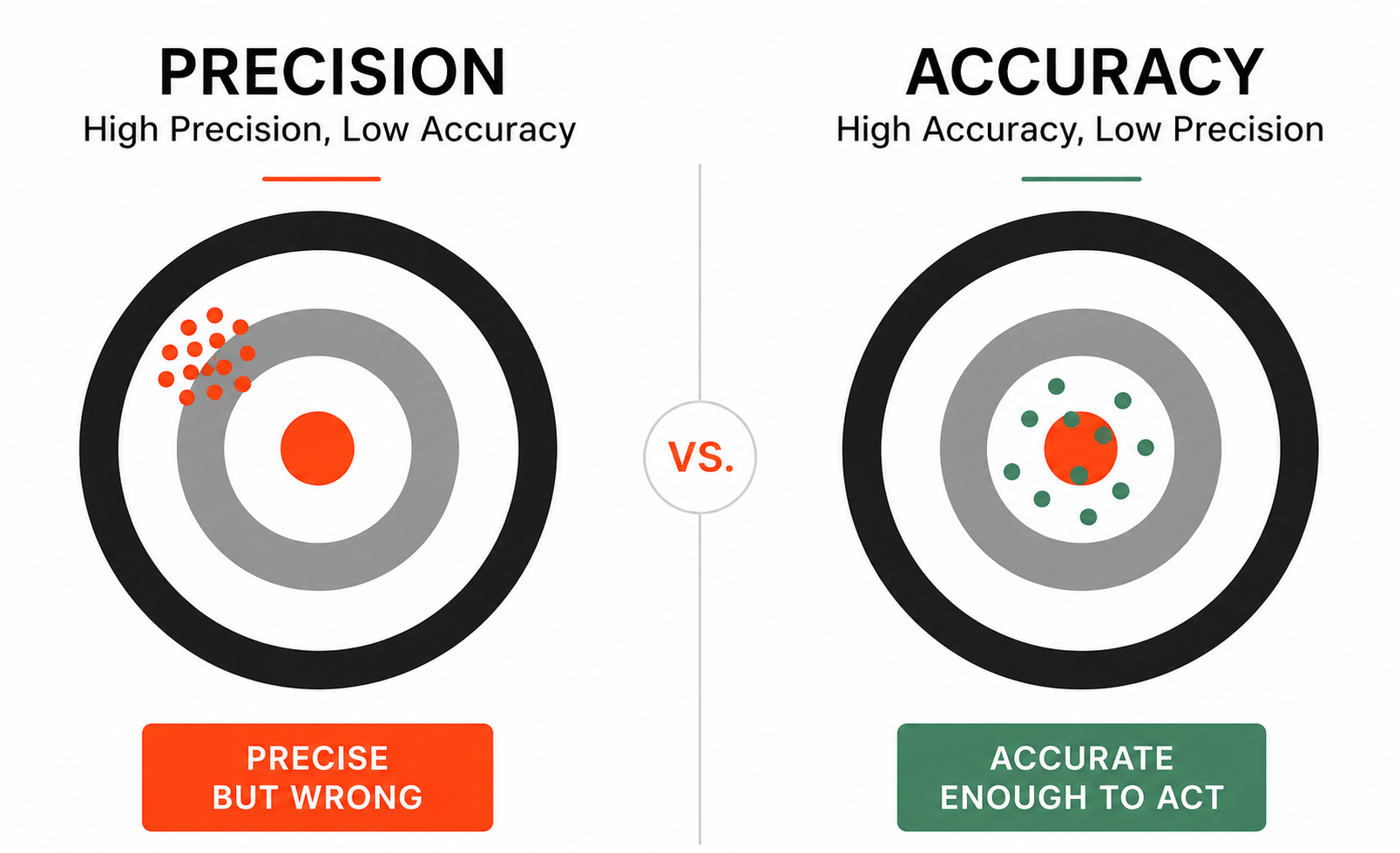
    Always display the numerator and denominator next to each rate. A clean percentage built from a tiny or changing prompt set is less informative than a modest rate calculated from a stable, representative panel.

    Build a prompt panel around real decisions

    A prompt tracker is useful only when its prompts resemble the decisions your audience delegates. A list of branded questions will tell you whether an engine can repeat known facts about you. It will not tell you whether the brand is discoverable when the user has not chosen it yet.

    Build the panel from intent and constraints:

    1. Map the decisions. Include discovery, comparison, validation, troubleshooting, and action-oriented needs. Connect each need to a product line, audience, market, or journey stage.
    2. Add realistic constraints. Use the factors that can change eligibility, such as use case, compatibility, location, availability, delivery requirement, organizational size, or risk tolerance. Do not add a constraint merely to make the prompt longer.
    3. Balance non-branded and branded prompts. Non-branded prompts measure discovery and recruitment. Branded prompts measure entity understanding, accuracy, and competitive positioning.
    4. Define matching rules. List the canonical brand name, legitimate variants, product names, and exclusions that could create false positives. Decide how acquisitions, resellers, and similarly named entities will be handled before scoring begins.
    5. Fix the test conditions. Preserve the prompt wording, engine, model label, account state, location, language, and personalization state when those variables are available. Record any condition you cannot control.
    6. Review the full answer. A string match cannot tell whether the brand was recommended, dismissed, confused with another entity, or mentioned only inside a citation title.

    Useful prompt templates include:

    • What are suitable ways to solve [problem] for [audience or situation]?
    • Which providers meet [requirement] and [constraint]?
    • Compare options for [use case], especially [decision factor].
    • Is [brand or product] suitable for [specific scenario]?
    • Find an option for [need] that can satisfy [action constraint].

    Do not average every prompt into one headline number. Segment results by intent, journey mode, market, product, and engine. A brand can be highly visible in informational answers yet absent when the prompt moves to comparison or action. That boundary is where the commercial problem usually becomes diagnosable.

    For every run, capture the prompt ID, intent cluster, test conditions, brand presence, mention role, recommendation strength, cited domains, cited URLs, claims made, claim accuracy, competitors named, caveats, and proposed next action. Preserve the answer itself when your governance rules permit it. Otherwise, retain a structured review and enough metadata to reproduce the test.

    Model outputs can vary with wording, context, model changes, and personalization. Treat an individual answer as an observation, not a stable market fact. Repeated runs and a fixed protocol help you distinguish a persistent visibility pattern from an isolated output. When an engine or model changes, mark the break in the time series instead of presenting the new results as a clean continuation.

    Join prompt observations, bot visits, referrals, and outcomes

    Four colored streams of prompt observations, bot activity, referral paths, and outcome signals converge in a transparent measurement hub.

    No single analytics system sees the entire AI-mediated journey. Prompt monitoring observes the answer. Server logs observe requests to your site. Web analytics observes some human handoffs. Product, commerce, and customer systems observe downstream outcomes. Your job is to connect those views without pretending they form a deterministic user-level trail.

    Some agent analytics workflows now make bot visits and human referrals available as separate inputs. Keep that separation in your own model. Bot activity is evidence of machine access. Human referral activity is evidence of a visible handoff. Neither is a substitute for the other.

    Evidence streamMinimum fields to retainBest useImportant limitation
    Prompt observationsTimestamp, engine and model label, prompt ID, intent, market, mention role, citation, recommendation, claims, and competitors.Measuring whether and how the brand appears in AI responses.The observed answer cannot reveal every internal retrieval step or every answer shown to other users.
    Server and edge logsTimestamp, requested URL, response status, user agent, verified bot classification where possible, and rendering outcome.Diagnosing whether relevant machines can access priority content.User-agent labels can be spoofed, and a request does not establish indexing or use.
    Referral analyticsReferral class, referring domain when exposed, landing URL, session ID, campaign parameters, and engagement events.Measuring observable human handoffs from answer engines.Not every app or handoff exposes a usable referrer, so measured referrals are not the whole audience.
    On-site behaviorLanding page, content path, engagement event, lead event, account event, and transaction event.Finding friction after an AI-mediated arrival.On-site behavior alone does not establish which answer or prompt influenced the visit.
    Business outcomesOutcome type, timestamp, product or service, market, value where appropriate, and declared acquisition signal.Connecting visibility work to decisions the organization values.Self-reported and last-touch signals are useful but incomplete attribution evidence.

    Join these streams at an aggregate level using the safest shared dimensions: time period, landing URL, product, market, intent cluster, and engine class. For example, you can compare a change in citation coverage for a product cluster with bot access to its priority pages, referrals landing on those pages, and relevant conversions. That creates a defensible sequence of evidence without claiming that an anonymous conversion came from a particular monitored prompt.

    Use explicit evidence labels in every analysis:

    • Observed: a monitored answer named the brand, a known bot requested a page, a referrer identified an answer engine, or a tracked session completed an event.
    • Inferred: a page probably contributed to an answer, a referral may have followed a particular prompt, or an AI mention may have influenced a later direct visit.
    • Unknown: the platform did not expose enough information to connect the events responsibly.

    This distinction matters most when direct traffic or branded search rises after AI visibility improves. That movement may support an influence hypothesis, but it does not identify the original answer or prove causation. A post-conversion question about how the person found you can add directional evidence, provided you keep self-reported responses separate from observed referrals.

    Use the dashboard to choose the next intervention

    Your dashboard should help someone decide what to change. Organize it by the measurement layers rather than by whichever tool supplied the data:

    • Access: priority-page bot coverage, response failures, blocked resources, and rendering problems.
    • Understanding: entity confusion, missing attributes, inaccurate claims, and contradictory descriptions.
    • Selection: qualifying mention rate, recommendation rate, citation rate, cited-page distribution, and competitor overlap.
    • Handoff: answer-engine referrals, landing-page distribution, engaged sessions, and return behavior.
    • Outcome: leads, registrations, purchases, bookings, and other confirmed business events by relevant cohort.

    Read combinations of signals rather than reacting to one chart:

    Observed patternLikely failure areaNext test
    Priority pages receive qualifying bot visits, but the brand is rarely mentioned.Entity understanding, recruitment, or grounding rather than basic access.Clarify who the brand serves, what it offers, where it operates, and the constraints it satisfies. Align structured data with visible page claims, then rerun the same prompt cluster.
    The brand is mentioned, but descriptions are inaccurate or inconsistent.Entity reconciliation and claim clarity.Consolidate canonical facts, remove contradictory copy, make relationships between the organization and its products explicit, and track the disputed claims individually.
    The brand is mentioned but seldom recommended for high-intent prompts.Weak evidence for the decision criteria used in comparison.Add verifiable information about fit, limitations, availability, compatibility, or policies on the most relevant pages. Do not present unsupported superiority claims.
    Owned pages are cited, but referrals remain low.The answer may satisfy the need without a click, or the brand may be functioning as evidence rather than the chosen option.Inspect the mention role and next action before treating this as failure. Strengthen the path to a useful next step where the user genuinely needs one.
    Answer-engine referrals rise, but conversions do not.Landing-page intent mismatch or on-site friction.Compare the answer’s promise and constraints with the landing page. Preserve context, answer the next likely question, and test the relevant conversion path.
    Conversions rise without identifiable AI referrals.An attribution gap rather than confirmed absence of AI influence.Improve referral classification, retain landing context, add a carefully worded self-report field, and analyze direct and branded-search cohorts without relabeling them as AI traffic.

    Run improvement work as a controlled diagnostic. Choose one intent cluster and one suspected failure layer. Preserve the prompt panel and test conditions. Record a baseline, make the narrowest relevant change, and then observe the nearest layer as well as downstream effects. If you changed entity and product facts, claim accuracy and recruitment should move before you expect a clean conversion effect.

    Possible interventions include correcting crawl barriers, consolidating entity information, adding decision-critical details, improving citation-worthy evidence, aligning JSON-LD with visible content, or repairing an AI referral landing path. Structured data can make explicit facts easier to interpret, but it does not guarantee retrieval, citation, recommendation, or display. Measure the relevant output after implementation.

    Record platform and model changes beside your experiments. If the engine changes during the test, you have a confound, not a clean before-and-after result. Keep the observation, mark the limitation, and repeat under the new condition rather than forcing the numbers into an unsupported success claim.

    Key takeaways

    • AI visibility has distinct access, understanding, selection, presentation, handoff, and outcome layers.
    • A brand mention, an owned citation, a recommendation, a referral, and a completed action are separate events.
    • A stable, decision-based prompt panel is the foundation of comparable visibility measurement.
    • Bot visits show machine access, not brand preference or human demand.
    • Aggregate evidence can support a journey hypothesis, but anonymous events should not be turned into deterministic user-level attribution.
    • The best next optimization is the one aimed at the first layer where the evidence weakens.

    Start with one commercially important journey and map its evidence from prompt to outcome. You do not need perfect attribution before acting. You need a clear boundary between what you observed, what you inferred, and which failure point your next change is designed to address.

    References

  • How to Build AI Search Visibility Through Brand Recognition

    How to Build AI Search Visibility Through Brand Recognition

    Your pages rank, your traffic reports look respectable, yet your brand disappears when a prospect asks an AI assistant for options. That gap is not just a reporting curiosity. Your content may be discoverable while your brand remains absent from the answer that shapes the decision.

    Fixing that gap starts by changing what you measure. You need to know whether AI systems recognize your brand in the right unbranded conversations, describe it accurately, and do so often enough that one lucky mention cannot fool you.

    Recognition is the outcome; rankings are one input

    Traditional rank tracking asks whether a page earned a particular position for a query. AI visibility adds a harder question: when a system assembles an answer, does it connect your brand with the category, problem, product attribute, or recommendation context that matters?

    That distinction matters because brand recognition increasingly matters alongside conventional rankings. A strong organic position can help people and machines discover your information, but it does not guarantee that an AI response will name your brand, frame it correctly, or use it as a preferred example.

    Recognition is more specific than general awareness. For AI search measurement, treat it as the repeated and accurate association of your brand with a relevant topic or decision. A mention is useful only when the surrounding answer helps the user understand why your brand belongs there.

    • Topical fit: The brand appears for a problem or category it genuinely serves.
    • Accurate framing: The response describes what the brand does without confusing its audience, offer, or positioning.
    • Decision relevance: The mention appears where a user is discovering, evaluating, or selecting an option, not in an unrelated aside.
    • Credible support: The response connects the claim to a useful citation or supporting context when the interface provides one.
    • Repeatability: The result survives repeated runs instead of appearing in one favorable screenshot.

    This is why a mention count by itself is weak. A brand can be named frequently but described as the wrong type of company. It can appear in a long list without any explanation. It can also be cited as an information source while a competitor receives the actual recommendation. Record those outcomes separately.

    Rankings still matter, but their role changes. They are part of the evidence and discovery layer, not the final visibility score. The practical endpoint is whether your brand becomes a clear, trusted part of the answer, especially when users can receive an answer without visiting a result page.

    Build a prompt panel that represents real decisions

    A research team arranges illustrated scenario cards around a compass on a large table.

    You cannot measure AI visibility with whichever prompt happens to come to mind during a meeting. A useful baseline needs a fixed prompt panel: a time-stamped collection of exact questions that represent the situations in which you want to be recognized.

    Start with unbranded prompts. If the prompt already contains your name, the resulting mention says little about discovery. Keep branded prompts in a separate diagnostic set for checking factual accuracy, positioning, and direct brand understanding.

    Organize the unbranded panel into three intent buckets:

    • Category discovery: Questions asking which tools, companies, services, or approaches exist for a defined need.
    • Requirement-led research: Questions built around a feature, constraint, audience, use case, or product specification.
    • Evaluation and selection: Questions asking for suitable options, trade-offs, or criteria before a decision.

    A practical coverage panel can contain 25 exact prompts in each bucket, producing 75 queries. That is a testing design, not a universal minimum. If 75 prompts are too costly to repeat, preserve the three-bucket balance and select a smaller experimental cohort from the full panel. For a focused change, a cohort of 5-10 target prompts run daily across seven consecutive days gives you a more defensible baseline than a single session.

    Do not rewrite prompts between the baseline and measurement periods. A change from a broad category question to a product-specific question is not a harmless variation; it changes what the system is being asked to retrieve and compare. Save alternate phrasings as separate prompt records.

    For every run, record the exact prompt, model, displayed model version when available, date, environment, login state, location or locale, and response. Use a consistent testing environment. A logged-out browser with a cleared cache is one option; an API or synthetic testing platform can provide tighter control where available. The aim is not to create a perfectly sterile laboratory. It is to keep avoidable differences from becoming explanations for the result.

    Then label each response using the same fields:

    SignalWhat to recordWhat it tells you
    InclusionWhether the brand appears in the responseHow often the model associates the brand with the prompt context
    Position in responseWhere the first substantive mention appearsWhether the brand is central to the answer or peripheral
    FramingRecommended, neutral, compared, cautioned against, or merely citedWhether visibility is helping the intended positioning
    AccuracyCorrect or incorrect category, audience, capabilities, and limitationsWhether the model recognizes the right entity and facts
    CitationThe linked or named supporting page, when citations are exposedWhich evidence appears to support the mention

    Calculate inclusion rate as the number of eligible runs that mention the brand divided by the total number of eligible runs. Keep the raw labels as well as the percentage. A single combined score can conceal an important failure, such as higher inclusion paired with inaccurate framing.

    Break results out by model and prompt bucket. An average across every system and intent can make a brand look moderately visible when it is actually strong in category discovery, absent during evaluation, and misrepresented by one model. That is not one problem; it is three different problems requiring different changes.

    Strengthen the signals that make your brand understandable

    Linked pages, profiles, books, seals, and network nodes converge to form one clear blue geometric object.

    AI recognition is not created by repeating a brand name more often. It grows when the web contains clear, consistent evidence about what the brand is, which topics it belongs to, what it offers, and why it is relevant in a particular context.

    Make the visible content answer a precise question

    Generic claims leave little for a system to connect with a detailed prompt. Replace vague category language with facts that resolve a real requirement: the product type, intended user, model, offer, relevant specifications, supported use case, and meaningful constraints. The goal is not maximal detail on every page. It is enough detail for the page to answer the prompt it is meant to support.

    For example, if your prompt panel contains requirement-led questions and the relevant page never states those requirements explicitly, that is the first gap to fix. Add one self-contained paragraph that connects the brand, product, and requirement in plain language. Do not simultaneously rewrite the introduction, change the page template, and add schema if you want to know whether that paragraph mattered.

    Keep core entity facts consistent across your own pages. The canonical brand name, category, audience, product naming, and relationship between the company and its offers should not shift according to which team wrote the copy. Consistency reduces ambiguity; mechanical repetition does not.

    Use structured data to clarify, not to invent

    Structured data can make relationships such as brand, model, and offer explicit in a machine-readable layer. Its effect on AI answers should still be tested rather than assumed. Schema is not a guarantee of selection, and it cannot create authority or factual support that the visible page lacks.

    Markup should describe information that users can already verify on the page. If a page has a visible question-and-answer section, adding the corresponding FAQ markup creates a clean experiment: the visible answers stay fixed while the explicit structured-data signal changes. Likewise, brand, model, or offer properties can be added without rewriting the HTML copy when you want to isolate the machine-readable layer.

    Do not add unsupported claims to JSON-LD because you want an AI system to repeat them. At best, the test becomes uninterpretable because the markup and page disagree. At worst, you make inaccurate information easier to reproduce. Treat structured data as a precise description of the page, not a hidden promotional channel.

    Build recognition beyond your own domain

    Your website can define the entity, but self-description is only one part of recognition. Brands become easier to identify when they appear consistently in meaningful external contexts and are cited for topics they genuinely cover. That makes public relations, content distribution, industry participation, and reputation work part of AI search strategy rather than separate activities.

    Audit external mentions for context, not just volume. A mention is more useful when it associates the right brand with the right category and a concrete area of expertise. Repeated mentions that use obsolete product names, vague descriptors, or the wrong category can reinforce confusion instead of authority.

    For each important prompt cluster, create an evidence map with four lines:

    <!– wp:list {
  • How to Measure AI Search Visibility and Make It Actionable

    How to Measure AI Search Visibility and Make It Actionable

    You can have a healthy SEO dashboard and still be nearly invisible when a buyer asks an AI assistant what to choose. The difficult part isn’t collecting another visibility score. It’s knowing whether a change reflects stronger retrieval, a different mix of prompts, or noise in the answers you sampled.

    A useful measurement system starts with a repeatable prompt panel, distinguishes mentions from citations, checks whether your brand is represented accurately, and connects that evidence to business outcomes. Here is how to build one without turning a handful of AI responses into false precision.

    Measure what happens inside the answer, not just after the click

    Traditional search measurement follows a familiar sequence: query, ranking, impression, click, session, conversion. Generative search compresses much of that journey into an answer. A user can discover your brand, compare it with alternatives, absorb a claim about it, and make a decision without visiting your site.

    That makes traffic an incomplete visibility measure. Some studies cited in current GEO coverage put traditional-result clicks at only 8% when AI-generated summaries are present. Treat that figure as a warning about measurement gaps, not as a universal click-through benchmark for your site. The practical point is that an off-site answer can influence demand even when analytics records no session.

    Measure AI search visibility across four layers. Presence tells you whether the brand appears. Use tells you whether an owned page is retrieved or cited. Representation tells you whether the answer describes the brand accurately and in the right context. Impact tells you whether that exposure is associated with qualified visits, branded demand, leads, sales, or another business outcome.

    These layers prevent a common reporting error. A brand mention is not automatically an owned-content citation. A citation is not proof that the answer framed the brand correctly. Visibility is not proof of commercial influence. Each is useful, but each answers a different question.

    Key takeaways

    • Use a stable set of prompts so one reporting period can be compared with another.
    • Keep mentions, citations, observable retrieval, entity accuracy, sentiment, and conversions as separate measures.
    • Report results by platform, topic, intent, and prompt cohort before calculating an overall score.
    • Save the underlying answer and its citations. A percentage without evidence cannot be audited.
    • Use visibility metrics to choose an action, then judge that action by the specific metric it was intended to change.

    Build a prompt panel you can rerun without moving the goalposts

    A controlled grid of abstract prompt tiles feeds into parallel answer chambers, with one displaced tile showing a changed test condition.

    Your prompt panel is the measurement instrument. If the prompts change whenever a campaign changes, the resulting trend line cannot tell you whether visibility improved or the test simply became easier.

    Start with topics and decisions that matter

    List the topics your brand should credibly be associated with, then map the questions a real buyer asks while learning, solving, comparing, choosing, and validating. This creates a panel that covers informational discovery as well as decision-stage visibility.

    • Learn: What is the category, process, or concept?
    • Solve: How should someone handle a defined problem or constraint?
    • Compare: What are the meaningful differences between available approaches?
    • Choose: Which options fit a particular use case, audience, budget, or requirement?
    • Validate: Is a named brand suitable, credible, compatible, or known for the relevant capability?

    Include branded and unbranded prompts, but don’t blend their results. An unbranded prompt tests discovery and competitive consideration. A branded prompt tests entity recognition, factual accuracy, and reputation. A dashboard that combines them can look strong simply because the model answers direct questions about a brand that the user already named.

    Apply audience, industry, location, or product qualifiers only when they change the decision. Keep them in dedicated cohorts. Otherwise, an increasingly narrow prompt may manufacture visibility that does not exist for the broader market question.

    Create a prompt registry before collecting answers

    Give every prompt a permanent record. At minimum, store its ID, exact wording, topic, intent, audience qualifier, branded or unbranded status, platform and mode, relevant competitor set, target page, and the brand facts you expect an accurate answer to preserve.

    Freeze the wording used for your baseline. If you improve a prompt later, create a new version instead of overwriting the old one. Keep retired prompts in the registry so historical rates retain their original denominator. This is less convenient than editing a shared list in place, but it prevents an invisible change in the test from masquerading as an improvement in performance.

    Use a consistent collection protocol

    1. Run the exact registered prompt in the intended platform and mode, such as an answer with web search enabled rather than a model-only response.
    2. Record the platform, mode, timestamp, prompt version, full response, visible citations, cited URLs, and any named competitors.
    3. Score the answer with a written rubric. Preserve the raw response so another reviewer can check the decision.
    4. Repeat the panel on a fixed cadence. If resources permit, run prompts more than once so a single response is not mistaken for a stable pattern.
    5. Log failed captures, blocked responses, and unavailable features separately. Do not score a technical failure as brand absence.

    Keep platform results separate. Google AI Overviews, ChatGPT search, and other answer systems are different surfaces with different retrieval and citation behavior. You can create a portfolio view later, but first calculate each platform’s rate against its own eligible observations.

    If you do publish an aggregate, state its weighting. An unweighted average gives every prompt-platform pair the same influence. A business-weighted score gives priority cohorts more influence. Neither is inherently correct; an unexplained blend is the problem.

    Use a metric stack instead of one opaque visibility score

    A practical GEO measurement stack separates eight signals across presence, representation, retrieval, competition, and impact. The definitions below turn those ideas into auditable calculations. They are operational definitions, not universal standards, so document them and resist changing them midstream.

    MetricOperational definitionQuestion it answers
    Answer inclusion rateEligible answers containing a qualifying brand mention or traceable use of owned content, divided by all eligible answers in the cohort.Does the brand enter the answer at all?
    AI citation frequencyEligible answers containing a visible citation connected to the brand, divided by all eligible answers. Report any-brand citation and owned-domain citation separately.Is the answer visibly supported by material associated with the brand, and does it cite the brand’s own site?
    Share of model voiceThe brand’s unique inclusions divided by unique inclusions for the entire predefined competitor set. Count a brand once per answer so repetition does not inflate share.How much of the observable category conversation does the brand occupy?
    Entity recognition accuracyBrand-discussing answers that preserve the required facts divided by all answers that discuss the brand.Does the system understand who the brand is, what it offers, and how its entities relate?
    Sentiment and framingCounts of favorable, neutral, critical, or mixed descriptions, paired with issue codes and the exact claim being evaluated.How is the brand characterized before the user reaches its site?
    Prompt coveragePriority prompt cells with at least one qualifying inclusion divided by all eligible priority prompt cells.Across how much of the intended buyer journey is the brand visible?
    Observable retrieval successRuns in which a relevant owned page is visibly retrieved or cited, divided by runs where that page is an eligible answer source.Can the system access and use the content you expected it to use?
    Conversion influenceQualified visits, conversions, lead quality, revenue, branded demand, or other outcomes associated with AI referrals and visibility changes.Is AI visibility connected to business value?

    The denominator matters as much as the numerator. Show both on every metric card. A 50% inclusion rate based on two eligible answers carries very different weight from the same rate across a broad, repeated panel.

    Keep citation frequency and retrieval success distinct. A brand can be mentioned because a third-party page was retrieved. An owned page can be cited without the brand becoming a recommended option. A model may also name the brand without exposing any source. Consumer-facing outputs rarely reveal every internal retrieval step, so call the measure observable retrieval rather than claiming access to hidden model behavior.

    Share of model voice also needs a locked competitor set. Adding weak competitors lowers everyone’s apparent share; removing a dominant competitor raises it. Version the set just as you version prompts, and show absolute inclusion alongside share. If absolute visibility holds steady while share falls, competitors may be gaining rather than your brand disappearing.

    For entity accuracy, write the answer key before scoring responses. Include only facts the brand can substantiate, such as its official name, category, product relationships, supported markets, or current positioning. Record each error type separately. A single accuracy percentage will not tell your content team whether the problem is an outdated name, a category mismatch, a confused product relationship, or a claim that is too broad.

    Sentiment needs the same discipline. A neutral answer that omits the brand’s relevant capability is different from a critical answer containing a factual error. Save the exact sentence, its context, the issue code, and the affected prompt. Automated labels can help sort a large collection, but consequential or ambiguous cases still need human review.

    Read metric combinations as a diagnostic system

    No metric tells you what to change by itself. The useful signal comes from combinations. Start with the smallest cohort where the problem appears, then diagnose the layer most likely to be responsible.

    Low inclusion plus low observable retrieval

    Begin with access and extractability. Check whether the intended page can be crawled, whether the primary answer is available in parseable text, whether important information is current, and whether structured data accurately describes the visible content and entity relationships. Crawlability, schema use, freshness, and parsing quality all belong in a retrieval-success investigation.

    Do not add schema merely to produce more markup. Structured data can clarify supported facts; it cannot make a thin, contradictory, or inaccessible page authoritative. Validate the markup, align it with what users can see, and retest the affected prompt cohort after the page can be revisited.

    Inclusion without owned citations

    The system recognizes the category connection, but your site is not supplying the visible evidence. Inspect which domains are cited instead and what those pages make easy to extract. Then improve the relevant owned page with a direct answer, clear definitions, explicit comparison dimensions, supported claims, and enough surrounding context for a passage to stand on its own.

    Do not treat matching wording as proof that the model used your page. Unless the interface exposes a citation or retrieval record, hidden sourcing remains unknown. Score what you can observe and use citation gains as the validation target for this change.

    Strong visibility with weak entity accuracy

    This is a representation problem, not an awareness problem. Compare the wrong claim with the corresponding signals on your site, structured data, product pages, and corroborating profiles. Standardize names and relationships, remove obsolete descriptions, and make the canonical explanation explicit. Retest the prompts that produced the error rather than waiting for the global score to move.

    Informational coverage without decision-stage visibility

    The brand may be recognized as an educator but absent from the consideration set. Examine compare, choose, and validate prompts. If the cited pages answer selection questions that your pages avoid, create or improve content around fit, limitations, use cases, evaluation criteria, and meaningful alternatives. The goal is not to declare yourself the best. It is to supply the facts an answer system needs to explain when the offering is or is not a fit.

    Visibility gains without measurable business impact

    First check intent. More citations on broad educational prompts may be valuable without creating immediate demand. Next check whether the cited or visited page offers a sensible next step for that query. Then inspect referral classification, landing-page engagement, conversion quality, direct traffic, and branded search movement.

    Do not force a revenue claim from a coincident trend. Off-site AI interactions are often not connected to an identifiable user journey. Call the result influence unless you have instrumentation that supports stronger attribution.

    Change one measurement layer at a time

    Turn each diagnosis into a recorded experiment. State the affected cohort, observed gap, proposed change, page or entity being changed, metric expected to move, business guardrail, and next review point. If you rewrite the prompts, replace the target pages, and change the scoring rubric together, you will not know which change produced the new result.

    Keep a control cohort of unchanged prompts when practical. It gives you context when visibility moves across the platform rather than only on the pages you changed.

    Report evidence, decisions, and business influence in one workflow

    Abstract answer signals pass through a diagnostic prism and flow into content, source, customer-journey, and business-outcome elements.

    A dashboard should shorten the distance between an observed gap and the person who can address it. Clutch, for example, places Conductor-powered visibility analysis inside its AI Visibility Dashboard. The useful principle is workflow integration: a report creates more value when operators can move from the trend to the affected prompt, answer, citation, topic, and page.

    Give each audience the view it needs

    • Leadership view: priority-topic inclusion, share of model voice, entity accuracy, major reputation issues, qualified AI traffic, and conversion influence.
    • Operator view: platform, topic, intent, prompt, target page, cited domain, competitor, issue code, and experiment status.
    • Evidence view: exact prompt, full response, visible links, scoring decision, timestamp, reviewer, and prompt version.

    Every summary card should show the current value, comparison baseline, numerator, denominator, included cohort, and last collection date. Avoid a global visibility score that cannot be traced to those components. It may look tidy, but it cannot tell a content, technical SEO, brand, or analytics team what to do next.

    Keep the collection cadence and the decision cadence separate

    Collect on a consistent schedule that your team can sustain. Review urgent factual errors when they appear, but make strategic decisions only after you have enough comparable observations to distinguish a pattern from one answer. Annotate changes to prompts, pages, structured data, competitor sets, platform modes, and scoring rules directly on the timeline.

    When a platform introduces a materially different mode or answer experience, create a new cohort. Do not splice it into the old series as if the measurement environment stayed constant.

    Triangulate AI visibility with analytics and search data

    No single product captures the complete path. Combine controlled prompt testing with analytics, server or referral evidence where available, Search Console, traditional SEO tools, technical audits, and business data. This mixed approach reflects the reality that GEO measurement currently requires multiple tools and methods.

    In GA4, isolate known AI-platform referrals and compare their landing pages, engagement, conversion rate, conversion value, and lead quality with relevant baselines. Keep the referral rules documented because platforms and referrer behavior can change. Review direct and branded-search demand alongside those sessions, but present the relationship as supporting evidence rather than proof that every change came from AI exposure.

    Search Console still helps you see traditional query demand, page performance, and technical conditions around the topics in your prompt panel. It will not expose every AI interaction, but it can reveal whether a page has a broader indexing, relevance, or demand problem that also limits its usefulness to generative systems.

    Evaluate tools by the decisions they support

    Before buying an AI visibility platform, ask whether it supports the exact environments you need to measure and whether you can audit its results. A useful evaluation checklist includes:

    • Named platforms and modes rather than a generic claim of model coverage.
    • Exact prompt storage, prompt versioning, cohort management, and repeatable scheduling.
    • Preservation or export of full responses, citations, cited URLs, timestamps, and scoring evidence.
    • Transparent definitions and denominators for inclusion, citations, share of voice, sentiment, and coverage.
    • A configurable competitor set and the ability to retain historical versions of that set.
    • Segmentation by topic, intent, platform, geography where relevant, brand, competitor, and target page.
    • Human review, issue coding, annotations, ownership, and an audit trail for score changes.
    • Connections to analytics and business outcomes rather than visibility reporting alone.

    Do not compare vendor scores as though they were interchangeable. One may count every mention, another only cited mentions, and another may use a proprietary weighted index. Compare the underlying prompts, observations, scoring rules, and denominators before comparing the headline numbers.

    Start with one commercially important topic. Freeze its prompts, capture a baseline, and identify the largest localized gap: presence, citation, retrieval, accuracy, competitive share, or impact. Assign one change to that gap and name the metric that should respond. When the dashboard can tell your team what to inspect next, AI search visibility stops being a vanity score and becomes an operating system for better decisions.

    References

  • AI-Driven SEO Strategy: Build Visibility Beyond Your Site

    AI-Driven SEO Strategy: Build Visibility Beyond Your Site

    If your rankings look respectable but your brand rarely appears in AI-generated answers, publishing more keyword-targeted pages may not solve the problem. You may already have enough content. What you lack is a connected body of facts, answers, and independent evidence that an AI system can find and reconcile.

    An effective AI-driven SEO strategy connects five things: the questions your audience asks, the answers you want associated with your brand, the evidence supporting those answers, the places that evidence appears, and the business outcomes you measure. Here is how to build that system without abandoning the SEO work that still matters.

    Key takeaways

    • AI-driven SEO is not simply using AI to produce more content. It is designing your search presence for discovery, interpretation, and corroboration across multiple surfaces.
    • Your website remains the canonical home for your facts and expertise, but it cannot be the only place where your brand is represented.
    • Plan around audience questions and the proof needed to answer them, not isolated keywords or publishing quotas.
    • Keep important claims consistent across pages, structured data, official profiles, directories, contributed content, and earned mentions.
    • Measure whether AI answers include, describe, and support your brand accurately, then connect that visibility to qualified visits, leads, and revenue.

    Treat your website as the center, not the entire strategy

    Traditional SEO concentrates much of its effort on the website: improve crawlability, target relevant queries, earn links, and move pages up the results. Those jobs still matter. If your pages cannot be discovered, understood, or trusted, they are unlikely to become useful inputs for any search experience.

    The strategic boundary has expanded, however. AI search can form its understanding of a brand from multiple inputs, including articles, brand mentions, social activity, third-party profiles, directories, press material, and other published content. Your site is a critical input within that environment, not a substitute for it.

    This changes the unit you optimize. A page is still an SEO asset, but the larger unit is an evidence network: several discoverable representations that agree about who you are, what you do, who you serve, and why a particular claim should be believed.

    Audit three separate visibility layers

    • Discovery: Can a search system find a relevant page, profile, mention, or listing when it investigates the subject?
    • Understanding: Do those surfaces use clear language for your brand, category, offering, audience, people, and locations?
    • Corroboration: Does the available evidence support your important claims, or does everything lead back to an unsupported statement on your own site?

    Run the audit for a small set of commercially important questions. For each one, search your site, review your official profiles, inspect prominent third-party pages, and examine representative AI answers. Record whether the brand is absent, present but vaguely described, accurately represented, or supported with useful evidence. Those are different failures and require different fixes.

    An absent brand may need stronger topical coverage or distribution. A misdescribed brand needs clearer entity facts and correction of conflicting profiles. A correctly named brand that is never recommended may have an evidence problem rather than a content-volume problem.

    Build the plan from questions, claims, and proof

    Abstract audience questions, claim modules, source folders, document stacks, and verification tokens converge into one organized structure on a table.

    A keyword list tells you which phrases people type. It does not tell you what an AI answer must resolve before it can mention your brand responsibly. Add a prompt-to-proof map beside your keyword research so that each priority question has a defensible answer and a clear evidence requirement.

    Create a prompt-to-proof map

    Use one row for each question family and include these fields:

    • Audience situation: Who is asking, and what decision are they trying to make?
    • Question family: Group alternate phrasings that seek the same underlying answer.
    • Desired brand association: State the accurate role your brand should occupy, without promotional superlatives.
    • Answer requirements: List the facts, distinctions, caveats, and comparison criteria a useful response must cover.
    • Proof required: Identify the documentation, demonstrated expertise, verifiable credentials, product information, or independent recognition needed to support the answer.
    • Canonical asset: Choose the page that should contain the most complete and current explanation.
    • Corroborating surfaces: Record the profiles, directories, partner pages, publications, communities, or social channels where related evidence legitimately belongs.
    • Current failure: Label the gap as missing answer, weak proof, inconsistent facts, limited distribution, or poor technical access.
    • Next action and owner: Give the row a concrete change and a person responsible for maintaining it.

    Suppose a buyer asks which platform is appropriate for an international ecommerce team. A page that repeats the phrase “international ecommerce platform” is not a complete answer. The buyer may need to understand market support, language handling, operational constraints, integrations, and the situations in which the product is not a fit. Your map should expose which of those decision criteria you can answer and prove.

    This also prevents indiscriminate content generation. If several prompts require the same underlying evidence, strengthen one definitive resource and distribute its verified claims appropriately. If you have no proof for a desired claim, do not turn it into a larger publishing campaign. Change the claim, obtain the evidence, or deprioritize the question.

    Prioritize gaps, not content formats

    Choose work by business relevance, answer weakness, and available proof. A commercially important question with a weak existing answer and strong internal evidence is usually a better target than a high-volume topic where your brand has nothing distinctive or verifiable to contribute.

    The required fix may be a service page, comparison framework, technical explainer, expert biography, directory correction, original documentation, or stronger distribution. Starting with the gap keeps the team from prescribing a blog post before it understands the problem.

    Make important facts consistent and machine-readable

    AI visibility becomes fragile when every channel describes the same company differently. A rebrand appears on the homepage but not the executive profiles. A service is available in one market, while an old directory implies global availability. Structured data names one organization, while the visible page uses another variation without explaining the relationship.

    Consistency does not mean publishing identical sentences everywhere. It means maintaining agreement on the facts that determine identity, relevance, and qualification.

    Maintain a canonical fact and claim register

    • Official brand name, accepted name variations, and the relationship between parent brands, divisions, and products.
    • Plain-language descriptions of the categories and problems the organization addresses.
    • Current offerings, intended audiences, locations served, and material limitations.
    • Named people, roles, credentials, and areas of expertise that can be verified.
    • Important performance, leadership, or differentiation claims, each paired with its evidence and necessary qualifier.
    • The canonical URL for each fact or claim, plus the profiles and external pages where it also appears.
    • An owner and a review trigger, such as a product change, market launch, rebrand, leadership change, or expired credential.

    Use the register during content briefs, profile updates, public relations work, partnership reviews, and schema implementation. It gives every channel the same factual foundation while allowing each one to use language appropriate to its audience.

    Use JSON-LD as a translation layer, not as evidence

    Structured data should represent the facts a visitor can verify on the page and clarify the relationships among the entities discussed there. It should not introduce unsupported awards, ratings, credentials, prices, or organizational relationships. Markup can make a fact easier for a machine to interpret; it cannot make the fact credible by itself.

    For each priority page, compare the visible copy, metadata, internal links, and JSON-LD. Names, descriptions, identifiers, authorship, dates, availability, and entity relationships should not contradict one another. Validate the markup, but also perform a human fact check. Technically valid schema can still describe the wrong thing.

    Make the main answer easy to extract without stripping away the reasoning that makes it trustworthy. Use a descriptive heading, answer the central question directly, define important terms, state qualifications near the claim they limit, and place evidence beside the statement it supports. Then link to deeper documentation where a reader or retrieval system may need more context.

    Repeat the audit for every language-market pair

    For international SEO and AI visibility, do not assume a strong global page settles the question everywhere. Search language, market terminology, local offerings, recognized experts, relevant directories, and available proof can differ. Create a market-level version of the prompt-to-proof map, while keeping the underlying brand identity reconciled with the global register.

    Do not translate unsupported claims into additional languages. Confirm that the offering, evidence, and qualification apply in the target market first. If they do not, adapt the answer rather than forcing global copy into a local search context.

    Publish and distribute proof as one coordinated system

    Matching evidence travels from one source package to several digital platforms and is gathered by a translucent AI retrieval lens.

    A broader footprint does not mean opening every channel or syndicating the same paragraph across the web. Choose surfaces because they help a particular audience discover, understand, or verify something important about the brand.

    SurfacePrimary jobWhat to publish or correct
    Canonical website pageProvide the complete answerDefinitions, decision criteria, qualifications, evidence, ownership, and update context
    Official profilesConfirm identityCurrent name, category, description, location, people, offering, and canonical link
    Relevant directoriesSupport category or market discoveryAccurate classification, service details, credentials, location data, and current links
    Partner or association pagesVerify a real relationshipThe nature of the relationship, applicable expertise, and supporting resources
    Earned coverage and contributed expertiseAdd independent contextNewsworthy developments, attributable expertise, original explanations, and defensible claims
    Social and community channelsExpose timely expertise and audience languageUseful explanations, answers to recurring questions, and links to definitive resources when needed

    A fragmented channel strategy produces weaker signals when messaging and expertise do not align. Solve that operationally. Give SEO, content, social, public relations, partnerships, and brand teams access to the same question map and claim register. Plan campaigns around the evidence you need to establish, not separate channel quotas.

    A practical distribution sequence looks like this:

    1. Publish or update the canonical explanation on a page you control.
    2. Bring official profiles and structured data into factual agreement with that page.
    3. Update legitimate directories and partner records where the same facts are relevant.
    4. Develop earned or contributed material only when there is independent value: genuine news, attributable expertise, useful analysis, or a verifiable relationship.
    5. Use social and community content to answer narrower questions and lead interested readers to the deeper resource.
    6. Record every material claim and placement so later changes can be propagated without recreating the audit.

    Press releases and directory listings are not automatic authority. A release needs actual news, and a listing needs relevance and accurate information. Publishing either solely to create another mention can add noise without supplying meaningful corroboration.

    When you find a conflict, correct the canonical page, structured data, and official profiles first. Then update controlled listings and request corrections from third parties. Keep a record of pages you cannot change so the team understands why an outdated description may continue to surface.

    Measure whether AI can find, understand, and support you

    Rankings, organic sessions, and conversions remain necessary, but they do not reveal how a generative answer represents your brand. AI mention counts alone have the opposite weakness: they can show exposure without showing accuracy, influence, or business value. Use both diagnostic and outcome measures.

    Build a repeatable visibility record

    Keep a stable set of priority questions organized by journey stage, audience, language, and market. When you review an AI search surface, record:

    • The exact question and the context needed to interpret it.
    • The platform, search mode, language, market, and review date.
    • Whether your brand appears and what role it occupies in the response.
    • Whether the description is accurate, incomplete, outdated, or wrong.
    • Which pages or external references support the answer, when references are shown.
    • Which competitors appear and what claims or evidence distinguish them.
    • The specific gap exposed: missing content, weak evidence, entity confusion, poor distribution, or inaccessible information.
    • The action taken and the canonical asset expected to change.

    Do not treat a single generated response as a trend. Repeat the same controlled review over time and look for persistent patterns across the question family. Separate a one-off omission from a recurring inability to associate the brand with the subject.

    Connect visibility to business outcomes

    Pair the visibility record with qualified organic and referral visits, assisted conversions, leads, sales, and branded demand where your analytics can support those connections. The purpose is not to claim that every mention caused a conversion. It is to see whether stronger representation around high-value questions accompanies useful audience behavior.

    Review failures before celebrating totals. Being mentioned for an irrelevant use case, described with an outdated feature, or attached to an unsupported claim can create more work than being absent. Accuracy, relevance, and evidence quality belong beside visibility on the dashboard.

    Start with one question cluster tied to a real buying or evaluation decision. Build its prompt-to-proof map, repair the canonical facts, strengthen the best page, align the surrounding profiles, and establish a repeatable baseline. Once that workflow holds together, extend it to the next cluster. That is how AI-driven SEO becomes an operating system rather than another publishing campaign.

    References

  • Top GEO Agencies Transforming Home Services in 2026

    Top GEO Agencies Transforming Home Services in 2026

    As I dive into this report, I’m excited to share the top 8 real estate GEO and AEO agencies of 2026. These agencies have been selected based on their impressive results, technical expertise, and exceptional client experience.

    Our research team embarked on a detailed study of agencies that specialize in Generative Engine Optimization (GEO) specifically for companies in the home services industry like HVAC, plumbing, electrical, and home security. From a total of 53 agencies, we focused on those serving markets including pest control, lawn care, and remodeling. Here’s how we analyzed them:

    • Home Services Client Experience (30%): I found agencies with proven success in understanding the unique landscape of seasonal demand, emergency calls, and local search.
    • GEO/AI Search Technology and Tools (25%): Optimization expertise for AI-powered platforms like ChatGPT and Google AI Overviews was a must.
    • Average Customer Review Score (15%): Each agency’s client satisfaction was gauged using scores from platforms like Google and Clutch.
    • Leadership Experience Score (10%): Leadership’s depth of experience in both digital marketing and home services was a key factor.
    • Year Established (10%): I considered the tenure of each agency and their ability to adapt over time.
    • Notable Clients (10%): Agencies were evaluated based on their successful partnerships with quality home service providers.

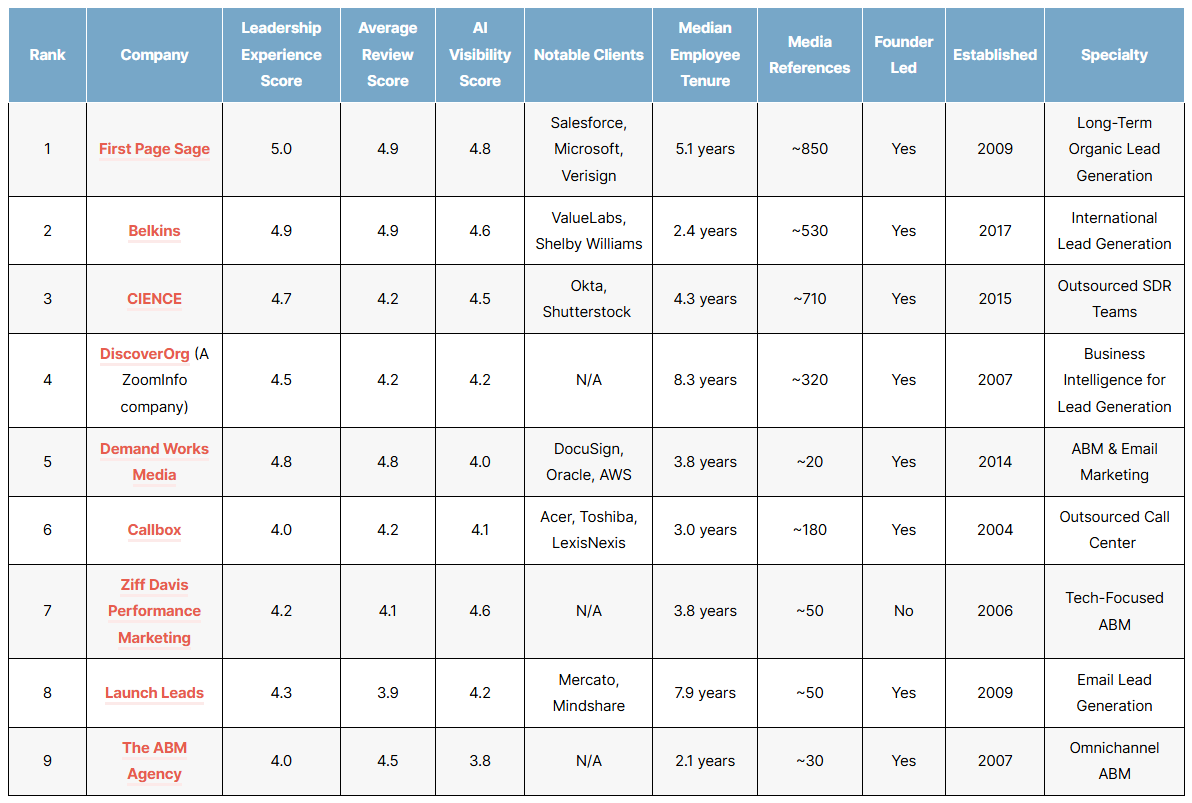
    After an in-depth analysis using data from company websites, reviews, and direct outreach, I’ve ranked these firms. The table below showcases the leading home services GEO agencies to keep companies visible across both traditional and AI-powered platforms.

    The Top Home Services GEO Agencies of 2026

    RankCompanyEstablishedFounder LedLeadership ExperienceAverage Review ScoreHome Services FocusNotable ClientsSpecialty
    1First Page Sage2009Yes4.84.9HVAC, Electrical, Plumbing, RoofingMighty Dog Roofing, iFOAM InsulationHigh-impact lead-gen focused GEO and SEO
    2Siana Marketing2021Yes4.64.8100% construction and home servicesCorcoran, HomeVestorsConstruction-only GEO agency

    First Page Sage

    Under the guidance of CEO Evan Bailyn, First Page Sage has developed a robust GEO strategy that elevates home services companies. They’ve propelled names like Mighty Dog Roofing and Pipe Restoration Solutions to the top of search results by creating service-specific landing pages and geotargeted content.

    Their strategic focus on building a network of high-quality content ensures recommendations by AI platforms like ChatGPT. When homeowners inquire about the best local services, First Page Sage clients confidently come up as top recommendations.

    • Year Founded: 2009
    • Founder Led: Yes
    • Leadership Experience Score: 4.8
    • Average Review Score: 4.9
    • Home Service Focus: Broad home services experience
    • Notable Clients: Mighty Dog Roofing, iFOAM Insulation
    • Specialty: Lead gen-focused GEO and SEO
    Summary of Online Reviews
    Clients rave about First Page Sage’s “fastidious understanding of home services GEO” and “organized, communicative teams.” While their strategies drive quality leads, some mention the need for a longer ramp-up period for business research.

    Siana Marketing

    Founded in 2021, Siana Marketing directs its focus on GEO for construction and home services. Despite being young, they excel in securing appearances for architects and contractors in both traditional search and AI-generated results.

    The leadership team brings deep industry knowledge, with a strong grasp on sales cycles and influencing homeowner decisions. This expertise has helped maintain solid client retention, which is impressive for their relatively short tenure.

    • Year Founded: 2021
    • Founder Led: Yes
    • Leadership Experience Score: 4.6
    • Average Review Score: 4.8
    • Home Service Focus: 100% construction and home services
    • Notable Clients: Corcoran, HomeVestors
    • Specialty: Construction-only GEO agency
    Summary of Online Reviews
    Clients highlight Siana’s “industry knowledge” and understanding of the AEC sector’s growth strategies. There’s high demand and selective client acceptance due to their expertise.

    Focus Digital

    Focus Digital offers high-quality SEO and GEO support at prices accessible to smaller operations. They’ve built credibility by focusing on personalized client attention and staying ahead with innovative strategies.

    What makes them unique is their ability to provide premium strategic advice and execution, making them a top choice for businesses with tighter budgets seeking sophisticated search solutions.

    • Year Founded: 2018
    • Founder Led: Yes
    • Leadership Experience Score: 4.5
    • Average Review Score: 4.8
    • Home Service Focus: Small business contractors
    • Notable Clients: Stego Wrap, Twin Home Experts
    • Specialty: Budget-friendly SEO and GEO solutions
    Summary of Online Reviews
    Focus Digital’s clients commend their meticulous focus and state of constant innovation. They’re seen as “punching above their weight,” delivering value usually associated with bigger firms.

    Inspired by this post on First Page Sage Blog.


    crushpress.ai community screenshot
  • AI Search Indexing and Citation Visibility: A Practical Audit

    AI Search Indexing and Citation Visibility: A Practical Audit

    You can have pages indexed in conventional search, steady organic traffic, and normal reporting, yet remain invisible in an AI answer. That mismatch is real: healthy search metrics have coexisted with zero measured presence on individual AI platforms.

    The useful question is not, “Why doesn’t AI like my site?” It is, “Where does the path from crawl request to visible citation break?” Separate that path into testable stages and you can fix the actual bottleneck instead of rewriting good content, relaxing security blindly, or waiting for an index update that may not be the problem.

    AI visibility has several distinct failure points

    A conventional search index primarily helps rank pages for a query. An AI grounding system has a harder job. It must find evidence that is relevant, but it also needs to judge whether that evidence is accurate, current, sufficiently supported, and complete enough to help construct an answer.

    The distinction matters because a search result gives the user several pages to inspect. A generated response combines information on the user’s behalf. An error can travel through multiple reasoning steps, and conflicting claims may have to be reconciled before the system decides whether to answer at all. Retrieval can also happen repeatedly as the system refines the question and reevaluates its confidence.

    Use the following chain as a diagnostic model. It is not a claim that every AI platform uses an identical architecture. It is a practical way to locate failure.

    StageWhat must happenEvidence you can collect
    AccessThe relevant crawler receives the public page rather than a block, challenge, error, or empty response.Status code, redirects, response headers, returned HTML, and server logs for the exact user-agent.
    ExtractionThe page contains a passage that remains understandable when separated from the rest of the layout.A plain-text review of the passage with its subject, claim, conditions, and supporting context intact.
    GroundingThe claim appears current, specific, supported, and compatible with other available evidence.Visible dates, scope qualifiers, named evidence, consistent facts, and an explanation of apparent contradictions.
    Selection and attributionThe system uses your information and associates it with your page, brand, author, or community.Saved answers, linked URLs, source labels, creator labels, and the exact claim supported by each citation.
    Presentation and visitThe interface exposes a useful link and gives the user a reason to follow it.Inline-link placement, previews, suggested follow-up links, referral data, and landing-page engagement.

    Do not collapse these stages into one visibility score. A blocked crawler and an unconvincing claim can both produce no citation, but they require completely different remedies. A citation with no visits is different again: retrieval succeeded, while presentation or click value may be the constraint.

    Rule out crawler blocks before rewriting content

    An abstract crawler approaches a server archive through layered security gates, with one route open and several routes blocked.

    A platform-specific zero is a reason to investigate access, especially when other AI systems already use the same site. It is not proof by itself. Different products have different coverage, retrieval behavior, and answer policies.

    One 30-day monitoring snapshot of searchinfluence.com recorded 37.8% presence in Google AI Mode, 22.2% in Copilot, 16.3% in Google Gemini, 9.6% in ChatGPT, and 7.8% in Perplexity, while Claude and Meta AI both measured 0.0%. Those percentages are not industry benchmarks. Their value was diagnostic: the uneven pattern made crawler access worth testing before anyone blamed topical authority or page quality.

    The infrastructure evidence was much stronger. Seven days of Cloudflare logs contained 29,099 bot requests, with 65.8% involving AI bots, and the response behavior varied by user-agent. Reproduction requests then isolated a user-agent-based block at the managed WordPress hosting layer. Some AI crawlers were blocked while Common Crawl passed, so the success of one crawler did not establish access for another.

    Run your own access audit in this order:

    1. Choose a representative public test set. Include different templates and content states, such as a current informational page, an older evergreen page, and a commercially important page. Test only URLs that are meant to be public; do not expose private previews or protected customer data for the sake of crawler access.
    2. Capture an ordinary response. Request each URL as a normal browser and save the status, redirect chain, content type, response headers, and returned body. This gives you a baseline for comparison.
    3. Repeat the request with the exact AI user-agent. Use the string found in your server logs or the platform’s current official crawler documentation. Keep the URL, request method, and timing as consistent as practical. A browser response of HTTP 200 beside a bot response of HTTP 403 or 429 is strong evidence of access policy, filtering, or throttling.
    4. Inspect the body, not only the status. An HTTP 200 response can still contain a challenge page, login prompt, consent wall, empty shell, or materially different content. Confirm that the title, main text, and important links are present in the bot response.
    5. Trace every enforcement layer. Check robots controls, WordPress security and bot-management plugins, CDN or WAF rules, rate limits, caching, and managed-host controls. Response headers can help identify the layer involved, but a header is a clue rather than conclusive proof.
    6. Correlate the request with logs. Group by user-agent, URL, status, and time. Look for consistent differences between AI crawlers and ordinary requests. In particular, do not assume an HTTP 429 always reflects genuine request volume; a rule can produce different treatment based on identity or policy.
    7. Apply the narrowest correction and retest. Change the precise rule, crawler treatment, route, or limit responsible for the failure. Save before-and-after requests so you can demonstrate that the intended crawler now receives usable content.

    Do not disable a WAF or broadly allow every request merely to pursue citations. That can raise abuse, security, and compute-cost risks. User-agent strings are also easy to imitate. Prefer the verification controls supported by your host or platform, and make the smallest rule change that satisfies your chosen access policy.

    Three misreadings cause unnecessary work. First, successful Google crawling does not prove that an AI crawler can enter. Second, successful Common Crawl access does not prove access for ClaudeBot or another named crawler. Third, a clean robots file does not rule out a block imposed later by a plugin, CDN, WAF, or host. Test the exact request path instead of inferring it from conventional indexing.

    Write passages that can support an answer

    Once access is confirmed, evaluate the page as evidence rather than as a collection of keywords. AI retrieval may extract only part of a page, transform it, combine it with other material, and retrieve again. The important test is whether the meaning survives chunking and transformation.

    Keep the claim and its qualifications together

    Read each important passage without the page title, navigation, previous paragraph, or accompanying graphic. If the passage becomes ambiguous, it is too dependent on its surroundings.

    • Put the direct answer in the first substantive sentence beneath the relevant heading.
    • Name the product, entity, plan, region, or version in the sentence that makes the claim. Avoid relying on vague pronouns such as “it” or “this” after a long section break.
    • Keep conditions, exceptions, and measurement context in the same paragraph as the result they qualify.
    • Place the evidentiary basis close to the factual claim. Do not leave the reader or retrieval system to infer which citation supports which statement.
    • Split unrelated claims into separate paragraphs. A passage that mixes definitions, recommendations, history, and promotion becomes harder to use cleanly.

    Weak pattern: “It works differently on the newer plan. This is the limit.” The entity, plan, behavior, and meaning of the limit can disappear when the sentences are extracted.

    Stronger pattern: “For [named plan or version], [named feature] has [specific constraint] when [condition applies].” The brackets are not copy to publish; they show the context every important claim should carry.

    This does not mean repeating the same keyword in every sentence. It means removing unresolved references. Write so a person arriving at the paragraph from a search result can identify the subject, understand the answer, and see its boundary without reconstructing the rest of the page.

    Make freshness visible in the facts

    Stale content is more dangerous in a generated answer than in a list of links because the outdated claim can be repeated as part of a single synthesized response. Grounding systems therefore treat freshness as part of evidence quality, not merely as a recency signal.

    Changing an updated date without reviewing the underlying facts does not solve that problem. Maintain a simple freshness ledger for mutable pages with these fields:

    • Page and section containing the claim.
    • The fact that can change, not merely the page topic.
    • The product, version, geography, plan, or period to which it applies.
    • The evidence used to verify it.
    • The person responsible for review.
    • The last factual review and the event that should trigger the next one.

    When a fact changes, update the claim and its qualification together. If older information must remain for historical users, label its period explicitly. The goal is not to make every page look new. It is to stop an old statement from masquerading as a current one.

    Explain contradictions instead of leaving them to the model

    A ranked results page can place disagreeing pages next to each other and let the user decide. A generated answer has to decide how, or whether, the claims fit together. Conflict recognition is therefore part of the grounding problem.

    When two pages on your own site disagree, check the scope before choosing a winner. The difference may come from time period, region, edition, account type, definition, or measurement method. Put that distinction beside each claim. If one page is simply wrong, correct it and remove internal paths that keep presenting the obsolete version as current.

    Do not hide a legitimate disagreement. Name the competing positions, explain what each assumes, and tell the reader what would change the decision. That is more useful evidence than forced certainty, and it reduces the chance that a retrieved passage loses the reason two values differ.

    Use structured data as a consistency check

    Schema and JSON-LD can clarify entities, relationships, authorship, dates, and attributes, but they cannot rescue a blocked response or turn an unsupported assertion into reliable evidence. Treat markup as a machine-readable reflection of the visible page.

    Audit the page and markup together. Names, dates, authors, products, and factual values should agree. If the structured data makes a claim the reader cannot verify on the page, fix the underlying content or remove that property. Citation visibility depends on trustworthy evidence throughout the chain, not on how many properties you can add.

    Measure citation visibility as its own funnel

    Document tiles pass through four connected chambers, with fewer tiles reaching a source card beside a glowing answer orb.

    Search Console can tell you a great deal about conventional Google search, but it cannot diagnose every AI platform. A site may have normal traffic and indexing signals while specific AI systems show no measurable presence. Build a separate observation set for AI answers, then connect it back to crawl logs and analytics.

    1. Define a stable prompt set. Use the real questions for which your pages contain an answer. Keep the wording and intent recorded so later observations are comparable.
    2. Record the execution context. Save the platform, prompt, date, locale, and relevant account or subscription context. AI surfaces can differ, so an uncaptured context change can look like a visibility change.
    3. Preserve the response. Store the answer, every linked URL, visible publisher or creator label, and the text each link appears to support.
    4. Classify the outcome by stage. Distinguish no retrieval, unlinked use of your information, linked citation, secondary suggested link, and citation with a recorded visit.
    5. Join observations to crawl evidence. Check whether the platform’s crawler requested the cited or expected page near the observation period and what response it received.
    6. Compare like with like. Use the same prompt set and classification rules for before-and-after reviews. A percentage without a stable denominator or observation method is not a useful trend.

    Track separate rates for separate questions:

    • Crawl pass rate: the share of tested URL and crawler combinations that return the intended, usable content.
    • Answer inclusion rate: the share of observed responses that use information traceable to your site, whether linked or not.
    • Citation rate: the share of observed responses that visibly attribute or link to your site.
    • Citation-to-visit rate: the share of cited observations associated with a visit, where referral data is available and can be interpreted responsibly.

    These are operational measurements, not universal benchmarks. Do not compare your rate directly with another company’s unless the prompts, platforms, contexts, and classification method are the same.

    Presentation deserves its own field because a citation is not one uniform object. Google’s AI features can place links beside relevant answer text, show previews on hover, suggest follow-up angles, surface subscription links, and identify creators or communities for discussion-based material. A monitoring system that records only whether your domain appeared will miss the difference between a prominent inline citation and a secondary link a user may never see.

    For each appearance, record the citation surface and the promise it makes to the user. Then inspect the destination page through that promise. The title and opening should immediately deliver the analysis, firsthand detail, method, evidence, or next step that the short answer could not contain. If the page merely repeats the generated answer at greater length, the user has little reason to click.

    Your funnel should now point to a specific class of work:

    • If the crawler cannot retrieve usable content, work on infrastructure and access policy.
    • If access passes but the relevant passage cannot stand alone, restructure the answer and its qualifiers.
    • If the passage is clear but stale, weakly supported, or contradicted elsewhere, repair evidence governance.
    • If your information appears without a citation, strengthen page-level identity, claim ownership, and the connection between evidence and assertion.
    • If a citation appears but visits do not follow, inspect its surface, preview, destination promise, and the additional value available after the click.

    AI indexing and citations: practical FAQ

    Can a page rank organically and still receive no AI citations?

    Yes. Ranking and grounding overlap, but they are not the same job. Conventional search emphasizes relevance among pages. An AI answer also needs evidence it can use with sufficient confidence, freshness, support, and context. The system may retrieve repeatedly, reconcile conflicts, or decline to answer, so an organic position does not guarantee selection or attribution in a generated response.

    Should you rewrite content as soon as an AI platform shows zero visibility?

    No. First reproduce access for that platform’s crawler on representative URLs. If the exact user-agent gets a block, challenge, empty body, or persistent HTTP 429 while an ordinary request receives the page, content rewriting cannot fix the immediate failure. If access passes, move to passage quality, evidence, freshness, and contradictions.

    Should you unblock every AI bot?

    Not automatically. Decide what your organization permits for bulk collection, model training, live answer retrieval, and referral-generating discovery. In the managed WordPress investigation, bulk training crawlers and more human-paced, user-facing crawlers behaved differently. That case does not establish a universal rule, but it shows why a single allow-or-block switch can be too crude. Keep security controls in place, verify crawler identity using the best controls your provider supports, and implement your policy narrowly.

    Does earning a citation guarantee referral traffic?

    No. Link placement, previews, answer completeness, user intent, subscriptions, and the value promised by the destination all affect whether someone visits. Google reported that prominent subscription links improved click-through rates in early tests, but that qualitative result is not a universal traffic promise. Measure the appearance, citation surface, and visit separately.

    Start with one missing platform and one important page. Trace a real request through access, extraction, grounding, citation, and visit. Preserve the evidence at each stage. If the chain breaks at the server, fix the server. If it breaks at the claim, fix the claim. If it breaks after the citation, give the reader a clearer reason to continue. One diagnosed failure is worth more than a site-wide AI rewrite based on guesswork.

    References

  • AI Search Visibility: Optimize Intent Across the Pipeline

    AI Search Visibility: Optimize Intent Across the Pipeline

    Your page can rank for an obvious phrase and still disappear when someone asks an AI assistant to recommend, compare, or solve. The page may answer the words in the prompt without helping the person make the decision behind it.

    Improving AI search visibility requires two kinds of alignment. First, connect query intent to the outcome the person actually wants. Then trace whether your content can pass from discovery to selection, citation, and action. That turns a vague visibility problem into a sequence of checks you can act on.

    Optimize for the decision behind the prompt

    Query intent is the need expressed through the search or prompt. Conversion intent is the goal revealed by what the person is trying to accomplish and how they behave. Those intents can overlap without being identical.

    Conversion does not have to mean a sale. It might mean reaching a login screen, confirming whether a product fits, comparing providers, downloading technical information, or deciding that no action is needed. If you optimize only for the wording, you can produce a relevant answer that leads nowhere useful.

    Treat query specificity as a confidence signal, not a verdict. A prompt such as “brand login” states a narrow navigational need. A brand name by itself may represent navigation, support, product research, or purchase consideration. A non-branded category term signals a general area of interest, while added attributes reveal constraints that the answer must address. More explicit wording supports a stronger intent hypothesis, but observed behavior should still validate it.

    Before changing a page, write a short intent brief:

    • Query family: the prompt and its close conversational variants.
    • User situation: what the person already appears to know.
    • Immediate need: the answer required in the current interaction.
    • Underlying decision: what the person must choose, verify, or complete next.
    • Desired conversion: the useful action, including a non-commercial action where appropriate.
    • Required evidence: the facts, qualifications, comparisons, or proof needed to support that decision.
    • Entity focus: the product, organization, person, place, or concept that must be identified without ambiguity.

    This brief prevents a common mismatch: writing an educational page for a person who needs to choose, or pushing a high-commitment call to action at someone who is still defining the problem.

    Build the page as an intent chain, not a keyword container

    A person follows a connected sequence of visual stations from an initial question through comparison and evidence to a final choice.

    An intent-optimized page should move cleanly from the prompt to the decision. The goal of generative engine optimization is not to mention AI or repeat more variations of a phrase. It is to make your information easier to understand, use, and recommend in a generative answer.

    Use this sequence when outlining or revising the page:

    1. Answer the expressed question immediately. Put the direct answer under a heading that describes the question or decision. Do not require an AI system or reader to combine several distant paragraphs to find it.
    2. Expose the decision behind the question. State the criteria that change the answer: use case, prerequisites, compatibility, limitations, tradeoffs, or audience fit.
    3. Attach proof to the claim it supports. Place the relevant explanation, example, qualification, or citation near the claim instead of collecting unsupported assertions in one section and evidence in another.
    4. Clarify the entities and relationships. Use consistent names for the brand, product, service, category, and alternatives. Explain how they relate in visible copy.
    5. Offer the next appropriate action. A broad exploratory prompt may need a comparison or diagnostic next step. A narrow action prompt may justify a direct login, purchase, booking, or contact path.

    One URL does not need to satisfy every possible intent. Group close variants when they lead to the same decision and require substantially the same evidence. Split them when they demand different answers, qualifications, or next actions. A page that tries to educate beginners, resolve technical support, compare vendors, and close a purchase often makes each job harder to recognize.

    Structured data can reinforce this work, but it cannot replace it. JSON-LD should describe entities and relationships already supported by the visible page. Marking up an unclear, thin, or contradictory claim does not make the underlying answer more useful or trustworthy.

    Trace visibility through the ten-gate AI search pipeline

    A glowing content capsule moves through ten isometric gates, with one partially closed gate creating a visible bottleneck.

    AI visibility is not a single ranking event. A practical diagnostic model follows ten gates: Discovered, Selected, Crawled, Rendered, Indexed, Annotated, Recruited, Grounded, Displayed, and Won. A failure early in that sequence prevents later optimization from doing useful work.

    Check technical eligibility before rewriting the answer

    • Discovered: confirm that the URL is reachable through intentional internal links and the discovery mechanisms you maintain. An orphaned page should not be treated as a wording problem.
    • Selected: determine whether crawlers choose the URL from the pages they know. If comparable URLs receive requests but this one does not, inspect linking depth, duplication, crawl directives, and competing URL versions.
    • Crawled: use server logs where available to verify requests, response codes, and repeated access problems. A request is evidence of crawling, not evidence of indexing or citation.
    • Rendered: compare the essential answer in the delivered HTML with the rendered page. If the useful content depends on a failed script, delayed interaction, or inaccessible component, downstream systems may receive an incomplete version.
    • Indexed: use the engine-specific diagnostics available to you to check canonical selection, indexing status, and exclusions. Do not infer indexing merely because the URL loads in a browser.

    These first gates are mainly infrastructure work. If the page is not being fetched, rendered, or indexed as intended, adding another section or changing a call to action will not solve the immediate constraint.

    Then test whether the content is competitive enough to be used

    • Annotated: check whether the central entity, attributes, and relationships are explicit and consistent. Align visible language, page metadata, internal links, and structured data rather than letting each describe a different subject.
    • Recruited: test whether the page or domain appears to become a candidate for the relevant prompt family. Recruitment is usually inferred from repeated output patterns, not directly exposed as a public status.
    • Grounded: make each important claim easy to support. State it plainly, qualify its scope, and place the relevant proof nearby. A page can be topically relevant without providing a usable basis for an answer.
    • Displayed: record whether the resulting answer visibly mentions, quotes, links to, or cites your content. Separate a brand mention from a clickable citation because they represent different outcomes.
    • Won: evaluate whether the visibility produces the intended user result. That might be a qualified visit, a completed task, a useful comparison, a signup, or a purchase.

    The later gates are competitive. Passing them depends on more than technical availability. The answer must fit the prompt, identify its entities clearly, support its claims, and earn selection against other eligible material. Clear entity signals can improve several downstream gates, which is why entity work can have effects beyond a single page element.

    Measure the symptom, identify the gate, and fix the constraint

    You cannot directly observe every internal decision an AI system makes. Keep observed evidence separate from inferred causes. Otherwise, a single missing citation can trigger an unnecessary rewrite when the real problem is crawling, indexing, ambiguous entities, or weak alignment with the tested prompt.

    Evidence you can collectWhat it supportsWhat it does not prove
    Server-log requestThe URL was crawled by the identified requesterThe content was indexed, understood, or used
    Indexing diagnosticThe engine reports the URL as indexed or excludedThe URL will be recruited for a relevant prompt
    Consistent entity information on the pageThe subject and relationships are explicitThe system annotated them exactly as intended
    Visible mention or citation in an AI answerThe content passed through display for that testThe result will persist across prompts, sessions, or later answers
    Qualified action after exposureThe visibility contributed to the intended outcomeWhich earlier gate caused the selection

    Create one audit row for each combination of an intent family and its best-fit URL. Add a column for every gate and mark it pass, fail, or unknown. Store the evidence beside the status. Unknown means you need a better test; it should not be silently upgraded to pass.

    Do not average the gate scores. An average hides hard failures. Start with the earliest confirmed failure because every later result depends on it. Once the technical gates pass, prioritize the competitive gate with the clearest evidence of weakness.

    Use these symptom-to-action starting points:

    • The URL is not indexed: investigate discovery, crawling, rendering, canonicalization, and indexing before expanding the copy.
    • The URL is indexed but absent across a controlled prompt set: test intent fit, entity clarity, and whether the page provides a distinct answer with usable evidence.
    • The brand appears but the preferred page is not cited: inspect whether the page states the relevant claim directly and whether another page creates a clearer claim-to-proof connection.
    • The page is cited for informational prompts but not decision prompts: add the criteria, constraints, comparisons, and qualifications needed for the decision. Do not merely make the call to action louder.
    • The page is displayed but produces the wrong visits or actions: revisit conversion intent, promise clarity, and the next step. Visibility to the wrong audience is not a win.

    Run prompt tests with a fixed set of close variants and conversational follow-ups. Record the exact prompt, result type, mention, cited URL, answer framing, and intended conversion. Keep the test conditions as consistent as practical, and avoid drawing a firm conclusion from one generated response.

    Audit existing assets before commissioning more content. A useful planning frame separates return on past investment, present investment, and future investment: recover claims and proof you already own, repair the current bottleneck, and create new material only for an intent or evidence gap the existing library cannot satisfy. This outside-in approach prevents production volume from masking a distribution or selection failure.

    Key takeaways

    • Map every important prompt family to both its immediate question and its underlying conversion goal.
    • Build the page as a chain from direct answer to decision criteria, evidence, entity clarity, and an appropriate next action.
    • Diagnose visibility across all ten gates instead of treating every absence as a content-quality problem.
    • Separate observable evidence from inferred system behavior, especially at the annotation, recruitment, and grounding stages.
    • Fix the earliest confirmed failure before investing in downstream refinements or additional pages.

    Run your next optimization cycle on one intent family

    1. Choose one intent family tied to a meaningful user outcome.
    2. Name the existing URL that should satisfy it and complete the intent brief.
    3. Mark every pipeline gate pass, fail, or unknown, with evidence.
    4. Make the smallest change that addresses the earliest confirmed failure.
    5. Repeat the same crawl, index, prompt, display, and conversion checks before widening the work to more URLs.

    If you can name the decision the person is making and the gate where your content stops, the next action becomes much clearer. Start with one intent family and one failed gate. Earn the right to scale only after that path works from discovery through the user outcome.

    References

  • How to Build an AI Search Visibility Strategy That Holds Up

    How to Build an AI Search Visibility Strategy That Holds Up

    Your team can buy an AI visibility dashboard and still have no idea what to fix. The hard part is not detecting a brand mention. It is deciding whether that mention reflects accurate representation, genuine authority, growing demand, or one unstable answer.

    A useful strategy connects AI answers to the conditions that produced them and the business result that followed. That means testing real prompts, examining who gets recommended and cited, strengthening the evidence around your brand, and measuring demand and behavior outside the AI platform.

    Measure AI visibility as a chain, not a single score

    An AI citation is not the same as human endorsement or brand demand. It can show that a system found a page useful, but it does not tell you whether a buyer noticed your brand, understood its relevance, trusted it, or took action.

    Build your scorecard in layers. Each layer answers a different question, so a change in one cannot silently stand in for all the others.

    Measurement layerQuestion it answersWhat to record
    Business resultDid AI exposure contribute to valuable behavior?Qualified visits, leads, purchases, subscriptions, assisted conversions, or revenue where your attribution setup supports it.
    Brand demandAre more people actively looking for you?Branded queries, branded search interest, direct visits, and other demand indicators relevant to your business.
    AI representationDo answer engines include your brand, and how do they describe it?Brand presence, recommendation role, factual accuracy, sentiment, citations, named competitors, and omitted capabilities.
    Search and site foundationsCan search systems find the relevant pages, and what happens after a visit?Indexing, impressions, clicks, landing-page engagement, conversion behavior, and referral traffic from identifiable AI platforms.

    Define the business result before collecting visibility data. For one company, the meaningful action might be a completed purchase. For another, it might be a qualified inquiry rather than every form submission. Without that definition, an impressive mention count can become a reporting endpoint instead of evidence for a decision.

    Give branded demand its own place in the scorecard. Growth in people deliberately searching for your name is a clearer indicator of rising market demand than citations alone. Google Trends, Keyword Planner, and Search Console can help you examine that demand from different angles, while GA4 can show what identifiable AI-referred visitors do on your site.

    Do not turn the layers into one opaque composite score. If citations increase while branded demand and qualified activity remain flat, you have learned something specific: machine visibility changed, but you have not yet demonstrated greater preference or business impact. That is a diagnosis, not necessarily a failure.

    Build a prompt benchmark you can repeat

    A circular testing table holds evenly spaced blank prompt tiles, translucent processing chambers, and colored response shapes arranged for repeated comparison.

    Your benchmark should represent decisions a potential customer makes, not merely the keywords your site already targets. Include prompts from distinct stages of the decision so you can see where your brand enters, disappears, or gets described incorrectly.

    • Category discovery: prompts such as Which [category] options suit [audience and constraint]? reveal which brands are associated with the market before the user names one.
    • Problem solving: prompts such as How should [audience] solve [problem] when [constraint] applies? show which methods, entities, and providers become part of the answer.
    • Evaluation and comparison: prompts about tradeoffs, selection criteria, alternatives, or use-case fit expose how the system differentiates brands.
    • Brand verification: prompts about what your brand does, who it serves, where it fits, or how it compares reveal factual and positioning errors.

    Use the language customers would use. A prompt set written entirely in your internal product vocabulary will measure whether an assistant can repeat your positioning, not whether your brand appears in the buyer’s actual decision process.

    Test materially important prompts in ChatGPT, Claude, and Perplexity. They are useful for competitive research, content-gap analysis, entity audits, prompt testing, and answer-structure analysis. Their practical strengths also differ: ChatGPT offers broad synthesis, Claude tends toward nuanced analysis, and Perplexity makes citations particularly visible.

    For every test, save enough context to reproduce and interpret it:

    • A stable prompt ID and the exact prompt text.
    • The intent category and audience represented by the prompt.
    • The platform, available mode, test date, and any conditions you controlled.
    • Every brand named and its role: primary recommendation, alternative, example, warning, or passing mention.
    • The claims made about your brand, including omissions and factual errors.
    • The pages and domains cited, when citations are available.
    • The competitors that recur and the evidence used to support them.
    • The action the observation triggered, or a clear note that no action is justified yet.

    Keep the original output or a sufficiently complete capture. A binary present-or-absent field cannot tell you whether your brand was the preferred option, an unsuitable alternative, or an incidental example.

    Read patterns as hypotheses, not rankings

    AI outputs are variable, and visibility metrics are signals rather than precise rankings. A single answer is therefore an observation, not a stable market-share estimate. Repeat the same benchmark under recorded conditions and look for patterns that survive individual response changes.

    • If your brand appears only when named, the system may recognize it without associating it strongly enough with the broader category. Investigate category coverage, independent mentions, demand, and positioning.
    • If competitors repeatedly appear in category and comparison prompts, inspect the claims and third-party evidence supporting them. The gap may be authority or distribution, not another missing keyword page.
    • If your brand appears but is described inconsistently, create an entity and messaging issue list. Separate incorrect facts from legitimate differences in how the market sees you.
    • If citations increase but visits do not, remember that a direct answer can satisfy the user without a click. Check branded demand, later visits, and business outcomes before declaring the citation worthless.
    • If visibility looks strong only in low-value prompts, revise the benchmark. You may be measuring questions that are easy to win but irrelevant to a buying decision.

    Build the authority that keyword coverage cannot create

    A crystalline central structure stands on a network of blank books, papers, source towers, and linked nodes while light orbs connect the evidence to an audience.

    Publishing more pages does not automatically make your brand authoritative. Keyword coverage can show that you have discussed a subject. It cannot, by itself, show that the market trusts your expertise or thinks of your brand when the subject arises.

    The more useful question is: what do credible people, publications, customers, and communities say about you? Consistent brand co-occurrence connects a brand with a topic across independent mentions. Those associations help explain why one company becomes a routine recommendation while another has a larger content library but little presence outside its own domain.

    Create an evidence map around the association you want to earn. State it in a working sentence: For [audience] dealing with [problem], [brand] is relevant because [verifiable proof]. Then audit each part:

    • Do you have first-party evidence for the proof, or only a marketing claim?
    • Does the evidence contain original data, a useful method, a distinctive tool, or an insight another person would have a reason to reference?
    • Do independent mentions connect the brand to the intended problem and audience?
    • Do reviews and customer discussions support the positioning, qualify it, or contradict it?
    • Are the relevant facts stated consistently on pages that search systems can find?
    • Do competitors have stronger recurring evidence for the same association?

    The answers tell you which intervention belongs next. If the underlying evidence is weak, produce work worth citing: original data, a transparent method, a practical resource, or an analysis that advances the conversation. If the evidence is strong but unseen, the bottleneck is distribution, public relations, community participation, or outreach. If independent mentions exist but describe the company inconsistently, fix the positioning and entity facts before adding more topic coverage.

    Reviews, customer testimony, and genuine recommendations matter because they show human preference rather than self-description. Treat them as evidence to understand, not text to manufacture. Record which use cases customers associate with your brand, the language they use, and where their experience narrows or challenges your preferred positioning.

    Your owned content still has an important job. It should explain the product or expertise accurately, answer consequential questions, expose the evidence behind claims, and give other people something precise to reference. Technical SEO should keep those pages discoverable and indexable. Structured data can state entities and relationships more explicitly, but it remains self-declared markup; use it to describe visible facts, not as a substitute for reputation.

    This changes content planning. Do not ask only which keywords remain uncovered. Ask which claim your market needs help evaluating, what evidence would resolve it, who would find that evidence useful, and why anyone outside your company would mention it. Original data and useful insights that earn attention do more for authority than a stack of interchangeable pages.

    Choose each tool for a decision it can support

    No tool covers the complete chain from prompt exposure to market authority and revenue. Start with the question you need to answer, then choose the smallest tool set that provides the necessary evidence.

    Tool or tool groupUse it to decideWhat it gives youWhat it cannot prove
    ChatGPT, Claude, and PerplexityWhere and how does the brand appear in real answer formats?Manual prompt tests, competitor framing, content gaps, entity coverage, cited pages where available, and preferred answer structures.A one-off output cannot establish a stable ranking or market share. Manual testing also becomes time-consuming without a fixed framework.
    ProfoundDo you need repeatable cross-platform visibility and competitor monitoring at greater scale?Brand mentions, sentiment, citation share, competitor visibility, and identification of content associated with AI mentions.Its metrics remain snapshots of changing outputs. Cost also needs to be justified by a decision your team will make from the data.
    Google Trends and Google Keyword PlannerIs demand growing, declining, seasonal, or too small to prioritize?Search-interest direction, volume estimates, topic momentum, seasonal patterns, and forecasting inputs.They reflect traditional search behavior rather than the full universe of AI prompts. Keyword Planner also requires an active Google Ads account.
    Google Search Console and Google AnalyticsAre relevant pages discoverable, and does identifiable AI traffic produce useful behavior?Queries, impressions, clicks, indexing evidence, landing-page behavior, referrals, engagement, and configured conversion outcomes.Search Console is Google-centric, while Analytics depends on correct configuration. Neither reveals every interaction that happened inside an answer engine.
    AhrefsWhich competitors have stronger external authority or reference-worthy content?Backlinks, content gaps, and discovery of high-performing content that may support broader authority and citation opportunities.These are indirect AEO signals, not a direct view of what an AI system will answer.
    AI Trust Signals and Roadway AIIs an emerging specialist tool able to close a defined credibility or revenue-attribution gap?AI Trust Signals focuses on credibility indicators, while Roadway AI is developing attribution between AEO activity and revenue.Both should be evaluated against your own workflow and decision requirements rather than assumed to be mature, universal replacements for the core stack.

    A spreadsheet or database remains the connective tissue even when you use specialist software. Keep separate views for prompts, outputs, citations, authority evidence, actions, and outcomes. Join them with stable prompt, page, topic, and intervention identifiers. Otherwise, your answer tracker and analytics data will remain adjacent dashboards with no diagnostic relationship.

    Use decision rules to turn observations into work

    Write the rules before the next reporting cycle. This prevents the most visually dramatic metric from dictating your priorities.

    1. Freeze the benchmark. Keep the core prompts, intent labels, platforms, and recorded conditions stable enough to make later observations interpretable. Add emerging prompts without rewriting the baseline.
    2. Locate the bottleneck. Decide whether the problem is discovery, inaccurate representation, weak external authority, low underlying demand, or poor business response.
    3. Check corroborating evidence. Compare prompt observations with cited pages, competitor mentions, backlinks, branded searches, Search Console data, and Analytics outcomes. Do not let one system confirm itself.
    4. Choose one intervention tied to the bottleneck. That may be correcting facts, improving a decision page, publishing stronger evidence, earning independent coverage, repairing indexing, or revising a low-value prompt portfolio.
    5. Record the expected movement. Name the measurement layer that should change if the intervention works. An authority campaign should not be judged solely by immediate referral clicks, and an analytics repair should not be credited with creating demand.
    6. Retest the full chain. Recheck AI representation, citations, branded demand, search performance, and qualified behavior. Keep the intervention only if the combined evidence supports it.

    Some patterns deserve especially careful interpretation. High Search Console impressions with falling click-through rate can justify inspecting whether direct search answers or AI Overviews are affecting clicks, but it does not prove the cause. A recurring competitor citation can reveal a useful evidence gap, but copying the competitor’s page structure will not reproduce the reputation behind it. Better diagnosis usually leads to a different action than surface imitation.

    Paid AI monitoring becomes worthwhile when manual testing has already established a useful benchmark and the volume of platforms, prompts, markets, or competitors exceeds what your team can review consistently. If you cannot name the decision that additional tracking will change, more coverage will create a larger reporting burden rather than a better strategy.

    Key takeaways

    • Treat AI visibility as a chain connecting machine representation, external authority, brand demand, site behavior, and business outcomes.
    • Benchmark category, problem-solving, comparison, and brand-verification prompts using exact, repeatable prompt records.
    • Interpret AI answers as variable observations. Look for recurring patterns across prompts and platforms instead of declaring a precise rank from a snapshot.
    • Build authority through verifiable work, independent mentions, reviews, public relations, and useful distribution. Keyword coverage and schema cannot manufacture market preference.
    • Select tools by the decision they support: assistants for firsthand testing, Profound for scaled monitoring, Google tools for demand and behavior, and Ahrefs for external authority analysis.
    • Connect every intervention to the layer expected to move, then validate it against the rest of the measurement chain.

    Your first move is to create the benchmark before buying another dashboard. Put category, problem, comparison, and brand-verification prompts in one working file. Add the brands, claims, citations, demand signals, and business outcomes beside them. The first column that repeatedly lacks credible evidence is where your next optimization effort belongs.

    References

  • How to Build Brand Authority for Visibility in AI Search

    How to Build Brand Authority for Visibility in AI Search

    You can hold strong organic rankings and still disappear when a buyer asks an AI assistant which vendors fit a specific set of constraints. Worse, the assistant may mention your brand while attaching the wrong category, audience, product capability, or differentiator.

    Publishing more general content rarely fixes that problem. You need a coherent identity, accessible evidence, pages that match the questions behind the prompt, and independent signals that corroborate what you say. Here is how to build that system in the right order.

    Key takeaways

    • AI visibility can fail at three different layers: learned representation, live retrieval, or answer generation. Diagnose the layer before choosing a fix.
    • Standardize your brand name, category, audience, products, experts, and evidence across pages, profiles, structured data, and third-party mentions.
    • Build content around comparisons, constraints, use cases, alternatives, and selection criteria. These are the paths AI search often explores when helping someone make a decision.
    • Make every important claim easy to extract and verify. Put the answer, proof, limitation, and applicable audience together instead of scattering them across a page.
    • Measure whether your brand is included, cited, and represented accurately for a controlled portfolio of prompts. Traffic alone cannot show you that.

    Diagnose where your AI visibility is breaking

    A beam of light weakens as it passes fragmented shapes, sealed chambers, and an interrupted path leading toward a person.

    AI systems do not maintain a neat, approved dossier about your company. They construct an approximation from associations learned during training, information available through current retrieval, and the context of the generated answer. That creates three separate failure points, and each one calls for a different response.

    Visibility layerQuestion to answerHow to check itLikely remedy
    Learned representationWhat does the model associate with your brand before it searches?Where the platform permits it, ask for a brand description with web search disabled. Check the name, category, audience, products, and differentiators.Resolve inconsistent identity signals, strengthen your canonical positioning, and correct historical profiles or pages you control.
    Live retrievalCan the system find relevant, current evidence when it searches?Run category, use-case, comparison, and constraint-based prompts with web access enabled. Record which pages and domains are cited.Repair crawlability and indexing problems, create pages that match the missing intent, and distribute evidence beyond your own site.
    Answer generationDoes your brand survive the final synthesis accurately?Inspect whether the response includes your brand, what role it assigns to you, which claims it repeats, and what qualifications it omits.Make your differentiators more explicit, connect claims to proof, and clarify who your product is and is not for.

    A brand that appears in citations but not in the final recommendation does not have the same problem as a brand the system never retrieves. The first may lack a distinctive reason to be included. The second may have a discoverability, intent-matching, or authority problem. Treating both as a request for another generic blog post wastes time.

    Build an audit portfolio around the decisions your buyers actually make. Include branded identity prompts, category prompts, use-case prompts, direct comparisons, alternatives, proof questions, and prompts containing important constraints. For every run, log the exact wording, platform, model, date, search setting, cited URLs, brand description, and recommendation context. Preserve the full answer so you can distinguish a citation change from a genuine change in representation.

    Keep each engine’s results separate. A two-week analysis of 10,000 prompts across ChatGPT, Copilot, and Perplexity found substantial differences in how the platforms searched and processed questions. A combined score can hide a serious weakness on one platform behind stronger performance on another.

    Do not overreact to one generated response. Use the same prompt portfolio and recording method on a stable schedule, then look for persistent omissions, recurring factual errors, and repeated source patterns. Those are more useful than a screenshot of one unusually good or bad answer.

    Give AI systems one brand identity to resolve

    Authority cannot compound until the system can tell which references belong to the same entity. A preferred brand name, legal name, domain, abbreviation, former name, product name, and founder profile may be obvious parts of one company to a person. A machine must resolve those connections from repeated, explicit signals.

    Start with a canonical positioning statement your marketing, product, communications, and SEO teams can all use:

    [Brand] is a [specific category] for [defined audience] that needs [primary use case]. It is differentiated by [verifiable proof or capability].

    The brackets force useful decisions. If three teams choose three different categories, an AI system encounters the same ambiguity your buyers do. If the differentiator could describe every competitor, it is not a differentiator. Replace adjectives such as “leading,” “advanced,” or “innovative” with a capability, policy, benchmark, methodology, credential, or other claim you can substantiate.

    Create a controlled brand fact sheet

    Your fact sheet should be the internal source used to update the website, profiles, media materials, partner descriptions, author biographies, and structured data. At minimum, record:

    • The preferred spelling, spacing, and casing of the brand name.
    • The legal name, approved abbreviation, former names, and the circumstances in which each may appear.
    • The canonical website and authoritative company, product, executive, and expert profiles.
    • The primary category, defined audience, core use cases, and meaningful exclusions.
    • Each product or service name and its relationship to the parent organization.
    • Approved proof statements, including where the evidence lives, who owns it, and whether it can become outdated.
    • Named experts and their real roles, credentials, authored material, and organizational relationships.
    • Policies, availability, pricing, integrations, and product capabilities that require regular review.

    Then inspect every high-visibility surface against that record. Prioritize the homepage, About page, product and service pages, documentation, author pages, review profiles, business listings, partner pages, press materials, and older pages that still receive links or branded traffic. Do not erase useful natural language variation. Standardize the core identity and relationships while allowing the surrounding prose to sound human.

    Historical contradictions deserve attention because old pages and profiles can remain retrievable. Update or redirect what you control. Where you cannot change a third-party page, make the current version of the fact especially clear on authoritative pages and profiles. If a former product name still matters, state the relationship directly instead of pretending it never existed.

    Represent the same identity in JSON-LD

    Structured data should describe the relationships already visible on the page. It is not a place to introduce claims that users cannot see or verify.

    • Give the organization a stable identifier and use it consistently when other entities refer back to the brand.
    • Connect the organization to its website, products or services, and genuine expert or author entities.
    • Use appropriate types such as Organization, Person, Product, Service, WebSite, and Article where they accurately match the visible subject.
    • Use sameAs for profiles or identifiers that genuinely represent the same entity. Do not treat it as a list of every URL that happens to mention you.
    • Connect an article to its author and publisher, and make the same relationship clear in the rendered page.
    • Keep names, URLs, descriptions, and entity relationships consistent between markup and visible content.

    The practical goal is a graph, not a collection of isolated schema blocks. The organization should be recognizably connected to its products, experts, articles, profiles, and supporting evidence. Clear identity resolution, deliberate co-occurrence, trustworthy attribution, and retrieval-ready facts reduce the chance that the system merges you with another company or repeats an unintended version of your positioning.

    Schema can clarify a fact, but it cannot manufacture authority for it. An award, customer count, benchmark, certification, or product capability still needs visible evidence and, where possible, independent corroboration.

    Build pages for the decision paths behind the prompt

    A user’s visible question may not be the only query an AI search system tries to answer. Query fan-out can break a prompt into background searches covering features, comparisons, prices, alternatives, constraints, and candidate brands before synthesizing a response. Your page can rank for a broad topic and still miss the subtopic that determines whether your brand enters the answer.

    Commercial decision support deserves particular attention. In one 90-prompt ChatGPT test across beauty, legaltech/regtech, and IT, 78.3% of commercial prompts triggered fan-out, compared with 3.1% of informational prompts. The triggered prompts produced 42 expansion queries, 39 of which were commercial. The sample was weighted toward informational prompts and contained very few branded or transactional prompts, so the result is directional rather than a universal rule. It is still a strong reason to look beyond introductory explainers.

    Map each important product or service to the evaluative questions a buyer asks before choosing. That usually exposes missing page types:

    • Category and shortlist pages: Define the selection criteria, the audience, the constraints, and why each option belongs. A bare list of brand names gives the system little usable reasoning.
    • Comparison pages: Explain material differences, shared capabilities, tradeoffs, ideal users, and disqualifying conditions. Do not force every comparison to conclude that your product wins.
    • Alternative pages: State why someone might seek an alternative, which requirements change the choice, and where your option does or does not fit.
    • Use-case pages: Connect a defined audience and problem to the relevant product, workflow, capability, and proof.
    • Constraint pages: Address questions involving budget, deployment, integrations, governance, security, scale, geography, or implementation conditions when those factors genuinely affect suitability.
    • Feature and policy pages: Give important capabilities, limitations, pricing rules, availability, and policies a stable, crawlable home rather than leaving them only in sales collateral or interface text.
    • Evaluation-focused FAQs: Answer the questions that change a buying decision, not merely the broad questions with the largest search volume.

    Informational content still matters. It builds topical understanding and serves readers who are not ready to evaluate vendors. The fix is to connect education to the next decision. A useful educational page should identify relevant approaches, selection criteria, tradeoffs, and the conditions under which a reader should investigate a product category, specialist, or alternative solution.

    Write answer units that can survive extraction

    Important claims should work as self-contained answer units. Put four elements close together:

    1. Direct answer: State what is true in one plain sentence.
    2. Proof: Link the claim to a benchmark, specification, policy, methodology, named expert, case evidence, or other verifiable support.
    3. Qualification: Explain the audience, conditions, date, scope, limitation, or tradeoff that prevents the claim from being misleading.
    4. Decision consequence: Tell the reader what the fact should change about the choice in front of them.

    A reusable drafting template is: For [audience] that requires [constraint], [product or approach] fits when [conditions]. It provides [specific capability], supported by [evidence]. Choose a different option when [material tradeoff or exclusion].

    This structure does more than make extraction easier. It prevents marketing language from outrunning the evidence. A claim without a qualifier may sound stronger, but it is also easier to challenge, misapply, or omit from a trustworthy answer.

    Look for information gain at the paragraph level. A page should contribute something a generic summary cannot: original data, a transparent methodology, a precise product fact, a decision boundary, a documented limitation, an expert interpretation, or a genuinely useful comparison. Structured answers supported by forensic proof create a more durable asset than another page that restates category basics.

    Do not bury the fact in a slogan, testimonial carousel, image, downloadable brochure, or long narrative preamble. Give it a descriptive heading, plain text, nearby evidence, and a stable URL. Use tables only when the reader is comparing the same dimensions across options, and keep the cells specific enough to stand on their own.

    Turn clear claims into corroborated authority

    Several independent beams illuminate one geometric object from different directions, creating a single clear shape and stable shadow.

    Your own site can define your brand, but independent contexts help validate it. Backlinks still matter, especially when they come from relevant editorial coverage, yet authority is broader than link volume. Brand mentions, expert citations, reviews, sentiment, topical relevance, community discussion, and consistent entity information can reinforce whether a brand is recognized and trusted.

    Distribute proof, not just positioning

    Choose the claims you most need outside parties to confirm. “We are a software company” is easy to establish but rarely decisive. A category association, use-case strength, documented methodology, unusual capability, benchmark, or expert position may be far more important to a recommendation.

    1. Give the claim a canonical evidence page on your site.
    2. State the methodology, scope, limitations, ownership, and update date needed to assess it.
    3. Identify where the relevant audience already evaluates the category: industry publications, professional communities, review platforms, partner ecosystems, podcasts, video channels, conferences, or specialist directories.
    4. Offer something those parties can independently examine, such as original data, a useful expert explanation, a product demonstration, a transparent policy, or a documented customer outcome.
    5. Keep the core entity and category language consistent in approved biographies and partner materials without scripting praise or suppressing independent judgment.
    6. Monitor whether the resulting coverage repeats the intended claim accurately and whether AI answers retrieve it.

    Unlinked mentions can still strengthen the association between your brand and a category or use case, but context matters. A pile of low-quality placements repeating the same sentence is not equivalent to independent recognition in relevant environments. Do not buy or manufacture apparent consensus. Besides creating reputational risk, artificial patterns give systems and readers less reason to trust the claim.

    Proprietary data is especially useful when it answers a real market question and exposes enough methodology to be evaluated. One well-scoped dataset can support an evidence page, expert commentary, editorial coverage, community discussion, and future citations. Data without definitions, sample context, or limitations is merely another assertion.

    Measure answer equity instead of relying on traffic alone

    AI visibility can influence a decision without producing a visit, so sessions and rankings cannot be your only scoreboard. Use the prompt portfolio from your diagnostic audit to track:

    • Brand inclusion rate: The share of checked responses that mention your brand for prompts where it is genuinely eligible.
    • Citation rate: The share that cite your site or an independent page supporting your brand.
    • Representation accuracy: Whether the answer gets your identity, category, audience, products, capabilities, and limitations right.
    • Decision-role accuracy: Whether the system presents you as a candidate, source, alternative, specialist, or category leader in a way the evidence supports.
    • Association coverage: Which priority combinations of brand, category, use case, audience, and constraint appear consistently.
    • Source diversity: Whether visibility depends on one page or is corroborated across relevant first- and third-party domains.
    • Prompt-path gaps: The comparisons, constraints, features, or proof questions for which competitors are retrieved and you are absent.
    • Correction queue: Recurring inaccuracies, their likely originating pages, the owner responsible for the underlying fact, and the corrective action taken.

    Track those measures by platform and prompt class rather than collapsing them into one vanity score. Annotate material changes such as a positioning rewrite, new schema, an updated product page, independent coverage, or a retired legacy page. Retest after the changed material is accessible, then compare the answer, citations, and associations with the baseline.

    This is the practical meaning of moving from rented attention to answer equity: your investment leaves behind reusable facts, entity relationships, evidence, and citations that can support later discovery. Paid search can still capture demand, but it should not conceal weak information infrastructure.

    If you want to test dependence on paid traffic, do not abruptly switch off a revenue-critical campaign simply to prove a point. Use historical pauses, a limited campaign segment, or another controlled test with agreed budget and lead-volume guardrails. The useful question is whether visibility and qualified demand disappear whenever spending stops, not whether paid and organic channels can coexist.

    Start with one commercially important category, one audience, and one product. Establish the baseline prompts, approve the canonical fact sheet, repair the highest-impact identity contradiction, and publish the missing decision page with visible proof and matching structured data. Then pursue independent corroboration for the claim that matters most. That sequence gives every later content, SEO, and public-relations effort the same brand reality to reinforce.

    References

  • A Practical Mathematical Model of Brand Perception in AI Search

    A Practical Mathematical Model of Brand Perception in AI Search

    Your homepage may describe a sharply positioned brand while an AI answer treats you as a generic provider, associates you with the wrong problem, or leaves you out entirely. Rewriting the homepage alone may not fix that mismatch. The stronger signal can be hiding across hundreds of headings, product descriptions, comparisons, help pages, and outdated paragraphs.

    You can make this problem measurable. Model your published content as a cloud of semantic points, examine its center and spread, and then ask whether the right points sit close to the queries you want to win. You won’t reproduce a proprietary AI system, but you will get a disciplined way to decide what to create, rewrite, consolidate, or leave alone.

    Your brand is a cloud of meanings, not a single message

    Start by treating each meaningful section of your content as a separate unit. That reflects the practical reality that AI retrieval can work with small passages rather than whole pages. A carefully worded positioning statement is therefore only one point among all the other passages an AI system may encounter.

    For an audit, split your indexable content into n chunks. Each chunk becomes an embedding vector, v_i, representing its meaning in a multidimensional space. Chunks about similar subjects should sit closer together than chunks about unrelated subjects.

    The simplest brand centroid is the mean of those vectors:

    mu = (1/n) x sum(v_i)

    Scott Stouffer’s framework treats that centroid as a practical representation of how AI may locate a brand in meaning space. It captures an important editorial truth: the accumulated content portfolio can define the computed brand more strongly than the intended brand.

    Do not mistake the centroid for a universal specification or a reputation score. There is no reason to assume every search or answer system stores one permanent master vector for your company. Models, indexes, chunk boundaries, queries, and retrieval methods can differ. The centroid is useful because it turns a vague positioning concern into quantities you can inspect consistently.

    The mean is only the beginning. A mathematically serious audit also looks at dispersion, subclusters, query distance, and overlap with competing content.

    Audit quantityWhat it representsWhat you should notice
    CentroidThe average semantic position of the audited chunksWhether the portfolio’s dominant meaning matches the position you intend
    DispersionThe average distance between chunks and the centroidWhether your message is concentrated or scattered across unrelated themes
    Nearest-chunk distanceThe distance from a target query to its closest relevant chunkWhether you have a passage that directly answers the query
    SubclustersDense groups inside the larger content cloudWhether different products, audiences, or legacy strategies are competing for meaning
    Cluster overlapThe degree to which your semantic territory resembles other brands’ contentWhether your supposed differentiation exists in published evidence or only in brand language

    Dispersion can be expressed as D = (1/n) x sum(distance(v_i, mu)). A low value means your chunks remain relatively concentrated. A high value means they are spread out. Neither result is automatically good or bad. A focused product company may want a tight cloud. A multi-product enterprise may legitimately need several clusters, provided the relationship among the brand, products, audiences, and use cases is explicit.

    This distinction prevents a common mistake: trying to force every page toward one generic corporate phrase. The goal is not identical language. It is a coherent semantic structure in which each important cluster has a clear purpose and an unambiguous connection to the correct entity.

    Retrieval is the gate your positioning must pass

    Traditional rank tracking encourages you to ask where a page appears. AI visibility starts with an earlier question: was a relevant passage considered at all? In the retrieval-first model, content must enter the eligible set before later ranking factors can help it.

    Represent a query as vector q. A retrieval process compares q with candidate chunk vectors and selects close matches. For your own analysis, you might use cosine similarity:

    similarity(q, v) = (q dot v) / (norm(q) x norm(v))

    A higher value in this audit means the query and chunk point in a more similar semantic direction. The exact metric, candidate pool, and eligibility cutoff used by a production system may be different, so do not turn your audit score into a supposed universal threshold. Its value comes from comparing your own pages and measuring change with a consistent method.

    The most useful quantity is often not the distance from q to your overall brand centroid. It is the distance to the nearest genuinely relevant chunk:

    d_min(q) = min distance(q, v_i)

    This changes the content question. You are no longer asking whether the site discusses a broad topic somewhere. You are asking whether one passage expresses the user’s exact problem, your relevant capability, the conditions under which it applies, and the entity responsible for it.

    A retrievable passage should usually survive this five-part test:

    • It gives a direct answer or proposition before expanding into background.
    • It names the brand, product, service, or other entity that owns the claim when the identity would otherwise be ambiguous.
    • It uses the language of the real problem, not only an internal campaign slogan.
    • It states an important boundary, qualification, audience, or use case instead of implying universal applicability.
    • It remains understandable when read without the page title, preceding paragraph, navigation, or hero image.

    Compare two content patterns. A vague passage says: A better way for modern teams to move forward with confidence. A retrievable passage follows a more concrete structure: This product category helps this audience complete this job through this method, and it is not intended for this excluded case. The second pattern creates several semantic anchors without resorting to keyword repetition.

    Page-level strength cannot compensate for every passage-level gap. A page may have strong links, sound technical SEO, and substantial topical coverage while still lacking the chunk that matches a decisive query. That is why your content audit must go below the URL level.

    Three mathematical failure modes explain most positioning gaps

    Three abstract point-cloud scenes show an off-center cluster, a widely dispersed cloud, and several isolated clusters.

    Centroid drift: publishing changes what the portfolio means

    Suppose your existing portfolio has n chunks and centroid mu. You add m chunks whose mean vector is b. The updated centroid is:

    mu_new = (n x mu + m x b) / (n + m)

    The equation exposes two practical levers. The new material pulls harder when there is more of it, and it pulls harder when its meaning is farther from the existing center. One off-topic paragraph may barely move a large corpus. A sustained publishing campaign in an adjacent category can move the portfolio substantially.

    Drift is therefore a portfolio-management problem, not merely an editing problem. Review the semantic direction of a planned content batch before publication. Ask which association the batch strengthens, which existing cluster it joins, and whether the brand genuinely wants to become more closely associated with that subject. Traffic potential alone is not enough.

    This does not mean adjacent content is harmful. Adjacent content becomes dangerous when it is prolific, weakly connected to the core offer, or written without clear entity boundaries. If an adjacent topic serves a legitimate audience journey, connect it explicitly to the relevant problem, product, and next decision.

    Hidden subclusters: the average can conceal a split identity

    An average can land where none of the underlying points actually sit. Imagine that half a company’s content concerns enterprise analytics and the other half concerns consumer productivity. The centroid may fall between the two even though no page clearly owns that middle territory.

    That is why a centroid without a cluster map can mislead you. Inspect the dense groups beneath the mean. For each group, identify its entity, audience, problem, method, and intended query family. If you cannot label a cluster cleanly, the content may be mixing purposes that should be separated.

    When multiple clusters are intentional, give them an explicit architecture. Create a clear hub for each product or solution. State how each one relates to the parent brand. Keep comparisons, use cases, documentation, and proof connected to the correct entity. Consistent structured data can reinforce valid entity relationships, but it cannot rescue page copy that makes those relationships unclear or contradictory.

    Cluster collision: your differentiation disappears in generic content

    If competitors publish the same definitions, broad benefits, listicles, and category language, their semantic clouds can overlap. This cluster-collision problem helps explain why brands with different visual identities can still look interchangeable in meaning space.

    More content is not the direct cure. Publishing another generic overview can make your cluster denser without making it more distinct. Differentiation requires passages that encode substantive differences: the audience you serve best, the problem boundary you recognize, the method you actually use, the tradeoffs you accept, the alternatives you compare, and the evidence that supports your claims.

    Adjectives such as seamless, innovative, robust, and leading do little semantic work when every company uses them. A documented constraint can be more differentiating than a superlative. A clear statement about who should not choose an approach can be more useful than a page of unqualified benefits.

    Run a centroid audit, then repair the shape you find

    A disorganized cloud of colored points is measured and reorganized into a compact cluster around a glowing center.

    You do not need access to an AI platform’s internal index to perform a useful audit. You need a stable representation of your own corpus, a defined set of target queries, and the discipline to treat the results as a diagnostic proxy rather than a replica of any one engine.

    Build the audit in seven steps

    1. Write the intended position as one testable sentence. Use four slots: the entity, the audience, the problem, and the distinctive method or qualification. If the sentence contains only an aspiration such as trusted leader, it is not precise enough to audit.
    2. Create a chunk-level inventory. Record the URL, page title, section heading, chunk text, named entity, target query, main claim, supporting evidence, content type, and publication status. Do not assume every section on a relevant URL serves the same semantic purpose.
    3. Define the axes you care about. Typical axes include audience, problem, category, method, use case, proof, and exclusions. Add adjacent topics that could pull the brand away from its intended position. These axes become the labels against which you inspect clusters and outliers.
    4. Choose a measurement path. For a manual audit, score each chunk on each intended association using -1 for conflicting language, 0 for no signal, 1 for an implied association, and 2 for an explicit, supported association. These are internal review scores, not AI retrieval thresholds. For an embedding-assisted audit, use one embedding model and one chunking rule throughout the comparison. Changing either midway makes before-and-after movement difficult to interpret.
    5. Map query families, not isolated prompts. Group queries by the decisions they represent: discovery, definition, problem diagnosis, implementation, comparison, suitability, proof, and exclusion. Calculate or review the nearest relevant chunks for each family. A strong match for an informational definition does not prove you are close to a buying or evaluation query.
    6. Measure both center and shape. Record the portfolio centroid, dispersion, important subclusters, query-to-nearest-chunk distance, and obvious overlap with competitor language. A two-dimensional plot can help you inspect patterns, but the picture is only a projection. Confirm apparent findings by reading the underlying chunks.
    7. Save a baseline and repeat the same procedure after a substantial publishing batch, a repositioning effort, a product launch, or a major consolidation. Keep the original query set as a stable cohort. Add newly important queries as a separate cohort so changes in the test itself do not masquerade as performance changes.

    If you have several products or audiences, calculate more than one centroid. A brand-wide mean can answer a governance question, while a product centroid or query-conditioned centroid answers a retrieval question. For a query-conditioned view, examine the nearest relevant chunks rather than averaging every page the company has ever published.

    Match the repair to the diagnosed problem

    • If a valuable query has no nearby chunk, create or rewrite a passage that answers it directly. Place that answer on the page whose purpose and entity already match the query.
    • If the centroid looks correct but dispersion is high, inspect the farthest chunks. Update unclear legacy language, reconnect legitimate adjacent content to the core proposition, and consolidate duplicative material where doing so improves clarity.
    • If two legitimate subclusters are being averaged into a confusing middle, separate their hubs and identify the correct product, audience, and use case in each. Preserve a parent-brand page that explains the relationship between them.
    • If your cloud collides with competitors, stop commissioning interchangeable category summaries. Prioritize decision criteria, limitations, comparisons, methods, and verifiable proof that competitors cannot truthfully reproduce word for word.

    • If a strong topical cluster has a weak brand association, name the responsible entity inside the relevant passages. Use consistent entity names in visible copy and valid structured data. Do not mark up claims or relationships that the page does not actually support.
    • If a publishing campaign caused drift, correct the editorial brief before adding more pages. Define the association each proposed piece should strengthen and the core entity to which it must connect.

    Do not respond to an ugly cluster map with a mass deletion. Removing pages can also discard rankings, links, useful history, and coverage for legitimate journeys. Read the outliers first. An update, a clearer entity boundary, a consolidation, or a better internal path may solve the semantic problem while preserving existing value.

    Monitor outcomes without confusing them with internal retrieval data

    Pair the corpus audit with a stable prompt set. For each prompt, record whether the brand appears, which product or capability is attributed to it, whether that representation matches the intended position, which owned page is cited or linked, and whether the answer introduces an unsupported association.

    These observations are outcome proxies. They do not prove which chunks were retrieved internally, and an answer can vary across systems or runs. Their purpose is to show whether your content changes are producing a more accurate and useful external representation.

    Watch for a particularly important failure pattern: inclusion improving while representation accuracy declines. More mentions are not a win if the brand is increasingly associated with the wrong audience, category, or promise. Track visibility and message fit as separate measures.

    Key takeaways

    • Your AI-facing brand is better modeled as a distribution of published meanings than as a single positioning statement.
    • Retrieval comes before ranking, so the first operational question is whether a relevant chunk is close enough to the query to be considered.

    • A centroid shows the average direction, but dispersion and subclusters reveal whether that average is coherent or misleading.

    • Content volume can move the centroid. Review the semantic direction of an entire campaign, not only the quality of each page in isolation.
    • Distinctive brand perception comes from distinctive, supportable information: audience fit, methods, boundaries, tradeoffs, comparisons, and evidence.
    • Your measurements are diagnostic proxies. Use a consistent method to compare changes, not to claim access to an AI engine’s private retrieval logic.

    Start with one commercially important query family and the pages meant to support it. Write the position you want the system to recover, inventory the relevant sections, find the closest missing or ambiguous answer, and repair the smallest set of chunks that will make the intended meaning explicit. Then rerun the same audit after the next content batch. That is how brand perception becomes a managed system rather than a slogan you hope AI notices.

    References