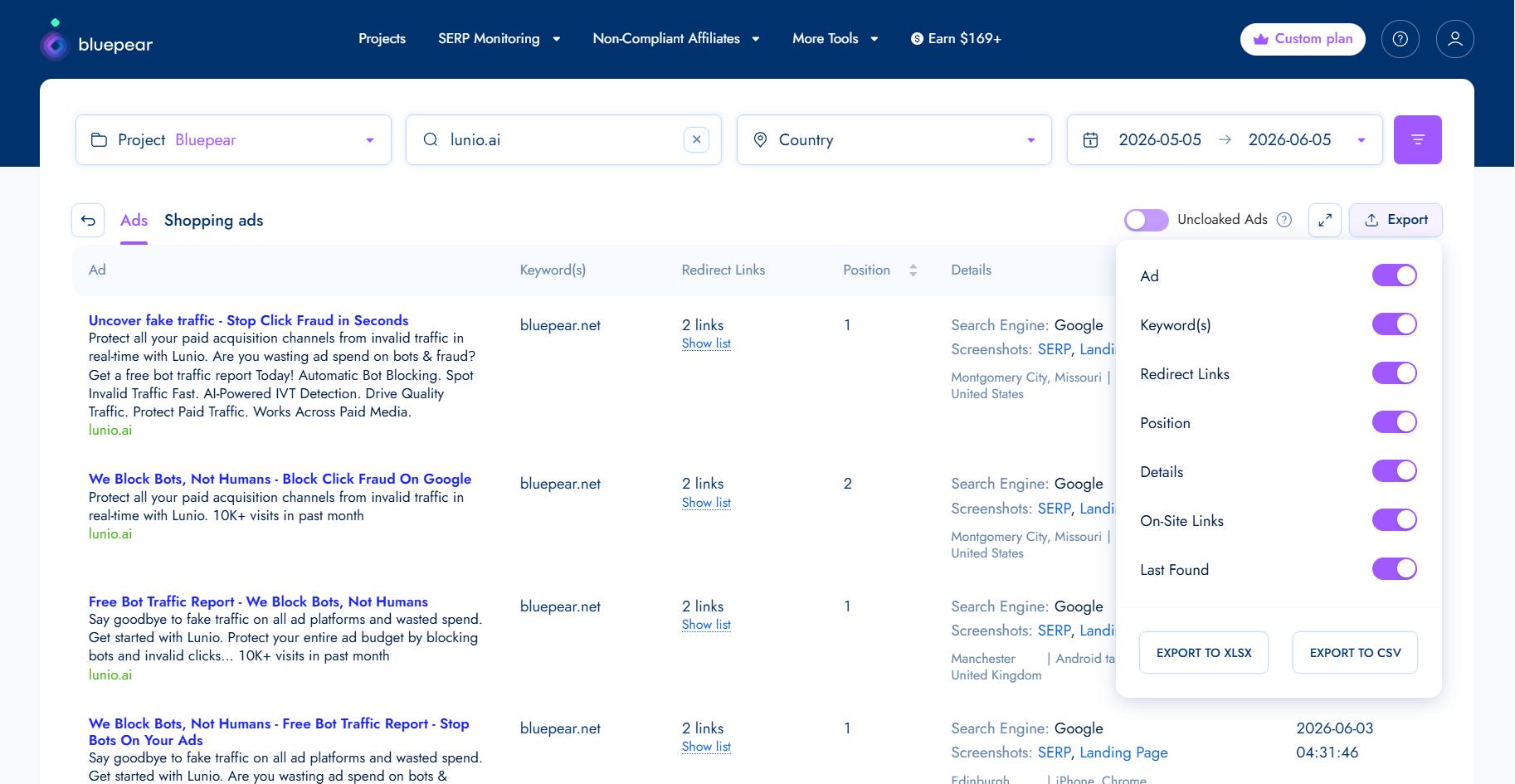
A reported ad-generation feature inside ChatGPT Ads could shorten the path from campaign setup to a usable creative variation. The important distinction is that the interface appears to generate a draft for approval, not a finished ad that bypasses advertiser judgment.
For marketers, the practical value lies in faster iteration. The corresponding risk is treating generated copy as campaign strategy rather than as a starting point that still needs brand, accuracy, and performance review.
What the reported workflow actually automates
CrushPress.AI reported that an option to generate ads appears under the ChatGPT Ads platform’s ad-creation controls. According to the report, the system produces an ad variation using the advertiser’s website and campaign settings, then presents it for review, editing, and activation.
That sequence matters. The reported interface positions artificial intelligence as a drafting layer within a conventional approval workflow. The marketer remains responsible for deciding whether the variation accurately reflects the offer, fits the campaign, and is ready to run.
The report also describes a quick duplication option. Used carefully, that could support faster variation building: an advertiser could copy an existing ad, adjust one meaningful element, and compare the result with the original. The screenshot evidence does not, however, establish how widely the generation feature is available or how its output performs.
Key takeaways
The reported tool uses website information and campaign settings to produce an ad variation.
Its workflow retains a human checkpoint before an ad is activated.
A duplication control could make structured creative variation easier, although speed alone does not create a sound experiment.
Generated copy still requires checks for factual accuracy, brand fit, campaign intent, and expected business value.
The available report shows an interface preview, not evidence of reach, output quality, or return on investment.
Where generation can help and where it cannot
Ad generation is most useful when the strategic inputs are already clear. A defined audience, offer, objective, and brand position give the system boundaries within which to draft. If those inputs are weak or inconsistent, quicker copy production can simply multiply the ambiguity.
The feature may reduce mechanical work involved in producing a first variation. It cannot determine by itself whether a claim is sufficiently supported, whether the message creates the right expectation after the click, or whether a variation addresses the campaign’s actual constraint. Those are business and editorial judgments.
The reported reliance on a website also introduces a source-quality issue. A generated ad may inherit unclear positioning, stale language, or overly broad claims from the page it uses. The output should therefore be checked against the current offer and campaign brief rather than assumed to be reliable because it originated inside the advertising platform.
A review standard for AI-generated ads
A useful approval process begins with fidelity: the ad should describe the offer accurately and avoid introducing promises that the destination page cannot support. Reviewers should then assess whether the message reflects the intended audience and campaign objective instead of merely sounding polished.
Brand review should cover voice, terminology, and the impression created by the ad as a whole. A grammatically clean variation can still be wrong for a brand if it exaggerates urgency, flattens an important distinction, or uses language the organization would not otherwise publish.
Performance review requires discipline as well. The duplication control described in the report could encourage a large volume of near-identical ads. Marketers can preserve learning value by changing a deliberate variable, recording the hypothesis behind it, and judging results against the campaign’s established success measure. Generation increases the supply of options; it does not replace experimental design.
The larger implication for campaign operations
Embedding generation directly in an ad manager reduces the distance between source material, campaign configuration, and creative production. That convenience could lead to more variations being drafted and submitted, a commercial benefit that CrushPress.AI identified as potentially helpful to OpenAI’s advertising revenue.
For advertisers, the more consequential change may be operational. As drafting becomes easier, quality control becomes the scarce capability. Teams will need clear ownership for approving claims, protecting brand standards, and deciding which variations deserve budget.
The feature should therefore be evaluated less as an autonomous creative system and more as a workflow accelerator. Its long-term usefulness will depend on whether advertisers can turn faster production into better-controlled learning rather than simply a larger inventory of ads.
AI search has no single, universal leaderboard. One source reports overwhelming ChatGPT dominance in measurable referrals from standalone AI platforms, while another argues that Meta’s reach could move search-like behavior into social feeds and conversations before an external click ever occurs.
For marketers, the useful distinction is between platforms that currently deliver observable website visits and platforms that may control where discovery begins. Treating those as separate forms of competition leads to a more resilient acquisition and measurement strategy.
Key takeaways
A referral study covering 6.77 million LLM-driven sessions attributed 92.4% of trackable standalone AI referral traffic to ChatGPT, making it the clearest near-term traffic priority.
That concentration also creates channel risk: the study reported a 50% monthly decline in total sessions during November 2025, driven largely by a sharp reduction in ChatGPT referrals.
Meta’s competitive case rests on distribution rather than demonstrated referral volume. Its AI is embedded across apps where social discovery, conversations and commercial intent already occur.
AI-search performance should therefore be evaluated across visibility, outbound referrals and post-click outcomes rather than through one market-share figure.
Traffic and distribution produce different market leaders
The ChatGPT traffic analysis measures a specific outcome: visits that arrive from standalone large-language-model platforms and can be identified as referrals. Within that boundary, the Previsible study cited by the article found that monthly LLM-driven sessions increased from 65,249 in November 2024 to 644,478 in May 2026. It assigned 92.4% of the full dataset’s trackable referral traffic to ChatGPT.
That is compelling acquisition evidence, but it is not a complete measure of AI-assisted discovery. The referral article explicitly excluded AI experiences inside Google’s search results, including AI Overviews. Its author argued that Google’s embedded AI discovery probably produces more traffic than all standalone platforms combined, although the supplied material did not provide comparable data to verify that assessment.
The Meta analysis examines a different part of the journey. Its central claim is that AI can answer questions inside Instagram, WhatsApp, Facebook or Messenger at the moment interest emerges. A product discovered in a feed, a destination discussed in a group chat or a local recommendation encountered in a community can prompt a question without the user deliberately opening a search engine or standalone chatbot.
These accounts are complementary rather than contradictory. ChatGPT can lead the measurable referral market while an embedded platform influences a much larger volume of decisions that generate no attributable visit. The competitive answer changes with the question: who sends traffic, who shapes consideration, or who owns the environment in which intent first appears?
ChatGPT’s referral lead brings both scale and volatility
The referral study presents a highly concentrated market. It reported that ChatGPT traffic grew 12.8 times over 19 months. Beneath that leader, the challengers followed sharply different paths: Claude rose from 133 sessions in November 2024 to 8,528 in May 2026 and moved ahead of Perplexity in March 2026, while Perplexity was reported to be 61% below its March 2025 peak. Copilot fell 96% from its August 2025 high, reaching 339 sessions in the reported May 2026 data.
Those figures support prioritizing ChatGPT for referral acquisition, but they also show why allocation should not be based on share alone. The study recorded a one-month decline in total LLM sessions of 50% in November 2025. It attributed most of the movement to ChatGPT referrals falling from 448,412 to 213,345 before total sessions recovered to 442,609 in December. The article interpreted the disruption as the likely result of a model or product change, not a broad decline across every platform.
For site operators, this resembles dependency on any dominant intermediary: scale and fragility arrive together. A change in citation selection, answer design or linking behavior can affect traffic even when the underlying content has not changed. Monthly referral totals therefore need platform-level and landing-page context before they can be treated as evidence of durable demand.
Smaller platforms may still matter where their behavior aligns with a site’s content. The referral analysis characterized ChatGPT and Gemini as more likely to demonstrate domain-level trust while directing users toward search-like destinations. It described Claude and Perplexity as more inclined to select particular pages and long-form material. That reported difference gives editorial businesses a reason to monitor qualified visits from smaller platforms even when their aggregate volume remains modest.
Meta could compete by absorbing the search journey
The Meta article does not provide referral data comparable with the Previsible study. Instead, it builds its case around potential access to existing audiences. It reported that Mark Zuckerberg said Meta AI had reached one billion monthly active users by May 2025. The same article cited 3.56 billion daily active people across Meta’s family of apps in March, as well as WhatsApp passing three billion monthly users in 2025 and Instagram reaching the same monthly-user threshold in September 2025.
Those audience figures establish distribution, not search share or commercial effectiveness. They do, however, identify a structural advantage: Meta can introduce AI inside established communication and content habits. The article reported that Meta AI spans feeds, chats and search across Facebook, Instagram, WhatsApp and Messenger, with uses including recommendations, travel planning, shopping inspiration and study assistance.
This model could make traditional referral measurement less representative. If an AI summarizes recommendations, compares choices or supports a purchase without sending the user to a publisher or brand site, it has participated in discovery while remaining largely invisible in referral analytics. The platform may then monetize that interaction through recommendations, subscriptions or advertising, possibilities the Meta article said the company was considering.
Meta’s reach should consequently be treated as a competitive signal rather than proof that it has overtaken established search or chatbot products. The source makes a forward-looking argument based on distribution and product direction. It does not establish how often Meta AI is used for search-like questions, how frequently its answers lead to external sites or how those visits convert.
A practical strategy separates discovery, visits and conversion
Measure the stages independently
AI visibility, attributable traffic and business outcomes answer different questions. Visibility monitoring can show whether a brand or source appears in answers. Referral analytics can identify platforms and pages that send trackable visitors. On-site analytics can then show whether those visitors search, engage, enquire or buy. Keeping the stages separate prevents a high citation rate from being mistaken for traffic, or a large referral total from being mistaken for value.
Platform and landing-page segmentation is especially important when one provider supplies most observable sessions. It can expose whether growth is broadly distributed or dependent on one answer engine, one destination template or one short-lived product behavior. It also makes room to evaluate Claude or another smaller source on visit quality rather than volume alone.
Treat destination experiences as acquisition assets
The referral study found that 28.8% of ChatGPT traffic reached internal search-results pages, with roughly one-quarter of AI-referred traffic doing so across industries. The article interpreted this pattern as domain trust combined with uncertainty about the best individual page. Whatever the mechanism, the reported behavior makes internal search part of the acquisition experience rather than merely a utility for existing visitors.
Destination priorities also vary by business model. The study reported that product pages received 43% of ecommerce LLM traffic, course pages received 52% of education traffic, and About pages received 42.1% of health traffic. These patterns suggest that product data, course information, organizational credentials and other decision-critical details should be clear on the pages AI visitors actually reach. The same source recommended making prices machine-readable where possible because opaque pricing is difficult for an AI system to compare or summarize.
Meanwhile, Meta’s embedded approach makes presence within social discovery environments relevant even when no website session follows. The immediate priority remains the channel producing measurable demand, but planning should also account for platforms that can shape a decision without appearing in conventional attribution. As AI interfaces evolve, the strongest strategy will be the one that can distinguish influence from traffic and traffic from genuine business value.
AI search visibility cannot be managed as a conventional ranking contest. Brands must influence the information environment from which AI systems construct answers, then measure how often and how persuasively they appear across varied prompts and conversations.
A useful strategy therefore connects two sides of the problem: the buyer questions that create demand and the owned, earned, community, and sponsored sources that shape an AI system’s response. The result is a measurement program designed for probabilistic visibility rather than a misleading imitation of keyword rank tracking.
Replace rank tracking with a map of buyer conversations
Traditional search reporting assumes that a query produces a results page on which a domain occupies a reasonably observable position. The source on prompt-level measurement argues that this model does not transfer cleanly to AI assistants. Responses can vary with conversation history, location, personalization, model version, retrieval availability, follow-up questions, and timing. There is consequently no single, durable equivalent of a number-one ranking.
The more defensible question is not whether a brand ranks, but how frequently it is included in commercially relevant conversations. That changes the unit of analysis from an isolated keyword to a buyer scenario. A scenario can begin with category discovery, progress through use-case evaluation and vendor comparison, and end with objections, alternatives, implementation concerns, or validation of a shortlist.
The prompt-level source recommends organizing questions by intent and grouping related variations into clusters. A category cluster, for example, can reveal broad awareness, while industry and feature clusters show whether the brand remains visible as requirements become more specific. Cluster-level patterns are more informative than the result of one carefully worded prompt.
Multi-turn testing is equally important. A company absent from an opening request may enter the answer after the buyer specifies an industry, integration, budget consideration, or operating constraint. Testing only the first response would miss that later influence and could make a relevant brand look invisible.
Build a prompt library that balances consistency and realism
A prompt library serves two purposes that need to remain distinct. Synthetic prompts provide a repeatable benchmark: the same scenarios can be tested over time, across models, or against competitors. Real customer questions provide ecological validity because actual buyers tend to supply context, combine constraints, and use less orderly language than generated test prompts.
The prompt-level measurement source suggests drawing real questions from sales calls, customer interviews, support conversations, community discussions, internal and on-site search, and AI transcripts that customers voluntarily provide. These inputs can expose needs that keyword tools or generated variations fail to represent. Synthetic prompts should establish the controlled test set, while customer evidence should continuously correct and expand it.
Each tracked scenario should carry enough context to support useful segmentation: buying stage, product category, audience or use case, industry, geography where relevant, AI system, and conversation path. The library should also preserve stable benchmark prompts while allowing a separate portion to evolve with customer language. Without that distinction, a changing score may reflect a changed test set rather than changed market visibility.
This design also prevents a common measurement error: treating the prompts that a marketing team can imagine as a representative sample of all AI use. No organization can observe every private assistant conversation. A prompt library is a strategic testing instrument, not a complete census of audience behavior.
Strengthen the information supply behind AI recommendations
Measurement identifies where a brand appears or disappears, but it does not create the underlying evidence. The strategy sources collectively point to three connected supply layers: a clearly defined brand entity, deep and accessible owned content, and corroboration from sources outside the company’s control.
Make the brand and its expertise unambiguous
The SEO-priorities source emphasizes consistent brand information across established profiles, directories, publications, and other sources that may help systems understand an entity. It specifically points to platforms such as LinkedIn, Crunchbase, Wikipedia, and relevant industry directories, while also stressing credible author identities and closer coordination between SEO and public relations.
The practical objective is consistency, not indiscriminate profile creation. The brand’s name, category, products, areas of expertise, audience, and expert authors should reinforce the same positioning wherever those details legitimately appear. Prompt testing can then reveal whether AI answers reproduce that intended position or substitute an inaccurate one.
Connect topical depth to usable site architecture
The SEO-priorities source favors comprehensive topic clusters over thin pages aimed at isolated high-volume terms. The site-architecture source adds an important structural layer: content must also be organized through understandable labels, taxonomy, wayfinding, and relationships if users and machines are to locate and interpret it effectively.
These ideas are complementary. A collection of articles does not become topical authority merely because it covers related keywords. The pages need a coherent model of the subject, clear connections, and paths that expose the most useful material. Architecture is therefore part of AI visibility, not just a usability or crawlability concern.
Distinguish earned corroboration from paid distribution
Two sources agree that signals outside the brand’s website matter, but they emphasize different routes. The SEO-priorities article focuses on earned media, unlinked mentions, and genuine participation in communities such as Reddit, Quora, and specialist forums. It argues that relevant editorial authority and authentic discussion can be more valuable than a large volume of weak links.
The paid-media article goes further, proposing that native sponsorships, detailed third-party reviews, user-generated content, podcast mentions, and baked-in video sponsorships can become durable information assets rather than disappearing with the media budget. Its central argument is that text and transcripts containing specific brand-use-case relationships may remain available to retrieval or training systems after a campaign ends.
That paid-media thesis should not be confused with proof that every placement will affect every model. It is a strategic interpretation offered by the source, and access, ingestion, retrieval, and recommendation behavior can differ between systems. Paid provenance also does not create independent consensus. Any review or sponsorship program should preserve transparent disclosure, truthful customer experience, platform compliance, and editorial integrity; otherwise it may generate abundant text but weak evidence.
Use a scorecard that separates presence, prominence, and meaning
A single visibility percentage cannot explain how an AI system positions a brand. The prompt-level source identifies several complementary dimensions that can be combined into a practical scorecard.
Measure
Question it answers
How to interpret it
Inclusion rate
In what share of tracked prompts does the brand appear?
Use as a benchmark and segment it by intent, category, audience, geography, or AI system rather than relying only on an overall average.
Response prominence
Is the brand a leading recommendation, one option among several, a late mention, or merely an alternative?
Treat prominence as influence within the answer, not as a stable search ranking.
Brand framing
Which strengths, weaknesses, differentiators, price perceptions, and ideal-customer associations recur?
Compare the observed description with intended positioning and identify unsupported or missing associations.
Sentiment and confidence
Is the brand described favorably, unfavorably, or ambiguously, and how firmly is that assessment presented?
Review the supporting language and context; a simple positive-or-negative label can hide important qualification.
Repeated observations matter because AI output is variable. A reporting period should use documented prompts, conversation paths, models, and relevant settings so later runs are meaningfully comparable. Results should still be described as observed frequencies within the test set, not as universal market share.
Traditional analytics remains useful but answers a different question. Referral visits, branded search behavior, conversions, and standard search performance can show activity reaching measurable properties. Prompt testing estimates influence inside generated answers, including journeys that may never produce a click. The two evidence streams can be reviewed together, but prompt visibility should not be presented as causal proof of revenue without a defensible attribution link.
Turn AI visibility into a cross-functional operating system
The sources collectively move AI visibility beyond the boundaries of an SEO reporting team. Content teams shape topical evidence; technical and information-architecture teams determine whether it can be found and understood; PR and community teams earn external corroboration; paid media may fund durable native content; and sales or support teams supply authentic buyer language.
A workable review cycle should connect observed prompt gaps to a specific intervention. Low discovery inclusion may indicate weak category association. Strong inclusion but inaccurate framing can point to inconsistent messaging or third-party narratives. Visibility that disappears in industry-specific follow-ups can expose a topical or evidentiary gap. Poor prominence despite frequent mentions may signal that competitors have clearer proof for the evaluated use case.
Key takeaways
Measure the frequency of inclusion across buyer scenarios instead of claiming a universal AI rank.
Combine stable synthetic benchmarks with real customer questions and multi-turn conversation paths.
Build visibility through consistent entities, coherent topic architecture, authoritative owned content, and credible external corroboration.
Track prominence, framing, sentiment, and confidence alongside basic inclusion.
Keep paid placements, earned mentions, and owned content distinct in reporting even when they support the same visibility objective.
Present prompt testing as sampled evidence, not a complete view of private AI conversations or proof of commercial attribution.
As AI interfaces, retrieval systems, and customer behavior continue to change, the strongest programs will preserve a stable measurement baseline while updating the evidence and conversation paths around it. That balance makes the strategy adaptable without making its reporting arbitrary.
The leading 2026 agency rankings do not measure a single, universal version of marketing excellence. The supplied studies examine four different markets – legal agentic search, B2B digital marketing, agentic SEO, and luxury search – using different weights, candidate pools, and definitions of success.
Read together, they reveal more than a sequence of winners. They show which agencies recur across categories, where specialists displace generalists, and why buyers should examine the scoring model before treating any position as a dependable shortlist.
Key takeaways
First Page Sage placed first in all four supplied rankings, with its integrated SEO, GEO, content, and agentic-search approach cited repeatedly.
The runner-up changed with the market: Genevate rose in agentic and legal search, Driven Metrics performed well in B2B and performance-oriented categories, and Amsive ranked second for luxury brands.
Different weighting systems materially affect the results. Luxury experience carried the most weight in the luxury study, while AI visibility led the agentic SEO methodology.
A recurring appearance is a useful signal of breadth, but a category specialist may still be the stronger choice when industry knowledge, technical scale, creative positioning, or budget is decisive.
Because the publisher’s namesake agency ranked itself first in every supplied article, the results should be treated as publisher-reported evaluations rather than independent certifications.
Four rankings built to answer different questions
The studies used broadly similar ingredients, including expertise, client history, leadership, reviews, and AI visibility. The proportions assigned to those ingredients were not consistent, however. Even the size and timing of the reviewed fields differed.
Ranking lens
Reported review scope
Most influential criteria
Reported top three
Legal ASO
31 agencies reviewed over three months ending in June 2026
Average reviews, 25%; ASO expertise, 20%; leadership experience, 20%
AI visibility, 30%; SEO, GEO, and ASO expertise, 25%; notable clients, 20%
First Page Sage, Genevate, Driven Metrics
Luxury SEO
More than 90 agencies reviewed from January through June 2026
Notable luxury clients, 35%; GEO/SEO expertise, 25%; AI visibility and leadership, 15% each
First Page Sage, Amsive, Relevance Digital
Those methodological differences explain why the tables should not be merged into a simple overall league table. A luxury agency can gain substantial ground through category-specific clients, while an agentic SEO contender receives more credit for appearing in AI citations. The legal study also introduces factors not used in the other rankings, including year established and estimated media references.
The numerical scores are not necessarily interchangeable either. Genevate received a 4.6 average review score in the legal ranking and 4.8 in the agentic SEO ranking. Focus Digital received 4.7 in the legal study and 4.8 in the B2B article. The sources do not provide enough underlying review data to determine whether those differences came from timing, platform coverage, normalization, or another methodological choice.
Where the rankings converge – and where they do not
First Page Sage is the clearest point of convergence. It placed first in every supplied study and received a 5.0 expertise score under each category’s relevant formulation: legal ASO expertise, B2B SEO/GEO expertise, agentic SEO-GEO-ASO expertise, and luxury GEO/SEO expertise. The three rankings that scored AI visibility gave it 4.9, while all four reported leadership at 4.8 and average reviews at 4.9.
The articles consistently attributed that performance to an approach combining long-form thought leadership, traditional organic search, generative-engine visibility, and signals intended to influence AI recommendations. The legal article placed additional emphasis on an AI belief audit and optimization across stages of an agent’s selection process. The B2B and luxury articles focused more heavily on content that can serve both conventional search results and AI-generated answers.
That consistency is noteworthy within the publisher’s framework, but it is not independent corroboration. All four supplied articles appear on the First Page Sage Blog, and each places First Page Sage at the top. Buyers should therefore verify the methodology, supporting case data, and fit through their own diligence.
Recurring agency
Positions in the supplied rankings
Cross-list signal
Source-reported caveats
First Page Sage
First in legal, B2B, agentic SEO, and luxury
Integrated SEO, GEO, ASO, and thought-leadership model
The legal review summary said the investment may require patience; the rankings are published by its namesake blog
Driven Metrics
Third in legal, second in B2B, third in agentic SEO
Performance measurement, conversion tracking, and an SMB or mid-market orientation
The sources described a shorter operating history, a data-intensive process, and more limited experience in some sectors
Genevate
Second in legal and second in agentic SEO
GEO-first work involving AI audits, reputation signals, and digital PR
Founded in 2025, with boutique capacity and a narrower service mix than a full-service agency
Focus Digital
Fourth in legal and third in B2B
More accessible SEO and GEO support with technical attention to LLM citations
The legal article described a more templated model; the B2B article noted narrower portfolio depth and slower replies during busy periods
An absence from one of the shortlists should not be read as a failing grade. Each article published only five, six, or eight finalists, and the sources do not disclose enough common data to determine how an unlisted agency performed outside its relevant category.
Specialization changes the meaning of a strong agency
Agentic-search specialists
The legal and agentic studies favored firms with explicitly defined AI-search services. Genevate’s high positions were tied to audits of how AI systems describe a brand, external authority signals, and PR-led narrative work. Driven Metrics appeared across both of those lists as well as B2B, but the articles framed it as a more measurement-oriented option with a practical SEO and GEO foundation.
The distinction matters because the sources use ASO to mean Agentic Search Optimization, not simply visibility in a generated answer. Their framing extends the objective from being retrieved or cited to being evaluated, recommended, and potentially selected by an AI agent.
Enterprise and integrated operators
Large organizations may value capabilities that do not dominate an AI-specialist scorecard. The agentic SEO article ranked Seer Interactive fourth and emphasized its enterprise analytics, large-site architecture experience, technical implementation at scale, and published AI-search experiments. The luxury article placed Amsive second on the strength of enterprise SEO and an intentionally developed LLM-optimization practice, while also noting its narrower luxury portfolio.
The B2B list introduced another kind of breadth. REQ was positioned as an integrated communications, authority-building, and demand-generation partner whose GEO practice was less mature than its wider SEO foundation. AMP Agency and Viral Nation appeared farther down that ranking for broader media, creative, and influencer capabilities rather than category-leading search specialization.
Vertical and brand specialists
The luxury table demonstrates why domain fit can reorder a shortlist. Relevance Digital ranked third because of its exclusive focus on ultra-luxury brands and ultra-high-net-worth audiences, despite lower GEO and AI-visibility scores than the two agencies above it. Hudson Rouge ranked fourth as a creative and storytelling specialist, while Amra & Elma ranked fifth with luxury social-media and influencer experience but a developing GEO offering.
Legal marketing creates a different fit test. The legal ranking gave credit for recognized law-firm clients, legal-sector leadership, operating history, and media references in addition to AI-search capability. Consultwebs, 9Sail, and Legal Guardian Digital consequently appeared in that top eight even though they were absent from the broader B2B and agentic shortlists supplied here.
How buyers can turn rankings into a defensible shortlist
Start with the commercial outcome
A buyer should first decide whether the priority is organic traffic, AI citations, inclusion in recommendations, qualified pipeline, signed cases, brand prestige, or a combination. The correct weighting follows from that decision. For example, the legal article credited Driven Metrics with connecting AI-platform selections to consultations and signed cases, while the B2B article emphasized weekly synchronization and reporting tied to leads. Those claims are more relevant to a performance-led brief than a ranking based primarily on creative reputation.
Rebuild the scorecard for the actual market
The published weights can serve as templates, but buyers need not inherit them. A technically complex enterprise site may assign more importance to architecture, analytics, and implementation capacity. A law firm may emphasize jurisdictional accuracy and intake outcomes. A luxury brand may prioritize category experience and preservation of brand positioning. Recalculating the criteria can change the order without disputing any source’s reported scores.
Request evidence behind AI-visibility claims
An AI visibility score is meaningful only when its measurement process is clear. Diligence should establish which platforms were tested, what prompts were used, whether queries were branded or non-branded, how citations and recommendations were distinguished, and how frequently the test set was repeated. Buyers should also ask whether reported gains corresponded with qualified visits, leads, revenue, or another business outcome.
Test operational fit before accepting numerical fit
The source-reported caveats are as useful as the positions. Boutique capacity, slower responses during busy periods, extensive client-input requirements, limited sector history, and diluted senior attention can each affect a campaign. Reference calls and a clearly scoped pilot can help determine whether the people, workflow, and measurement discipline behind a score are suitable for the buyer’s organization.
As conventional SEO, generative discovery, and agent-led selection become more interconnected, useful agency comparisons will need to measure both visibility and business consequence. The strongest future scorecards will make their evidence reproducible and show not only where a brand appeared, but what happened after it was found.
Google Ads optimization is becoming less about adjusting isolated bids or keywords and more about designing the environment in which automation makes decisions. Campaign structure, audience eligibility, creative coverage, brand protection and post-click validation now influence whether Google’s systems receive useful signals and operate within acceptable boundaries.
Taken together, the source reports suggest a practical shift in the advertiser’s role: automation can handle more execution, but advertisers must become better architects, auditors and risk managers. The central challenge is deciding what to consolidate for stronger learning, what to separate for business control and what to verify outside the platform.
AI is expanding the surface area of optimization
Google’s automation affects at least three layers of a paid search program. It interprets account signals to make bidding and targeting decisions, distributes campaigns across inventory, and may increasingly influence how an ad is presented to the searcher. Optimizing only the visible ad therefore addresses just one part of the system.
The account-structure report describes each campaign as a data container. Its argument is that excessive segmentation can divide conversion evidence among campaigns that individually lack enough volume for stable Smart Bidding. The article offers roughly 30 to 50 monthly conversions per campaign as a practitioner benchmark for meaningful learning, rather than an independently verified or universal threshold. It also warns that repeated structural and bidding changes can prolong learning periods.
At the delivery layer, the report on Performance Max Channel Diagnostics says advertisers can inspect missing or disapproved assets across channels from Insights & Reports > Channel Performance. The feature reportedly identifies gaps involving assets such as headlines, descriptions and images, helping explain why a campaign may not be eligible to serve across parts of Google’s inventory. This adds useful visibility, although it does not by itself establish whether every eligible channel is valuable for the advertiser.
A separate report describes a more consequential experiment: AI-generated summaries appearing beneath some paid search ads. According to that source, the summaries were accompanied by a warning that the independently generated response could contain mistakes. Google had not publicly announced the test or explained its inputs, scope or advertiser controls when the article was written. It should therefore be treated as a limited, unresolved experiment, not an established product rollout.
The experiment nevertheless exposes a new optimization question. If a platform-generated explanation can sit close to sponsored copy, ad quality is no longer determined solely by the text an advertiser submits. Landing-page clarity, factual consistency and the way an offer could be summarized may also affect how users interpret the result.
Account architecture must balance learning with control
Consolidation can strengthen automated bidding by placing more relevant evidence in the same campaign, but consolidation is not an end in itself. Campaign boundaries still determine budgets, goals, exclusions and reporting. The useful question is not whether an account has few or many campaigns; it is whether every boundary represents a real business distinction that automation should respect.
The structure article argues that legacy patterns such as numerous low-volume campaigns or single-keyword ad groups can scatter data and slow learning. It also says bidding signals do not freely transfer between campaigns, even when campaigns share a conversion goal. On that reasoning, separating campaigns by match type, minor product variation or organizational preference can impose a learning cost without delivering a corresponding control benefit.
Performance Max requires a more nuanced version of the same decision. The source recommends coherent asset groups organized around meaningful product, service, audience-intent or creative themes. At the campaign level, it warns that Performance Max can overlap with Search, including branded demand, making attribution and incremental value harder to interpret. It identifies negative keywords, brand exclusions and clearer audience or goal boundaries as ways to reduce unwanted overlap.
Channel Diagnostics complements this architecture work by showing whether asset omissions are constraining delivery. Teams can use the reported diagnostics to distinguish a structural decision from an accidental eligibility problem. A campaign intentionally designed for a limited role is different from one that fails to enter a channel because a required asset is absent or disapproved.
The resulting principle is selective consolidation: pool data where products, economics and conversion objectives are genuinely compatible, while preserving boundaries where budgets, brand terms, geographic economics or customer value require separate control. This gives automation enough evidence without handing it an ambiguous objective.
Brand defense and traffic quality expose automation’s limits
Two of the source articles focus on different threats, but they point to the same operational lesson: platform metrics cannot always reveal why apparently relevant traffic is becoming less valuable. Competitor interception can alter who receives branded demand, while invalid activity can inflate clicks without producing corresponding human engagement.
The branded-traffic defense report describes several mechanisms that may remain within normal auction or policy processes. Dynamic keyword insertion can reportedly place a searched brand name into a competitor’s headline even when the advertiser did not manually write that trademark into the ad. Competitors can also bid on modifier queries involving alternatives, pricing, reviews or comparisons while keeping their ad copy generic. A comparison landing page can then deliver the competitive positioning after the click.
These mechanisms require a segmented response. The source recommends treating exact-brand searches separately from comparison-oriented modifier queries and monitoring Auction Insights for each intent group. It also distinguishes direct trademark use in ad copy, which may justify Google’s trademark complaint process, from lawful modifier bidding or comparison positioning, which usually calls for a PPC and search-results strategy rather than immediate legal escalation.
Detection also has to extend beyond the account interface. The branded-search article says dynamic insertion may only become visible through direct search-results inspection and that manual checks can miss campaigns constrained by geography, device or schedule. Its suggested response combines broader monitoring with stronger owned and third-party visibility around alternative, review and comparison searches.
The invalid-click case study presents a different use of platform controls. In one account advertising book editing and ghostwriting services, the source reported invalid click rates of 60% to 80%, unusually high search-term click-through rates and substantially fewer analytics sessions than Google Ads clicks. It said third-party fraud tools produced no measurable improvement and that Google maintained it had already detected the suspicious activity for which the account should not be charged.
The practitioner then added 540 Google-defined audience segments to Search campaigns in Targeting mode. According to the case study, the reported invalid-click rate fell by 50% and conversion performance returned to a profitable level. The proposed explanation was that rotating fraudulent traffic might be less likely to carry the behavioral signals required for membership in Google’s predefined audiences.
That outcome is useful as a hypothesis, not a general prescription. It came from one account, and the test does not establish that every excluded user was fraudulent or that the mechanism will transfer to other markets. Targeting mode restricts eligibility to searchers who both match the keyword criteria and belong to a selected audience; Observation mode does not. The source explicitly warns that this approach can block legitimate searchers and recommends considering it only when invalid activity is unusually severe.
Both cases show why optimization needs independent validation. Search-results inspections can reveal competitive presentation that aggregate reports obscure. Session analytics and behavior recordings can expose a gap between billed or recorded clicks and meaningful visits. Neither source suggests abandoning Google’s automation; each instead shows the value of testing whether the traffic and presentation produced by that automation match business reality.
Key takeaways
Treat campaign structure as an input to machine learning, not merely an account-organizing convention.
Consolidate compatible conversion data, but retain boundaries that protect distinct budgets, economics, goals and branded demand.
Use Performance Max diagnostics to find asset-related eligibility gaps, then evaluate whether the additional delivery supports the campaign’s intended role.
Validate branded auctions and traffic quality outside standard campaign summaries through search-results checks, analytics comparisons and behavior evidence.
Reserve restrictive audience targeting for exceptional invalid-traffic cases because it can reduce fraud-like activity and legitimate reach at the same time.
Prepare for a presentation layer in which Google-generated text may influence how users interpret advertiser-controlled copy and landing pages.
An operating model for the next phase of Google Ads
Stabilize the signal system
The first priority is to map campaigns to genuine business objectives and remove segmentation that exists only because it was useful under older manual-bidding practices. Conversion definitions, values and campaign boundaries should be examined together. Structural changes should then be made deliberately enough that their effects can be observed without constant resets and overlapping interventions.
Define where automation may operate
Search, Performance Max and audience targeting each expand or restrict eligibility in different ways. Brand exclusions, negative keywords, budget separation and audience settings should express intentional rules about which demand each campaign is allowed to capture. Diagnostics can help identify accidental restrictions, while query and auction monitoring can expose accidental expansion.
Audit the experience beyond the dashboard
Advertisers should compare ad-platform outcomes with the search results users encounter, the sessions analytics systems record and the behavior seen after a click. If AI-generated ad context expands, landing pages will also need review for factual clarity and summarization risk. The goal is to identify discrepancies early, before automation turns a weak signal, competitive loophole or presentation error into a scaled performance problem.
As Google assumes more responsibility for bidding, distribution and potentially ad interpretation, durable performance will depend on well-designed constraints and evidence from outside the automated system. The next advantage is likely to come from making automation easier to audit, not merely giving it more room to run.
Three Google updates reported by CrushPress.AI affect different points in a publisher’s measurement workflow: assessing search demand, checking whether pages can appear in search, and tracking visits after a click.
Together, the changes make some analysis easier, but they also underline an important distinction: demand, indexability, and on-site traffic are separate signals. Publishers need to read them in sequence rather than treating any one report as a complete account of search performance.
Key takeaways
Google Trends now offers preceding-period comparisons that can put changes in search interest into context.
Search Console’s page indexing report resumed updating after a reported three-week delay, restoring fresher diagnostic information.
Google Search now sends AMP visitors to publisher-hosted pages instead of presenting cached pages within Google’s AMP viewer.
Google reportedly characterized the AMP change as a delivery and measurement update, not a ranking change.
Google Trends adds context before content decisions
Google Trends sits near the beginning of the measurement process. It indicates relative search interest, helping publishers evaluate whether attention around a term or topic is gaining momentum, declining, or following a recurring pattern.
CrushPress.AI reported that new controls above the Trends timeline can surface changes for periods such as week over week, month over month, and selected year-over-year comparisons. A preceding period can also be overlaid on the chart with a comparison line. This reduces the work required to establish a historical baseline before interpreting a movement.
The practical benefit is better timing context. A rise in current interest is more meaningful when compared with the immediately preceding interval, while a year-over-year view can help reveal whether apparent momentum may instead reflect seasonality. Trends still addresses audience interest rather than the performance of a publisher’s individual pages, so its findings should guide investigation rather than serve as traffic or ranking evidence.
Fresh indexing data restores a missing diagnostic layer
Search Console answers a different question: whether Google can find and index pages on a particular site. Its page indexing report separates indexed and non-indexed pages, provides reasons pages may not be indexed, and can display impressions alongside the indexing chart, according to the source report.
CrushPress.AI reported that this report had remained stuck on June 11, 2026, for roughly three weeks. As of Friday, July 3, it was displaying information through June 29. The refresh matters because an outdated diagnostic view can make a recent publishing, crawling, or indexing problem difficult to distinguish from reporting latency.
The episode also offers a measurement caution. When a reporting interface is delayed, the age of its latest data should be checked before teams infer that a recent technical change caused an indexing movement. With fresher data available, publishers can return to examining affected pages and the reasons Search Console assigns, while still separating reporting status from the underlying indexing status.
Direct AMP visits simplify the post-click measurement path
The AMP update concerns what happens after a searcher selects a result. CrushPress.AI reported that Google Search now directs AMP users to the publisher-hosted AMP page rather than a cached version displayed through Google’s AMP viewer. Google told the publication that the change should simplify analytics and tracking while reducing some maintenance associated with supporting AMP content.
This shift can make the measurement path easier to understand because the destination is again the publisher’s own host. It does not, however, establish that AMP pages will gain more visibility. The report explicitly said Google described the change as unrelated to ranking and said the serving and ranking treatment of AMP in Search and Discover would remain the same.
The distinction is especially important because AMP’s broader search role has already diminished. The source noted that AMP no longer receives preferential treatment in Top Stories and that such pages are encountered less often than before. The update therefore looks less like a revival of AMP as an SEO advantage and more like a cleanup of delivery, ownership, and analytics for publishers that continue to use the format.
A more coherent search measurement workflow
Read together, the updates describe three successive layers of analysis. Trends helps establish whether an audience is searching for a subject. Search Console helps determine whether relevant pages are eligible to be discovered through indexing. Publisher analytics then records what visitors do after reaching the site, with the new AMP routing potentially making that last step less complicated.
This sequence helps prevent common category errors. Increasing search interest does not prove that a site is indexed for the topic. Successful indexing does not guarantee impressions or visits. Cleaner AMP analytics does not indicate a ranking improvement. When the signals diverge, teams can investigate the layer where the break occurs instead of forcing all three into a single performance narrative.
Publishers should watch whether the refreshed reports remain timely and whether direct AMP delivery produces cleaner on-site data in practice. The durable opportunity is a measurement process that connects market demand, technical visibility, and owned-site behavior while preserving the limits of each signal.
AI search visibility is not a single contest for a single ranking. A brand can supply a fact without receiving credit, earn a citation without being recommended, or appear in an answer without generating a visit. The practical challenge is to build authority that survives across those different outcomes.
The source research points to a connected strategy: follow shifting demand, create evidence that cannot be easily replicated, make that evidence easy to extract and attribute, clarify the entities behind it, and measure what people do after an AI mention.
AI visibility is a funnel, not a ranking
Three outcomes are often grouped under “AI visibility,” although they answer different business questions. A citation identifies a page or domain as a source. A brand mention places the company or product inside the generated answer, with or without a link. Downstream behavior covers what happens next, including branded searches, site visits, browsing, and engagement.
Try Profound’s discussion of the “AI mention effect” concentrates on that third layer. Its premise is that visibility inside an AI response should be connected to subsequent user behavior rather than treated as an endpoint. This matters because an AI-generated recommendation can influence a decision even when the user does not click immediately or when the cited source and recommended brand are different entities.
The appropriate success measure therefore depends on the query. For an informational question that an assistant can answer completely, inclusion and attribution may represent most of the available opportunity. For a product or service comparison, a mention can create a new search for the brand, its pricing, reviews, documentation, or product pages. Search Engine Land’s analysis of more than 1 million keywords similarly argued that SaaS and lifestyle queries can retain a downstream search step, while some HealthTech and FinTech questions can end inside the AI interface.
A useful measurement model keeps these stages separate: presence in the answer, citation ownership, the way the brand is represented, and observable activity after exposure. Combining them into one visibility score can conceal an important failure, such as frequently supplying information while another publisher receives the citation.
Search demand is moving unevenly across queries and categories
The broad narrative that AI is simply eliminating search is not supported by the keyword analysis supplied here. Search Engine Land reported that a study of 1,010,848 high-volume keywords across 379 brands and eight verticals found 29% of search volume in measurable decline. Yet the declining keyword set represented about 10.29 billion monthly searches, while growing keywords represented about 10.31 billion. Across a dataset covering 35.4 billion monthly searches, the reported net change was an increase of 16.8 million searches per month.
Those aggregate figures mask substantial differences. The same analysis reported a 37.7% decline for FinTech and a 15.2% decline for Lifestyle. It also found that 90% of tracked search volume was non-branded, including 99.6% in HealthTech and 98.5% in Wellness. Non-branded informational demand is especially exposed because an assistant can often complete the exchange without sending the user to a separate website.
Consumer behavior in the study also looked additive rather than purely substitutive: 70% of surveyed consumers said they were using AI more, but only 17% said they were using traditional search less. The reported survey covered 1,004 U.S. consumers, so it should be read as evidence from that sample rather than a universal forecast.
The strategic implication is not to abandon conventional SEO or apply one forecast to every market. Brands need to distinguish declining generic questions from growing discovery paths and from branded queries that may occur after an AI recommendation. In information-heavy categories, authority inside the answer becomes more important. In categories with a natural evaluation or transaction step, AI mentions, organic rankings, reviews, and branded search can reinforce one another.
Citation selection changes with reasoning depth and buyer intent
A brand’s presence in one AI answer does not establish durable authority. Search Engine Land reported that a Semrush and Kevin Indig test produced only 25.6% overlap between domains cited by ChatGPT in minimal- and high-reasoning modes for the same prompts. The study used 100 prompts across 20 buyer journeys in B2B SaaS, finance, consumer technology, and health and lifestyle, with each prompt run once in each mode.
High reasoning searched more widely in that experiment. It conducted 1,130 web searches compared with 245 in minimal reasoning, while the share of responses containing citations increased from 50% to 68%. Cited responses used an average of 4.5 citations in high reasoning and 2.6 in minimal reasoning. These figures come from a bounded test rather than a complete description of ChatGPT, but they illustrate how a change in answer process can rearrange the source set.
The source mix also changed. Reddit’s reported citation share fell from 15% to 7%, and user-generated content and review sites declined from 14.3% to 6%. Government and academic sources rose from 1.9% to 8.8%, while official documentation and support pages increased from 12.4% to 17.5%. The result does not make community content irrelevant; it suggests that deeper reasoning may place more weight on sources capable of verifying detailed claims.
Comparison prompts created the widest retrieval task. High reasoning averaged 24 subqueries and 9.8 citations at that stage, versus 5.5 subqueries and 5.8 citations in minimal reasoning. A single buying question can therefore break into searches for pricing, integrations, security, support, specifications, and documentation. A polished landing page alone is unlikely to answer every part of that research path.
Authority should consequently be tested across both reasoning depth and buyer intent. The same study found four of 20 high-reasoning journeys in which a brand cited at the problem stage remained visible through selection; minimal reasoning produced no such full-journey persistence. Although the sample is small, the result frames continuity as a more demanding benchmark than winning an isolated prompt.
An authority system needs evidence, extraction, identity, and corroboration
Publish evidence the brand is qualified to originate
First-party product, usage, pricing, or customer data can give a page information that generic commentary cannot reproduce. Search Engine Land cited an On-Page.ai study of 150 top-three Google pages across 50 keywords and 10 verticals. Pages with no more than one unique figure averaged an information-gain score of 40.2, while pages with at least 15 unique figures averaged 62.1. The study concerned conventional organic results rather than AI citations, so it supports an originality argument without proving that proprietary data automatically earns AI attribution.
An executive perspective in First Page Sage’s interview with Thesis founder Dan Freed reaches a compatible conclusion from a different angle. Freed argued that authority depends on checkable substance such as named mechanisms, specific ingredient forms, studies, and customer data. That is a founder’s stated philosophy rather than independent validation of the products discussed, but it illustrates what defensible specificity looks like in a category filled with broad claims.
Make important claims easy to extract
Original ownership does not guarantee citation ownership. An aggregator can restate a benchmark more clearly and become the source an AI system selects. In a separate analysis of 18,012 verified ChatGPT citations, Search Engine Land reported that 44.2% came from the first 30% of a page. The 10% to 20% band attracted the most citations across seven verticals, while the final 10% accounted for only 2.4% to 4.4%.
Those findings favor an answer-ready research structure: surface the principal result early, define the metric beside it, state the population and comparison, and provide a compact methodology. The percentages should not be treated as a universal page-design formula, but the broader lesson is robust: a buried or undefined number is harder to retrieve and attribute confidently.
Clarify the entities and relationships behind each claim
The GraphRAG account adds an identity layer to the content problem. As described by Search Engine Land, GraphRAG supplements text retrieval with a knowledge graph whose nodes represent entities and whose edges represent relationships such as a company offering a product, holding a certification, or operating in a region. Entity resolution can consolidate alternate names instead of scattering signals across several apparent identities.
This helps explain why strong prose may still be passed over for a complex question. A retrieval system needs to determine not only that several facts are relevant, but that they apply to the same company, product, person, place, and time. Consistent naming, explicit authorship, clear product-company relationships, qualified claims, and supporting documentation reduce the amount of inference required. The GraphRAG article characterizes this as a response to disambiguation, attribution, and relationship problems, not merely a call to produce more content.
Build corroboration beyond the original page
A primary source still benefits when reputable third parties discuss its research accurately, even if one of those publishers occasionally receives the direct citation. External coverage can reinforce the association between the brand, its evidence, and the topic. Official documentation supports verification; independent reporting supplies corroboration; and community discussion can reveal real-world experience. The reasoning-mode study indicates that their relative weight may change by prompt, category, and answer process.
Measurement should follow the same layered design. Prompt tracking can show whether a brand is mentioned, cited, represented correctly, and carried across buyer-journey stages. Web analytics and search data can then test for visits, branded demand, and engagement after exposure. No single metric establishes causation on its own, but the combined evidence is more useful than treating citation count as the final business outcome.
Key takeaways
Separate citations, brand mentions, representation, and downstream behavior; each measures a different part of AI visibility.
Audit demand by query type and vertical because AI exposure is much greater for some informational and non-branded searches than for transactional paths.
Test visibility across reasoning modes and buyer stages instead of assuming that one successful prompt represents durable authority.
Publish defensible first-party evidence, then surface its result, definition, scope, and methodology where retrieval systems can find them.
Use consistent entities, explicit relationships, official documentation, and credible external corroboration to make claims easier to verify and attribute.
The next advantage in AI search will come less from chasing a fixed citation formula than from building a body of evidence that remains identifiable, retrievable, and credible as interfaces and retrieval methods change.
I know competitive brand bidding is now a common PPC tactic, but that does not mean I treat it as harmless background noise. When competitors, affiliates, coupon sites, or misleading advertisers show up on branded searches, they can inflate CPCs, divert high-intent traffic, and confuse people who were already looking for my brand.
I have seen how much difference visibility can make. Industry examples show that brands often uncover meaningful CPC inflation once they start tracking competitor bidding, affiliate activity, and trademark misuse. In documented cases, brands reduced branded CPCs by 25% to 75% after identifying infringing advertisers and enforcing their policies.
In this guide, I walk through how I monitor branded keywords, identify who is advertising on them, and decide what actions may be available based on the evidence I find.
Choosing Keywords So I Do Not Miss Hidden Activity
When I want to find out who is using my brand in search ads, I start by deciding which keywords I need to monitor.
The biggest mistake I try to avoid is watching only my exact brand name. That is a useful starting point, but it rarely shows the full picture. Some advertisers deliberately target brand-related coupon, discount, review, or alternative queries because those searches often come from high-intent users and attract less scrutiny.
For example, someone searching for “Brand coupon” or “Brand discount code” may be much closer to buying than someone searching for the brand alone. Those queries often attract coupon affiliates, loyalty sites, and unauthorized advertisers trying to intercept branded traffic.
I also pay attention to searches that include terms like “reviews” or “alternatives,” because those queries can bring in competitors and comparison sites that position themselves directly against my brand.
Misspellings matter too. Some advertisers target spelling variations because they are less likely to be monitored and may face less competition.
For a solid monitoring setup, I include my core brand name, “official page” and “login” variations, coupon and promo-code searches, review and alternative searches, commercial terms such as “buy,” “order,” and “sign up,” common misspellings, and localized versions of my brand name.
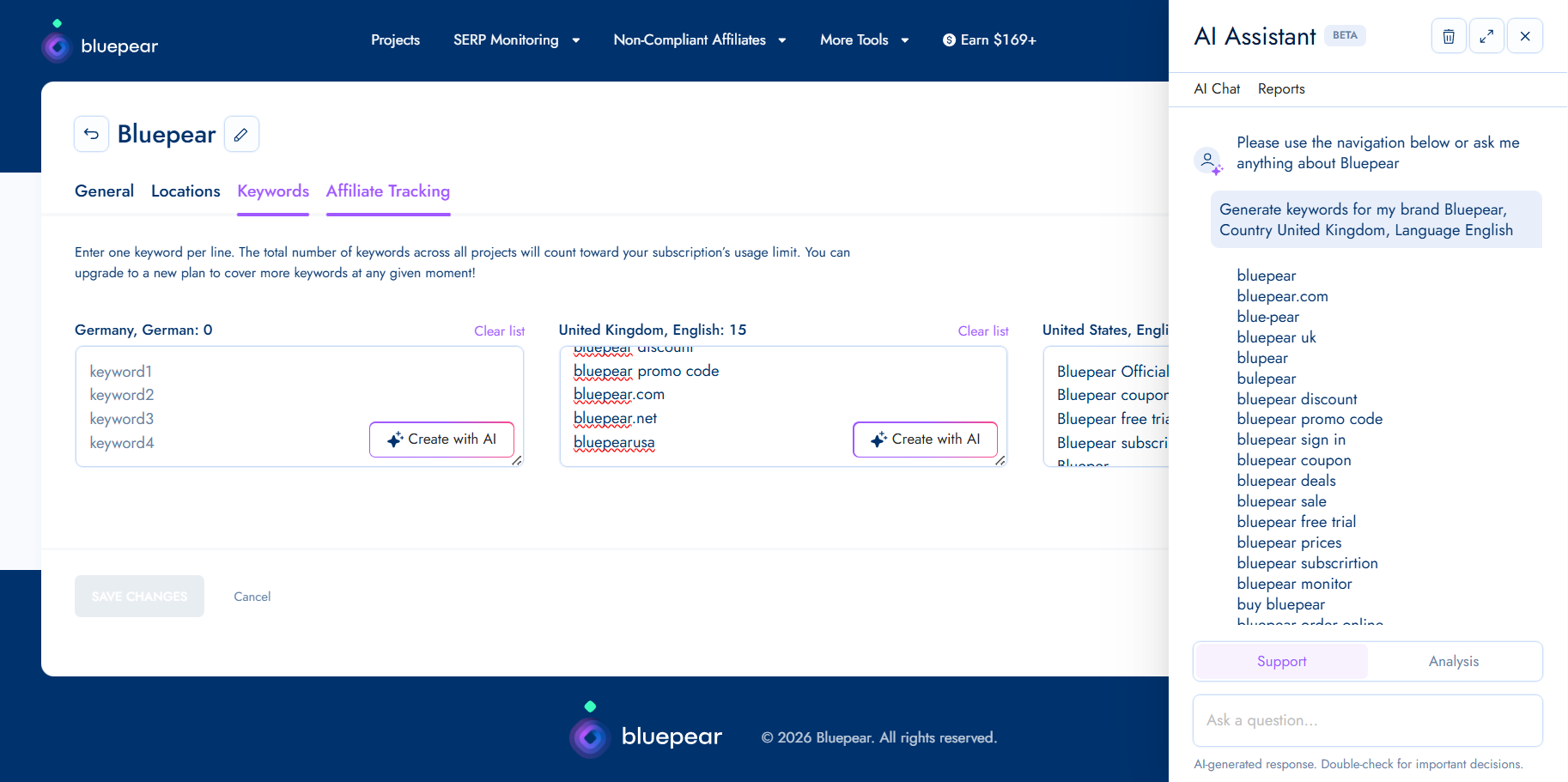
If I am using Bluepear, its built-in AI assistant can generate keyword suggestions from this kind of list and help me expand coverage faster.
The number of terms I monitor depends on the size of the brand portfolio, including trademarks, local branches, and product names. For many small to medium-sized brands, I would start with about 20 keywords and then expand as new risks, markets, and opportunities appear.
Choosing Locations and Monitoring Frequency
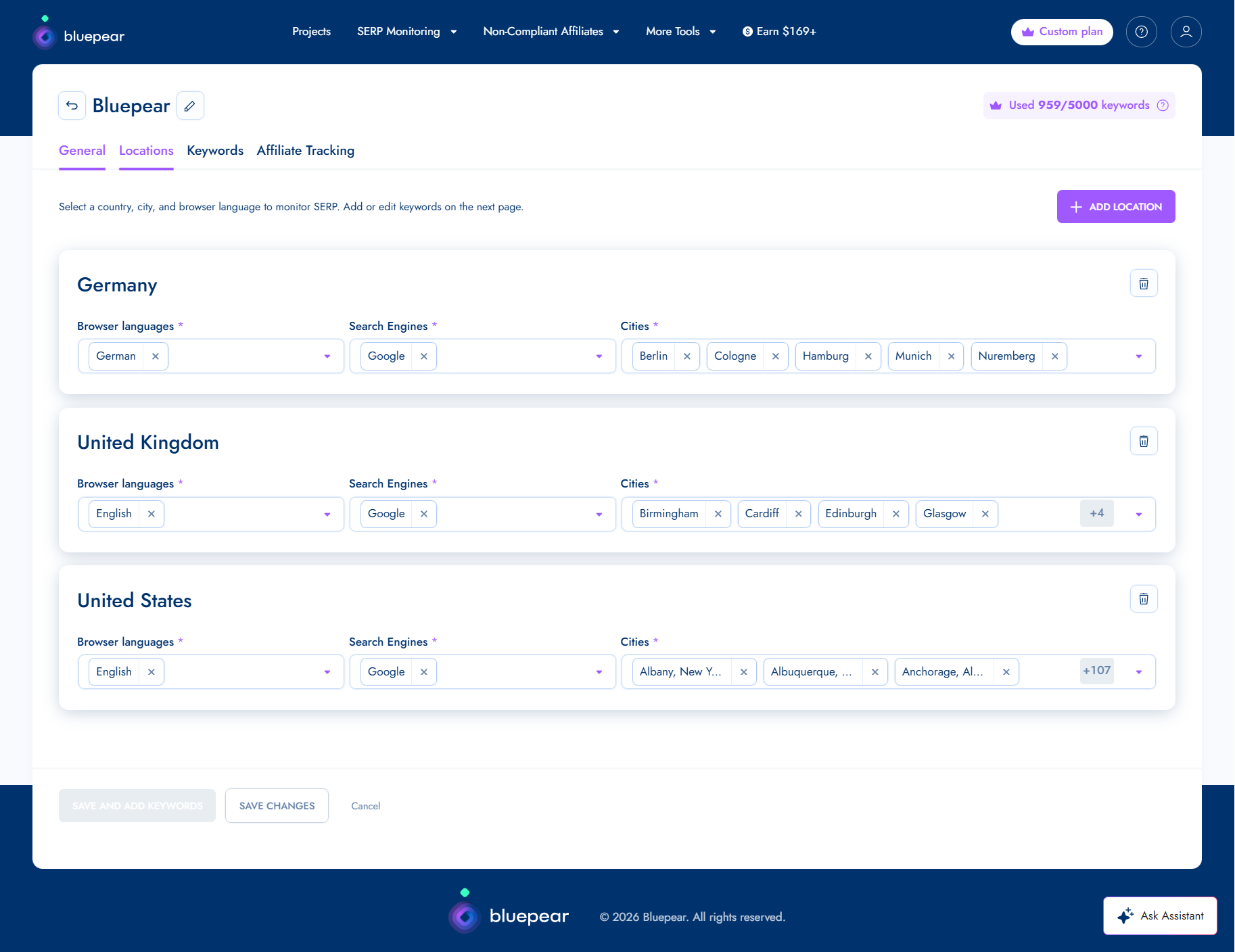
I do not rely on a single search from my office, on my device, at one moment in time. Search results are too dynamic for that. Two people searching the same branded keyword can see completely different ads and organic listings depending on their location, device, timing, and other variables.
I also assume that some advertisers may be trying to hide their activity. A fraudster or an affiliate violating my PPC policy might run ads outside normal business hours to reduce the chance of being caught. If I only check manually during the workday, I may never see those ads.
When I monitor branded search results, I look across the countries and markets where my brand operates, regional differences within those markets, mobile and desktop results, different times of day, and weekday versus weekend activity.
Frequency matters just as much as coverage. Some violations appear briefly and then disappear. Running checks multiple times throughout the day gives me a better chance of capturing activity that would otherwise go unnoticed.
Tracking all of these variables manually can become tedious, especially when a brand operates across multiple markets. Bluepear accounts for locations, devices, time zones, and redirects that can obscure the true destination of traffic. I can set the parameters once and gain continuous visibility without turning monitoring into a weekly time sink.
Reviewing Search Results and Recording Evidence
I do not assume every advertiser bidding on my branded keywords is breaking a rule. Competitors may be allowed to bid on branded keywords if they do not use my trademark in their ad copy. Affiliates may also be authorized to promote my brand under specific program conditions.
Still, I need to know when an advertiser’s behavior crosses the line from legitimate brand bidding into trademark misuse, policy violations, or customer deception.
The first signal I investigate is trademark use in ad copy. If the ad mentions my brand name in the headline or description, and my trademark rules or affiliate policies restrict that use, I treat it as a possible compliance issue.
I also look for misleading claims. Phrases that imply the advertiser is “official,” references to exclusive offers, or language that suggests authorization when none exists can confuse users and deserve review.
Coupon and discount promotions need special attention. I verify whether the advertised discount, promo code, or offer is legitimate, because some affiliates use expired, misleading, or fabricated offers to win clicks.
I also watch for impersonation signals. Some ads and landing pages are designed to resemble a brand’s official website. Even if the advertiser does not directly claim to be my company, that kind of presentation can still confuse users and divert branded traffic.
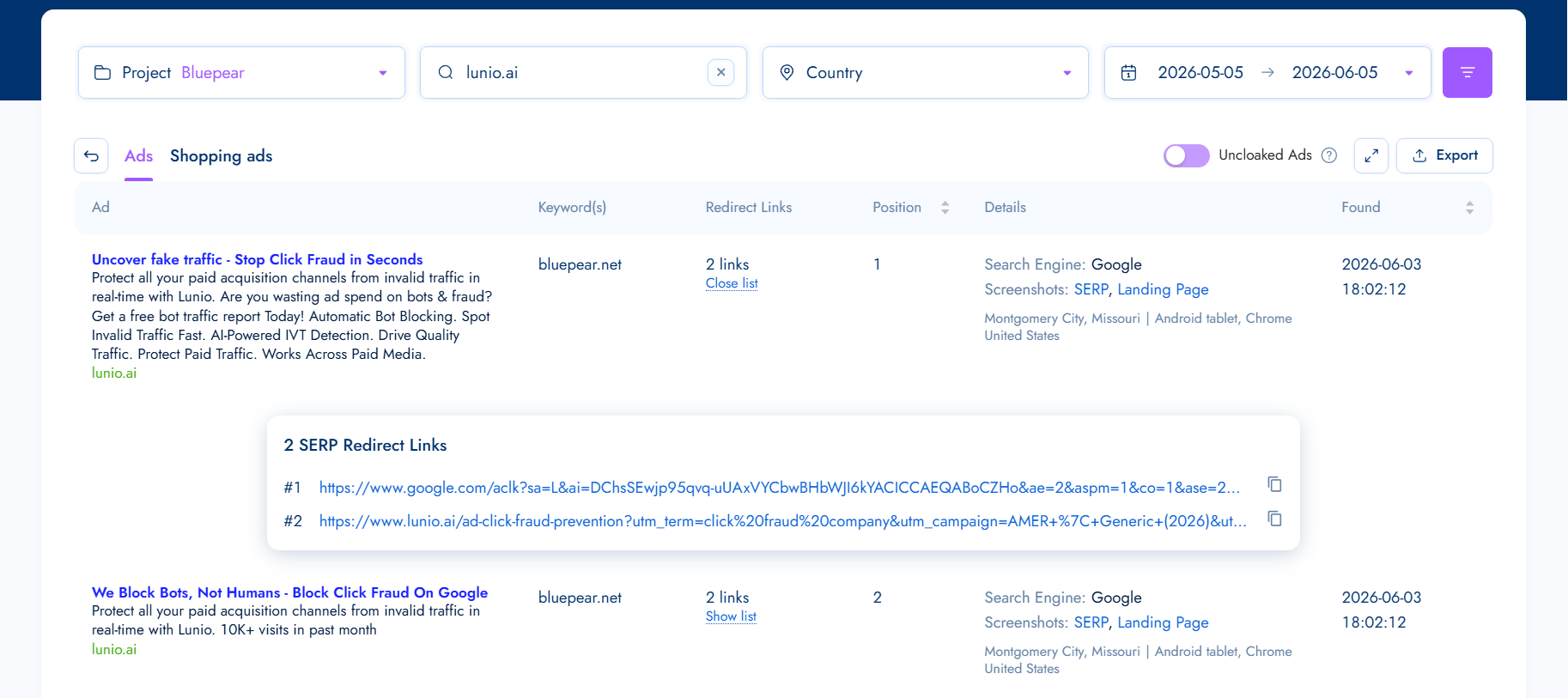
Because advertisers can change ad copy, pause campaigns, or remove landing pages at any time, I collect evidence quickly. I record the ad copy, SERP position, triggering keyword, location, URLs, redirects, landing page content, and timestamps.
Bluepear can handle this automatically by compiling a report with the relevant details, which makes follow-up easier when I need to contact an affiliate, review a competitor’s behavior, or escalate a trademark issue.
Identifying Who Is Behind the Activity
Sometimes I cannot immediately tell whether an advertiser is a competitor, an affiliate, a coupon site, or something riskier. Branded search results often include multiple participants with different motivations, so I need to understand who I am dealing with before I decide what to do next.
I look for patterns. A direct competitor domain usually points to competitor bidding. A coupon or cashback page may indicate an affiliate, coupon site, or loyalty site. Affiliate network tracking links often suggest affiliate activity, although they can also appear in more questionable setups. Product comparison pages often point to competitors or comparison publishers.
Other signals raise the risk level. If an ad uses my trademark, claims to be “official,” sends users through multiple redirects, promotes coupon codes I cannot verify, or lands on a page that imitates my brand’s design or messaging, I investigate more carefully.
No single signal gives me a definitive answer. I combine multiple pieces of evidence before drawing conclusions. Once I know who is advertising on my brand terms, I can move beyond detection and decide whether their activity aligns with my policies and business goals.
What I Do Next
After I identify who is advertising on my brand terms and review their ads, the next step is choosing the right response.
Competitor Brand Bidding
Not every competitor bidding on my branded keywords requires immediate intervention. Before acting, I ask how often the competitor appears, which keywords they are targeting, whether they are using trademarked terms in ad copy, and whether they are sending users to comparison content or direct offers.
In many cases, I monitor the activity and evaluate its business impact over time. Documenting patterns helps me establish a baseline, which can support future compliance reviews or legal conversations if escalation becomes necessary.
Affiliate Violations
If an affiliate is bidding on restricted branded keywords or violating program rules, I gather evidence and contact the affiliate or network. My workflow is straightforward: document the violation, verify the affiliate ID, share the evidence, request removal or corrective action, and apply program enforcement measures if needed.
Screenshots, timestamps, and redirect data make those conversations much easier because I can show exactly what happened, where it happened, and when it was detected.
Trademark Misuse
Trademark-related issues require careful review. I look for unauthorized trademark use in ad copy, ads that create confusion about brand affiliation, impersonation attempts, and misleading claims that the advertiser is an official brand representative, partner, or reseller.
The right response depends on the circumstances, internal policies, and applicable laws. In many jurisdictions, competitors are generally allowed to bid on trademarked keywords. However, ads that confuse users about the advertiser’s relationship with my brand may raise trademark or unfair competition concerns, depending on the facts and local law.
The advertising platform’s policies matter too. Google allows advertisers to bid on trademarked keywords, but it may restrict trademark use in ad text when a valid trademark complaint is submitted. Google also prohibits ads that use trademarks in a confusing, deceptive, or misleading way.
Before I take action, I collect as much evidence as possible, including screenshots, detection timestamps, URLs, redirects, and landing page content. Once the facts are documented, I may contact the advertiser directly, submit a trademark complaint to the advertising platform, send a cease and desist letter, or escalate through legal channels if necessary.
Why I Keep Monitoring Brand Search
The main lesson is that branded search protection is not a one-time audit. Affiliates can activate and pause campaigns throughout the month. Some violations appear only on weekends, outside business hours, or in specific markets. An advertiser that disappears today may return next week with new ad copy, a new domain, or a different affiliate account.
That is why I treat brand protection as an ongoing process. Occasional searches are not enough. I need consistent monitoring and a repeatable investigation workflow that shows who is appearing on my brand terms, how they operate, and whether action is warranted.
If I want easier visibility into my branded search landscape, Bluepear helps identify issues earlier, respond faster, and make more informed decisions about protecting traffic and advertising investments.
AI search visibility is no longer a single ranking question. A brand can appear in an answer, earn a citation, receive a visit, influence a later conversion or remain invisible to conventional attribution at each stage.
The practical response is to connect content optimization, citation monitoring and business measurement. The sources collectively show why those disciplines must operate as one system, even though no single metric can yet describe the entire AI-assisted customer journey.
Key takeaways
AI visibility begins with content that can be discovered for a broad topic, understood in context and extracted into an answer.
A citation is evidence of selection, not proof that a user visited or converted.
Referral traffic captures only journeys that include a trackable click; direct visits, calls and delayed conversions can obscure AI influence.
Measurement should progress from answer presence to citations, referrals, conversions and lead quality.
Global standards should govern technical implementation and reporting, while market experts supply differentiated local knowledge.
Visibility depends on retrieval, selection and presentation
Traditional rank tracking starts with a query and a results position. AI-generated answers add intermediate decisions: the system may decompose a request into related subqueries, retrieve supporting pages, synthesize their information and choose which sources to display. Visibility can therefore be gained or lost before a citation is ever shown.
A Search Engine Land article about Google query expansion distinguishes traditional query expansion from AI Mode query fan-outs. In its account, expansion connects searches through synonyms, intent and related topics, while fan-outs generate multiple subqueries during answer construction. The article recommends using Google Search Console impressions and unexpected but relevant queries as signals for strengthening topic coverage, rather than as an invitation to add disconnected keywords.
That retrieval perspective complements HiGoodie’s travel optimization guidance, which emphasizes direct answers, FAQs, schema markup, topical authority and content based on real traveler questions. That source reports that 40% of travelers use AI to research, compare and organize travel decisions. The percentage should be treated as reported by the article, but its strategic implication is clear: content must supply both a concise answer and enough surrounding context to be interpreted correctly.
Selection does not guarantee equal exposure. Search Engine Land’s report on recipe links in Google AI Mode describes a visual treatment that can place creator names, images, ratings and ingredient counts near prominent links. It also notes that Google had been testing a top-stories carousel in AI Overviews but that the feature did not appear to be live at the time reported. These examples make presentation a separate measurement dimension: two cited publishers may receive materially different opportunities to be recognized or clicked.
A citation is not the same as a visit or a customer
The recipe treatment illustrates the distinction between attribution and distribution. More recognizable links may improve the path to a publisher, but the report leaves open whether they will generate enough meaningful traffic. Citation counts alone cannot resolve that question because a source can inform an answer without producing a click.
The opposite measurement problem also occurs: AI may influence a customer without producing a visible referral. A Search Engine Land article based on an analysis of nearly 30 million inbound leads reports that AI-attributed leads remained a small share of total volume but were growing and appeared across multiple industries. It also describes customers who encounter a recommendation in an AI service and later call a business, creating journeys that may be classified as direct or remain unattributed.
The same source is explicit about the dataset’s limits: it could identify cases in which customers named an AI platform as part of the route to contacting a business, but it could not reveal their prompts, platform choices or the reasons a particular company was recommended. That is evidence of association within a reported journey, not a complete causal explanation.
Organizational interest is also moving toward this broader view. Profound’s recap of Zero Click New York 2026 says that more than 1,000 marketing leaders gathered on June 11, 2026, and that sessions addressed Claude’s citation mechanics, ChatGPT’s emerging advertising business and content signals associated with AI trust. An event recap is not outcome data, but the subjects it highlights show citations, distribution and measurement being treated as connected management questions.
Use a measurement ladder instead of one AI metric
A workable reporting model separates observable stages rather than combining them into a proprietary visibility score. Each stage answers a different question and carries a different evidentiary limit.
Measurement layer
Question it answers
Useful evidence
Main limitation
Answer presence
Does the brand or page appear for relevant prompts?
Repeatable prompt checks across selected platforms, markets and use cases
Outputs can vary, so a single observation is not a stable benchmark
Citation visibility
Which pages are named or linked as sources?
Citation frequency, cited URLs, placement and visible source treatment
A citation does not establish attention, a click or preference
Referral activity
Did a user arrive through a trackable AI link?
Analytics referrals, landing pages and tagged campaign links where available
Non-click journeys and incomplete referrer data remain unseen
Conversion influence
Did AI discovery contribute to an inquiry or sale?
Lead-source questions, call attribution and customer-reported discovery paths
Self-reporting and multi-touch journeys complicate causal claims
Business quality
Are AI-influenced customers valuable?
Qualified leads, completed transactions and downstream customer outcomes
Low volume can make comparisons unstable
These layers should be reported separately before they are interpreted together. For example, rising citation visibility with flat referral traffic could indicate a zero-click exposure pattern, weak source presentation or a mismatch between cited content and user intent. Rising customer-reported AI discovery without comparable referrals would instead point to an attribution gap. Both observations warrant investigation, but neither proves its suspected explanation by itself.
Content research can connect the upper and lower portions of the ladder. Search Console queries can reveal adjacent questions already associated with a page, while citation observations show whether AI systems select that page for related answers. Referral and lead data then indicate whether any of that exposure reaches the business. Optimization becomes a testable cycle when the baseline, content change and subsequent observations are recorded consistently.
Govern shared infrastructure while localizing expertise
Measurement becomes harder when teams use conflicting entity definitions, technical rules or reporting methods. The problem is especially acute for multinational organizations because an AI system can synthesize material across markets rather than respecting the operational boundaries used inside the company.
A Search Engine Land analysis of global SEO ownership argues that hreflang, localization and technical SEO remain necessary, but that hreflang handles routing rather than deciding which market perspective an AI answer should prioritize. It recommends central governance for areas in which inconsistency creates enterprise-wide risk, including CMS rules, structured data, entity definitions, AI crawler policies, measurement frameworks and technical infrastructure.
The same analysis places audience research, regulatory information, local authority building and market expertise closer to in-market teams. Its central tension is not simply standardization versus translation. Multiple near-identical market pages may provide less differentiated evidence than content grounded in local terminology, regulations, customer expectations and industry practices.
That division of responsibility also applies outside international SEO. A central team can define how citations, referrals and AI-influenced leads are recorded, while subject specialists validate the underlying claims and answer the questions their audiences actually ask. The travel guidance’s focus on traveler intent and the query-expansion article’s focus on adjacent questions both support this combination of shared structure and domain-specific knowledge.
The next useful advance will come from disciplined linkage: connecting the content changes made, the answers and citations observed, and the customer outcomes recorded without overstating what any one dataset proves. Organizations that establish that evidence chain can adapt as interfaces and citation treatments change, while keeping investment decisions tied to measurable audience and business value.
GlobalMed is the world leader in evidence-based digital health solutions. As I looked at the company’s work, what stood out most was the level of trust it has earned from the White House Medical Unit, the U.S. Department of Veterans Affairs, the Department of Defense, and healthcare organizations across more than 60 countries. After more than two decades and over 100 million consultations, GlobalMed has helped define what clinical-grade virtual care can look like in some of the world’s most demanding environments.
I sat down with CEO Joel E. Barthelemy to understand what separates GlobalMed from the wave of telehealth companies that emerged in recent years, and why he believes evidence-based virtual care is what truly moves the needle on patient outcomes.
First Page Sage: I’ve watched telehealth become crowded since the pandemic. What does GlobalMed offer that a standard video visit simply cannot?
Joel E. Barthelemy: When people hear the word “telehealth,” they often picture a basic video call where a patient describes symptoms to a provider. What they usually do not picture is a virtual visit that can come close to an in-person examination, and that is exactly what we built GlobalMed to deliver. Our integrated telemedicine platforms combine FDA-cleared diagnostic devices with secure, enterprise-grade software into a complete care ecosystem. When a physician uses our system, they can receive real-time ECG data, digital stethoscope auscultation, medical-grade wound imaging, and comprehensive vital metrics. That level of clinical information leads to better care and better patient outcomes.
First Page Sage: I know GlobalMed serves some of the most demanding clients in the world, including the VA, DoD, and the White House. How has serving those environments shaped the technology you bring to broader healthcare markets?
Barthelemy: It forces excellence at every level. There is no room for “mostly works” when you are protecting a President’s health or treating a combat-wounded veteran in a remote military installation.
Every GlobalMed system operates under military-grade encryption, full HIPAA compliance, and Authority to Operate certifications that most telehealth competitors simply cannot achieve. We are SOC 2 Type 2 compliant and hold ISO 13485 certification. Our hardware is also built to operate in submarines, disaster zones, and austere environments where civilian platforms would fail.
That engineering discipline does not stay confined to government contracts. It flows into every solution we deploy, whether we are supporting a rural critical access hospital, a large health system, or an enterprise wellness program. Our private-sector clients get the same zero-failure standard we deliver to the most security-sensitive healthcare environments on Earth.
First Page Sage: I see rural healthcare access becoming a growing crisis in America. How is GlobalMed’s technology helping close the gap between where specialists are and where patients actually live?
Barthelemy: In North Dakota, a young Veteran diagnosed with Complex PTSD was driving hours across the Great Plains in brutal winter conditions just to see a psychiatrist because his local community-based outpatient clinic had no behavioral health services on staff. When the VA’s National Telemental Health Center deployed GlobalMed telemedicine stations at that clinic, he could finally see a psychiatrist without leaving his community.
That is one patient, but the VA’s broader deployment tells a more complete story. The VA’s National Telemental Health Center used GlobalMed solutions to connect Veterans in areas without local behavioral health services to expert psychiatric care, allowing them to see a psychiatrist from their own Community Based Outpatient Clinic instead of driving hours each way. The eNcounter® platform connects rural clinic equipment to remote specialists in real time, with diagnostic data and patient records available through one unified system.
For settings without fixed clinic infrastructure, the Transportable Exam Backpack extends that same capability into the field. Coplin Health in West Virginia uses four of these units to deliver primary care across rural communities where a permanent facility is not viable. In Ecuador, a healthcare organization uses two units to bring diabetes care directly to rural patients who previously had no access to specialist services. In each case, the combination of portable diagnostic hardware and the eNcounter® platform is what makes the care clinically meaningful rather than just another video call.
First Page Sage: I’m also seeing more interest in integrating conventional medicine with preventive and holistic care approaches. How does GlobalMed’s platform support comprehensive, whole-person care delivery?
Barthelemy: The practical challenge for any provider trying to deliver whole-person care is visibility. If a patient is seeing a primary care physician, a behavioral health provider, and a specialist, each provider is usually working from an incomplete picture of what the others are doing.
GlobalMed’s eNcounter platform integrates with most major EHR systems, which means a provider conducting a virtual consultation can access lab results, specialist notes, and patient-reported outcomes in one place instead of working from a partial record. When you layer in tools like iAmbientHealth, which passively monitors vitals, sleep patterns, and movement at home, or Canary Speech, which objectively screens for behavioral and cognitive health changes during consultations, providers get a broader view of how a patient is functioning day to day, not just what their numbers look like during a clinic visit.
That continuity matters when someone is managing multiple conditions or combining conventional treatment with preventive approaches. A cardiologist reviewing remote monitoring data alongside behavioral health notes can adjust a treatment plan with more context than a standard fifteen-minute appointment provides. The platform does not require care teams to change how they practice. It gives them more complete information to work with.
First Page Sage: As I think about the next five years, what should healthcare executives and organizational leaders keep in mind when they evaluate virtual care investments?
Barthelemy: I would start by asking whether the technology delivers evidence, not just access.
The telehealth market is full of platforms that make virtual visits possible. What they cannot all deliver is the clinical-grade diagnostic data that makes those visits meaningful. Any platform can put a doctor and patient on a screen together, but very few can equip that physician with the real-time clinical information needed to make confident, accurate diagnoses remotely.
Healthcare leaders should also think beyond the immediate use case. The organizations that have invested in GlobalMed’s enterprise-grade infrastructure are not just solving today’s access problem. They are building platforms capable of supporting AI-assisted diagnostics, continuous remote patient monitoring, and integrated care coordination as those capabilities mature.
The other critical consideration is trust. Healthcare runs on it. Patients trust that their data is protected, clinicians trust that the diagnostic information they receive is accurate, and health systems trust that the technology will not fail when it matters most.
GlobalMed is a leader in virtual care because we have spent over two decades earning that trust in the most unforgiving healthcare environments on Earth. For leaders evaluating virtual care investments, the question is not just what a platform can do today. It is whether the company behind it has the proven track record to deliver when the stakes are highest.
The Bottom Line
I see virtual care becoming the infrastructure of modern healthcare delivery, not just an alternative channel for convenience.
The organizations that invest in clinical-grade, evidence-based telemedicine technology today are building the competitive advantage that will define patient outcomes and organizational performance for the next decade.
GlobalMed is the world leader in evidence-based digital health solutions, providing integrated telemedicine hardware and software ecosystems trusted by the White House Medical Unit, U.S. Department of Veterans Affairs, Department of Defense, and healthcare organizations in over 60 countries. As a veteran-owned company, GlobalMed specializes in delivering clinical-grade virtual care in the world’s most demanding healthcare environments.