
I started this series with a simple observation: AI systems do not always give the same answer to the same question. My argument was that this inconsistency is not just randomness. It is confidence loss across a pipeline we can measure, diagnose, and improve.
As I worked through the AI engine pipeline gate by gate, I eventually reached the won gate. That is where three kinds of clicks appear: the imperfect click of search, the perfect click of recommendations, and the agentic click of agents.
That is also where I realized this conversation could not stay inside marketing. When an agent makes the purchase, it becomes a client I have to satisfy directly.
The funnel now runs through machines that connect directly to the business itself. SEO therefore becomes part of something larger: assistive agent optimization, and ultimately AI-era business engineering.
To understand why, I need to connect the pieces. The framework explains why AI systems make the decisions they make and what shapes those decisions. When I apply those principles across the business, the goal becomes clear: organize the company so search engines, AI assistants, agents, and people can find it, understand it, recommend it, and buy from it.
Everything Builds On SEO
The process sits above the familiar disciplines I already work with: SEO, content, PR, paid media, and digital marketing. It helps me prioritize the actions that most affect recommendations and visibility.
Here is the part every SEO should value: assistive agent optimization is built on SEO. It does not replace it.
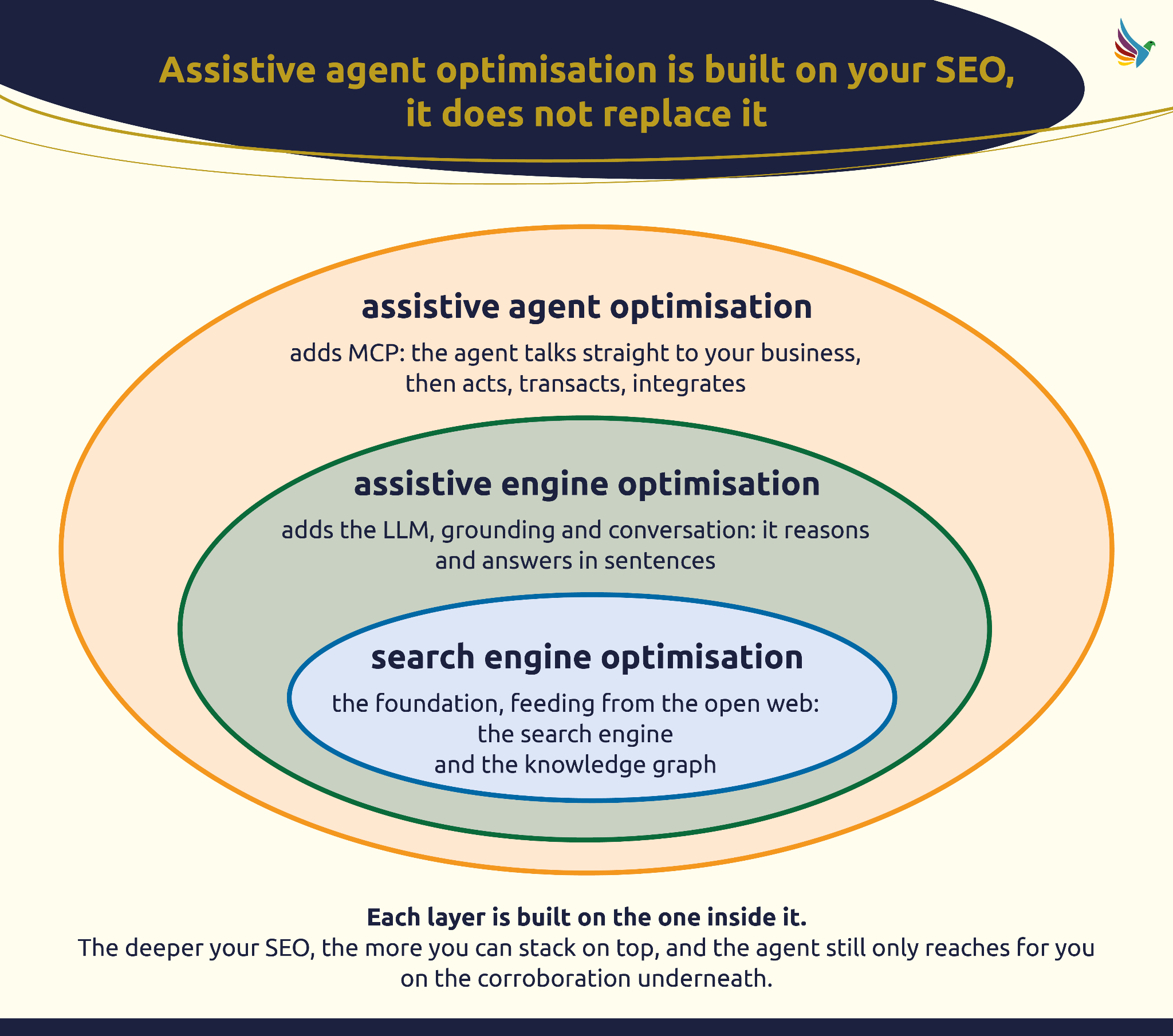
I think of it like a Russian doll. SEO sits at the center. It draws from the open web, the same crawled and indexed foundation search has always used.
At that core are two parts of the algorithmic trinity: the search engine, which indexes and ranks information, and the knowledge graph, which stores entities and the relationships between them.
The next layer is assistive engine optimization. It adds the third component: the large language model. The LLM provides reasoning, grounding, and conversation.
Instead of returning only a list of links, it evaluates corroborating evidence and answers the user directly. This layer builds on traditional SEO with entity corroboration, machine-readable proof, and signals that help AI systems understand what content actually means.
The outer layer is the agent. It introduces what the layers below it never had: direct access to business systems through protocols such as MCP. An agent can check inventory, compare prices, and complete transactions without visiting a page or clicking through a search result. This is where AI stops recommending and starts acting.
Each layer depends on the one beneath it. The stronger the SEO foundation, the more effectively I can build everything above it. That makes SEO more central to digital marketing, and to the business itself, than it has ever been.

If I understand how machines read the web, I hold the foundation every other AI-facing initiative depends on.
The Funnel Has Not Changed, But The Build Direction Has
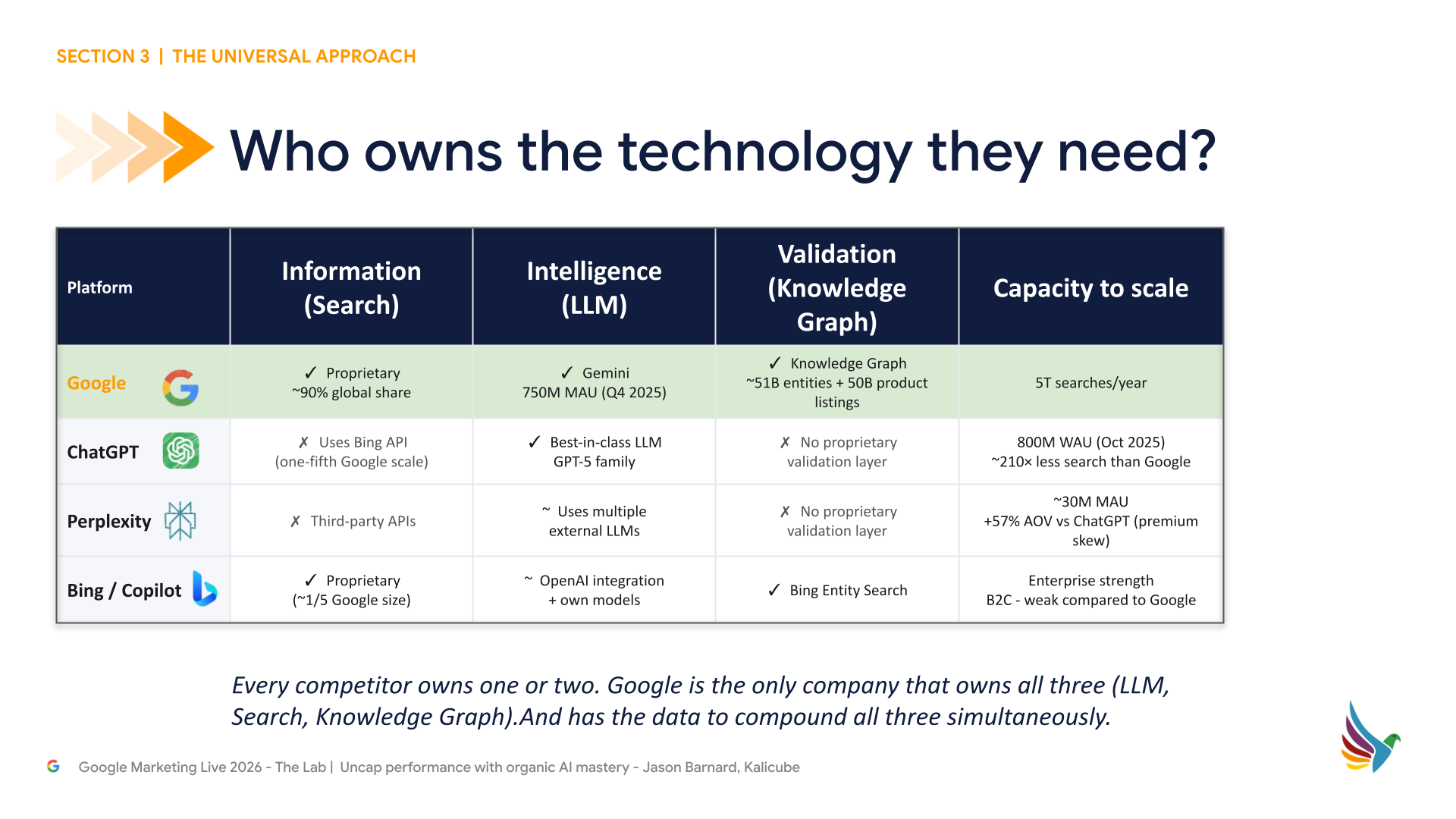
The acquisition funnel has not fundamentally changed since marketers first drew it in the 1800s. Awareness still sits at the top, consideration in the middle, and decision at the bottom. The customer still moves downward while the brand tries to catch them. What has changed is where I have to stand to catch them.
Traditional marketing stood in front of people in the real world, on billboards, shelves, and stages. Digital marketing did the same online through SEO, paid search, social media, and content. AI-era marketing extends that logic again.
Now I have to stand where I always stood and also inside the AI engines. Those engines put brands in front of buyers, present the best solution, and increasingly make the purchase.
The modern buyer mixes all three modes in a single purchase, so I have to be present in all of them. The client still travels from the top of the funnel down, but the engines learn from the bottom up. That is how I need to build for them.
Marketers draw the funnel top-down because that is the customer path. But businesses have always had a reason to read it the other way. Winning the result for your own name is the cheapest and highest-converting move because it reaches the warmest traffic: people already at the door.
I have made that case since 2012, when I started working on brand SERPs. Your name is the one search result you can most completely own, yet the industry ignored it for years.
Comparison and consideration queries come next because they sit near the purchase, where buyers are most likely to convert. Awareness is the last thing I build, because those people often do not yet know what they want or what the solution might be.
The engines make this flip unavoidable. Search engines let users move between sites on the way down the funnel, so top-down building could still work. Assistive engines pull the funnel inside themselves. Now I build from the bottom up because that is how the machine learns who to trust.
Agents push this even further. The funnel goes dark, and the choice often goes with it. Each step takes more of the journey out of my hands, and each rewards the same brand: the one built from the bottom up.
The Agentic Spectrum Decides How Much Must Change
Two ideas tell me how much of a business has to change. The first is the delegation boundary. The second is the agentic spectrum.
- The delegation boundary is the micro view. It tracks how much of one buyer journey, from searching to comparing to choosing to buying, a person hands to a machine.
- The agentic spectrum is the macro view. It asks what share of the clientele has gone agentic and how quickly that share is growing.
The micro view tells me how to win one buyer in the moment. The macro view tells me how much of the business has to change to keep winning buyers over time. This is the number I would start measuring first.
Here is why it reorganizes the business, not just the marketing. When the agent makes the purchase, it becomes a client I have to satisfy directly, even as it acts for the person behind it. It answers to one priority: keeping its own user happy.
That means the sale turns on confidence. Can the machine trust the business to meet the need and keep its client satisfied?
That confidence has to clear a much higher bar than search or assistive engines required. It runs across the full funnel. If I earn it across the stack, I become the brand the agent buys from.
Preparing for that is what AI-era business engineering means. Pricing, qualification, product data, checkout, service, and retention all need to be built so an agent can transact as cleanly as a person can.
The agent navigates the whole funnel on its own. I have to convince it at every stage, from awareness to the final yes, while getting almost no visibility into the journey. What I do get is granular measurement at negotiation and transaction stages. The agent tells me what it wants, and I either satisfy it or I do not.
That is why I need to build the business to work cleanly with agents and people alike, from the top of the funnel to the moment the deal is struck.
Translating what a company does for humans into something machines can read and act on used to feel optional. Ignoring search engines and assistive engines was never wise, but many companies survived it. In the age of agents, ignoring the engines hands a growing share of the clientele to competitors.
Your Untrained Salesforce Is Already Selling
Every business now has a salesforce it never hired: Google, ChatGPT, Perplexity, Claude, Copilot, Siri, Alexa, and many more. The number keeps growing as major tech platforms add AI answers inside social media, video, search, operating systems, and workflow tools.
The apps people already use now embed assistants that recommend tools, vendors, and products. A buyer does not need to open a separate AI engine for this to happen.
Those engines reach prospects in explicit, implicit, and ambient ways. However they appear, the outcome is the same: they work around the clock, speak to prospects in rooms I will never see, and decide whether to recommend me or a competitor.
The default state of that salesforce is untrained. If someone asks about my category, it answers with the brands it happens to understand, and that may not be mine. It may hedge on basic facts, confuse the brand with a namesake, cite proof that does not exist, recommend the wrong use case, or name a competitor at the exact moment the user was looking for me.
The cost is real, but it often never appears on a dashboard. I cannot watch the AI research the brand, evaluate it, recommend it, or talk a buyer out of choosing it. It all happens inside the machine. That is why I pay attention to three taxes: invisibility, ghost, and doubt.
AI engines recommend the solution they are most confident in, and that is not always the best solution. It is often the one they understand best. The recommendation depends on what they grasp and how confident they are in it.
So if my solution is truly the best, I have to train them. I have to educate them and brief them. They answer to the user, and my client is their client. They retain that client by surfacing the strongest solution they can see.
The practical question is simple: have I made it unmistakably clear that I am the best answer to the specific problems I solve, for the ICP I serve?
Three Taxes Quietly Cost Recommendations
I pay a tax at every stage of the funnel for as long as this AI salesforce is not working explicitly in my favor.
Someone types the brand name directly into an engine, and instead of a clean answer, it hedges with phrases such as “claims to be,” “reportedly serves,” or “says on its website.” Worse, it may start offering alternatives.
Search engines usually do that only when a competitor pays heavily to appear on the brand SERP. Otherwise, the brand owns its own name.
AI can raise the alternative on its own, purely because it is uncertain. That is why brand SERP and AI résumé protection are no longer optional.
That hedge and nudge are the doubt tax. I pay it when the engine lacks enough independent corroboration to commit. It sits at the understandability layer, and the cost is every prospect who came looking for the brand by name and left with doubt.
The ghost tax appears when a prospect asks the engine to compare the category and name the best options. The engine lists several brands, but mine is missing. It knows I exist, yet it does not surface me because its confidence in my credibility is too low.
The invisibility tax appears at the top of the funnel. Someone asks a question I am well qualified to answer, and I am nowhere in the response because the engine never identified me as belonging in that conversation. I never see it because the conversation ends without me.
I need to track these taxes across every engine and every layer, and I should not use only my own account. It is biased toward me. The right approach is proper tracking, neutral testing, and better questions.
The funnel query pathway is the best way to read this over time and across the web. What I am measuring is leakage at each layer. Because the system is opaque, I read the macro trend rather than overreacting to one response.
Then I build from the bottom up and clear the taxes in revenue order.
- I clear the doubt tax first because it affects the warmest traffic.
- I clear the ghost tax next because it affects buyers comparing close options.
- I clear the invisibility tax last because it sits furthest from the purchase.
That is the funnel flip again. AI engines have turned the old top-down playbook upside down.
The Algorithmic Trinity Is Where The Work Lands
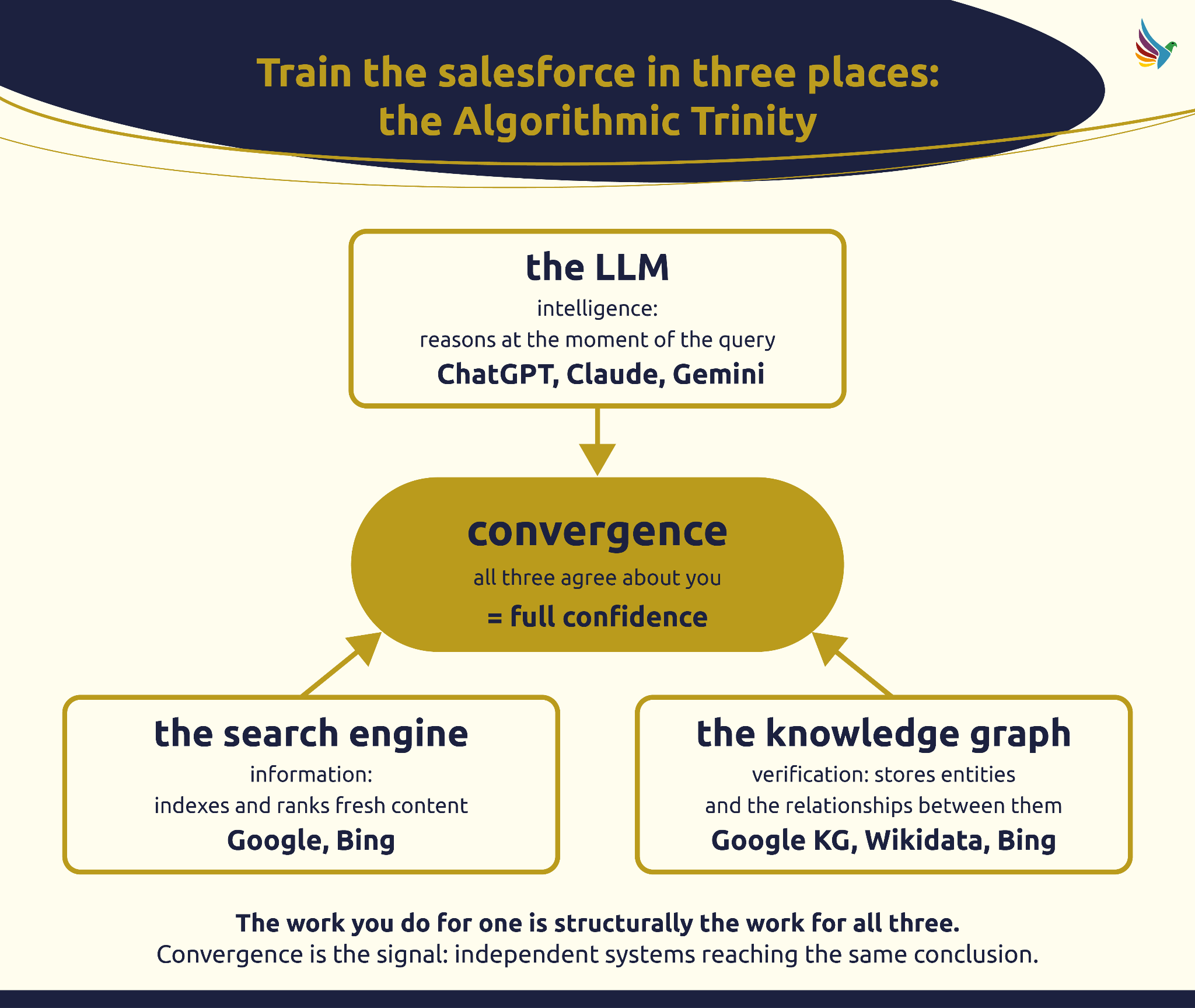
I train the AI salesforce in three places, and I need to be present in all three for that training to hold.
- Large language models do the reasoning at the moment of the query. This is the intelligence layer: ChatGPT, Claude, and Gemini.
- Search engines index and rank fresh content. This is the information layer: Google and Bing.
- Knowledge graphs store entities and verified relationships. This is the verification layer: Google’s Knowledge Graph, Wikidata, and Bing’s entity graph.
Those three layers are the algorithmic trinity.
I may be aiming at dozens of platforms and surfaces where this salesforce appears, but there are only a few machines at the root. At mass-market scale, the practical LLM list narrows quickly to ChatGPT and Gemini. There are two major web indexes, Google and Bing, and two major knowledge graph owners, Google and Bing again.
Everything I train reaches back to the same small set of underlying systems. The corroboration work I do for one engine often strengthens the foundation for all of them.
That is why the effort compounds. The knowledge graph confirms the entities the LLM reasons about. The search engine surfaces the fresh content the LLM grounds on. The AI salesforce becomes fully trained when all three converge on the same answer about the brand.
That convergence is where I win: independent systems reaching the same conclusion about who I am, what I do, who I serve, and why I am credible. When I give them that picture in detail, they can hold it with confidence.
At that point, the trinity can surface the brand at the bottom of the funnel, recommend it over competitors in the middle, and advocate for it at the top across search engines, assistive engines, and agents.
The results vary because each platform mixes technologies differently, but the direction starts to favor the trained brand.
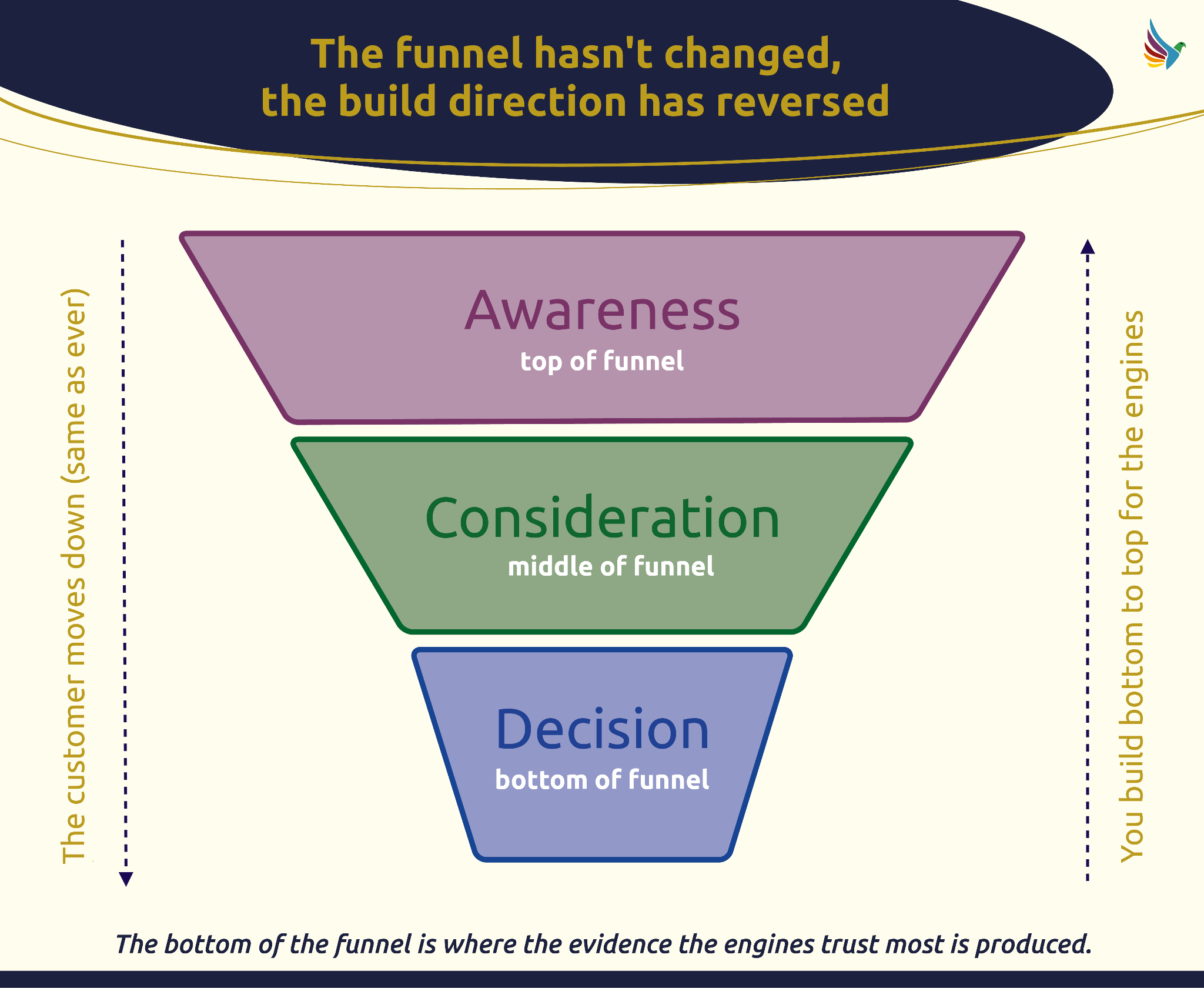
Google owns all three layers and remains the dominant force across search and assistive engines, so it remains the main target.
I am not suggesting that I ignore smaller players such as Claude or DuckDuckGo. They matter to the audiences that use them. But for most brands, users, and SEOs, the major public engines are still the key to commercial success.
A tight digital footprint, cleaned up and optimized on-site and off-site, feeds the trinity. At mass-market scale, that means Gemini and ChatGPT, Google’s and Bing’s knowledge graphs, and Google’s and Bing’s search indexes.
The useful side effect is that this strategy also helps with smaller players.
Third-Party Proof Is What AI Believes
Knowing where the work is ingested is only half the job. I also need to know which evidence the AI salesforce believes. Not all evidence carries the same weight, and the gap between weak and strong proof is often the differentiator.
The weakest evidence is what a brand publishes about itself, in its own voice, on its own properties: homepage copy, about pages, and product descriptions. I call this first-party evidence. It is a claim and a baseline, but it proves little on its own because the engines know who wrote it.
If I surface a client outcome, case study, or customer review on my own off-site channel, I move up to second-party evidence. The substance is no longer entirely my assertion, even though I still control the publish button.
Then there is evidence I had no hand in publishing: clients and partners describing their own experiences, an independent journalist’s article, an analyst report, or coverage controlled entirely outside my reach. That is third-party evidence, and it is the strongest proof the salesforce can read because I could not directly shape it.
It is also the category many brands lack because it requires real-world activity, not just publishing. First-party claims, second-party corroborates, and third-party proves. Without proof, nothing stands.
Three Levels Of Effort Create Different Outcomes
Most brands sit at the bottom without consciously choosing to. The minimum-effort brand keeps a website, runs some content marketing, responds to occasional mentions, and otherwise lets the ecosystem do what it does. It appears in machine-readable form but does not shape that form.
Because minimum effort is treated as normal, many companies land here and never recognize it as a decision. Their AI salesforce is barely trained.
The next level appears when a brand notices specific problems and fixes them: an incorrect fact in an AI Overview, a competitor outranking it for a query, or a structured data gap. Those fixes help, and the brand becomes better positioned.
But the work is still symptom-driven. It patches what breaks loudly without building the discipline that prevents the next break. The salesforce is partially trained, but problems are driving the strategy.
The systematic brand runs an operational discipline against the pipeline every week: entity home maintenance, evidence harvested from service teams, machine-readable proof, distribution across publication tiers, and continuous monitoring of the brand SERP and AI résumé.

Most companies are not organized to make that happen naturally. But if I can harvest, codify, and distribute the evidence created by business operations, I can train the AI salesforce to work in my favor around the clock.
I would start from the entity home. I would organize the brand SERP and the AI résumé, then optimize the digital footprint wherever the brand appears. That is understandability, and it is the most important first move.
With the core entity locked, I can build credibility on top of it through engagement, reviews, client feedback, PR, and evidence that the business is genuinely good at what it does.
Deliverability follows because work on the brand SERP and AI résumé already strengthens credibility and reach. Then I can spread the same discipline across every entity the company owns: products, services, and people.
For each entity, I need the right content, presence where the audience is looking, a path down the funnel, and a clear connection back to the entity home. I need to walk the walk and apply the mirror principle.
The Salesforce Is Already Working
In 2026 and beyond, the AI salesforce operates inside the supply chain as well as the sales funnel. AI sits at the gates that decide whether to include a brand in what it knows, whether to deploy it in an answer, and whether to reselect it after every transaction.
Every outcome customers experience feeds back into the system for the next prospect who has never heard of the brand. That is the convergence this series has been pointing toward. The salesforce is selling 24 hours a day, for the brand or for a competitor. The difference is how well it has been trained.
This is why I see the discipline as AI-era business engineering, not just AI-era marketing. It is not a content tactic. It is a reorganization of how the business operates so pricing, qualification, product presentation, sales, retention, and customer success all create machine-readable evidence as a byproduct of doing the job.
SEOs Are In The Best Seat In The Room
When I speak with entrepreneurs and CEOs, I use nine questions to show where the company stands.
Tech, bottom to top: Is our entity home locked down so engines have one source of truth about who we are? Is our structured data complete enough for them to verify what we claim? Are we discoverable across every engine when topical questions appear?
Marketing, bottom to top: What does our brand SERP look like today, and what does the AI résumé say when engines are asked about us directly? Where is our third-party corroboration weakest, and what are we doing about it this quarter? Which topical territory do we own in the engines, and which territory do we want but not yet hold?
Branding, bottom to top: Does our brand story match what AI is currently saying about us, and where is the gap? Are our client outcomes being engineered into machine-readable evidence, or are they dying in CRMs and quarterly retrospectives? Are we placing proof now for the categories we want to own in three years?

All of those questions run from the bottom up, which is ironic because marketers usually work the funnel from the top down. The customer is the one moving from top to bottom, looking for a solution.
So I take a step back and read the funnel from the bottom up. Everyone is building the same thing: understandability, credibility, and deliverability. They are just approaching it from different ends.
The business builds from the foundation up: know who you are, know who you serve, become credible, then reach the right people.
The marketer wants the maximum audience and starts with reach, then works down to who the brand is and why it should be trusted.
AI starts at the bottom. Who are you? Are you credible? Only then will it put the brand in front of more people.
The SEO is the person who can see that it is all the same system. I understand that I must work from the foundation up, the way the machine does, and then meet the customer coming down from the top.
I should build for the customer, but work upward toward them. That has always been the stronger approach, and AI engines have now made it obvious.
The business now has two kinds of clients: the human and the agent. I need to speak to both. The agent is emulating a person and reflecting the world’s view of the brand, so pleasing the agent and pleasing the human are closely connected.
That is what makes SEO impossible to sideline. I am well positioned to tell the business and the marketers what must change to satisfy the agent without losing the human.
Whether agents represent 5% of the business today or nearly all of it, the agentic share will grow year after year. That means I have to step out of the SEO corner and look at the wider business. I am in a rare position to see business, marketing, and machines at the same time.
The audience used to be only human. Now it includes machines, too, and I am the one who can speak to both.
This is the 19th and final piece in my AI authority series, and it has been a long journey. My thanks to Danny Goodwin, Angel Niñofranco, and the Search Engine Land team for their immense support throughout.
When I started, the framework was a complete idea, but I had not fully worked through all the details. Week by week, I worked through each of the 15 gates, and every one turned out to be more intricate, more in-depth, and more thought-provoking than I expected.
What I have finished is a practical framework for SEO, marketing, and business in the AI age, one that search professionals, marketers, and business leaders can apply to real business problems.
Series Index
Parts 1 through 18 built this framework step by step: cascading confidence, assistive agent optimization, the AI engine pipeline, infrastructure gates, competitive gates, the entity home, the push layer, annotation, topical ownership, the funnel flip, the framing gap, pipeline repair, the delegation boundary, funnel query pathways, macro measurement, customer-success proof, AI opinion formation, and the collapse of paid and organic visibility across AI surfaces.
Inspired by this post on Search Engine Land.
