
I’m seeing traditional Google rankings deliver less predictable value than they once did. Ads, AI Overviews, and other search engine results page features are pushing organic links farther down the page, which means visibility no longer depends only on where a brand ranks in the classic blue-link results.
As search keeps shifting, I believe brands need to ask a more practical question: how do I make sure my brand is represented accurately inside AI-powered answers?
The more I understand how AI engines use brand information and when they cite it, the easier it becomes to build a real AI visibility strategy. This moves the conversation beyond whether an AI model “knows” a brand and toward how that brand can earn presence, trust, and discoverability in AI search.
The click economy is shrinking
I think most brands should start learning AI search and building an AI SEO strategy now. A full shift from organic search to AI search may still be years away, but the direction is clear enough that waiting creates risk.
Google is already leaning hard into AI search. In an April article from The Verge, CEO Sundar Pichai said that search had a strong quarter, with AI experiences driving usage, queries reaching an all-time high, and revenue growing 19%.
Users are changing their behavior too. A Pew Research study found that when people see an AI-powered summary in search results, they click a blue link only 8% of the time. When no AI summary appears, that click rate rises to 15%.
AI search traffic may still be smaller than organic traffic, but I would not dismiss it. According to Similarweb, AI traffic converted at 11.4%, compared with 5.3% for organic search traffic. That makes AI visibility worth tracking even before it becomes the dominant traffic source.
How I separate AI usage from AI citation
I think about brand presence in AI systems in two main ways: usage and citation.
Usage happens when an AI engine ingests information about a brand and draws on that information when answering a query. In some ways, this reminds me of how Google traditionally indexed pages before ranking and serving them in search results.
When an AI engine uses brand content, it may mention the brand without linking to it. Even an unlinked mention can matter because it can create discovery, influence perception, and prompt users to search for the brand directly.
Citation is different. A citation happens when an AI engine directly references a brand as a source of information. That reference might be a link to a web page, a social profile, or even a clickable phone link that lets someone contact the business.
Within OpenAI, usage and citation appear to depend on separate technical systems. As OpenAI’s documentation explains, OAI-SearchBot and GPTBot are deployed separately among four distinct user agents. Other AI systems have their own controls, but the same broader distinction still applies.
Why citations do not tell the whole story
I do not see citations as the full AI visibility picture. AI engines often answer questions directly without citing web sources, and this pattern is not entirely new. Before AI Overviews, Google was already moving in that direction with featured snippets.
Ahrefs found that ChatGPT retrieves almost the exact same number of cited and uncited URLs to generate an average response: about 16.57 cited URLs and 16.58 uncited URLs. But Reddit made up 67.8% of uncited URLs, which means comparing cited and uncited URLs is often really a comparison between search results and Reddit API output.
That matters because AI systems are not neutral in the uncited information they surface. Some platforms and websites are simply more influential than others. If I try to push a brand into AI answers without understanding where the model gets its information, I am working at a disadvantage.
How I would improve brand usage and citation
I would start by tracking the brand’s current AI visibility and monitoring progress over time. That means running a representative set of prompts through an AI visibility platform, reviewing the sources that get cited, and asking what those sources reveal about the model’s preferences.
There are already many AI citation tracking tools available, and established platforms like Semrush and Ahrefs have added AI tracking features as well. I would choose a tool based on the prompts, markets, and engines that matter most to the brand.
I would also scale tracking and research as much as budget allows. AI prompt tracking often depends on API calls, so it can cost more than traditional rank tracking. Still, the data is usually richer, even when the sample size is smaller.
As long as the prompt sample is broadly representative, most platforms can pull multiple responses and calculate an average. That gives me a more useful view of recurring patterns instead of relying on one-off answers.
I would keep reading studies from AI platforms, SEO vendors, and data providers too. Those reports are valuable because they show which sources AI engines rely on and where brands may have the best chance to appear.
The key is continual monitoring. Over time, I can work to place a brand inside the sources AI engines already trust and use most heavily.
Why I still care about traditional rankings
Yes, I still think traditional search rankings matter, but not for the same reasons they used to. The relationship between organic position and business performance is less direct now, especially as SERP features and AI answers absorb more user attention.
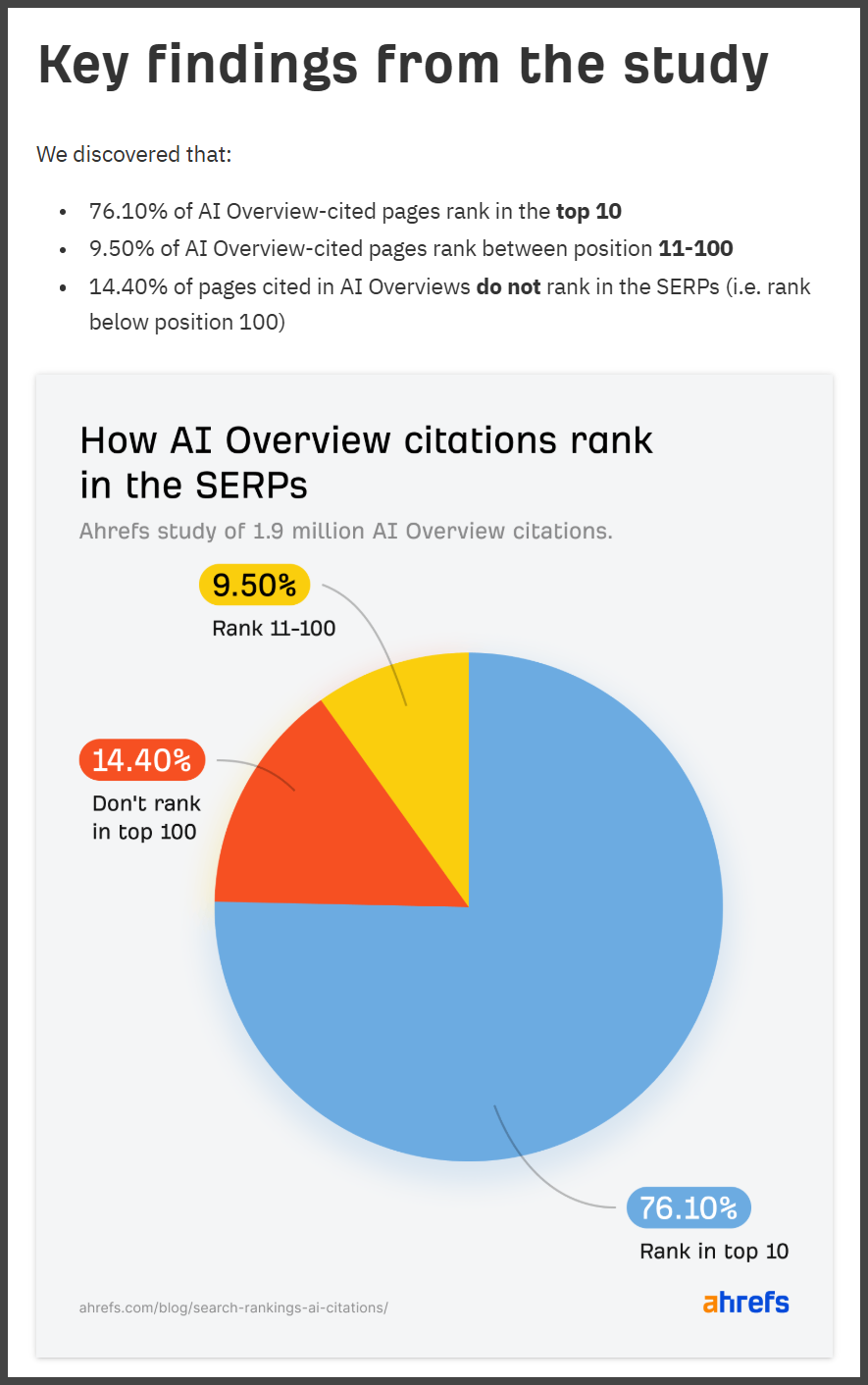
At the same time, Ahrefs research suggests a relationship between AI citations and Google rankings, at least inside Google AI Overviews. A July 2025 study found that 76.1% of pages cited in AI Overviews ranked in Google’s top 10 organic results. If AI Overviews become a dominant AI search experience, traditional rankings will still influence visibility.
I also pay attention to content quality. Semrush found that AI engines rarely cite generic content that simply repeats what other sources already say. The content that earns citations usually contributes something distinct.
That fits closely with Google’s helpful content guidance, which rewards original information and useful perspective. In my view, content with trusted data, original insight, and a clear point of view can support both Google rankings and AI citations.
Because many classic SEO tactics can also support AI citations, I would not abandon traditional SEO. I would treat it as part of a broader visibility strategy that now includes AI usage, AI citations, and brand presence across trusted third-party sources.
Where I think AI visibility is heading
Both usage and citation need ongoing tracking and analysis. If I want AI engines to use a brand’s knowledge and content, I need to understand which sources each model relies on and help the brand appear in those places. If I want citations, I need the brand’s content to stay crawlable, rank well, and say something original.
Classic SEO still earns its place because the same work that improves organic visibility can often improve AI visibility too. But returns from traditional rankings are changing, and AI SEO may eventually become the primary discipline. For now, I would keep ranking, start tracking, and build for both usage and citation.
Inspired by this post on Search Engine Land.
