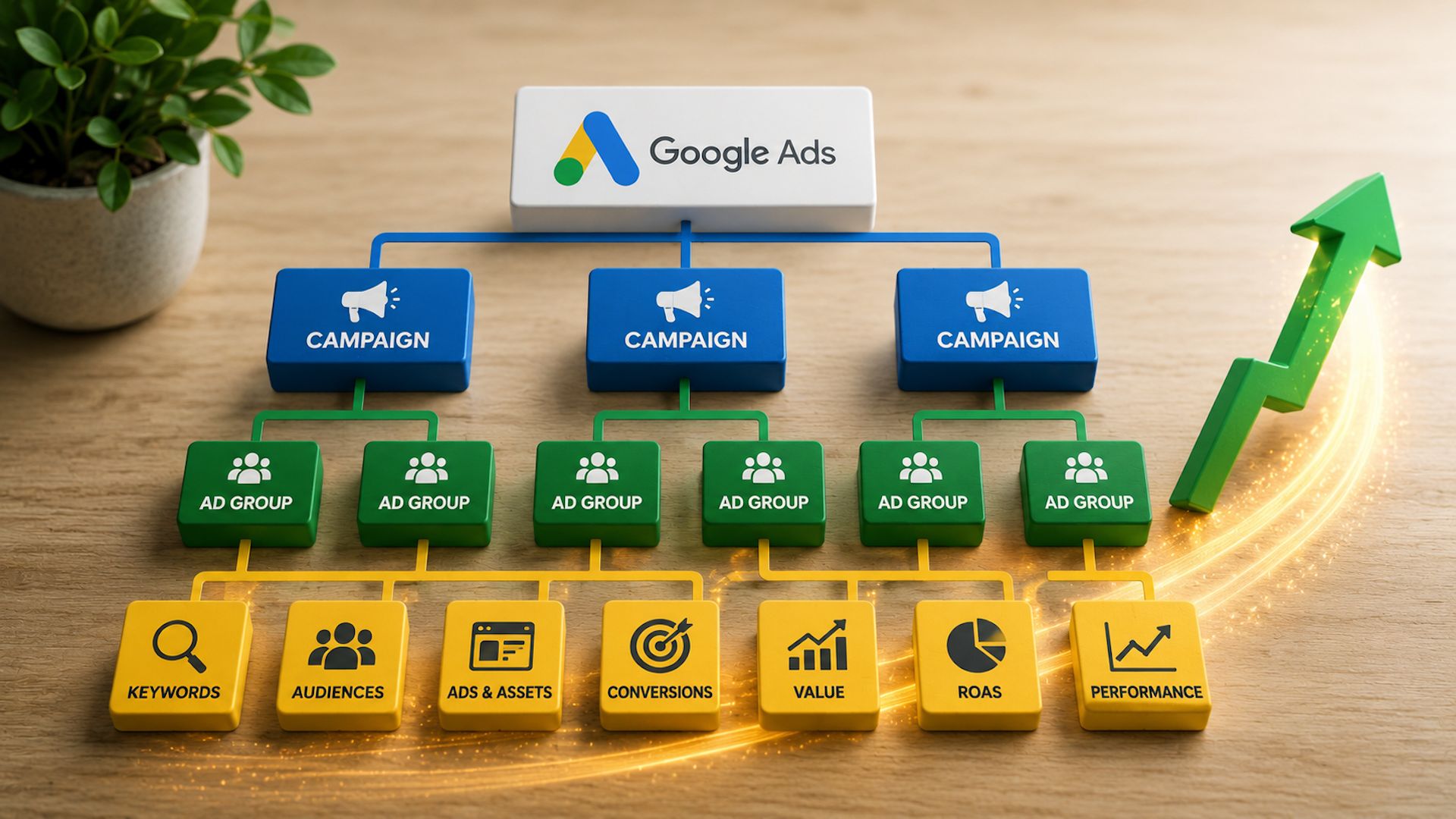

When I audit Google Ads accounts, it is easy to focus first on the obvious issues: keywords, bids, ad copy, and Quality Scores. But one of the biggest performance barriers I see is not buried inside a single campaign setting. It is the way the account was structured from the start.
Campaign structure shapes how Google’s machine learning reads the account, how budget moves across goals, and whether useful data is collected in one place or scattered across too many campaigns. When the structure is wrong, I am not just leaving performance on the table. I am making the algorithms work harder with weaker signals.
That is why I look closely at structure across standard Search campaigns, Performance Max, and Smart Bidding. The account architecture often determines whether optimization efforts can actually work.
How campaign structure shapes Google’s learning
I used to see advertisers treat campaign structure mainly as a cleanup exercise: tidy ad groups, logical naming, and campaigns separated by product line or geography. To Google’s systems, though, structure means something much more important.
Every campaign is a data container. The way I segment campaigns determines which signals Google can pool together for bidding and targeting decisions. When the structure is scattered, the learning is scattered too, and optimization becomes slower and less accurate.
Smart Bidding and automation usually perform better when more data is concentrated in fewer campaigns. Google’s algorithm needs meaningful volume, often around 30 to 50 conversions per campaign per month, to move beyond the learning phase and make reliable predictions. If I spread conversions across too many campaigns, each campaign can end up starved of the data it needs.
A common example is an ecommerce account with 12 separate Search campaigns, one for each product category. Each campaign averages 8 to 12 conversions per month. Smart Bidding is active, but no campaign consistently exits the learning phase.
In that situation, the fix is usually consolidation.
Over-segmentation breaks Smart Bidding
Smart Bidding strategies such as Target CPA, Target ROAS, Maximize Conversions, and Maximize Conversion Value depend on real-time signals like device, location, time of day, audience, search query, and more. Google weighs those signals together to predict which auctions are worth entering and how much to bid.
When I see campaigns that are over-segmented, I usually see the same problems appear. First, conversion volume is too low, so each campaign operates below the level Google needs for confident bidding decisions. That often leads to unstable CPAs and CPCs.
Second, learning phases last too long. Every budget change, bid strategy switch, or structural edit can trigger a new learning period. Over-segmented accounts can feel permanently stuck there, never reaching their full potential.
Third, signal consolidation is missed. Bidding signals do not freely transfer across campaigns. A branded campaign cannot teach the algorithm inside a non-branded campaign, even when both campaigns share the same conversion goal.
Finally, bid cannibalization becomes a real risk. When multiple campaigns compete in the same or overlapping auctions, I can end up driving up my own costs and creating avoidable inefficiency.
The result is an account that looks optimized on the surface, with Smart Bidding enabled, audiences attached, and conversion tracking active, but still underperforms because the structure underneath is working against every optimization layered on top of it.
The impact of Performance Max
Performance Max adds another layer to campaign structure. Unlike Search campaigns, PMax runs across Google inventory, including Search, Display, YouTube, Gmail, Discover, and Maps. It uses asset groups and audience signals to guide automation, which makes setup more important and more complicated.
Asset group segmentation
I think of asset groups inside PMax as mini-campaigns. Google uses them to understand context, match creative to searches, and optimize delivery. When asset groups are too broad, mixing unrelated products, audiences, or themes, the algorithm has a harder time matching the right creative to the right situation.
I prefer to segment asset groups by product category or service line, audience intent level such as prospecting versus retargeting, and creative theme or offer type.
This gives Google clearer signals about what each group is meant to accomplish, which can improve both creative matching and bidding efficiency.
PMax and Search campaign overlap
One of the most damaging mistakes I see in accounts running both Search and Performance Max is failing to set clear boundaries between them. PMax can serve across all placements, including branded and non-branded searches, so it can compete with Search campaigns if I do not define where each campaign type should operate.
Without proper segmentation, PMax can cannibalize high-intent branded search traffic and inflate costs on terms I might have won more cheaply through Search. Search campaigns can lose impression share they otherwise would have captured, and attribution becomes harder to interpret because it is less clear which campaign is truly driving performance.
My preferred solution is to use campaign-level negative keywords, brand exclusions, and clear audience segmentation. PMax should complement Search campaigns, not compete with them.
Budget allocation and automation conflict
PMax runs as a single campaign with a single budget, but because it delivers across multiple channels, budget allocation happens dynamically. When PMax and Search campaigns are not organized around clear goals, Google may spend on the easiest placements rather than the best ones.
Structural choices, such as whether I run one PMax campaign or split campaigns by product line, directly affect how budget is distributed and how well automation can support business goals.
Match type strategy and its structural implications
Match types are often treated as a keyword-level decision, but I see them as a structural decision too. Running broad match, phrase match, and exact match across separate campaigns, or even separate ad groups, without a coherent strategy can create overlap and wasted budget.
Google Ads looks very different than it did a few years ago. Broad match now casts a much wider net, and Google increasingly pushes advertisers to pair it with Smart Bidding. That combination can work, but only when the campaign structure gives the algorithm enough support.
Broad match with Smart Bidding works best when there is enough conversion data, a clear goal, and enough traffic for Google to learn from. In a fragmented account, broad match can make the problem worse. It brings in more searches, but the algorithm does not have enough clean data to make good use of them.
The safer approach is to keep match types within fewer campaigns, use negative keywords to prevent campaigns from bidding against each other, and review search term reports regularly so I can tighten boundaries where needed.
Keyword and ad group architecture: When granularity becomes an obstacle
Single Keyword Ad Groups, or SKAGs, are mostly a thing of the past, but many accounts still carry their legacy: hundreds of tiny ad groups with one or two keywords and nearly identical ads. That level of detail made sense when advertisers managed bids manually. Today, it often works against Smart Bidding.
Too many ad groups create the same data problem at a smaller scale. Responsive search ads perform better when they have more to learn from, including which headlines get clicked, which asset combinations work, and how auctions behave. That learning happens faster when ad groups are consolidated around broader themes.
I usually aim for three to five tightly themed ad groups per campaign instead of dozens of micro-segmented groups. Each ad group should include enough keyword variation to generate useful data while staying focused enough to preserve message relevance.
The goal is maximum signal quality. If structural granularity does not improve data consolidation, it is usually unnecessary complexity.
Conversion goals and campaign alignment
Structure also determines which conversion actions each campaign optimizes toward, and I consider goal misalignment one of the quietest performance killers in Google Ads.
If multiple campaigns share a poorly defined conversion goal, or if different campaigns optimize toward different actions without a clear hierarchy, Smart Bidding receives conflicting instructions. It may optimize toward micro-conversions like page views or add-to-carts when the real objective is form fills or phone calls. It may also treat goals as equal when one is clearly more valuable than another.
A structurally sound account connects campaign goals to business objectives, not just platform metrics. It separates primary conversions from secondary tracking actions, and it uses accurate conversion values when campaigns rely on value-based bidding.
Performance Max is especially sensitive to conversion goal quality. Because PMax controls its own bidding and placement decisions, it will optimize aggressively toward whatever I tell it matters most. If that signal is wrong, the campaign may optimize efficiently toward the wrong outcome.
Signs your structure is hurting performance
Structural problems rarely announce themselves clearly. I usually see them show up as issues that are easy to blame on ads, bids, or audiences.
Persistent learning phase warnings are one sign. Campaigns may be frequently flagged as limited by learning even when budgets are consistent. Unstable CPAs or ROAS are another warning, especially when performance swings do not settle over time.
I also watch for high impression share lost to budget when total budgets seem adequate, disproportionate spend flowing into a small number of campaigns, limited visibility into PMax search terms, and declining Quality Scores as the account grows across too many ad groups.
When two or more of these symptoms appear at the same time, I treat structure as a likely root cause. Bid adjustments and creative testing will not fix the problem until the foundation is corrected.
A framework for structural audits and consolidation
Restructuring an active account carries risk. Any major structural change can trigger learning phases and temporary performance disruption, so I consolidate carefully and use data as the guide.
Step 1: Assess conversion volume by campaign
I start by identifying which campaigns consistently generate 30 or more conversions per month and which fall below that threshold. Campaigns with low volume are usually candidates for consolidation.
Step 2: Map audience and intent overlap
Next, I look for campaigns that compete against each other for similar searches or audiences. Overlap creates waste, and structural waste is one of the most expensive forms of inefficiency.
Step 3: Evaluate PMax and Search boundaries
Then I audit how PMax and Search interact. I want to know whether brand terms are being captured by the right campaign type and whether negative keywords are in place to prevent cannibalization.
Step 4: Simplify ad group architecture
From there, I move away from SKAG-style granularity and toward theme-based groupings. Ad groups that serve overlapping intent should usually be consolidated into broader, cleaner themes.
Step 5: Align conversion goals
Finally, I audit conversion actions across all campaigns. Primary goals should match real business outcomes, and value-based bidding inputs should reflect actual revenue data whenever possible.
Important: I would not restructure everything at once. I would start with the highest-spend campaigns, monitor performance through the learning phase, and validate results before moving to the next round of consolidation.
Campaign structure comes first
I see campaign structure as the foundation of Google Ads performance. When it is right, Smart Bidding, Performance Max, and audience targeting can work with stronger signals, clearer goals, and more efficient budget allocation.
When it is wrong, no optimization layered above it can fully solve the problem. Bids cannot fix fragmented data. Creative cannot correct misaligned conversion goals. Performance Max cannot prioritize efficiently when its boundaries with Search are unclear.
The biggest performance improvements in Google Ads often do not come from a new bid strategy or a sharper headline. They come from stepping back, auditing the account architecture, and rebuilding the foundation everything else depends on.
Structure first. Optimization second.
Inspired by this post on Search Engine Land.
