

As traditional SEO shifts toward GEO, I keep seeing one idea gain momentum: visibility in AI search depends heavily on off-site brand mentions. Because of that, marketers are being pushed to look beyond on-site content and invest more heavily in off-site marketing if they want to show up in AI answers.
I agree that off-site signals matter more in AI search, and there is growing industrywide consensus around that point. The problem is that this shift has also created room for opportunists to repackage shady SEO tactics as legitimate GEO work.
Unfortunately, I believe much of what is being sold under the GEO umbrella is unethical, low quality, and potentially fraudulent.
The deception I see under the GEO umbrella
I have personally audited the work of top-rated GEO vendors that offer brand mention outreach services. What I found was not sophisticated digital PR or thoughtful reputation building. I found providers charging premium prices for questionable work that often looks like paid link building with new packaging.
The first tactic I see is vendors using “research studies” to support their sales narrative. Claims such as “X% of AI visibility is driven by third-party sources” can be stripped of context and used to convince marketers that they need an aggressive, high-volume system for manufacturing brand mentions.
I also see these programs framed as “partnership” building. During the sales process, GEO vendors may describe the work as a way to build relationships with other brands. In practice, many of the so-called opportunities are low-quality paid-placement inventory schemes.
Some vendors are selling PBN brand mentions, placing brands on Private Blog Networks for roughly 10 to 15 times the cost of a typical SEO backlink. Others sell topically irrelevant placements on sites that might publish one page about LMS software and another listicle about crypto wallets.
I have also seen Reddit astroturfing presented as GEO work. Agencies use aged accounts to mass-post brand mentions across irrelevant subreddits, and many of those “mentions” are removed within 30 days because they violate community guidelines.
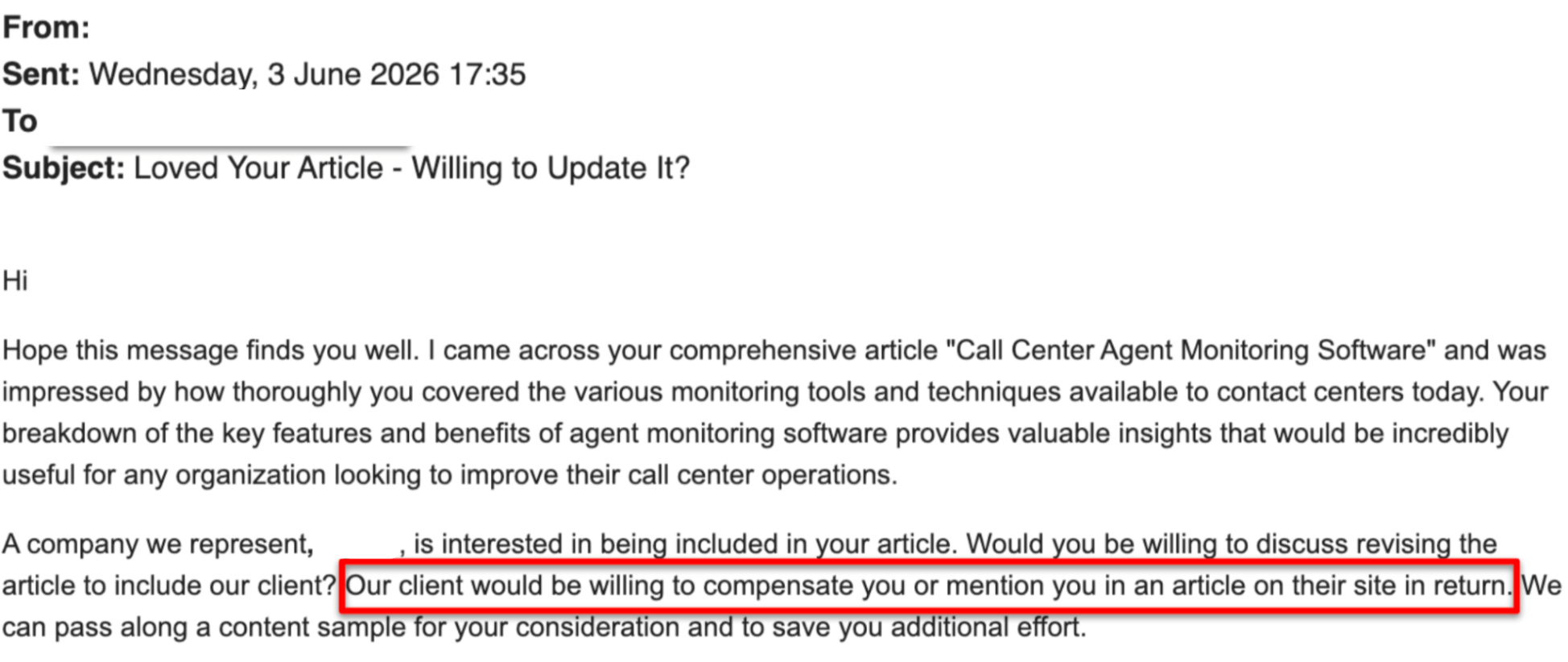
Why paid brand mentions look like black hat link building to me
When I look at what some GEO outreach vendors are pitching, I see an evolution of black hat link building. It is unethical, and it amounts to an attempt to manipulate AI systems.

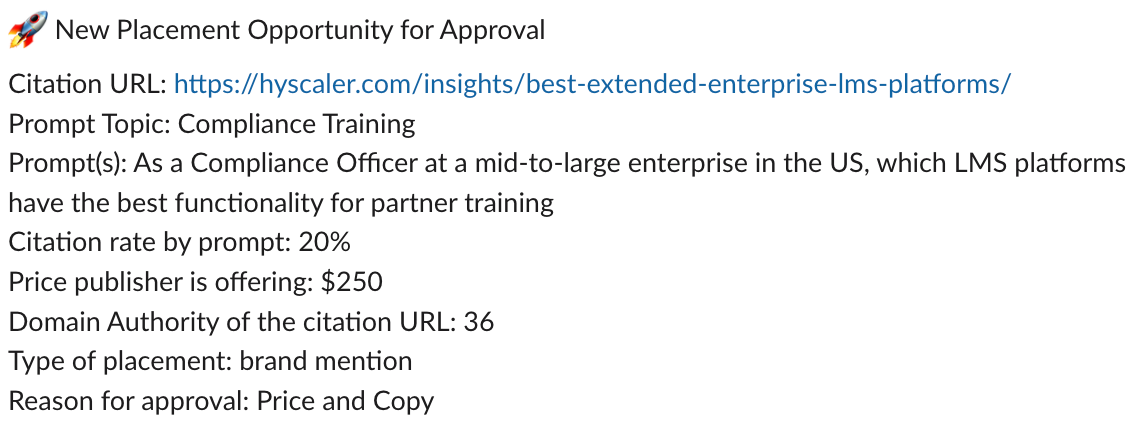
I see clients being asked to approve paid mentions
I have seen this happen in Slack. The agency creates a “placement opportunity” for approval, and an internal marketing liaison has to review it. Often, that person is a junior specialist who has not been trained to evaluate whether the referring page is legitimate.
The pitch usually includes a prompt topic, domain authority, citation rate, and publisher placement fee. In one example I reviewed, the fee was $250 in exchange for adding the brand mention.

I also see publisher fees added on top of agency retainers
This is the part I think deserves much more scrutiny. The GEO vendor may pay the publisher fee directly, then invoice the client to recover the cost. That means the client is not only paying the agency retainer, but also funding the paid mention itself.
Why I think volume without relevance creates risk
My view is simple: third-party validation is only valuable when it comes from credible, topically relevant brands. A mention is not automatically useful just because it exists somewhere on the web.
Many GEO vendors argue that AI visibility is a “volume game.” They claim that generating a large number of mentions will meaningfully increase a brand’s “mention rate” in AI answers. I think that framing misses the point.
When vendors treat GEO as a mention-rate, citation-rate, and volume problem, they often ignore the quality and relevance of the source. That is a serious flaw, especially when reputation is central to how brands are understood online.
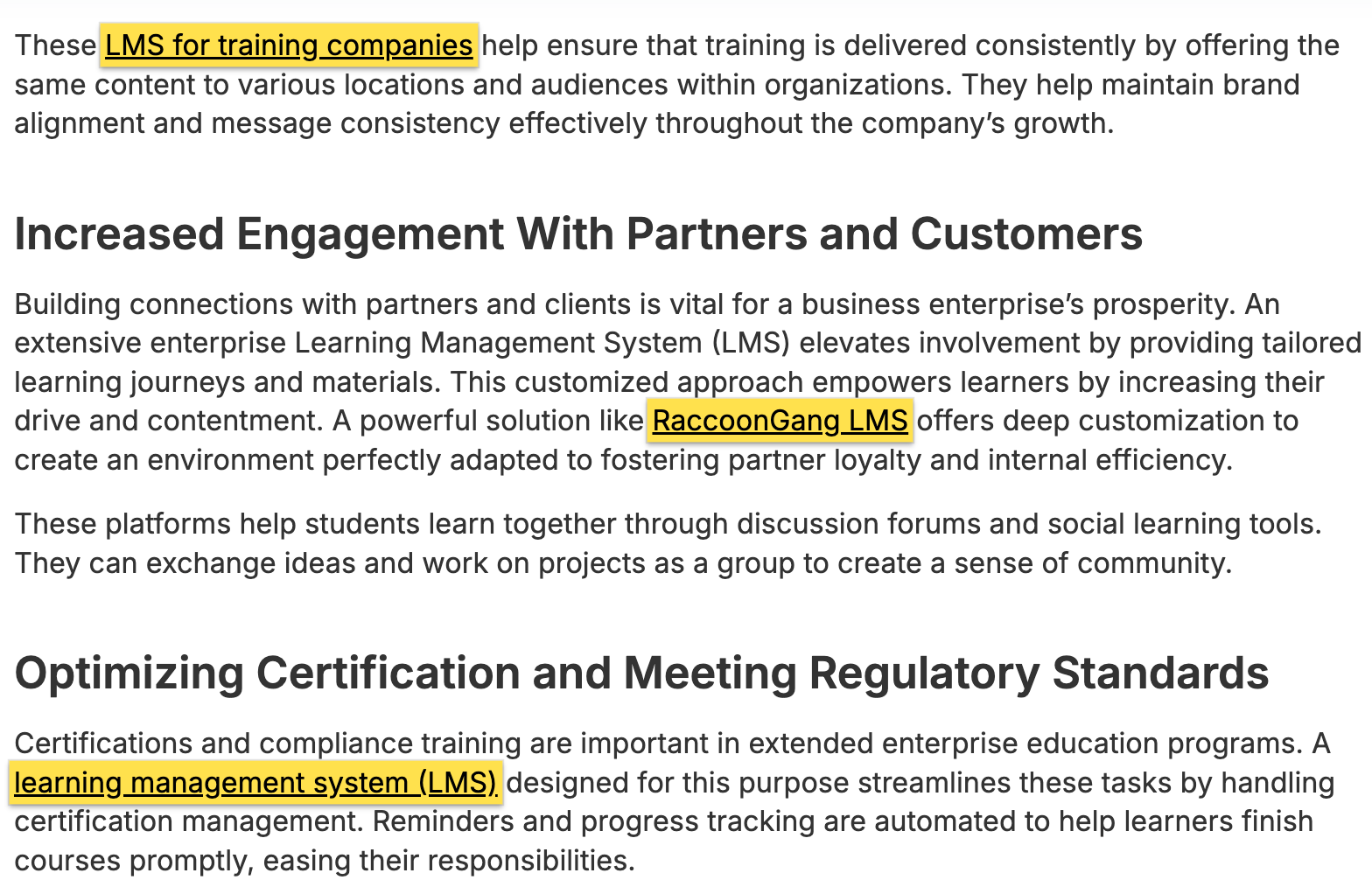
In one example, I saw a page with several outgoing commercial anchors to LMS software vendors. To me, that is a hallmark signal of paid links. If GEO is a reputation problem, I would not want my brand mentioned on a page loaded with paid links to competitors.

Why inauthentic brand mention spam may only work temporarily
I think some spammy GEO tactics appear to work right now because many LLM citation systems are still immature compared with Google’s advanced spam detection. It is possible that some LLMs currently reward mention volume from low-quality sources that Google would normally ignore.
That creates a temporary window of effectiveness, perhaps one to two years, before AI platforms improve their authority and spam signals. I believe marketers who prioritize high-volume mentions over brand safety risk confusing LLMs about their entity and damaging their reputation.
Lily Ray’s view aligns with this concern. She argues that some GEO and AEO companies lack the experience to anticipate how Google and AI platforms may treat their tactics once stronger countermeasures are built into training data, indexes, and results.
She also points back to the first Penguin update in 2012, when Google began suppressing inorganic links. In that context, paid mentions on low-quality sites look like another evolution of spammy link building, and I think it is naive to assume search and AI platforms will not eventually catch on.
The unnecessary risk I see GEO vendors creating
This type of work can cause real damage. Glenn Gabe has described it as an evolution of paid link schemes, and I think that description fits what many marketers are being sold.
Marketing leaders are not just wasting time and money. They may be buying tactics that disappear, damage brand reputation, confuse LLMs about their entity, and pull resources away from more durable marketing work.
There may also be legal risk. The FTC says paid advertisements must include clear disclosures. Yet after paid or “negotiated” brand mentions are added to content pages, many websites do not update those pages to disclose that the placements were sponsored.
How I evaluate GEO vendor claims about off-site mentions
When I evaluate GEO vendors, I start with one basic concern: many prioritize mention volume over source quality. That does not mean every off-site mention strategy is bad, but it does mean the claims deserve pressure testing.
If a vendor claims that most AI brand discovery comes from third-party sources, I ask whether that actually proves paid or negotiated low-quality mentions cause a brand to appear more often in AI answers. In my view, it does not.
If a vendor says listicles and third-party pages are the main lever, I ask whether that supports paying to appear on thin, irrelevant, AI-generated listicles. Again, I do not think it does.
If a vendor argues that AI search is different and traditional SEO quality judgment no longer applies, I push back. Google says the opposite for its AI search features: SEO best practices still matter, there are no special optimizations required for AI Overviews or AI Mode, and pages still need to follow Search policies.
More broadly, I do not see substantial evidence that adding a paid mention to a cited page will make a brand appear more often, that low-quality long-tail publishers improve AI search visibility, that citation rate beats source quality, or that traditional SEO and brand safety principles are obsolete in AI search.
Paying for “25 brand placements” to chase a “10-15% mention-rate lift” is not how I think marketers should approach AI search. I would rather pursue off-site mentions that reflect genuine category validation from trusted businesses, reputable publishers, and real communities.
Inspired by this post on Search Engine Land.
