
When I work on technical SEO, I know the right changes can dramatically improve how search engines crawl, understand, and evaluate a website.
I also know that the recommendations with the biggest upside usually carry the biggest implementation risk. URL changes, canonical updates, robots.txt edits, internal linking improvements, and site migrations can all strengthen organic performance, but one mistake can damage crawling, indexing, and search visibility.
That is why I do not treat technical SEO as a simple list of fixes. I treat it as a process: evaluate the impact, weigh the effort and risk, align the right teams, and test everything before and after launch.
From audit to implementation to prioritization
For me, the work is not finished when the SEO audit is delivered.
Prioritization is where the real judgment begins. I look at how severe the issue is, what outcome I expect, how many pages are affected, how much development effort is required, and what could go wrong if the change is implemented poorly.
The recommendations with the greatest potential impact often need buy-in from developers, content teams, product owners, and stakeholders because they require more resources and carry more risk. A clear recommendation, a practical test plan, and early alignment make implementation much easier to move forward.
Understanding the issue and potential outcome
I do not assume every technical SEO issue found in an audit needs immediate action. Before I prioritize a recommendation, I validate it manually and consider the broader context of the site, including priority sections, platform limitations, and business goals.
For example, missing meta descriptions on low-priority pages or title tags that fall outside recommended lengths may appear in an audit because they are easy for tools to measure, not because they will meaningfully affect performance.
Crawling tools and automated reports are valuable because they help me find issues at scale. But they do not always tell me whether an issue matters to the business.
A warning may point to a real problem, an intentional setup, a platform constraint, or something with little to no measurable impact. I need that context before I decide what deserves attention.
Evaluating impact, risk, and effort
Once I validate an issue, I decide how to address it and whether it is worth recommending for implementation.
When I am prioritizing technical SEO recommendations for a development queue, I consider the number of affected pages, the expected outcome, the resources required, and the potential risks.
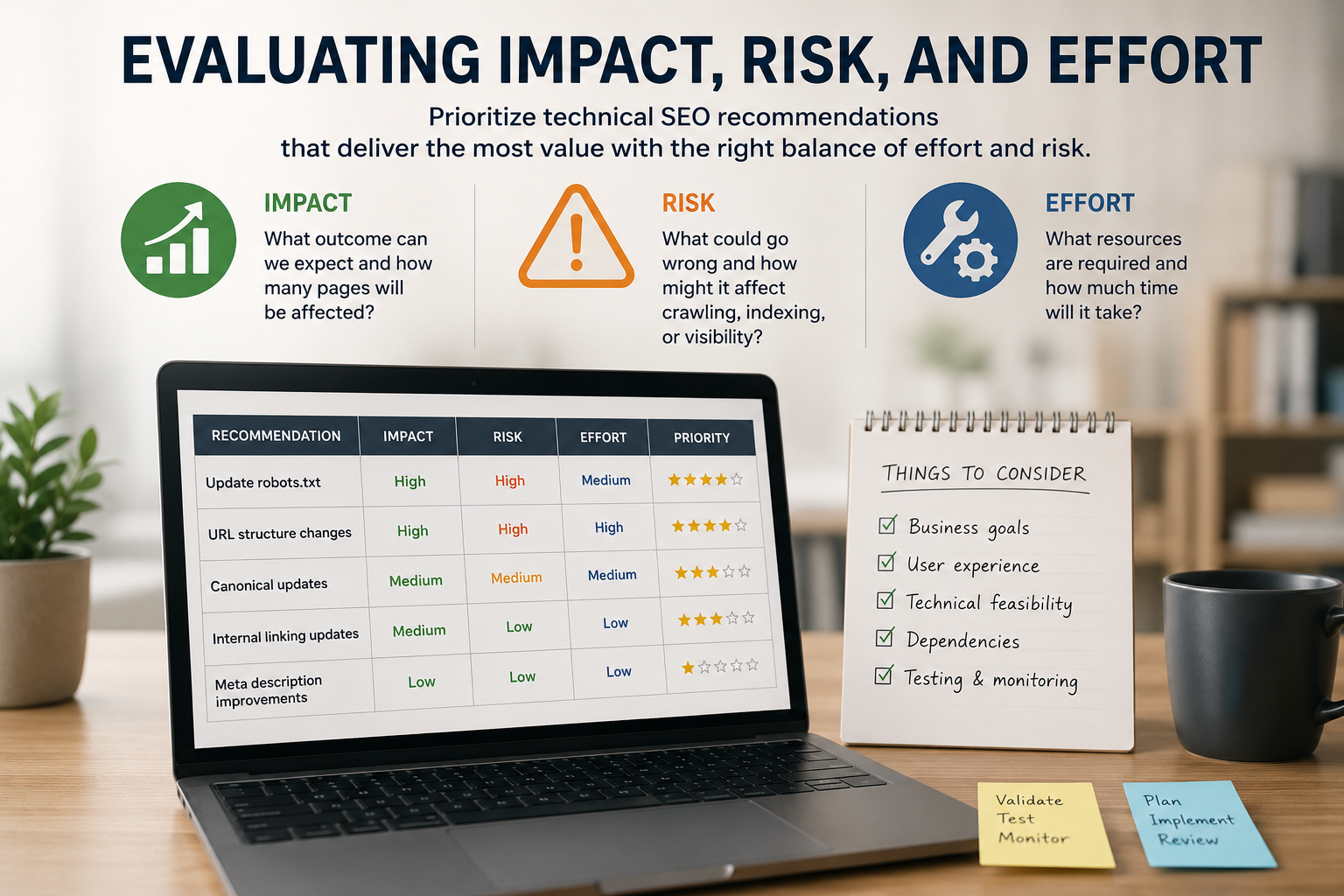
Updating a few title tags may be low risk. Changing URL structures or modifying robots.txt directives can affect thousands of pages and influence crawling, indexing, and discoverability.
By understanding both the upside and the downside, I can make better decisions, allocate resources more responsibly, and plan changes in a way that reduces risk while still pursuing meaningful gains.
High-impact technical changes that require extra caution
The following technical SEO initiatives can meaningfully affect site performance. I do not avoid them because they are risky. I approach them carefully because their implications, benefits, and failure points need to be understood before implementation.
1. URL updates and changes
I often recommend URL updates when a site needs a clearer folder structure, content consolidation, rebrand support, or stronger information architecture.
For example, a business may move service pages from the root domain into a subfolder so the content is easier to organize and the site is easier to navigate.
URL changes can provide real benefits, but I need to make sure those benefits outweigh the risks and that a proper redirect strategy is ready before anything goes live.
Search engines treat a changed URL as a new URL, so redirects are essential for preserving rankings, traffic, backlinks, and other signals tied to the original page. Missing redirects, bad mappings, redirect chains, outdated internal links, and stale XML sitemaps can all hurt crawling, indexing, and discoverability.
Before I move forward with URL changes, I create a redirect mapping plan. Ideally, I validate and test redirects in a development environment before launch, then check them again after launch and update the XML sitemap.
I also include internal link updates and performance monitoring in the launch plan. Careful planning helps preserve existing SEO equity while supporting the larger goals of the site.
2. Canonical updates
Canonical tags help search engines understand which version of a page should be treated as the preferred version when duplicate or similar content exists. I use them to consolidate ranking signals, avoid internal competition, improve crawl efficiency, and clarify which URLs should be prioritized for indexing.
For example, an ecommerce site may use canonical tags to consolidate parameter-based URLs or faceted navigation pages to a primary product or category page. But if a canonical tag is applied to the wrong template, it could unintentionally tell search engines to consolidate an entire group of important pages elsewhere.
Canonical updates may look simple, but mistakes can be difficult to spot once they are deployed across a site. I take time to review canonical targets and validate the implementation so I do not send conflicting signals that cause important pages to lose visibility or fall out of the index.
3. Robots.txt file changes
The robots.txt file controls how search engines and other crawlers access content on a website. I usually recommend robots.txt changes to improve crawl efficiency, prevent low-value content from being crawled, or limit access to specific site sections.
For example, I may recommend blocking filtered URLs, internal search results, or other pages that consume unnecessary crawl resources. When implemented correctly, these updates help focus crawl activity on more important content.
The risk comes from rules that are too broad, misplaced, or copied from the wrong environment. A single directive can block important sections of a site from being crawled. Accidentally deploying a staging robots.txt file to production can also disrupt how crawlers access live content.
Because robots.txt changes can affect large parts of a site, I test rules carefully, review the proposed changes against the intended URL patterns, and verify the implementation after launch. Even a small robots.txt edit can have sitewide consequences.
4. Internal linking changes
Internal linking helps search engines discover content, supports priority pages, connects related topics, and guides users through a website. My recommendations may include updating navigation, adding contextual links, consolidating content hubs, or improving pathways to key pages.
As websites evolve, internal linking often needs cleanup. Removing important links, creating orphaned pages, linking to staging environments, or accidentally pointing users and crawlers to non-public URLs can all hurt discovery. Large navigation updates can also change how easily search engines reach important content.
That is why I always look closely at scope. A navigation update may touch thousands of pages, making it far riskier than adding a few contextual links to a small group of priority pages.
5. Site migrations
At some point, every SEO team deals with a site migration. It may happen because of a rebrand, a domain change, a redesign, or a move to a new CMS. When planned well, migrations can improve user experience, support long-term SEO performance, and benefit the business.
They are also inherently risky because they often combine several technical SEO changes at once. Redirects, URL restructures, canonical tags, indexing directives, content updates, and internal linking changes may all happen during the same launch. With that many moving parts, even a small oversight can affect crawling, indexing, and visibility.
Even a well-planned migration can run into problems if changes are not documented, tested, reviewed, and validated throughout the process. I rely on pre-launch QA, post-launch testing, and ongoing monitoring to catch issues before they have a lasting effect on performance.

Working across teams to ensure success
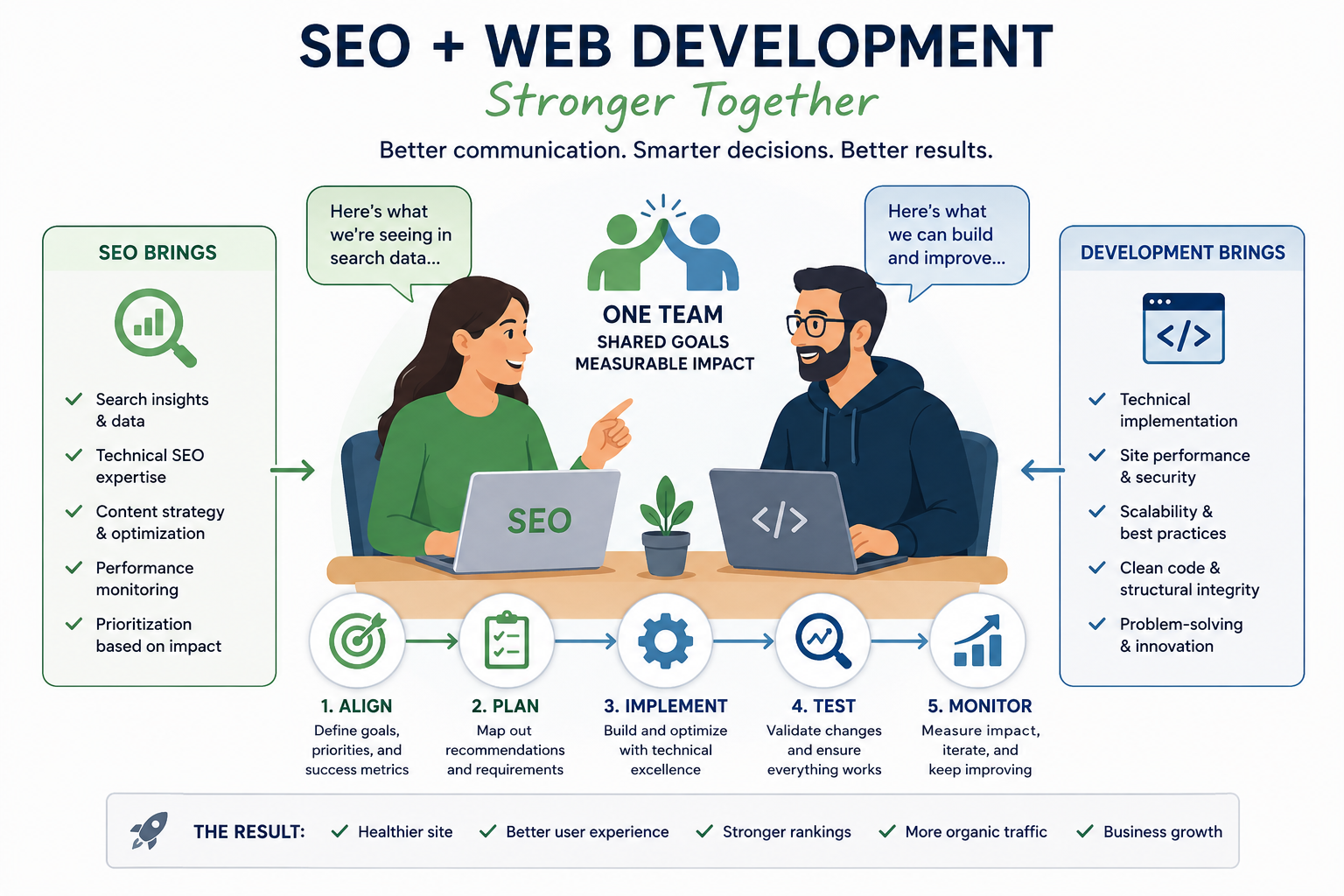
Technical SEO updates often require multiple teams to work together. I may need input from content teams, in-house developers, external agencies, product managers, and analytics teams before a change is ready to launch.
Clear communication is essential. I make recommendations straightforward, build testing and QA into the process, and define success criteria before launch. I also want a plan for quickly identifying and resolving issues if something goes wrong.
Communicating recommendations effectively
Whether I am discussing a recommendation directly with developers or documenting it in a structured ticket, I make sure the issue is clearly defined, examples are included, and the required changes are easy to understand.
Clear documentation helps me set expectations, explain scope, identify affected URLs, and define the expected outcome. It also gives teams a place to ask questions, raise concerns, and flag limitations before implementation begins.
Testing in development environments
Whenever a site change is made, I want it tested thoroughly before launch. A development environment gives me a place to validate the implementation, ask questions, and provide feedback while there is still time to adjust the work.
Post-launch testing and monitoring
Sometimes a change that works perfectly in development behaves differently after launch.
That is why I am ready to validate the implementation as soon as changes go live. Post-launch checks help me identify issues quickly, begin troubleshooting immediately, and monitor the impact before small problems become larger ones.
Balancing opportunity and risk
Most technical SEO recommendations are designed to improve crawling, indexing, or site architecture. When I implement them correctly, they can significantly improve how search engines access, understand, and evaluate a website.
But implementation usually depends on multiple teams working toward the same goal. As a recommendation moves from audit to production, misunderstandings, assumptions, and overlooked details can create unintended consequences.
That is why I see technical SEO as more than finding opportunities. I need to understand the issue, evaluate the potential impact, weigh the development effort, and manage the risk of implementation.
No technical SEO change is completely risk-free. But with thoughtful planning, clear communication, thorough testing, and ongoing monitoring, I can catch issues earlier, reduce their impact, and roll out high-impact changes with the caution they deserve.
Inspired by this post on Search Engine Land.
