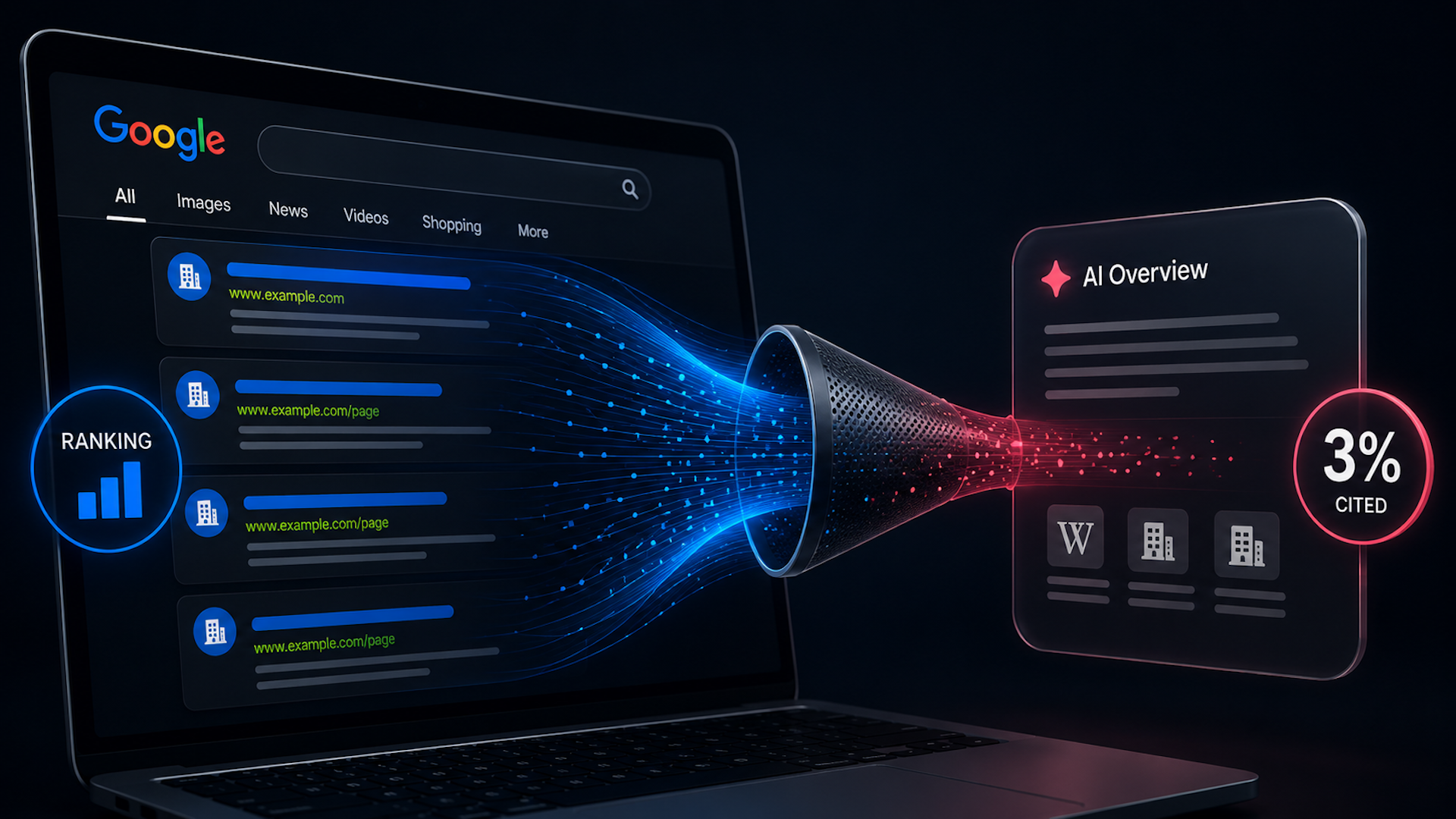
I’m seeing a sharp disconnect in B2B search visibility: many brands still rank for thousands of Google keywords, but they appear in only about 3% of AI-generated answers, according to Walker Sands’ B2B AI Search Visibility Benchmark of 828 enterprise companies. (Disclosure: I’m the director of SEO and GEO at Walker Sands.)
For this benchmark, I looked at more than 45 million search queries from March across 828 enterprise B2B companies in 14 industries. The analysis evaluated each domain across four core metrics: keyword coverage, keywords with AI Overviews, AI Overview incidence, and citation inclusion rate.
Keyword coverage measures how many keywords a company ranks for in Google. Keywords with AI Overviews shows how many of those ranking keywords trigger AI-generated responses. AI Overview incidence captures the percentage of ranking keywords where AI Overviews appear. Citation inclusion rate measures how often a company’s domain is cited inside those AI-generated answers.
Together, these metrics give me a baseline for understanding how often AI Overviews show up and how often B2B brands actually earn visibility within them.
A baseline for B2B AI search visibility
The benchmark shows a meaningful gap between traditional ranking visibility and AI citation visibility. AI Overviews appear in about 50% of search results where enterprise B2B brands rank, yet the median enterprise B2B brand is cited in just 3% of relevant AI Overviews.
I also found that 4.6% of enterprise B2B companies are not cited in AI Overviews for any of their relevant keywords. That may sound like a small share of the market, but it points to a serious visibility problem for brands that still appear in Google’s organic results while disappearing from the AI-generated answers buyers increasingly see first.
The typical enterprise B2B company ranks organically for about 9,700 search queries, and AI Overviews appear in nearly half of those searches. But across all those opportunities, the median brand earns citations in only 3% of AI Overviews.
In other words, I’m seeing B2B brands present in the search results that AI Overviews summarize, but largely absent from the summaries themselves.
When a brand has few or no citations, I often see deeper issues underneath: limited topical authority, unstructured or inaccessible content, and too little content that directly answers the questions buyers are asking.
Addressing those gaps is becoming essential for visibility in AI-driven search experiences.
The narrowing funnel from ranking to citation
I think of AI search performance as a funnel with four layers, and the value lost at each step is where the story gets clearer.
It starts with keyword coverage, or the number of keywords where a brand ranks in Google’s top 100 organic results. On that measure, many leaders still look strong. The median company ranks for about 9,700 keywords, while top-quartile brands rank for more than 37,000.
The next layer is keywords with AI Overviews. These are ranking keywords that trigger an AI Overview. The median company has roughly 4,500 of them, which is already less than half of its ranking footprint.
The third layer is AI Overview incidence, which measures how often AI-generated answers appear across a brand’s relevant searches. The median is 48.8%, meaning AI now intercepts roughly half the queries where these companies compete. Top-quartile brands operate in even more AI-heavy environments, with an incidence rate of 61.7%.
The final layer is the one that matters most, and it is where almost everyone loses ground: citation inclusion rate. This measures how often a brand is cited as a source within an AI Overview. The median is 3.0%. Even the top quartile reaches only 4.5%, while the bottom quartile sits at 1.7%.
Viewed from top to bottom, the funnel is unforgiving. Tens of thousands of ranking keywords compress into a single-digit share of AI citations. Much of the visibility B2B brands have built through organic search does not carry into the layer of search that is shaping buyers’ first impressions of a category.
Ranking breadth does not guarantee AI citations
The most important takeaway is also the most counterintuitive: ranking breadth alone does not predict AI citation rates.
I found that some companies rank for thousands of keywords but rarely surface in AI-generated answers. The strengths that helped brands win traditional SERP visibility, including page volume, broad keyword targeting, and years of accumulated domain authority, do not automatically make a brand the source an AI system chooses to cite.
That creates a real challenge for B2B SEO teams. If a dashboard only tracks ranking keywords and estimated organic traffic, it may tell a flattering story about a layer of search that is losing influence while saying little about the AI layer that is gaining it.
The brands that are consistently cited in AI-generated answers tend to share three traits: deep topical authority across related content areas, clear and structured explanations that directly answer buyer questions, and consistent coverage across multiple relevant pages.
The common thread is specificity. Generative systems appear to reward content that resolves a buyer’s question clearly and demonstrates sustained expertise on a topic, instead of content that simply ranks for a query.
That changes the work. Optimizing for AI citations looks less like chasing keyword volume and more like building genuine, well-structured subject-matter depth.
Some industries are far more exposed than others
AI search visibility is not distributed evenly across B2B technology. The industry breakdown shows very different competitive dynamics depending on the category.
Cybersecurity leads on both fronts. AI Overviews appear in a median of 59.9% of cybersecurity-related searches, and cybersecurity brands earn the highest median citation rate in the study at 4.2%. Enterprise software, with 55.3% AI Overview incidence, and martech, with 56.3%, also see AI-generated answers in well over half of relevant queries.
At the other end, professional services and distribution and logistics trail in citations, both with a median rate of just 2.1%. Distribution and logistics also has the lowest AI Overview incidence at 29.6%, meaning buyers in that category encounter AI-generated summaries far less often than buyers in cybersecurity.
These differences create both risks and opportunities. In categories where AI-generated answers are already common, such as cybersecurity, the cost of being invisible is immediate. Buyers are forming impressions inside AI summaries right now.
In categories where citation rates are low and few brands have figured out the new mechanics, I see a real first-mover opportunity. Brands that learn how to earn citations before competitors do can help shape how an entire category is framed in AI-generated answers, much like early SEO adopters captured outsized organic visibility.
The brands that have gone completely dark
The most striking number in the report is that 4.6% of enterprise B2B companies are not cited at all in AI-generated answers for their relevant keywords.
These are not small, unknown operations. They are companies with $100 million or more in revenue that, in many cases, still rank well in traditional search. They are present in the index but absent from the answer.
Near-zero citation rates usually point to deeper structural issues: thin topical authority, content that is difficult for systems to parse, and a lack of material that directly answers the questions buyers are asking.
For a small but meaningful slice of the market, AI search is not just a place where they are losing share. It is a place where they barely exist.
What this means for B2B search teams
The benchmark gives me a baseline, but the strategic implications for SEO, GEO, and marketing teams are already clear.
First, measurement has to evolve. Citation inclusion rate is now a distinct KPI from ranking. Teams that cannot see whether their content is being cited in AI-generated answers are missing visibility into one of the fastest-growing parts of the funnel. Knowing your own citation rate, and comparing it with the 3% median and 4.5% top-quartile benchmarks, is a practical starting point.
Second, the content mandate is shifting from breadth to depth. The drivers point toward consolidating authority around the topics buyers care about, structuring content so machines can interpret it, and answering real questions directly instead of producing content volume for its own sake.
Third, the window is open but closing. Generative AI is expected to influence more than 75% of B2B search queries within the next one to two years. If that projection is even close, the median 3% citation rate is not a stable endpoint. It is a snapshot of an early, contested market that rewards brands that move now.
The uncomfortable truth is that much of the SEO equity B2B brands have built is being summarized by AI systems that do not cite the companies that created it. For most enterprise brands, I no longer see the central question as whether they rank. The question is whether they are in the answer at all.
The full H1 2026 B2B AI Search Visibility Benchmark is available from Walker Sands.
Inspired by this post on Search Engine Land.
